333333
Misconnections Research
Contents
1. Introduction ...2
Background ... 2
Objectives ... 2
Methodology... 2
2. Key Findings...5
3. Recommendations ...6
4. Summary ...8
5. Home plumbing ...11
6. Correcting plumbing ...18
7. Focus group - London ...28
8. Focus group - Birmingham ...35
1. Introduction
Background
Misconnections result in the pollution of surface water drains that are intended to carry away rain water run-off. Instead of being routed to the foul drainage system where it would be treated to a high standard at a water treatment works, the waste water is discharged into rivers, streams and the sea where it impacts on both local wildlife and the quality of the environment for local population.
Misconnections often originate from the incorrect plumbing of ‘white goods’ and sanitary wares to the surface water drainage system in domestic and commercial properties. They can also arise from cross-connections between foul and surface water sewers or the regular misuse of surface water drains, predominantly on commercial sites.
Although incidences of misconnections to the wastewater drainage system vary from area to area, it is estimated that there may be one million cases in the UK at any given time, with an estimated 300,000 cases currently causing pollution. Whilst Local Authorities have the power to enforce rectification by the householder and the Water Companies have a remit to reduce incidents of misconnections, the cost of rectification ultimately impacts on bill payers through higher water charges.
One of the challenges in reducing the number of misconnections is that householders, commercial property owners and the trades likely to be responsible for ensuring that drainage systems are correctly connected are unlikely to be aware of the implications of incorrectly installed pipe work.
Objectives
1. To provide baseline measures of awareness and understanding of ‘misconnections’ issues amongst the pilot audiences and hotspots identified.
2. To explore attitudes and perceptions towards the impact of misconnected drains in terms of the effect they have on the environment and quality of life.
3. To identify the key messages that would increase understanding and act as drivers of behavioural change.
Methodology
ApproachOne of the key target audiences are homeowners and this is the audience we have focused our attention on. To enable us to conduct a robust study amongst this audience we have used an omnibus approach. This provides the National Misconnections Strategy Group with
some measures on awareness and understanding of the issues, which can be used as a benchmark for future research.
Quantitative research
Questions were included on our GB omnibus survey (Capibus) where we conduct 2,000 interviews amongst adults aged 15+ each week at a number of sampling points across England, Wales and Scotland. We were not concerned with those who did not own their own home which are included in the 2,000 interviews, therefore these were excluded from involvement in our questions. The survey was a five minute interview of 13 questions. These interviews are nationally representative.
Qualitative research
There are urban and coastal hotspot postcode areas. We conducted three focus groups, one in an urban hotspot area, another in a coastal hotspot area, and the third in an area not recognised as a hotspot. The qualitative research was amongst homeowners with the discussion aimed at finding out more about homeowners’ understanding of the issue of misconnections, their general awareness, the impact this has on the environment, their attitudes towards the issue and what action they would/would not consider taking and why. Each focus group was designed to run for 90 minutes.
This stage of research was undertaken after the quantitative omnibus survey was completed to provide the client with a deeper understanding of the issues amongst home owners.
©Ipsos MORI/J34687
Key findings and
recommendations
2. Key Findings
A third of respondents do not have any idea what type of drainage system their property has.
Fifteen to thirty four year olds and women are least likely to know what type of drainage system their property has.
Eight in ten respondents claim that most household installations were plumbed in by qualified tradesmen.
Almost nine out of ten respondents feel that their installations have been plumbed in correctly.
Most would only check their installations’ plumbing if a drainage problem occurred.
Most would go to a local plumber to seek advice, however the youngest are least likely to do this and claim that they don’t know where they would go for information.
Fifty five to sixty four year olds are most likely to state that they would correct bad plumbing if they found out about it. The youngest (15-24) are split, with some being the least likely to correct bad plumbing, claiming that it is not their responsibility, and others in this group being the most likely to state that they don’t know whether they would make corrections or not.
Women are more likely to cite safety reasons as a reason for correcting bad plumbing – this also ties in with evidence from the qualitative research carried out.
Those in the London urban area appear to have a more insular outlook and are influenced more by things that can are seen to affect them directly, rather than those that affect their local area or community.
Thirty five to forty four year olds are most likely to say they would correct bad plumbing to avoid further damage.
Men are more likely than women to re-consider correcting bad plumbing when
prompted to do so, particularly if given some sort of grant towards the re-plumbing.
Almost one third of respondents think it will cost between £51 and £100 to correct bad plumbing on just one household installation. Over a quarter however have no idea how much it would cost.
Overall, nearly seven out of ten think that is unlikely that they will be traced and fined if found to have bad plumbing. Those aged 45-54 are most cynical with 38% stating that it is “not at all likely”.
3. Recommendations
A significant proportion of respondents are not aware of the kind of drainage system they currently have in their homes and so as a starting point it is important that the general awareness of home drainage systems is increased.
Individuals will need to be more informed of the differences that exist with a two drainage system and why it is important not to have waste water run off into surface water drains. This should alert individuals to any misconnections they may currently have and also encourage people to be more aware of misconnections occurring with any future plumbing.
In order to encourage individuals to check their plumbing for any misconnections and then correct them, the negative effects of these misconnections ought to be emphasized; the damage they could possibly do to one’s plumbing in general and the negative effects they could have on one’s health and safety in particular. It seems people are most likely to respond to these messages.
The perceived cost of putting right any misconnections is a barrier for many people coupled with a lack of understanding about what the likely costs would be. Alongside creating greater awareness of misconnections it would be useful to demonstrate the likely or typical costs that people would incur if they had to correct any bad plumbing.
Informing individuals they could possibly be polluting their local environment, that pollution could be traced to individuals, that they could possibly be fined and having their water company or local authority contact them are all measures worth considering as a means to persuading people to take action with regard to misconnections.
4. Summary
When house was built
Respondents are most likely to have a house which was built between 1900 and 1949 (49%) while a similar but slightly smaller proportion of people have a house built in either the 1960s or 1970s (45%).
The majority of focus group participants have a house that was built prior to or during the 1950s while very few live in a house built after the 1950s. Two participants live in a house that was built in the 1960s or 1970s
Drainage systems
Respondents are most likely to say they have one drain where everything goes into this one drainage system (42%) while in contrast a quarter of respondents (24%) say they have one drain for their foul water and a separate drain for surface water. A significant proportion of respondents (34%) are unaware of the type of drainage system they currently have in their homes and it is younger respondents and women who are least likely to know what their drainage system is.
Participants in the London group and the Birmingham group seem to have a greater understanding of how drainage systems work than those in Torquay and recognise that some properties have two drains that separate waste water and rain water. The Torquay group don’t seem to be as clear on this and are generally unsure of how drainage systems work.
In order to find out what kind of drainage system they had at home the London group are more likely to turn to their council. The Birmingham and Torquay group are likely to turn to their council as well as their water company.
Home installations
Around four in ten respondents (42%) have installed at least one white good that involved connecting up pipes to the drainage on the outside of their house and these installations have mostly been made by a quality tradesman (80%). The vast majority of respondents feel that these installations have been plumbed in correctly (85%).
On the whole participants across the three focus groups had their white good installations made by a mixture of both qualified tradesmen and amateur DIY people, although those in the Torquay group did seem to rely more on qualified tradesmen.
Checking installed plumbing
Respondents are most likely to make checks on the quality of their installation and whether or not the plumbing had been done correctly if a drainage problem occurred; and they would be most likely to turn to their plumber to check on this.
Both the Birmingham and Torquay groups are likely to be prompted to check on the plumbing of their installations if their local stream/river/beach was polluted, if a friend/neighbour or water company/local authority asked them to check or if their health or safety was at risk because of their bad plumbing. The London group would be influenced by friends and neighbours as well as a threat to their health and safety, but do emphasize that they are ultimately most motivated by things that directly affect them alone.
Correcting bad plumbing
Respondents are likely to correct their plumbing should it be discovered that one or more of their installations has been incorrectly plumbed in; 67% say that this would be very likely. This is especially the case amongst 35-44 year olds who would want to prevent further damage and amongst women who are more likely to be concerned about safety. Men are more likely to be swayed if prompted in some way and if offered some kind of financial incentive such as a grant.
Only one in twenty respondents would be unlikely to correct their bad plumbing and around half of these would all reconsider if encouraged by their neighbour or water company/local authority, if offered a grant or threatened with a fine and if they thought their bad plumbing was polluting a local stream and could be traced back to their home. Younger respondents are the least likely to correct bad plumbing claiming that it is not their responsibility.
Respondents on the whole, mostly think it is unlikely they would be traced and fined if they were found to have bad plumbing, especially those in the older age range (55-64). Those in the 45 – 54 age range are significantly more likely to believe that tracing and fining is not at all likely to happen (38%).
Approaching six in ten respondents (56%) think that the cost to correct one installation is over £50 while in comparison around a fifth (17%) thinks it will cost less than £50. It is felt across the three groups that it could be quite expensive to have to correct a misconnection and so both the London group and Torquay group feel that a grant towards any plumbing work that needed to be done would encourage them to fix a problem. However, participants in the Birmingham group do not feel that this will suffice and would expect the water company to pay for any work as they feel the money they pay for their water should cover this.
Participants of the London group say they are most likely to listen to and be influenced by what their plumber has to say about misconnections. The Birmingham and Torquay group say they are most likely to take into account what is said by the Environment Agency as they believe they are the most objective as they are most concerned about the environment.
Home plumbing
3.1. When house was built
Half of all respondents (49%) say their house was built during or before the 1950s while around four in ten (45%) say their house was built after the 1950s; 26% of respondents live in a house built in the 1960s or 1970s.
One in twenty respondents (6%) do not know approximately when their house was built; around a third (35%) of these believe their house was built sometime during or before the 1950s while approaching five in ten (46%) believe their house was built sometime after the 1950s. Around two in ten (18%) maintain that they do not know at all when their house was built.
Figure 3.1
When house was built
6%
14%
7%
29%
7%
14%
13%
7%
5%
Up to 1900Base: 1273 respondents, fieldwork dates: January – February 2009
1900 to 1949 Please tell me approximately when your house was built?
1950 to 1959 1960 to 1969 1970 to 1979 1980 to 1989 1990 to 1999 Don’t know 2000 onwards
Of those who say they do not know when their house was built, it is mostly the youngest, i.e. 15-24 year olds (32%) saying they do not know when their house was built.
5. Home plumbing
5.2. Drainage systems
Two-thirds of respondents (66%) are aware of the kind of drainage system that exists in their home. A quarter of respondents (24%) say they have two separate drains, one for all the dirty water and a second for rainwater; in contrast around four in ten (42%) say everything goes into one drainage system only. A third of respondents (34%) are unaware of the kind of drainage system in use in their home.
Figure 5.2
Drainage systems
34%
42%
24%
Two drains - We have a drain for all the dirty water and a separate drain for rainwater
Base: 1273 respondents, fieldwork dates: January – February 2009 Don’t know
Do you know whether the waste water that leaves your home connects into one or two separate drainage systems?
By two separate drainage systems we mean where there is one drain for the waste water coming from the toilet, bath, sink and washing machine or dishwater and a separate drain for the water that falls onto your roof i.e. rainwater. Or does all this water go off into one drainage system?
One drain – Everything goes into one drainage system
When we consider the 34% that claim not to know what type of drainage system they have and break it down, we see that it is the youngest that are significantly more likely to claim that they do not know (15-24; 56% and 25-34; 40%).
We also see that women are significantly less likely to know which type of drainage system their property has; 41% claim they do not know.
Don’t know (by age & gender)
Base: All saying they “don’t know” which type of drainage system they have (498) % Total 34 15-24 56 25-34 40 35-44 35 45-54 29 55-64 25 65+ 31 Male 26 Female 41
Source: Ipsos MORI
When asked about their knowledge of the type of drainage system their property has we see those in post 1950s housing are significantly more likely to say that they have a two drain system than those in pre/during 1950s housing. However consequently we see that those in pre/during 1950s housing are significantly more likely to state that everything goes into one drain. Overall though a third of those in all ages of housing claim not to know what type of drainage system they have.
Drainage systems
Total Pre/During 1950s
Post 1950s
Base: All respondents (1,273) %
(658) %
(598) %
We have a drain for all the dirty water
and a separate drain for rainwater 24 20 29
Everything goes into one drainage
system 42 49 35
Don’t know 34 31 36
5.3. Home installations
Around two-fifths of respondents (42%) have had at least one of the installations that involved connecting up pipes to the drainage on the outside of their house. A washing
machine is most likely to have been installed (34%), while a fifth have installed a toilet (21%), sink (21%) or dishwasher (20%); slightly fewer have had a bath or separate shower cubicle installed.
Respondents who live in housing built pre/during the 1950s are significantly more likely to have had one of the installations made (48%) while those who live in post 1950s housing are significantly less likely to have ever installed any of these white goods (37%).
Figure 5.3
42
34
21
21
20
17
14
48
10
% Home installationsAs far as you know, since living in your home, has anyone ever installed any of the following that involved c onnecting up pipes to the drainage on the outside of your house?
Base: 1 273 respon dents, field work dates: January – February 20 09 (pre/during 1950s 658, po st 19 50s 598 ) NOTE: Re spo ndents could indi ca te more than one respon se
Dishwasher Don’t know Sink None of these Toilet Bath
Separate shower c ubicle Washing machine P re/during 1950s Post 1950s 39 27 27 22 23 17 40 12 29 16 14 19 11 11 56 7 Installed Any 48 37
When we look at those who claim to have installed white goods, we see that the
youngest (15-24) are least likely to have installed anything in their homes (24%).
Installed Any (by age)
Base: All respondents (623) % Total 42 15-24 24 25-34 37 35-44 48 45-54 47 55-64 48 65+ 41
On the whole, installations were mostly made by qualified tradesman; in the majority of instances over eight in ten respondents (80%) say that a qualified tradesman has done the plumbing. Dishwashers and washing machines are slightly more likely to be installed by amateur DIY people (in 22% and 28% of cases respectively) but are still mostly installed by qualified tradesmen. Figure 5.4 87 86 85 84 76 70 12 13 12 13 22 28 1 2 2 3 2 2 Separate shower cubicle (166)
Who did the plumbing?
Qualified tradesman % Dishwasher (240) Bath (214) Toilet (265) Sink (257)
Was the ... plumbed in by a qualified tradesman or was it plumbed in by an amateur DIY person?
Base: All valid responses (base sizes in brackets), fieldwork dates: January – February 2009
Amateur DIY person Don’t know
Approaching nine in ten respondents (85%) who have had an installation believe they have been correctly plumbed in while a tenth (10%) believe these installations may have been done incorrectly. Figure 5.5
Incorrect plumbing
5%
10%
85%
NoBase: 543 respondents, fieldwork dates: January – February 2009 Don’t know
Is it possible; do you think that any of these installations may have been incorrectly plumbed in?
6. Correcting plumbing
6.1. Checking installed plumbing
The occurrence of a drainage problem is most likely to encourage respondents to check to see if any of their installations had been incorrectly plumbed in; half of all respondents (50%) say that this is the case.
Respondents are far less likely to be influenced if told to by their water company or local authority, if they thought bad plumbing could be traced to their house, if a friend or neighbour pointed out that they could be polluting, if they thought that they could be fined or if they thought their local stream, river or beach was being polluted; just a tenth or less feel that any of these other factors would encourage them to check their plumbing.
Respondents who live in housing built pre/during the 1950s are significantly more likely to check if any installations had been incorrectly plumbed in if they thought bad plumbing could be traced to their house (10%); on the other hand, respondents who live in post 1950s housing are significantly less likely to check in this case (6%).
Figure 6.1
50
9
8
5
5
3
13
10
17
If your friend or neighbour pointedo ut that you could be polluting
%
Checking installed plumbing
Don’t k now
If you thought that bad plumbing could be traced to your house
None of these
If you were told to by your water company or local authority
If you thought that you could be fi ned
If you thought that your loca l
stream/rive r/beach was being polluted
What would make you c heck to see if any of your installations had been inc orrectly plumbed in? (unprompted)
Base: 1 273 respon dents, field work dates: January – February 20 09 (pre/during 1950s 658, po st 19 50s 598 ) NOTE: Re spo ndents could indi ca te more than one respon se
If a drainage problem occurred
Pre/during 1950s Post 1950s 48 10 10 6 6 4 13 10 53 9 6 4 4 3 12 10 Other 17 17
Respondents are most likely to turn to their local plumber if they wanted to know whether any of their installations had been incorrectly plumbed in; 52% of respondents say that this is the case. Around a tenth of respondents would go to their local authority (12%) or their water company (8%) while few respondents would go on to the internet regarding this. Around a fifth of respondents (17%) don’t know where they should go to find out whether their installations had been done incorrectly.
We see that those in the 15-24 age category are significantly less likely to go to their local plumber to find out about incorrect plumbing (38%), however they are also significantly more likely to state that they don’t know where they would go (37%).
Figure 6.2
52
12
8
4
12
17
Water company %Where to go to find out about incorrect plumbing?
Local authority
Don’t know Local plumber
Internet Other
If you wanted to know whether any of your installations had been incorrectly plumbed in where would y ou go to find out?
Base: 1 273 respon dents, field work dates: January – February 20 09 (age 15-24, 9 5) NOTE: Re spo ndents could indi ca te more than one respon se
Age 15-24 38 14 4 5 8 37
6.2. Correcting bad plumbing
Approaching nine in ten respondents (87%) say they are likely to correct any installations should they find out they have been plumbed in incorrectly; 67% say they are very likely to do this. Conversely, just one in twenty respondents (5%) say they are unlikely to correct bad plumbing in of installations.
Those in the 55-64 age bracket are significantly more likely to state that they would be very likely to correct any bad plumbing (77%). Again we see that it is the youngest (15-24 year olds) that are significantly less likely to say that they would correct any bad plumbing. Also almost a third claim that they don’t know how likely they would be to have anything corrected.
Figure 6.3
Correcting bad plumbing
67%
1 9%
3%
2 % 8 %
Very likely
Base: 1 273 respon dents, field work dates: January – February 20 09
Fairly likely
If you found out that one or more of these installations had been incorrectly plumbed in, how likely would you be to have that corrected?
Don’t k now Fairly unlikely Very unlikely % Unlikely = 5% % Likely = 87% Age 55-64 77% Age 15-24 32%
Likely to have bad plumbing corrected
Base: All respondents (1,273) % Total 87 15-24 61 25-34 92 35-44 85 45-54 91 55-64 91 65+ 90
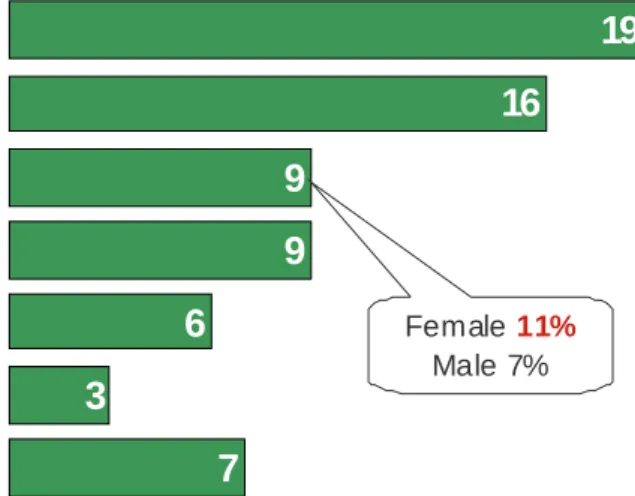
When determining the likelihood of having bad plumbing corrected, respondents are most likely to want to avoid further damage or want to make it right (19% and 16% respectively). Safety reasons and peace of mind are determining factors for a tenth of respondents (9% in each case). The ability to personally fix bad plumbing influences just one in twenty
respondents (6%).
Respondents who live in housing built pre/during the 1950s are significantly more likely to correct bad plumbing for their peace of mind (11%), while respondents who live in post 1950s housing are significantly less likely to do so (8%).
Women are significantly more likely to cite safety reasons as a reason for correcting bad plumbing (11%) than men (7%).
Figure 6.4
19
16
9
9
6
3
7
%Correcting bad plumbing
Don’t know
If you found out that one or more of these installations had been incorrectly plumbed in, how likely would you be to have that corrected?
Why do you say that?
Base: 1 273 respon dents, field work dates: January – February 20 09 (pre/during 1950s 658, po st 19 50s 598 )
P re/during 1950s Post 1950s 8 Safety reasons To make it right Avoid further damage
Peace of mind Would fix it myself
17 17 10 11 5 20 15 8 8 6 6 2 3
Not my respons ibility
Female 11% Male 7%
When we examine this by age, we see that the youngest (15-24) are significantly
more likely to claim that it’s not their responsibility to correct bad plumbing (21%) or
that they don’t know (17%). Those aged 35-44 are significantly more likely to say
that they would correct bad plumbing to avoid further damage (26%) and those aged
65+ are more likely to say that it’s for peace of mind (15%).
Correcting bad plumbing (by age)
Total 15-24 25-34 35-44 45-54 55-64 65+
Base: All respondents (1,273) % (95) % (158) % (188) % (209) % (286) % (337) %
Avoid further damage 19 15 19 26 21 16 14
To make it right 16 12 16 10 19 19 18
Safety reasons 9 5 8 9 8 11 11
Peace of mind 9 2 4 11 9 9 15
Would fix it myself
6 4 9 5 4 5 7Not my responsibility
3 21 0 0 1 0 1Don’t know
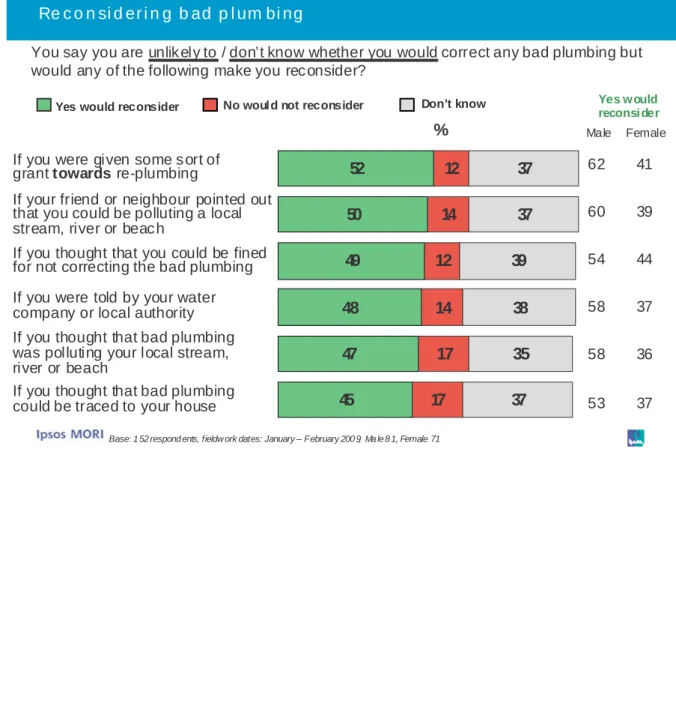
7 17 13 4 7 4 5Respondents’ views towards each of the proposals are quite similar across the board. Around a half of respondents, unlikely to/unsure of correcting any bad plumbing, would reconsider in each of the instances presented, while around a tenth to a sixth say they would not reconsider and approaching four in ten do not know if they would reconsider.
We do however see that there are marked differences between genders across the board when it comes to reconsidering making changes to bad plumbing, with men being
significantly more likely to reconsider than women for all the potential reasons.
Figure 6.5 52 50 49 48 47 45 12 14 12 14 17 17 37 37 39 38 35 37 If you were given some s ort of
grant towardsre-plumbing
Reconsidering bad plumbing
%
If you thought that bad plumbing was polluting your local stream, river or beach
If you thought that you could be fined for not correcting the bad plumbing If you were told by your water company or local authority
If your friend or neighbour pointed out that you could be polluting a local stream, river or beac h
You say you are unlik ely to / don’t know whether you would correct any bad plumbing but would any of the following make you rec onsider?
Base: 1 52 respond ents, fieldw ork dates: January – February 200 9, Ma le 8 1, Female 71
Yes would reconsider No woul d not reconsider Don’t know
If you thought that bad plumbing could be traced to your house
36 58 37 53 37 58 44 54 39 60 41 62 Female Male Yes w ould reconsi der
Respondents are unlikely to have any further reasons to reconsider the likelihood that they would not correct any bad plumbing; A little over a quarter (27%) say nothing would make them reconsider while around a third (37%) do not know what else might make them reconsider. Figure 6.6
27
4
3
3
2
16
37
2
It would be up to my parents/family member %Reconsidering bad plumbing
Health reasons/bad smells/drainage/pollution
Don’t know Nothing
Don’t need it For safety reasons
You say you are unlikely to / don’t know whether you would correct any bad plumbing but would any of the following make you reconsider?
What else might make you reconsider?
Base: 151 respondents, fieldwork dates: January – February 2009 Other
Around a fifth of respondents (17%) think it will cost fifty pounds or less to correct the plumbing on one existing household installation; in comparison, approaching six in ten respondents (56%) think it will cost over fifty pounds to do this. Approaching three in ten respondents (27%) don’t know how much it would cost to correct the plumbing on one existing installation.
Figure 6.7
Cost of correcting plumbing
4
12
32
17
4
3
27
1
% Less than £25Base: 1273 respondents, fieldwork dates: January – February 2009
Typically how much do you think it would cost to correct the plumbing on just one existing household installation such as the sink or the washing machine?
Between £26 and £50 Between £51 and £100 Between £101 and £200 Between £201 and £300 More than £300 Don’t know
A third of respondents (32%) think it is likely that they would be traced and fined if they were found to have bad plumbing while around two-thirds (68%) think that this is not likely to be the case.
Those in the 45-54 age bracket are significantly more likely to think that it is not at all likely that they will be traced and fined if found to have bad plumbing (38%). Those in the 25-34 age bracket are significantly more likely to think that overall it’s likely that they will be traced and fined (44%).
Figure 6.8
Traced and fined for bad plumbing?
12%
20%
38%
30%
Very likely
Base: 1273 respondent s, f ieldwork dates: January – February 2009
Fairly lik ely How likely is it, do you think, that y ou would be traced and fined if you were found to have bad plumbing?
Not very likely N ot at all lik ely
% Not likely = 68% % Likely = 32% Age 25-34 44% Age 45-54 38%
7. Focus group - London
7.1. Background to group
Six respondents say their house was built during or before the 1950s, two say their house was built after the 1950s and one respondent doesn’t know when their house was built. One respondent lives in a house built in the 1960s or 1970s.
Five respondents were female, five male and ages ranged approximately from 25 -45 (please note that no quotas were set on age of respondents for this group and it was not specifically recorded. This estimation is provided for reference only).
7.2. Home installations
Respondents say they have had the likes of a dishwasher, washing machine and new boiler installed since living in their house. Respondents mention boilers being installed by Corgi registered engineers and washing machines being installed by parents and partners, and so it appears these installations have been done by a mixture of professional tradesmen and amateur DIY people.
7.3. Drainage systems
Respondents on the whole were unsure of how the drainage system works. One respondent seemed to be clear on this and did recognise that rainwater goes into one drain and foul water into another, with one respondent admitting to not knowing this at all.
“Two drains. The rainwater goes into a different one and the manhole one is a separate one.”
“I wasn’t aware of that.”
Respondents mention that they would go to the council to find out what kind of drainage system they had in their house, and also mention building regulations, neighbours, the property developer, the builder and the previous owner.
“I would go to the council (for clarity on drainage). Because, I don’t know whether when the property’s sold things like that come up in the treatment searches.”
7.4. Checking installed plumbing
Respondents, for the most part, seem to believe that they have things which are incorrectly installed; they acknowledge that it isn’t something they really think about until it is put in front
of them, but instead assume that everything is okay as surveys are done when they move into a new place. Respondents say that the only reason they would look into it is if their drain was blocked.
“It’s like someone said before it’s just kind of like a drain is a drain and when you move into a place you kind of assume that when they do all the surveys and everything that it’s all OK.” “I think the only reason you’d look into it is if your drain blocked.”
“Or there was a problem with it. Otherwise you just assume that all is well.”
Respondents say they would go to a local plumber or their maintenance company if they wanted to know whether any installations had been incorrectly plumbed in.
Respondents again mention that a leak, a blockage or some type of problem would make them check to see if any of their installations had been incorrectly plumbed in. They would not be influenced by the knowledge that their local stream, river or beach was being polluted because they believe that is the Government’s problem. They would be influenced by a friend, neighbour or their children pointing out bad plumbing and would then look into it depending on the cost to do so and the cost to change it. They would also check their installations if they thought that bad plumbing could be traced to their house and would be quite concerned about that. They say they would definitely look into things if they thought their health and safety could be at risk.
“No I would not go and check (if thought local stream/river/beach was being polluted) because you would think that it’s the Government’s problem.”
Respondents say they are ultimately more likely to be influenced by things that directly affect them rather than peripheral issues. Raising awareness is also mentioned as factor that could encourage respondents to check their plumbing with a Thames Water leaflet on the issue being given as an example. A piece in the local paper about the issue and its effects is also mentioned.
“Yes things that directly affect you rather than peripheral issues I think.”
“Having your awareness raised. You know if Thames Water or whoever it was sent out a leaflet saying “is your home properly plumbed in? Can you go and have a look at this?” Then I might then go yes I should go and have a look at this. But if you don’t know in the first place then.”
Respondents say a problem in their home is most likely to make them physically check to see if they have got any misconnections. Outside of this, a warning message detailing the bad effects of misconnections on health and safety is thought to be likely to have an effect on respondents.
“I think if it had something which said this could affect your health and safety not something saying you could be fined”
7.5. Correcting installed plumbing
The majority of respondents feel that a misconnection is quite a major thing to have to correct and therefore feel that it would be quite expensive to fix. They feel that they would therefore try and get away with it for as long as possible without correcting it because of this.
“Probably mainly about cost for me I think. I mean if you think there’s a problem with your bathroom the thought of having to rip the bathroom out, the hassle and the cost of that. Change all the plumbing that would just be ridiculous. I’d try and get away with it probably as long as I could.”
Respondents say they would contact the person who had made an installation to put it right if it is found to have been done incorrectly. They say some kind of help from the council or water department in the form of a grant perhaps, would encourage them to correct any bad plumbing. Free checks are also mentioned as possible help they could receive in dealing with the problem.
“Some kind of help from the council or the water department, something like that. Like some kind of grant if it came to it so that you’re not shouldered with huge, huge costs.”
Respondents say that environmental issues for the most part would not prompt them to make a change to their bad plumbing because it is a wider problem that cannot necessarily be attributed to them. Cost is again mentioned as a determining factor. Respondents think it will cost a lot to fix a misconnection unless it was done by a family member or friend. A letter from the council with a threat of a fine is thought would cause people to fix any
misconnections they have also, although respondents aren’t sure how likely it is they can be traced or potentially fined if they were found to have misconnections.
7.6. Influence
Respondents say they are most likely to listen to and be influenced by a plumber if they were telling them about misconnections; there is some mention of the water company also,
although there would be some suspicion of the water company trying to make extra money.
“I wouldn’t trust the water company. I’d just think they were trying to make extra money.”
7.7. Taking notice of misconnections and correcting them
Respondents say the following would cause them to take notice of the problem and encourage them to go about fixing it:
Tracing the problem back to their property.
Pressure from their neighbours.
Financial help in fixing the problem.
Free checks and advice on plumbing.
Incentives e.g. a discount on their water bill.
Campaigns showing the impact on children playing at beauty spots affected by pollution, or the harmful effects on wildlife.
Diagrams or leaflets showing how to check a drainage system.
A message of the potential health effects caused by the pollution.
A personal more targeted message to individuals about this problem.
Information on how changes can be made and the cost and time implications.
A focus on the positive aspects of making changes.
7.8. The leaflet – “Are YOU polluting rivers and streams”
Respondents feel that the leaflet needs to look more important and official than it does otherwise it is likely to get lost among the numerous leaflets that are dropped through the door each day. It is suggested that the leaflet is accompanied by an official letter personally addressed to people; also there respondents say there should be some sort of branding on the front of the leaflet and not all on the back of it.
“If you had that official letter you might read it, but if that came through my door on its own, particularly a flat where you have seven of them dropped through the letter box, I wouldn’t even pick it up. Because you get in from work and you just want to relax and do what you want to do.”
Respondents also feel that the front page could be improved upon to encourage people to want to open it and read more. The pictures and information inside the leaflet are mostly considered to be good, and respondents feel something as eye catching ought to be on the front of the leaflet.
“... I like the before and after pictures, it really gives you that visual of what can happen and that is pretty awful ... But the front cover isn’t enough at the moment to make you actually want to open it and read what is inside it.”
Respondents say that the leaflet shouldn’t start off talking about the legal implications of having a misconnection as it comes across harshly; others feel this information is important but is easily lost in the format of the text on that page and should be a lot clearer.
Respondents feel it should be a legal obligation for surveyors to check these connections without having to be told to do so.
Respondents feel that the leaflet would be a lot more effective if it was distributed in conjunction with a TV campaign as people would then be far more aware of the issue. It is thought that focusing on specific areas affected by pollution would also be more effective due to more awareness of the issue.
Respondents feel that a website should be included on the leaflet, where people can go for more information on the issue, and maybe then some of the information on the leaflet could be cut down and simplified so that it isn’t too wordy. The website could also identify pollution issues in their areas.
Respondents feel the message on the front of the leaflet doesn’t clearly state that it is a problem with drainage systems and so this needs to be explicitly stated.
7.9. The logo – “Connect right”
Respondents feel that the logo isn’t clear enough and it isn’t obvious what it refers to as it doesn’t really link to drainage systems or pipes explicitly enough. They feel the picture could be any number of things e.g. a washing machine or a swimming pool and so it needs to be more obvious. Some respondents also feel the colours of the logo could be brighter and therefore more eye catching.
“I wouldn’t choose any of them, just because I don’t think they make enough of an impact. That looks like a washing machine or a swimming pool, there is nothing to differentiate that, there is nothing on that that says, this is linked to your pipes and the drainage system. It just looks like it could be anything.”
8. Focus group - Birmingham
8.1. Background to group
All ten respondents say their house was built during or before the 1950s; five say their house was built during the 1950s and five say it was built prior to the 1950s.
Four respondents were male, six female and ages ranged approximately from 35 to 70.
8.2. Home installations
Respondents say they have had the likes of a dishwasher, washing machine, sinks and toilets installed since living in their house. These installations have been done by a mixture of professional tradesmen and amateur DIY people.
8.3. Drainage systems
Respondents on the whole seem to understand how the drainage system works and
recognise that rainwater goes into one drain and foul water into another, although at least a couple of respondents are not as sure about this.
“... Everybody has a foul and a fresh water drain.” “I wouldn’t know quite frankly.”
“I am on the corner and I don’t know where my drains are.”
Respondents mostly mention that they would go to Severn Trent who is their water provider to find out what kind of drainage system they had in their house, and some also mention the planning department of their Council.
8.4. Checking installed plumbing
Respondents are confident that they do not have any installations that have been incorrectly plumbed in. They believe that if they did have a misconnection it would be down to builders taking short cuts, with one respondent mentioning a home DIY job as a possibility. A couple of respondents say they would check if they had a problem or if their installation was broken, and some say they would check if it was brought to their attention that it was a possibility; because of the problems that could arise later on.
Respondents would be influenced by the knowledge that their local stream, river or beach was being polluted and if there was a possibility they were contributing to this, they would check their circumstances. This is partly due to a fear of being fined as at least one
respondent believes this is a possibility, while others believe pollution can be traced back to the responsible individual. The cost of sorting out a plumbing problem is raised as a concern and a possible deterrent to sorting out these issues.
“You can get fined terribly”
“I know they can trace it back to you. I called up Severn Trent, probably about five years ago now, my drain is in the veranda and there was an awful smell the whole summer and in the end I asked them to go down and look at it, and they found a blockage. I asked them if everything was OK and they reassured me that everything in my bit was OK.”
Respondents would also be influenced by a neighbour or their children pointing out bad plumbing and would then look into doing something about it providing it is clear that they are causing pollution. Respondents would respond to their water company or local authority telling them they were polluting and would certainly be prompted to take action if this could be traced back to their house. Respondents it seems would be most prompted to check on their plumbing if their health or safety was at risk.
“If your health or your safety was at risk, you would get it done tomorrow.” “You would jump and do it, really.”
8.5. Correcting installed plumbing
Respondents feel that a grant towards paying for re-plumbing shouldn’t be necessary as the responsibility for this shouldn’t be placed on the individual but on the water company instead, due to the money being paid for water in the first place.
“... if they were going to make grants available the sensible thing to me would be to make the grants to Severn Trent for a programme of checking and maintenance and replacement.”
Respondents do believe that there is a likelihood that they could be fined if bad plumbing was traced to their property. The majority of respondents feel that a misconnection is quite a major thing to have to correct and therefore feel that it would be quite expensive to fix also. The majority agree that it would cost somewhere between five hundred and one thousand pounds.
8.6. Influence
Respondents say that environmental agencies and the local government ought to be responsible for making the public at large aware of these misconnection issues. They also feel the water company should educate people on looking after drains.
Respondents say they are most likely to listen to and be influenced by the Environment Agency regarding misconnections because they are a governing body whose priority is the environment.
“Because they are concerned about the environment. And it is a government body as well. Severn Trent is a private company that wants to make profits to pay its shareholders. They are not really interested in the environment, are they?”
8.7. Taking notice of misconnections and correcting them
Respondents say the following would cause them to take notice of the problem and encourage them to go about fixing it:
Television – A short commercial showing the effects of pollution.
Provision of a telephone number where people could call to raise their concern.
Leaflets or booklets though the door explaining that you can ring a certain number if you have a problem.
Using shock tactics.
Targeting the younger generations to change and having them influence the adults.
8.8. The leaflet – “Are YOU polluting rivers and streams”
Respondents feel that the diagram of the house is colourful, clear and easy to understand and is therefore informative. However the diagrams of the two pipes and the pictures of the rivers are considered to be too small. Respondents feel that the picture of the rivers had to be bigger to make a greater impact visually. The tick and the cross in the diagram of the pipes does not make sense to the respondents.
“The pictures are very poor, the photographs are very poor ...”
“I don’t think a general person will understand what you are trying to show there. The polluted river needs to make an impact statement, it needs to be bigger.”
there needs to be a separate paragraph on health and exactly what the law is as these get lost in the text. They say the helpful hints could also be better spaced out and made clearer to read. Respondents also say there isn’t any information on any support that would be offered in trying to sort out any misconnections.
8.9. The logo – “Connect right”
Respondents preferred the green logo as they felt it tied into the environmental “green” issues. They do feel the word ‘connect’ needs to stand out more against the green back drop with the blue being made deeper in the word ‘right’.
Respondents feel that the logo isn’t clear enough in regards to what is being talked about with drainage systems and the connection of pipes, particularly if one hadn’t attended the discussion.
“It is not really getting the message across, is it?”
Misconnections Research 2009 - Report
9. Focus group - Torquay
9.1. Background to group
Five respondents say their house was built during or before the 1950s; two say their house was built in the 1800s. One respondent says it was built in the 1970s while another knows it was built in the 1900s.
Five respondents were male, four female and ages ranged approximately from 40 to 70.
9.2. Home installations
A respondent has had a bathroom moved and sinks taken out and put elsewhere, all of which was done by a professional tradesman while another has recently had a new kitchen and bathroom fitted by professionals.
9.3. Drainage systems
Respondents for the most part are not sure how the different drainage systems work and do not seem to know what kind of system they have in place in their homes; one respondent seems to be more familiar with this than the others.
“We do know that all the sewer water goes into the sewer and fresh water doesn’t” “I didn’t know.”
“I was completely ignorant of it.”
Respondents say they would go to the council, the water board, British Standard specification or the builder to find out what kind of drainage system they had in place.
9.4. Checking installed plumbing
Respondents feel that it is a possibility that they might have installations that have been plumbed in incorrectly. Respondents would mostly turn to their plumber to check on their installations and whether they had been plumbed in correctly.
Respondents say they would be influenced by the knowledge that their local stream, river or beach was being polluted and would therefore check their plumbing because of this.
Respondents would also be influenced by a friend or neighbour pointing out their bad plumbing to them as well as their Water Company or local authority bringing this issue to their attention. A health or safety risk would also prompt people to take some action.
“The water company would first need to tell me that I have two drains and they would need to tell me that they think there is a pollution issue.”
Misconnections Research 2009 - Report
9.5. Correcting installed plumbing
Respondents feel that more people would be likely to fix their plumbing if people were made more aware of the issue nationwide and so everyone was acting on it rather than just a select few who happened to hear about it. If it came down to money respondents feel it would then come down to each individual.
“I think if it is a nationwide thing, I think if we went home tonight and we saw that our drains weren’t right, we would probably say why should I do mine if next door is not going to do theirs. If it was a nationwide thing, and everybody was made aware of it, then I think more people would do it.”
Respondents are more likely to correct any bad plumbing if it isn’t too big of a job and if they were actually the ones responsible for it in the first place rather than having inherited the problem from previous owners.
“It would depend on the logistics as well, if it’s just the matter of rerouting one pipe, that is one thing. But if your two drains are the other side of the house it is a nightmare, isn’t it.” “I think how you would feel about it was whether it was you who screwed it up in the first place; or whether you moved into a house with a problem.”
The knowledge that their local stream, river or beach was being polluted would persuade respondents to actually correct their misconnection as would people pointing out their problem to them. A grant towards re-plumbing would also be a motivating factor as would a threat to an individual’s health and safety. Respondent’s feel that a fine would be wrong and not fair on people who are largely unaware of this problem. Overall, respondents are most likely to actually correct their bad plumbing if they can be giving concrete information on what the problem is, how they are causing it and what exactly needs to be done to fix it.
“That is this governments answer to everything, fine everybody. I think that is wrong.” “I don’t think it is right because we have all inherited these problems. So I don’t think it is right. You should issue an incentive not a fine.”
Respondents feel that the cost of making corrections to their plumbing will vary widely depending on how much work needs to be done. They also feel it is unlikely that a pollution problem could be traced back to an individual property.
Misconnections Research 2009 - Report
9.6. Influence
Respondents say that the water company (South West Water) and Environment Agency ought to be responsible for making the public at large aware of these misconnection issues. Respondents say they are most likely to listen to and be influenced by them regarding misconnections because they’re concern is the environment and so they are more objective.
9.7. Taking notice of misconnections and correcting them
Respondents say the following would cause them to take notice of the problem and encourage them to go about fixing it:
TV and radio campaigns on the issue.
Posters addressing the issue.
Showing people how to check for misconnections.
Incentives for fixing bad plumbing.
A campaign slogan.
Visuals that are shocking and focus on the unpleasant effects of having sewage going into the sea.
9.8. The leaflet – “Are YOU polluting rivers and streams”
Respondents feel the leaflet isn’t shocking, horrific or dramatic enough to grab people’s attention and alert them to the seriousness of the issue but is in fact too tame. They do not feel it is particularly appealing in any way either. Respondents also say it isn’t hard hitting enough and doesn’t really emphasize the issue and what people need to do about it.
“It has got to have a picture of something pretty horrific for you to go, oh what is that about then.”
“Walking through a load of sewer now that would frighten people.” “Kids treading through poo basically.”
On a more positive note some respondents feel that the diagram in the middle is a good one and it does a good job of explaining the two drain system which a number of people might not know about.
It is also suggested that this should be received with the water bill rather than just being put through the door which is thought wouldn’t be effective.
Misconnections Research 2009 - Report
9.9. The logo – “Connect right”
Respondents feel that the logo isn’t clear enough and doesn’t really say anything regarding the issue at hand. They remark that it looks like a swimming pool sign or a washing machine. They also say the slogan connect right could be referring to anything and isn’t clear it is talking about water connections.
“It says nothing environmental does it.”
“What is right and what is connected. There is no message.” “It could be connect to anything. Connect to digital.”