Context-Aware Confidence Sets for
Fine-Grained Product Recognition
IPEK BAZ 1, ERDEM YORUK2, AND MUJDAT CETIN 1,3, (Fellow,IEEE)1Faculty of Engineering and Natural Sciences, Sabanci University, Orhanli, Tuzla, 34956 Istanbul, Turkey 2Vispera Information Technologies, Levent, Besiktas, 34330 Istanbul, Turkey
3Department of Electrical and Computer Engineering, University of Rochester, Rochester, NY 14627, USA
Corresponding author: Ipek Baz ([email protected])
This work was supported by the Scientific and Technological Research Council of Turkey through a graduate student fellowship.
ABSTRACT We present a new approach for fine-grained classification of retail products, which learns and exploits statistical context information about likely product arrangements on shelves, incorporates visual hierarchies across brands, and returns recognition results as ‘‘confidence sets’’ that are guaranteed to contain the true class at a given confidence level. Our system consists of three important components: 1) a nested hierarchy of product classes are automatically constructed based on visual similarities, 2) a confidence set predictor is trained based on class posteriors by using coarse-to-fine binary classifiers to discriminate each nested cluster of the hierarchy from the remainder of classes and a Bayesian network (BN) model that encodes the joint distribution of classifier scores with the fine-level class variable, and 3) n hidden Markov model (HMM) is trained with nested hidden states from the class hierarchy to model spatial transition across the nodes of product class hierarchy and resolve errors in the context-free confidence set results. Novel aspects of the proposed method include 1) combining confidence sets and context information via a HMM, 2) applying this concept to fine grained recognition of products arranged in retail shelves, and 3) presenting experimental results on four large datasets, collected from actual retail stores. We compare our approach with existing confidence set approaches and state-of-the-art convolutional neural networks classifiers including SENet-154, DenseNet-161, B-CNN, and Inception-Resnet-v2. Our approach performs comparably or better than state-of-the-art deep classifiers and exhibits high accuracy for relatively small confidence set sizes.
INDEX TERMS Confidence sets, context-aware classification, hidden Markov model, fine-grained
classi-fication, hierarchical classification.
I. INTRODUCTION
In recent years, computer vision has become a major instru-ment in automating retail processes with emerging smart applications such as shopper assistance, visual product search (e.g., Google Lens), no-checkout stores (e.g., Amazon Go), real-time inventory tracking, out-of-stock detection, and shelf execution. At the core of these tasks lies the problem of prod-uct recognition, which in contrast to generic object recogni-tion poses a variety of new challenges.
Product recognition is a special instance of fine-grained classification [1]–[3]. Considering the sheer diversity of packaged goods in a typical hypermarket, we are confronted with up to tens of thousands of different classes, which, if under the same product brand, tend to have only minute
The associate editor coordinating the review of this manuscript and approving it for publication was Mohammad Anwar Hossain.
visual differences in shape, packaging texture, metric size, etc. making them very difficult to discriminate from one another. Another challenge is the limited number of available datasets, which either have only a few training examples per class that are taken under ideal studio conditions [4]–[6], hence requiring cross-dataset generalization, or are captured from the shelf in an actual retail environment and thus suffer from issues like blur, low resolution, occlusions, unexpected backgrounds, etc. Thus, an effective product classification system requires substantially more information in addition to the knowledge obtained from product images alone.
Our goal is to create a classification system to address the problem of the fine-grained product recognition by uti-lizing both context information and taxonomic relationships between the product classes. As in many real-world image classification problems, the retail product classes inherently form a hierarchy consisting of many levels of abstraction.
76376
2169-35362019 IEEE. Translations and content mining are permitted for academic research only.
This information enables the classifier to identify very similar classes and work on one or more level up instead of the finest level of the tree. In a fine-grained classification set-ting, the taxonomic relationship between similar classes are closer than other classes and the confusion between highly-similar classes is more likely than the confusion between dissimilar classes. Standard classification methods return a single estimate, but do not have satisfactory performance for some real-world applications. Even the most advanced methods may not be able to output the correct answer by returning singleton estimate in challenging applications (e.g., fine-grained product recognition). In the large scale image classification problems like ImageNet challenge, the deep learning models report top-5 error rate, which is the fraction of test images for which the correct label is not among the top-5 most probable classes, to show the performances of the models. Thus, in a fine-grained classi-fication problem like product recognition, returning either a ranked list or a small set of predictions based on the class hierarchy, which is guaranteed to contain the true class at a given confidence level, may well be preferable than a single class prediction without such statistical guarantees. A human operator can be employed to find the true class from returned recognition sets which may consist of more than one recogni-tion suggesrecogni-tion. In such strategies, there is a natural trade-off between the accuracy and the average size of the recognition sets. This trade-off can be managed by specifying the desired level of confidence in the classifier outputs.
In product recognition, the context information can be extracted in the form of contextual priors, since products on the shelves are not arranged randomly, but according to a spatial arrangement plan, the so called ‘‘planogram’’, which is carefully crafted to optimize sales. In general, planograms are specific to the store or the shelf of concern, but they do share one common principle: Different instances of the same product or those belonging to the same brand or category are to be placed adjacent to each other. Accordingly, despite any shelf distortions incurred by shoppers, we observe a rather ‘‘smooth’’ spatial formation of shelf items and likely contexts for each individual product. Moreover, the arrangements of the products on the shelves are also consistent with a product taxonomy. That is, shelves tend to contain certain product categories only (e.g., soft drinks, confectionery, etc.), and certain brands tend to be displayed next to each other. This implies that the context can be exploited in a coarse-to-fine sense and not just in the finest level. In fact, in contrast to the common flat classification paradigm, where a single class is to be returned for a query, both context and class hierarchy can be integrated into a statistical model, such that given some target confidence level 1−, we can return a minimal set of results, the so-called ‘‘confidence set’’ [3], for which the probability of not containing the true class will be less than∈[0,1].
In light of the aforementioned challenges and potential remedies, we propose a new context-aware and hierarchical approach for fine-grained product recognition, which consists
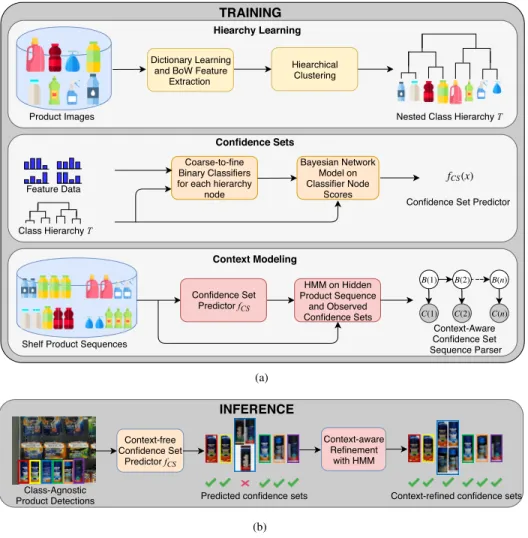
of three important components: (i) A hierarchical clustering of product classes based on their visual similarities to approx-imate a product taxonomy, (ii) A confidence-set predictor that is composed of (ii.1) coarse-to-fine binary classifiers sensitive to each node of the hierarchy, and (ii.2) a Bayesian Network (BN) model that encodes the joint distribution of classifier scores with the true class; and finally (iii) A hidden Markov model that uses context-free confidence set predic-tions obtained from the BN as observapredic-tions, and combines them with contextual information about spatial transitions across the nodes of the class hierarchy to finally decode the hidden product sequences on the shelves. The overall system (see Figure1) takes as input the spatial sequence of product detections on real shelf images but with unknown class information, and returns minimal confidence sets for each spot on the shelf, while adhering with the context priors and ensuring that the true class is present within each pre-dicted confidence set at some user-defined confidence level. Accordingly, we measure the performance of our method not only by the classification accuracy, but also by the size of confidence sets returned, where the smaller is the better.
To better demonstrate the effectiveness of incorporating context and product hierarchy, in contrast to context-free baseline methods and state-of-the-art deep neural networks, we based our approach primarily on conventional image descriptors and classifiers. In particular, we use dense SIFT+BoW features as our image descriptors, with which we construct the visual clustering of product classes into a coarse-to-fine hierarchy, as well as train support vec-tor machine (SVM) classifiers for each cluster node. Thus, we are concerned about fine-grained classification of item patches using their spatial arrangements on the scene, and not about detecting them. The detection step can be integrated using a generic product detector or applying sliding windows in conjunction with our method.
We have collected four challenging and fine-grained datasets of retail products, which cover soft-drinks, cleaners, confectionery, and beverage categories [7]. Images are taken by an 8MP smart phone camera from 20 different retail stores monitored over a course of 6 months. Annotations are pro-vided in terms of product labels and bounding boxes around retail objects. The datasets contain a total of 86760 cropped instances and 19278 retail shelf sequences. We conducted extensive experiments and compared our method with both conventional methods (BoW+SVM, BN) and several state-of-the-art deep learning-based methods (Inception-Resnet-v2 [8], B-CNN [9], DenseNet-161 [10], SENet-154 [11]. In most of the experiments, our method outperforms several existing methods by achieving more than 99% accuracy while returning relatively small confidence set sizes.
We make multiple contributions to a practically relevant fine-grained classification problem, namely product recogni-tion. We present a novel retail product classifier that com-bines (i) a visually trained class hierarchy, (ii) corresponding coarse-to-fine classifiers, and (iii) context priors learned as nested HMMs across retail shelves, and (iv) returns as
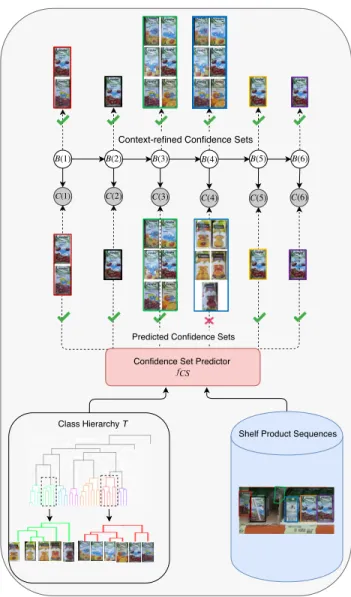
FIGURE 1. Overview of the proposed system.(a) Training:The context-aware and hierarchical system consists of three main components: A hierarchical clustering of product classes (ii) A confidence-set predictor (iii) An hidden Markov model.(b) Inference:Given an input product image, first, features are extracted. Then, confidence sets, which contain visually coherent classes, are found. Finally, contextual relationships in retail shelves is used to improve the classification accuracy by executing a context-aware approach.
recognition output confidence sets, i.e., minimal and context-aware sets of fine-level classes at a given confidence level. To the best of our knowledge, such a comprehensive com-bination of confidence sets and spatial priors has not been exploited in the context of fine-grained product recogni-tion. To show the effectiveness of our approach and to encourage researchers in relevant fields, we also introduce comprehensive product datasets that contains fine-grained product classes consisting of beverage, biscuits, chocolate, and hygiene products.
The paper is organized as follows: SectionIIreviews the relevant literature. In Section III, the proposed method is described in detail. Section IV presents our experimental findings on product recognition. Finally, SectionVcontains our concluding remarks.
II. RELATED WORK
Our work is related to existing work on retail product recog-nition, context-aware object classification, and fine-grained classification.
A. RETAIL PRODUCT RECOGNITION
Recently, recognition of products on retail shelves has become an interesting research topic in computer vision [4]–[6], [12]–[21]. Several commercial product search systems exist and obtain good classification results on some product categories with specific planar shapes and textures such as CDs and books [12], [13]. The methods in [4]–[6], [14]–[16], [18]–[21] focus on retail product recognition on shelves.
The work in [4] introduces a new multimedia database of 120 grocery products, GroZi-120. Three commonly used object recognition/detection algorithms (color histogram matching, SIFT matching, and boosted Haar-like features) are applied. [5] presents a dataset of 26 grocery product classes and proposes a hierarchical algorithm. First, possible labels that a test image may contain are filtered by ranking the output of a fine-grained classifier. Second, fast dense pixel matching is performed for the classes in the filtered list. Then, multi-label image classification is achieved based on the matching score, context and recognition localization
results. In contrast to our approach, [5] simultaneously rec-ognizes and localizes all the individual products in a shelf image with only one single training image per label. They claim that failure cases are mainly due to significant visual resemblance between training images, blurry conditions of test images, and wrong facing products. Our experiments show that our proposed method can potentially solve these problems. [14] proposes an inference graph, ViCoNet, that builds contextual relationships of retail objects in a scene. Their dataset consists of 62 product classes which are from non-similar categories such as pasta and detergent. Unlike our approach, this work involves only a small number of classes and the problem posed is not a fine-grained recognition prob-lem. Their emphasis is more on efficiency than accuracy of recognition.
The most relevant methods to ours among previous work are [15], [16], which used a dataset very similar to our dataset in terms of the number of classes and sample prod-uct images. [15] extracts and matches SURF features. The classifier returns several similar products for each product image similar to our approach. However, in the next step, disambiguation steps are applied to eliminate recognitions and the method returns a single recognized product. They correctly recognize 87.4% of the 223 products and indicate that all the products that were misclassified were classified as products from the same group which consists of visually similar products. [16] presents a context-aware product clas-sification system. It improves the accuracy of context-free classifiers such as SVMs, by combining them with a graphical model based on HMMs or Conditional Random Fields. This context-aware approach recognizes all the products on the shelf by using input product images and knowledge learned about which products tend to be adjacent in planograms.
The use of deep learning techniques in product recogni-tion has been limited so far because the available datasets consist of small number of images per class. Some recent pieces of work [6], [17], [21] have considered deep leaning techniques for product recognition and detection. In [17], a deep neural network called ScaleNet is proposed. This method estimates object scales in images and generates object proposals for product detection. In [6], a convolutional neural network (CNN), is used for recognizing objects with only a single training example per class. The method proposed in [6] uses a multi-view dataset to improve recognition. Unlike our approach, their aim is not fine-grained recog-nition. Their emphasis is more on robustness to viewpoint changes with a limited training dataset. As indicated in [6], the method should be extended for robustness to occlusions, lighting changes, and many other types of challenges in the real world. In [21], to extract region proposals from the query image, a state-of-the-art object detector known as Yolo-v2 [22] is used by fine-tunning the network. Then, each cropped region proposal is sent to another CNN (VGG-16 [23]) which computes an ad-hoc image representa-tion. These are then deployed to recognize products through a K-NN similarity search in a database. Finally, they apply a
final refinement step which aims to prune out false detections among similar products and re-rank the first K-NN found in the previous step in order to fix possible recognition mistakes. Their emphasis is more on refinement steps than utilizing deep learning methods for product recognition.
B. CONTEXT-AWARE OBJECT CLASSIFICATION
The context-aware object classifiers are the recognition systems which can extract, model and use context infor-mation. Graphical models provide a powerful framework for modeling statistical structures in scene understanding problems [24]–[27]. HMM is commonly used for recognition in time-sequential images such as human action recogni-tion [24]. The features are extracted from a set of time sequen-tial images and then HMM model parameters are learned over the sequence of quantized features. There are also more complex graphical models used in object recognition prob-lems. [25] proposes a hierarchical probabilistic model for the detection and recognition of objects. It is based on a set of parts, which describe the expected appearance and posi-tion in an object-centered coordinate frame, and each object category has its own distribution over these parts. Although there are context-aware approaches, which combine visual information with context knowledge in other application domains [24]–[27], many of the studies [4], [6], [18]–[21] on product recognition do not consider the context knowledge, except [5], [14]–[16].
In [5], the context knowledge is modeled such that classes, which fall under the same category, are more likely to occur together than those, which fall in different categories. They only consider this assumption as the context model and their dataset does not involve a product arrangement. [14] proposes an inference graph, ViCoNet, that builds context between products in a scene. [14] does not exploit spatial relationships, but rather whether two classes are present together in a large scene, as it is temporally captured by a shopper’s sensor. The approach in [15] is based on the observation that prod-uct arrangements on shelves reveal some simple left-to-right order rules and an internal logic. Context information is not the main aim of [15]; it is used in the disambiguation sub-step to improve the overall recognition rates. In contrast to these works, which make context assumptions, our method directly learns the context information from shelf sequence data. [16] proposes a probabilistic model, which encodes the relations between the products on a shelf, and combines that with vision based image classification methods. However, [16] can only work at the fine-grained level and ignores the structure of class taxonomies. Our proposed work is distinguished from [16], since, in this paper, context information is com-bined with the confidence set approach and product hierarchy in a novel way.
C. FINE-GRAINED CLASSIFICATION
Several approaches have been proposed for recognizing fine-grained classes of birds [2], [9], [28], flowers [29], [30], leaves [3], [30], and other objects [1], [9], [31], [32].
In most of these approaches, first, systems find image regions that contain discriminative information. Then, features are extracted from discriminative parts of the object, and used in a set of one-vs-all classifiers. [9] presents an effective deep architecture for fine-grained visual recognition called Bilin-ear Convolutional Neural Networks (B-CNNs). B-CNNs rep-resent an image as a pooled outer product of features derived from two CNNs and capture localized feature interactions which are transitionally invariant.
Many of the studies about fine-grained classification prob-lems in the literature provide a single estimate to users [1], [2], [9], [28]–[32]. However, some classification algorithms output sets of classes called ‘‘confidence sets’’ that are guaranteed to contain the true class at a given confidence level [3], [33]. There are different methods which use the pos-terior probabilities to generate the confidence set. In the first method, the posterior distributions over classes are computed to generate confidence sets. Then, an input object image is assigned to a group of classes, for which the cumulative poste-rior exceeds a confidence threshold. In another method, clas-sifier scores are sorted andktop-ranked classes are selected as a confidence set.
In [3], [33], hierarchical classification approaches are pro-posed. They choose to give a confidence set instead of a single estimate by tracing along the hierarchy. In hierarchical classification methods, information gain is zero at the root node and maximized with correct classification at a leaf node. In real-world classification problems, some test images are very problematic due to the challenges caused by the real world environment. If hierarchical classifiers always output the root node, they yield 100% accuracy with uninformative produced labels especially for these challenging cases. Also, as we increase the confidence threshold, specificity is traded off for higher accuracy rate. In [33], the classifier can select the appropriate level, trading off specificity for accuracy in case of uncertainty.
Our work is closely related to [3], which proposes a confi-dence set method for fine-grained categorization of plants. They use vantage feature frames [30], which is a special feature extraction technique for leaves. [3] computes the posterior probabilities for each node of the class hierarchy and then, selects the node of minimal size subject to the constraint of containing the true species with a given confidence level. If the posterior probability of any leaf node at the first level of the hierarchy is not higher than a user specified confidence threshold, the method checks the confidence of the nodes at higher levels of the hierarchy. They claim that the posterior probabilities may be poorly estimated due to challenges in a dataset and the system may return the node at a very high level of the hierarchy as confidence set, which contains almost all classes, for difficult classification tasks. This causes increases in the average confidence set size. Therefore, we used their method with an additional constraint to decrease the expected size of the confidence sets because our datasets are very challenging and suffer from issues like blur, occlusions, unex-pected backgrounds, etc.. We propose a strategy to limit and
decrease the confidence set size by stopping the classification at a certain level of the hierarchy. The dissimilarity measure between the classes under the nodes of the hierarchy is used as a stopping criterion (see Eq.1). Similar to the method in [3], we also compute the posterior probabilities for each node of the hierarchy and then, select the node of minimal size which exceeds the user defined confidence threshold 1−. However, in contrast to [3], if the dissimilarity measure of the selected node is higher than the thresholdθ, the descendant node of the selected node, which has the highest posterior probability and has a dissimilarity measure below the threshold, is returned as the confidence set by our algorithm. The experiments in SectionIV-Cshow that our HMM method can usually correct potential classification errors caused by limiting the confi-dence sets. So, by combining conficonfi-dence sets with context information, our algorithm provides more specific classifica-tion results while guaranteeing a high accuracy.
In retail product recognition, to the best of our knowledge, the existing methods in the literature [4]–[6], [14]–[16], [18]–[21] do not exploit the information coming from the taxonomy of the product classes to improve the classifier performance. Furthermore, there is no previous work which uses hierarchical classification and confidence set approaches, in product recognition problems. The use of class hierarchy and confidence sets makes our method more efficient, robust, and accurate, especially when the data are challenging.
III. PROPOSED METHOD
The proposed approach consists of three main parts (see Figure 1(a) for the flow diagram). In the first part we automatically construct a nested hierarchy of classes based on their visual similarities. In the second part, we train coarse-to-fine binary classifiers, each dedicated to an individual node of the hierarchy, while treating its consisting classes as positive samples and the rest as negative. Then, we use the same class hierarchy as the dependency structure among classifier scores to implement a Bayesian network that mod-els the joint distribution of these scores with the true class, and that is used to predict confidence sets based on class posteriors. In the third part, an HMM is trained with nested hidden states from the class hierarchy to model contextual relations between (sets of) classes and resolve errors in the context-free confidence sets results. In inference, the overall system (see Figure 1(b)) takes as input the spatial sequence of product detections on real shelf images but with unknown class information, and returns minimal confidence sets for each spot on the shelf, while adhering with the context priors.
A. IMAGE DESCRIPTORS
In this work, we used Bag-of-Words (BoW) descriptors formed from a codebook of dense SIFT features for represent-ing the visual information from product images. In the first step, dense set of multi-scale SIFT features are computed with five patch sizes (8, 12, 16, 24, 30) by using the VLFEAT tool-box [34]. In the second step, vocabulary learning, K-means
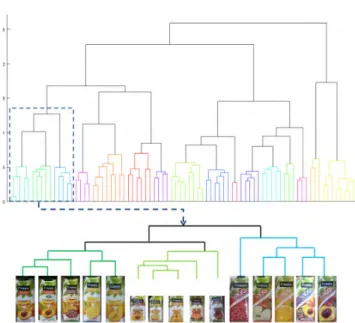
FIGURE 2. Top:Class tree and sub-tress of 80 classes in the Beverage dataset is shown where the vertical axis represents the distance between classes, and the horizontal axis represents the product classes. Bottom:
Zoom-in to the sub-tree (15 classes).
algorithm is used to cluster large sets of feature descriptors into dictionaries of 768 visual words. In the third step, spa-tial histograms are computed. A Kd-Tree algorithm is used to map visual descriptors to visual words efficiently. Then, the visual words are accumulated into a spatial histogram. After that, pre-transformation, which computes an explicit feature map that applies a non linearχ˜2-kernel, is applied on the features to make the feature set more meaningful for linear classifiers. At the end of this step, a 2304 dimensional feature set is computed.
B. CLASS HIERARCHY
LetY denote the set of all product classes. We construct a tree structured class hierarchyT via a nested partitioning of
Ydown to its individual members. In particular, each nodet
ofT will carry a subsetCt ⊆Y, where equality holds for the
root nodet0ofT.
T is formed by bottom-up agglomerative clustering of the data, where we start from singleton nodes, i.e., individual classes and iteratively merge most similar pair of pending nodes to a new and larger cluster. While doing so, each nodet
is represented by ut¯ of BoW vectors pooled from samples belonging to classes inCt. We used Wards criterion, where the dissimilarity of two pending nodeslandr, with respective node centersu¯landu¯r and cluster sizesnlandnr, is given by
d(l,r)= nlnr nl+nr
|| ¯ul− ¯ur||2 (1)
Figure2 shows an example treeT produced this way on 80 fine-grained product classes. Note how the visual clus-tering will reveal semantic class groupings with categories,
brands, packaging types appearing in the hierarchy as one goes from top to bottom.
As explained next, the class hierarchyT will be of core importance for multiple purposes: We will (i) train coarse-to-fine product classifiers dedicated to individual nodes ofT, (ii) define a Bayesian network on classifier responses usingT
as our network topology, (iii) encode nested context priors via a HMM with spatial transitions between the nodes ofT, and (iv) eventually generate confidence sets as our recognition results from the nodes ofT.
C. COARSE-TO-FINE BINARY CLASSIFIERS
For each node t of the class hierarchy T, except for its roott0, we train a binary SVM classifierft to discriminate
classes fromCtfrom the restY\Ct, where BoW vectors from the former are treated as positive instances, and the remaining samples are labeled as negative. Clearly,t0is excluded, since withCt0 =Y, no negative samples are available to trainEt0. As a result, we obtain a collectionE = {et :t ∈T \ {t0}}of classifiers that discriminateYat different resolutions.
D. BAYESIAN NETWORK MODEL ON CLASSIFIER NODE SCORES
Given a test sample with true classY ∈ Y, letX = {Xt : t ∈ T \t0}denote the set of SVM scores returned by the collectionE of classifiers, where eachXt is the real-valued
signed margin of the data sample to the decision boundary ofet.
We model the joint distributionp(x,y) = p(x|y)p(y) of SVM scores with the class variable, by a Bayesian network, wherep(y) is assumed uniform overY and the dependency structure among X is copied from the precomputed class treeT, with its roott0being excluded. Accordingly, eachXt is assumed conditionally independent of its ancestors given its parent scoreXpa(t) =xpa(t)underT, and the class mem-bershipY =y, such that we can factor their joint conditional density as
p(x|y)=g1(x1|y)g2(x2|y) Y
t∈T\{t0,t1,t2}
gt(xt|xpa(t),y) (2)
wheregt are local conditional densities, withg1andg2 cor-responding to the immediate two children oft0. We model (Xt,Xpa(t)) to be jointly normal given Y = y, with
con-ditional means {µt,y, µpa(t),y}, variances {σt2,y, σ2
pa(t),y} and
class-conditional correlationρt,y. Thengt(xt|xpa(t),y) is also
normal with mean µt,y + ρt,yσσt,y
pa(t),y(xpa(t) −µpa(t),y) and variance (1−ρt,y2)σt2,y[3], [35], and is given by
gt(xt|xpa(t),y)= 1 σt,yp2π(1−ρt,y) exp (xt−µt,y−ρt,y σt,y σpa(t),y(xpa(t) −µpa(t),y))2 2(1−ρt,y2)σ2 t,y (3) Similarly,g1 andg2 corresponding to largest cluster nodes
respective class-conditional means µ1,y,µ2,yand variances
σ2 1,y,σ
2
2,y. Sample mean and standard deviation are used to
estimate the parameters of a normal distribution for a suffi-ciently large dataset.
E. CONFIDENCE SET PREDICTOR
The proposed confidence set predictor is trained based on the class hierarchy,T, and the class posteriors computed by using the BN model. The confidence sets are selected by tracing along the hierarchy [3]. Thus, the confidence sets are restricted to the nodes of the hierarchy of product classes based on visual similarity.
In the proposed method, the classification is stopped at a certain level of the hierarchy instead of returning a node at a very high level of the hierarchy as the confidence set for challenging test images. To do this, the distances between classes is used as an additional constraint. The agglomerative hierarchical clustering algorithm in SectionIII-Breturns an array,D, which gives the distances of pairwise cluster merges (See Eq. 1). By thresholding D, subgroups that join at a distance below a threshold θ are put in the same cluster. LetU denote the union of subtrees corresponding to those clusters,U ⊂ T. These subtrees consist of visually similar classes as shown in Figure2, where each subtree gets its own color in the tree.
In addition to the class hierarchy, posterior probabilities are also used to generate the confidence sets. In BNs with continuous variables, exact inference is only possible when all the continuous variables are Gaussian and have no dis-crete children, as in our case. According to Bayes’ theorem, the posterior probabilities are proportional to the likelihood when the prior is uniform.
The proposed confidence set predictor consists of three main steps. In the first step, the posterior probabilities
P(Y ∈Ct|X=x) are computed for each nodet ∈T. P(Y ∈Ct|X =x)= X y∈Ct P(Y =y|X =x) = X y∈Ct p(x|y)p(y) p(x) = P y∈Ct p(x|y) P y∈Y p(x|y) (4) In the second step, the set of nodes for which the class posterior exceeds 1−is selected as follows:
S(x)= {t :P(Y ∈Ct|X =x)>1−,t∈U} (5) where ∈ [0,1] is a small error tolerance and U denotes the union of the subtrees. In the final step, the confidence set is determined as the smallest confidence set among the set of candidate nodes S(x) as in Eq.6. If S(x) is empty, by construction the most confident node will be one of the roots of the subtreesU.
fCS(x)= argmin Ct∈S(x) |Ct|, ifS(x)6= ∅. argmax Ct∈U P(Y ∈Ct|X =x), otherwise. (6)
Classes in the same subtree (confidence set) have a small distance from one another, while classes in different subtrees are at a large distance from one another. In fine-grained classification, it is less likely to misclassify a sample object image into a class with no relation to the true class than into a class close to the true class, and commonly confused classes are visually similar. Therefore, our method restricts confidence sets to containing similar classes based on the class hierarchy and the dissimilarity constraint. By using the proposed strategy, we want to maintain high specificity of the confidence sets, while not sacrificing more on the confidence guarantees. The efficiency of this algorithm will be demonstrated in a variety of experiments in SectionIV-C.
F. CONTEXT-AWARE REFINEMENT WITH HMM
The proposed context-aware system is performed by adding a HMM model to the context-free confidence set predictor.
LetY = (Y(1),Y(2), . . . ,Y(n)) be the hidden sequence of n adjacent objects (true labels). Suppose, for each spot k∈1,2, . . . ,n, the confidence set predictor returns an observed confidence set Cl found at level l in the hierarchy, which is a variable-length list of classes. Note that, level indices l for different spots k do not need to be same. Let C=(Cl1
t1(1),C
l2
t2(2), . . . ,C
ln
tn(n)) denote the observed sequences of confidence sets. Let
B=(Bl1(1),Bl2(2), . . . ,Bln(n)) denote the sequence of hid-den sets, where each element is from the same level as the corresponding observed confidence sets in C, and where
Blk(k) contains the unknown ground truth labelsY(k) for all
k=(1,2, . . . ,n). We construct an HMM over set sequences
C (observations) and B (hidden set states). State spaces of both observations (C’s) and hidden states (B’s) areT, but the observations come from the confidence set predictor and the hidden states correspond to the ground-truth.
Training an HMM requires calculating the model param-eters involved in the transition matrix, the emission matrix, and the prior probabilities of the initial states. If training data contains the class labels, the HMM parameters can be empirically computed from the training data by maximum likelihood estimation. In this work, all emission and transition parameters are computed by maximum likelihood estima-tion approach. Transiestima-tion probabilitiesP(b|b0) among hidden states can be written using transition probabilities P(y|y0) among hidden true labels.
P(b|b0)=X y∈b P(y|b0) =X y∈b X y0∈b0 P(y|y0,b0)P(y0|b0) = 1 |b0| X y∈b X y0∈b0 P(y|y0) (7)
P(y|y0) is empirically estimated by using the relative fre-quency of transitions observed in the sequence data from object labelY(k−1)=y0to object labelY(k)=y.
The emission probabilities P(c|b) between observed and ground-truth confidence sets are estimated using emissions
P(z|y) between their singleton counterparts where sets c
and b belong to the same level of the class hierarchy, and
P(y|b) are taken uniformly.
P(c|b)=X z∈c P(z|b)=X z∈c X y∈b P(z|y,b)P(y|b) = 1 |b| X z∈c X y∈b P(z|y) (8)
The maximum likelihood estimator, which is the MAP estimator argmaxyP(Y =y|Z =z) when the prior is uniform, is used as the free classifier. The context-free classifier returns only the classes with the maximum posterior probability, which is computed by using joint probabilities encoded by the BN (See SectionIII-E). Outputs of this classifier are used to find the singleton counterparts of the observed confidence sets. The emission probabilities
P(Z = z|Y = y), where the context-free classifier label is
Z =zwhen the true label isY =y, are empirically estimated by using maximum likelihood estimation.
Now, given confidence set observationsc=(cl1
t1(1),c
l2
t2(2),
. . . ,cln
tn(n)) (deduced from the proposed confidence set model), argmaxbP(b|c) can be found with standard Viterbi decoding using the above transition (Eq.7) and emission (Eq.8) probabilities. Note that, this can also be done across different levels of the class hierarchy, where level lk can
vary along the sequence. For any level l of tree T, let
Cl denote thel-level confidence set of objects. Accordingly, when the confidence set C1 is found at 1-level (level of the leaf nodes) in the hierarchy, it contains a single classY
and the problem boils down to conventional flat classifi-cation in which classifiers are restricted to return a single class.
The proposed HMM model is trained to evaluate, con-firm, and correct the classification results performed by the context-free approach (See Figure 3). Unlike conventional flat classifiers which are restricted to output singleton classes, in the proposed HMM model, the predicted confidence sets are used as the observations and the observations can con-sist of more than one class. Given context-free suggestions of the confidence sets at each spot, the proposed context-aware confidence sets approach uses the context information (coarse or fine depending on the level), and tries to recover a more coherent sequence of confidence sets.
IV. EXPERIMENTS
We empirically demonstrate our proposed method’s effectiveness on several fine-grained datasets described in Section IV-A. We provide experimental settings in Section IV-B and a comparison with state-of-the art approaches for image classification in SectionIV-C. We then present an ablation study, where we evaluate the key elements of our proposed method; confidence sets and context-aware strategies in SectionIV-D.
FIGURE 3. Diagrammatic representation of context aware refinement with HMM. A sample test shelf sequence data and constructed hierarchy are provided to the context-free confidence set predictor as input and it returns predicted confidence sets at each spot. Then, through the use of context information, the HMM model aims to improve upon the classification results of the confidence set predictor.
A. DATASET DESCRIPTION
We have collected fine-grained datasets of retail products, which cover soft-drinks, cleaners, confectionery, and bever-age categories [7]. These four challenging Vispera retail prod-uct datasets were used for experimental evaluation. Images are taken by an 8MP smart phone camera from 20 different retail stores monitored over a course of 6 months. Annota-tions are provided in terms of product labels and bounding boxes around retail objects.
1) SOFT-DRINKS
The dataset consists of soft-drink products [7]. It contains 32315 cropped instances of 178 distinct labels and 9238 non-overlapping product shelf sequences. The number of sample
FIGURE 4. Sample images from datasets [7]. Each image corresponds to a different product class. (a) Soft-drinks Dataset. (b) Confectionery Dataset. (c) Beverage Dataset. (d) Cleaners Dataset.
product images in fine-grained classes varies from 180 to 330. Figure 4(a) shows sample product images from the dataset.
2) CONFECTIONERY
In this dataset, the products range from biscuits to cakes, wafers to chocolate, and crackers to candy [7]. The segmen-tation and manual labeling of these kinds of products are very challenging problems. In this dataset, there are some mislabeled and mis-segmented retail product samples. These samples make the product recognition more challenging. This dataset contains 29262 cropped instances of 160 dis-tinct labels and 5191 non-overlapping product sequences. The number of training images in fine-grained classes varies from 61 to 553. Figure 4(b) shows sample product images from the dataset.
3) BEVERAGE
This dataset contains 17282 cropped instances of 69 distinct beverage product classes and 3210 non-overlapping product
sequences [7]. The number of product images in fine-grained classes varies from 70 to 822. Figure 4(c) shows sample product images from the dataset.
4) CLEANERS
The dataset consists of cleaning agents, as well as per-sonal care and hygiene products [7]. The dataset con-tains 7901 cropped instances of 86 distinct labels with 60-396 exemplars in each fine-grained classes. There are 1639 non-overlapping product sequences. Figure 4(d) shows sample product images from the dataset.
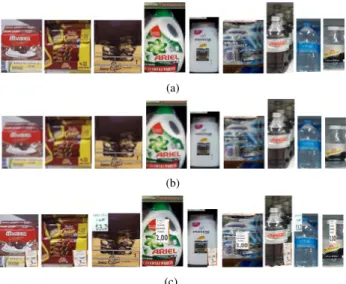
Although all the datasets contain product images which suffer from real-world conditions such as blur, occlusion, and different lighting as shown in Figure5, we also created more challenging test images by occluding the original images and blurring the original datasets with a 2-D Gaussian smoothing filter (σ = 5,11×11 kernel) to test the robustness of our approach. Sample original, blurred, and occluded test images are shown in Figure6.
FIGURE 5. The first column of the each sub-figure is a sample of the four coke classes with different metric sizes. The second and third column of each sub-figure contain examples of problematic product images in the dataset. (a) 2.5lt. (b) 1.5lt. (c) 1lt. (d) 450ml.
FIGURE 6. Samples of original, blurred, and occluded test images. (a) Original Test Images. (b) Blurred Test Images. (c) Occluded Test Images.
B. EXPERIMENTAL SETTINGS
In each experiment, we split the dataset into four groups to train and test the proposed method. 30% of the entire data is used to train the local classifiers at each node of the product hierarchy. 30% of the data is used to evaluate SVM scores and estimate the parameters of the BN. 30% of the data is used as the training dataset of the HMM and the remaining is used for testing the overall system. For competing methods, we use 10% of the data for testing and the remaining for training. In all experiments, we use=10−2, where 1−denotes the confidence threshold, andθis 30% of the maximum distance in the hierarchyT, whereθis used to find the group of nodes in theT whose dissimilarity is less thanθ.
C. CLASSIFIER PERFORMANCE
To evaluate the performance of our proposed method, sev-eral context-free classifiers are tested. The first four are flat classifiers which are restricted to output singleton classes. For comparison, we trained Inception-ResNet-v2 [8], B-CNN [9], DenseNet-161 [10] and SENet-154 [11] which are state-of-the-art deep convolutional neural networks for image classification. We fine-tuned Inception-ResNet-v2 [8], B-CNN [9], DenseNet-161 [10], and SENet-154 [11], which have been pre-trained using ImageNet [36] on the training parts of our product datasets, with a batch size of 32 examples. We used the default parameter settings of available
implementations. We fine-tuned Inception-Resnet-v2 by using the Adam optimizer with a learning rate of 0.002, decayed every two epochs using an exponential rate of 0.9 and utilizing TensorFlow [37]. We fine-tuned the remaining net-works using stochastic gradient descent (SGD) with momen-tum (set to 0.9) and an initial learning rate of 0.01 which was reduced by a factor of 10 each time the validation loss plateaued by utilizing PyTorch [38].
The remaining context-free methods are set-based approaches, which return recognition sets (RSs) (just like the confidence sets involved in our approach). In set-based approaches, a RS may contain more than one recognition suggestion. This is a variation we implemented for a fair comparison with our set-based approach. Inception-ResNet-v2_cum [8], B-CNN_cum [9], DenseNet-161_cum [10], and SENet-154_cum [11], which select classes until the total mass exceeds 1− were implemented. In addi-tion, Inception-ResNet-v2 (top-5) [8], B-CNN (top-5) [9], DenseNet-161 (top-5) [10] and SENet-154 (top-5) [11], which returns the top-ranking 5 classes, were implemented. These state-of-the-art architectures are considered as com-monly accepted baseline set-based methods for object recognition. In addition to deep CNN architectures, [3], which is the only work that proposed a confidence sets method for fine-grained classification, was implemented. Detailed descriptions of the context-free classifiers are given in Table1.
In addition to context-free classifiers, two different context-aware classifiers (see Table 2), which are able to extract, interpret and use context information for classi-fication, are tested. First one, CSlim + HMM, is our proposed context-aware confidence sets method and the other is a context-aware flat baseline classifier (BoW +
SVM + HMM [16]). In our experiments, both set-based approaches (ResNet-v2_cum [8], Inception-ResNet-v2 (top-5) [8], B-CNN_cum [9], B-CNN (top-5) [9], DenseNet-161_cum [10], DenseNet-161 (top-5) [10] and SENet-154_cum [11], SENet-154 (top-5) [11], CS [3], and CSlim+HMM) and the other classifiers which output a sin-gleton class (BoW+SVM+HMM [16], Inception-ResNet-v2 [8], B-CNN [9], DenseNet-161 [10] and SENet-154 [11]), are evaluated. Also, experiments evaluate the classifiers in terms of context-awareness.
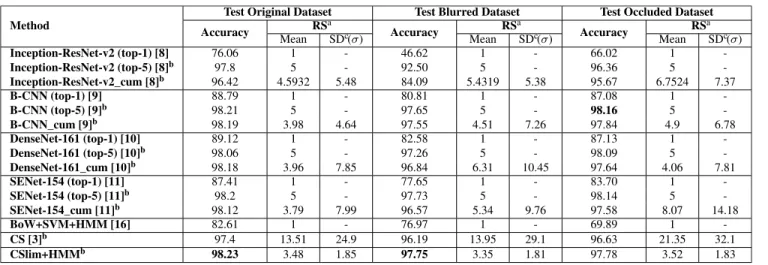
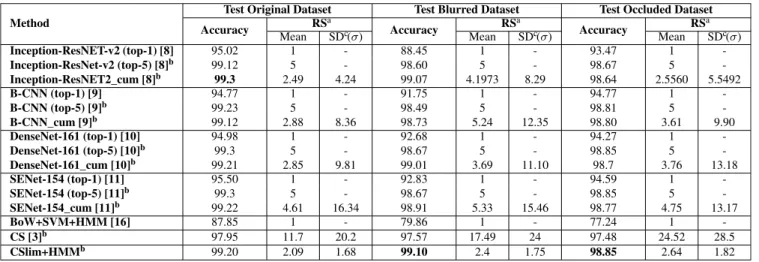
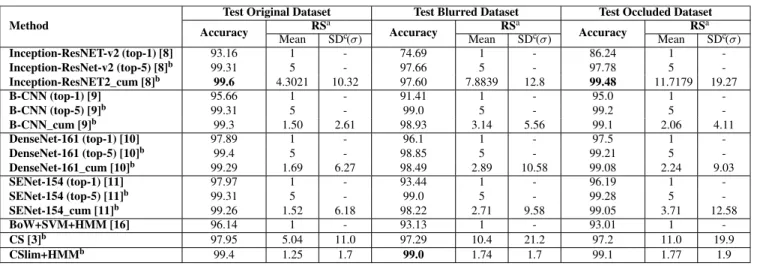
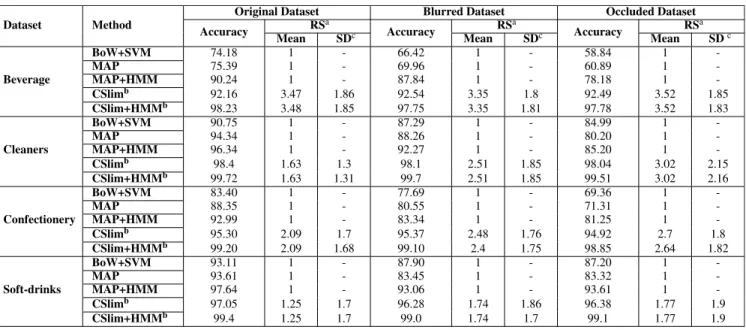
The performance is measured in terms of recognition accuracy, average size of the recognition set (RS), and its standard deviation. We tested all these methods on four challenging retail product datasets and reported our results in Tables3,4,5, and 6. We examined three test cases for each of the four datasets: in the first case we used the original dataset without the artifacts of Gaussian blur and occlusion, in the second case the original dataset is used in training and Gaussian blurred images are used in test to make the problem more challenging, and in the third test case we randomly place some irrelevant occluder (e.g., price tags) onto each product image in the test set for each test image. In Tables3,4,5and6, the second, third and fourth columns show the results of the
TABLE 1. Context-free classifiers.
TABLE 2. Context-aware classifiers.
TABLE 3. Results of various classifiers for beverage dataset (69 classes).
first case, the results of the second test cases are shown in fifth, sixth and seventh columns and the results of occluded test case are shown in the last three columns.
1) BEVERAGE
In Table3, the comparison among the context-free flat clas-sifiers (Inception-ResNet-v2 (top-1) [8],B-CNN [9] (top-1), DenseNet-161 (top-1) [10] and SENet-154 (top-1 [11]) shows that DenseNet-161 [10] achieves the best result (89.12% accuracy). Among context-free confidence sets approaches, (CS [3], Inception-ResNet-v2_cum [8], Inception-ResNet-v2 (top-5) [8], B-CNN_cum [9], B-CNN (top-5) [9], DenseNet-161_cum [10], DenseNet-161 (top-5) [10] and SENet-154_cum [11], SENet-154 (top-5) [11]), B-CNN (top-5)
achieved the best accuracy with 98.21% by returning top-5 predict labels. Among all confidence sets approaches (CSlim+HMM, CS [3], Inception-ResNet-v2 (top-5) [8], Inception-ResNet-v2_cum [8], B-CNN_cum [9], B-CNN (top-5) [9], DenseNet-161_cum [10], DenseNet-161 (top-5) [10] and SENet-154_cum [11], SENet-154 (top-5) [11]), our proposed method, CSlim + HMM, achieves the best performance with 98.23% accuracy. Our method returns 3.48 average RSs size, which has a standard deviation of 1.85. Compared to other set-based methods, CSlim + HMM returns relatively small RSs with a small standard deviation.
Blurring the test dataset significantly reduces the clas-sifiers’ performance especially Inception-ResNet-v2’s [8].
TABLE 4. Results of various classifiers for cleaners dataset (86 classes).
TABLE 5. Results of various classifiers for confectionery dataset (144 classes).
Our proposed method, CSlim + HMM, significantly outperforms all set-based strategies and all flat classifiers with 97.75% accuracy and 3.35 average RS size. Product recognition is very challenging when the objects are partially occluded. The results in the last three columns of Table 3 show that the best result is achieved by B-CNN (top-5) [9]. B-CNN (top-5) [9], DenseNet-161 (top-5) [10] and SENet-154 (top-5) [11] perform equally well in terms of accuracy by returning top-5 classes. These methods are slightly better than our method (CSlim+HMM), which achieves a classification accuracy of 97.78% with only 3.52 average RS size when the products are occluded. However, these methods return larger average RSs than our method to achieve the accuracy listed in Table3. The standard deviation of the RSs returned by our method is smaller than other confidence sets based approaches.
2) CLEANERS
Our results on the Cleaners dataset are summarized in Table4. The results in Table 4 emphasize that the proposed context-aware confidence set method, CSlim+HMM, out-performs all the other conventional and deep learning meth-ods for the all test cases including original, blurred, and occluded test dataset. Our method has satisfied the accuracy guarantee for original test dataset with only 1.65 average RS size. As shown in the last six columns of Table4, it is also clear that the proposed method (CSlim+HMM) is resistant to occlusion and blurring, and satisfies the accuracy guarantee while returning relatively small RSs.
3) CONFECTIONERY
In Table5, the comparison among the context-free flat clas-sifiers shows that SENet-154 (top-1) [11], achieves 95.50%
TABLE 6. Results of various classifiers for soft-drinks dataset (178 classes).
accuracy for original test dataset. Among confidence sets approaches (CSlim + HMM, CS [3], Inception-ResNet-v2(Top5) [8], Inception-ResNet-v2_cum [8], B-CNN_ cum [9], B-CNN (top-5) [9], DenseNet-161_cum [10], DenseNet-161 (top-5) [10] and SENet-154_cum [11], SENet-154 (top-5) [11]), Inception-ResNet-v2_cum [8], DenseNet-161 (top-5) [10], SENet-154 (top-5) [11], yields-99.3% accuracy by returning top-5 predictions as recognition sets for each test sample. Although this method performs slightly better than our proposed context-aware confidence sets method, CSlim+HMM, which achieves 99.2% accuracy with only 2.09 average RS size for original data test, it pro-duces a larger RS. The reason is that parameter estimation and automatic hierarchy construction are more difficult in the Confectionery dataset than in others, because there are some mislabeled and mis-segmented retail product samples in this challenging dataset. CSlim+HMM returns relatively small confidence sets sizes while satisfying the given accu-racy guarantee. In extreme test cases including blurred and occluded datasets, our method, CSlim+HMM, outperforms all methods by returning relatively small RSs with a small standard deviation.
4) SOFT-DRINKS
In the original test case, Inception-ResNet-v2_cum [8] achieved the best accuracy with 99.6% on original test data as shown in Table6, but it return the largest RS on average. DenseNet-161 (top-5) [10] and our method, CSlim+HMM, perform equally well in terms of accuracy and achieve 99.4% accuracy. However, DenseNEt-161(5) [10] return top-ranking 5 classes as RS while our method is returning a single estimate at most of the time. For occluded test data, Inception-ResNet-v2_cum [8] achieved the best accuracy %99.48 with 11.72 average RS size In this case, we achieve a classification accuracy of 99.1% with only 1.77 average RS size, which
is much smaller than Inception-ResNet-v2_cum [8]. Also, DenseNet-161 (top-5) [10], SENet-154 (top-5) [10], and B-CNN (top-5) [10] obtain %99.2 accuracy by returning top-ranking 5 classes. Although the some set-based deep learning methods performed equally well or slightly better than our context-aware confidence sets method, CSlim +
HMM, in terms of accuracy, these methods returned relatively large RSs with a high standard deviation. We argue that this is because Inception-ResNet-v2_cum [8] returned RSs con-taining almost all classes for challenging test images. In the blurred test case, our method CSlim+HMM outperforms all methods in terms of both accuracy and average RS size. All the results in Table6show that compared with other methods, our method, CSlim+HMM, is more robust and informative especially with challenging, low-quality data.
We also compared confidence sets approaches with differ-ent confidence thresholds on all datasets. Figure7presents the average size of the RSs versus accuracy curves for CSlim + HMM, CS [3], and Inception-ResNet-v2_cum [8], B-CNN_cum [9], DenseNet-161_cum [10], and SENet-154_cum [11]. We set the accuracy guarantee 1 − to
{0.99,0.95,0.9,0.8,0.7,0.6,0.5}. Note that our CSlim +
HMM is able to satisfy the given accuracy guarantee except only one test on the Beverage dataset for which the accuracy guarantee is set to 0.99. As we increase the confidence thresh-old, the average size of RSs significantly increases for CS [3] and Inception-ResNet-v2_cum [8] compared to our method, CSlim+HMM, especially when the datasets are challenging. In confidence sets methods, the performance is measured by the accuracy and the average size of the set of candidates. Our CSlim+HMM approach and deep networks (B-CNN_cum [9], DenseNet-161_cum [10], and SENet-154_cum [11]) per-form equally well in terms of accuracy on Beverage, Con-fectionery, and Soft-drinks test datasets, but, our proposed method returns relatively smaller RSs. The results on the
FIGURE 7. Accuracy versus average size of the RS’s for all tests. When we increase 1−, in our method, the increase in the average size of RS’s is generally smaller than other methods.
TABLE 7. Additional experiments for ablation studies of the proposed method.
Cleaners dataset show that our method outperforms others in terms of both accuracy and RSs size for all confidence levels.
D. ABLATION STUDY
To gain a better understanding of the improvements provided by various components of our proposed method, we con-duct additional experiments for an ablation study as shown in Table7. We analyzed results on the Beverage, Cleaners, Confectionery, and Soft-drinks datasets using versions of our approach that aim to demonstrate the effect of using context, confidence sets, and class hierarchy. In SectionIII-C, BoW+SVM binary classifiers at each node ofT are trained and then, the classifier scores are used to learn the Bayesian network. For ablation study, we used BoW + SVM as a flat baseline classifier. Then, in SectionIII-D, Bayesian net-work on classifiers is learned. MAP, which outputs only the classes with the maximum posterior probability computed by using joint probabilities encoded by the Bayesian net-work, is additionally implemented as a flat and hierarchical classifier which uses BN with embedded class hierarchy.
In Section III-E, the context-free piece in our framework called CSlim is proposed.
Table7 summarizes how performance gets improved by adding each component into our method. The comparison between MAP and BoW + SVM shows us the effect of using class hierarchy for flat classifiers. In most of the case, MAP performs better than BoW+SVM. As seen in Table7, using the context-free confidence set strategy, CSlim, improves the performance of the context-free flat classifier MAP. By allowing the use of confidence sets as the out-put of the classifier, CSlim enables significant increases in classification accuracy. To show the importance of context-awareness for a flat classifier, MAP, we additionally imple-ment MAP+HMM, which is context-aware version of MAP. The results show that the context model improves the perfor-mance of MAP in all test cases. CSlim and CSlim+HMM are both confidence set approaches. The comparison between these context-free and context-aware confidence set methods indicates that the use of context information provides signifi-cant improvement in classifier performance. Moreover, from
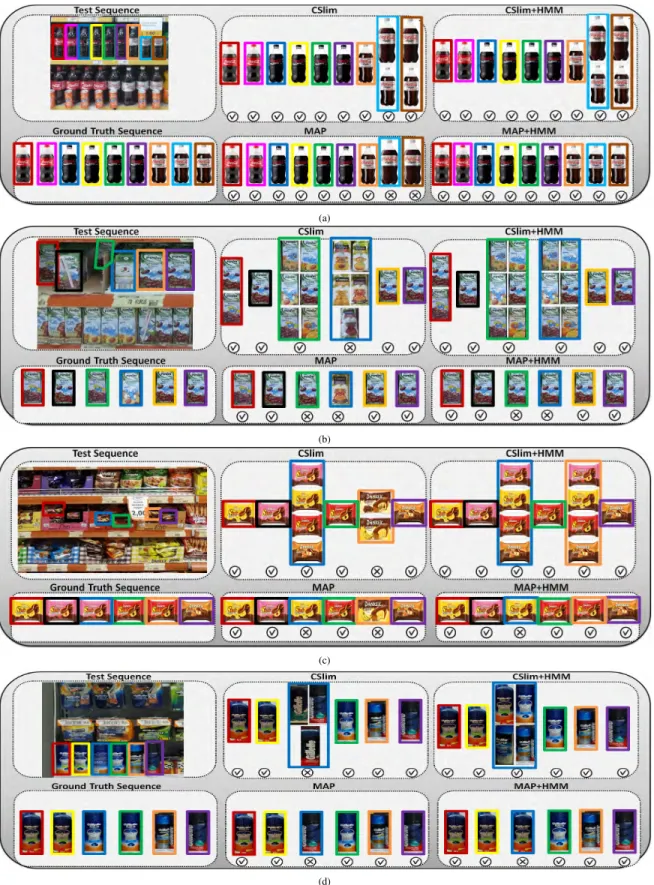
FIGURE 8. Each sub-figure shows a sample test shelf sequence data, ground truth class of the test images in the shelf sequence and recognition results of the classifiers (CSlim, CSlim+HMM, MAP, MAP+HMM) for individual products in the test sequences. In each test sequence, the annotated test images are indicated with different colored boxes. Same colored boxes are also used to indicate outputs of the classifiers for each test image in the given sequence data. Tick and cross marks under the item images indicate whether the classification for that spot is correct or not.
FIGURE 8. Each sub-figure shows a sample test shelf sequence data, ground truth class of the test images in the shelf sequence and recognition results of the classifiers (CSlim, CSlim+HMM, MAP, MAP+HMM) for individual products in the test sequences. In each test sequence, the annotated test images are indicated with different colored boxes. Same colored boxes are also used to indicate outputs of the classifiers for each test image in the given sequence data. Tick and cross marks under the item images indicate whether the classification for that spot is correct or not.
Table7, we see that both CSlim+HMM and MAP+HMM are context-aware methods, but, CSlim + HMM achieves higher accuracy than MAP+HMM by allowing returns in the form of a recognition set, which may contain more than one recognition suggestion.
All our extensive experimental results show that in prod-uct recognition, there are two typical reasons for the poor performance: (1) distorted product images captured in the supermarket environment with blur, occlusions, varied view-ing angles and different lightview-ing conditions, and (2) visu-ally similar products which have fine-grained differences. The first issue can be potentially addressed by the context-aware nature of the proposed method. In shelves, transition probabilities between similar objects which have different metric size and between dissimilar objects are low. In such cases, analysis of the context-free flat classifiers and their context aware versions show that context information may potentially improve classification. In Figure 8, sample test sequences and classification results for individual products in the sequence are shown. As seen in Figure 8(a), generally, small-sized products (e.g., Coca-cola 1 lt) are placed on the upper shelves while large size (e.g., Coca-cola 1.5 lt) products are on the lower shelves. The context-free flat classifier,
MAP, confused a product image (Coca-cola 1.5 lt) with a similar class (Coca-cola 1 lt), but the context-aware one, MAP + HMM, correctly classifies this product. How-ever, in shelves, transition probabilities between the simi-lar products which have same metric size are usually high (See Figure 8(b)). So, context information may not help address the second issue raised above about the fine-grained nature of the problem. The classification results in Figure 8(b) show that use of confidence sets, CSlim, extends the recogni-tion set so as to contain the true class with a certain confidence level and addresses the second issue. By combining the confi-dence set approach and context information, our final method, CSlim+HMM, remains robust even for the classification of visually similar products and distorted or low-quality product images for which the traditional and context-free classifiers and even state-of-the-art methods may give inaccurate results as shown in Figure8.
V. CONCLUSION
We have presented a hierarchical context-aware confidence set approach for fine-grained classification problems. Our proposed object classification method is robust especially when dealing with both fine-grained similarity between
classes and problematic images that suffer from blur, occlu-sions, varied viewing angles, and different lighting condi-tions. Our method outputs confidence sets which contain objects from the same groups instead of a singleton class, if the output of the classifier is not confident at the finest level of the hierarchy. The proposed method tries to give maxi-mum information about the object label without being wrong. Thus, the suggested confidence sets, which are guaranteed to contain the true lass at a given confidence level, can be used for final check by a human operator to find the true classes with relatively less effort. Moreover, the context-aware nature of the proposed system helps improve the performance of the classifier, especially for classification of low-quality or prob-lematic images.
We have applied our method to classifying retail prod-ucts and demonstrated its effectiveness on several product datasets [7]. We conducted extensive experiments and com-pared our method with both conventional methods and several deep learning methods (Inception-Resnet-v2 [8], B-CNN [9], DenseNet-161 [10] and SENet-154 [11]) which are the state-of-the-art methods for image classification in various domains. In most of the experiments, our method out-performs existing methods by achieving more than 99% accu-racy while returning relatively small confidence sets sizes. Compared with other methods, our experiments emphasize that the proposed approach yields better performance and can potentially address central problems of fine-grained product classification especially when processing low quality images. Although we have applied our proposed method to retail products only, our algorithm is general and can be applied to other fine-grained object recognition problems such as plant/animal species recognition and clothing style recogni-tion, as well as challenging recognition problems involving object sequences such as handwriting recognition.
REFERENCES
[1] B. Yao, A. Khosla, and L. Fei-Fei, ‘‘Combining randomization and dis-crimination for fine-grained image categorization,’’ inProc. IEEE Conf. Comput. Vis. Pattern Recognit. (CVPR), Jun. 2011, pp. 1577–1584. [2] T. Berg, J. Liu, S. W. Lee, M. L. Alexander, D. W. Jacobs, and
P. N. Belhumeur, ‘‘Birdsnap: Large-scale fine-grained visual categoriza-tion of birds,’’ inProc. IEEE Conf. Comput. Vis. Pattern Recognit. (CVPR), Jun. 2014, pp. 2011–2018.
[3] A. R. Sfar, N. Boujemaa, and D. Geman, ‘‘Confidence sets for fine-grained categorization and plant species identification,’’Int. J. Comput. Vis., vol. 111, no. 3, pp. 255–275, 2015.
[4] M. Merler, C. Galleguillos, and S. Belongie, ‘‘Recognizing groceriesin situusingin vitrotraining data,’’ inProc. IEEE Conf. Comput. Vis. Pattern Recognit. (CVPR), Jun. 2007, pp. 1–8.
[5] M. George and C. Floerkemeier, ‘‘Recognizing products: A per-exemplar multi-label image classification approach,’’ inComputer Vision—ECCV. Cham, Switzerland: Springer, 2014, pp. 440–455.
[6] D. Held, S. Thrun, and S. Savarese, ‘‘Deep learning for single-view instance recognition,’’ 2015, arXiv:1507.08286. [Online]. Available: https://arxiv.org/abs/1507.08286
[7] Vispera Information Technologies. Accessed: Jul. 16, 2018. [Online]. Available: http://www.vispera.co/
[8] C. Szegedy, S. Ioffe, V. Vanhoucke, and A. A. Alemi, ‘‘Inception-v4, inception-resnet and the impact of residual connections on learning,’’ in
Proc. AAAI, vol. 4, 2017, p. 12.
[9] T.-Y. Lin, A. RoyChowdhury, and S. Maji, ‘‘Bilinear CNN models for fine-grained visual recognition,’’ inProc. IEEE Int. Conf. Comput. Vis., Dec. 2015, pp. 1449–1457.
[10] G. Huang, Z. Liu, L. van der Maaten, and K. Q. Weinberger, ‘‘Densely connected convolutional networks,’’ inProc. IEEE Conf. Comput. Vis. Pattern Recognit., Jul. 2017, pp. 4700–4708.
[11] J. Hu, L. Shen, and G. Sun, ‘‘Squeeze-and-excitation networks,’’ inProc. IEEE Conf. Comput. Vis. Pattern Recognit., Jun. 2018, pp. 7132–7141. [12] Google Goggles. Accessed: Jul. 1, 2018. [Online]. Available:
http:support.google.com/websearch/topic/25275
[13] Amazon Mobile Looks Up Any Product You Snap a Picture of. Accessed: Sep. 22, 2018. [Online]. Available: https://developer.amazon.com/public/ [14] S. Advani, B. Smith, Y. Tanabe, K. Irick, M. Cotter, J. Sampson, and
V. Narayanan, ‘‘Visual co-occurrence network: Using context for large-scale object recognition in retail,’’ inProc. IEEE 13th Symp. Embedded Syst. Real-Time Multimedia (ESTIMedia), Oct. 2015, pp. 1–10. [15] M. Marder, S. Harary, A. Ribak, Y. Tzur, S. Alpert, and A. Tzadok, ‘‘Using
image analytics to monitor retail store shelves,’’IBM J. Res. Develop., vol. 59, no. 2/3, pp. 3:1–3:11, Mar./May 2015.
[16] I. Baz, E. Yoruk, and M. Cetin, ‘‘Context-aware hybrid classification sys-tem for fine-grained retail product recognition,’’ inProc. IEEE 12th Image, Video, Multidimensional Signal Process. Workshop (IVMSP), Jul. 2016, pp. 1–5.
[17] S. Qiao, W. Shen, W. Qiu, C. Liu, and A. Yuille, ‘‘ScaleNet: Guid-ing object proposal generation in supermarkets and beyond,’’ 2017,
arXiv:1704.06752. [Online]. Available: https://arxiv.org/abs/1704.06752 [18] M. George, D. Mircic, G. Soros, C. Floerkemeier, and F. Mattern,
‘‘Fine-grained product class recognition for assisted shopping,’’ inProc. IEEE Int. Conf. Comput. Vis. Workshops, Dec. 2015, pp. 154–162.
[19] X. Shen, Z. Lin, J. Brandt, and Y. Wu, ‘‘Mobile product image search by automatic query object extraction,’’ inComputer Vision—ECCV. Springer, 2012, pp. 114–127.
[20] S. S. Tsai, D. Chen, V. Chandrasekhar, G. Takacs, N.-M. Cheung, R. Vedantham, R. Grzeszczuk, and B. Girod, ‘‘Mobile product recogni-tion,’’ inProc. ACM 18th Int. Conf. Multimedia, 2010, pp. 1587–1590. [21] A. Tonioni, E. Serra, and L. Di Stefano, ‘‘A deep learning pipeline for
product recognition on store shelves,’’ 2018,arXiv:1810.01733. [Online]. Available: https://arxiv.org/abs/1810.01733
[22] J. Redmon and A. Farhadi, ‘‘YOLO9000: Better, faster, stronger,’’ 2017,
arXiv:1612.08242. [Online]. Available: https://arxiv.org/abs/1612.08242 [23] K. Simonyan and A. Zisserman, ‘‘Very deep convolutional networks for
large-scale image recognition,’’ 2014,arXiv:1409.1556. [Online]. Avail-able: https://arxiv.org/abs/1409.1556
[24] J. Yamato, J. Ohya, and K. Ishii, ‘‘Recognizing human action in time-sequential images using hidden Markov model,’’ inProc. IEEE Comput. Soc. Conf. Comput. Vis. Pattern Recognit. (CVPR), Jun. 1992, pp. 379–385. [25] E. B. Sudderth, A. Torralba, W. T. Freeman, and A. S. Willsky, ‘‘Learning hierarchical models of scenes, objects, and parts,’’ inProc. IEEE 10th Int. Conf. Comput. Vis. (ICCV), vol. 2, Oct. 2005, pp. 1331–1338.
[26] M. Isard, ‘‘PAMPAS: Real-valued graphical models for computer vision,’’ inProc. IEEE Comput. Soc. Conf. Comput. Vis. Pattern Recognit., vol. 1, Jun. 2003, p. 1.
[27] A. Rabinovich, A. Vedaldi, C. Galleguillos, E. Wiewiora, and S. Belongie, ‘‘Objects in context,’’ inProc. IEEE 11th Int. Conf. Comput. Vis. (ICCV), 2007, pp. 1–8.
[28] J. Deng, J. Krause, and L. Fei-Fei, ‘‘Fine-grained crowdsourcing for fine-grained recognition,’’ inProc. IEEE Conf. Comput. Vis. Pattern Recognit., Jun. 2013, pp. 580–587.
[29] M.-E. Nilsback and A. Zisserman, ‘‘Automated flower classification over a large number of classes,’’ inProc. 6th Indian Conf. Comput. Vis., Graph. Image Process. (ICVGIP), Dec. 2008, pp. 722–729.
[30] A. R. Sfar, N. Boujemaa, and D. Geman, ‘‘Vantage feature frames for fine-grained categorization,’’ inProc. IEEE Conf. Comput. Vis. Pattern Recognit., Jun. 2013, pp. 835–842.
[31] S. Maji, E. Rahtu, J. Kannala, M. Blaschko, and A. Vedaldi, ‘‘Fine-grained visual classification of aircraft,’’ 2013,arXiv:1306.5151. [Online]. Available: https://arxiv.org/abs/1306.5151
[32] O. M. Parkhi, A. Vedaldi, A. Zisserman, and C. V. Jawahar, ‘‘Cats and dogs,’’ in Proc. IEEE Conf. Comput. Vis. Pattern Recognit. (CVPR), Jun. 2012, pp. 3498–3505.
[33] J. Deng, J. Krause, A. C. Berg, and L. Fei-Fei, ‘‘Hedging your bets: Opti-mizing accuracy-specificity trade-offs in large scale visual recognition,’’ inProc. IEEE Conf. Comput. Vis. Pattern Recognit. (CVPR), Jun. 2012, pp. 3450–3457.
[34] A. Vedaldi and B. Fulkerson, ‘‘Vlfeat: An open and portable library of computer vision algorithms,’’ inProc. ACM 18th Int. Conf. Multimedia, 2012, pp. 1469–1472.
![FIGURE 4. Sample images from datasets [7]. Each image corresponds to a different product class](https://thumb-us.123doks.com/thumbv2/123dok_us/10984521.2986281/9.864.58.811.91.677/figure-sample-images-datasets-image-corresponds-different-product.webp)