This item was submitted to Loughborough’s Institutional Repository (https://dspace.lboro.ac.uk/) by the author and is made available under the
following Creative Commons Licence conditions.
For the full text of this licence, please go to: http://creativecommons.org/licenses/by-nc-nd/2.5/
1- 1
2013. In xxxx (Eds.). Proceedings of the 37th Conference of the International Group for the Psychology of Mathematics Education, Vol. 1, pp. XXX-YYY. Kiel, Germany: PME.
USING ACTIVITY THEORY TO MAKE SENSE OF DIFFERENCES IN
PERSPECTIVES ON MATHEMATICS TEACHING
Barbara Jaworski Carol Robinson, Janette Matthews Tony Croft Loughborough University, UK
ACTIVITY THEORY ANALYSES OF RESEARCH FINDINGS
We use Activity Theory to make sense of findings from the design and study of an innovative approach to teaching a mathematics module to first year (university) engineering studentsi. The innovation was designed to promote students’ conceptual understandings of mathematics and included use of inquiry-based questions and tasks, a GeoGebra medium for exploring functions, small group tutorial activity and a small group project (assessed). Significant in the findings were the differences between teaching aims in design of teaching and student perspectives on their experiences and learning goals (Jaworski, Robinson, Matthews & Croft, 2012). The teaching-research team designed tasks and approaches for lectures and tutorials to engage students and promote students mathematical meaning making, their conceptual understanding. The students engaged with tasks in lectures and tutorials and developed their own perceptions of this experience. It is relevant to quote students’ words from focus group interviews held after the teaching had finished:
I found GeoGebra almost detrimental because it is akin to getting the question and then looking at the answer in the back of the book. I find I can understand the graph better if I take some values for x and some values for y, plot it, work it out then I understand it … if you just type in some numbers and get a graph then you don’t really see where it came from.
Understanding maths – that was the point of Geogebra wasn’t it? Just because I understand maths better doesn’t mean I’ll do better in the exam. I have done less past paper practice. Activity (in Activity Theory terms) in this project is the whole with which we work and in which we participate. ‘We’ are the teachers and researchers, the students, and other stakeholders, administrators, policy makers and so on. Included also are interlinking and interacting conditions, and the issues that are generated through practical interpretation of theoretical goals and their interaction with the cultures involved. Thus the Activity is everything, and not just the sum of all the parts. According to Leont’ev (1979), “Activity is the non-additive, molar unit of life … it is not a reaction, or aggregate of reactions, but a system with its own structure, its own internal transformations, and its own development” (p. 46). Thus, one reason for employing activity theory is to capture complexity in the wholeness described, as well as to examine specific elements and their contribution to the whole. We recognize that different groups within this constituency act in different ways towards the whole: they have different ‘motives’ for activity or ‘goals’ for their actions (e.g., Leont’ev, 1979).
Jaworski, Robinson, Matthew and Croft
1- 2 PME 37- 2013
In Engeström’s (e.g., 1999) terms they have different ‘objects’ within activity. We distinguish here between Activity as in Activity Theory, and the activity that students and teachers engage in locally with tasks in a lecture or tutorial. We rely on context to make this distinction clear.
We use Activity Theory specifically to address issues that we see between the intentions of the approaches to teaching and use of resources (in the innovation) and
students’ responses, engagement and performance. The institutional context is central to analysis, but hard to factor in. So, one purpose of the use of AT is to try to make sense of the relationship between the purposes of the innovation and associated findings and the aspects of context in which the innovation is embedded.
USING ACTIVITY THEORY FRAMEWORKS TO MAKE SENSE OF THE FINDINGS
We express these findings first, using Engeström’s (e.g., 1999) expanded mediational triangle to explore conflicts and contradictions, and second, using Leont’ev’s three levels of activity: activity–motive, actions–goals, and operations–conditions to aid characterization of activity. In the first, due to the differences (or tensions or contradictions) which have emerged in the ways in which the teaching team and the students perceive the activity as a whole, we hypothesise two activity systems operating side by side – the activity as experienced by the students in contrast with activity as experienced by the teaching team. There are apparent areas of overlap between them which we need to explain. This framework emphasizes differing objects
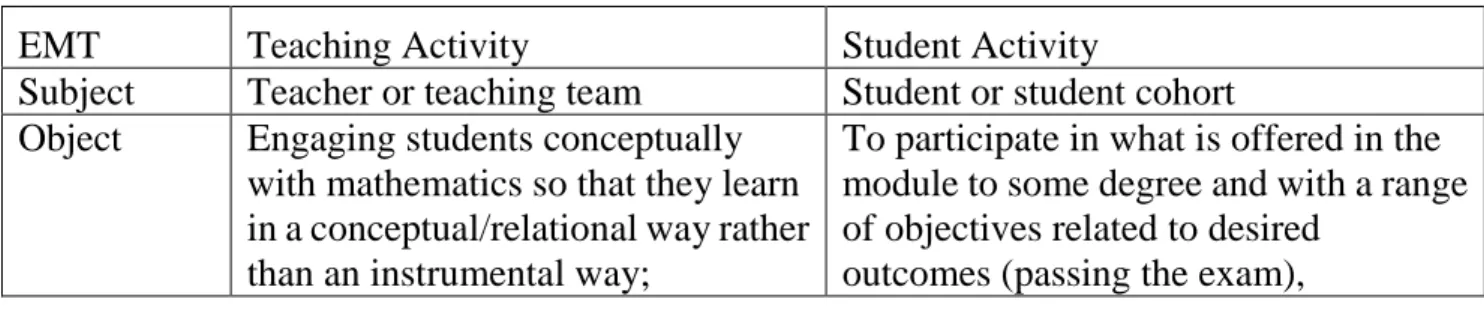
for activity. We start from the triangular representation of Engeström, and use our own tabular form as a more effective way of presenting our data. The central double arrow representing outcomes of activity is of especial interest as we discuss below.
Figure 1: Two versions of Engeström’s expanded mediational triangle (EMT) representing teachers’ (left) and students’ (right) perspectives of the teaching-learning environment as shown in Table 1.
Table 1: Elements of Engeström’s triangle expanded for the two systems
EMT Teaching Activity Student Activity
Subject Teacher or teaching team Student or student cohort Object Engaging students conceptually
with mathematics so that they learn in a conceptual/relational way rather than an instrumental way;
To participate in what is offered in the module to some degree and with a range of objectives related to desired
PME 37 - 2013 1- 3
understand the concepts involved in a way that they can use mathematics flexibly in relation to engineering tasks.
perceptions of what it means to study and learn (practicing past papers, plotting graphs by hand), and the amount of effort they will give. Mediating
artefacts
GeoGebra, inquiry-based questions, small groups, project.
Theoretical concepts underpinning the innovation.
The lecturer, GeoGebra, i-b questions, small groups, project, demands of other modules which inhibit their devoting time to mathematics, other students, social life
Rules Curriculum, assessment, university regulations, norms & expectations. Nature of discipline - what it means to ‘understand’ mathematics. Time allocation, e.g. in lectures, where concepts often have to be rushed.
University programme, curriculum, assessment, university regulations and norms/expectations; expectations of peers, what is needed to be successful (e.g., to pass the exam). Grading system. Community Academic, university and education
communities, the wider world, and the cultures that permeate these communities
Student, academic, and university communities, the wider world, and the various cultures that permeate these communities
Division of labour
There are things that teachers do and that students do, usually different. Teachers have expectations of students’ activities and roles.
There are things that teachers do and that students do, usually different. Students have expectations of teachers’ activities and roles.
This tabular form emphasises some of the differences (such as the objects of activity of each group) but suggests that certain aspects are in common (such as the academic and university community). Important here is that it is not the objective nature of these communities that is in question but the perceptions of them held within the two groups. Teachers’ perceptions of community see relationships within the communities with respect to academic practice, conceptual learning within a discipline, in our case the nature of mathematics, and so on. Students’ perceptions of community see relationships in terms of what is required of them, what they are prepared to contribute, and how they discern their position in relation to official authority in contrast with the demands of their own culture. These differences of perception extend to division of labour and how labour within the two groups is perceived very differently, both in terms of own labour and of labour in the other group. Seen in these terms it is not surprising that outcomes seem quite different in relation to perceptions within the groups, although, in objective terms, measures of achievement have similar value for both groups (i.e. students who get the highest score get the highest grades).
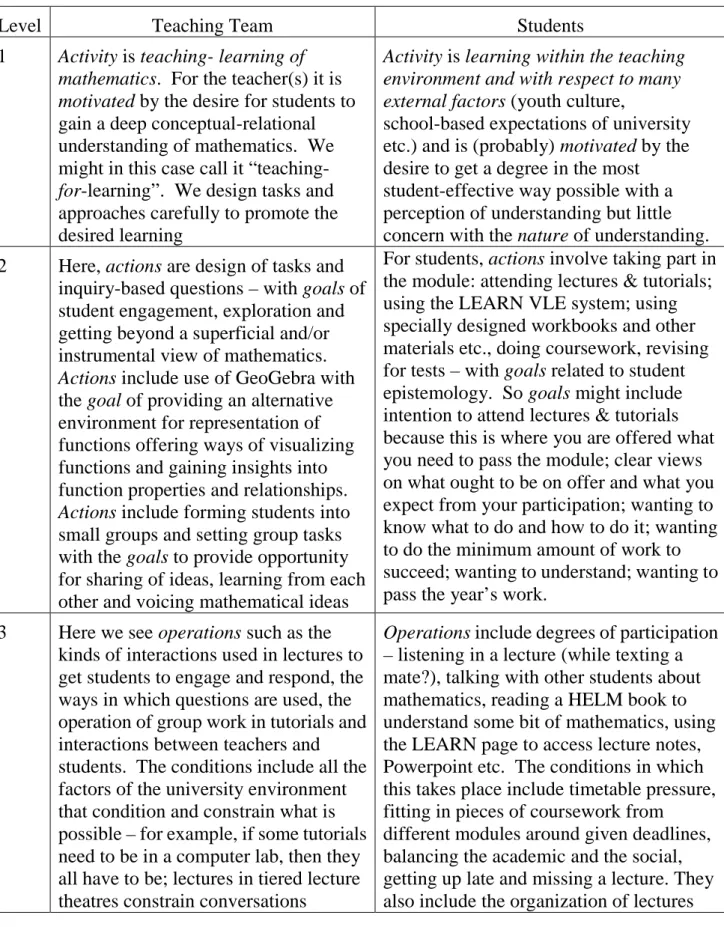
In the second case, in Leont’ev’s three levels, we contrast the activity of teaching with the activity of students’ learning: all activity is necessarily motivated (level 1) and can be seen in terms of actions that are explicitly goal-related (level 2). Actions can be seen to be mediated by certain operations which are conditioned within prevailing circumstances and constraints (level 3). This framework emphasises ways in which
Jaworski, Robinson, Matthew and Croft
1- 4 PME 37- 2013
the nature of activity is actually different for the two constituencies or cultures involved, that of the teachers and that of the students.
Table 2: Leont’ev’s levels of activity expanded for the two systems
Level Teaching Team Students
1 Activity is teaching- learning of
mathematics. For the teacher(s) it is
motivated by the desire for students to
gain a deep conceptual-relational understanding of mathematics. We might in this case call it “teaching-
for-learning”. We design tasks and approaches carefully to promote the desired learning
Activity is learning within the teaching
environment and with respect to many
external factors (youth culture,
school-based expectations of university etc.) and is (probably) motivated by the desire to get a degree in the most student-effective way possible with a perception of understanding but little concern with the nature of understanding. 2 Here, actions are design of tasks and
inquiry-based questions – with goals of student engagement, exploration and getting beyond a superficial and/or instrumental view of mathematics.
Actions include use of GeoGebra with
the goal of providing an alternative environment for representation of functions offering ways of visualizing functions and gaining insights into function properties and relationships.
Actions include forming students into
small groups and setting group tasks with the goals to provide opportunity for sharing of ideas, learning from each other and voicing mathematical ideas
For students, actions involve taking part in the module: attending lectures & tutorials; using the LEARN VLE system; using specially designed workbooks and other materials etc., doing coursework, revising for tests – with goals related to student epistemology. So goals might include intention to attend lectures & tutorials because this is where you are offered what you need to pass the module; clear views on what ought to be on offer and what you expect from your participation; wanting to know what to do and how to do it; wanting to do the minimum amount of work to succeed; wanting to understand; wanting to pass the year’s work.
3 Here we see operations such as the kinds of interactions used in lectures to get students to engage and respond, the ways in which questions are used, the operation of group work in tutorials and interactions between teachers and students. The conditions include all the factors of the university environment that condition and constrain what is possible – for example, if some tutorials need to be in a computer lab, then they all have to be; lectures in tiered lecture theatres constrain conversations
Operations include degrees of participation
– listening in a lecture (while texting a mate?), talking with other students about mathematics, reading a HELM book to understand some bit of mathematics, using the LEARN page to access lecture notes, Powerpoint etc. The conditions in which this takes place include timetable pressure, fitting in pieces of coursework from
different modules around given deadlines, balancing the academic and the social, getting up late and missing a lecture. They also include the organization of lectures
PME 37 - 2013 1- 5
between lecturer and students when tasks are set, limitations on time constrain what can be included.
and tutorials and participating within modes of activity which do not fit with your own images of what should be on offer.
The above juxtapositioning adds strength to our hypothesis that we have two different activity systems here within (apparently) the same environment with common elements. However, in most cases the common elements are perceived/experienced differently. Perhaps the most important difference is the object of activity (Engeström) or the motivating force (Leont’ev) for the two systems. Both are valid, but the fact that they are different means that along with other factors – values placed on forms of understanding (the rules of the enterprise) or whether GeoGebra is positively helpful in promoting learning (mediating artefacts) – they result in the tensions observed.
What is the value of seeing the whole in these terms? What implications do we find? Having expressed our intention to work within a sociocultural frame, taking account of context and culture is fundamental. Here “we” are both the teaching team and the research team. As researchers we employ theory to synthesise from our findings. As teachers we seek to know more about how we can achieve our teaching-learning goals. Continuing teaching approaches as things stand is likely to perpetuate the position characterised above. Changing cultures (mathematical culture, student culture …), and some aspects of context (allocation of time to lectures, use of laboratories …), is difficult or impossible. Working within culture and context focuses attention on the local situations in which teaching and learning take place since this is where change is more possible. The innovation itself was itself such a change (quite a dramatic one!). In conceptualising new approaches, in making such changes we have to keep coming back to the global perspectives revealed through the analysis above. We shall be reporting further from our ongoing questioning about how to develop students mathematical meaning making within the complexity we have revealed.
References
Engeström, Y. (1999). Activity theory and individual and social transformation. In Y. Engeström, R. Miettinen & R-L Punamäki (Eds.), Perspectives on activity theory (pp. 19-38). Cambridge: Cambridge University Press.
Jaworski, B. & Matthews, J. (2011) Developing teaching of mathematics to first year engineering students. Teaching Mathematics and its Applications30(4): 178-185
Jaworski, B., Robinson, C., Matthews, J. & Croft, A. C. (2012). Issues in teaching mathematics to engineering students to promote conceptual understanding: a study of the use of GeoGebra and inquiry-based tasks. The International Journal for Technology in
Mathematics Education, Vol. 19, No 4, 147-152.
Leont’ev, A. N. (1979). The problem of activity in psychology. In J. V. Wertsch (Ed.), The
Jaworski, Robinson, Matthew and Croft
1- 6 PME 37- 2013
Here is an abstract in case you need it (Fabrice said not)
A study of the design and implementation of an innovative mathematics teaching approach and students’ responses to that approach revealed differences in perspective from those designing teaching (the teaching/research team) and those experiencing the teaching (the students).Two frameworks from activity theory were used to juxtapose these perspectives and to gain insight into whole sociocultural settings within which teaching and learning were constituted.
i The ESUM Project – Engineering Students Understanding Mathematics, Jaworski & Matthews, 2011. Funded by the HE
STEM Programme through the Royal Academy of Engineering – For two Case Studies from the project see
http://www.hestem.ac.uk/resources/case-studies/engineering-students-understanding-mathematics-1 and