Learning to Be a Postgraduate Tutor in a Mathematics
Support Centre
Michael Grove1 &Tony Croft2
Published online: 20 May 2019
#The Author(s) 2019 Abstract
The study reported here investigates the role, experiences and aspirations of a commu-nity of mathematics postgraduates as they learn to tutor in a mathematics support centre in a research-intensive university. This is achieved through in-depth interviews with nine postgraduate tutors all of whom had experience working in the centre. The data is analysed through the lens of communities of practice and presented through the voices of the postgraduates themselves. It sheds light on their personal trajectories as‘ new-comers’to the peculiarities of tutoring within a mathematics support centre, and the ways in which they learn from, support and cooperate with each other in their common endeavour. As the postgraduates progress through their three or four years working in the centre the data reveals a growing confidence and, for some, a strong willingness to nurture and encourage their younger colleagues. Some of the‘old timers’go on to assist in the recruitment of new tutors and demonstrate insights into the ways their experience as tutors in the support centre will inform and influence their own future careers as academics. In particular, our work highlights the ways in which tutoring in the centre contributes to their own mathematical learning and personal development. The work is driven by a need to better understand the practices of postgraduate tutors in the growing field of university mathematics support and a desire to improve these. We consider how what we have learned can be put to use both in mathematics support centres and in university mathematics education more generally. By doing so we contribute to the solution of a widely reported‘mathematics problem’in higher education. At the same time this work strengthens what has been described as a‘fragile’relationship between mathematicians and educational researchers, bridging the gap between theoretical understanding and practice in a research-intensive university mathematics department.
Keywords Mathematics support . Postgraduate tutors . Community of practice
* Michael Grove [email protected]
1
School of Mathematics, University of Birmingham, Birmingham B15 2TT, UK
Introduction and Background
University level mathematics support has been defined by Lawson, Croft and Halpin (2003, p9) asBa facility offered to students (not necessarily of mathematics) which is in addition to their regular programme of teaching, lectures, tutorials, seminars, problems classes, personal tutorials, etc.^. The most common model that is used is a‘drop-in’ centre which offers one-to-one support to students who drop-in at a time of their choosing. The establishment of such centres represents one way in which many UK universities have responded to the challenges mathematics educators face at the school/ university transition. This so-called‘mathematics problem’can be summarised as the under-preparedness of new undergraduates (primarily in non-mathematical sciences disciplines) for the mathematical and/or statistical demands of their degree programme (Hawkes and Savage2000). These challenges have been articulated in the UK’s Post-14 Mathematics Inquiry’s conclusion thatBhigher education has little option but to accommodate to the students emerging from the current GCE (General Certificate of Education, i.e. pre-university schooling) process^(Smith2004, p95). More widely, in both Ireland (O’Sullivan et al. 2014) and Australia (MacGillivray and Wilson2008) mathematics support centres are also a recognized means of responding to difficulties in learning mathematics encountered by students when starting their university studies.
The case for mathematics support centres has already been made extensively (e.g. Tolley and Mackenzie2015). While their greatest benefit is the availability of focused one-to-one support as an immediate response to specific problems, student users also comment on the importance of the atmosphere and learning environ-ment, an increase in student control and lack of time pressure, and the informality and psychological security of centres (Lawson et al.2001). Solomon et al. (2010) describe their role in the encouragement of undergraduate learning communities, particularly for mathematics specialists in the later years of a degree, and Solomon and Croft (2016) in engendering positive attitudes to university study of mathe-matics and overcoming widely-reported alienation from the subject even amongst those who choose to study it at university.
Within many mathematics support centres postgraduates working as tutors are at the frontline in providing support to undergraduates with their learning of mathematics. Their role consists of working with students, typically on a one-to-one basis, to try and understand their mathematical problems and then offering advice, guidance, motivation and support to help the student successfully work through these issues. While the impact of mathematics support upon institutions, and the students themselves, is becoming increasingly understood (Grove et al.2019a; O’Sullivan et al.2014), there has been little work to date exploring the lived experiences of those individuals who provide this support although some have commented upon the role of the postgraduate tutor in this process (e.g. Foster2005).
Our goal here is to investigate postgraduate tutors’ perceptions of their role in a mathematics support centre and report on ways that they say they have developed and learned through the experience. We want to understand their day-to-day experiences in the centre and how they react to contingencies that arise. We set out to explore the extent to which these tutors share a common purpose and support each other in their endeavours. In the research reported here, data from the perspective of the postgraduate tutors, collected through nine in-depth interviews, is used to explore the nature of their
working in mathematics support and the crucial role of the community of which they are part. We aim to achieve this goal through an analysis that draws upon the theoretical perspectives of communities of practice.
The authors have been at the forefront of establishing mathematics support centres throughout the UK and of developing and delivering training for those who work in them (Croft and Grove2016). They have been instrumental in the design of higher education policy in respect of mathematics support centres (e.g. Mackenzie et al.2016). The research reported in this paper combines a drive for understanding the community of postgraduate mathematics support tutors - framed using existing theoretical under-standing of communities of practice - with a desire to improve the practice of those involved. This work can be regarded as‘use-inspired basic research’, located in the so-called Pasteur quadrant (Stokes1997) and as bridging the gap between rigorous theory and practice-based evidence. As such it makes a significant contribution to strength-ening of what Nardi and Iannone (2004, p401) refer to as Bthe fragile, yet crucial relationship between mathematicians and researchers in mathematics education^.
We consider how this understanding can be put to use both in mathematics support centres and in university mathematics education more generally and by doing so contribute to the solution of the previously noted and widely reported‘mathematics problem’in higher education.
Context of the Study
The research took place in a research-intensive English university. The University has a drop-in mathematics support centre, established in 2012, and based in the University Library. As is common practice the centre is equipped with student workspace, whiteboards and access to computing facilities. It opens for six hours daily during term time and students from any discipline and at any level of study can drop in to ask for specific help with mathematical or statistical problems arising in any of their courses. While the University Library manages the centre (within a wider student study skills support operation) academic oversight (in-cluding the recruitment and training of tutors, responding to tutor queries and concerns, ongoing liaison with the tutors, and the monitoring of the quality of the support) is provided by the University’s School of Mathematics by a named member of the academic staff, herein referred to as the ‘centre manager’. A particular characteristic of the centre, and one that distinguishes it from many university support centres, is that its tutors are exclusively recruited from the School’s large (approximately 60 in 2017/2018) postgraduate population. Tutors always work in pairs for typically three hours at a time and receive hourly payment. These tutors are drawn from all three or four years of their postgraduate lifetimes, with first years being relatively new to tutoring, and others having worked in the centre for between two and four years. Within the School, approx-imately 55% of postgraduates undertake their research in pure mathematics and 35% research in applied topics; the remainder work in management mathematics and statistics. As we shall see, this split is not reflected in the proportions of each group that work as tutors and the interviews will reveal how this situation is mitigated. There is a strong gender bias amongst the School’s postgraduate
population (approximately 80% are male) and this is reflected in the number of male/female tutors who work in the centre.
All new postgraduates involved in teaching within the School receive a com-pulsory mathematics-specific one-day training session as described in Grove et al. (2006). While broader than the training model described in Croft and Grove (2016), which is widely used for those working in mathematics support, it contains elements highly relevant to working in a support centre, for example presenting and communicating mathematics and problem solving. A briefing is arranged with those postgraduates who express a desire to work in the centre to discuss what the work involves, common issues and challenges and strategies for providing support. This meeting includes representation from tutors with signifi-cant experience so that this can be shared and questions answered. Following this meeting, new tutors are scheduled trial (but still paid) sessions alongside a more experienced tutor. After this, feedback is sought from both tutors, and as appro-priate, an informal debrief held. If the sessions have progressed well, and all parties are happy, the new tutor is added to the termly centre rota.
When the centre described here opened in 2012, it did so with the aim of providing students with an additional source of support to aid their learning of the mathematical components of their programmes of study. Whilst accessible to all learners within the University, it was particularly targeted at foundation and first-year undergraduates and at students from other year groups identified as having particular difficulties with introductory mathematical and statistical techniques. In its first year of operation, it received a total of 482 visits, of which 85% were from students on programmes that would be classified as science, technology, engineering and mathematics, and the remainder by students studying other programmes such as economics, business, geog-raphy and sports science. By 2015/16 the total number of visits increased to 793. For the start of the 2016/17 academic year, the centre moved to a purpose-built location within the new main University Library which was in a much more prominent location. As a result, in 2016/17, total visits increased to 980.
A particular characteristic of this centre, and one which is highly relevant to the work herein, is the students who make use of it. Beneath these headline figures it is interesting to note that as a percentage of overall visits, the number made by students from the School of Mathematics increased from 34% (163 visits) in 2012/13 to 80% (786 visits) in 2016/17. It is very much the case now that the majority of users of the centre are specialist, that is single or joint honours, mathematics students. Further, and unlike many other centres, the majority of student users are in fact second and third year mathematicians: considering 2016/ 17 alone of the 786 visits made to the centre by mathematics students, 39% were in the second year of their studies, and 41% were in their third year. As such the centre described here is, importantly, not one which works primarily with non-specialist students at the transition into university which is the case often reported. While we do not discuss here the impact of the centre upon the students who choose to make use of it, its impact upon specialist mathematics students has recently been explored elsewhere (Grove et al. 2019b). The findings from this work show that students value the centre because of the convenient availability of support, its personalised nature with friendly tutors of a similar-age and subject profile, and the opportunity to use the centre as a group study space to work with friends.
Theoretical Foundation and Research Questions
For the analysis of how the postgraduates learn and develop, their participation as mathematics support centre tutors and their personal trajectories through this role we draw upon the theoretical perspective ofcommunities of practice.This term was first used by Lave and Wenger (1991) to describe learning through practice and participa-tion, emphasising the importance they attached to learning in a social setting (situated learning) in contrast to that of traditional learning theories. They go on to define a community of practice as a group of individuals who come together to share common interests and goals, with the aim of sharing information, developing knowledge and developing themselves both personally and professionally. Lave and Wenger (1991) also introduce the concept oflegitimate peripheral participationto describe the way
‘newcomers’to a community become drawn into a practice, develop and eventually (some) become‘old-timers’. Wenger, McDermott and Snyder (2002, p4) later defined a community of practice to beBgroups of people who share a concern, a set of problems, or a passion about a topic, and who deepen their knowledge and expertise in this area by interacting on an ongoing basis^. In their paper expressly studying specific practices within a university, and especially those that concern the teaching and learning of mathematics, Biza, Jaworski and Hemmi (2014, p162) define a community to beBa group of individuals identifiable by who they are in terms of how they relate to each other, their common activities and ways of thinking, and their beliefs and values^. Lave and Wenger (1991) suggest that the process of learning should offer individual learners opportunities to participate in the practices of a community whereby individual identity is engendered through a sense of belonging and commitment to the community. We shall see that using the framework offered by this theory enables us to examine systematically the community we are researching.
We now briefly describe relevant aspects of the elements of the theory. In Wenger’s social theory of learning (Wenger1998, p5) four components are identified:meaning,
practice, communityand identity. Meaning,or learning as experience, refers to the ways in which members of a community understand and talk about the environment in which they work, the activities in which they participate and their abilities to undertake the tasks necessary. As Wenger (1998, p53) notes, the making of meaning requires negotiation – Bcontinuous interaction, gradual achievement, give-and take^. Thus meaning can be changed through experience and negotiation.Practice, or learning as doing,refers to the perspectives members of the community adopt and resources they draw upon in their practice, on a day-to-day basis, which help to maintain their engagement in pursuit of the enterprise they are undertaking. The component commu-nity, orlearning as belonging,represents the ways in which members talk about and draw upon the community, its structure and the way it functions.Identity,orlearning as becoming,is concerned with the ways in which the learning that takes place impacts on and can change the members themselves.
Wenger (1998, p73) defines practice through three dimensions of:mutual engage-ment–ways of working, how this work can be done differently or better through observing and interacting with others, social relationships; joint enterprise – the negotiation that takes place to develop common understandings of what the enterprise is about, discussions of accountability, responses to local contingencies; andshared repertoire - resources through which meaning is negotiated, routines, words,
discourses, tools, actions and Bconcepts which the community has produced or adopted in the course of its existence^. Wenger (1998, p55) refers to two further concepts of relevance here:participationandreification. Participation refers to living or being within the community and taking part in its activities, interacting and negotiating and more. But it goes beyond simple engagement: as Wenger notes, participation is not something that is turned off once the specific context of engage-ment ends. Its effects will permeate other areas of the members’lives and as such is a constituent of their identity and will help shape it. Reification refers to the representation of some abstract concept by something more material and concrete and plays an important role in the negotiation of meaning. Wenger (1998, p. 58) states,
BWe project our meanings onto the world and then we perceive them as existing in the world, as having a reality of their own^. So, for example, being an ‘effective’ community member is a rather abstract notion that might be reified by projecting the meaning of‘effective’onto more tangible attributes such as the skills a member has and the uses to which they are put. Given time and usage such a reification can start to take on a life of its own and contribute to the shared repertoire. Participation and reification are viewed by Wenger as being intimately connected because reification is crucial to the negotiation that is necessary for participation.
Communities of Practice theory has previously been used to explore learning in both formal settings such as schools and informal settings such as apprenticeships and playgrounds. Biza, Jaworski and Hemmi (2014, p161) have discussed extensively the theoretical foundations of communities of practice in university mathematics and describe learning asBa process of participation and reification in a community in which individuals belong and form their identity through engagement, imagination and alignment^. Again in the university mathematics context, and specifically in respect of students working as partners in the teaching and learning process, Duah (2017) has used the theory to analyse both academic internships and peer-assisted learning highlighting the contribution that students themselves can make in improving the experience of mathematics undergraduates.
We now turn to the research which is the focus of this paper. The postgraduates who work in the centre are engaged in activities which go beyond that found in their usual university practice. Traditionally, in addition to their day-to-day research work, math-ematics postgraduates undertake problem classes for specific taught undergraduate modules, where the course leader, a university lecturer or professor, will provide problem sheets for the undergraduates to work through, together with solutions for the use of the postgraduates. They may also undertake marking of assessed coursework and computer laboratory supervision. On the other hand, and crucially, when these postgraduates work in the support centre, the nature of the work is quite different in several important ways. Firstly, they have no prior knowledge of a student who walks into the centre seeking help. The student could be studying in almost any discipline (for example bioscience, economics, engineering, in which case such a student may not have studied mathematics beyond GCSE, i.e. beyond the age of 16) including math-ematics. They could be from a foundation year, with or without an A-level in mathe-matics, a final year project student or a postgraduate masters or research student, and anything in between. This makes finding the appropriate level to pitch a response particularly challenging for the tutor. Secondly, they have no prior knowledge of the question they are likely to be asked. They must quickly learn to think on their feet and
be willing to explore and research possible solutions in partnership with the student. For these reasons it is difficult to prepare for sessions - a marked distinction from the module problems class which is highly focussed and for which lecturers’resources are available in advance. On the other hand, to counter these two differences, the flexibility of drop-in centre work can often permit a tutor to spend longer time with a student on a one-to-one basis, to work together on a particular problem and to come jointly to a solution. Moreover, there is also the possibility of either referring to or working with the partner tutor on duty in the centre at the same time, or the wider mathematics postgraduate community as we shall see.
Thus postgraduates mustlearnto become mathematics support tutors. They do not do this in isolation. With just one day of formal training, their substantive learning is truly situated and takes place in the context of their participation in the life of the support centre. As the data will show, there is a strong network of other tutors upon which they draw and to which they contribute. We see this learning as taking place in the social context of their interactions with students, their postgraduate partner tutor in the centre, the wider group of postgraduate tutors and the academic lead in the School. We are interested in how the tutors make meaning of their role and in the negotiation required–for example, interactions, discussions, tensions, disagreements - to achieve this. We are interested to learn about the extent of collaboration between tutors– for example, the advice and support they offer each other - and between tutors and students who use the centre. To accomplish our overarching goal of understanding the role played by the tutors who work in the mathematics support centre and how they learn and develop through this experience we asked two research questions:
a) What is the role and extent of negotiation and collaboration in postgraduates
learningto become mathematics support centre tutors?
b) What is the nature of this negotiation and collaboration and what is its impact on individuals and on their self-reported practice?
In this paper, we aim to respond to these through an analysis that draws upon the theoretical perspectives of communities of practice outlined above. Whilst the research questions arise pragmatically from a need to better understand the ways in which tutors work, the chosen theoretical perspective influences the data collected, how it is collected and how it is analyzed. There is a reflexive process between the research questions and the theoretical perspective which influences how we address the inter-view questions and how we interact with the participants. It follows that semi-structured interviews were an appropriate means of data collection. Further details are given in the following section.
Methodology
For the semi-structured interviews, pre-prepared questions, which had been provided to the participants in advance of the interviews, covered five key themes: the mathemat-ical background of the tutor, their ambitions and motivation for working in the centre; what the tutors know and think about mathematics support; the practices tutors adopt whilst working in the centre, the ethos of that work; tutors’ views concerning
postgraduates working in the centre; and, the skills and qualities tutors think they have been able, or hope, to develop through this work. Illustrative interview questions are provided in Appendix1.
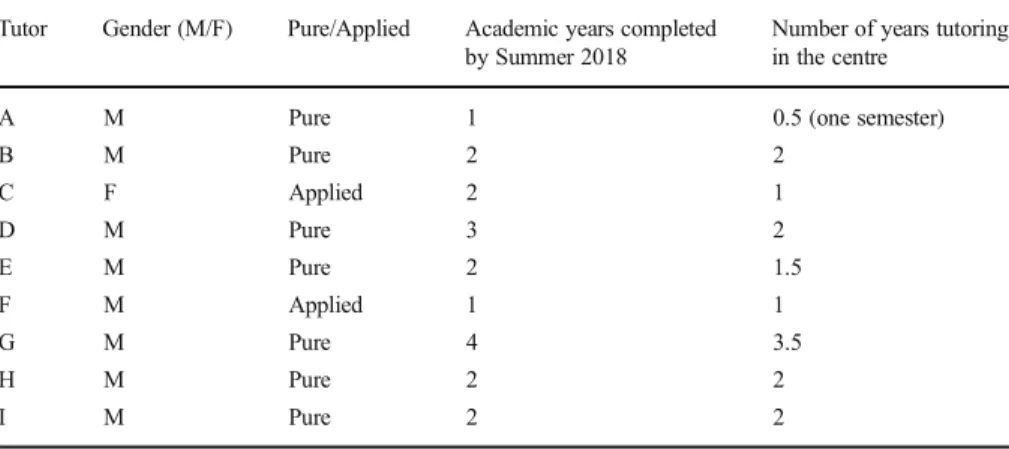
Whilst these questions gave focus to the interviews, the interviewer worked with prompts and sub-questions to follow up participant’s responses. They were encouraged to speak freely about any aspect of this work they thought pertinent. In the spring of 2018, of the postgraduate population eligible to undertake teaching duties within the School, 21 were working, or had worked previously, in the mathematics support centre. All 21 were invited by email to participate in this research via interview; nine responded with a willingness to do so. Whilst we acknowledge that this is a self-selecting sample they are nevertheless representative of the tutor population as a whole. Table1 provides biographical information on the nine participants, outlines the splits between pure and applied mathematicians and genders, and the lengths of their experiences as tutors in the centre. We interviewed the nine postgraduates over two days towards the end of the academic year in July 2018. The individual interviews were conducted by one of the authors who had no involvement with the postgraduates either in their work in the support centre or more generally in the School; nevertheless he had extensive experience of working in a support centre and therefore was aware of the issues that can confront a tutor. Each interview lasted approximately 45 min. The interviews were audio recorded and then transcribed.
Ethical approval was granted by the University. Appropriate ethical guidelines (BERA 2011) were followed. A description of the research was made available in advance, and at interview, all participants signed informed consent forms detailing how the collected data would be used.
The data thus gathered provided rich and complex narratives for each of the nine postgraduates. We chose to proceed thematically (Braun and Clarke 2006) and by following the coding process described by Creswell (2008). Thus, the analysis began with reading and re-reading the transcripts, and listening to the audio recordings to allow us to become familiar with the depth and breadth of the content and begin organizing the data. As noted above the interviews were conducted by one of the authors who also produced the transcripts, a key factor
Table 1 Data on the nine postgraduate tutors who were interviewed Tutor Gender (M/F) Pure/Applied Academic years completed
by Summer 2018
Number of years tutoring in the centre
A M Pure 1 0.5 (one semester)
B M Pure 2 2 C F Applied 2 1 D M Pure 3 2 E M Pure 2 1.5 F M Applied 1 1 G M Pure 4 3.5 H M Pure 2 2 I M Pure 2 2
which helped in this familiarisation and data immersion process and enabled insights to emerge. In-depth discussions of the data and its classification were undertaken throughout the analysis with the second author which formed an important check of validity (Creswell and Miller 2000). The following broad categories for data classification had been predetermined having been generated from Wenger’s components and dimensions of communities of practice and the concepts of participation and reification:
& Components of learning: meaning, practice, community, identity;
& Dimensions: mutual engagement, joint enterprise, shared repertoire;
& Participation;
& Reification.
Then, working systematically, each transcript was read again, this time assigning the above categories to segments of text. Due to the small size of the data set, this process was performed without the use of software. So, for example, when Tutor H, describing the difference between tutoring in a module problem class and in the support centre stated BIn the support centre you can get asked about absolutely
anything. So you don’t have preparation - you have to improvise as you go along^
this was categorised under‘practice - learning as doing’. When asked how they might help a student when they did not have the required knowledge they stated
Bwhat I usually do is direct them to some other postgraduate in the support centre^and this segment was assigned‘joint enterprise’. As relevant text segments were being categorised descriptive codes were generated Bin vivo^ (King 2008). For example, when Tutor A statedBI would basically guide them in this process of let’s do things bit by bit.^ this was assigned the code‘scaffolding’.
Repeated consideration of these categories and codes enabled us to draw together interesting commonalities and differences amongst the participants, particularly in respect of how they were learning and developing in their role and the importance of interactions. We choose, following Wenger (1998), to report our findings using the four components, learning as: experience, practice, belonging and becoming, presented from the perspectives of, and through the voices of, the tutors.
Analysis
Learning as Experience
To establish a background to their role, postgraduate tutors were asked about their knowledge of the purpose of a mathematics support centre and what they understood to be their role within it. They demonstrated considerable empathy and an understanding of the many reasons why students might access mathematics support and in particular that it may be more accessible to students than other forms of assistance. Some tutors reflected on their own experiences as undergraduates and recalled the difficulties they faced. They are aware that students can find both mathematics and mathematics academics intimidating and that they, as postgraduates might be less-so. Their views reinforce the findings of Solomon et al. (2010) who describe support centres as
‘physical safe spaces’. Convenience and informality of the learning environment also come to the fore, as noted by Lawson et al. (2001).
Tutor B: …you have...people for a whole range of reasons. People don't like
knocking on professors' doors, it's much more approachable to go to young people your own age and get help; relaxed, readily available - the way it's there all day, if you're struggling it's something you can go in anytime.
Tutor G:Well one of the big issues with maths is that…it's a scary world, a lot of
people very often in the university will struggle because of curriculum issues, from being from another country, or not having done modules, or just because they find it hard…like when I was an undergraduate it was always very, a bit harder to go and talk to a lecturer about problems whereas postgraduates are more approachable in that sense.
Tutors were asked about their motivation for becoming involved in the work of the centre. Several, expectedly, referred to the remuneration which was clearly welcome. However, many went on to describe the intellectual challenges both mathematically and pedagogically that they expected to face, how they liked teaching, and the skills that they intended to develop. They recognised in this work the opportunity not only to acquire and advance their pedagogical expertise, but also to hone and expand their own mathematical skills:
Tutor I:I quite like trying to teach things, at least at an undergraduate level because the problems aren't trivial normally...you have to have a think about them. So to come up with a way of doing it yourself is great and also trying to work with the students and make them understand what is going on.
In terms of Wenger’s component of identity and learning as becoming, (see later section5.4) they saw this work as providing an opportunity for them to broaden what they do professionally, and to learn how to adapt their teaching styles to accommodate a broad range of learners:
Tutor D:…a skill that I always wanted to get better at is, it's not quite public
speaking, but more to deal with people in a professional environment, to be able to adapt my teaching style to different people who might learn in different ways.
They also referred specifically to the skills that they hoped to be able to develop through working in the centre. These included being able to respond to unforeseen and unfamiliar problems, and to devise alternative methods of solution or explanations tailored to individual’s needs:
Tutor D: It’s quite a good challenge because anyone can walk through those doors; you can't prepare for everything obviously, but you have to be prepared to try and tackle anything and that's a good skill to have. Something that I found really useful is when you try and help someone and they say `I don't understand your explanation’and you have to go right back to the drawing board. You've got to think of another way of getting to the same answer.
Tutors were well aware that they would need to work with students from a variety of discipline areas. In fact, the opportunity to work with students from disciplines other than mathematics was a draw for some of the tutors, particularly in how they would learn to transfer their mathematical knowledge into new and unfamiliar domains:
Tutor F: …it's a different kind of experience that you get from doing normal
teaching because that's just mathematicians; so I'll have people from, you know, from chemistry, geography, physics from different backgrounds asking for differ-ent maths help and you have to translate how you interpret maths to someone with a different background. It helps maybe train me in a way that just doing normal teaching…wouldn't allow.
Learning as Doing (Practice)
In this section we consider the descriptions the tutors provide of their practices whilst working with students, the resources upon which they draw to support this practice, and how, through experience gained, they learn to evolve their practice.
Working with Students
To learn to work in the support centre tutors must be able and willing to think on their feet. There are important differences in approach depending upon whether the tutor is familiar or unfamiliar with the mathematics with which they are presented, and as a consequence, the extent to which they seek help from or offer help to other members of their community.
When the topic is familiar the tutors are able to offer scaffolding (a range of teaching techniques and explanations used progressively to move students toward greater understanding) and make up their own examples as they are working with the student. The following illustrative quotes demonstrate that some tutors possess good levels of pedagogical maturity: working to and fro with students to gauge their level of under-standing and knowledge. They have the confidence to probe rather than‘tell’. They recognise the importance of drawing out solutions from the students themselves. They are willing to challenge. Consider, for example, Tutor B:
Tutor B:I will try and gauge where they're at. I ask them questions, you probe them a little. If it's part D you ask them how they did in Part C. You ask them...you never just show them the answer. You're constantly asking them questions and almost make them answer it themselves…I guess you learn through time that if you show someone the solution they don't understand it as well than if you make them come up with the solution themselves, and you can pick up on it - you can feel the penny drop...
Tutor B, explicitly referring here to him learning through time the importance of engaging the students actively, reflects a deepening insight and the development of a
Tutor H:So, I do remember, this past year there was a student who would come asking for help with the graph theory module and they were all problems that I could easily solve. What I would do is I would force her to do it. I would give them a pen for them to go to the white board and for them to write down everything that the statement says.
Tutor H, went on to offer a strategy for problem solving but insisted that the student took ownership:
Tutor H:…because very often there is a lot of information in the statement and people become confused and do not know what to do with all of the information. What you need to do is write[down]the information and then try to combine the bits one by one to reach the conclusion that you want. So I make them go to the white board and write everything down. And you could do just small pieces and then just put them altogether to get the result. I would basically guide them in this process of let's do things bit by bit. Looking to this - just this - I know you can solve that - they solved it.
The importance of probing in unearthing student’s difficulties is evident in this quote from Tutor G:
Tutor G: Do you understand what the statement says? An issue with this approach is that often they will say yes, and then when you ask them what does that word mean, they say no...And something I have found out is that very often just by clarifying this word, at some point the student will say, oh can we try something like this. They may be right or not, but very often just at least that discussion is already a help.
Sometimes however, this familiarity with the mathematical topic can lead to ways of working which are short-lived and need to be modified. This tutor described how, by drawing upon his own knowledge, understanding and approach to tack-ling a particular problem, which differed from that taught to the student, he caused more confusion. In recognising this he learned to adapt his teaching accordingly:
Tutor G:And if I know about the topic - I may know about the topic but from a different angle, or I may have learned it differently, so very often I always try to follow their lecture notes because at first I tried to do it the other way and sometimes I confused people...[we needed to use]some fairly advanced results that I find almost trivial, or I am so used to them that I use them without thinking and I could be using something from later in the course to…presume something...
Adaption to individual students’ needs was evident. The following excerpt describes how Tutor D became aware that the abstract nature of a particular topic in linear algebra was causing difficulties for a student who he thought might benefit from a more concrete approach, and how he modified his own approach accordingly. He was able to reify abstract notions as they had been taught by the lecturer, referring to the more familiar and concrete cases of two
and three dimensions, and through analogy believed that this provided the insight required to help the student:
Tutor D:...there was one student[struggling with] these notions of dimension, basis; so one way of doing that is to go very abstract, to go from the definitions, and after this explanation it was quite clear that the student was not getting this so I went back to the basics, back to the example of Euclidean space, you have these standard basis vectors, so in two dimensions you get the square and in three dimensions you get the cube etc...and explaining everything through analogy with that.
Tutor D went on to explain his strategy of explaining an abstract concept to this student not through a definition, which is the usual approach adopted in advanced pure mathematics courses, but by starting from an example and using that as a way into understanding the formal definition. As he said:Band supplementing with the
defini-tions rather than going straight from the definidefini-tions, helped that student.^
The foregoing excerpts are typical of the approach adopted when the tutor was familiar with the mathematics. However, on many occasions students, particularly from disciplines other than mathematics, or those studying advanced mathematics degree modules, ask for help with material which is completely beyond the experience and expertise of the tutor. The interviewees were asked about their strategies for dealing with such situations. The response depended upon whether a second tutor with the requisite knowledge was available at the time or not. The following demonstrate the extent to which the tutors value and draw upon the support of their peers in the community:
Tutor A:…the ideal situation is because you are working in the support centre with two people, I have been fortunate enough to have - most of the time - the other person with me is someone who either was at [this University] before and took the course or someone who is working in that field of research.
Tutor C:…my pure maths is fairly poor. Just because I did an applied masters.
So basically I could do second year fairly comfortably but if a third year came in, rather than me spend hours trying to read around it, you know I'd be better off sending them to another postgraduate.
But what happens when neither of the available tutors is a specialist? Neither knows how to solve the problem. It is evident that at this stage some tutors see the task as a joint enterprise and work together to try to come to a solution which will assist the student:
Tutor B:But it's when someone comes in with something that neither tutor is a specialist in - someone comes in with a partial differential equation or something, and it's me and a statistician or something - then we'll kind of bandy our strengths together and see what we...not always, but it does happen sometimes and I think that's a good thing too. Strength in numbers, and support each other as well...
Tutor H offers an interesting problem-solving perspective in what follows, demonstrating the value of two tutors approaching a problem in different ways,
one the ‘brute-force’ approach and the other bringing insight and elegance to the process:
Tutor H:…if it's something that neither of us have expertise on we usually try
and work together. I can think of some instances with - I think second year analysis - when you have to consider integrals in higher dimension which again is something I haven't looked at in many years. Very often there are some symmetries in these problems so while one person focuses on what the theoretical brute force solution would be, the other person can think about how we can simplify the problem by getting rid of this half and just multiplying by two, and things like that.
But what happens when the second tutor is already occupied helping someone else? When asked about how they deal with advanced, unfamiliar material, and when they have no immediate postgraduate peer help to call upon, they demonstrate a keen willingness to workwiththe student to learn together. They were also well aware of how their‘ignorance’can be turned into learning opportunities for the student often resulting in the student solving the problem for themselves and coming to a greater understanding (for both parties) through the negotiation that was taking place:
Tutor A:…they'll have to explain the problem to me…either I will understand it
and be able to assist them, or the process of them speaking it out loud to me is sometimes enough to motivate them to have the thought that solves the problem.
Thus dialogue and negotiation of meaning are crucial elements through which both tutors and students are learning in the support centre. In the following excerpt Tutor A asked the student to illustrate a problem using a diagram and this was sufficient for the student to come to a solution themselves:
Tutor A:I think the thing I can remember is random walks in combinatorics…they
couldn't understand this and I was like - well explain it to me - and they were trying to use words and I was like why don't you draw me a picture of what this random walk could look like; and they drew the picture, and they went...that this could happen, and then as they were drawing the picture they were like well that can't happen, and you ask a simple question, why can't that happen and they say it can't happen because we have this property and you say well turn it into a solution...
Enabling students to see that the tutors do not know all the answers but even then that they can demonstrate problem solving strategies is evidently one of the benefits of learning in a support centre environment - and one which is not normally apparent in a lecture or problem class.
Tutor B:People have come in with their undergraduate thesis and all kinds of stuff where they have papers, maybe something I am not familiar with…we just kind of sit down together, read through it. I do the best I can.
Tutor B:I think that helps them a lot as well. I think when they see the process of the instructor figuring it out, walking them through it, I mean it's not staged or anything, it's the genuine thing of this person beside them trying to figure it out just the way they've been trying to figure it out.
The idea that the tutor too struggles and that it is important for students to see this was evident in several interviews as Tutor H’s quote illustrates:
Tutor H: I do remember a problem about optimisation which also required tools from linear algebra…I think the module was a third year module, but the linear algebra tools were first year tools. I did spend about 20 minutes only to understand the notation and the problem. Once I understood everything I just realised, ok this is first year linear algebra, I can solve this. They were sitting with me and they saw that I was struggling and they were trying to explain to me the notation too, which is good.
Tutors were able to be quite specific about mathematical areas where learning collaboratively was crucial for progress. Here, Tutor F refers to reading lecture notes together, highlighting important parts and making suggestions which lead to success:
Tutor F: So this module called continuum mechanics that the third years do in the first term. That's quite abstract stuff so you need to know the lecture notes - it's different from a lot of other courses - I didn't have any experience with…I didn't know the material.So there was one question where you were trying to convert one form of a partial differential equation into another using manipulations you learn in class. So we just kept on looking at this example and I said, oh they've done that in this example, have you done this, and this time it was no, so I said try that - I just sat by him while he was working it through it...that worked.
Even when the solution of a problem defeats both the tutor and the student some tutors believe that there are learning opportunities for both parties. In what follows Tutor D, even though he could not solve the problem in-hand, talked through his strategies, explaining his thought processes, and importantly, what he was doing and why. This dialogue is invaluable for the student and is an excellent demonstration of the perseverance that undergraduate mathematicians need to develop:
Tutor D:Yes - we were doing all these crazy things...in terms of results it was a wasted half hour because they didn't get the answer but I hope it was useful trying to...so everything I was mentioning I was talking through why I was thinking this might...In those situations the strategy is quite important to get across. Right, I am going to try this - this is why I am going to try this - this is what I am hoping will happen when I try this. When that didn't work I go back to the drawing board. What can we try next?
This was not the end of the matter. Here we see an excellent example of how Tutor D did not simply‘turn off’his engagement at the end of the session, but the problem stuck with him and bothered him for quite some time:
Tutor D:This problem stuck with me - because I'd spent half an hour on it, I couldn't do it. Eventually I had to say - look, I'm really sorry but I can't. I asked the other postgraduate - they couldn't do it either. It was really spinning in my head for a couple of weeks. Then, a couple of weeks later a different student came in with the exact same question and because I had been stewing it over a couple of days before, I had actually come up with the answer. So I was able to say, this is what we are using in this question.
This permeation into areas of the tutor’s life beyond the support centre is a fine illustration ofparticipationas understood by Wenger (1998). Moreover, by being able to draw upon what the tutor has learned outside the centre, he was able to help a subsequent student. This immersion by the tutor in the life and well-being of the centre helps to ensure that it functions effectively and, in the tutor’s view, benefits students.
When the solution of the problem in-hand remains intractable - notwithstanding the work done with the student and with the second postgraduate - tutors referred to how they would frequently take the problem, at the end of the session, back to their peers. We evidence this in the section below onlearning as belonging.
Some tutors highlighted differences in practice when working with students from other disciplines and how they would tailor their work to the discipline and background of the student. The following excerpt demonstrates a sensitivity to the needs of the student and a recognition that not all require the same level of rigour as a student studying mathematics:
Tutor I:Sometimes you want to tailor your responses slightly...just because the ways things are done in the maths department is always very rigorous and formal and sometimes, say engineers just get completely confused by that. Sometimes you might want to go through a full derivation and show them where it all comes from but they[engineers]just get lost half way through so you skip the middle bit and say this is essentially this, and look at it a bit, and it looks about right and they are happy with that.
Tutor I continued by explaining that, as a mathematician, he sometimes found this approach uncomfortable, but recognised this pragmatic approach was sometimes appropriate:
Tutor I: I don't like to because it's always good to have a formal approach anyway. When they can't understand the full generality you can just skip the details.
However, this was not always the case, and some tutors referred explicitly to their primary focus being the‘question’or the‘mathematics’and not the student. Tutor D was probed about whether it was important to know at the beginning which department students had come from:
Tutor D: It probably is but I try and really focus on the question itself. It is sometimes fairly obvious. Certainly with maths[students]I am fairly familiar with which modules happen when and so this question is probably in this module this year. If they are sort of asking something outside that, that's a good indicator they are not a maths student and I maybe adjust my style accordingly. But I do try and focus on "ok this student has this problem, here is how I would normally tackle it^.
Notwithstanding their earlier comments about tailoring their responses, Tutor I, when asked if they treated biology and economics students turning up at the centre any differently (from mathematics undergraduates), stated:
Tutor I:No. I occasionally have to ask what they know so that I can actually avoid just confusing them. Not really. It's about the same...Normally they just come with a question and I just start dealing with that.
We shall return to this critical issue of primary focus - the student or the mathematics - later.
Drawing upon Resources
The predominant resources referred to by the tutors are the lecture notes of the student, or the lecturer’s notes available on the virtual learning environment (VLE). One tutor referred to lecture notes from modules previously studied by the student that would sometimes be referred back to:
Tutor E:I ask them, do they have their notes. I read their notes - see what they have written.
Interviewer:And when they don't have notes?
Tutor E:A lot of them do bring smart devices - laptops, tablets and stuff and I'll bring it up on there.
Tutor H:I think I have referred students to their own lecture notes both from the same module and from other modules. So if someone is asking me about a problem that I know they have solved in the previous year or I know appears in a very similar way in the notes, I just tell them look at these - it's very similar.
These quotes serve to illustrate the importance of students arriving for support at the centre with a good set of lecture notes if they are to maximise their opportunity to learn from the tutor. The provision by the lecturer of high quality notes on the VLE serves as a fall back when, for whatever reason, the student’s own notes are not available.
There is some evidence that the tutors draw in an impromptu fashion upon artefacts that are available to help illustrate the teaching points they are trying to make. Here Tutor D reports how he was able to illustrate key aspects of spherical trigonometry using the hemispherical top of a water bottle:
Tutor D:The student had a very large water bottle. Let’s have a look at this water bottle. The top was a hemisphere. I want to describe some point on here. So what are the two...you can describe this in two parameters. How can I describe this
point precisely? We need to pick the latitude. Ok, how can we describe that? We've got this point, it's on this latitude; for every point on this latitude, we can describe that by this angle here. Similarly, we have this cross-section that we are on. How can we describe which point on the cross-section we are on? Well we can move around on this, so this gives us the other angle. So once they were able to say "I know what these angles mean", we were able to go back to the algebra and say that's why this expression has these two important angles and that's all we are doing.
Drawing a relevant diagram or picture was frequently referred to as a means of producing a useful learning tool, in this case a tree diagram to illustrate probabilities:
Tutor D:Let's go into the algebra - the algebra wasn't helping them. So right, let's look at this probability. Let's draw it all out as a tree diagram; so a terrorist enters zone 1. Do we detect them, do we not? If we do detect them, do we catch them or do we not catch them? So, using this we were able to isolate each part of the formula that corresponds to each of these events.
Other tutors referred to video resources available online to which they had directed students:
Tutor F:In fluid mechanics there was an enthusiastic student so we got talking more about the actual area and there's this YouTube video on laminar flows. It's quite a good YouTube video displaying this thing they see in equations, so I said this is it in real life, you know.
Interviewer:Did you show them it?
Tutor F:Yes. They seemed to find that interesting.
Practice in the centre provides opportunities for postgraduates, on occasions, to share their more general experience with the students and to explain aspects of their own research:
Tutor G:I talk to them and even sometimes some people have asked what I have been doing as part of my research...there are some second or third year keener students asking about that because sometimes they will have a module that only a few of the postgraduates will know about and they finally find someone who can help them. And then they are probably happy about that.
Finally, mathematics support clearly provides an environment in which interpersonal skills such as empathy and sensitivity can develop. These aspects are discussed further in SectionLearning as becoming.
Learning as Belonging
In this section we consider the descriptions the tutors provide of how they learn through the support of the community of postgraduate tutors. They discuss the composition of that community - how it is comprised of tutors with different
academic interests and areas of expertise (e.g. pure mathematics, applied math-ematics, statistics), and how they know about these things and importantly, how they exploit these differences in support of their own learning and that of the students visiting the centre. They refer to tutors being at different stages of their academic careers, and how those with more experience (‘old timers’) support the newer members and assist in the maintenance of the community. They describe their understanding of what it means to be a ‘good tutor’ within the support centre environment, describing attributes that they have witnessed and often emulated.
There is substantial evidence that the community supports learning– but not just within the bounds of the centre a fact which further illustrates the truly participative nature of this community. Outside there are regular discussions about mathematical problems arising which tutors have been unable to resolve, pedagogical issues, and tensions and contingencies that have arisen (e.g. dealing with difficult students or peaks in demand). Collectively these characteristics help the community, and as a conse-quence the centre, thrive, and provide an engaging and rewarding working environment which provides an additional and welcome dimension to the academic lives of the postgraduate tutors.
Drawing upon each Other
The tutors are part of a strongly networked postgraduate community within the School of Mathematics. Not only are they all based within the same academic department, they interact professionally and socially. Many share a large open-plan office space, they attend seminars and short-courses together, and they provide collective teaching support to large undergraduate modules. There is also an active postgraduate society that organises both academic events, for example research conferences and poster presentations, along with weekly social activities. The pre-existence of this network helped enable the community of tutors to thrive, to readily call upon, learn from each other’s practice and help each other. They were able to articulate how they drew upon each other:
Tutor H:We pretty much have a good networking here so we know all the postgraduates in the School and you know what area of expertise they have. You know what they are working on for their PhD's. So I just try to look up the names of my colleagues and...if the student is asking me about dynamical systems I will go to someone who does analysis or applied maths who will hopefully be able to help.
Tutor B:There is two of us scheduled at any time so if the other guy or girl is specialist in this then I would bat the ball to them; if I really feel it's something out of my comfort zone I can get the timetable up. I can refer them to a slot when someone who is a specialist can...
Tutors were asked how they knew about the skills of the other tutors, and how they were able to access these. They referred to tools that assisted in this endeavour and specifically a list of tutors’skills that had been prepared:
Tutor A:Everyone's quite aware of the areas that the other people work in at that level…we have a sheet that was sent round amongst all the tutors to say this is what we can specialise in...
They themselves had instigated technology that would enable real-time communication between a tutor in the centre and other tutors outside, referring to the ‘group chat’ phone apps to which they have access. Clearly, even tutors who were not directly engaged in the centre at a particular instance were participating by being able and willing to offer advice from a distance:
Tutor C:...so I would just put a message on the group chat and say "hey can anyone do this thing? I'm struggling" and then if that person didn't reply and say "yes I could", someone else would probably reply and say "oh, [X] could probably do that".
Evidence that postgraduate tutors work together in the solution of a student’s problem has been described in SectionLearning as doing.The extent to which this can take place of course depends upon how busy the centre is and upon the skills each tutor has. Tutor B’s comment below exhibits both an interest and a keenness to engage in the joint enterprise of helping students:
Tutor B:If it's quiet sometimes and someone comes in - some people - I would like to think I am one of them, there's definitely others - if a person comes in and they're talking to this tutor and the tutor is kind of working with them, the other person might come over as well and they'll both work together.
Old Timers Supporting Newcomers
There is substantial evidence that‘newcomers’to the practice are supported by the more experienced tutors. But the role of the old timers goes further than providing support. They provide models of mathematics tutoring. Through observation the newcomers internalize the notion of being a ‘good teacher’ and report how they emulate what they have seen:
Tutor H:There are quite a few older postgraduates…if I was struggling with
some problem I would ask for help. There is also the process of observing how more experienced people do it and you can copy things you really like that they do, in particular this idea of forcing the student to solve the problem. I picked that up from another postgraduate who was working there.
The mere presence of a more experienced tutor in the centre with a newcomer assists in alleviating any apprehension they may have as reported by Tutor A:
Tutor A:…in those first four weeks...I don't want to say [I was] nervous, but maybe a little less confident to just sit someone down and try to figure out a
problem in front of them, so then you have this...a fourth year comes along who as12 been doing this a long time and has probably come across that problem themselves - and even if they don't cover and start teaching it - it's all support…
Outside the confines of the centre, discussions continue and‘old-timers’give advice on practices and ways of recognising and responding to affective issues that students may have. This included offering reassurances to students who were worried or anxious.
Tutor F: I used to talk to a tutor called [name] - and he was really good at teaching people; he's left now, but that was outside the maths support centre he used to talk about things and say what he did and how he taught in the centre and...
Interviewer:Can you think of any specific things he advised you to do or not do?
Tutor F:…sometimes if you have students who are getting stressed and worked
up about not getting something he said like keep on emphasising, so quite often they've already done a part, say you've done that bit, so you know that stuff, you know this stuff you just need to…get more practice, and say likeBoh you've got some time, this is what revision is for, you know…to learn this stuff^.
Throughout the interviews the notion of being a‘good’support centre tutor was reified by the interviewees in several ways. So, Tutor H, above, has learned that involving the student actively in the problem solving process – ‘forcing the student to solve the problem’- is effective and is a characteristic of a good teacher. Tutor F refers explicitly to a peer as beingBreally good at teaching people^ and through probing is able to concretise this in terms of having a sympathetic attitude and offering constructive advice. There is also evidence that more experienced colleagues, spotting that there were issues arising, would actually intervene during a session and that the new tutor valued this:
Tutor F:We had this difficult student; sometimes, if he didn't get it…he'd become
annoyed and it would kind of seem like he's annoyed with you. He could be quite difficult. There was also this tutor called[name]who was in the centre at the same time; she was looking over and occasionally put a word in to try to...help him…I was trying to explain things to him. She just managed to word it in a different way which actually seemed to help.
Interviewer:She wasn't intervening about his annoyance, she was intervening to try and help him with the maths?
Tutor F:Yes - to explain it in a different way...Obviously in my first year - I'd not had that much experience whatsoever. My first term, my first couple of weeks and she helped me out.
The role of some of the‘old timers’ went beyond supporting their less-experienced peers. They were found to be supporting the centre manager in recruitment of new tutors and thereby helping to maintain and grow the community. Here Tutor G goes so far as to recommend working in the centre:
Tutor G:I think it's[the centre]a good idea and I would encourage all the first year postgraduates to try to do it...the new people when they come they have this
introduction to teaching with [name]. The centre is advertised to them, and sometimes some of them are like "is it useful" or "is it not useful". And myself and lot of other tutors have tried to encourage them to help.
Through the conversations in the office, postgraduates who are not tutors are often inspired to take on the role in the future:
Tutor F:People talk about it and the other students, similar first year people this year, are tempted to do it next year, because of how I've talked about it...so from hearing what its actually like they've said ok yeah I can do that, you know.
Outside the Centre - and Still Learning
To follow up on the notion of community maintenance, the tutors were asked about the extent to which,outsideof the support centre, they continued to support or be supported by other tutors. Tutor H, here, was receptive to a request for help from another:
Tutor H:In particular there was one time when someone came to me and said "I was struggling with this problem in combinatorics that a student brought up and I couldn't solve it, how would you solve it?"
and confirmed that he did indeed offer advice. Tutor A referred to how he was able to learn something about fluid mechanics from peers in his (pure mathemat-ics) research group because they had previously studied that module whilst undergraduates at the same university. He was later able to put this learning into practice when tutoring in the centre:
Tutor A:…a large number of the PhDs here did their undergrad at[university]
so they have taken the course. So maybe I'll talk to someone who's also in the algebra group about a problem in fluid mechanics, just because they happened to take that as an undergrad and they'll be able to answer.
Interviewer:So have you been able to learn from this other postgraduate and then go back and advise a student differently?
Tutor A:Yes, absolutely.
When discussing the nature of communication amongst the group of postgrad-uate tutors that went on outside the centre there were clear examples that this was taking place, in part, to forewarn colleagues about impending deadlines and likely topics that students would seek help with. Tutor E’s comments are illustrative:
Tutor E:We'll have a session, we'll come out and we'll talk about what questions we got asked and how the students were. Sometimes it's like a heads-up to say oh this week many students coming to ask questions on…we find out when the deadlines are because the students talk to us - this is this module, we have this
exam(ple) sheet and it's in for this day, and so we relay this information to each other. We know when there's gonna be like a build- up of sheets...
Tutor A went further and explained that he had advised tutor colleagues that a particular student would be asking for specific help and invited them to prepare a response prior to them attending the centre on the following day:
Tutor A:If there is a problem that I can't solve I maybe say come back tomorrow, then I go back to the building[i.e. the postgraduate tutors' shared office]and I say - I've said for someone to come in tomorrow - this is what the question is, maybe you can prepare an answer to give them. The office I work in has…20-30 students, so we have someone from every area of research so if I can't do something I will say…pre-emptively, someone is going to come in tomorrow and ask you this question…
Using the Community to Work Together to Resolve Tensions
When asked about tensions and disagreements arising between either tutors or tutors and students, there was little evidence that problems were arising. There was reference to one or two students who became such regular users that this became a nuisance and was unfair to others but the situation was resolved through the intervention of the centre manager:
Tutor G:There have been one or two students which pushed some of the tutors a bit in that they were in very often and asking the same thing to a lot of different tutors. It's not common...We've had discussions about whether the centre was used properly, whether some people were abusing...some of us from the centre would have talked about that and then one of the people would have gone and talked to [centre manager].
The interviewees were well aware that should issues arise, there were mechanisms to raise them:
Tutor G: [Centre manager] has meetings every term with the people at the Library - like there is always an email and we try to think of things to mention.
There was little evidence of disagreements between tutors but the following quote shows the spectrum of empathy and understanding, particularly in respect of students from different disciplines:
Tutor F:There has been disagreement with this one tutor about how he interprets students who need help. He can be a bit arrogant - having seen him teach in the centre he doesn't bring that into the centre, he's fine, but when he talks about it afterwards he was like saying this person was an absolute idiot and I'd say no -they're just struggling a bit - people have different skill sets so maths is not their forte - but I've seeing nothing like that - he doesn't bring it to the centre.
Learning as Becoming
Working in the centre provides significant opportunity for personal development, mathematically, pedagogically and in terms of more general transferable skills. Tutors were asked about whether working in the centre provided a valuable additional dimension to their working lives. They went on to report how they perceived this work had enabled them to become not only better teachers but better at mathematics. Through the interviews they were able to reify these notions. Some reported becoming ‘more professional’ and described the profes-sional pride that they took in learning how to solve problems in previously unfamiliar areas, how to better communicate with students and how their practices change in order to ‘become better’. Some reported that their experience had impacted upon them sufficiently to consider modifying their career aspirations. Others reported a growing confidence sufficient to enable them to suggest changes to university teaching practices. These aspects will be explored in what follows.
A Valuable Dimension
The students were asked if they enjoyed working in the centre. This work was an eye-opener for Tutor D who hadn’t expected that he would like teaching:
Tutor D:I do. I would say now that I enjoy teaching. I don't think I realised that until I started working in the centre...And doing the support centre work is very one on one, or one on a small group. It has definitely opened my eyes to the fact that I actually do enjoy teaching…
Tutors C and I valued the opportunity this work gave them to maintain interest in mathematical topics that would otherwise have been left behind:
Tutor C:I think that it keeps you a lot more linked with what you did in your undergraduate[degree]because you are constantly reviewing it - so because a PhD is so specialised it is so easy to forget and to get rusty.
Tutor I:If nothing else it gives me more experience looking at the other areas of maths that maybe I haven't done them for a while, or I've forgotten details from them. They are not the ones I already teach here so it's nice to see that occasionally because I can remember how things work. They are unlikely to be useful to me again at some point but it's just nice to...
The fact that Tutor I believes that exposure to other areas of mathematics through working in the support centre isBjust nice^even whenBthey are unlikely to be useful to me^is an affirmation of a maturing identity as a mathematician and an important by-product of participation in the life of the centre.
Becoming Better at Maths Teaching
There are numerous references in the interviews toBnot being a very good tutor^orBnot being as good as I would like to be^. These notion are reified in the illustrative quotes: