Doctoral Dissertations University of Connecticut Graduate School
7-26-2016
Categories of Conceptions of Proofs by Students of
Computer Science
Thérèse Smith
University of Connecticut - Storrs, [email protected]
Follow this and additional works at:https://opencommons.uconn.edu/dissertations
Recommended Citation
Smith, Thérèse, "Categories of Conceptions of Proofs by Students of Computer Science" (2016).Doctoral Dissertations. 1188.
Students of Computer Science
Th´er`ese Mary Smith, Ph.D. University of Connecticut, 2016
ABSTRACT
Guided by constructivism, which posits that students assimilate new knowledge into what has made sense to them previously, we researched student conceptualiza-tions of proof. We used the qualitative research methods of thematic analysis and phenomenography to learn and categorize student conceptualizations of proof, and of mathematization more generally. Our published work exhibited an explanatory connection between publications of others in the mathematics education community and the computer science education community. The connection we found is lack of understanding of proof by mathematic induction as an argument, as occurs among students of mathematics and of computer science, explains lack of understanding of how recursive algorithms work. We used these phenomenographic categories to intuit ideas whose emphasis might be helpful for students’ development of deeper understanding of proof.
Students of Computer Science
Th´er`ese Mary Smith
M.S. Computer Science and Engineering, University of Connecticut, Storrs, Connecticut, USA, 2014
M.S. Biomedical Engineering, Iowa State University of Science and Technology, Ames, Iowa, USA, 1982
S.B. Physics, Massachusetts Institute of Technology, Cambridge, Massachusetts, USA, 1975
A Dissertation
Submitted in Partial Fulfillment of the Requirements for the Degree of
Doctor of Philosophy at the
University of Connecticut
Th´er`ese Mary Smith
APPROVAL PAGE
Doctor of Philosophy Dissertation
Categories of Conceptions of Proofs by
Students of Computer Science
Presented by
Th´er`ese Mary Smith, S.B. Physics, M.S. BME, M.S. CSE
University of Connecticut 2016
ACKNOWLEDGMENTS
Thank you to all of the members of the department, each of whom has helped me to some degree. Your daily example means a great deal. Scholarship, graciousness, patience and compassion are a few of the qualities with which you inspire us, the students. Thank you to Professor Schwartzmann for inviting me to the department and giving me the courage to apply. Thank you to Professor Donald Sheehy for helpful suggestions and exemplary teaching. Thank you to Professor Rajasekaran, especially for helping me with United Technologies. Thank you to Professor Huang for conversations about computational biology. Thank you to Professor Mandoiu for conversations about architectural support for computational biology. Thank you to Professor Peters for conversations about computation biology on IBM BlueGene, and knots in computational biology. Thank you to Professors Gokhale and Ammar for shared papers, support and kindness. Thank you to Professors Russell and Michel for inspirational research and teaching. Thank you to Rebecca Randazzo and Joy Billion for exemplary competence and unfailing assistance. Thank you to Professor McCartney for support, example, and astonishing patience. Thank you to Jack,
Contents
Ch. 1. Introduction 1
1.1 Research Questions . . . 3
1.2 Qualitative Research . . . 5
1.3 Phenomenography with Variation Theory . . . 6
1.3.1 Conceptualizations . . . 8
1.3.2 Relevance Structure . . . 9
1.4 Phenomenography / Variation Theory for these Research Questions . 12 1.5 Overview . . . 12
Ch. 2. Research Perspective and Epistemological Framework 13 2.1 Phenomenography and Variation Theory . . . 16
2.1.1 Variation Theory . . . 17
2.1.2 Application to Proof in Computer Science . . . 19
2.1.3 An example of applying variation theory . . . 20
2.1.4 Variation Theory and Conjunctions . . . 21
2.2 Constructivism . . . 22
2.2.1 Piagetian Constructivism . . . 23
2.2.2 Social Constructivism . . . 25
2.3 Mathematics Education . . . 28
Ch. 3. Methodology 31 3.1 Design of the Study . . . 32
3.2 Parts of the Study . . . 33
3.3 Population Studied . . . 34
3.3.1 Proofs by Mathematic Induction . . . 36
3.3.2 Purpose of Proof . . . 37
3.3.4 Student Use of Proof for Applicability of Algorithms . . . 38
3.4 Data Collection . . . 38
3.4.1 Interviews . . . 39
3.4.2 Documents . . . 39
3.4.3 Observations from Tutoring and Help Sessions . . . 40
3.4.4 Other Sources . . . 40
3.5 Method of Analysis . . . 40
3.5.1 Analysis of Interviews . . . 48
3.5.2 Analysis of Help Session and Tutoring . . . 51
3.5.3 Example: Application of Phenomenographic Analysis to What Students Think Proof is For . . . 53
3.6 Method of Creating Summary Report (for Member Checking) . . . . 53
3.7 Method of Addressing Validation . . . 54
3.8 Method of Presentation of Results . . . 54
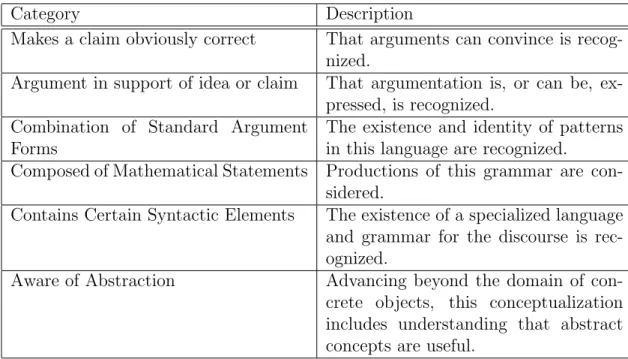
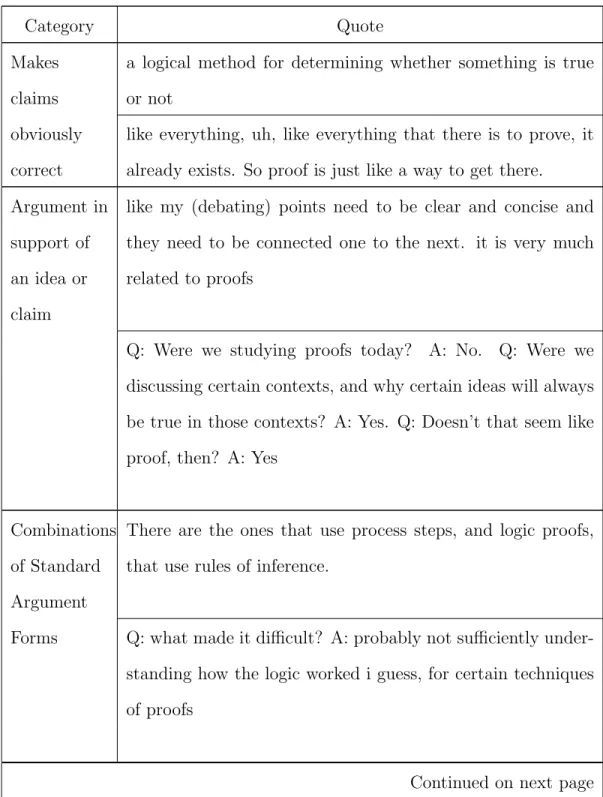
Ch. 4. Phenomenographic Analysis 56 4.1 Phenomenographic Analysis of What Students Think Proof Is . . . . 58
4.1.1 Categories . . . 58
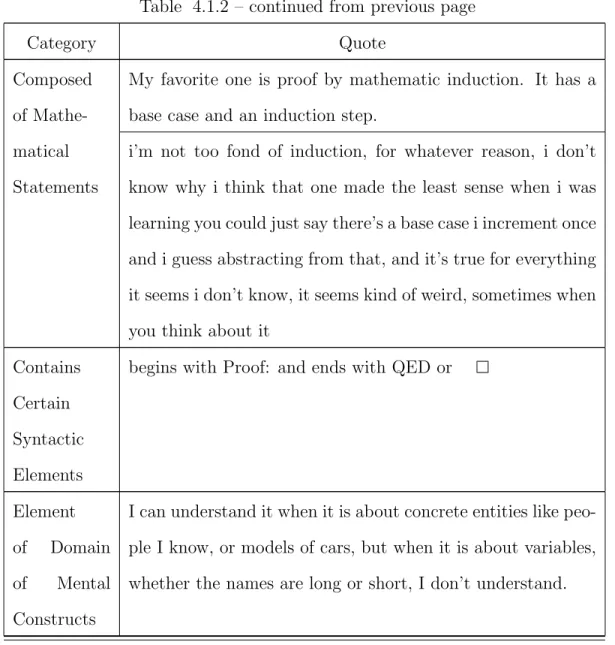
4.1.2 Illustrative Quotations for Categories . . . 60
4.1.3 Relations . . . 62
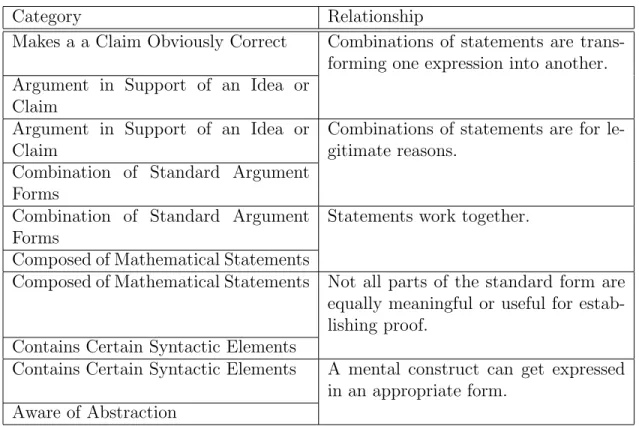
4.1.4 Critical Factors . . . 63
4.1.5 Dimensions of Variation . . . 65
4.1.6 Validation . . . 71
4.1.7 Outcome Space . . . 72
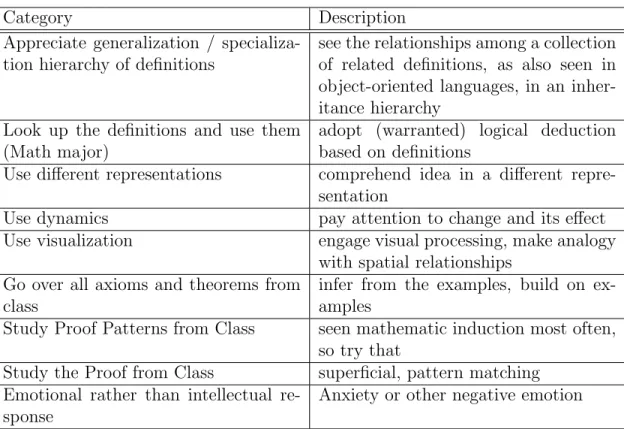
4.2 Phenomenographic Analysis of How Students Attempt to Understand Proofs . . . 76
4.2.1 Categories . . . 76
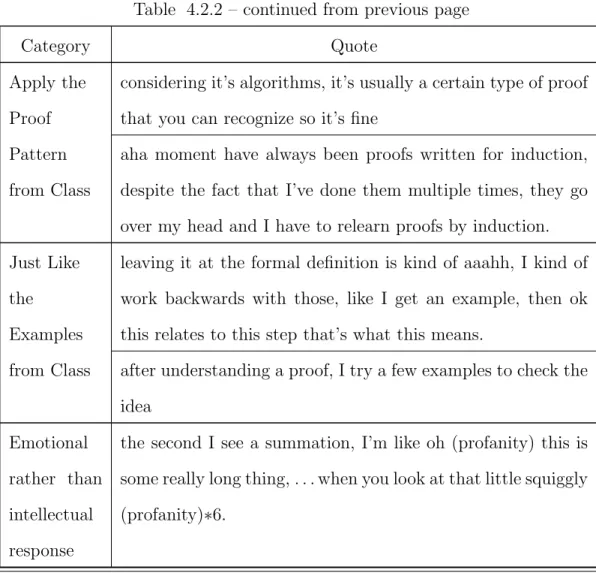
4.2.2 Illustrative Quotations for Categories . . . 78
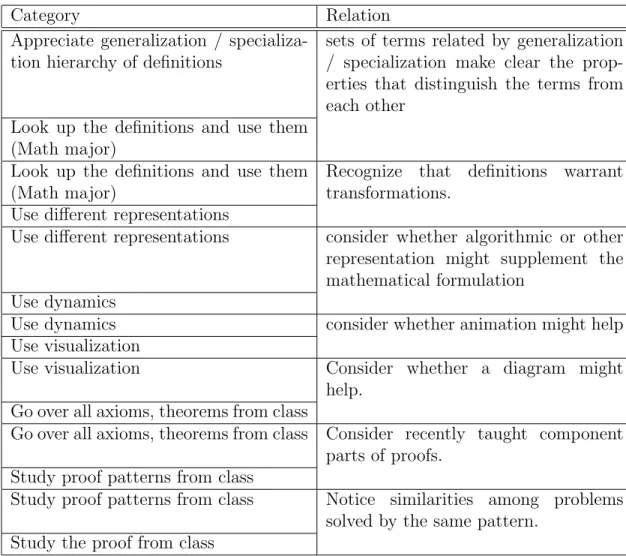
4.2.3 Relations . . . 83
4.2.4 Critical Factors . . . 84
4.2.5 Dimensions of Variation . . . 87
4.2.6 Validation . . . 87
4.2.7 Outcome Space . . . 88
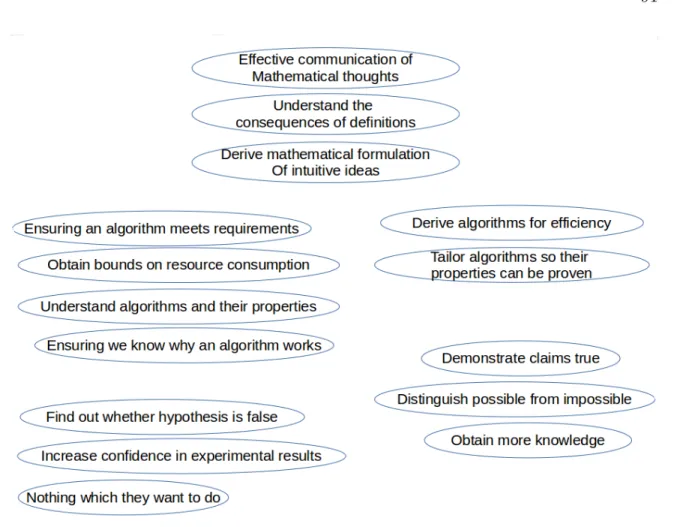
4.3 Phenomenographic Analysis of What Students Think Proof is For . . 91
4.3.1 Categories . . . 91
4.3.2 Illustrative Quotations for Categories . . . 94
4.3.3 Relations . . . 95
4.3.4 Critical Factors . . . 96
4.3.6 Validation . . . 98
4.3.7 Outcome Space . . . 98
4.4 Phenomenographic Analysis of How Students Attempt to Apply Proofs (When Assigned) . . . 100
4.4.1 Categories . . . 100
4.4.2 Illustrative Quotations for Categories . . . 100
4.4.3 Relations . . . 102
4.4.4 Critical Factors . . . 103
4.4.5 Dimensions of Variation . . . 104
4.4.6 Validation . . . 104
4.4.7 Outcome Space . . . 105
4.5 Phenomenographic Analysis of How Students Attempt to Apply Proofs (When Not Assigned) . . . 107
4.5.1 Categories . . . 107
4.5.2 Illustrative Quotations for Categories . . . 107
4.6 Phenomenographic Analysis of Whether Students Exhibit Consequences of Inability With Proof (such as avoiding recursion) . . . 108
4.6.1 Categories . . . 108
4.6.2 Illustrative Quotations for Categories . . . 108
4.6.3 Relations . . . 109
4.6.4 Critical Factors . . . 109
4.6.5 Dimensions of Variation . . . 109
4.6.6 Validation . . . 109
4.7 Phenomenographic Analysis of Student Familiarity with Specific Proof Techniques . . . 110
4.7.1 Categories . . . 110
4.7.2 Illustrative Quotations for Categories . . . 111
4.7.3 Relations . . . 113
4.7.4 Critical Factors . . . 113
4.7.5 Dimension of Variation . . . 114
4.7.6 Outcome Space . . . 115
4.8 Phenomenographic Analysis of How Students Use Structure in Proof 117 4.8.1 Categories . . . 117
4.8.2 Illustrative Quotations for Categories . . . 117
4.8.3 Relations . . . 119
4.8.4 Critical Factors . . . 119
4.8.5 Dimensions of Variation . . . 120
4.8.6 Validation . . . 121
4.9 Phenomenographic Analysis of What Students Think Makes a Proof
Valid . . . 124
4.9.1 Categories . . . 124
4.9.2 Illustrative Quotations for Categories . . . 124
4.9.3 Relations . . . 126
4.9.4 Critical Factors . . . 126
4.9.5 Dimensions of Variation . . . 127
4.9.6 Validation . . . 128
4.9.7 Outcome Space . . . 129
4.10 Phenomenographic Analysis of Combined Data . . . 131
4.10.1 Categories . . . 131
4.10.2 Illustrative Quotations for Categories . . . 133
4.10.3 Relations . . . 138
4.10.4 Critical Factors . . . 139
4.10.5 Dimensions of Variation . . . 140
4.10.6 Validation . . . 140
Ch. 5. Interpretation/Discussion 141 5.1 Interpretation of What Students Think Proof Is . . . 143
5.2 Interpretation of How Students Attempt to Understand Proofs . . . . 146
5.3 Interpretation of What Students Think Proof is For . . . 148
5.4 Interpretation of How Students Attempt to Apply Proofs (When As-signed) . . . 150
5.5 Interpretation of How Students Attempt to Apply Proofs (When Not Assigned) . . . 152
5.6 Interpretation of Whether Students Exhibit Consequences of Inability With Proof (such as avoiding recursion) . . . 153
5.7 Interpretation of Student Familiarity with Specific Proof Techniques . 153 5.7.1 Processes and Conviction . . . 154
5.7.2 Alternate Dimensions of Variation . . . 155
5.7.3 Alternate Critical Factors . . . 155
5.8 Interpretation of How Students Use Structure in Proof . . . 156
5.9 Interpretation of What Students Think Makes a Proof Valid . . . 158
5.10 Interpretation of Combined Data . . . 159
5.10.1 Interpretation of Analysis from Section 4.10 . . . 160
5.10.2 Combined Interpretations . . . 164
5.10.3 Comparison of Combination Before vs. After Interpretation . 165 5.11 Report: Navigating Through Space of Conceptualization of Proof . . 166
5.11.1 Context . . . 166
5.11.2 Conjectures and Conceptualizations . . . 168
5.11.3 Report . . . 172
Ch. 6. Validity and Reliability 175 6.1 Introduction . . . 175
6.2 Validity and Reliability Goals in the Social Constructivist Paradigm . 176 6.2.1 Trustworthiness . . . 177
6.2.2 Credibility . . . 177
6.2.3 Transferability . . . 178
6.2.4 Confirmability . . . 179
6.3 Approaches . . . 179
6.3.1 Purposefully Seeking Diversity . . . 180
6.3.2 Diversity in Participants . . . 181
6.3.3 Diversity in Sources . . . 182
6.3.4 Alternative Explanations . . . 184
6.3.5 Consistency Checking . . . 185
6.4 Specific Papers and Manuscripts . . . 187
6.4.1 Validity and Reliability in Proofs Using the Pumping Lemma for Regular Languages . . . 187
6.4.2 Proof by Induction . . . 189
6.5 Statement of Researcher Bias . . . 190
Ch. 7. Related Work 191 7.1 Summary . . . 196 7.2 Research Questions . . . 197 7.3 Constructivism . . . 198 7.3.1 Social Constructivism . . . 208 7.3.2 Radical Constructivism . . . 218
7.3.3 Neo-Piagetian Theory of Cognitive Development . . . 225
7.3.4 Definitions . . . 226
7.3.5 APOS Theory . . . 227
7.4 Social Science Research . . . 228
7.4.1 Psychology of Decision Making . . . 228
7.4.2 Qualitative Research . . . 230
7.5 Mathematics Education Related to Proof . . . 238
7.5.1 Mathematical Problem Solving . . . 246
7.5.2 Proof . . . 248
7.6.1 Logic . . . 257
7.6.2 Abstraction and Representation . . . 261
7.6.3 Quantifiers . . . 264
7.6.4 Symbols . . . 264
7.6.5 Mathematic Induction and Recursion . . . 266
7.6.6 Teaching Pumping Lemmas . . . 266
Ch. 8. Conclusion 268 8.1 What Students Think Proofs Are . . . 269
8.2 How Students Attempt to Understand Proofs . . . 270
8.3 What Students Think Proof is For . . . 270
8.4 How Students Attempt to Apply Proof, When Assigned, and When Not Assigned . . . 271
8.5 Whether Students Exhibit Consequences of Inability With Proof . . . 271
8.6 Student Familiarity with Specific Proof Techniques . . . 272
8.7 How Students Use Structure in Proof . . . 272
8.8 What Students Think Makes a Proof Valid . . . 273
8.9 Conclusions from the Combined Data . . . 273
8.10 Recognizing an Endpoint . . . 276
8.11 Application of Findings / Implications for Pedagogy . . . 277
Ch. 9. Future Work 278 9.1 Pursuit of Conclusions . . . 278
9.2 Helping Students Discern Derivation for Proof of Correctness . . . 280
Bibliography 281 Appendices 317 Ch. A. Brochure for Critical Aspects Integrated into Curriculum 318 A.1 Motivation . . . 320
A.2 Step of Abstraction . . . 320
A.3 Language of Abstraction . . . 322
A.4 Logical Deduction, from Definitions, without Anxiety . . . 323
A.5 Representations . . . 323
A.6 Transformation Trajectories . . . 324
A.7 Recognizing When Techniques Apply . . . 325
Ch. B. Examination of Multiple Representations 326 B.1 . . . 327 B.2 . . . 329 B.3 . . . 330 B.4 . . . 332 B.5 . . . 333 B.6 . . . 335 B.7 . . . 336 B.8 . . . 337 B.9 . . . 338 B.10 . . . 339 B.11 . . . 340 B.12 . . . 341 Ch. C. Interview Protocol 342
List of Figures
4.1.1 Outcome space from What Proof Is. The outcome space consists of categories of understandings, shown as ovals, and critical factors, given in italic text. Critical factors are thoughts that are necessary[177] for students, in order to develop a deeper or more inclusive understanding. 59 4.2.1 Outcome space from How Students Approach Comprehending Proof . 77
4.3.1 Initial Categories from What students think a proof is for . . . 91
4.3.2 Outcome space from What students think a proof is for . . . 93
4.4.1 Outcome space from How Students Attempt to Apply Proofs When Assigned . . . 101
4.7.1 Outcome space from How Students Use Structure in Proof . . . 110
4.8.1 Outcome space from What Structural Elements Students Find in Proof 118 4.9.1 Outcome space from What Students Think Makes a Proof Valid . . . 125
4.10.1Categories from Combined Data . . . 131
7.5.1 How proof develops, Tall Mejia-Ramos . . . 240
B.1.1Equation (1) . . . 327
B.1.2Equation (2) . . . 327
B.2.1Three part diagram . . . 329
B.2.2Four part diagram . . . 329
B.3.1First . . . 330
B.3.2Second . . . 330
B.6.1Puzzle pieces . . . 335
List of Tables
1.3.1 Distinct Ways of Experiencing Learning, from Marton and Booth [176]. 8 3.2.1 Parts of the Study . . . 34 3.5.1 Phenomenographic Analysis of Reasons for Teaching Proof . . . 41 4.1.1 Categories for Student Conceptualizations of What Proof Is . . . 60 4.1.2 Illustrative Quotations for Student Conceptualizations of What Proof Is 61 4.1.3 Relationships for Student Conceptualizations of What Proof Is . . . . 64 4.1.4 Critical Factors for What Proof Is . . . 66 4.2.1 Categories for Student Conceptualizations of How to Understand Proofs 76 4.2.2 Illustrative Quotations for How Students Approach Comprehending
Proof . . . 81 4.2.3 Relationships for Student Conceptualizations of How to Understand
Proofs . . . 85 4.2.4 Critical Factors for How Students Approach Comprehending Proof . . 86 4.3.1 Categories for Student Conceptualizations of Reasons for Teaching Proof 92 4.3.2 Grouped Categories for Student Conceptualizations of Reasons for
Teaching Proof . . . 93 4.3.3 Illustrative Quotations for What Students Think Proof is For . . . 95 4.3.4 Relationships for Student Conceptualizations of Reasons for Teaching
Proof . . . 96 4.3.5 Critical Factors for What Students Think Proof is For . . . 97 4.4.1 Categories for How Students Attempt to Apply Proofs (When Assigned)100 4.4.2 Illustrative Quotations for How Students Attempt to Apply Proofs
(When Assigned) . . . 102 4.4.3 Relations for How Students Attempt to Apply Proofs (When Assigned) 103 4.4.4 Critical Factors for How Students Attempt to Apply Proofs (When
4.5.1 Illustrative Quotations for How Students Attempt to Apply Proofs
(When Not Assigned) . . . 107
4.6.1 Illustrative Quotations for Whether Students Exhibit Consequences of Inability With Proof (such as avoiding recursion) . . . 108
4.7.1 Categories for Student Conceptualizations of Specific Proof Techniques 111 4.7.2 Illustrative Quotations for Student Familiarity with Specific Proof Tech-niques . . . 111
4.7.3 Relationships for Student Conceptualizations of Familiarity with Spe-cific Proof Techniques . . . 113
4.7.4 Critical Factors for Student Familiarity with Specific Proof Techniques 114 4.8.1 Categories for Student Conceptualizations of What Structural Ele-ments are Found in Proofs . . . 117
4.8.2 Illustrative Quotations for How Students Use Structure in Proof . . . 118
4.8.3 Relationships for Student Conceptualizations of What Structure Stu-dents Notice in Proofs . . . 119
4.8.4 Critical Factors for What Structure Students Notice in Proofs . . . . 120
4.9.1 Categories from What Students Think Makes a Proof Valid . . . 124
4.9.2 Illustrative Quotations for What Students Think Makes a Proof Valid 125 4.9.3 Relationships from What Students Think Makes a Proof Valid . . . . 127
4.9.4 Critical Factors from What Students Think Makes a Proof Valid . . . 128
4.10.1Categories for Combined Data . . . 132
4.10.2Illustrative Quotations for Combined Data . . . 134
4.10.3Relationships for Combined Data . . . 138
Chapter 1
Introduction
Proofs are taught in the computer science curriculum, with the intent that students will be able to use them. Students should use them to ascertain whether the algo-rithms they have learned are applicable to the problems they wish to solve. Moreover, it is desirable that students will be able to show that the resource consumption of their implementation is suitable for the circumstances of their implementations. Be-yond correctness and resource utilization, students will use proof to know that many problems are undecidable, and that complexity classes can be defined.
It can be the case that not every student gains the whole of the capabilities that we might wish. Insight into the partial understandings students do achieve might direct our attention to those elements of the related courses, further emphasis upon which might aid student learning.
The population we study is students of computer science, or of computer science and engineering (henceforth, computer science).
these students, so as to provide information that might be helpful for teaching. It is a qualitative study, because we seek the variety in the nature of the various under-standings. We do not attempt to establish the relative frequencies with which these conceptualizations occur.
The analytic lens of the study is phenomenography, including variation theory[172, 253, 176, 179]. This lens is appropriate for discovering ideas critical for advancing between stages of understanding.
In this chapter we list our research questions addressing conceptions of proof in students of computer science. We briefly summarize what distinguishes qualitative research from other research. We provide a short description of phenomenography as extended to variation theory. We explain how phenomenography and variation theory are suited to investigate the questions we have pursued.
It is important for students of computer science to comprehend, apply, and syn-thesize proofs. These skills are needed because proofs are used to demonstrate the resource needs and performance effects of algorithms, as well as for safety, liveness, and correctness/accuracy. We claim herein that some students, having learned an al-gorithm, are not certain of the problem environment in which this kind of algorithm is effective, and as a result are reluctant to apply the algorithm. It is desirable for students to be able to ascertain that an algorithm is a good match for a problem, which can sometimes be proved, otherwise their knowledge of the algorithm is less useful.
1.1
Research Questions
In order to address the students effectively, it can help to know their preparation and their approach to gaining new knowledge. This preparation may include useful ideas, and also may include unhelpful conceptions. Their approach to learning might not yet include the degree of attentiveness to precision and thoroughness that is appropriate for deductive logic. Besides their current knowledge and learning approach, their opinion of the structure of relevancy is of interest. We have identified facets of student conceptions surrounding the idea of proof, which led to specific questions.
We propose to research these questions:
• What do students think a proof is?
• How do students attempt to understand proofs?
• What do students think a proof is for?
• What do students attempt to apply proof, when assigned and when not as-signed?
• Do students exhibit any consequence of inability in using proof (i.e., applying proof techniques they have studied, or noticing that proof is an appropriate technique when it is), such as, avoiding using recursion?
• How do students use structure in proof?
• How familiar and/or comfortable are students with different (specific) proof techniques: induction, construction, contradiction?
These questions are interesting because, with the curriculum, we are trying to build capabilities into the students, that will enable them to tackle various problems they may encounter. Moreover, we wish the students to develop the ability to have, in the terminology of Harel and Sowder[118], conviction with an internal source, and to be correct in their convictions. As new situations emerge, and as students who have graduated find the occasion to modify an algorithm to a new situation, we want these individuals to be able to know that their modified algorithms are appropriate. It is important that they understand this algorithm-applicability purpose of proof, so that they can judge applicability for themselves, and it is important to know what hindrances they are experiencing, so that we can help the students overcome them. It is important that they recognize that there is structure in proofs, and that they can construct their own proofs, because we cannot foresee every situation our students may experience.
Because we are greatly concerned that students should apply their knowledge of proof to algorithm-related contexts they may subsequently encounter, the split be-tween what students perform for assessment, and what students perform for their own purposes is significant to us. Thus it may be helpful to supplement what assessments tell us, about the extent to which the students are absorbing the knowledge about proof we are trying to impart, with information from interviews. Interviews impose a burden of analysis which is usually too extreme for a lecture class. Progression across multiple courses is beyond the scope of a lecture class.
Phenomenographic research yields critical factors, which are ideas whose emphasis is thought to be particularly helpful in deepening student understanding. Thus the relevance of this research to the curriculum is that the work will generate suggestions about points to emphasize.
1.2
Qualitative Research
“When instructors understand what students know and how they think — and then use that knowledge to make more effective instructional decisions — significant increases in student learning occur” Black and Williams[30] How students think, for example, how they approach the study of proof, is a qualitative question.
One product of qualitative analysis is definition of categories that describe some structure of the collection of understandings in the student population. These can help phrase questions for quantitative studies.
Qualitative analysis has types; some of these were created to address specific domains of research. These types include basic qualitative research, phenomenol-ogy, ethnography, grounded theory, and narrative analysis, each of which is inter-pretive [190]. Critical research, while qualitative, goes beyond interpretation, as it intends to reform the object of its attention. Each of the above is a type of qualitative research associated with, and characterized by, a qualitative research methodology. One type of research, which differs from those above in that it delimits its scope to the description of ways of experiencing, by a student, the communication from a source of instruction, is phenomenography[253]. While the formerly mentioned types of quali-tative research are characterized by a qualiquali-tative research methodology, phenomenog-raphy is characterized by an aim, namely to describe people’s conceptions. [253]. All the methods just mentioned produce descriptions. In phenomenography, it is neces-sary that the descriptions be subject to comparison and to systematization. As for the methods associated with phenomenography, Svensson states [253, p. 161–162] “development of methods was included as a main aim of the research and the
devel-opment of methods was an integrated part of the tradition. However, methods have been dealt with in a problem-solving attitude rather than by giving prescriptions. The methods have been considered to have been derived from the basis of the general aim, the general character of the phenomena of conceptions and also from the basis of the specifics of the phenomena and the situation under investigation. Therefore phe-nomenographic research represents a research approach in a double sense. It means an emphasis on approaching the research objects in the sense of creating methods adapted to the objects. . . . The approach to describing conceptions is closely related to the view of the research objects and is not a system of generally defined methods. The most significant characteristics of the approach are the aiming at categories of de-scription, the open explorative form of data collection and the interpretive character of the analysis of data.”
Svensson [253] reports that phenomenography was extended to include variation theory. Variation is key to the phenomenography/variation theory qualitative re-search approach. Variation, by the instructor, of the communicated information is deemed necessary for discernment by the student of what is being described by the instructor[177].
1.3
Phenomenography with Variation Theory
Phenomenography is an empirical research approach. [253] Svensson states [253, p. 169–171] that phenomenography’s “methodological assumptions also tend to have generality. The most central characteristics are the explorative character of the data collection and the contextual analytic character of the treatment of data. . . . The
analysis, then must not only mean an aggregation of specific data within generally given interpretations, but a delimitation of specific data related to each other as referring to parts of the same phenomena.. . . The content is, then, not primarily considered in terms of meaning of linguistic units, but from the point of view of expressing a relation to parts of the world. . . . scientific knowledge about conceptions is based on differentiation, abstraction, reduction and comparison of meaning”.
Booth [36] states “When I say ‘methodology’ I mean that phenomenographic stud-ies are based on certain principles but that the actual methods used vary according to the specific question being addressed; it is not prescriptive. Phenomenography is not an experimental methodology – phenomenographers do not set up controlled trials and attempt to measure the results of change; but it is relatively naturalistic, researchers engage with the learners themselves, in close proximity (both spatial and conceptual) to the learning situations they find themselves in. Nor is it a quantita-tive methodology – the results are descripquantita-tive and lie at a collecquantita-tive level, in the sense that individuals are seen as contributing fragments of data that together constitute a whole and collective experience, which can be subjected to research analysis.”
Marton and S¨alj¨o [180] performed an experiment which showed that students’ approaches to learning have been predictive of their learning outcome, reiterated in Marton and Booth. [176, p. 22] In looking at, and developing categories for, students’ ways of experiencing their learning, we may obtain insight into the students’ approaches, and can hope to improve their outcomes.
Marton[176, p. 36] has defined that one conception (of a thing, x) differs from another, for the purposes of phenomenography, by the existence of a distinct manner in which participants were found to voice the way they thought about x. The cate-gories of conceptions (also, conceptualizations) include two overriding catecate-gories,[176,
p. 35] the first being “a learning task, some facts to memorize”, and the second hav-ing as objective “a way to change oneself, to see thhav-ings in a new light, to relate to earlier learning, and to relate to a (changed) world.” At the next level of drawing distinctions, S¨alj¨o [225] has found five qualitatively distinct conceptualizations, and Marton [176] has found six distinct conceptualizations falling into the two overriding, task and objective. (See Table 1.3.1.)
Table 1.3.1: Distinct Ways of Experiencing Learning, from Marton and Booth [176].
1. learn as increase knowledge
2. learn as increase and be able to reproduce knowledge 3. be able to apply new knowledge
4. acquiring new meaning, multiple ways of thinking about things, changed per-spective, improved understanding, thinking more logically
5. modified perspective, multiple perspectives, dynamic perspective 6. changing the person
Marton and Booth[176, p. 78] observe that successive understandings increase in completeness as they move toward a theoretical understanding.
1.3.1
Conceptualizations
Selden and Selden[142] include, in their questions regarding teaching and learning mathematics, that instructors aim for their students to “achieve the kind of organizing and integrated use of language” used in the mathematics community.
D¨orfler[69, p. 122] complements the idea of concept, saying “ ‘ What is the concept
actions can be recorded and/or guided by the conceptxy?’ . . . Learners must indulge in the discourse . . . mathematical objects . . . are discursive objects. This means they come into existence exclusively by and within the discourse, even if this discourse ascribes to them existence an properties of an objective and independent character.” Wittgenstein said [301, p. 19–20] “To understand a phrase, we might say, is to understand its use. . . . Similarly, you only understand an expression when you know how to use it”.
So, we are inquiring into student conceptualizations, as shown by the students’ use of their concepts, and by the students’ reflections (in interviews) upon their concepts.
1.3.2
Relevance Structure
Relevance structure is a part of phenomenography: Marton and Booth state [176, p. 143] “Each situation, whether we consider it a learning situation or a situation in which one is applying something learned, has a certain relevance structure: the person’s experience of what the situation calls for, what it demands. It is a sense of aim, of direction, in relation to which different aspects of the situation appear more or less relevant. It is the way the learner experiences the situation as a whole, . . . that renders the perspective in its component parts.”
Knowledge may alter the perspective with which students view new material. For example, students who know they are about to work on projects, in which they are expected to apply new material they are studying, are enabled to receive and organize, mentally, that new material, assisted more or less by its relation to their anticipated use of it.
of learning”[176, p. 145] and assert that learning’s “chief mechanism is variation”. Changes in the curiosity of the learner, as may be brought about by the presentation of problems, can change the student’s capability of experiencing something, and thereby change the student’s way of experiencing it, which is learning. Sudden insight is an example of a change in a person’s way of experiencing something.
Booth has written on relevance structure in learning computer science. [36] She writes “In pedagogical terms, the course aims to provide the heterogeneous group of new students with a relevance structure . . . a whole sense of the programme, what it is aimed at, what it demands and where it will lead – not only by bringing about genuine needs to use the practical tools they are learning, but also by raising questions that relate to theoretical studies to come and to social issues” [36, p. 176]
There is a connection between the ideas relevance structure and motivation, as illustrated in a remark of Booth’s “to create a relevance structure, or motivation if preferred, for the coming education by offering the students from the start a whole picture – however vague and incomplete at the outset – that encompasses the overall goals of the programme” [36, p. 178]
Thota[265] refers to the relevance structure when considering “pedagogic princi-ples . . . that consider how to tie students’ experiences to the course goals (relevance structure) . . . The two principles of teaching that are espoused in phenomenographic pedagogy are (a) the relevance structure – making the learner personally experience the relevance of the learning situation, and (b) variation theory – emphasizing the critical aspects that lead to a change in the learner’s understanding of a learning con-cept.” Thota claims that “The learning that occurs is dependent on how the learner personally experiences the relevance of the learning situation”.[265, p. 127]
of professional situations, likely to be encountered in the future, enables students to develop holistic capabilities that link disciplinary knowledge and professional skills.” Thota relates that a relevance structure can be built, in part, by relating and contex-tualizing learning.[265, p. 128]
Thota reports[265, p. 131], of students “they become more engaged in learning when they see the relevance of programming to their chosen major and future career needs.”
Thota summarizes[265, p. 131] “The building of the structure of relevance can be achieved by: (a) awareness of pedagogical content knowledge as it should be un-derstood by learners; (b) ensuring learners reveal their experience of ways of learning (including the what and how of learning); (c) relating learning to the learner’s own personal interests and motivations and contextualizing the set assignments to create authentic situations.”
Relevance structure plays a role in motivating student learning. Relevance struc-ture can be present in a course at different levels of detail. Present not only at the level of “this test driven development practice might aid your employability”, rele-vance can be shown at the level of an individual algorithm. For example, the purpose of learning to prove whether a problem has optimal substructure can be to determine whether a dynamic programming approach is suitable for a solution. Students who do not know that optimal substructure is important for the use of a dynamic pro-gramming approach might not make mental connections between these ideas; it might not occur to them to make use of a dynamic programming approach in a situation when that is warranted. It is claimed herein that relevance structure provides another avenue for retrieval of knowledge, lessening the risk of knowledge being inert (in the sense of Whitehead[300]).
1.4
Phenomenography / Variation Theory for these
Research Questions
Conceptualizations, as we have seen above, are important for our research questions, and are a central object of attention for phenomenography.
Phenomenography and variation theory (henceforth “phenomenography”) address mental concepts without reference to any sensory modality through which they may have been acquired. [176, p. 160] As a deductive, logical argument, a proof is a mental concept that can exist without reference to any sensory modality.
Phenomenography concerns itself with students’ approaches to learning. This allows us to hope to effect a change in approach, and thereby effect an improvement in students’ outcomes.
1.5
Overview
Chapter 2 discusses the phenomenographic research perspective, and the epistemolog-ical framework. Chapter 3 discusses the methodology applied in the study, including sections on sample selection, data collection, and analysis. Chapter 4 shows the analysis and describes the results. Chapter 5 provides interpretation and discussion. Chapter 6 discusses validation and reliability. Chapter 7 discusses some related work. Chapter 8 concludes the description of completed work. Chapter 9 describes some possible future work.
Chapter 2
Research Perspective and
Epistemological Framework
This work is a phenomenographic study, adopting the epistemological framework of social constructivism.
A qualitative study ought, for transparency, to contain a description of the au-thor’s viewpoint, or at least, the viewpoint that was exercised in the study. Ernest[86, p. x], crediting von Glasersfeld[278, p. 41], notes:
To introduce epistemological considerations into a discussion of educa-tion has always been dynamite. Socrates did it, and he was promptly given hemlock. Giambattista Vico did it in the 18th century, and the philosophical establishment could not bury him fast enough.
The work of others has contributed to both the research perspective and the epistemological framework1.
• Marton developed the phenomenographic research perspective, which is broadly applicable to education.
• Many researchers have contributed to the literature on educating students in the use of proof.
• Significant work has been done on teaching computer science students about mathematical proof.
Vygotsky pointed out the “zone of proximal development”, contrasting what stu-dents could achieve on their own with that which stustu-dents could achieve with the assistance of others. He wrote:[283, p. 85]
In studies of children’s mental development it is generally assumed that only those things that children can do on their own are indicative of mental abilities. We give children a battery of tests or a variety of tasks of varying degrees of difficulty, and we judge the extent of their mental development on the basis of how they solve them and at what level of difficulty. On the other hand, if we offer leading questions or show how the problem is to be solved and the child then solves it, or if the teacher initiates the solution and the child completes it or solves it in collaboration with other children – in short, if the child barely misses an independent solution of the problem – the solution is not regarded as indicative of his mental development. This “truth” was familiar and reinforced by common sense. Over a decade even the profoundest thinkers never questioned the assumption; they never entertained the notion that what children can do with the assistance of others might be in some sense even more indicative
of their mental development than what they can do alone. He wrote[283, p. 86]
When it was it was first shown that the capability of children with equal levels of mental development to learn under a teacher’s guidance varied to a high degree, it became apparent that those children were not mentally the same age and that the subsequent course of their learning would obvi-ously be different. This difference . . . is what we call the zone of proximal development. It is the distance between the actual developmental level as determined by independent problem solving and the level of potential de-velopment as determined through problem solving under adult guidance or in collaboration with more capable peers.
By choosing a version of social constructivism that directs attention to finding that zone in which a teacher, sometimes employing collaboration with peers, may most effectively advance the student’s development, we inherit the situation described by Ben-Ari[26]: “The task of the teacher is significantly more difficult than in the classical paradigm, because the guidance must be based on the understanding of each student’s currently existing cognitive structures.”
This choice about social constructivism affects our perspective by establishing a scope, namely, addressing specifically how a teacher may assist a student to learn, and how a teacher may make use of collaboration among peers to assist a student to learn. Using Vygotsky’s definition of the zone of proximal development affects our perspective by focusing our efforts on matching teaching interventions with stu-dents’ readiness to benefit from those interventions. By choosing as a basis, this social constructivism, the perspective is directed towards curriculum design, so that
the students’ zones of proximal development may be encouraged to advance along a trajectory supported by sequenced teaching activities.
2.1
Phenomenography and Variation Theory
Phenomenography, a research orientation created and developed by Ference Marton and colleagues[176, 253], has as its purpose the discovery and elucidation of categories of conceptions, mainly in the context of education. Its subject of investigation is conceptions present in a group of students. Theseconceptions, alsoconceptualizations, are of the meaning of some thing, in particular of some thing which is the object of the instructor’s exposition, called, the learning objective. To describe partial or imperfect learning, it is helpful to separate the meaning understood by the instructor from the meanings developed by the students. The nature of the conceptualizations, which are collectively the object of the description, is the meaning that something has to the individual, i.e., the individual’s understanding.
To understand in some detail the degree of completeness of a conceptualization, the degree of superficiality or depth of a conceptualization, description of concep-tualizations are needed. Note that the students’ concepconcep-tualizations are not limited to a subset of the instructor’s meaning, as students may bring other data, including incorrect understandings, from other sources. The descriptions are categorized, pro-ducing categories of description. The categories of description, to be useful, must be sufficiently comparable to be seen in relation to one another. When categories of de-scription are related, the distinguishing factors between categories make manifest the concepts that are necessary for students to discern, to advance to an adjacent, better,
conceptualization. These are thecritical factors. In the context of conceptualizations differing in completeness, these are also called critical aspects.
Thus the process of obtaining the descriptions and their categories is of some interest. The process uses an open, exploratory form of data collection. For raw data, researcher with with interview transcripts and other verbal productions be learners, extracting text fragments conveying meaning, and exploring possible categorizations of these excerpts.
Together, the categories and relationships between them are called the outcome space.
It can be that categories differ in completeness, and that more than two degrees of completeness are found in the conceptualizations of the students. It can be that categories differ in depth of understanding, and that more than two degrees of depth are found. These are only two examples of dimensions of variation. From the outcome space, researchers infer dimensions of variation. In turn, dimensions of variation provide a framework by which researchers can organize the information garnered from student verbal productions. Variation theory applies the idea of a range of values in multiple ways. One way is in making ideas discernible. Pang and Marton[177] describe that a child knowing of only one spoken language conflates the ideas of natural language and that one language, but a multilingual child knows that natural language is the more general concept.
2.1.1
Variation Theory
Dahlin[61, p. 328] recounts that variation theory was a development upon phe-nomenography that brought in dynamic elements to the description of
conceptu-alizations. “The concepts of discernment, variation and simultaneity are the core of variation theory. In order for learning to take place, the learner has to discern a critical aspect or dimension of variation in the phenomenon; she has to see how this aspect can vary; and she has to become simultaneously aware of the possible “values” along this dimension of variation in order to compare them.”
Variation is seen as occurring among conceptualizations, and as occurring during the learning. That is, the teacher may emphasize variation of an aspect of the ma-terial being taught, and may emphasize that values taken on along this dimension of variation are significant for the material being taught. This emphasis serves to help students discern not only the dimension of variation, but the factor that is changing; change of the factor calls attention to the factor. Were that factor constant, it might not be noticed. Variation among the categories of description extends the outcome space, such that more distinct conceptualizations are found.[176, p. 124–125].
Variation theory[178] suggests that critical aspects, which are particular ideas, are necessary[177] for meaning-making (understanding), to progress from one level of conceptualization to a more advanced level.
The research approach associated with variation theory has the goal of identifying these specific ideas, which, on the basis of an identification of the conceptualizations present in a student population, empirically are seen to differentiate one level of conceptualization from another.
Variation theory uses these so-called critical factors. They are emphasized in teaching, specifically by varying them, and considering the consequences. For exam-ple, we may highlight the significance of climate zones by considering the variation in annual rainfall from one zone to another. We may make salient the distinction be-tween the ideas of language as contrasted with speech, the difference bebe-tween speaking
(in general), and speaking in a specific language (in particular) by acquainting chil-dren with the existence of a second language. (In the context of only one language, the distinction still exists, but might not be so readily described or learned.)
Marton and Pang[177] identify “some necessary conditions of learning. To learn something, the learner must discern what is to be learned (the object of learning). Discerning the object of learning amounts to discerning its critical aspects. To discern an aspect, the learner must experience potential alternatives, that is, variation in a dimension corresponding to that aspect, against the background of invariance in other aspects of the same object of learning. (One could not discern the color of things, for instance, if there was[sic] only one color.) The study results illustrate that what students learn in a sequence of lessons is indeed a function of the pattern of variation and invariance constituted in that sequence. All teachers make use of variation and invariance in their teaching, but this study shows that teachers informed by a systematic framework do it more systematically, with striking effects on their students’ learning.”
2.1.2
Application to Proof in Computer Science
Phenomenography, and its extension variation theory, are appropriate tools for com-prehending student conceptualizations about proof in computer science, because the subject is the understandings, including those obtained after reflection, of proof present in the student population. These understandings have been seen to vary in completeness and in depth. Comparison of categorizations has suggested items to clarify for students, and students have responded positively to these suggested ideas. Marton and Booth[176] extended phenomenography and variation theory to
in-clude the idea of structural relevance. Using this idea, we can hope to help students discern an aspect of a learning objective, by pointing out a connection between this relatively new aspect and a pre-existing notion that provides, for example, motivation to take note of this aspect. With proofs we may bring to students’ attention that these will be used in future course work to understand algorithm’s properties, such as computational complexity.
By attending to the construction of structural relevance as well as to the construc-tion of the curriculum’s learning objectives, we can provide help to students, in the form of motivation.
2.1.3
An example of applying variation theory
A commonly used example of a proof utilizing one application of modus ponens is: All men are mortal.
Socrates is a man. Socrates is mortal.
Variation theory tells us we must vary critical factors, for students to discern them. Some examples of variation are:
Some men are mortal. Socrates is a man.
Socrates is mortal, maybe, but not necessarily.
When we have removed insignificant items from our proof, what’s left matters. It’s easy to find elements to vary that will affect the outcome.
All men are mortal. John Doe is a man. Socrates is mortal.
What’s different here is, we have lost the warrant for Socrates being mortal. With-out that, we cannot know for sure that Socrates is mortal.
All men are mortal. Socrates is a person. Socrates is mortal.
This time we’ve kept our attention on Socrates, but we have lost the warrant. To have a warrant, we must remain within the domain granted by the axiom.
All men are mortal. Socrates is a man. Socrates is an orator.
The final statement, though possibly true, is not justified by any warrant.
2.1.4
Variation Theory and Conjunctions
Marton and Booth[176] have observed that increased differentiation, i.e., specializa-tion, and also integration in the ways in which we experience the world are the results of learning.
The mind quickly learns certain specializations. This was predicted by Valiant[270]. This was verified experimentally by Fried, using single neuron experiments[93]. Cogni-tive neuroscience predicts that specializations that are conjunctions of posiCogni-tive literals of existing concepts are easy to learn and that conjunctions containing literals that are not existing concepts, but are negations of existing concepts may not be[270]. By examining the conceptualizations present in the population of learners, we can hope to find clusters from which we can learn features whose values differentiate the clus-ters. It is these features, called in variation theory “critical factors”, which instructors should emphasize, showing in their positive and negative form.
2.2
Constructivism
Constructivism entails the idea that students learn by aggregating new information onto their present conceptions.
Whilst part of what we perceive comes through our senses from the object before us, another part (and it may be the larger part) always comes out of our own head
–William James (Quoted in [273])
Brooks and Brooks[43, p. 4] observe: “Each of us makes sense of our world by synthesizing new experiences into what we have previously come to understand.”
There are many specializations of constructivism.[87] These range over the radi-cal constructivism of von Glasersfeld[280] and social constructivism.[283] Some debate has gone on, in the mathematics education literature as to which type of construc-tivism is most suitable for mathematics education.[159, 26]
2.2.1
Piagetian Constructivism
Piaget[203] studied learning, and proposed the idea that learning was a form of adap-tation to the environment. He suggested that learning took place as development, by additions to and modifications of what was already present. This has been called constructivism. Others have been influenced by constructivist ideas.
McGowen and Tall[186] suggest that “it is even more important to take into account the particular mental structures available to the individual that have been built from experience that the individual has ‘met-before’.” They say [p. 170] “New experiences that build on prior experiences are much better remembered and what does not fit into prior experience is either not learned or learned temporarily and easily forgotten.”
Thompson [264] states “. . . an instructor who fails to understand how his/her students are thinking about a situation will probably speak past their difficulties. Any symbolic talk that assumes students have an image like that of the instructor will not communicate. Students need a different kind of remediation, a remediation that orients them to construct the situation in a mathematically more appropriate way.”
It appears that within constructivism there are degrees to which the teachers regard their role as facilitative.
Wenger[299, p. 279–280] notes “Constructivist theories focus on the processes by which learners build their own mental structures when interacting with an environ-ment. Their pedagogical focus is task-oriented. They favor hands-on, self-directed activities oriented toward design and discovery. They are useful for structuring learn-ing environments, such as simulated worlds, so as to afford the construction of certain
conceptual structures through engagement in self-directed tasks.”
Brooks and Brooks[43] enumerate, in their description of constructivism applied in the classroom, five overarching principles:
• Teachers seek and value their students’ points of view.
• Classroom activities challenge students’ suppositions.
• Teachers pose problems of emerging relevance.
• Teachers build lessons around primary concepts and “big” ideas.
• Teachers assess student learning in the context of daily teaching.
They[43, p. x] go on to say “Engagement in meaningful work, initiated and medi-ated by skillful teachers, is the only high road to real thinking and learning.” They illustrate the student’s viewpoint of such interactions: “teachers . . . made difficult concepts accessible by seeking to understand what [the student] knew at the time . . . these remarkable teachers mattered so much because they were less concerned about covering material than they were about helping students connect their current ideas with new ones.”
Ben-Ari[26] articulated a slightly different version of constructivism:
“Passive learning will likely fail, because each student brings a different knowledge framework to the classroom, and will construct new knowledge in a different manner. Learning must be active: the student ‘must construct knowledge assisted by guidance from’ the teacher and feedback from other students.”
The value of social interaction is shown clearly by an experiment by Bausell et al.[25], carefully comparing tutoring with classroom instruction, in which tutoring produced significantly greater achievement.
Marton contrasts what he calls individual constructivism with his idea of social constructivism. [176]
2.2.2
Social Constructivism
There are multiple perspectives on social constructivism.
Wenger[299, p. 4] states: “My assumptions as to what matters about learning and as to the nature of knowledge, knowing, and knowers can be succinctly summarized as . . .
1. We are social beings. Far from being trivially true, this fact is a central aspect of learning.
2. Knowledge is a matter of competence with respect to valued enterprises – such as singing in tune, discovering scientific facts, fixing machines, writing poetry, being convivial, growing up as a boy or a girl, and so forth.
3. Knowing is a matter of participating in the pursuit of such enterprises, that is, of active engagement in the world.
4. Meaning – our ability to experience the world and our engagement with it as meaningful – is ultimately what learning is to produce.
As a reflection of these assumptions, the primary focus of this theory is on learn-ing as social participation. . . . belearn-ing active participants in the practices of social communities and constructing identities in relation to these communities.”
Ernest[86, p. 65] reports “social constructivism is used to refer to widely diver-gent positions. What they share is the notion that the social domain impacts on
the developing individual in some formative way, and that the individual constructs (or appropriates) his or her meanings in response to his or her experiences in so-cial contexts.” He[86, p. 66] says, “In simplified terms, the key distinction among social constructivist theories of learning mathematics is that between individualis-tic and cognitively based theories (e.g., Piagetian or radical constructivist theories), on the one hand, and socially based theories (e.g., Vygotskian theories of learning mathematics), on the other.”
Lev Vygotsky founded the idea of social constructivism, which can be summarized as learning is facilitated by interactions in a group.
According to Cole and Scribner[283, p. 1], Vygotsky “and his colleagues sought to develop a Marxist theory of human intellectual functioning”. They say[p. 5–6] that “What Vygotsky sought was a comprehensive approach that would make possible description and explanation of higher psychological functions in terms acceptable to natural science. To Vygotsky, explanation meant a great deal. It included identifica-tion of the brain mechanisms underlying a particular funcidentifica-tion; it included a detailed explication of their developmental history to establish the relation between simple and complex forms of what appeared to be the same behavior; and, importantly, it included specification of the societal context in which the behavior developed.”
According to Cole and Scribner[283, p. 6], “In stressing the social origins of lan-guage and thinking, Vygotsky was following the lead of influential French sociologists, but to our knowledge he was the first modern psychologist to suggest the mechanisms by which culture becomes a part of each person’s nature. Insisting that psychological functions are a product of the brain’s activity, he became an early advocate of com-bining experimental cognitive psychology with neurology and physiology. Finally, by claiming that all of these should be understood in terms of a Marxist theory of the
history of human society, he laid the foundation for a unified behavioral science.” According to Cole and Scribner[283, p. 7], “Vygotsky believed that the internal-ization of culturally produced sign systems brings about behavioral transformations and forms the bridge between early and later forms of individual development. Thus for Vygotsky, in the tradition of Marx and Engels, the mechanism of individual de-velopmental change is rooted in society and culture.”
Marton and Booth[176, p. 11] “prefer to use ‘social constructivism’ as an umbrella term for a rather diverse set of research orientations that have in common an em-phasis on what surrounds the individual, focusing on relations between individuals, groups, communities, situations, practices, language, culture and society.” They give further examples[176, p. 201] “an emphasis on cultural, linguistic, social, historical situations”. Of social constructivism, they[176, p. 12] say “Individual constructivism is a form of cognitivism in the sense that it regards the outer (act, behavior) as being in need of explanation and the inner (mental acts) as explanatory, whereas, as we have pointed out, the reverse is true of social constructivism.” This understanding must be taken in context, because Marton and Booth go on to say[176, p. 12] that “in this book the dividing line between ‘the outer’ and ‘the inner’ disappears. . . . The world . . . isconstituted as an internal relation between them.”
It can also be observed that a person’s inner life can be influenced by the external world, and that the inner life can in turn motivate an individual’s behavior, and that the social surround of a person may react to that behavior, with the reaction impacting the individual. Thus, a cyclic feedback situation may result. The idea of a person embedded in a feedback situation seems to encompass more possibilities than either of the ideas Marton places in contrast, “individual constructivism” or “social constructivism”. Moreover, feedback loops, which seem a feasible model for human
interaction with society, enjoy more complex dynamics than open loop systems, which may endow them with greater explanatory power.
From this range of inquiry about and understanding of social constructivism, we extract a domain over which we can imagine the style of thinking our students are using. Some students may wish to think individually, developing an opinion in their own way, exploring relevant materials and activities on their own, before engaging socially in discussion on a topic. Other students might find exploration of possibilities in a social context helpful, as they are in the process of deciding how they are experiencing and integrating new concepts with what they already know.
In this study we employ a social constructivism into our theoretical and epistemo-logical framework: We are aware the students can vary as to their ways of acquiring, consolidating, relabilizing and reconsolidating meaning.
2.3
Mathematics Education
Part of the research perspective is formed by the goals for what students learning proof should know: according to Ball et al.[170, p, 32 – 34] “These activities – math-ematical representation, attentive use of mathmath-ematical language and definitions, ar-ticulated and reasoned claims, rationally negotiated disagreement, generalizing ideas, and recognizing patterns – are examples of what we mean bymathematical practices. . . . These practices and others are essential for anyone learning and doing mathematics proficiently. . . . investing in understanding these ‘process’ dimensions of mathematics could have a high payoff for improving the ability of the nations’ schools to help all students develop mathematical proficiency”. Ball goes on to say[170, p. 37] “Another
critical practice – the fluent use of symbolic notations – is included in the domain of representational practice. Mathematics employs a unique and highly developed symbolic language upon which many forms of mathematical work and thinking de-pend. Symbolic notation allows for precision in expression. It is also efficient – it compresses complex ideas into a form that makes them easier to comprehend and manipulate. Mathematics learning and use is critically dependent upon one’s being able to fluently and flexibly encode ideas and relationships. Equally important is the ability to accurately decode what others have written.”
Even more tightly focused on proofs, Ball continues [170, p. 37–38] “A second core mathematical practice for which we recommend research and development is the work of justifying claims, solutions, and methods. Justification centers on how mathematical knowledge is certified and established as ‘knowledge’. Understanding a mathematical idea means both knowing it and also knowing why it is true. For example, knowing that rolling a 7 with two dice is more likely than rolling a 12 is different from being able to explain why this is so. Although ‘understanding’ is part of contemporary education reform rhetoric, the reasoning of justification, upon which understanding critically depends, is largely missing in much mathematics teaching and learning. Many students, even those at university level, lack not only the capacity to construct proofs – the mathematician’s form of justification – but even lack an appreciation of what a mathematical proof is.”
Rota[219] points out that proofs that are perceived by mathematicians as beautiful are easier to remember.
Of course there is more to the use of proof than learning some proofs, and learning some proof techniques. There is a creative, problem solving, component, that appears in creating proofs, and also sometimes in applying proofs (for example, in Introduction
to the Theory of Computation).
Mathematician Alan Schoenfeld, who has had noteworthy success in teaching students to be creative mathematicians and problem solvers, states [142, p. 91] “develop knowledge and skills, pursue connection, extensions, generalizations to know how to make good conjectures and know how to prove them, have a sense of what it means to understand mathematics and good judgment about when they do. Have the tools that will enable them to do so. That means having a rich knowledge base, a wide range of problem solving strategies and good meta-cognitive behavior”. He had, earlier on the same page, described meta-cognitive behavior as reflecting and acting on what you know.
Chapter 3
Methodology
Knowledge about how students conceptualize has a qualitative nature. For quali-tative research, methodology varies, but has standard parts: design of the study, sources and their selection, data, the process of analysis, the interpretation, and the approach to validation. Sample selection is recorded and reported so that others may judge transferability to their own context. The kinds of data in a qualitative study include interviews and documents. Interviews are the principle technique used by phenomenographical research[190, p. 86]. Normal conduct of teaching can also pro-vide data that can be used, if in an anonymous, aggregate form. Both deductive and inductive analysis can be carried out on these data. The analysis produces a descrip-tion of the situadescrip-tion under study. This descripdescrip-tion may include a narrative, often called a thick and rich description, and also specific attributes, such as categories of findings and relationships among these categories.
3.1
Design of the Study
Information learned in tutoring and lecturing undergraduates inspired the research questions. More specifically, questions asked by the students suggested that they were not learning enough about proof techniques to understand material that appeared later in the curriculum. So, it seemed useful to discover what their ideas were, about proofs. We used Bloom’s taxonomy of the cognitive domain[32] to subdivide the domain in which we hope to find student ideas. Correspondingly we created parts of the study: recognition and comprehension were grouped together into one part, application was a part of the study, and the third part included analysis, synthesis, and evaluation.
We chose a qualitative approach because we seek to be able to describe the na-ture of the various understandings achieved by the students, rather than the relative frequency with which any particular understanding is obtained. We chose a phe-nomenographic approach because it is aimed at identifying and expressing student understandings in a way that transforms these understandings into suggestions how to help them advance their learning.
We collected data about recognition and comprehension in interviews, and in group help sessions and during tutoring, and also with a written list of questions, and by incorporating observations of computer science classes. We collected data about application on homeworks, and on practice and actual examinations. We collected data about analysis in interviews. We collected data about synthesis on homeworks, and on practice and actual examinations.
We conducted over 30 interviews. The conceptualizations of undergraduate com-puting students were sought. We incorporated into our design, a method of validation,
called triangulation. To check our findings, we also interviewed faculty and graduate students who had provided courses related to proof. Our interview participants were sampled from a large public research-oriented university in the northeastern United States.
Consistent with a grounded theory approach, we used interviews conducted early in the study to explore students’ notions of proof, adapting to the student preference for proof by mathematical induction and incorporating the use of recursive algorithms. We used interviews conducted later in the study to investigate questions that developed from analysis of earlier interviews.
We used exams to study errors in application of the pumping lemma for regular languages.
We used homework to observe student attempts at proofs, and to observe student familiarity/facility with different (specific) proof techniques: induction, construction, contradiction, and what students think it takes to make an argument valid. We used yet later interviews to discover whether students used proof techniques on their own, and how students ascertained whether circumstances were appropriate for the application of algorithms they knew, and how students ascertained certain properties of algorithms.
3.2
Parts of the Study
The parts of the study reflect the several research questions. The parts of the study are organized taking inspiration from Bloom’s Taxonomy of Cognitive Domain.[32] The first part of the study was about recognition: what undergraduates think proof
Table 3.2.1: Parts of the Study
Part Purposes recognition, what proof is
comprehension and how students approach understanding proofs structural relevance what proof is for
application how students apply proofs they have been taught analysis, use of structure
how is validity attained synthesis and comfort level with proof
student use of proof
consequences of not applying proof evaluation
is, and comprehension: how they go about understanding them, and about structural relevance (part of phenomenography[176]): why students think proof is taught. The second part was about application: How students attempt to apply proof. The third part was about analysis, synthesis and evaluation: what students do when a situation might be well-addressed by proof. This part informed us about any structure students used as they pursued proof-related activities, and about what students thought was required for an attempted proof to be valid. This part also informed us about the comfort level students have about the use of proof, and the consequences students experience, as a result of their choices about application of proof.
These parts are summarized in Table 3.2.1.
3.3
Population Studied
The population of interest is undergraduate students in the computing disciplines. In a phenomenographic study, it is desirable to sample widely to obtain as broad as possible a view of the multiple ways of experiencing a phenomenon within the
population of interest, according to Marton,[176], who in turn cites Glaser and Strauss 1967[103]. We studied undergraduate students who have taken computer science courses involving proof. Typically but not always, these are students majoring in computer science. Some of these undergraduate students are dual majors, in computer science and mathematics. We interviewed graduate students emphasizing those who have been teaching assistants for courses involving proofs. We interviewed faculty who have taught courses involving proof. We have interviewed former students who have graduated from the department. We have interviewed undergraduates who transferred out of the department.
The demographics of the interviewed students is somewhat representative of the demographics of the Computer Science & Engineering department. The demographic categories used in our university are:
• male/female
• full time / part time
• non-resident alien / resident
• Hispanic Latinx / American Indian or Alaska native / Asian / Black or African American / Hawaiian or other Pacific Islander / White / Two or more races The demographic categories of (volunteer) participants in our study were:
• male/female: 85% male
• full time / part time not requested