Characterization of micro- and mesoporous solids by
physisorption methods and pore-size analysis
Sebastian Storck, Helmut Bretinger, Wilhelm F. Maier
*Max-Planck-Institut fuÈr Kohlenforschung, Kaiser-Wilhelm-Platz 1, 45470 MuÈlheim an der Ruhr, Germany Received 23 February1998;received in revised form 12 May1998;accepted 12 May1998
Abstract
Physisorption methods as routine tools for the characterization of micro- and mesopores of new materials have been explored. Crystalline zeolite structures of Na-Y and Na-ZSM-5, amorphous microporous mixed oxides, mesoporous SiO2and
MCM-41 materials have been investigated and tested by a variety of methods to differentiate between meso- and microporous structures. Problems encountered with micropore analysis by routine application of the t-plot and the Horvath±Kawazoe method (HK) are identi®ed. It is shown that neither type I isotherms nort-plots,s-plots or HK-pore-size distributions are
reliable evidence for microporosity. The pore sizes in micropore-size distributions derived from the adsorption isotherm are very sensitive to adsorbate gas and adsorption temperature. Only with argon as the adsorbate at the temperature of liquid argon, reliable pore sizes in the micropore range are obtained. This manuscript attempts to guide scientists in the selection of suitable methods for theroutine characterization of porous solids with commercial equipment based on our experiences.
#1998 Elsevier Science B.V. All rights reserved.
Keywords: High-resolution physisorption; Microporous and mesoporous solids; AMM; MCM-41; Na-Y; Na-ZSM-5; Isotherm; Horvath±Kawazoe; Pore-size distribution;t-plot; Argon; Nitrogen
1. Introduction
Surface area and porosity are important properties in the ®eld of catalyst design and heterogeneous catalysis. Total surface area is a crucial criterion for solid catalysts since it determines accessibility of active sites and is thus often related to catalytic activity. The pore architecture of a heterogeneous catalyst controls transport phenomena and governs selectivity in catalyzed reactions. Properties, such as pore volume and pore-size distribution, are therefore
essential parameters especially in shape selective catalysis. Today, pore size and distribution are often a target of catalyst design.
Gas sorption among other methods [1] is routinely used in heterogeneous catalysis to characterize porous materials with mesopores (diameter 2±50 nm) as well as with micropores (diameter <2 nm). This manuscript is an attempt to guide scientists engaged in catalyst development in the selection of suitable physisorption methods that can be used to identify, differentiate and characterize materials with pores in the range of micro- and mesopores (0.5±50 nm). Scopes and limi-tations of these methods are discussed and illustrated by examples. This attempt to stress and clarify pro-*Corresponding author. Tel.: 3062447; fax.:
+49-208-3062987; e-mail: [email protected]
0926-860X/98/$ ± see front matter#1998 Elsevier Science B.V. All rights reserved. PII: S0926-860X(98)00164-1
zeolites [2]. According to pulsed ®eld gradient NMR studies of small molecule diffusion, AMM materials contain a one-dimensional pore structurewith distances between channel intersections smaller than ca. 0.6mm [3]. Since the materials are amorphous, no X-ray data related to pore size can be obtained. Therefore, reliable physisorption isotherms have been essential to evaluate the pore structure of these AMM materials and to unambiguously distinguish between micro- and meso-porosity and associated border line cases.
2. Experimental
Crystalline microporous materials selected for this study were Na-ZSM-5 (Si/Al55) and Y. ZSM-5 was provided by Alsi±Penta GmbH and Na-Y by Grace GmbH. The micropore sizes of these samples are well known. They have been determined by single crystal X-ray diffraction to 0.530.56 and 0.510.55 nm for Na-ZSM-5 and 0.74 nm for Na-Y, respectively [4]. An amorphous microporous SiO2
(AMM-Si) prepared by a modi®ed sol±gel process described elsewhere [2], a mesoporous SiO2material
prepared according to a MCM type synthesis [5] and a mesoporous MCM-41 were investigated in detail. All samples were outgassed prior to the measurement at 523.15 K and 10ÿ4mbar for 12 h. Adsorption
iso-therms were recorded in static volumetric technique with a modi®ed Omnisorp 360 by Coulter. Both nitrogen and argon were used as analysis gas at 77.3 and 87.5 K, respectively. The Milestone 200 Sorption Software Advanced Data Processing, version 3.03 (Porotec GmbH) was used for all calculations based on isotherm data.
3. Isotherms
The ®rst important information about surface and porosity obtained from a physisorption experiment is
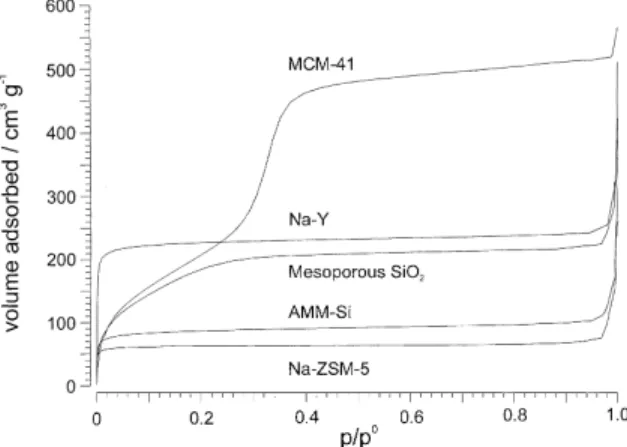
type IV isotherms indicates the presence of micro-pores associated with mesomicro-pores. Experimental iso-therms of both types, obtained with argon at 87.5 K are presented in Fig. 2. According to the de®nition of Brunauer the zeolites Na-ZSM-5, Na-Y, the AMM-Si, and the mesoporous SiO2material are characterized
by type I isotherms. A type IV isotherm is encountered for the MCM-41 sample with a typical adsorbate uptake starting at 0.3p/p0.
4. Mesoporosity
The increase in adsorbed volume at higherp/p0in
type IV isotherms is caused by capillary condensation below the expected condensation pressure of the adsorbate. Capillary condensation is a secondary pro-cess that requires the preformation of an adsorbed layer on the pore walls formed by multilayer adsorp-tion. Both processes generally occur simultaneously in the region of 0.3±1p/p0. The latter is described by the
Kelvin equation (Eq. (1)) that relates the curvature of the meniscus present in a pore to the p/p0 value
associated with condensation. rKRTÿln2 pv=1p
0 (1)
whererKis the Kelvin radius,v1the molar volume of
the liquid condensate, andthe surface tension of the liquid condensate.
The Kelvin radius, the radius of the condensed adsorbate, is obtained via this method. The pore radius for cylindrical pores is given by the Kelvin radius and the ®lm thickness of the adsorbed multilayer t (Eq. (2)).
rprKt (2) whererpis the pore radius andtthe statistical
thick-ness of adsorbed ®lm. Values fortcan be derived from standard isotherms.
Several methods to calculate the mesopore-size distribution from adsorption isotherm data have been developed [7,8]. Most computational methods are based on the BJH model by Barrett, Joyner and Halenda [9]
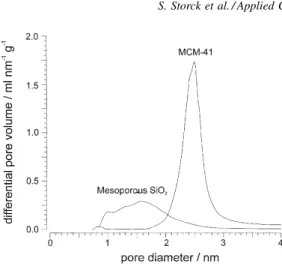
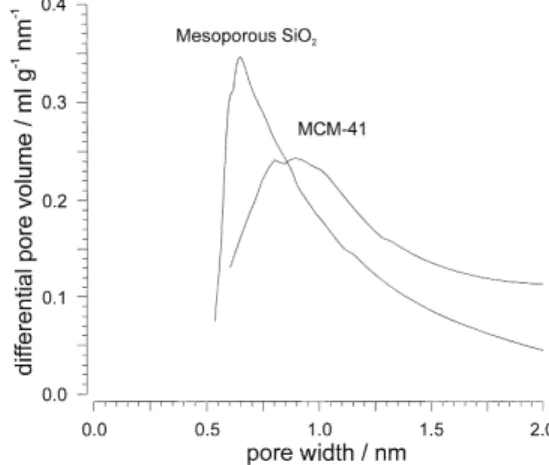
Isotherm data can be derived either from the desorption branch or from the adsorption branch of the isotherm to calculate the mesopore-size distribu-tion. The pore-size distribution of the mesoporous SiO2 material and the MCM-41 material shown in
Fig. 3 have been calculated from the adsorption branch of the isotherm by the BJH method. A pore-size maximum for the MCM-41 material at 2.5 nm has been found. The mesoporous SiO2 exhibits smaller
mesopores (2±2.5 nm) associated with larger micro-pores (1±2 nm) according to the BJH method. BJH-pore-size distributions in the small mesopore to large micropore region should be interpreted with caution because the Kelvin equation (basis of BJH) is reliable only for pores >2 nm. Due to lack of materials with well-de®ned narrow pore-size distributions ranging from 1±2 nm, little can be said about the reliability of size assignments in this pore-size range. However, there is no doubt that the pore sizes of mesoporous SiO2 are in this region, since
below 1 nm and above 2 nm pore-size assignments are reliable.
Fig. 1. Adsorption isotherm types defined by Brunauer [6].
Fig. 2. Adsorption isotherms of the samples tested with Ar at 87.5 K.
5. Microporosity
5.1. Micropore filling
The assessment of micropores (diameter <2 nm) is by no means trivial. Generally, two mechanisms of pore ®lling of micropores have been described by Sing [10]. `Primary' micropore ®lling occurs at low relative pressures (p/p0 <0.01) and involves pores with
dia-meters comparable to the size of the gas molecules used. Adsorption forces (adsorbent±adsorbate) across the pores cause the ®lling of these narrow pores. Larger micropores are ®lled by cooperative effects in a `secondary' process involving adsorbent±adsor-bate interactions in the relative pressure region betweenp/p00.01±0.2.
molecules to block micropores [1]. Empirical methods that allow a semiquantitative analysis of the micropore surface area are thet-plot and thes-plot [11,12]. Both
methods are based on the comparison of adsorption isotherm data of a porous sample and of a nonporous sample of identical chemical composition and surface character (reference isotherm, type II).
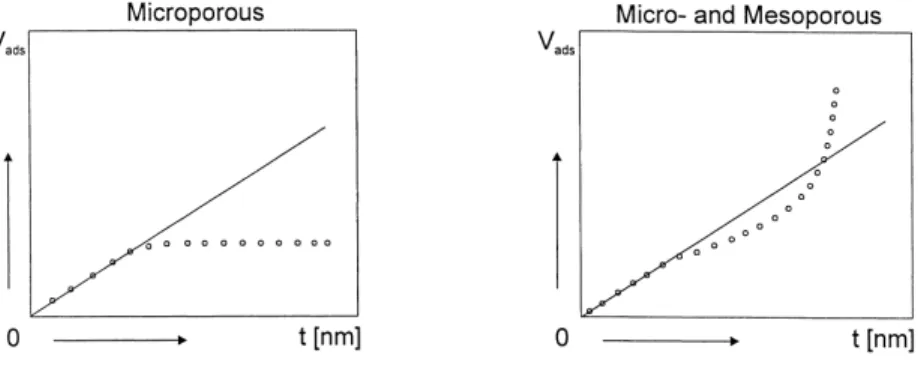
Thet-plot is considered to be the graph ofVadsvs.t.
If both reference and sample isotherm are identical, as is the case for nonporous solids, a straight line passing through or passing close to the origin, should result (Fig. 4). Horizontal departures from the straight line indicate the presence of micropores while vertical plots reveal mesopores. The micropore volume pre-sent is obtained from a straight line extrapolated to a positive intercept on the ordinate (Fig. 5). Although the method could be used quantitatively to determine the micropore surface area, for routine analysis it is, however, dif®cult to obtain reference isotherms of nonporous solids and ensure a precise analysis. For semiquantitative investigations Lecloux suggested the use of reference isotherms with approximately iden-tical BET C constant as the solid to be tested [13,14]. This method has been subject of debate in Ref. [8]. Fig. 3. Pore-size distribution according to the BJH method.
The t-plots of our samples were calculated for a qualitative interpretation by the Lecloux method. In Fig. 6 the intercepts on the y-axis indicate larger micropore volumes for Na-Y, Na-ZSM-5 and the AMM-Si. However, some micropore volume seems also to be present in the mesoporous SiO2material and
in the MCM-41 material. Additional small adsorption steps ca. 0.34 nm present in thet-plots of three micro-porous materials could be interpreted as adsorption in larger micropores or on the outer surface. However, since this step at 0.34 nm appears in all materials, an artefact of the evaluation software is more likely.
A clear upward deviation at large ®lm thickness (0.35 nm) which is typical for mesopore volume is observed for the MCM-41 and the mesoporous SiO2
materials. A positive intercept combined with an upward deviation suggests the presence of a small micropore volume associated with dominating meso-porosity for the MCM-41 and the mesoporous SiO2in
Fig. 6. The shapes of the calculated t-plots strongly deviate from the idealt-plots shown in Figs. 4 and 5. We believe that these differences are mainly caused by the use of the Lecloux method. To obtaint-plots more similar to their expected ideal shape, reference iso-therms stemming from nonporous materials of iden-tical chemical compositions would be required. For routine applications, such as ours, this is usually not possible and the scientist has to rely on such non-idealized t-plots as shown in Figs. 4 and 5.
The s-plot [11] takes a similar approach to the
assessment of micropores. The advantage here is the use of a reduced standard isotherm. Evaluation of micro- and mesopores remains the same as for the t-plot method, also the presence of small micropore regions in the two mesoporous samples is con®rmed. The results of the chosen samples are identical to those found in thet-plot as Fig. 7 depicts. The indication of micropore volume for the MCM material is in clear contradiction to the Ref. [15].
5.3. Isotherms of microporous materials
Information about possible microporosity present in a material can be obtained from points of in¯ection at very low p/p0in the isotherm plotted in logarithmic
scale (high-resolution isotherm). The point of in¯ec-tion corresponds to the pore size of the materials. For materials with smaller pores the pressure transitions should be observable at lower pressures. Different plots have been reported in the literature to locate pressure transitions in adsorption isotherms of crystal-line porous materials.
Venero and Chiou [16] have investigated the zeo-lites Ca-A, Na-ZSM-5 and Na-Y with nitrogen and Fig. 5. t-Plots of microporous and micro- and mesoporous solids.
argon as adsorbates using a continuous volumetric technique at 77.3 and 87.5 K. They report character-istic `S' shaped isotherms in the low-pressure region plotting w/w0 (volume adsorbed divided by volume
absorbed atp/p00.5) vs. logp/p0. Only for argon as
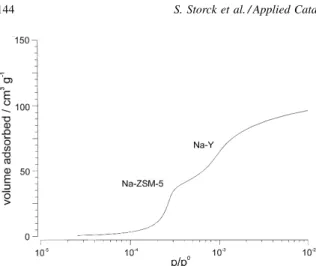
the adsorbate the ®rst-transition regions correlate with the pore diameters of the zeolites. The argon data used in conjunction with the Horvath±Kawazoe (HK) model provides realistic pore-diameter values. The same plot has been used by Saito and Foley [17] and Hathaway and Davis [18]. Borghard et al. pre-sented their results of argon sorption experiments with ZSM-5 by plotting the ®rst derivative of the adsorption isotherm vs. the log of the relative pressure [19]. The two maxima obtained were attributed to 21 and 30 argon atoms per unit cell, respectively. We have investigated the test samples using a plot volume adsorbed vs. log of the relative pressure. It should be emphasized, that the use of one of these methods is crucial for a reliable assignment of microporosity.
From the series of test samples, Na-Yand Na-ZSM-5 have been selected as suitable microporous test materials. The two zeolites should show a difference of ca. 0.2 nm in pore size. The isotherms in the low-pressure region below 10ÿ3p/p
0have been obtained
with N2 (77.3 K), Ar (77.3 K) and Ar (87.5 K) to
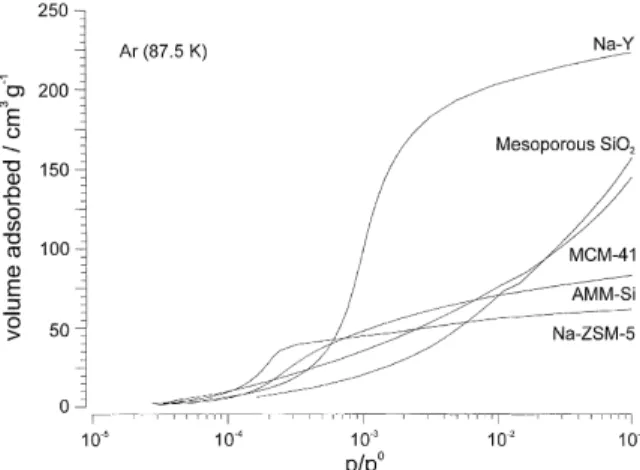
document the effect of adsorbate/temperature combi-nation for physisorption experiments of microporous materials. From Fig. 8(a±c) it can clearly be seen that points of in¯ections at the correct relative pressure can only be obtained with Argon at 87.5 K. With the use of nitrogen as adsorbate it is not possible to differentiate
between the two zeolites, presumably due to its large quadruple moment.
Therefore, the isotherms of all samples obtained with Ar (87.5 K) have been investigated (Fig. 9) Fig. 7.s-Plots of the tested samples.
Fig. 8. Low-pressure regions of the adsorption isotherms of Na-Y and Na-ZSM-5 with N2at 77.3 K, Ar at 77.3 K and Ar at 87.5 K.
con®rming that the AMM-Si material shows a point of in¯ection and is purely microporous. However, Fig. 9 also shows that the pore-size distribution of the AMM-Si material is not as narrow as that of the two crystal-line materials. This might be caused by the presence of a variety of micropore sizes in the AMM material, but it may also be a consequence of differences in che-mical composition and the amorphous nature of the pore walls. Na-ZSM-5 with the smallest micropores adsorbs at 210ÿ4p/p
0followed by the AMM-Si at
510ÿ4p/p
0. A distinct transition for Na-Y appears at
110ÿ3p/p
0. The plot allows a qualitative
classi®ca-tion of micropore sizes according to the pressure transitions. The mesoporous MCM-41 and the meso-porous SiO2materials show a continuous increase in
adsorbed volume withp/p0from 10ÿ5up to 10ÿ1with
no pressure transitions and no in¯ection point indica-tive of the complete absence of micropores and in perfect agreement with the Ref. [15]. There are two explanations for the absence of a distinct point of in¯ection at low p/p0. Either there is an extremely
homogeneous distribution of micropores of all sizes ranging from 0.3 to 3 nm (which is theoretically possible but unlikely in a real system) or there are no micropores at all and the continuous adsorption withp/p0is due to continuous adsorption on a large
surface. The continuous adsorption in the low pressure region of MCM-41 and mesoporous SiO2 (Fig. 9)
does not indicate the presence of micropores, since such continuous adsorption is also present in the low pressure regions of the well de®ned zeolites. However,
this is in contradiction of the qualitative assignment derived from thet-plot method and thes-plot above,
both of which seem to suggest the presence of small amounts of micropores in these mesoporous materials. Since no micropores are present (see above), we con-clude that botht-plot ands-plot assignments must be
wrong. Reasons for this deviation of thet-plot ands
-plot must be the lack of a suitable nonporous standard material and the use of the standard parameters supplied by the software. Both methods should, therefore, be applied with caution in routine applications.
The low resolution isotherm of the mesoporous SiO2material (Fig. 2) is remarkable because it shows
a type I isotherm typical of microporous materials while apparently no micropores are present. This ®nding emphasizes the crucial importance to double check sorption data for the presence of micropores. The shape of the isotherm, as recommended in the traditional literature, is clearly no longer a suf®cient criterion. We emphasize the inspection of the low-pressure range of the isotherm as already recom-mended by Davis and others.
To document the high resolution by the use of Argon at 87.5 K together with proper vacuum condi-tions, we have performed a competitive adsorption experiment with a physical mixture of Y and Na-ZSM-5. As shown before by Saito and Foley [17], both transitions are present and indicate volume uptake in different p/p0 regions (Fig. 10). This procedure of
competitive adsorption assures identical adsorption conditions and should be recommended as a suitable test procedure for equipment characterization. Only such equipment, capable of differentiating among different pore sizes of zeolites should be entrusted with micropore analyses.
5.4. Pore-size distributions
Micropore-size distributions are derived from phy-sisorption isotherm data and provide valuable micro-structural information. The HK model [20] relates relative pressure (p/p0) to a micropore radius
described by a Lennard±Jones potential [2]. Isotherm data acquisition at very low pressure in the region of micropore ®lling (p/p0<0.01) is necessary for the HK
model to obtain reliable data. [21] However, the HK method shows some major drawbacks which limit its reliability. The HK slit model was proposed for the Fig. 9. Low-pressure regions of the adsorption isotherm of all
evaluation of micropores in carbon molecular sieves. For zeolites, oxides and aluminophosphates, this HK model may not be adequate because the effects of curvature on the forces of adsorption are neglected. Nor are there parameters that distinguish between crystalline and amorphous materials. Further pro-blems are caused by the assumption that the adsor-bate±adsorbate and adsorbate±adsorbent interactions are considered to be equal within the narrow micro-pores. To overcome some of these problems modi®ca-tions have been suggested in the past. The polarizability and the magnetic susceptibility in the potential term have been adjusted to the adsorbate and adsorbent used. But it has been found that the in¯u-ence of the potential parameter on the position of the distribution maxima is only small [1]. It is striking that we could obtain correct distribution maxima for sili-con oxide based materials using a nitrogen on carbon potential while calculations performed with an argon on silicon dioxide potential did not lead to satisfying results for the same materials. A problem of the method is the limited availability of physical para-meters required in the Lennard±Jones potential term especially for new catalyst materials. Nevertheless, the method can be used for routine analysis effec-tively, if based on careful calibration with de®ned microporous structures. Zeolites are well suited for this task since they have been characterized in detail using a variety of methods to determine their pore size. The isotherms discussed above have been used to calculate HK-pore-size distributions. Fig. 11(a±c)
con®rm our results that only with the use of Ar at 87.5 K it is possible to distinguish between pore sizes of Na-Y and Na-ZSM-5. The HK-pore-diameter dis-Fig. 10. Low-pressure regions of the adsorption isotherm of the
competitive adsorption of Na-Y and Na-ZSM-5 with Ar at 87.5 K.
Fig. 11. Pore-size distributions of Na-Y and Na-ZSM-5 according to the HK method with N2at 77.3 K, Ar at 77.3 K and Ar at 87.5 K.
tribution plots for N2at 77.3 K and Ar at 77.3 K show
inaccurate pore-size maxima. The results are summar-ized in Table 1. This calibration procedure allowed a precise pore-diameter determination for the AMM-Si material. Fig. 12 shows the AMM-Si catalyst with a pore-size maximum of 0.62 nm located between both zeolite structures. As already expected from the broad transition region in the plot adsorbed volume vs. log p/p0, the AMM material has a broader micropore
distribution than the zeolites The HK method can be applied to differentiate micro pore size distribution maxima located close to each other in a physical mixture of two different zeolite materials as shown in Fig. 12. According to Fig. 13, HK indicates also the presence of micropores in both mesoporous materials, the MCM-41 and the mesoporous SiO2. Fig. 14, the
micropore distribution of these mesoporous materials plotted with a different scale of they-axis suggest the clear presence of micropore volume con®rming thet -plot and thes-plot as discussed above. However, as
already outlined above, the absence of a point of in¯ection in the high-resolution isotherm is direct evidence for the absence of micropores in these mate-rials. Therefore, this micropore assignment of the HK method as well as of thet-plot and thes-plot must be
an error. We recommend to apply these secondary methods only, if the high-resolution isotherm shows a clear point of in¯ection in the micropore region. 6. Conclusions
For the analysis of new microporous materials, a calibration procedure with substances of de®ned pore Table 1
Mean pore diameters of Na-ZSM-5 and Na-Y according to the HK method with N2at 77.3 K, Ar at 77.3 K and Ar at 87.5 K
Adsorbant N2 Ar Ar Data of Ref. [5]
T(K) 77.3 77.3 87.5 Na-Y Pore size (nm) 0.66 0.74 0.70 0.74 Na-ZSM-5 Pore size (nm) 0.65 0.72 0.62 0.530.56 0.510.55
Fig. 12. Pore-size distribution of Na-Y and Na-ZSM-5 in competitive adsorption (from Fig. 10).
Fig. 13. Pore-size distributions of all tested samples according to the HK method with Ar at 87.5 K.
Fig. 14. Pore-size distributions of MCM-41 and mesoporous SiO2 samples according to the HK method with Ar at 87.5 K from Fig. 13 with different scale of they-axis.
adsorbed volume against logp/p0as already suggested
by others. Isotherm shape, HK treatment,s-plot and
t-plot have been shown to be misleading. Pore-size distributions obtained by the HK method and assign-ments froms- andt-plots should only be trusted, if the
former condition is ful®lled. We have shown that the physisorption analysis of microporous solids can be carried out routinely with commercial technical equip-ment if proper calibration and calculation procedures have been applied.
Acknowledgements
We thank H. Reichert for valuable discussions, F. SchuÈth for a MCM-41 sample and the Fonds der Chemischen Industrie for ®nancial support.
References
[1] J. Seifert, G. Emig, Chem.-Ing.-Tech. 59 (1987) 475. [2] W.F. Maier, I.-C. Tilgner, M. Wiedorn, H.-C. Ko, Adv. Mater.
5 (1993) 726.
[9] E.P. Barrett, L.G. Joyner, P.P. Halenda, J. Amer. Chem. Soc. 61 (1951) 373.
[10] K.S.W. Sing, J. Rouquerol, in: G. Ertel, H. KnoÈzinger, J. Weitkamp (Eds.), Handbook of Heterogeneous Catalysis, vol. 1, VCH, Weinheim, 1997, p. 427.
[11] K.S.W. Sing, Chem. and Ind., (1968) 1520. [12] B.C. Lippens, J.H. De Boer, J. Catal. 4 (1965) 319. [13] A. Lecloux, J.P. Pirard, J. Colloid Int. Sci. 70 (1979)
265.
[14] P. Schneider, Appl. Catal. A 129 (1995) 157.
[15] P.J. Branton, P.G. Hall, K.S.W. Sing, H. Reichert, F. SchuÈth, K.K. Unger, J. Chem. Soc. Faraday Trans. 90 (1994) 2965; M. Kruk, M. Jaroniec, A. Sayari, Langmuir 13 (1997) 6267.
[16] A.F. Venero, J.N. Chiou, Microstructure and Properties of Catalysts; Mat. Res. Soc. Symp. Proc. (Boston, MA), Characterization of Zeolites by Gas Adsorption at Low Pressures, (1987) 235.
[17] A. Saito, H.C. Foley, Microporous Mater. 3 (1995) 531. [18] P.E. Hathaway, M.E. Davis, Catal. Lett. 5 (1990) 333. [19] W.S. Borghard, P.T. Reischman, E.W. Sheppard, J. Catal. 139
(1992) 19.
[20] G. Horvath, K. Kawazoe, J. Chem. Eng. Jpn. 16 (1983) 470.