Multimodal Biometric System for Person
Identification using Wavelet Function
Ramneet Kaur1, Jyoti Saxena2, Sukhjnder Singh3
1
Research Scholar, 2Professor, 3Assistant Professor, Department of ECE, GZS-PTU Campus, Bathinda, Punjab, India
Abstract: In this paper, a multimodal biometric system which combines features of face, fingerprint and iris to overcome numerous limitations of unimodal biometric systems is presented. The quality of face, fingerprint and iris images are firstly enhanced using a series of pre-processing techniques such segmentation, normalization etc. Then the features of all these three traits are extracted from the pre-processed images. This approach has been tested on a Casia database consisting of 90 images and shows promising results as compared to other techniques.
Keywords— Receiver Operating Characteristics curve, Segmentation, Normalization, Feature Extraction and Reverse bio-orthogonal wavelet Transform etc.
I. INTRODUCTION
A biometric system provides automatic recognition of an individual based on some sort of unique feature or characteristic of the individual. The system is based on fingerprints, facial features, voice, hand geometry, handwriting, the retina and iris. Biometrics is derived from Bio (means life) and Metrics (means system used for measurement). This means that biometrics is the technology of measuring and analysing physiological or biological characteristics of living body for identification and verification purposes. Unimodal biometric systems face a variety of problems such as noisy data, intra-class variations, restricted degrees of freedom, non-universality, spoof attacks and unacceptable error rates. The limitations imposed by unimodal biometric systems can be overcome by using multiple sources of information for establishing identity. Such systems are known as multimodal biometric systems. These systems are more reliable due to the presence of multiple independent pieces of evidence. Spoofing is not possible in multimodal biometric system because it would be difficult for an impostor to spoof multiple biometric traits of a genuine user simultaneously.
Multimodal system is a combination of two or more than two biometric traits of an individual for the identification purposes. Use of multimodal biometric system provides high security as compared to unimodal biometrics. A number of approaches have been proposed and developed for the multimodal biometric authentication system. C.N Dinakardas et.al [1] discussed a multimodal system in which they use PCA(Principal Component Analysis), fisher face projection, minutia extraction and LBP (Local Binary Pattern) for Face ,Fingerprints and Iris traits. Le Hoang Thai and Ha Nhat Tam [2] discussed the standardized fingerprint model which is used to synthesize the template of fingerprints. John G.Daugman [3] was the first who proposed the Iris Recognition algorithm in 1990s and got US patent for his work. K.Kryszczuk et al.[4] have demonstrated a method of performing multimodal fusion using unimodal classifier data, signal quality measures, and reliability estimates. The example of face and speech modalities was taken so that the proposed method can be effectively applied to multimodal biometric fusion. Nadir Naurain Dawoud and Brahim Belhaouari Samir [5]examined wavelet functions in order to choose the best wavelet for face classification process and for finding the optimal number of levels of decomposition. All these systems provide efficient results but have complexity in the algorithm and time consuming also. So, the aim of this work is to reduce the complexity and improve the efficiency.
The structure of the remaining paper is divided into 4 sections. Implemented work has been detailed in section II. Section III gives the result evaluation of the methodology. Finally it is concluded in section IV.
II. IMPLEMENTATION
The process begins with pre-processing of the acquired images which removes the effect of noise. Then, features are extracted for the training and testing images and matched to find the similarity between feature sets. The matching scores generated from the individual recognizers are passed to the decision module where a person is declared as genuine or an imposter. In the next section a brief overview is described about the face, fingerprint and iris. Then all three individual recognizers combined together for the fusion. Figure 1 illustrates the flow chart of the algorithm used in the system. The steps of the process are briefly shown
in this.
Fig1: Flow chart of the algorithm
A. Iris Recognition
Iris is a unique feature of each individual which remains unchanged over the life. In the center of the eyeball a circular black disk is pupil which dilates when exposed light and contracts in dark. Iris is the portion between the dark pupil and the white sclera and contains the flowery pattern unique to each individual. The eye image is digitized and then the unique characteristics are extracted from the digitized image by using some image processing techniques and other algorithms. Then that unique feature is matched with the features stored in the database and the person is identified.
J.G.Daugman [3] proposed automated iris recognition system in which to extract texture phase structure information of the iris, the concept of multi-scale quardrature wavelets is used, XOR operator is used to generate a 2048 bit iris code and compares the difference between a pair of iris representations by computing their Hamming distance. To characterize the texture of the iris the zero-crossing representation of 1-D wavelet transform at various resolution levels of a virtual circle on an iris image has been calculated in[7] by W.W.Boles and B.Boashah. The important steps involved in iris recognition are:
1. Segmentation 2. Normalization
1) Segmentation: Segmentation is the first step of the iris recognition. Basically it is the process of localizing the iris portion i.e. the area between the pupil (dark portion of the eye) and the sclera (white portion of the eye). In this process Canny Edge Detection (CED) and Circular Hough Transform (CHT) have been used to localize the iris in the eye image[9].
a) Canny Edge Detection (CED): It is a widely used edge detection technique. A Gaussian filter is used to suppress the high frequency signals in the canny edge detection. From Gaussian filter a smoothened image is obtained.Figure 2 describes the original image of eye and output after the threshold.
(b)
Fig 2: (a) Original image and (b) Output image after threshold
Gradient operator is applied on this smoothened image to obtain the first order partial derivatives. In the last of the canny edge detection process the false edges removed by thresholding the output of Non Maxima Suppression (NMS).
b) Circular Hough Transform (CHT): After the CED, CHT is applied to obtain the contours of iris and pupil. CHT gives the boundary of the iris and the pupil, which are related by the following expression.
( ) are the centre coordinates of the circle and ‘R’ is the radius.
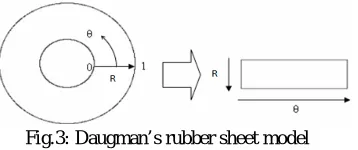
[image:4.612.229.408.273.348.2]2) Normalization: After the segmentation of iris normalization is performed. Daugman’s Rubber Sheet Model [3]is used for normalization of iris as shown in figure 3.
Fig.3: Daugman’s rubber sheet model
Using this model, the Cartesian coordinates (x, y) are converted into polar coordinates (R, ). After normalization the iris portion became rectangular in shape with fixed sizes for all the iris images. After that, the region of interest has been obtained. The normalized image is shown in Fig. 4(a).
(a)
(b)
(c)
Fig.4: (a) Normalized image (b) Region of interest and (c) Enhanced normalized image
After achieving normalization, region of interest is obtained by eliminating the iris portion that is occluded by the upper and the lower eyelids. Then the image is enhanced by using Gaussian filter. Fig. 4 (b) shows the resultant image for region of interest and (c) enhanced normalized image.
B. Fingerprint Recognition
Another one of the most widely used biometric trait is Fingerprint. Fingerprint recognition is one of the most popular and well-known biometrics. Because of their uniqueness, fingerprints have been used for recognition for over a century. Recently fingerprint recognition is becoming automated (i.e. a biometric) due to advancements in computing capabilities. The major steps involved in fingerprint recognition using minutiae matching approach after image acquisition are:
1. Image Enhancement 2. Minutiae Extraction
[image:4.612.206.407.399.506.2]2) Minutiae Extraction: The enhanced fingerprint image is binarized and submitted to the thinning algorithm which reduces the ridge thickness to one pixel wide. The skeleton image is used to extract minutiae points which are the points of ridge endings and bifurcations. The location of minutiae points along with the orientation is extracted and stored to form feature set. For extraction of minutiae points eight connected pixels are used.
C. Face Recognition
The least intrusive and fastest biometric technology is the face recognition. This technology works with the recognition of human face. Unlike other recognition systems in which people need to place their hands on a reader or precisely position their eye in front of the scanner, face recognition system takes picture of people’s face as they enter a defined area.After that normalization is done which is the process used to make all the images of same size. For the face recognition normalization is done before the feature extraction and then a Gaussian filter is used to remove the noise from images.
D. Feature Extraction
After normalization, the features of the normalized image are extracted. In the implemented algorithm, wavelet transform function is used for the features extraction of iris, Fingerprint and face images. Using 2-D Reverse bio-orthogonal wavelet transform (RBWT) Multi level decomposition has been performed. The extracted features from normalized images get stored in the coefficients of the wavelet transform. The next level of decomposition is performed on the coefficients of the previous level in the case of multilevel decomposition.
E. Fusion
Fusion is done after pre-processing and feature extraction of all three individual traits. Fusion is a process which is used to combine all the extracted features for the better results because no individual trait can provide 100% accuracy. The results generated from the individual traits are good but the problem arises due to exposure to light, variation in background and presence of cuts and scars on finger ,the user is not able to give his/her image during iris, face and fingerprint recognition. Thus to overcome the problems faced by individual traits of iris, face and fingerprint, a novel combination is proposed for the recognition system. The integrated system also provides anti spoofing measures by making it difficult for an intruder to spoof multiple biometric traits simultaneously. For the fusion of biometric template we simply take the assumption that the coefficient which are greater than zero are taken as +1 and the coefficient which are less than zero are taken as -1. Then we simply add the coefficients of all the traits
F. Template Matching
For matching purpose Hamming Distance (HD) has been calculated between the two templates. A threshold level is set 0.043. If the hamming distance between the two templates is less than the threshold, then the templates are considered to be of the same person. If the hamming distance is greater than that threshold, then the templates are of different persons. Hamming distance is calculated by taking exclusive-OR of the two inputs as shown below:
III.RESULTSANDDISCUSSION
Fig.5: Histogram of Inter class HD of images Fig.6: Histogram of Intra class HD of images
Fig.7: Overlapping of inter and intra classes
The area under ROC curve is the reliability measure. Results show that high performance was obtained by the proposed scheme when compared to other multimodal biometric systems. We compare wavelet transform technique in terms of sensitivity and specificity in terms of Receiver Operating Characteristics Curve (ROC). Fig. 7 shows the results. From the results shown in the graph, it is clear that Wavelet transform works more efficiently than PCA System which was used by Dinakardas CN et al [1].
positive rate at the various threshold settings.
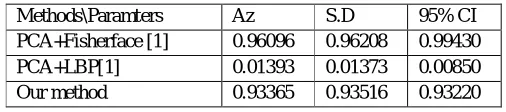
[image:7.612.179.432.182.238.2]In the following table comparison is done between proposed algorithm and pre-existing algorithm used for multimodal biometric system by Dinakardas CN et al. in the terms of area under curve (AZ), Standard Deviation (S.D) and 95% confidence Interval (CI).
TABLE I: Comparison of proposed algorithm with pre-existing algorithm
Methods\Paramters Az S.D 95% CI
PCA+Fisherface [1] 0.96096 0.96208 0.99430
PCA+LBP[1] 0.01393 0.01373 0.00850
Our method 0.93365 0.93516 0.93220
IV.CONCLUSION
This paper implemented an multimodal recognition algorithm with a new approach which includes 2-D RBWT used for extracting the features. The algorithm gives a high correct recognition rate with low FAR and FRR. Comparison of proposed algorithm with some well known algorithms is shown in Table I. It is clear from Table I that the performance of the proposed algorithm is better than Dinakardas CN et.al multimodal recognition system [1].
V. ACKNOWLEDGMENT
We would like to express our deep gratitude to Dr. J. S. Hundal for his valuable support. We are very thankful to whole staff for their guidance and motivation at every step.
REFERENCES
[1] Dinakardas CN, Dr.S Perumal Sankar and Nisha George, “A Multimodal Performance Evaluation on Two Different Models Based on Face, Fingerprint and Iris Templates”, IEEE International Conference on Emerging Trends in VLSI, Embedded System, Nano Electronics and Telecommunication System(ICEVENT), pp 1-6, Jan 2013.
[2] Le Hoang Thai and Ha Nhat Tam, “Fingerprint recognition using standardized fingerprint model,” International Journal of Computer Science Issues (IJCSI) vol. 7, pp. 11-17, May 2010.
[3] John G Daugman, “High Confidence Visual Recognition of Persons by a Test of Statistical Independence”, IEEE Transactions on Pattern Analysis and Machine Intelligence, vol.15,No.11, pp 1148-1161, Nov. 1993.
[4] K.Kryszczuk,1. Richiardi, P.Prodanov, and ADrygajlo, "Reliability-Based Decision Fusion inMultimodal Biometric Verification Systems", EURASIP Journal on Advances In Signal Processing ,Volume 2007, Article TD 86572 .
[5] Nadir Nourain Dawoud and Brahim Belhaouari Samir, “Best Wavelet Function For Face Recognition Using Multi-level Decomposition”, International Conference on Research and Innovation in Information System(ICRIIS), pp 1-6, Nov.2011.
[6] J. Fierrez-Aguilar, J. Ortega-Garcia, D. Garcia-Romero and J. Gonzalez-Rodriguez:A Comparative Evaluation of Fusion Strategies for Multimodal Biometric Verification, Springer-Verlag Berlin Heidelberg LNCS 2688, pp. 830-837, 2003.
[7] Boles and Boashash, “A Human Identification Technique Using Images of the Iris and Wavelet Transform”, IEEE Transactions on Signal Processing, vol. 46, no. 4, pp. 1185-1188, 1998.
[8] L. Masek, , “Recognition of human iris patterns for biometric identification”, Technical Report, School of Computer Science and Soft Engineering, The University of Western Australia.
[9] Mohd. Tariq Khan, Dr. Deepak Arora and Shashwat Shukla, 2 13 , “ Feature Extraction Through Iris Images using 1-D Gabor Filter on Different Iris Datasets”, 6th International Conference on Contemporary Computing (IC3), pp. 445-450, Aug. 2013