• No results found

Shaping the Future: A Vision for Learning Disability Nursing

N/A
N/A
Protected

Academic year: 2021

Share "Shaping the Future: A Vision for Learning Disability Nursing"

Copied!
44
0
0

Loading.... (view fulltext now)

Full text

(1)

Shaping the Future:

A Vision for

Learning Disability

Nursing

UK Learning Disability

Consultant Nurse Network

July 2006

(2)

Shaping the Future:

A Vision for Learning

Disability Nursing

edited by

Ruth Northway

Christine Hutchinson

Anne Kingdon

Publishers:

UK Learning Disability Consultant Nurse Network

United Kingdom

(3)

������������

��������������������������������������������������������������

�����������

�������������

��������������

������������

�������������

��������������

��������������

��������������

�������������

�����������

�������������

��������������

���������������

�������������

����������

��������������������

������������

���������������

�������������

�����������

�����������

��������������

������������

����������������

�����������

������������������

�������������������

����������������������������

���������������������������������������

����������������������������������������

�����������������������

�����������������������������������

��������������������������������������

��������������������������

�������������������������������

��������������������������

�������������������������

�����������������������������������������������

����������������������������������

���������������������������������������������������

���������������������

������������������������������

������������������������������������������������������

�����������������������

����������

�������������������������������

����������������

�������������������������

��������������������������������

�������������������������������

�������������������������������������������

�����������������������������

(4)

Forward

Developing the vision for nurses specialising in addressing the health

inequalities experienced by people with learning disabilities is timely

and welcome as the evidence base clearly demonstrates people with

learning disabilities experience significant health needs that frequently

go unmet.

This has a significant impact on their quality of life and it is therefore

essential for nurses to clearly identify the range of contributions that

they can make in addressing those needs.

The Royal College of Nursing Learning Disability Forum is committed to

working with people with learning disabilities and their carers to

promote health improvement and wider social inclusion. The forum

recognises that the vision set out in this report will be invaluable for all

people and services involved in the provision of health and social care

for people with learning disabilities.

Michelle Persaud

Chair of Learning Disability Forum, Royal College of Nursing

The national network of learning disability nurses is delighted to

support the publication of the vision for learning disability nurses. All

nurses where ever they practice have an important role in meeting the

health needs of people with learning disabilities. Learning disability

nurses have a vital contribution in working in partnership with people

with learning disabilities, healthcare and social care services and the

independent sector. By promoting and enabling effective networking

and collaborative approaches to care, there is the opportunity for

learning disability nurses to help address the health needs of people

with learning disabilities across the United Kingdom.

Caron Thomas

(5)

Acknowledgements

Many other people have helped in the development of the document;

those who contributed to early discussions, responded to the

consultation, and acted as critical readers in the final stages. The UK

LD CNN extends thanks to all those people.

Additionally the cost of printing this document has been supported by:

Learning Disability

Forum

(6)

Section

Contents

Page

1.

Vision & Purpose

3

2.

Context

4

2.1

Historical Perspectives

4

2.2

Philosophical Perspectives

5

2.3

Policy Context

5

2.4

The Changing Role of the Learning Disability Nurse

6

2.5

Evidence of Health Need

7

Section 2 Summary

8

3

Achieving the Vision

9

3.1

Nursing Practice

9

3.2

Education

13

3.3

Leadership

14

3.4

Research

16

Section 3 Summary

17

4.

Action

18

4.1

Change Management

18

4.2

Influencing Policy

18

4.3

Workforce Issues

19

4.4

Career Pathways

19

5.

Recommendations

20

6

Conclusion

22

7.

References

23

Appendices

a

Terms & Definitions

28

b

Policy Table

30

c

Health Needs Table

31

d

Levels of Health Need Table

34

e

Change Management

35

(7)

Introduction

This document has been produced as the result of collaboration between

members of the UK Learning Disability Consultant Nurse Network and

others who are involved in meeting the needs of people with learning

disabilities.

The first section of the document describes a vision for the future of

learning disability nursing and the purpose of the document. Section two

considers the context from an historical and contemporary perspective,

reflecting on the developments in learning disability nursing practice and

evidence of health needs. Section three describes the building blocks for

achieving this vision in key areas in which we believe all learning

disability nurses have a role to play;

practice, education, leadership

and

research. Sections four and five describe areas for action and

provide recommendations for how these actions can be implemented.

Whilst this document is not intended to provide a definitive reference

regarding the needs of people with learning disabilities, or the roles of

learning disability nurses, a great deal of information was generated in

the course of it’s production. Additional information that will be useful to

learning disability nurses and others is included at the back of the

document in the form of appendices.

Coming together as a UK wide network to write this document has placed

the extraordinarily diverse roles that learning disability nurses undertake

into sharp focus and resulted in some very informative and lively

discussions. As a group of Consultant Nurses we all have a ‘practice’

component to our roles; lessons learnt from people with learning

disabilities, and their families and carers, through our collective direct

contact with them has been a major influence in shaping our vision and

the contents of this document.

People with learning disabilities themselves do not constitute an

homogenous group, and the social and cultural backdrop against which

people live and work differs greatly across the UK. We have attempted to

reflect this in our vision by focusing on broad principles for developments

in health services for people with learning disabilities, and the

contribution that nurses must make to these in order to ensure that they

are equitable, of a high standard, and able to meet the needs of all

people with learning disabilities.

We hope you will find this document informative and thought provoking.

We have learned a great deal from each other and from all those who

have been involved in producing it.

(8)

1.

Vision & Purpose

The United Kingdom Learning Disability Consultant Nurse Network

believes that in order for the learning disability nursing profession to

progress into the 21

st

century, “

with a renewed sense of purpose, devoid

of confusion and ambiguity associated with the legacies of the past”

,

(Jukes and Bollard 2003) it needs a shared vision to promote, articulate,

and drive the distinct identity and unique expertise of the learning

disability nurse.

The aim of this document is to set out the direction of travel for learning

disability nurses and provide a resource to help nurses to understand and

articulate their contribution to the health needs of people with learning

disabilities (see Appendix a for definitions). In setting out our vision, we

recognised that some learning disability nurses across the UK have been

at the forefront of practice and service development. However we also

recognise that there are nurses who need clarity of purpose to enable

them to develop.

Our vision is that:

Learning disability nurses will lead the way in achieving positive

health outcomes for people with learning disabilities. They will use

an inclusive and collaborative approach to address barriers to social

inclusion and will function as integral members of the wider family of

nursing, developing and using their specialist knowledge and skills to

improve the health and well being of children, adults and older

people with learning disabilities across all settings.

Learning disability nurses will realise this vision through the effective use

of

SPECIALIST NURSING PRACTICE, RESEARCH, EDUCATION

and

LEADERSHIP

.

This document is aimed primarily at learning disability nurses registered

with the Nursing and Midwifery Council (NMC) and those who are training

to be learning disability nurses. Its content will also be useful to others

who have professional contact with learning disability nurses for example

other nurses, service commissioners, local authority services and

independent (third) sector providers.

Over the last 30 years the settings in which learning disability nurses

practice and the nature of their role, has both developed and expanded

(Northway, 2004). Nonetheless no profession can rest on its laurels

particularly in the context of rapidly changing and developing services.

This document therefore aims to empower learning disability

nurses to:

Recognise and articulate their value and impact within a holistic approach to

healthcare.

(9)

Develop their practice within the context of developing services in their country

in the UK.

Reaffirm the place of learning disability nursing within the family of nursing and

achieve equal value with other members of the nursing profession.

2.

Context

When a professional group sets out a vision for its future development

there is a danger that it could be interpreted simply as a means of

preserving and promoting its own role. It is thus important to

understand that the starting points for this document were:

The recognition that learning disability services have undergone tremendous

changes in the past three decades;

That despite these changes people with learning disabilities continue to be

marginalized, segregated and excluded;

That there is growing evidence of a very high incidence of unmet physical and

mental health needs, including behavioural difficulties, in the population of people

with learning disabilities;

That there is clear evidence that the health needs of many people with learning

disabilities are complex, multiple and difficult to understand;

That this has a negative impact upon many people’s quality of life;

Our belief that the learning disability nursing profession makes a significant

contribution to meeting the health needs of people with learning disabilities;

That learning disability nurses need to keep step with modernisation and reform in

the NHS;

Recognition that the quality of the relationships nurses have with patients and

their families helps sustain confidence in the NHS (DoH 1999).

2.1 Historical perspectives

In setting out a vision for the future we believe it is essential to recall and

reflect on the legacies of the past. Many people with learning disabilities

have always lived in community settings either with families,

independently, or within Social Services’ hostel accommodation (Mental

Health Foundation, 2001, Mencap, 1998).

Between 1946, when the

National Health Service was introduced, and 1971 when the Government

(DHSS 1971) announced the need for closure of the long stay

institutions, learning disability nurses worked exclusively in large ‘mental

handicap’ hospitals. Historically these hospitals provided both community

and home to many people with learning disabilities and the roles of

nurses were very broad involving the delivery of all aspects of care and

support. The day-to-day care that would now be recognised as specialist

health provision has therefore traditionally been delivered within long

stay institutions and been limited to those residing within them (Phillips

et al, 2004).

The community is now fully recognised as the rightful place for people

with learning disabilities (DH, 2001; Jones, 1999). This shift has resulted

in the closure of most long stay hospitals with many learning disability

nurses transferring their caring role from hospital to community settings.

It has increasingly been recognised that some people have needs that

cannot be met by their direct support staff or carers alone. This

(10)

recognition has been associated with the development of dedicated

specialist health services in the community. In most areas these services

have taken the form of teams of health professionals whose primary

focus is on providing specialist health interventions to people with

learning disabilities. Whilst the constitution of teams varies greatly from

area to area most teams include a significant number of learning

disability nurses.

The closure of long stay institutions has also seen the development of

alternative specialist in-patient services in the NHS and by independent

(third) sector providers. In the main these ‘hospital’ services no longer

provide homes for life but have evolved, or been newly established, to

provide dedicated in-patient services where people receive specialist

health interventions and treatment. Much of the direct care, and a

significant proportion of the interventions in these services are provided

by learning disability nurses.

2.2 Philosophical Perspectives

A social care model of service provision, in keeping with changing

philosophies of care, now predominates in most service settings. In

some instances this has been associated with a neglect of health needs in

the mistaken belief that a focus on such needs constitutes a drift back

towards the medical model. There is also some confusion regarding the

difference between a social model of service provision and the social

model of disability. The former relates primarily to who provides the

support that people with learning disabilities receive. The latter refers to

a view of disability which argues that people with impairments are

disabled by a range of physical, social, economic, psychological and

attitudinal barriers that prevent or limit their full participation in society

(Prime Ministers Strategy Unit, 2005). Ill health and behavioural

challenges can and do limit participation in society. The primary focus of

nursing interventions within the social model of disability is therefore

upon reducing or eliminating barriers to good health and thereby

increasing social inclusion.

It could be argued that the emphasis given to social models of service

provision has resulted in some learning disability nurses having lost, or

no longer seeing themselves as members of the wider “family of

nursing”. We believe that the proactive involvement of all learning

disability nurses in wider nursing developments will bring benefits for

people with learning disabilities, their families and carers, and there is

much that nurses from other branches of the profession can learn from

their learning disability nursing colleagues.

2.3 Policy Context

Devolution of governmental responsibility for health and social care

means that England, Scotland, Wales and Northern Ireland have each

developed their own policies in relation to the provision of services for

people with learning disabilities. Learning disability nursing also needs to

be considered within the context of wider developments in nursing and

(11)

each country has developed its own policies in relation to nursing and, in

some instances, specifically in relation to learning disability nursing (see

Appendix b).

Since the closure of all but a few of the long-stay hospitals discreet

nursing roles have emerged in both community settings and within

mainstream and specialist hospital settings. Current policy calls for

actions to ensure that people with learning disabilities are able to access

mainstream healthcare provision equipped to meet their needs. Policies

across all UK countries recognise that this cannot be achieved without

active intervention and support from specialist learning disability health

services that are not available from wider ‘mainstream’ health service

provision.

Learning disability nurses play a crucial role by providing health

assessment, treatment, intervention, education and support for people

with learning disabilities, their carers, generic health services and others.

This partnership approach between primary care, child health, mental

health, acute care, other agencies and dedicated learning disability health

services is essential.

2.4 The changing role of the learning disability nurse

Learning disability nurses have responded positively to radical changes in

the way services are provided. They have adapted their practice in the

face of close scrutiny and have largely moved away from working in

closed institutional settings to community based practice in partnership

with others.

Changes in the way services are provided have raised questions as to the

appropriate role of specialist health services for people with learning

disabilities. As a result there is sometimes a feeling amongst the learning

disability nursing profession that their knowledge and skills are not fully

valued, and that the contribution that they make to meeting the health

needs of their client group is not fully recognised, understood, or utilised.

Attention has revolved primarily around two questions:

Whether the support needs of people with learning disabilities are primarily social

or health in nature? and;

Whether nursing support should be of a specialist or generic nature?

Responses to these questions have included a nursing curriculum based

upon a social care model (ENB and WNB 1985) and the validation of joint

training programmes in the 1980’s producing practitioners qualified as

both learning disability nurses and social workers (Brown, 1994). The

need for a completely new form of practitioner has also been considered,

but rejected.

Cullen (1991) explored options for the role of the learning disability nurse

within the context of changing responsibilities arising from new

arrangements for community care. The preferred option was for the

(12)

health promotion role of the learning disability nurse to be advanced. It

was argued that all people with learning disabilities had both health and

social care needs although the level and complexity of these needs would

vary from person to person. Cullen recognised that nurses could

therefore work to address health needs across the range of settings in

which people with learning disabilities live and work.

Kay et al (1995) confirmed the Government’s commitment to learning

disability nursing. “Continuing the Commitment” sought to clarify and

articulate the specific contribution of the learning disability nurse to the

support and care of people with learning disabilities. Subsequent policy

across the UK has re-affirmed this commitment and identifies the roles

that specialist learning disability nurses will play in the delivery of both

mainstream and specialist health services to people with learning

disabilities.

2.5 Evidence of health needs

Evidence suggests that the number of people with learning disabilities will

increase by about 1% over the next 15 years (DH, 2001). Greater

numbers of people with learning disabilities are now surviving into

adulthood and living longer into old age with many presenting with

complex and multiple health needs (DH 2001). A study by the Disability

Rights Commission due for completion in summer 2006 will no doubt

contribute further to the evidence base regarding health needs. These

factors have obvious implications for all services including those provided

by learning disability nurses.

There is clear evidence that many physical health needs are more

common and are present in greater number in people with learning

disabilities (Howells 1986, Wilson and Haire 1990, van Schrojenstein

Lantman-de Valk et al 1997). Evidence also points to a differing pattern

of health needs and cause of death of this group (Cooper et al 2004),

(see Appendix c). As a result people with learning disabilities, despite

living longer than has previously been the case, can still expect to have a

significantly shorter life expectancy (Hollins et al 1998, Patja 2000) and

are much more likely than others in the population to die before the age

of 50. Many people experience multiple health needs and life expectancy

is shortest amongst people who have the most support needs (McGuigan

et al 1995).

In addition to physical health needs people with learning disabilities are

at greater risk of developing some psychological disorders, more likely to

experience mental health problems, are frequently excluded from

services as the result of challenging behaviour and often encounter

insurmountable barriers regarding access to mainstream services.

Assessing both the physical and mental health needs of people with

learning disabilities can be complex and as a result many health needs go

unrecognised and untreated. This can have grave consequences for

(13)

some and will have a significant negative impact on the quality of life of

the person with a learning disability, their family and carers.

As members of society people with learning disabilities have the right to

be valued and supported as equal citizens. This includes the right to

receive equitable health care. People with learning disabilities require

access to all areas of the health service (DH 2001, Scottish Executive

2002b).

Section 2 Summary

Learning disability nurses must remain true to their philosophical roots and use

and create opportunities to challenge marginalisation, stigmatisation, segregation,

exclusion and inequalities.

The health agenda for people with learning disabilities is focused in two broad

areas; promoting and maintaining good health and the delivery of specialist health

and behavioural interventions. As a profession learning disability nurses must not

invest a disproportionate amount of effort in one area at the expense of the other

and must ensure that they are able to fulfil key roles in both these areas.

Learning disability nurses have demonstrated that they are adaptable and flexible

in the face of rapid change and close scrutiny. They must continue to adapt,

working across service, agency and organisational boundaries to respond

effectively to the wide variety of health needs experienced by people with learning

disabilities. This group are at particularly high risk of exclusion from mainstream

health services and nurses must take on a lead role to ensure that these barriers

to healthcare are overcome

Learning disability nurses must develop the knowledge and skills to work with

those with the most complex needs to ensure that people are able to remain in

their own homes and communities.

The range and complexity of health care needs of people with learning disabilities

cannot be met by generic health care services alone. In order to meet the health

needs of people with learning disability learning disability nurses must take on a

lead role to achieve a partnership approach between dedicated learning disability

health services and primary care, child health, mental health, acute care, other

learning disability providers, people with learning disabilities and their families and

carers.

Learning disability nurses must ensure that they are fully aware of the developing

evidence base regarding the health needs of, and disparities experienced by,

people with learning disabilities. They must utilise this evidence to challenge

inequalities and inequities in health and challenge the barriers to good health.

3.

Achieving the Vision

To realise the vision in this document it is essential to consider the

contribution nurses make in the areas of specialist nursing practice,

research, education and leadership. It is also necessary to identify how

learning disability nurses can make a contribution not only at the level of

the individual client but also at a group and population level. This section

will consider each of these components individually; in practice they

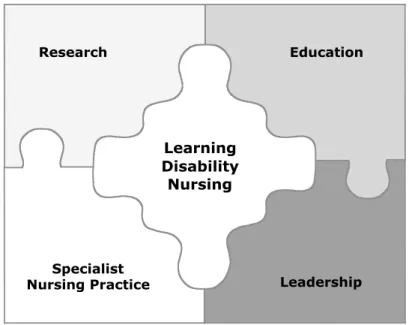
should be seen as interlinking and interdependent (Figure 1).

(14)

Figure 1 – Building blocks for achieving the vision

3.1 Nursing Practice

Nursing practice should be seen as a combination of the attitudes, beliefs,

experiences, knowledge and skills of the nurse and the way these interact

to influence their work, both as an individual and with others, to meet the

needs of people with learning disability.

Cullen (1991) commented that no profession could lay claim to a skill

that could not be performed by someone else. Against a backdrop of

modernisation across the health service role boundaries are diminishing

and flexibility increasing. It would therefore be difficult to argue that

learning disability nurses fulfil a unique role in terms of the tasks they

undertake.

Learning disability nurses are however unique in being the only

professional group who are trained exclusively to work with people with

learning disabilities. It can be argued that what differentiates learning

disability nurses from other health professionals is the breadth, depth

and combination of skills and knowledge that are acquired through the

process of becoming a registered nurse in learning disability. The ability

of the learning disability nurse to make a unique contribution is further

enhanced by the opportunities that exist, and that can be created, as the

result of working as a health professional, and the frequency and level of

contact that most nurses have with people with learning disabilities their

families and carers.

Some nurses have gone on to gain more in-depth knowledge, experience

and skills to develop one or more areas of their practice further, or to

focus on work with a group of people who share a specific characteristic

or diagnosis. The areas where learning disability nurses have deepened

their knowledge and expertise include profound and multiple disabilities,

Specialist

Nursing Practice

Education

Research

Leadership

Learning

Disability

Nursing

(15)

challenging behaviour and forensic needs, autistic spectrum disorders,

mental health, epilepsy and dysphagia.

Specialist learning disability nursing services must remain flexible and

adaptable. As dedicated health professionals nurses should be skilled at

what they do and have first hand experience of working directly with

people with learning disabilities with the most complex needs.

Good practice is that which combines a values led, person centred

approach with the best available evidence when making clinical decisions

in healthcare practice (Hincliff et al, 2003). Therefore learning disability

nurses need skills in accessing, appraising and utilising evidence in order

to plan, develop and deliver interventions designed to promote health

gain and strong person centred values upon which to base their practice.

Nurses should increasingly be able to demonstrate expertise, and be able

to generate and draw upon an evidence base for their practice. These

principles apply regardless of setting and whether the nurses’ practice is

focussed primarily on facilitating access to mainstream health and other

services, supporting people with complex care needs, working with

people to help them with their behaviour or (as will be the case for most

nurses working in dedicated learning disability services) involves a

combination of all these roles and others.

Core themes can be considered to run through all learning disability

nursing practice. The degree to which each individual nurse’s role is

focussed on a particular core theme, or themes, will differ from post to

post.

3.1.1 Learning Disabilities

First and foremost all learning disability nurses are specialists in the area

of learning disability itself. Learning disability nurses can demonstrate an

extensive knowledge of learning disability that enables them to carry out

a range of functions and, when recognised, this is valued by other health

professionals, service users and families.

Learning disability nurses play a key role in translating theoretical

knowledge of learning disability into day-to-day practice and supporting

others to understand the relationship between the needs people have and

their level of cognitive and social functioning. Learning disability nurses

are able to pair this knowledge with frequent contact with service users,

their families and other carers and are therefore in a good position to

ensure that issues which specifically arise as a result of learning

disabilities are recognised and addressed.

3.1.2 Consent and Best Interests

Obtaining consent to treatment must be seen as a core theme in the

work of learning disability nurses. Consent has several important

functions. It affirms and safeguards the autonomy of the person, it

fosters respect for the person and informed participation enhances the

(16)

quality of the healthcare experience (McParland et al 2000). Consent is

essential in modern health care and is required within law for each of the

four UK countries.

The practice of obtaining consent from people with learning disabilities

can be difficult and may involve a series of complex decisions. It is often

necessary to make a determination about the capacity of the person to

give valid consent and, where it is decided that they lack capacity, the

need arises to make decisions in a person’s best interests. Whilst

historically it has been the evidence of psychiatrists and psychologists

that has been relied upon, learning disability nurses are increasingly

taking on an active role in the assessment of capacity and consent.

As the only professional group trained specifically within the field of

learning disability, nurses are able to bring a broad understanding of the

impact of cognitive impairment on the decision-making capabilities of the

people they support. This information is important in making a

determination of capacity to consent. Perhaps more importantly

interventions, education and support provided by learning disability

nurses can enable some people with learning disabilities to retain and

understand information therefore helping them to move from a position

of being considered to lack capacity, to being informed sufficiently to

make a choice and give valid consent.

3.1.3 Anti-discriminatory Practice

There is no doubt that people with learning disabilities are subject to

discrimination on all levels. Mitchell (2000) argues that against a

backdrop of discrimination and stigmatisation of people with learning

disabilities learning disability nurses have been devalued by colleagues

from other branches of nursing. Mitchell states that “the manner in which

a person is devalued will affect the way that person behaves”. It is

therefore particularly important that learning disability nurses develop a

sophisticated understanding of the nature of stigmatisation and

discrimination. It is essential that learning disability nurses assume equal

status with colleagues from other branches of nursing in order to

challenge the discrimination experienced by many, if not most, people

with learning disabilities.

It is crucial that nurses make effective use of the social and political

aspects of their work and take advantage of all the opportunities

available in their day to day practice to challenge discrimination and

oppression in all its forms.

3.1.4 Behavioural Practice

The term challenging behaviour is a socially constructed umbrella concept

embracing many meanings and a wide range and variety of

interpretations (Slevin 1995). Studies suggest that 12 – 17% of people

who are defined as having a learning disability will display ‘challenging

behaviour’ (Emerson et al 1998, Kiernan & Alborz 1996, Emerson et al

(17)

1997) making it a relatively common problem that can result in

considerable practical difficulties and have adverse effects on health,

quality of life and opportunities.

The way society responds to challenging behaviour in people with

learning disabilities depends on a broad range of interrelated factors

including the circumstances in which the behaviour occurs, the impact of

the behaviour, the cognitive and social abilities of the person concerned

and external cultural and societal factors. Challenging behaviour and

offending behaviour are differentiated in the main by the level of

understanding of the person with a learning disability and the societal

response to the behaviour in question.

Understanding the causes of challenging behaviour in people with

learning disabilities is extremely complex and developing positive

behavioural supports has become a key focus of the work of many

learning disability nurses.

The need to develop capacity across the wider health services is an

important issue for the NHS. Learning disability nurses have crucial role

to play in building this capacity. However, this aim will not be achieved if

specialist learning disability nurses neglect the key role that they must

play in providing services that respond effectively to needs not otherwise

provided for in the wider NHS. Learning disability nurses must continue

to ensure that they have skills to work directly with people who develop

behavioural challenges and offending behaviour and the credibility to

work directly with the person and their carers, other professionals and

partner agencies.

3.1.5 Access to Health Care

Regardless of other needs all people with learning disabilities need to

access and utilise mainstream health services at some stage in their

lives. Therefore the roles of all learning disability nurses may include

working directly with people to enable this access and indirect work to

influence the ability of mainstream health services to respond effectively

to the physical and mental needs of people with learning disabilities. The

differing levels of intervention relating to health need can be considered

as being for everyday health needs, extra health needs due to the

existence of learning disability, and complex health needs (see Appendix

d).

3.1.6 Public Health

The purpose of public health is to improve all aspects of the health and

well-being of the whole population. Public health policy has been

developed separately for each of the countries within the UK (see

Appendix b).

Achieving public health is everyone’s business and all healthcare

professionals should maximise opportunities available within the scope of

(18)

their role to make a contribution. Public health is achieved through public

health practice which:

Takes a population perspective;

Mobilises the organised efforts of society and acts as an advocate for the public’s

health;

Enables people and communities to increase control over their own health and

well-being;

Acts on the social, economic, environmental and biological determinants of health

and well-being;

Protects from, and minimises the impact of, health risks to the population; and

Ensures that preventative, treatment and care services are of a high quality,

based on evidence, and are of best value. (adapted from Skills for Health, 2004)

The evidence of health need among people with learning disability

highlights a clear remit for learning disability nurses to address the wider

public health needs of people with learning disabilities. People with

learning disabilities need to be included in all the health improvement

initiatives aimed at the whole population to ensure they have equity of

access to national screening programmes, health education, and health

promotion activities. In addition to this, many will require specific,

targeted programmes, aimed at their differing health needs (NHS Health

Scotland 2004, DH 2001).

An aspect of public health practice is the understanding of the needs of

specific groups within the population in comparison to those of the

remainder of the population. This process is known as Health Equity

Audit. The evidence base for health need in Appendix c provides a

population perspective, however, at a local level there is a need to

undertake audits. Learning disability nurses, together with other health

professionals in specialist learning disability services, have a key role to

play in working with colleagues in public health to initiate and complete

local audits and ensure that results inform the development of services.

3.2 Education

In order to fulfil the diverse range of roles required and respond to future

developments in healthcare provision, learning disability nurses need to

be prepared by innovative and forward thinking curricula. Both the

content of educational programmes and the means by which they are

delivered need to be flexible and adaptable to ensure they keep pace with

change.

If the vision set out in this document is to be realised then it follows that

learning disability nurses need to be able to address, at a range of levels,

the factors which influence the physical and mental health needs of

people with learning disability, and be able to use the best available

evidence when doing so.

The changing nature of service provision and the rapidly expanding

nature of knowledge means that a culture of life long learning must

continue to be nurtured. The educational process must provide a vehicle

(19)

for the development of knowledge paired with real world opportunities to

put this theoretical knowledge into practice. Pre-registration learning

must enable students to develop skills to work in direct roles with people

with learning disabilities who have the most complex needs and to work

collaboratively with colleagues, both within and outside the health

service, to respond more effectively to these needs. Life long learning

should enhance and develop knowledge and skills further but should not

loose sight of the core and unique components of the nurses’ role.

The NHS Knowledge and Skills Framework (DH 2003a) is concerned with

the NHS investing in the ongoing development of all it's staff. Each post

outline developed will need to indicate the required post registration

requirements for life-long learning.

In addition to uni-professional education there is much to be gained from

engaging in shared and joint learning with other disciplines and agencies.

Educational opportunities need to be delivered at certificate, diploma,

bachelors, masters and doctoral levels in a manner which is sufficiently

flexible to enable service users and carers to be involved in the

educational process, meet the changing needs of people with learning

disability and services, and in a manner that enables learning disability

nurses to remain in practice.

3.2.1 Learning disability nurses as educators

All learning disability nurses play a role in the education of people with

learning disabilities, their carers and families and other colleagues within

services, this aspect is integral to learning disability nursing practice.

Formal education of others is for some a small part of the role, where

others specialise in education. The crucial skill is to maintain a focus on

the role (as in the specialist nursing practice section) whilst integrating

research and leadership into the education experience offered.

3.3 Leadership

“The only way we can predict the future is by gaining the positions of

power and influence to shape things to come”

(Faugier 2004). If learning

disability nurses are to lead and shape their own destiny they must

embrace the opportunities that have become available through NHS

reform by taking on lead roles at all levels. This may present a challenge

to nurses who have traditionally been dependant on both hierarchical

structures of management and on senior staff (often from other

disciplines) for direction.

The educational preparation and ongoing practice of learning disability

nurses places them in a unique position. As registered nurses they are

accountable for their own practice which must be based on contemporary

and valid evidence, governed by the code and standards of the nursing

profession (NMC 2004). With this profile learning disability nurses are

well placed to take on leading roles.

(20)

However, leadership is not about being an expert in a specific area of

clinical practice, or having lots of academic or professional qualifications.

Whilst it is absolutely essential that nurse leaders are good at their jobs,

these achievements alone do not equip people to lead others. Good

leaders are those who possess and develop a range of personal qualities

that enable them to influence and inspire others. Leaders are passionate,

committed, and liberating.

They demonstrate recognisable

characteristics such as the ability to mobilise or influence the actions of

others. They are empowering and demand high standards of themselves

and others.

The NHS Leadership Qualities Framework (DH 2003b) provides a detailed

description of the range of personal, cognitive and social qualities which

contribute to good leadership. This framework can be used by individuals,

teams and across services as the basis for development of leadership

skills at all levels of practice. These are arranged in three clusters as

follows:

Personal Qualities

-

self-belief, self awareness, self management, drive for

improvement and personal integrity.

Setting Direction

-

Broad scanning, intellectual flexibility, seizing the future,

political astuteness and drive for results.

Delivering the Service

-

Leading change through people, holding to

account, empowering others, effective and strategic influencing and collaborative

working.

Poor clinical leadership leads to poor standards of care (DH 1999).

Learning disability nurses must continue to develop a broad spectrum of

competencies to fulfil increasingly independent and autonomous nursing

roles and develop their own leadership qualities to enable them to take

up leadership roles.

The recognition of potential leaders in the field of learning disability

nursing will allow for them to be nurtured with positive opportunities

created for their growth and development. Sustainability and succession

planning are integral to ensuring consistent, high quality care and

support for people with learning disabilities, their families and carers

where learning disability nurses

“gain the positions of power and

influence to shape things to come”

(Faugier 2004).

3.4 Research

Excellence in health care is dependent on research and development

(RCN 2004). Yet generally nurses are failing to maximise the

opportunities for the nursing contribution within research and

development (DH 2000).

Parahoo et al (2000) suggest that learning disability nurses are less likely

to report using research to inform their practice than nurses from other

branches. Possible reasons for this are suggested as organisational

constraints as well as the likelihood that proportionally less research is

(21)

conducted in learning disability nursing when compared to other

specialisms. Nonetheless learning disability nurses need to see research

and development as crucial to their practice (NMC, 2004), supporting

clinical competence and credibility, informing care delivery, and

developing the evidence base for nursing and learning disabilities.

To achieve this learning disability nurses need to:

Access and use evidence in practice;

Contribute to the development and expansion of the knowledge base from which

nurses draw;

Extend capability and research awareness through its identification as a core

competence at all levels;

Enhance capacity through developing this as a key role with dedicated time

identified in practice; and

Utilise ‘inclusive research’ methods (Walmsley, 2001).

The challenge for learning disability nurses is to understand research as a

way to answer day-to-day clinical questions either through networking,

accessing evidence, or conducting research. These activities should not

be seen as the domain of the few but as one part of each nurse’s broader

role. Most nurses will never be employed solely as a researcher or

academic and we cannot rely solely on the ability of those who are in

those positions to construct the evidence base for clinical practice.

Brimblecombe (2004) noted that whilst prioritising the time for research

and development activities can be difficult it creates the opportunity to

develop skills that contribute to the challenge of new and established

practice.

Research and development standards in learning disability nursing should

be parallel to those in other health professional groups (RCN 2004). This

requires an infrastructure with commitment from individual learning

disability nurses, service managers, commissioners and education

providers. Research and development should be a core competency from

novice to advanced learning disability nurse practitioner.

3.4.1 Service User Involvement

How people with learning disabilities can be involved in research and how

research is disseminated and accessed by people with learning disabilities

is a matter for any learning disability nurse researcher.

‘Inclusive research’ has been developed as a term (Walmsley, 2001)

which describes the variety of levels and roles of involvement which

people with learning disabilities have from taking part in other people’s

research through to owning or controlling the research project. There is

still a long way to go before ‘inclusive’ research principles are more

widely practiced (Walmsley, 2004), however learning disability nurses

need to facilitate the development of ‘inclusive research’ methods in

practice.

(22)

Section 3 Summary

Learning disability nurses are unique in being the only professional group who are

trained exclusively to work with people with learning disabilities. They must retain

this characteristic and continue to work directly with people with learning

disabilities.

The fundamental differentiating factor that informs learning disability nursing

practice lies less in what they do and more in how and why.

Many learning disability nurses have developed additional expertise in the area of

behavioural work. Working with people to resolve behavioural difficulties enables

them to cope better with both health and social problems and is still a core role for

all learning disability nurses.

Learning disability nurses at all levels must take advantage of, and create

opportunities to engage with colleagues within public health, primary care, mental

health and other health services to learn more about the specific health needs of

people with learning disabilities and respond more effectively and equitably to

these needs.

Learning disability nurses must be able to draw on an evidence base for their

practice. They must be skilled in appraising the existing evidence and should

increasingly be involved in generating new evidence to inform practice.

Learning disability nurses must be aware of national policy initiatives and the

direction for mainstream health services for responding to and improving public

health.

Good quality education is integral to the role of the nurse and required to ensure

that learning disability nurses are fit for purpose in each of the four areas of

specialist nursing practice, education, research and leadership. Pre registration

and post registration provision needs be flexible in responding to the changing

healthcare agenda and the developments in the learning disability nursing role.

Good leadership is central to the transformation and modernisation of healthcare

delivery. Learning disability nurses must make use of their unique position to take

on lead roles to influence the development and delivery of mainstream and

specialist healthcare services for people with learning disabilities.

Learning disability nurses at all levels must develop leadership qualities and skills

to achieve equal status with other nurses and healthcare professionals, challenge

discrimination and reduce inequalities for people with learning disabilities

Both the use of research evidence and the undertaking of research studies need to

be prioritised within the work of learning disability nurses to ensure a solid

evidence base for practice with the inclusion of people with learning disability and

their carers as equal members of the research team

4.

Action

The vision in this document cannot be realised without action. This

section will explore some of the mechanisms that can be developed and

used by learning disability nurses to bring about change.

4.1 Change management

Changes in services for people with learning disabilities have created both

challenges and opportunities. Some learning disability nurses have

(23)

experienced isolation whilst others have benefited from greater autonomy

and an opportunity to practice in a flexible and creative way. As change

within all public sector services continues there is a need for learning

disability nursing to develop further. Learning disability nurses should be

leading this change and not simply responding to a direction of travel laid

down by others.

To be effective as change agents, learning disability nurses need to be

politically aware; to exercise influence; be adept at networking and think

and act strategically. Appendix e provides further information regarding

these 4 key areas for effective change management

4.2 Influencing policy

Historically there has been a perception that nursing has had little in the

way of influence upon health policy development (Antrobus and Kitson,

1999). However nurses increasingly want and need to become involved

in this process (Aroskar et al, 2004). There is recognition that the impact

of health policy on nursing can be immense and nurses are becoming

increasingly active in bringing their influence to bear on this process.

As core members of the nursing profession, learning disability nurses can

and should influence and contribute to the policy process at the

formulation, implementation and evaluation stages (International Council

of Nurses, 2001; Lee et al, 2002; Scottish Executive, 2002b). Providing

a learning disability nursing response (both individually and collectively)

to Government consultations is one way in which nurses at all levels can

be involved in the reform of policy and process of policy development.

To ensure credibility within the policy environment, learning disability

nurses need to publish and disseminate papers detailing good and

effective practice to a wider audience. Channelling this work through

larger organisations that share similar agendas, is one way nurses can

progress their issues (International Council of Nurses, 2001).

Policy makers are one of the major stakeholders in the policy

environment. Learning disability nurses must aim to be part of, and

influence, this group and provide evidence of the contribution they make

in relation to helping to meet the explicit aims of the government of the

day. Nurses need to take advantage of fora, organisations and other

arenas such as the Royal College of Nursing, the Scottish Parliamentary

Forum and National Networks to gain access to policy makers in order to

articulate the needs of people with learning disability and the scope of the

nursing contribution to improving care.

4.3 Workforce issues

In order to ensure that the needs of people with learning disabilities are

met by healthcare services and to enable learning disability nurses to

develop new roles, commissioners and providers of services need to

address a number of workforce issues.

(24)

There needs to be an appropriate number of learning disability nurses

with the right competencies, right experiences, right skills and right

attitudes in the right locations to deliver high quality care. However, the

total number of learning disability nurses is not in itself a guide to quality

and efficiency. With around 50% of learning disability nurses working

outside the NHS, much will depend on the way such nurses are educated,

utilised, supported and developed as a skilled resource.

Quality services require effective use of the nursing workforce and, in

many circumstances, the pursuit of quality will continue to break down

professional barriers and bring further changes and extension to what

have been seen as traditional learning disability nursing roles. Whilst the

role of learning disability nurses has evolved, and continues to change,

there is no evidence to suggest that such posts are not required or that

people with learning disabilities, their families and carers no longer need

or want the services that learning disability nurses provide.

Workforce planners should take account of the vision outlined in this

document when identifying local nursing requirements. Sufficient training

places should continue to be commissioned. There are issues with the

recruitment of sufficient students to the learning disability nursing

branch. There is a danger that there will be insufficient learning disability

nurses to enable specialist health services to develop further. Attention

needs to be given to student nurse recruitment and retention issues and

clear career pathways need to be developed to support this process.

Learning disability nurses currently in practice should raise awareness of

the role and its value as a career choice and take advantage of

opportunities in their own roles to encourage recruitment.

4.4 Career pathways

Learning disability nurses fill a diversity of roles and play a central part in

service provision for people with learning disability across a wide range of

settings. To fulfil this role they need to retain and develop skills that can

respond to current and future challenges within a framework that

recognises and rewards the acquisition of skills and the acceptance of

responsibility. Flexible career pathways should enhance recruitment and

retention and enable learning disability nurses to move between

employment in the NHS and other organisations.

Not all learning disability nurses will choose the same career path. Some

may remain in a focussed role; some may opt to work in a range of posts

that enhance a particular area of their practice and competence, while

others may choose to extend their level of responsibility and authority.

All roles will, however, encompass some components of practice,

leadership, research and education.

In modifying the nursing career model put forward by DH (1999),

Appendix f provides detail for how careers in learning disability nursing

(25)

can develop by illustrating four different levels. The focus is upon those

progressing through a career primarily within clinical practice, where

overlaps exist between the levels. The table in Appendix f details the

practice, leadership, educational and research components of such roles

along with the levels of authority and responsibility and the qualifications

required.

Not all learning disability nurses will be working in roles that include the

title of nurse (although they may have been appointed due to their

nursing qualification, skills and or knowledge). Appendix f uses various

levels of worker to encompass a range of job titles currently used across

the field

Nurses working in academic and research roles should be able to draw

comparisons to the career framework available to them.

5.

Recommendations

The summaries at the end of sections two and three provide guidance to

assist and support learning disability nurses to articulate their

contribution to the health needs of people with learning disabilities with a

renewed sense of purpose and confidence. In addition to the direction

provided in the summaries actions involving both nurses and other key

players are required at individual, organisational and strategic levels to

ensure that the vision set out in this document is taken forward:

Individual Level

Learning disability nurses and the learning disability nursing profession should be

proactive in realising this vision.

Learning disability nurses should recognise the value of their own roles and take

on lead roles in delivering and influencing the development of mainstream and

specialist healthcare services for people with learning disabilities.

Learning disability nurses should actively engage in networks and forums.

More research needs to be undertaken by learning disability nurses and concerning

learning disability nursing. In particular research should focus on the effectiveness

of learning disability nursing in addressing the health and behavioural needs of

people with learning disabilities Research should be accompanied by increased

dissemination, including publication, and increased utilisation of research and

evidence in practice.

Learning disability nurses should be more active in local, regional, national and UK

wide policy development (for example in responding to consultation documents,

initiating policy development, working with people with learning disabilities to

shape responses).

Organisational Level

Nurse education providers and service providers should take action to ensure that

learning disability nursing students have experience and opportunities for the

development of skills in a range of settings to prepare them to work confidently

Figure

Figure 1 – Building blocks for achieving the vision

References

Related documents

The summary resource report prepared by North Atlantic is based on a 43-101 Compliant Resource Report prepared by M. Holter, Consulting Professional Engineer,

Reviewers should document any additional information they review, including sources of the information and their findings about the MCO’s compliance, to the Compliance Review

The second part focused on respondents’ view of internal capabilities such as human resource management practices, marketing function, finance, as well as

For Microsoft SQLServer, MySQL, Sybase ASE, PostGres, MongoDB and Casandra database technologies, the PulseDBA package applies to a single server on which the database software is

1) Develop communication and language abilities of the child (e.g., Total Communication, calendars, objects, pictures, augmentative and alternative communication devices, words in

Although the above literature suggests maintaining professional boundaries may be particularly difficult for nurses and healthcare workers in forensic services, knowledge around how

“The Business Support Services team at Travers Smith provided legal, strategic and tactical.. guidance in shaping a critical outsourcing deal for our business with complex

Virginia’s initial efforts were accomplished through a contract awarded to Dynamic Works Institute to provide at no cost to the host agencies or staff the coursework, exam