
Consumer Perspectives of Brand Extension Effects : Information Analysis Determining the Consumer Behaviour Patterns
21
0
0
Full text
(2) 2. Rajagopal Professor of Marketing Business Division, Monterrey Tec University, ITESM, Mexico City Campus 222, Calle del Puente Mexico DF 24380. Author acknowledges sincere thanks to Dr. Romulo Sanchez, Director, Department of Marketing, ITESM, Mexico City Campus for providing the data support from the project on Consumer Decision Making being administered by the Department of Marketing of the institute during 2001-2002..
(3) 3. Abstract. Brands are successful because people prefer them to ordinary products. In addition to the psychological factors already mentioned, brands give consumers the means whereby they can make choices and judgments. The secret to successful branding is to influence the decisions the way in which consumers perceive the company or product, and brands can affect the minds of customers by appealing to the information acquired and analyzed. This paper attempts to emphasize the relationship between empirical and theoretical considerations in the information analysis of brand extensions on consumer behavior. Broadly the study focuses on analysis at the individual or micro-level and tries to draw implications towards buying decisions on the extended brands analyzing the aggregate relationships. The discussion. analyzes categorical similarity as a determinant of. diagnostic behaviour and explore the premise that high accessibility of extension information in some of the past studies may have left little room to observe the effects of diagnostic behaviour..
(4) 4. Brands are not just names, terms, symbols, designs or combinations of these, although it is true to say that such things can differentiate certain products and companies from others. The additional constituents that makes a successful brand is personality. Today's leading brands are personalities in their own right and are well known in all societies and cultures as film heroes, cartoon characters, sports stars or great leaders. Brand extension categories are often chosen based on shared attributes with the family brand. Therefore, the extension's performance on these shared dimensions is likely to be at least moderately diagnostic or informative for the family brand, regardless of category similarity. Similarly, the extension information is likely to be at least somewhat accessible for the family brand evaluation, given our focus on situations where the extension has the family brand name. While some factors (e.g., large time gap) may make the extension information inaccessible, focus is not laid on the latter scenario because its implications are fairly intuitive inaccessible information will not be used in the judgment. Therefore, our research examines at least moderate levels of both accessibility and diagnosticity, which are not only realistic but also have important implications for the branding area. It can be concluded that the previous studies on feedback effects of brand extensions has ignored the role of accessibility and oversimplified the notion of diagnosticity. By addressing the effects of accessibility and diagnosticity, the research framework accounts for some of the mixed findings in the literature and addresses when and why feedback effects are likely to vary across different extension categories..
(5) 5 It has been argued in some studies that agreements to exchange information affect the value of information and the decision making on the brands. With unknown cost, a learning-by-doing like effect also arises in the process of decision making. These effects affect consumer welfare, the incentive to receive information, and the incentive to enter information sharing agreements. Information sharing contracts may have negative future effects on firms through decreased information production. However, the decreased information production has the current benefit of softening competition, which induces information sharing agreements under conditions contrary to previous results and vice versa. A Consumer review article features this new line of products of a company owning reputed brand as unreliable. Will this negative information about the extension dilute the family brand image? What happens if the negative information is about a new line of video cameras instead of a personal computers? In other words, will dilution effects vary as a function of extension category? Some research studies suggests that dilution effects are more likely for close brand extensions, whereas other school of research suggests that dilution occurs regardless of extension category or does not occur at all (Keller 1998, Aaker 1992; Lane and Jacobson 1997; Loken and John 1993; Milberg, Park, and McCarthy 1997; Romeo 1991). Consider another variation of this scenario. A Consumer review article features this new line as one of the most technologically advanced and reliable products in the marketplace. Will such positive information enhance the family brand image? It is difficult to answer this question based on the limited amount of research that has addressed the effects of positive extension information on the family brand name..
(6) 6 This paper attempts to analyze. categorical similarity as a determinant of diagnostic. behaviour and explore the premise that high accessibility of extension information in some of the past studies may have left little room to observe the effects of diagnostic behaviour. Therefore, an important goal of the current research is to understand the nature and extent of feedback effects from the brand extension to the family brand when information about the extension is not highly accessible.. This study discusses the. information interactions with categorical similarity that influence the diagnosticity of extension information and helps the consumers to make decisions on the brands.. Review of Literature. The new emphasis on relationships in marketing has spurred a resurgence of interest in brand loyalty and the positive effect of brand loyalty on company profitability and longterm survival have been well-documented in recent years. Recent research has begun to identify new types and sources of subject that might comprise and distinguish loyalty responses, especially from a phenomenological perspective. This article focuses on exploratory consumer behavior, an often-neglected influence on brand loyalty that has received almost no attention in the brand loyalty literature. Risk-taking in product and retail outlet choice innovative shopping behavior, variety and novelty-seeking, browsing and recreational shopping and curiosity-motivated information processing are among the many consumer behaviors thought to have strong exploratory components (Burgess and Harris, 1998). The brand stretching or extension of a successful brand label from an initial home market to a different product line--using a model that assumes that brand.
(7) 7 identity is a complementary feature that enhances consumer willingness to pay. The pattern of brand-stretching implies an entry in which (1) firms with strong brand identities may prefer to extend their brands to markets that are "far" from their original product line, and (2) fragmented or un-concentrated markets with no strong incumbent brands are attractive entry targets for brand extension ( Lynne and Daniel, 2002). Competition with product rivalry has greater implications where products are differentiated by both quality and brand name. With no commitment, firms produce a full product line. When firms can commit to restrict their product offerings, firms specialize if the degree of brand-specific differentiation is small and they produce a full product line if brand-specific differentiation is large relative to intra-firm differentiation. Firms may crowd a product space when all competitors would be better-off with specialization. Brand proliferation is a credible entry-deterring strategy if the degree of brand-specific differentiation is not too large (Gilbert and Matuets, 1993). The marketing literature refers to the concept of brand capital and provides empirical evidence that firms with a large stock of well-established brands have an advantage in introducing new products. One of the theories of brand extension as a mechanism for informational leverage in which a firm leverages off a good's reputation in one market to alleviate the problem of informational asymmetry encountered in other markets. It is observed that brand extension helps a multi-product monopolist introduce a new experience good with less price distortion (Jay, 1998).. The accessibility-diagnosticity model explains any factor that increases the accessibility of an input is also expected to increase the likelihood with which that input will be used.
(8) 8 for the judgment. Therefore, in the brand extension context, temporal proximity between information about brand extension and family brand evaluation is likely to result in a disproportionate influence of the activated or accessible cognition (i.e., extension information) on the judgment (i.e., family brand evaluation) made shortly after its activation. The review of previous literature on brand extension effects indicates that dilution/enhancement effects generally emerge in the presence of highly accessible extension information (Lane and Jacobson 1997; Loken and John 1993; Milberg et al. 1997). Milberg et al. (1997) examined in his study the. negative feedback effects,. subjects rated the family brand immediately after exposure to information about the extension, making extension information highly accessible at the time when family brand evaluations were assessed. Buyers select from among that subset of available brands of which they are aware. When this subset grows, there are social surplus gains, but the distribution of these gains between firms and consumers is shown to be sensitive to the structure of the market. It is possible for either the sellers or the buyers to be worse off in the better -informed environment (Ross, 1988). However, dilution effects were found in the context of both close and far extensions. Lane and Jacobson (1997), also focused on negative feedback effects, found dilution effects in a study where extension evaluations took place immediately prior to brand evaluations, making the extension information more accessible. Loken and John (1993) in one of his research studies raised issues about comprehension of target attributes after reading negative information about the extension. They found a dilution effect for both moderately typical and atypical extensions when the extension information was salient (i.e., when consumers rated their beliefs about the family brand name immediately after the comprehension task). The.
(9) 9 negative information analysis often leads to the strategic non-participation with the brands. Willingness to pay, which can be computed only in equilibrium, will reflect, besides private valuations, preemptive incentives stemming from the desire to minimize the negative externalities. We find that the best strategy of some agents is simply not to participate in the market, although they cannot in this way avoid the negative external effects (Philippe and Benny,1996).. Consumers observe the performance of the firm's products, and product performance is positively related to the firm's quality level. If a firm is to launch a new product, should it use the same name as its base product that may be stretching the brand reputation, or should it create a new name and start afresh the reputation chronology? It has been observed that for a given level of past performance (reputation), firms stretch if and only if quality is sufficiently high (Luis, 2000). Stretching thus signals high quality. However, when subjects rated the typicality of the extension before assessing beliefs about the family brand name, which is likely to have increased the attributes of typicality judgments while decreasing the attributes of the extension information, dilution did not occur for the atypical brand extensions. The respondents might have perceived information about atypical extensions as less diagnostic for evaluating the family brand.. Similarly, Romeo (1991) found dilution effects when the extension was closely associated to the family brand, although these effects were only marginally significant. Subjects were told that they would evaluate a case study and were asked questions about the case before they expressed their evaluations of the family brand name. This procedure.
(10) 10 may have decreased the accessibility of the extension information and reduced its impact on family brand evaluations.. Keller and Aaker (1992) examined both dilution and. enhancement but found evidence only for enhancement. Further, enhancement effects were observed regardless of extension category. In their study, subjects were exposed to extension information and then evaluated the family brand, which may have led to high accessibility of extension information. Interestingly, dilution effects did not emerge in Keller and Aaker's (1992) research. One possible explanation is that subjects might have discounted the negative information since they were told that unsuccessful extensions were discontinued. Skowronski and Carlston (1987) argue that the greater the shared associations between two targets, the more diagnostic information about one is for making judgments about the other. In the context of brand extension, this finding implies that as the shared associations between the family brand and the extension increase so does the diagnosticity of information about brand extension for making judgments about the family brand name. That is, one may expect a positive relationship between extension category similarity and feedback effects. However, there exists the scope of future research in understanding the asymmetries in the impact of positive versus negative extension information on family brand evaluations.. Framework of Research. The review of previous researches reveal that the. negative information is more. diagnostic than positive information in forming product judgments because negative information helps assign the target to a lower quality category more easily than positive.
(11) 11 information helps assign the target to a higher quality category (Herr et al. 1991). Most brands are expected to perform well in manufacturing products that are close to their current product offerings. Hence, not only high quality brands are expected to perform well most of the time, also low or mediocre quality brands perform well at times. Consequently, positive information about a close extension is not very indicative of the family brand quality. However, negative information about a close extension clearly signals a low quality brand. Therefore,. H1:. In the domain of close extensions, negative information is likely to be rated as more diagnostic than positive information.. H2:. In the domain of far extensions, positive information is likely to be rated as more diagnostic than negative information. Generally the brands are expected to have a low level of ability in manufacturing and/or marketing a product leading the far brand extensions with a lower probability of success and higher risk than are close extensions (Aaker 1997). It is more difficult to successfully extend the brands into a far category. The successful far extensions may indicate a high quality brand. However, failure in this domain would be more ambiguous because both high and low quality brands could fail.. The study was conducted in an empirical design with the sample of 145 consumers in Mexico city addressing to over 40 consumer brands available in different categories of markets. The respondents belonged to the processed food products category and.
(12) 12 cosmetics. Respondents were organized into small groups and were randomly assigned to conditions in a 2 (extension category: close, far) × 2 (information : positive, negative) between-subjects design. The questionnaire contained a scenario describing the experience of a company with a new product extension.. Findings and Discussion. Brand choice models implicitly assume that consumers incorporate all relevant marketing information such as price, display, and feature for key brands on each purchase occasion. In the context of brand extensions, information about the extension will be highly accessible when consumers are asked to report their evaluation of the family brand immediately after reading the extension information. Under such conditions, a highly accessible negative (positive) extension is expected to lead to a dilution (enhancement) effect regardless of product category as observed by past studies in this area (Loken and John 1993; Milberg et al. 1997). This is because highly accessible information about a new extension is likely to be sufficient for making a judgment about the family brand. It is also possible that the accessibility of the information may influence its perceived diagnosticity. That is, consumers may perceive the extension information to be more diagnostic if it is highly accessible. In any case, extension information is likely to affect family brand evaluations, regardless of extension category, when it is highly accessible. The information about the extension will not be highly accessible or dominant when consumers report their evaluation of the family brand, at a later point in time. In such a.
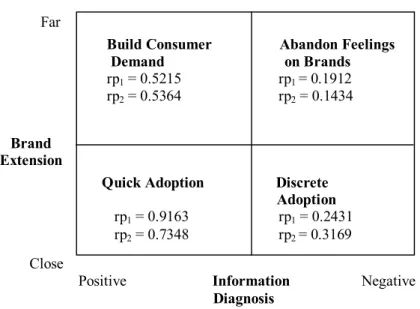
(13) 13 situation, extension information will be used in the brand evaluation based on its diagnosticity.. The ANOVA on the diagnosticity index for the process food sector brands revealed a significant interaction between information and extension category {F(1, 86) = 24.07, p < .001}. Consistent with Hypothesis 1, the simple-effects test revealed that negative (vs. positive) information was rated as more diagnostic for close extensions {M's = 0.63 vs. 0.57; F(1, 86) = 7.61 p < .01}. In contrast, as predicted by Hypothesis 2, positive (vs. negative) information was rated as more diagnostic for far extensions {M's = 0.69 vs. 0.57; F(1, 86) = 17.42, p < .001}. Similar findings were obtained with the cosmetics products brands. Specifically, an ANOVA on the diagnosticity index yielded a significant information × extension category interaction {F(1, 124) = 20.03, p < .001}. As expected, the simple-effects test indicated that negative (vs. positive) information was rated as more diagnostic for close extensions {M's = 0.63 vs. 0.59; F(1, 124) = 6.36, p < .05}, while subjects rated positive (vs. negative) information as more diagnostic for far extensions {M's = 0.63 vs. 0.57; F(1, 124) = 13.13, p < .001}. The data was analyzed using a 2 (extension category: close vs. far) × 2 (information : positive vs. negative) betweensubjects ANOVA. The coefficient of correlations for the close brand extensions and positive information lead to higher degree as compared to any other relationships. The Figure 1 exhibits the consumer perceptions matrix in reference to the brand extension and information diagnosis parameters.. // Figure 1 about here//.
(14) 14. It was expected that, consistent with past research on the negativity effect, negative (vs. positive) information would be perceived as more diagnostic in the domain of close extensions (H1); however, positivistic effect (positive perceived as more diagnostic than negative) would be obtained for far extensions (H2). This pattern of results calls for an interaction between extension category and information. There is a likelihood that an information used as a basis of response to a subsequently measured construct and may be. determined by (i) the accessibility of the input in memory, (ii) the perceived. diagnosticity of the input for the judgment, and (iii) the accessibility of other inputs in memory. An input is considered diagnostic if it helps to assign the target to one particular category - high or low quality (Herr, Kardes, and Kim 1991). Therefore, in the context of information feedback effects, the extension. information would be diagnostic to the. extent that it indicates the quality of the family brand. The extension information is highly accessible, it will influence family brand evaluations, irrespective of the brand extension's diagnosticity. This is because in this condition, the extension information is highly featured and sufficient for making a judgment about the family brand name (Feldman and Lynch 1988). The trend diagnosis of information for the processed food products and cosmetics in the specific market locations- retails stores and super stores has been exhibited in Table 1. The analysis reveals that the correlation of brand extension variables - positive close, positive far, negative close and negative far with buying decisions on the extended brands showed lower degree of association. It may be stated in view of the results that the ambience of market outlet does not have. a strong.
(15) 15 influencing factor over the information diagnostics for the consumers to make decisions on buying the extended brands.. //Table 1 about here//. The increasing availability of customer-level data on brand information and the willingness of marketers to customize the products offered through the brand extensions makes the segment-level description of household purchase decisions a compelling issue.. The respondents were provided with the brand profiles and either positive or negative attribute information about the new brand extension. The brand profiles contained the relative ranking of the competing brands in each sector. Reliability was chosen as the target attribute because a pretest indicated that it was an important attribute for both categories of the products. The comparison brands were chosen on the basis of pretests and actual consumer reviews indicating their perceptions about the brands in their respective categories. For example in the positive-information condition, the new extension introduced by some the brands like Jumex was portrayed as being clearly superior to the moderate brands and as having the same level of reliability as the high quality brand (Jugo del Valle or Great Value). In the negative-information condition, the extension was portrayed as clearly inferior to all the competing brands in reliability. All the moderate brands (including Jumex) were assigned similar ratings on ease of use, slightly lower than those of the leading brands (Jugo del Valle and Great Value). The respondents rated the extent to which processed food products and cosmetics are reliable.
(16) 16 on three scales anchored by "strongly disagree" and "strongly agree," "extremely unlikely" and "extremely likely," "not at all probable" and "very probable." The mean of the belief parameters constituted the belief index ( = 0.92). Brand evaluations were measured via three scales anchored by "very unfavorable" and "very favorable," "very negative" and "very positive," and "very bad" and "very good." These items were averaged to form an evaluation index ( = 0.84). The perception on beliefs about the brand extensions in the conditions of normal accessibility of both the categories of products, in terms of reliability were enhanced in response to positive information (M close = 5.31, t = -2.05; M far = 5.46, t = -2.64; p's < .05), and were diluted in response to negative information (M close = 3.44, t = 3.21; M far = 3.90, t = 2.77; p's < .01) regardless of the extension category.. The impact of the positive extension information can be enhanced such as providing information about extension on the packages of other products of the same family brand name by making it more accessible in the decision situation. Similarly, diagnosticity of the extension information can be influenced by communication strategies that enhance/diminish the relevance of attribute beliefs in evaluating the family brand. The findings of the study in general establishes the hypotheses framed in the paper.. Research Implications. This study on one hand endorses the Keller's (1998) conceptualization and also extends it by demonstrating an interaction between fit and the brand extension information..
(17) 17 However the best fit of the model (Figure 1) can be subject to implementation through similarity between the family brand and the extension on the basis of product-related attributes or non-product related attributes such as brand image (Keller 1998). The underlying construct is similarity between the family brand and the extension, which is likely to influence the perceived diagnosticity of the extension information for the family brand evaluation. Another interesting issue is whether the type of positive/negative information interacts therewith. However, future studies may tend to examine the ambiguities associated with consumer expectations in the context of brand extensions and provide extension information on a reliability attribute that is likely to be easily interpretable at the brand performance level, and hence diagnostic for the brand evaluation.. Brand information (positive or negative) can have an important function in markets with consumption externalities apart from its persuasive and informative roles. Information inflow on brands and outflow through inter-personal communication may act as a device to coordinate consumer expectations of the purchasing decisions of other consumers in markets with consumption externalities. The implications of positive and negative communications on the brands. as a coordinating device may be analyzed by the. companies to help their decisions strategically on brand extensions. However, there may be some of the forces that can lead to herd behavior in diagnosing the brand communication. Under certain circumstances, consumers may simply mimic the fellow buyers’ decisions ignoring substantive private information. Although this behavior is.
(18) 18 inefficient from a social standpoint, it can be rational from the perspective of brand managers who are concerned about their reputations in the product or service market.. It is observed that a group of individuals can learn and influence decision without substantial information base on its positive or negative versions and with only a small amount of rationality. The degree of such influence may be so intensive that the decisions are repeated many times by different players. Each player chooses an optimal reply, based on incomplete information about what other players have done in the past. Occasionally they make mistakes. When the likelihood of mistakes is very small, typically one coordination equilibrium will be played almost all of the time over the long run. Such situations towards the diagnosticity of the information on brand extensions are not many but at the same time can not be ignored by the brand managers. Future researches may address these complexities also in terms of brand relationship and consumer decision making towards brand extensions. However, strategically a company may empower the consumers to add value to their mother brand by migrating an extended brand to the public communication networks like television, internet etc. The organization needs to recognize that any promised experience hinges on buyers’ knowledge of the brand’s history. Nike tried to make its promise of winning become personalized, by allowing consumers to add their own word on the back of its trainers. However, the company need to monitor the information analysis patterns in the close and far brand extensions as it plays the key role in making purchase decisions..
(19) 19 References Aaker, David A. (1997), Should You Take Your Brand to Where the Action Is? Harvard Business Review, 75, September-October, 135-143. Aaker David A (1992), The Effects of Sequential Introduction of Brand Extensions, Journal of Marketing Research, 29, February, 35-50 Burgegss M Steven and Harris M (1998), Values Optimum Stimulation and Brand Loyalty- New Scales in New Populations, Michigan Business School, William Davidson Institute, Working Paper, 20. Herr, Paul M., Frank R. Kardes, and John Kim (1991), Effects of Word-of-Mouth and Product-Attribute Information on Persuasion : An Accessibility-Diagnosticity Perspective, Journal of Consumer Research, 17,March, 454-462. Gilbert Richard J and Matuets, Carmen (1993), Product Line Rivalry with Brand Differentiation, Journal of Industrial Economics, 41 (3), September, 223-240 Jay Pil Chai (1998), Brand Extension as Informational Leverage, Review of Economic Studies, 65 (4), October, 655-669. Keller, K.L. and Aaker David A(1992), The effects of sequential introductions on brand extensions, Journal of Marketing Research, .29, 35-50 Keller, Kevin L. (1998), Strategic Brand Management: Building, Measuring, and Managing Brand Equity, Upper Saddle River, NJ: Prentice-Hall. Lane, Vicki and Robert Jacobson (1997), The Reciprocal Impact of Brand Leveraging: Feedback Effects from Brand Extension Evaluation to Brand Evaluation, Marketing Letters, 8 (3), 261-271. Loken, Barbara and Deborah Roedder John (1993), Diluting Brand Beliefs: When Do Brand Extensions Have a Negative Impact? Journal of Marketing, 57, July, 7184. Luis M B Cabral (2000), Stretching Firm and Brand Reputation, RAND Journal of Economics, Winter, 658-673. Lynne Pepall M and Daniel Richard J (2002), The Simple Economics of Brand Stretching, Journal of Business, 75 (3), July, 535-552 Milberg, Sandra J., C. Whan Park, and Michael S. McCarthy (1997), Managing Negative Feedback Effects Associated with Brand Extensions: The Impact of Alternative Branding Strategies, Journal of Consumer Psychology, 6 (2), 119-140..
(20) 20 Philippe J and Benny M (1996), Strategic Non-Participation, RAND Journal of Economics, 27 (1), Spring, 84-98 Romeo, Jean B. (1991), The Effect of Negative Information on the Evaluations of Brand Extensions and the Family Brand, in Advances in Consumer Research, Vol. 18, ed. Rebecca H. Holman and Michael R. Solomon, Provo, UT: Association for Consumer Research, 399-406. Ross Thomas W (1988), Brand Information and Price, Journal of Industrial Economics, 36 (3), March, 303-313 Skowronski, John J., and Donal E. Carlston (1987), Social Judgment and Social Memory: The Role of Cue Diagnosticity in Negativity, Positivity, and Extremity Biases, Journal of Personality and Social Psychology, 52 (4), 689-699..
(21) 21 Figures and Tables Figure 1. Consumer Perception Matrix on Brand Extension and Information Diagnosis # Respondents 103 in both the product category brands Results refer to responses analyzed in different sales outlets Far Build Consumer Demand rp1 = 0.5215 rp2 = 0.5364. Abandon Feelings on Brands rp1 = 0.1912 rp2 = 0.1434. Brand Extension Quick Adoption rp1 = 0.9163 rp2 = 0.7348. Discrete Adoption rp1 = 0.2431 rp2 = 0.3169. Close Positive. Information Diagnosis. Negative. rp1 = Coefficient of correlation for processed food products category brands rp2 = Coefficient of correlation for cosmetics products category brands. Table I Trend Diagnosis of Information on Extended Brands in Retail Sales Outlets (# Outlets = 33, # Respondents =119) Analysis in reference to the variable : buying decision Information Variables Coefficient (r) F On Brand Extensions Processed Cosmetics Processed Cosmetics Food Food b Positive Close 0.39 0.44 13.51 18.83 Positive Far 0.51a 0.59a 21.16 13.85 Negative Close 0.40 0.37 42.27 16.94 Negative Far 0.34 0.41 47.91 13.62 a : significant at 5% level b : significant at 10% level.
(22)
Figure
Related documents
Furthermore, while symbolic execution systems often avoid reasoning precisely about symbolic memory accesses (e.g., access- ing a symbolic offset in an array), C OMMUTER ’s test
In this study, it is aimed to develop the Science Education Peer Comparison Scale (SEPCS) in order to measure the comparison of Science Education students'
Showing how Ghosh ’ s Ibis Trilogy ( Sea of Poppies [2008], River of Smoke [2011] and Flood of Fire [2015]) highlights the appropriation of natural resources by fi nancial markets,
The project will: (i) strengthen the legal, policy, institutional and financial framework to support an expanded protected land and seascape estate; (ii) more specifically, support
The main optimization of antichain-based algorithms [1] for checking language inclusion of automata over finite alphabets is that product states that are subsets of already
SIMETRI : MOTIV YANG SAMA (sama dan sebangun) BERJARAK SAMA TERHADAP SEBUAH PUSAT PENGAMATAN (dapat berupa garis, bidang maupun titik). UNTUK MEMPELAJARI “ BAGAIMANA” POLA
Secondly, the tax risk management is a breakthrough in the reform of tax collection, the implementation of tax risk management, is to put the limited collection resources
The following outlines the framework of the proposed Colorado Strategic Broadband Plan as developed by the Colorado Broadband Knights of the Roundtable, a collaborative group of
