Explaining the structural model of responsibility based on family function and
social competence with the mediator role of adolescent purpose in life
Abstract
Background and Purpose:Responsibility among adolescents is of great significance, and families can influence sense of responsibility by creating purpose in life and developing social competence. Herein, we aimed to investigate the structural model of the relationship of family functioning and social competence with sense of responsibility and mediating role of purpose in life in this relationship among female junior high school students.
Methods:This correlational study has practical objectives. The participants were 384 female junior high school students of District 2 of Sari, Mazandaran province, Iran. Cluster random sampling was used for sample selection. The instruments included four questionnaires: 1) responsibility scale of the California Psychological Inventory (CPI), 2) family functioning of MacMaser, 3) social competence of Felner, and 4) purpose in life of Crumbaugh and Maholick. Pearson correlation coefficient and path analysis were used to analyze the data. Results:The results indicated that family functioning, social competence, and purpose in life have a positive significant relationship with responsibility, and in the relationship of family functioning and social competence with responsibility, purpose in life plays a mediating role (P<0.05).
Conclusion: Adolescents spend a considerable amount of time in family and school; therefore, students’ family functioning and social competence can be by providing appropriate training courses for their families and teachers. Furthermore, sense of responsibility can be reinforced among adelescents by creating purpose in life.
Keywords:Family functioning, Purpose in life, Responsibility, Social competence
Reyhaneh Gholamzadeh1, Mohsen Jadidi2*, Reza Donyavi3
(Received: 7 Feb 2017; Accepted: 13 Mar 2017)
1 Department of Psychology, Islamic Azad University, Sari Branch, Sari, Iran
2,*Corresponding author: Department of Clinical Psychology, Islamic Azad University, Bandar Gaz Branch, Bandar Gaz, Iran. Email: [email protected]
3 Department of Psychology, Islamic Azad University, Neka Branch, Neka, Iran
Original article
Introduction
Adolescence is a critical period in the construction and foundation of an individual’s personality. During this period, the individual determines his/her position in the family, group of friends, and community. Social, economic, and family-related factors play a significant role in shaping the behavioral pattern of teenagers. During this period, some physical and mental changes occur that affect individual’s life. Sometimes, these changes affect their character
and manners, as well (1). Thus, recognition of the psychological, intellectual, and physical aspects of adolescents makes it possible for this age group and the people around them to know the physical and mental changes and avoid the occurrence of certain incompatibilities during this period.
Therefore, considering the physical and mental changes of adolescents, it can be claimed that adolescents’ affairs require special attention
(2). Responsibility is one of the most important concepts in the field of psychology that has attracted considerable attention in recent years (3). Responsibility is a personality characteristic that is usually shaped in the form of attitude in person’s mental and behavioral structures. Adolescents have the potential to be changed into thoughtful, creative, and happy individuals by accepting responsibility and having effective communication with others. This age group make attempts at identifying and solving problems and do not get disappointed and discouraged (4). The significance of responsibility can be realized from its effects on different dimensions of life such as fostering a sense of adequacy and competence in life, feeling happiness, inner stability, and spiritual vitality, creating and increasing sense of appreciation of life, and preparing for taking on major responsibilities (5). In fact, adolescents voluntarily accept roles and endure pressure and challenges to show commitment and motivation, which leads to formation of a sense of responsibility during adolescence, youth, and middle age. It seems that this personality characteristic leads to success and creating a sense of sufficiency and efficiency, which can support people in attaining skills. Therefore, qualification or social competence includes a set of cognitive, behavioral, emotional, and motivational skills that people need for successful psychosocial and social adjustments.
Social competence enables people achieve their goals by considering others’ goals and needs (6). Social competence is considered as one of the best predictors of current and future academic and social success and optimal performance (7). Competence and social relationships of children and adolescents are shaped and improved under the influence of family, peers, and school; family and school officials can play a significant role in children’s competence (8). Ministry of Education as an important investor in human capital development can be the key to provide future security and success in the lives of adolescents (9). Furthermore, teachers play a key role in enriching social relationships of children by effective classroom management, encouragement, building partnership among students, and expansion of mutual respect (8).
In fact, family and school provide the fundamental ground for human development, which can lead to enhancing social-emotional skills and capacities of adolescents; it can also be effective in reducing their behavioral problems. Family and school environments are places where children learn concepts, laws, and cultural practices underlying social processes (10). Studies revealed that social competence can influence adolescents’ performance (11-13), and it is effective in their relationships and individual and social behaviors (14, 15). According to the studies of Gebauer-Bukurov, Markovic, Sekulic, and Bozic (2015), Bebard, Bouffard, and Pansu (2014), Zhang et al. (2014), Altay and Gure (2012), and Gundersen (2010), people with social competence are able to adopt more qualified plans in their life.
Purpose in life acts as a compass, directs adolescents’ life in the right direction (16). Research has indicated that purpose in life is linked with the development of adolescents’ life, life satisfaction, psychological health, happiness, and flexibility (16, 17). By creating purpose in adolescents’ life, an important source of motivation will be produced so that it directs adolescents toward using their skills in assuming social responsibility and making better lives for themselves as well as others (18).
The role of family is very crucial in shaping children’s goals; healthy families guide their children towards the right goals (19).In the present study, we aimed to answer the following research question:
can family functioning, social competence, with the mediating role of purpose in life, explain responsibility among female students in junior high schools in District 2 of Sari, Iran?
The main objective of the present study was to find out whether family functioning, social competence, with mediating role of purpose in life, can explain responsibility among female students at junior high schools in District 2 of Sari, Iran.
Materials and Methods
This descriptive, correlational, practical study
was performed on all female students (2834 participants) in junior high schools of District 2 of Sari, Iran, in academic year 2016-17. Using Krejcie and Morgan Table, 338 participants were selected through cluster random sampling.
The data collection tools included: 1) responsibility scale of California Psychological Inventory (CPI), 2) family functioning of MacMaser, 3) social competence of Felner, and 4) purpose in life of Crumbaugh and Maholick.
Responsibility scale of California Psychological Inventory includes 47 items. The participants were asked to complete a questionnaire rated using a 5-point Likert scale by selecting “1: strongly disagree” to “5: strongly agree”. This scale evaluates characteristics such as loyalty, responsibility, trustworthiness, and social honesty, which deal with measuring acceptance rate of social norms. The reliability coefficient of the questionnaire in the present study was estimated at 0.867 by piloting on 30 participants. The Family Assessment Device (FAD) was developed by Epstein, Baldwin and Bishop in 1983 according to a model by McMaster. This questionnaire includes 60 items rated using a 4-point likert scale (“1: strongly disagree” to “4: strongly agree”). This questionnaire assesses seven dimensions of problem solving including communication, roles, affective responsiveness, affective involvement, behavior control, and general functioning. The reliability coefficient of the questionnaire in the present study was 0.824 in a sample of 30 participants.
Social competence questionnaire for adolescents includes 47 items, constructed based on Felner’s theory (1990). It consists of four dimensions of behavioral, cognitive, emotional, and motivational skills. Likert’s test scoring method (1-7) was used in this questionnaire. The reliability coefficient of this instrument was estimated to be 0.876 in a sample of 30 participants.
Purpose in life questionnaire was originally developed by Crumbaugh and Maholick (1969). It is a 20-item scale measuring different dimensions of life purposes. This questionnaire was developed to measure personal feeling to purpose or meaning in life.
Data analysis
The statistical data was both descriptive and inferential. The descriptive statistics included mean and standard deviation for each of the main variables and its constructs. To achieve the aims of the study, Pearson correlation coefficient, stepwise regression, path analysis, and Sobel test were used. SPSS, version 22, and LISREL 8 were adopted to analyze the collected data.
Results
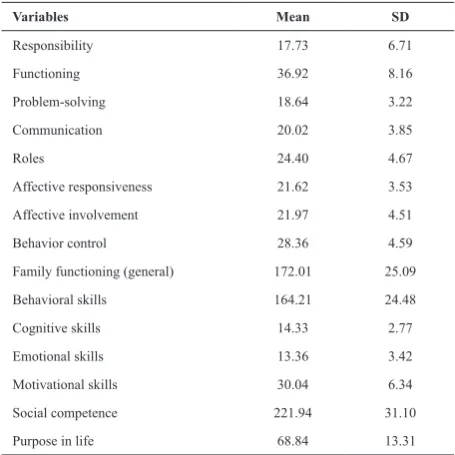
Table 1 presents the results related to the responsibility variable indicating that the calculated mean was 17.73; this index was rather low among adolescent students. The status of family functioning and its constructs was at a moderate level among the adolescents, the means of family functioning, problem solving, communication, roles, affective responsiveness, affective involvement, behavior control, and general family functioning were 36.92, 18.86, 20.02, 24.4, 21.62, 21.97, 28.39, and 172.01, respectively.
Analysis of social competence and its constructs showed that the means of behavioral, cognitive, emotional, and motivational skills, as well as general social competence were 164.21, 14.33, 13.36, 30.04,
Table 1. Means of the study variables
Variables Mean SD
Responsibility 17.73 6.71
Functioning 36.92 8.16 Problem-solving 18.64 3.22 Communication 20.02 3.85
Roles 24.40 4.67
Affective responsiveness 21.62 3.53 Affective involvement 21.97 4.51 Behavior control 28.36 4.59 Family functioning (general) 172.01 25.09 Behavioral skills 164.21 24.48 Cognitive skills 14.33 2.77 Emotional skills 13.36 3.42 Motivational skills 30.04 6.34
Social competence 221.94 31.10
Purpose in life 68.84 13.31
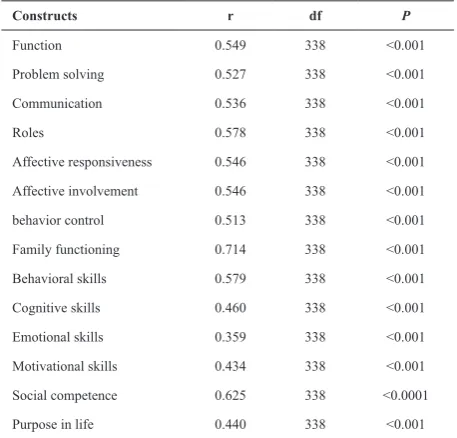
and 221.94, respectively, which were higher than the moderate level. The mean of purpose in life was calculated to be 68.84, which was at moderate level. Table 2 indicates that the relationships of family functioning and its constructs, social competence and its constructs, and purpose in life with responsibility were positive, and all the relationships were significant (P<0.001). The correlation between family functioning and responsibility was 0.714, showing the highest level of correlation, and among the constructs of family functioning, roles had the highest correlation with responsibility (r=0.578).
The correlation between social competence and responsibility was 0.625; among its indices, the correlation between behavioral skills and
responsibility was 0.579, which was at the highest level. Moreover, the correlation between purpose in life and responsibility was estimated to be 0.44. Then, stepwise regression analysis was used to investigate the contribution of the main variables (family functioning, social competence and purpose in life) to explain responsibility.
Table 3 shows that the variables were entered into the model during 3 steps and eventually, the final model was obtained in step 3. The coefficient of determination was 0.584 and the adjusted coefficient of determination was 0.58. Considering the degree of effectiveness of the variables, family functioning was entered into the model at the first, social competence at the second, and purpose in life at the third step. Coefficients of models in all the variables were significant (P<0.001). Therefore, multiple linear regression model for responsibility can be explained as follows.
Responsibility= -22.693+0.136 × family functioning + 0.042 × Purpose in life + 0.064 × social competence In order to examine the mediator role of purpose in life in the relationship of social competence and family functioning with responsibility, the researcher used path analysis and Sobel test.
As can be noted in Table 4, all the indicators related to conformity and goodness of fit are within the acceptable ranges. Fitness of model is accepted with the mediating role of purpose in life in the relationship of family functioning and social competence with responsibility.
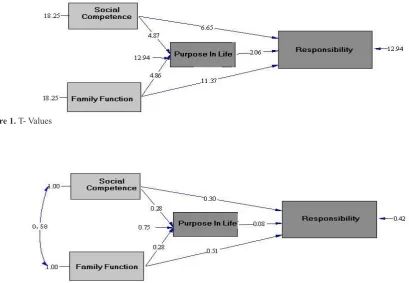
Figure 1 depicts the t values for path analysis model, it indicates all the model coefficients are significant because the calculated t is greater than 1.96; moreover, Figure 2 indicates the value of
Table 2. Results of Pearson correlation coefficient between family functioning, social competence, purpose in life, and
responsibility
Constructs r df P
Function 0.549 338 <0.001 Problem solving 0.527 338 <0.001 Communication 0.536 338 <0.001
Roles 0.578 338 <0.001
Affective responsiveness 0.546 338 <0.001 Affective involvement 0.546 338 <0.001 behavior control 0.513 338 <0.001 Family functioning 0.714 338 <0.001 Behavioral skills 0.579 338 <0.001 Cognitive skills 0.460 338 <0.001 Emotional skills 0.359 338 <0.001 Motivational skills 0.434 338 <0.001
Social competence 0.625 338 <0.0001
Purpose in life 0.440 338 <0.001
Table 3. Summary of results related to stepwise multiple regression analysis
Source SS df MS F P R2 R2
.adj
Step 3 Regression 8866.634 3 2955.545 156.358 <0.001 0.584 0.580
Error 6313.401 334 18.902
Table 4. Analysis related to fitness indices of the research model
χ2/DF RMSEA NFI NNFI CFI SRMR GFI AGFI
1.59 0.046 0.99 0.99 1 0.033 0.99 0.98
correlation in each variable in the model.
In the above model, the mediating role of purpose in life was investigated by considering the significance of direct effects on the relationship between independent variables with the mediator and the mediator with the dependent variables. Although the significance of path coefficients was confirmed, this method has low statistical power. Therefore, considering the fact that the role of the mediator variable and purpose in life is indirect
through the significance of effect coefficient, it is more appropriate to test directly the significance of indirect effect coefficient. Sobel test is one of the most widely used methods for this purpose; this test is based on standard error and regression coefficients of communication paths.
Results of Sobel test in Table 5 showed that the mediating role of purpose in life in the relationship of social competence and family functioning with responsibility was significant. In other words, the
Figure 1. T- Values
Figure 2. Standard Estimate
Table 5. Results of mediator analysis for evaluating the mediating role of purpose in life
Steps Predictor variables Criteria of variables B SE β t
1 Social competence Purpose in life 0.121 .025 0.282 4.870
Family functioning 0.149 0.031 0. 281 4.858
2 Purpose in life Responsibility 0.222 0.025 0.440 8.987
The mediation effect of purpose in life in the relationship between family functioning and responsibility Sobel test=4.28 P<0.001
The mediation effect of purpose in life in the relationship between social competence and responsibility Sobel test= 4.226 P<0.001
indirect relationship of the independent variables (social competence and family functioning) with the dependent variable (responsibility) is significant
(P<0.001).
Discussion and Conclusion
The results showed a significant relationship between family functioning and its constructs and responsibility. The findings of the present study are in line with those of other previous studies (2, 3, 5), suggesting that family functioning increases responsibility. The more purposeful the family is and the more diligent the parenting goals are, the more responsible become the children.
Moreover, the relationship between social competence and its constructs and responsibility was significant; this finding is in accordance with the findings of other researchers (4, 10, 15, 20). Social competence determines social bases of a person, and responsibilities are given to people according to their competences. People assume responsibilities considering the social competence they have, and they can be more responsible according to their attained competence.
Another finding of the study is the significant relationship between purpose of life and responsibility, this finding is in accordance with other findings (4, 18, 21). In fact, responsible people have some goals in their life and make attempts towards those goals in order to step into better paths.
Another finding of the study is the simultaneous significant relationship of family functioning, social competence, and purpose in life with responsibility, which confirms those of other researchers (2, 15, 22-24). The results suggest that family functioning, being purposeful in life, and social competence are important factors affecting sense of responsibility.
Moreover, our findings confirmed the mediating role of purpose in life in the relationship between family functioning and social competence, which is in line with other findings (5, 19, 25). Therefore, it can be proposed that purpose in life has a significant effect on other variables, such that purpose in life acts as a bridge for the effect of family on competence and responsibility of people, Therefore,
it is possible to clearly determine children’s goals from the beginning, and unify all the educational programs and facilities considering those goals and pave the way for children’s social competence and responsibilities assigned to them.
Considering the direct relationship of purpose in life with responsibility and its mediating role in the relationship of family functioning and social competence with responsibility, it is suggested that the authorities seriously consider educating families and teachers. By providing abundant training by specialists, they can institutionalize the necessary skills for teachers and families. In addition, the authorities need to look at the research studies on family and family functioning more positively.
More attention needs to be paid to constructs such as being sociable, responsibility, interpersonal values, and character in school course books such that students can acquire behavioral, cognitive, emotional, and motivational skills. The authorities should have some plans for adolescents with bad or no guardians, so that they can achieve the necessary competency, adequacy, and growth, when they are at a young age and not encounter confusion in life.
Limitations of the Study
Samples restricted to female students aged 15-18 years, lack of awareness regarding the culture of research in a number of respondents, and the lack of cooperation from some schools were the limitations of this study.
Recommendations
With regards to crucial role of parents and school in mental health and social competence of students, education authorities should take the necessary measures to assist families and teachers, that in the educational process they are coordinating together. Having social competence and
self-esteem is important for students to make important life decisions. Therefore, along with empowering students in the field of behavioral, cognitive, and emotional skills, motivational mental set should be provided. Those involved in education are
recommended to consider the social component, accountability, and interpersonal values in designing the content of school course books.
Conflicts of interest
None declared.Authors’ contributions
M. Jadidi and R. Donyavi were the thesis supervisor and advisor of the article, respectively, R. Gholamzadeh was in charge of writing and preparing the manuscript.
Acknowledgements
Appreciation and thanks are due to all the students who eagerly participated in this study.
References
1. Steinberg L. Age of opportunity: lessons from the new science of adolescence. Boston: Houghton Mifflin Harcourt; 2014.
2. Kamalifar F. Relationship between moral development and creativity with responsibility among elementary students. [Master Thesis]. Sari, Iran: Islamic Azad University of Sari; 2014 (Persian).
3. Soroush M. Personal and social responsibility, altruism and social trust: a study of adolescents in Shiraz. J Appl Sociol 2011; 23(2):193-211 (Persian).
4. Salusky I, Larson RW, Griffith A, Wu J, Raffaelli M, Sugimura N, et al. How adolescents develop responsibility: what can be learned from youth programs. J Res Adolesc 2014; 24(3):417-30.
5. Salimi A, Bahrami F, Taheri M, Younesi J, Hoseinzadeh S. The relationship between family function and responsibility in adolescents with visual impairments compared to normal adolescents. J Res Behav Sci 2015; 12(4):25 (Persian). 6. Malti T, Perren S. Social competence. Encycl Adolesc
2011; 2:332-40.
7. Rantanen K, Eriksson K, Nieminen P. Social competence in children with epilepsy--a review. Epilepsy Behav 2012; 24(3):295-303.
8. Petrucci GW, Borsa JC, Koller SH. Family and school in the socioemotional development in childhood. Trends Psychol 2016; 24(2):403-13.
9. Blazevic I. Family, peer and school influence on children’s social development. World J Educ 2016; 6(2):42.
10. Metka MČ. The individualization of responsibility and school achievement. Czech Sociol Rev 2012; 48(6):1093–114. 11. Gebauer-Bukurov K, Markovic J, Sekulic S, Bozic K.
Social competence among well-functioning adolescents with epilepsy. Epilepsy Behav 2015; 42:54-60.
12. Bédard K, Bouffard T, Pansu P. The risks for adolescents of negatively biased self-evaluations of social competence: the mediating role of social support. J Adolesc 2014; 37(6):787-98.
13. Gundersen KK. Reducing behaviour problems in young people through social competence programmes. Int J Emotion Educ 2010; 2(2):48-62.
14. Zhang F, You Z, Fan C, Gao C, Cohen R, Hsueh Y, et al. Friendship quality, social preference, proximity prestige, and self-perceived social competence: interactive influences on children’s loneliness. J Sch Psychol 2014; 52(5):511-26. 15. Altay FB, Gure A. Relationship among the parenting styles
and the social competence and prosocial behaviors of the children who are attending to state and private preschools. Educ Sci Theor Pract 2012; 12(4):2712-8.
16. Damon W. The path to purpose: how young people find their calling in life. New York: Simon and Schuster; 2009. 17. Mohammadzadeh J, Khosravi A. An investigation into
studying the relationship between purpose in life and conflicting styles with mental health among students at Islam University. J Health Sys Res 2012; 8(6):951-8 (Persian).
18. Bronk KC, Holmes Finch W, Talib TL. Purpose in life among high ability adolescents. High Abil Stud 2010; 21(2):133-45.
19. Shenasi M. An investigation into the effect of positive psychology on conformity, purpose in life, and social competence among female adolescents. [Master Thesis]. Sari, Iran: Islamic Azad University of Sari; 2015 (Persian). 20. Abolghasemi A, Rezaee H, Narimani M, Babolan AZ. A
comparison of social competence and its components in
students with learning disability and students with low, average and high academic achievement. J Learn Disabil 2011; 1(1):6-23 (Persian).
21. Ghadiry MH, Bozorghi MJ. Evaluate the relationship between purpose in life and demographic factors (based on Islam). Psychol Religious 2009; 2(6):131-56 (Persian). 22. Birami M, Hashemi Nosratabadi T, Farhadi A, Movahedi Y.
The role of predictive thrill-seeking, anger and aggression, meaning and purpose in life and academic motivation in predicting readiness for impatience. Sixth International Psychiatrists Congress on child and adolescents, Tabriz, Iran; 2014 (Persian).
23. Firoozsamadi M, Aghajani T, Shaterian F, Shoughi B, Sadeghi J. Relationship between religious attitudes and parent-child socials competence with emotional metacognition (A study in high schools in Saveh). J Sociol Stud Youth 2013; 4(15):95-110 (Persian).
24. Dehdari T, Yarahnadi R, Taghdisi MH, Daneshvar R, Ahmadpour J. The relationship between meaning in life and depression, anxiety and stress status among college students of Iran university of medical sciences in 2013. Iran
J Health Educ Health Promot 2013; 1(3):83-92 (Persian). 25. Rathi N, Rastogi R. Meaning in life and psychological
well-being in pre-adolescents and adolescents. J Indian Acad Appl Psychol 2007; 33(1):31-8.