Vol. 7, No. 1, 2015 Article ID IJIM-00458, 15 pages Research Article
Electromagnetism-like algorithm for fuzzy flow shop batch processing
machines scheduling to minimize total weighted earliness and
tardiness
S. Molla-Alizadeh-Zavardehi ∗†, R. Tavakkoli-Moghaddam ‡§, F. Hosseinzadeh Lotfi ¶
————————————————————————————————–
Abstract
In this paper, we study a flow shop batch processing machines scheduling problem. The fuzzy due dates are considered to make the problem more close to the reality. The objective function is taken as the weighted sum of fuzzy earliness and fuzzy tardiness. In order to tackle the given problem, we propose a hybrid electromagnetism-like (EM) algorithm, in which the EM is hybridized with a diversification mechanism and effective local search to enhance the efficiency of the algorithm. The proposed algorithms are evaluated by comparison against two existing well-known EMs in the literature. Additionally, we propose some heuristics based on the earliest due date (EDD) to solve the given problem. The proposed hybrid EM algorithm is tested on sets of various randomly generated instances. For this purpose, we investigate the impacts of the rise in problem sizes on the performance of the developed algorithm. Through the analysis of the experimental results, the highly effective performance of the proposed algorithm is shown against the two existing well-known EMs from the literature and proposed EDDs.
Keywords : Flow shop batch processing machines; Fuzzy due date; Hybrid electromagnetism-like
algorithm; Fuzzy earliness/tardiness.
—————————————————————————————————–
1
Introduction
B
atries is a common policy. Batching occurstching or grouping of jobs in many indus-in two different versions: parallel-batchindus-ing and serial-batching. On a parallel-batching machine, the jobs in a batch are processed simultaneously, so the processing time of a batch is the longest∗Corresponding author. [email protected] †Department of Industrial Engineering, Science and Re-search Branch, Islamic Azad University, Tehran, Iran.
‡School of Industrial Engineering, College of Engineer-ing, University of Tehran, Tehran, Iran.
§Research Center for Organizational Processes Im-provement, Sari, Iran.
¶Department of Mathematics, Science Research Branch, Islamic Azad University, Tehran, Iran.
processing time of jobs contained in the batch. On the serial batching machine, the processing time of a batch equals the sum of the processing times of jobs contained in the batch. In the lit-erature, parallel batching scheduling is known as batch processing machine (BPM) scheduling.
The BPM scheduling problem is important and mainly motivated by the burn-in operation found in semiconductor manufacturing [31, 32]. More-over, BPMs are encountered in various manufac-turing environments (e.g., aircraft industry, shoe manufacturing industry, ion plating industry, iron and steel industry, steel-casting industry, glass container industry,and furniture manufacturing industry). A complete explanation of the product flow in the BPM and also semiconductor
facturing can be seen in [31].
The BPM can process a group of jobs provided the sum of all the job sizes in the batch be less than or equal to the machine capacity. Once a batch is processed, it cannot be interrupted and no jobs can be added or removed until the process is completed.
Most existing models of scheduling problems neglect the presence of uncertainty within a man-ufacturing environment. In many real-world op-timization problems, uncertainty in due date of-ten do exist.This uncertainty may come about because of production problems (e.g., machine malfunctioning and defect in raw material) or problems with delivery itself (e.g., traffic jam and transportation delay). In some cases, due dates are considered as certain intervals and it may be appropriate to deal as fuzzy values. Fuzzy numbers are used to represent uncertain and in-complete information in optimization problems [1]. More and more, modeling techniques, con-trol problems and operation research algorithms have been designed to fuzzy data since the con-cept of fuzzy number and arithmetic operations with these numbers was introduced and investi-gated first by Zadeh [24].
The remainder of the paper is organized as fol-lows. Section 2 presents the literature on the problem under study. In Section 3, we describe the problem and present a fuzzy mathematical programming model. In Section 4, we propose our heuristics and hybrid electromagnetism-like (EM) algorithm and show the detailed implemen-tation. In Section 5, we show the design of in-stances and report the computational results. Fi-nally, the last section presents conclusions of our work.
2
Literature review
In this section, we focus on reviewing the stud-ies with the assumptions of multi-BPM flow shop and the case of a fuzzy environment.
2.1 Multi-BPM flow shop
Most studies on flow shop scheduling to date have focused on discrete machines. Flow shop with BPMs has received very little attention. Danneberg et al. [9] proposed constructive and local search algorithms for minimizing the
to-tal weighted completion time and makespan in a multi-BPM flow shop with identical job sizes. They assumed batch-dependent setup and a limit number of jobs in a batch. A problem reduc-tion procedure was proposed by Sung et al. [28] for removing dominated machines with respect to any regular performance measure. They studied a multi-BPM flow shop with the identical job sizes of one and constant batch processing times. The reduction procedure was combined with heuris-tics algorithms to minimize the total completion times and makespan. Husseinzadeh Kashan and Karimi [11] presented a mathematical model for multi-BPM flow shop to minimize the makespan and developed some lower bounds based on relax-ing the problem assumptions.
Amin-Naseri and Beheshti-Nia [2] presented a Genetic Algorithm(GA) and three heuristics for minimizing the makespan in hybrid flow shop with BPMs in some stages. Lei and Guo [16] pro-posed a variable neighborhood search (VNS) for the objectives ofthe maximum tardiness,number of tardy jobs and total tardiness in multi-BPM flow shop. Lei and Wang [17] developed a neighborhood search algorithm for multi-BPM flow shop to minimize the maximum lateness. Behnamian et al. [3] studied the minimization of makespan in a three machine flow shop scheduling problem with a BPM among first and third stages (discrete-BPM- discrete) under the assumption of transportation capacity and times among ma-chines. They proposed a mixed-integer program-ming (MIP) model and then a heuristic algo-rithm and GA. Damodaran et al. [8] proposed a Particle Swarm Optimization (PSO) algorithm to minimize the makespan and used some modified heuristics from the discrete flow shop problem to generate the initial population.
2.2 Fuzzy BPM scheduling
consumption. They studied the serial-batching problem with fuzzy due-dates in the presence of resource-dependent processing time and common setup. For fuzzy due dates, a membership function describing a non-decreasing satisfaction degree about job’s completion time is defined.
Yimer and Demirli [34] applied a fuzzy goal programming problem for batch scheduling on parallel machines in a two-stage flow shop to minimize the total weighted flow time of jobs. They considered the uncertainty for processing and setup times by triangular fuzzy numbers. They also developed a GA for solving large-sized problems. Cheng et al. [7] proposed an ant colony optimization (ACO) algorithm for the fuzzy makespan on a single BPM with non-identical job sizes. The uncertainty of the jobs and the machine in the processing is denoted us-ing triangular fuzzy numbers. For a further re-view on BPM scheduling problems, we refer to Potts and Kovalyov [22]. Besides, Mathirajan and Sivakumar [18] did a quite complete survey on scheduling with BPMs.
Minimizing the makespan is one of the most important criteria in scheduling problems. In the literature, there is no research that considers the objective of minimizing the fuzzy makespan, and proposes a new approach to solve a fuzzy multi-BPM flow shop scheduling problem. A trape-zoidal fuzzy number is considered for processing times as an extended triangular fuzzy processing time. Here, we present a new fuzzy mathematical programming approach for the first time. Since the problem is NP-hard for solving the addressed problem, a new hybrid EM algorithm is proposed to obtain good solution results.
3
Fuzzy Mathematical Model
3.1 Deterministic Model
There aren jobs, J, to be processed on m differ-ent BPMs, M, with a processing time pjm and
a corresponding size, sj. The BPM can
pro-cess several jobs simultaneously as a batch b, as long as the total size of all the jobs in the batch does not exceed the machine capacityCap. The processing time of a batch b on machine
m is given by the longest job in the batch (i.e.,
Pbm = max{pjm|j ∈ batch b}). The formulation
is as follows:
Notations:
Sets:
J Jobs, j= 1, ... , N B Batches, b= 1, ... , N M Machines, m= 1, ... , M
Parameters:
pj,m Processing time of jobj on
machinem sj Size of jobj
Cap Machines capacity
αj Earliness penalty (/unit/h) of jobj
βj Tardiness penalty (/unit/h) of jobj
dj Due date of jobj
LN Large number
Decision variables:
Xj,b A binary variable indicates the
assignment of jobj to batchb Pb,m Processing time of batch bon
machinem
cj Completion time of job j
Cb,m Completion time of batchbon
machinem Ej Earliness of job j
Tj Tardiness of job j
writ-ten as follows:
MinZ =∑
j∈J
βjTjsj (3.1)
s.t.
N
∑
b=1
Xj,b= 1 j= 1, ... , N (3.2)
N
∑
j=1
sjXj,b≤Cap b= 1, ... , N (3.3)
Pb,m≥pj,mXj,b
j= 1, ... , N;
b= 1, ... , N;
m= 1, ... , M
(3.4)
Cb,1 =
b
∑
b′=1
Pb′,1 b= 1, ... , N (3.5)
C1,m=
m
∑
m′=1
P1,m′ m= 2, ... , M (3.6)
Cb,m ≥Cb−1,m+Pb,m
b= 2, ..., N;
m= 2, ..., M (3.7)
Cb,m ≥Cb,m−1+Pb,m
b= 2, ..., N;
m= 2, ..., M (3.8)
cj ≥Cb,M−LN(1−Xjb)
j= 1, ... , N;
b= 1, ... , N; (3.9)
Tj ≥cj −dj j= 1, ... , N; (3.10)
Xj,b∈ {0,1}
j= 1, ... , N;
b= 1, ... , N; (3.11)
The objective function is to minimize the total weighted tardiness penalties of the jobs. Constraint set (2) ensures that each job can be processed in only one batch. Constraint set (3) ensures that machine capacity is not exceeded when jobs are assigned to a batch. Constraint set (4)determines the processing time for the batch bon machine m. Constraint set (5) determines the completion time of each batch. Constraint (5) determines the completion time of batches on machine 1. Constraint (6) determines the com-pletion time of the first batch on other machines. Constraint (7) states that batch b is processed in machine m after its previous job. Constraint (8) ensures that batch b is processed in machine m only after its completion in machine m-1. Constraint set (9) defines the completion time of each job as the completion time of the batch in
last machine that it is processed in. Constraint set (10) defines the tardiness of a job. Constraint set (11) specifies the type of decision variable
Xj,b.
Due to minimization of just only tardiness or total weighted tardiness penalties in the objective function, the model chooses the min-imum Pb in the constraint sets (4) to reach the longest processing time among all the jobs in that batch. The smaller the completion time of jobs, the more desirable the objec-tive function. Similarly, the model finds the minimumcj andTj in Constraint sets (6) and (7).
For the objective function of
∑
j∈J(βjTj+αjEj)sj,
in addition to Constraint set (10), Constraint sets (12) and (13) are needed to calculate the earliness and tardiness of jobs.
Ej ≥dj −cj j= 1, ... , N; (3.12)
cj+Ej−Tj =dj j= 1, ... , N; (3.13)
Contrary to tardiness, earliness of jobs de-creases when the completion time of jobs in-creases. So, the above model may not choose the minimum Cb,m ,cj in the constraint sets (4)
and (7-9) in some situation. So, to tackle the dilemma, for the objective function with total weighted earliness-tardiness penalties of jobs, the nonlinear constraint sets (14) to (16) should be used instead of linear constraint sets (4), (7) to (9),(for b= 1, ... , N;m= 1, ... , M).
Pb,m= max(∀j∈J :pj,mXj,b) (3.14)
Cb,m≥max (Cb−1,m+Pb,m, Cb,m−1+Pb,m)
(3.15)
cj = n
∑
b=1
Xj,bCb (3.16)
These three constraint sets (14) to (16) convert the model to a mixed-integer nonlinear program and make it more complex.
3.2 Fuzzy model
Definition 3.1 If X is a collection of objects
de-noted generically byx, then a fuzzy set in X is a
set of the ordered pairs:
˜
d=
{
x,d˜(x)|x∈X
}
,
whered˜(x)is called the membership function that
associates with each x ∈ X a number in [0,1]
indicating to what degree x is a number.
Definition 3.2 d˜j = (dj,1, dj,2, dj,3, dj,4) denote a Trapezoidal Fuzzy Number (TFN) as shown in Fig. 1.
Figure 1: Trapezoidal membership function.
As mentioned in the literature, the concept of fuzzy due dates has been used in scheduling prob-lems. Here, this concept is being firstly utilized in the BPM scheduling problem. In a fuzzy due date, the membership function assigned to each job represents the customer satisfaction degree for the delivery or completion time of that job. The membership function of a trapezoidal fuzzy due date of a job as a generalized triangular fuzzy due date is represented below.
µj(cj) =
0 if cj ≤dj,1
cj−dj,1
dj,2−dj,1 if dj,1 ≤cj ≤dj,2
1 if dj,2 ≤cj ≤dj,3
dj,4−cj
dj,4−dj,3 if dj,3 ≤cj ≤dj,4
0 if cj > dj,4
(3.17) From Fig. 1, we can see that the full satisfac-tion (i.e., µj(Cj) = 1) is attained if d(j,2) ≤cj ≤
d(j,3), and the satisfaction grade is positive if
d(j,1) ≤ cj ≤ d(j,2) or d(j,3) ≤ cj ≤ d(j,4) in the
membership function (1). If d(j,2) = d(j,3), the
fuzzy trapezoidal due date is called a triangu-lar fuzzy due date and can be denoted by triplet
˜
dj = (d(j,1), d(j,2), d(j,3)).
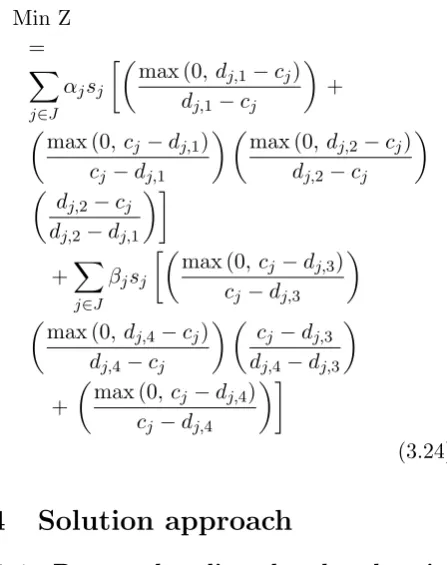
In a particular situation (e.g., just-in-time pro-duction system), the full satisfaction is not at-tained if a completion time is too early or tardy. According to the mentioned fuzzy due date, the studied problem can be formulated as a maxi-mization problem of the total degree of satisfac-tion over given jobs or equivalently, a minimiza-tion problem of the total degree of dissatisfacminimiza-tion. As mentioned above, the fuzzy mathematical for-mulation of the total degree of dissatisfaction is as follows.
Min Z =∑
j∈J
( Tj+ Ej) sj (3.18)
Ej = 1 if cj ≤dj,1 (3.19)
Ej =
dj,2−cj
dj,2−dj,1
if dj,1< cj < dj,2 (3.20)
Tj =
cj−dj,3
dj,4−dj,3
if dj,3 < cj < dj,4 (3.21)
Tj = 1 if cj ≥dj,4 (3.22)
We can also use the following objective function (23) to calculate the total degree of satisfaction instead of expressions (18) to (22).
Min Z =∑
j∈J
sj
[(
max (0, dj,1−cj)
dj,1−cj
)
+
(
max (0, cj−dj,1)
cj−dj,1
) (
max (0, dj,2−cj)
dj,2−cj
)
(
dj,2−cj
dj,2−dj,1 )]
+
∑
j∈J
sj
[(
max (0, cj −dj,3)
cj−dj,3 )
×
(
max (0, dj,4−cj)
dj,4−cj
) (
cj −dj,3
dj,4−dj,3 )
+
(
max (0, cj −dj,4)
cj−dj,4
)]
(3.23)
it with earliness tardiness penalties shown below.
Min Z =
∑
j∈J
αjsj
[(
max (0, dj,1−cj)
dj,1−cj
)
+
(
max (0, cj−dj,1)
cj−dj,1
) (
max (0, dj,2−cj)
dj,2−cj
)
(
dj,2−cj
dj,2−dj,1 )]
+∑
j∈J
βjsj
[(
max (0, cj −dj,3)
cj−dj,3 )
(
max (0, dj,4−cj)
dj,4−cj
) (
cj−dj,3
dj,4−dj,3 )
+
(
max (0, cj −dj,4)
cj−dj,4
)]
(3.24)
4
Solution approach
4.1 Proposed earliest due date
heuris-tics
In this subsection, we propose three constructive greedy heuristics based on the earliest due date (EDD) as a well-known heuristic method related to the due date. The details of these proposed heuristics are as follows:
1) Calculate the index of jobs to be scheduled. 2) Sort jobs in increasing order of their index. 3) Apply the first-first (FF) heuristic to group jobs into batches.
Accordingly, the details of these three vari-ants of EDDs are as follows:
EDD Algorithm: In this variant, the indexes are equal to the EDD of the respective jobs. Ranking of fuzzy numbers play an important role in decision making, optimization, forecasting etc [26] . The centroid-based distance method is used for ranking fuzzy numbers as follows.
d= 1
3
(
K1−
K2
K3
)
(4.25)
where
K1=d1+d2+d3+d4,
K2=d3d4−d1d2,
K3= (d3+d4)−(d1+d2).
The jobs are sorted in increasing order of their crisp due dates. So, the job that has the EDD will be allotted first.
EDD1 Algorithm: Sort jobs in increasing order of their d1.
EDD2 Algorithm: Sort jobs in increasing order of their d2.
EDD3 Algorithm: Sort jobs in increasing order of their d3.
EDD4 Algorithm: Sort jobs in increasing order of their d4.
4.2 Encoding scheme and
initializa-tion
A candidate solution is represented as an array. As mentioned earlier in the literature, the ran-dom key (RK) method is used for solving BPM scheduling problems. To generate a sequence by this method, random real numbers between zero and one are generated for each job. By ascending sorting of the value corresponding to each job, the job sequence is obtained and then the first-first (FF) heuristic is applied to group the jobs into batches.
After having a permutation and forming the batches, we can use it to compute the objective function value of this solution. Each job has a random real number between 0 and 1, and these numbers show the relative order of the jobs. In fact, the problem variables in the algorithms are limited between 0 and 1. For example, consider a problem with ten jobs. The encoding of this se-quence through the random keys is shown in Fig.
2. The sequence at position 1 is 2, which means we schedule job 2 in the beginning position and job 8 at last.
Jobs 1 2 3 4 5 6 7 8 9 10
Before RKs 0.23 0.18 0.38 0.87 0.53 0.76 0.46 0.93 0.36 0.84
Jobs sequence 2 1 9 3 7 5 6 10 4 8 After RKs 0.18 0.23 0.36 0.38 0.46 0.53 0.76 0.84 0.87 0.93
Figure 2: Representation encoding for a candidate solution.
4.3 The proposed hybrid EM
for seeking high-quality schedules within reason-able computation times. The EM was first intro-duced by Birbil and Fang [4] as a new stochas-tic population-based heurisstochas-tic optimization tool to solve the problems with bounded variables. Al-though the EM approach has been designed for continuous optimization problems, here we adapt it to solve the discreet optimization problems. The EM approach has been recently applied to solve several combinatorial optimization prob-lems, such as set covering problem [20], p-hub median problem [15], feature selection [27], single machine scheduling [6], flow shop [14], and job shop [29], and the like. To make meta-heuristics more efficient and robust in solving complex opti-mization problems, diverse and intense hybridiza-tion mechanisms have been successfully proposed.
4.3.1 Diversification phase
One of the important issues in designing the hy-brid meta-heuristic algorithm is to keep the di-versity to explore new unvisited regions of the so-lution space. The original EM often suffers from loss of diversity through premature convergence of the population, causing the search becoming trapped in a local optimum. In our procedure the diversification is applied when the best objective function does not change during the number of pre-specified consecutively iterations in the EM algorithm. Diversification refers to the process of replacing inferior solutions of the current popula-tion by replacing new randomly generated solu-tions. If the Xbest is not improved for more than a pre-specified number of iterations (no change), the restart phase triggers to regenerate the pop-ulation by the following process:
(1) Sort the population in ascending order of the objective function value;
(2) The firstγ% of individuals from the best in-dividuals are chosen to skip; and
(3) The remaining 1−γ% of individuals passed away from the population and regenerated randomly from the solution space to join the population such that the population size re-mainspopsize.
4.3.2 Intensification phase
The right balance between intensification and diversification makes meta-heuristic algorithms
naturally effective to solve the complex problems. The basic idea of the proposed local search proce-dures is to successively use a set of various neigh-borhoods to get a better solution. It searches either at random or systematically two hoods called interchange and inversion neighbor-hood to generate different landscapes and to es-cape from local optima. It exploits the fact that using different neighborhoods in local search may obtain better local optima and that the global optimum is one of the local optimum for a given neighborhood. Also, the results show that using the multiple neighborhoods structure is more ef-fective way to get a better control in balancing intensification and diversification. The proposed powerful local search procedures are illustrated in the following Algorithm.
ALGORITHM. Local (LSITER, interchange,
insertion)
1 : I = 0
2 : fori= 1 to popsizedo
3 : counter ←1
4 : while counter ¡ LSITER do
5 : if I = 0 then
6 : randomly generate a solution Y from interchange neighborhood structure onXi
7 : else
8 : randomly generate a solution Y from interchange neighborhood structure onXi
9 : end if
10 : if f(Y)< f(Xi) then
11 : Xi←Y
12 : else
13 : I ← |I−1| 14 : end if
15 : counter←counter+ 1
16 : end while
17 : end for
5
Computational experiments
5.1 Instances
we generate the required data that can affect the performance of the algorithms including the number of jobs (n), number of machines (m), range of processing time (pj), size (sj), earliness
costs (αi), tardiness costs (βi) and tightness of
jobs due date (dj).
30 different problem sizes with the com-binations of number of machines (i.e.,
m ∈ {3,5,10}) and number of jobs (i.e.,
n ∈ {10,20,30,50,75,100,125,150,175,200}) are considered for the experimental study. Three different types of processing times, size, earliness/tardiness costs and due date of jobs are generated randomly and Cap considered 20 in all instances. Hence, the number of parameter configurations in each problem size is equal to 34 = 81.
The crisp due dates in Tavakkoli-Moghaddam et al. [30], test problems are generated from a uniform distribution. We use such a procedure with some modifications to adapt the procedure for our problem as shown below.
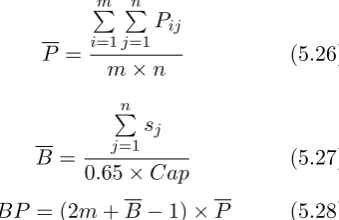
P =
m
∑
i=1
n
∑
j=1
Pij
m×n (5.26)
B=
n
∑
j=1
sj
0.65×Cap (5.27)
BP = (2m+B−1)×P (5.28)
After generating the BP , dj,1, dj,2, dj,3 and dj,4
are generated as explained in Table 1.
Table 1.
Test problems characteristics.
Parameter Level Count
Number of jobs (N) 10, 20, 30, 50, 75, 100, 125, 150, 175, 200 10
Number of machines (M) 3, 5, and 10 3
Processing time of jobs (P) Uniform distributions [1, 5], [1, 10],and [1, 20] 3
Size of jobs (S) Uniform distributions [1, 5], [1, 10],and [1, 15] 3
Tardiness cost (T) Uniform distributions [5, 10], [5, 15],and [5, 20] 3
Earliness cost (E) Uniform distributions [1, 4] 1
dj,4 Uniform distributions(0.4, 1) × BP, (0.4, 1.3) × BP, and (0.4, 1.6) × BP 3
dj,3 Uniform distributions (0.8, 0.9) ×dj,4 1
dj,2 Uniform distributions (0.6, 0.7) ×dj,4 1
dj,1 Uniform distributions (0.4, 0.5) ×dj,4 1
Total number of problem instances 2430
Figure 3: Variation of β on u when M = 1 and
K= 1.
5.2 Experimental parameters
The parameter values and operators are given as follows:
• LSITER: 30;
• Population size: 50;
• ν in revised EM: 0.5;
• Type of modification in revised EM: farthest point;
• no change: 20;
• γ : 0.4×P opSize;
5.3 Experimental results
A computational study was conducted to evaluate the efficiency and effectiveness of the proposed algorithm, which was coded in MATLAB and run on a PC with 2.8 GHz Intel Core 2 Duo and 4 GB of RAM memory. For this purpose, we present and compare the results of hybrid EM with the original EM, revised EM proposed by Birbil et al. (2004), EDD, EDD1, EDD2, EDD3 and EDD4. In order to be fair, the stopping criterion for all algorithms is equal to 6×(n+m) milliseconds.
This criterion is sensitive to a number of jobs and number of machines, so the searching time increases according to the rise of the problem size. Because the scale of objective functions in each instance is different, they cannot be used di-rectly. In order to make the comparison easy and comprehensive, we use the relative percentage de-viation (RPD) as a common and straight for-ward measure of comparing algorithms for each instance as follows.
RP D= Algsol−M insol
M insol ×
100
where Algsol and Minsol are the obtained
objec-tive value and the obtained best solution for each replication of instance in a given test problem, re-spectively. Clearly, lower values of the RPD are preferable. The results of the experiments are transformed into the RPD.
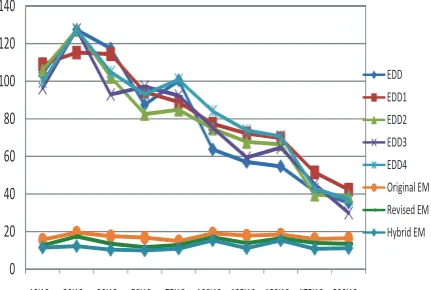
revealed that the EDD rule produces intermedi-ate solutions comparatively. Among heuristics, EDD1 and EDD4 have worst results, and it can be concluded that EDD3 is better than EDD2 and EDD. However, the comparison with hybrid EM, revised EM and original EM, they produce larger values, which are expected. As it can be seen, Hybrid EM keeps its robust performance in all the problem sizes. The revised EM has better performance than the original EM and outper-forms it. It is noticeable that with increasing the problem size in terms of both number of jobs and number of machines, gradually the RPDs of the proposed EDDs decreases and can be completive especially in the three last sizes.
To verify the statistical validity of the results, we carry out the analysis of variance (ANOVA) technique to accurately analyze the results. The means plot and LSD intervals at the 95% confi-dence level for all the algorithms are shown in Fig.
6. According to the results, the average RPD ob-tained by the proposed hybrid EM is 18.09, while for the revised EM, original EM, EDD, EDD1, EDD2, EDD3 and EDD4 are 23.665, 28.714, 110.963, 116.984, 112.331, 108.264 and 113.757, respectively.
0 50 100 150 200 250 300
10j3m 20j3m 30j3m 50j3m 75j3m 100j3m 125j3m 150j3m 175j3m 200j3m
EDD
EDD1
EDD2
EDD3
EDD4
Figure 4: Interaction between the number of jobs and performance of algorithms for instances with three machines.
The related results demonstrate that there is a clear statistically significant difference between performances of heuristics and meta-heuristics. It shows that there are no statistically signifi-cant differences between the EDDs; however,the EDD3 and EDD2 have slightly better perfor-mance compared with the EDD, EDD1 and EDD4. It is clear that the upper and lower
lim-0 20 40 60 80 100 120 140 160
10j5m 20j5m 30j5m 50j5m 75j5m 100j5m 125j5m 150j5m 175j5m 200j5m
EDD
EDD1
EDD2
EDD3
EDD4
OriginalEM
RevisedEM
HybridEM
Figure 5: Interaction between the number of jobs and performance of algorithms for instances with five machines.
0 20 40 60 80 100 120 140
10j10m 20j10m 30j10m 50j10m 75j10m 100j10m 125j10m 150j10m 175j10m 200j10m EDD
EDD1
EDD2
EDD3
EDD4
OriginalEM
RevisedEM
HybridEM
Figure 6: Interaction between the number of jobs and performance of algorithms for instances with ten machines.
its of the proposed hybrid EM do not have any overlapping.
6
Conclusions
Hybrid EM Revised EM Original EM EDD4 EDD3 EDD2 EDD1 EDD
140
120
100
80
60
40
20
0
R
P
D
Figure 7: Means plot and LSD intervals for the proposed algorithms.
search to implement the local search and global search.So, to enhance the exploitation and explo-ration capabilities of the proposed algorithm, two local search and diversification mechanism have been proposed in EM. To evaluate performance of algorithms, a set of test problems has been designed. The experimentation has shown that EDDs obtains good solutions partly and their re-sults have been better when the number of jobs and number of machines have increased. Among them, the EDD3 has performed better than oth-ers. The computational results and comparisons have demonstrated the effectiveness and robust-ness of the hybrid EM. Our future work is to investigate the other soft computing technique such as artificial neural networks [21,13,19] for the multi-BPM flow shop scheduling problems and generalize the application of the hybrid EM algo-rithm to solve other combinatorial optimization problems.
References
[1] T. Allahviranloo, R. Ezzati, S. Khezerloo, M. Khezerloo, S. Salahshour, Some
proper-ties of a new fuzzy distance measure,
Inter-national Journal of Industrial Mathematics 2 (2010) 305-317.
[2] M. R. Amin-Naseri, M. Beheshti-Nia,Hybrid
flow shop scheduling with parallel batching,
International Journal of Production Eco-nomics 117 (2009) 185-196.
[3] J. Behnamian, S. M. T. Fatemi Ghomi, F. Jolai, O. Amirtaheri, Minimizing makespan
on a three-machine flowshop batch schedul-ing problem with transportation usschedul-ing
ge-netic algorithm, Applied Soft Computing 12
(2012) 768-777.
[4] S. I. Birbil, S. C. Fang,An
electromagnetism-like mechanism for global optimization,
Jour-nal of Global Optimization 25 (2003) 263-282.
[5] S. I. Birbil, S. C. Fang, R. L. Sheu, On the convergence of a population-based global
op-timization algorithm,Journal of Global
Opti-mization 30 (2004) 301-318.
[6] C. W. Chao, C. J. Liao, A discrete electromagnetism-like mechanism for single machine total weighted tardiness problem
with sequence-dependent setup times,
Ap-plied Soft Computing 12(2012) 3079-3087.
[7] B. Cheng, K. Li, B. Chen, Scheduling a single batch-processing machine with non-identical job sizes in fuzzy environment using
an improved ant colony optimization,
Jour-nal of Manufacturing Systems 29(2010) 29-34.
[8] P. Damodaran, A. G. Rao, S. Mestry, Parti-cle swarm optimization for scheduling batch processing machines in a permutation flow-shop, International Journal of Advanced Manufacturing Technology 64 (2013)989-1000.
[9] D. Danneberg, T. Tautenhahn, F. Werner,A comparison of heuristic algorithms for flow shop scheduling problems with setup times
and limited batch size, Mathematical and
Computer Modelling 29 (1999)101-126.
[10] K. K. Harikrishnan, H. Ishii, Single ma-chine batch scheduling problem with resource dependent setup and processing time in the
presence of fuzzy due date, Fuzzy
Optimiza-tion and Decision Making 4 (2005) 141-147.
[11] A. Husseinzadeh Kashan, B. Karimi,An im-proved mixed integer linear formulation and lower bounds for minimizing makespan on
a flowshop with batch processing machines,
[12] H. Ishii, M. Tada, T. Masuda,Two
schedul-ing problems with fuzzy due-dates, Fuzzy
Sets and Systems 46 (1992) 339-347.
[13] A. Jafarian, S. MeasoomyNia, Utilizing a new feed-back fuzzy neural network for
solv-ing a system of fuzzy equations, International
Journal of Industrial Mathematics 5 2013 299-307.
[14] M. Khalili, R. Tavakkoli-Moghaddam, A multi-objective electromagnetism algorithm for a bi-objective flowshop scheduling prob-lem, Journal of Manufacturing Systems 31 (2012) 232-239.
[15] J. Kratica,An electromagnetism-like meta-heuristic for the uncapacitated multiple
al-location p-hub median problem, Computers
& Industrial Engineering http://dx.doi. org/10.1016/j.cie.2013.08.014./
[16] D. Lei, X. P. Guo, Variable neighbourhood search for minimising tardiness objectives on
flow shop with batch processing machines,
In-ternational Journal of Production Research 49 (2011) 519-529.
[17] D. Lei, T. Wang,An effective neighbourhood search algorithm for scheduling a flow shop
of batch processing machines, Computers &
Industrial Engineering 61 (2011) 739-743.
[18] M. Mathirajan, A. I. Sivakumar, A litera-ture review, classification and simple meta-analysis on scheduling of batch processors
in semiconductor, The International Journal
of Advanced Manufacturing Technology 29 (2006) 990-1001.
[19] M. Mosleh, Numerical solution of fuzzy dif-ferential equations under generalized
differ-entiability by fuzzy neural network,
Interna-tional Journal of Industrial Mathematics 5 (2013) 281-297.
[20] Z. Naji-Azimi, P. Toth, L. Galli,An electro-magnetism metaheuristic for the unicost set
covering problem, European Journal of
Op-erational Research 205(2010) 290-300.
[21] K. Parand, Z. Roozbahani, F. BayatBabol-ghani, Solving nonlinear Lane-Emden type equations with unsupervised combined
arti-ficial neural networks, International Journal
of Industrial Mathematics 5 (2013) 355-366.
[22] C. N. Potts, M. Y. Kovalyov,Scheduling with
batching: A review, European Journal of
Op-erational Research 120 (2000) 228-249.
[23] R. Saneifard, A Method for Defuzzification
by Weighted Distance, International Journal
of Industrial Mathematics 3 (2009a) 209-217.
[24] R. Saneifard, Defuzzification method for
solving fuzzy linear systems, International
Journal of Industrial Mathematics 4 (2009b) 321-331.
[25] R. Saneifard, Ranking L-R fuzzy numbers
with weighted averaging based on levels,
In-ternational Journal of Industrial Mathemat-ics 2 (2009c) 163-173.
[26] R. Saneifard, S. Nahid, A new parametric method for ranking fuzzy numbers based on
positive and negative ideal solutions,
Inter-national Journal of Industrial Mathematics 5 (2013) 119-128.
[27] C. T. Su, H. C. Lin, Applying
electromagnetism-like mechanism for
feature selection, Information Sciences 181
(2011) 972-986.
[28] C. S. Sung, Y. H. Kim, S. H. Yoon, A prob-lem reduction and decomposition approach for scheduling for a flow-shop of batch pro-cessing machines, European Journal of Op-erational Research 121 (2000) 179-192.
[29] R. Tavakkoli-Moghaddam, M. Khalili, B. Naderi,A hybridization of simulated anneal-ing and electromagnetism-like mechanism for job shop problems with machine availabil-ity and sequence-dependent setup times to
minimize total weighted tardiness, Soft
Com-puting 13 (2009) 995-1006.
[30] R. Tavakkoli-Moghaddam, A. Rahimi-Vahed, A. H. Mirzaei, A hybrid multi-objective immune algorithm for a flow shop scheduling problem with bi-objectives:
Weighted mean completion time and
weighted mean tardiness, Information
Sciences 177 (2007) 5072-5090.
System characteristics, performance
evalua-tion and producevalua-tion planning, IIE
Transac-tions 24 (1992) 47-60.
[32] R. Uzsoy, C. Lee, L. Martin-Vega, A re-view of prod planning and scheduling models in the semiconductor industry, part ii: shop
floor control, IIE Transactions 26 (1994)
44-55.
[33] J. Wang,A fuzzy robust scheduling approach
for product development projects, European
Journal of Operational Research 152 (2004) 180-194.
[34] A.D., Yimer, K. Demirli, Fuzzy schedul-ing of job orders in a two-stage
flow-shop with batch-processing machines,
Inter-national Journal of Approximate Reasoning 50 (2009) 117-137.
Saber Molla-Alizadeh-Zavardehi is an assistant professor of Industrial Engineering at College of Engi-neering, Islamic Azad University (IAU), Masjed-Soleiman Branch in Iran. He is the Graduate Programs Manager of Industrial Engineering at the IAU, Masjed-Soleiman Branch, in Iran. His research interests are production scheduling, sup-ply chain modeling, fuzzy set theory and meta-heuristic algorithms. He has about 8 years of teaching and research experience and has au-thored 25 papers published in various interna-tional journals.
Reza Tavakkoli-Moghaddam is a professor of Industrial Engineering at College of Engineering, Univer-sity of Tehran in Iran. He obtained his Ph.D. in Industrial Engineer-ing from Swinburne University of Technology in Melbourne (1998), his M.Sc. in Industrial Engineering from the Uni-versity of Melbourne in Melbourne (1994) and his B.Sc. in Industrial Engineering from the Iran University of Science and Technology in Tehran (1989). His research interests include facility lay-outs and location design, cellular manufactur-ing systems, sequencmanufactur-ing and schedulmanufactur-ing, and
us-ing meta-heuristics for combinatorial optimiza-tion problems. He is the recipient of the 2009 and 2011 Distinguished Researcher Award and the 2010 Distinguished Applied Research Award at University of Tehran, Iran. Additionally, he has been selected as National Iranian Distinguished Researcher for two years (2008 and 2010). Profes-sor Tavakkoli-Moghaddam has published 4 books, 15 book chapters and more than 500 papers in reputable academic journals and conferences