OPEN A
CCE
SS
JZ
AR E
videnc
e-based practic
OPEN A
CCE
SS
Evidence-based practice
Exploring the early social affiliations and behaviour of a captive Asian
elephant (
Elaphas maximus
) calf
Joe Petraccione, Holly Root-Gutteridge, Dana A. Cusano, Susan E. Parks Biology Department, Syracuse University, 107 College Place, Syracuse, NY 13244
Correspondance: Holly Root-Gutteridge; +315 443 0194; [email protected]
Keywords:
ethogram, social bonds, social development, herd behaviour
Article history:
Received: 28 March 2016 Accepted: 25 May 2017 Published online: 31 July 2017
Abstract
Asian elephants (Elephas maximus) are an endangered species with complex social behaviour. However, no previous studies have mapped the development of calves before the age of six months. This study seeks to fill this gap in knowledge through a characterisation of the earliest stages of development in the behavioural repertoire and social associations of a male elephant calf at the Rosamond Gifford Zoo in Syracuse, NY. The herd was composed of four adult females (mother, maternal aunt, grandmother, and one unrelated female) and one male calf born on 12th May 2015. Data were collected between May – and September 2015 while the elephants were on public display in a 3.5 -acre outdoor enclosure. The calf’s behaviour was recorded using continuous focal follows with one-zero sampling and instantaneous sampling with two-minute intervals, two-minute instantaneous sampling of the females’ behaviour, and herd association indices were collected at two-minute intervals. A total of 554 focal follow samples of the calf’s behaviour were collected across the first 17 weeks of development. The calf exhibited increasing levels of dexterity and behavioural complexity with time, particularly with fine motor skills associated with trunk use. The calf spent almost all of his time in close proximity to other herd members (98% of total observed time) and this remained consistent over the entire observational period. His most frequent association was with his mother (in close proximity in 70% of observations) and his lowest association was with his aunt (33%). The adults spent an average of 70% of observed time associating with any other elephant in the herd. There were no significant differences in the time the other elephants spent with related and non-related individuals within this zoo herd. Due to the importance of social affiliations and early bonding between herd members, we suggest that further studies on the early development of elephant calves could provide useful information on herd bonding, management, and husbandry.
Introduction
The Asian elephant (Elephas maximus) is an endangered species with an estimated wild population of less than 50,000 individuals (IUCN, 2014). Asian elephants have been shown to be highly intelligent with complex social structures in their matriarchal herds, which can be nested into larger hierarchical clan-based societies that stretch across their populations (Vidya and Sukumar 2005; Plotnik and de Waal 2014). However, there have been relatively few studies of Asian elephant behaviour (Schulte 2000; Venkataraman et al. 2002), despite their importance to ecosystems (Venkataraman et al. 2002) and their demonstrated intelligence (Bates et al. 2008). Furthermore, Asian elephants have suffered from low birth rates and high juvenile mortality in captivity in North America, suggesting that research should explore their captive behaviour and early life stages to attempt to reverse this trend (Wiese 2000).
females are considered more social than their Asian counterparts (de Silva et al. 2011; de Silva and Wittemyer 2012). This difference in sociality extends to the hierarchical clustering of social groups of African, but not of Asian, elephants (Fernando and Lande 2000). African elephants form hierarchical structured societies, with closely related females forming herds which make up the primary social group (Wittemyer and Getz 2007; Wittemyer et al. 2009). These herds fit into larger social structures as they associate with other, non-kin herds as part of a continually changing fission-fusion society (Wittemyer et al. 2009). Studies of wild Asian elephants have suggested that the social associations are limited to direct maternal lines and have association indices of 0.3 (de Silva et al. 2011), in contrast with the complex groups of the African elephant (Fernando and Lande 2000) and their stronger association indices of > 0.6 (de Silva et al. 2011). This raises the question of how social bonds form between elephants both in the wild and in captivity and how familial associations affect these bonds.
For both species, the calves in the herds benefit from both the social learning and resource provisioning provided by female herd members and allo-mothering has been witnessed in both species (Lee 1987; Greco et al. 2013; Vidya 2013). Herds can communicate through rumbles and co-ordinate movements through contact calls (Leighty et al. 2008). As elephants are capable of social learning (Poole and Moss 2008; Stoeger et al. 2012a; Smet and Byrne 2013), including vocal learning (Poole et al. 2005; Stoeger et al. 2012b), calves may also benefit through extensive contact with other herd members during development thus exposing them to different behavioural models and social contexts (Schulte 2000; Evans and Harris 2008).
Many studies have characterised the behavioural development of the offspring of other large, herd-living species (Plair et al. 2012; Greco et al. 2013; Berry and Bercovitch 2014; Horback et al. 2014). However there are no reported studies of Asian elephant calf behaviour before the age of six months, and many ontogeny studies have focused on African elephants, which may not be wholly comparable (Schulte 2000; de Silva et al. 2013). Studies of the ontogeny of African elephants have emphasised the timing of behavioural milestones including trunk use, play behaviour, independence from the mother and increasing interaction with other herd members (Lee 1986; Kowalski et al. 2008; Lee and Moss 2014). Some studies have characterised the elephants’ capacity for social learning and vocal learning, demonstrating that vocal dexterity improves with time and that some vocalisations produced are an imitation of the calls of others (Poole et al. 2005; Stoeger-Horwath et al. 2007; Stoeger et al. 2011). Furthermore, the first 24 hours of life have been intensively characterised for elephants but less has been reported about behavioural development over the following months (Sharma and Krishnamurthy 1984; Bercovitch and Andrews 2010), though initial investigations have begun using questionnaires filled in by zookeepers to map milestones (Kowalski et al. 2008).
Despite differences in situation, captive observations have been validated by studies in the wild where the same behaviour and development patterns have been observed (Schulte 2000; Bercovitch and Andrews 2010), making captive studies valuable to researchers who wish to better understand elephant behaviour and social ontogeny. As Asian elephant habitat comprises both dense and often remote forest rendering studies in the wild difficult (Sukumar 2006), observations in captivity are valuable to understanding the species.
This study aims to explore the behavioural and social development of a captive Asian elephant calf from two to 17 weeks of age, to quantify milestones and to investigate how these may differ from African elephant behaviour. This information can be used to better inform husbandry and management practices in captivity and to offer baseline statistics for studies in the wild.
Intervention - a case study
Subjects and Settings
An Asian elephant herd, comprising four adult females and one male calf was observed at the Rosamond Gifford Zoo, Syracuse, New York, USA. The females had been kept at Rosamond Gifford Zoo in this herd for more than 18 years (Targa aged 32) and Romani (aged 39), or from birth (Batu, born 12th May 2015; Mali and Kirina both aged 18). The familial relationships between elephants is shown in Figure 1. Note the calf Batu, is directly related to all but one of the females through his maternal grandfather.
Data Collection
Data were collected from 29th May until 4th September 2015, when the calf was aged between two and 17 weeks old. Observations were made from public access viewpoints when the herd was released into its external paddock during zoo operational hours (10 am to 5 pm). The paddock consisted of a large grassy area on a slope, with a permanent umbrella and surrounded by a metal fence and trees. The 3.5-acre paddock was sufficiently large that the elephants could choose to remain far enough apart to be out of passive association distance to any other elephant. The elephants were allowed twice daily access to this area for approximately an hour at a time. Enrichment in the form of food (dried hay) was placed in two separate areas by the zookeepers after allowing the elephants access into the paddock, and the elephants were observed to move hay to other locations, ensuring that feeding did not necessitate passive association.
Focal follows of behaviour
To quantify both the repertoire of, and time spent performing, behaviours by the calf, an ethogram was created based on behaviours listed in previous studies Schulte (2000) and Horback et al. (2014) (Table 1). A video focal follow (Altmann 1974) of the calf was conducted using a Panasonic HDC-TM900 video camera. Using both instantaneous interval sampling methods and one-zero sampling, whereby each behaviour was noted as 1 if it occurred and 0 if not (Altmann 1974), all behaviours observed within a two-minute period were noted. Observation time was restricted to when the calf was on public display. At least one and up to four recording periods were made every week for 15 weeks, resulting in 554 sets of two-minute follows and 554 instantaneous samples of the calf’s behaviour taken at the end of each focal follow. Instantaneous sampling of the elephants’ behaviour, including the calf, was performed at two-minute intervals by a second observer for seven weeks during the calf observation periods, totalling 257 scan samples for the whole herd’s behaviour. Data collection was limited by the availability of a second observer.
Social affiliation
Following Sukumar et al. (1988) and Schulte (2000), social bonds were assessed by noting the herd’s passive associations at < 5 m, using instantaneous sampling at two-minute intervals across seven weeks. These observations were limited to dates when a second observer was available. For the calf, social maturation was tracked by measuring the time spent in close affiliation with other elephants and time spent independent from his mother (Schulte 2000; Lee and Moss 2014), with the expectation that with increasing age come increasing independence. Time spent in association (257 instantaneous scan sample observations for the whole herd) across the total observed time for the whole herd was measured using the social network analysis software SOCPROG 2.4 (Whitehead 2009) in Matlab 2015a (MathWorks 2015).
Statistical analysis
The calf’s behaviour was compared to the activity budgets of the adult members of the herd. For both calf and adult behavioural follows, multiple sessions recorded in a single week were considered dependent. To correct for different sample sizes as the observation time for the elephants was limited to the time they were on public display, behaviour times were calculated as weekly totals, with all observations within a week considered as part of the same recording session. A total of 1108 minutes of video were recorded of focal follows, and 257 instantaneous scan samples of herd behaviour. For example, if in one week four hours of observation were made (120 2-minute observation periods), and the ‘suckle’ behaviour was recorded in 30 of the two-minute time segments, it was calculated as present in 25% of the activity budget (Altmann 1974). To make the data between the adults and calf comparable, we used only the 257 instantaneous scan samples for both.
The calf’s passive associations with other herd members were measured using instantaneous samples made every two minutes. These data were assessed as normally distributed by visual assessment of the Q-Q plots for each variable. The associations were compared across weeks (N = 15) and months (N = 4) using a one-way repeated measures analysis of variance (ANOVA) test, with a post-hoc Tukey’s HSD test performed in SPSS (IBM Corp. Released 2013). Time spent alone was also noted. This was used to investigate the development of social associations by the calf as he matured. One-way ANOVA was also used to determine whether the elephants exhibited different association indices across the seven observed weeks.
Results
Calf behaviour
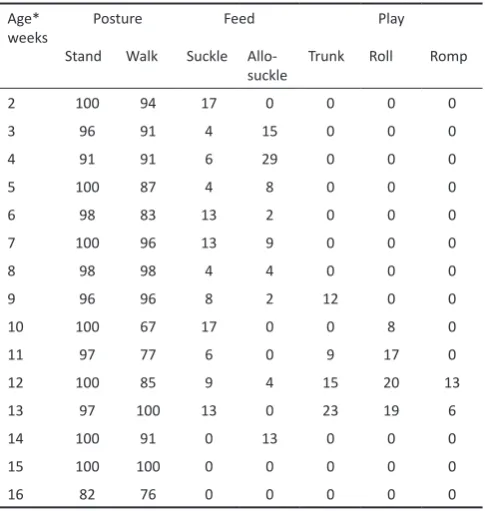
A total of 1108 minutes of video were recorded, representing 554 two-minute samples from 35 sessions across 15 weeks of data collection, with at least one session per week. The calf’s behavioural repertoire increased with age, with just three behaviours observed at two weeks of age and seven by 13 weeks of age (Table 1). Other behaviours were represented in less than 5% of time of observations and were therefore not included in further analyses. These behaviours included imitation of adult behaviours including lifting hay, leaves and sticks to his mouth and mimicking feeding behaviors. The percentage of observed time spent by the calf performing each behaviour is shown in Table 2. Note that while there was little variation in time walking or standing with age, there was an overall increase in repertoire as age increased.
*Behaviour Description Age first
observed/ weeks Feed Ate either hay or foraged for grass and
leaves (only observed in adults) -Stand Standing without significant movement 0* Suckle Suckling mother and apparently receiving
milk (analogous to ‘Feed’ in adults) 0* Walk Walking for at least 3 steps in one direction 0* Allo-suckle Lifting head and trunk into suckle position
under a female but not latching on or
receiving milk 4
**Play:
Trunk Grabbing an object (twigs, leaves, etc.) with trunk and moving it around 10 Play: Roll Rolling around on the ground 11 Play: Romp Stomping in circles with no apparent
objective 13
Other Any other behaviour not listed above e.g. rub against wood or dust bathe
*Behaviour seen at age 2 weeks when the study began but noted as occurring previously by keepers.
**Manipulation of object with trunk
Table 1. Behavioural description, age in weeks of first appearance in
repertoire. Age*
weeks Posture Feed Play
Stand Walk Suckle
Allo-suckle Trunk Roll Romp
2 100 94 17 0 0 0 0
3 96 91 4 15 0 0 0
4 91 91 6 29 0 0 0
5 100 87 4 8 0 0 0
6 98 83 13 2 0 0 0
7 100 96 13 9 0 0 0
8 98 98 4 4 0 0 0
9 96 96 8 2 12 0 0
10 100 67 17 0 0 8 0
11 97 77 6 0 9 17 0
12 100 85 9 4 15 20 13
13 97 100 13 0 23 19 6
14 100 91 0 13 0 0 0
15 100 100 0 0 0 0 0
16 82 76 0 0 0 0 0
*At the start of the study week. The calf was born mid-week therefore each of these weeks represents his age as the numeric week he had achieved on the Monday of the starting week, thus he was 2 weeks at the start and just over 17 weeks old at the finish of the study which lasted 15 weeks in total
four females when measured across weeks (F (3, 56) = 17.265, P = 0.000) or months (F (3, 12) = 8.292, P = 0.003). However, Tukey’s HSD test revealed that the only significant difference was between the mother and the other three females (P = 0.000) while the other three females did not significantly differ to each other (P > 0.999) across weeks or months. There was also no significant difference in time spent in association across weeks (F (14, 45) = 0.585, P = 0.863).
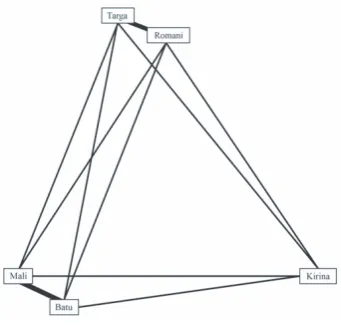
Social association behaviour of adults
The social network of the herd is represented in Figure 4. Note that the strongest bond was between Mali and her calf Batu (association index = 0.82) and the next strongest between the two oldest females, Romani and Targa (association index = 0.50), who were unrelated. Kirina, who was related to all other elephants, spent the least time in passive association with another elephant (mean = 0.36, range 0.33-0.43). However, there was no significant difference in time spent with other adults across weeks for any of the females (P > 0.05). The adult females spent an average of 70% (range: 61–93%) of their time associating with another elephant: mean = 55% in association with the calf (range = 42–87%) and mean = 61% (range = 56–67%) in association with another female. The results for the calf’s associations with the whole herd using only the 257 instantaneous sample observations did change significantly from using the full dataset of 554 observations (97.7– 98.4%) (t-test: t=17.585, d.f. =1, sig = 0.036) but this change was probably due to the difference in weeks of age (2–9 weeks for herd observations and 2–15 for the focal observations).
Discussion
The current study is, to our knowledge, the first investigation into the social and behavioural development of an Asian elephant calf under six months old. As he matured from birth, the calf developed a more complex behavioural repertoire and also displayed more physically adept behaviours (Table 1). This Figure 2. Activity budgets for the herd with time spent performing each
behaviour marked. Note that Feed (active behaviour) was the dominant behaviour for all adults (68% to 84% of observations) and stand (a passive behaviour) was dominant for the calf (67% of observations).
Figure 3. Box plot of the passive associations of the calf and the adult females in the herd. A one-way ANOVA found a significant difference in the amount of time spent in association with the mother (Mali) compared to the other females (Tukey’s HSD F (3,108) = 14.841, P < 0.001).
Figure 4. Social network of elephant herd with line thickness representing bond st.rength. Note that genetic relationship does not predict social affiliation except for mother and calf (Mali and Batu) with the mothers of the adult females spending more time in affiliation with each other than with their daughters. Affiliation strength is represented by line thickness and scaled to affiliation = 0 to strongest possible affiliation = 1, with Batu and Mali having the strongest bond (index = 0.82) and Targa and Romani the next strongest (index = 0.50). Spacing indicates the relative associations across the group – with Kirina featuring in the fewest groups but still maintaining a bond (index > 0.33) with all other members.
Adult behaviour
In total, 257 instantaneous samples of the herd’s behaviour were taken across seven weeks. Feed was the behaviour most often observed and was the only behaviour which varied significantly among the adults (F (3,28) = 6.517, P = 0.002), with Tukey’s HSD test showing that Kirina (18) spent the least time feeding (68%) compared to the other three females (81%–84%) (Figure 2). The next most dominant behaviours were “stand” (mean = 6.5%, range = 4%–9%) and “walk” (mean = 12.2%, range = 8–18%), while “other” behaviours such as dustbathing and playing were seen in less than 5% (mean = 2%, range = 1–4%) of total observations. There was no variation in behaviour from week to week for the adults (P > 0.05).
Association behaviour of the calf
suggests that behavioural development is probably closely linked to physical maturity and that dexterity improves with practice, which is consistent with previous findings (Pratt and Anderson 1979; Plair et al. 2012; Lee andMoss 2014). Compared to African elephants, his behavioural development was delayed with object manipulation not appearing until week 10 compared to week one for African elephant calves (Kowalski et al. 2008). Walk and stand are such common behaviours that it is to be expected that they will be represented in any two-minute period, thus finer scale times are required to demonstrate possible changes across time. A larger sample size for the study with additional individuals would also demonstrate whether these findings are peculiar to this calf or are reasonable representations of Asian elephant calf development. Additionally, the calf was not weaned and therefore his results could not compare easily to that of the adults where “feed” was the dominant behaviour but his stand behaviour was similar to their pose for feeding.
While social learning is known to be an important factor of elephant society (Schulte 2000; Evans and Harris 2008; Poole and Moss 2008), the calf did not spend significant amount of time actively interacting with the adults, but instead spent most of his time in passive association. He was occasionally seen to engage in play and to copy their actions in lifting hay, sticks and leaves to his mouth, apparently tasting the items as seen in African elephant calves (Kowalski et al. 2008). This was not a major proportion of his activity budget but demonstrated that he was gaining foraging skills by apparent mimicry of the behaviours of herd members and thus even apparently passive associations were likely beneficial in terms of social learning (Poole et al. 2005; Hart et al 2008; Arvidsson et al. 2012; Greco et al. 2013; Hyatt 2013).
The calf was rarely alone (2% of observations) but his social affiliations were not defined by his genetic relatedness as, other than his mother, he spent equal time with the related and unrelated females in the herd (Figure 3). This may be because social cohesion to the herd as a whole is advantageous and females may benefit from the experience of allo-mothering as practice for their own offspring, so that genetic relatedness is less important than herd membership for its performance (Riedman 1982; Lee 1987; Schulte 2000). This was supported by the finding that the adult females did not use genetic relationship as the basis of their strongest affiliations, with the two oldest females who were unrelated spending more time in close proximity with each other (49% of total observed affiliations) than with their actual relatives (33% to 43% of total observed affiliations). The strongest association between adults was that of Targa (32) and Romani (39), who were not kin. This bonding between adults of similar age is also seen in both related and unrelated African and Asian elephants (Wittemyer and Getz 2007; Wittemyer et al. 2009). Thus, age appears to be a strong driver of social bonds and should be considered as a factor when managing captive herds.
Kirina (18), the female with the lowest social affiliation indices (Figure 4), was frequently seen to carry hay away from the main feeding sites and to eat alone, possibly to maximise the resource without sharing. This may explain her position as the least social of the elephants, despite being the only elephant related to every other member of the herd (Figure 1). Resource guarding may be more significant for younger, subordinate herd members, but this has not been previously investigated. There is little direct behavioural evidence for resource guarding in wild Asian elephants, but de Silva et al. (2011) described competition over water and mud, and stronger associations between individuals during the dry season, when resources are less plentiful and resource-guarding may be more important. It would be valuable to explore how the associations alter when more valuable resources are offered and if there are differences in the resulting behaviour. Karina’s association index was also similar to that of many wild
Asian elephants, suggesting that her solitude was not unusual behaviour (de Silva et al. 2011).
Social affiliations are known to be important in both elephant society (McComb et al. 2000; Bates et al. 2008; Evans and Harris 2008) and in other herd animals (Pratt and Anderson 1979), but this study questions the assumption that the strongest bonds will be between genetically related individuals, such as siblings or mother-child. It also demonstrates that while Asian elephants in the wild live in primarily maternally derived groups (Fernando and Lande 2000), this is not reflected in the composition or affiliation of our studied group. The unexpected result that genetic relationships had no effect on passive affiliation is in direct contradiction of most herd species, where the closeness of female-genetic relationships dominate social affiliations (Pratt and Anderson 1979; Fernando and Lande 2000; Colson et al. 2012), and demonstrates that there is much left to understand regarding how elephants develop social bonds and behaviours and how herd behaviour is controlled. We also suggest that it would be beneficial to investigate how peer-groups and long-term social affiliations are developed and maintained in captive settings. In the wild, herd fragmentation caused by poaching has reduced social bond strength for African elephants, with the strongest bonds between related females made weaker and less frequent than those in populations which have not been poached (Gobush et al. 2009). African elephants have also shown greater associations between non-kin following predation events, suggesting that this ability to form social bonds outside of kin-groups allows greater stability of the society (Wittemyer et al. 2009). How bonds arise and strengthen in captive settings is currently not well reported, but a longitudinal study of affiliations across lifetimes and different herds could be illuminating as to the potential long term effects of herd fragmentation and re-organisation on elephant social structures.
Asian elephants are endangered (IUCN, 2014) and there is strong interest in their conservation both in and ex situ (Schulte 2000). Due to the importance to herd welfare of social affiliations and early bonding between individuals, we suggest that further studies of the behavioural development of elephant calves and their place within herd social affiliations would produce useful information. Overall, we suggest that there is significant value in long term research into elephant behaviour in captivity to better inform their management and care.
Acknowledgements
We would like to thank the staff of Rosamond Gifford Zoo, in particular all the elephant keepers, for their cooperation in this project, Mya Thompson for editorial assistance, and Syracuse University for their financial support of the project. JP was supported by a summer undergraduate research scholarship from the Biology Department at Syracuse University. The Syracuse University IACUC committee granted IACUC approval and Rosamond Gifford Zoo approved the project.
References
Altmann J. (1974) Observational Study of Behavior: Sampling Methods. Behaviour 49: 227–266. DOI: 10.1163/156853974X00534.
Arvidsson J., Amundin M., Laska M. (2012) Successful acquisition of an olfactory discrimination test by Asian elephants, Elephas
maximus. Physiology and Behavior 105: 809–814. DOI: 10.1016/j.
physbeh.2011.08.021.
Bates LA., Poole JH., Byrne RW. (2008) Elephant cognition. Current Biology 18: 544–546. DOI: 10.1016/j.cub.2008.04.019.
Bercovitch F.B.., Andrews J. (2010) Developmental milestones among African elephant calves on their first day of life. Zoo Biology 29: 120– 126. DOI: 10.1002/zoo.20179.
Colson K.E., Brinkman T.J., Person D.K., Hundertmark K.J. (2012) Fine-scale social and spatial genetic structure in Sitka black-tailed deer. Conservation Genetics 14: 1–11. DOI: 10.1007/s10592-012-0388-0. Evans K.E., Harris S. (2008) Adolescence in male African elephants,
Loxodonta africana, and the importance of sociality. Animal Behaviour
76: 779–787. DOI: 10.1016/j.anbehav.2008.03.019.
Fernando P., Lande R. (2000) Molecular genetic and behavioural analysis of social organization in the Asian elephant (Elephas maximus). Behavioral Ecology and Sociobiology 48: 84–91. DOI: 10.1017/ CBO9781107415324.004.
Gobush K., Kerr B., Wasser S. (2009) Genetic relatedness and disrupted social structure in a poached population of African elephants. Molecular Ecology 18: 722–734. DOI: 10.1111/j.1365-294X.2008.04043.x. Greco B.J., Brown T.K., Andrews J.R.M., Swaisgood R.R., Caine N.G. (2013)
Social learning in captive African elephants (Loxodonta africana
africana). Animal Cognition 16: 459–469. DOI:
10.1007/s10071-012-0586-7.
Hart B.L., Hart L.A., Pinter-Wollman N. (2008) Large brains and cognition: Where do elephants fit in? Neuroscience and Biobehavioral Reviews 32: 86–98. DOI: 10.1016/j.neubiorev.2007.05.012.
Horback K.M., Miller L.J., Andrews J.R.M., Kuczaj S.A. (2014) Diurnal and nocturnal activity budgets of zoo elephants in an outdoor facility. Zoo Biology 8: 1–8. DOI: 10.1002/zoo.21160.
Hyatt C. (2013) Two-choice discrimination learning in African elephants
(Loxodonta africana). Pachyderm 73–80.
IBM Corp. Released. 2013. IBM SPSS Statistics for Windows.
IUCN. 2014.IUCN Red List of Threatened Species. Available at www. iucnredlist.org
Kowalski N.L., Dale R.H.I., Mazur C.L.H. (2008) A survey of the management and development of captive African elephant (Loxodonta africana) calves: birth to three months of age. Zoo Biology 29: 104–119. DOI: 10.1002/zoo.20195.
Lee P.C. (1986) Early social development among African elephant calves. National Geographic Research 2: 388–401.
Lee P.C. (1987) Allomothering among African elephants. Animal Behaviour 35: 278–291. DOI: 10.1016/S0003-3472(87)80234-8.
Lee P.C., Moss C.J. (2014) African Elephant Play, Competence and Social Complexity. Animal Behavior and Cognition 2: 144. DOI: 10.12966/ abc.05.05.2014.
Leighty K.A., Soltis J., Wesolek C.M., Savage A. (2008) Rumble vocalizations mediate interpartner distance in African elephants, Loxodonta africana. Animal Behaviour 76: 1601–1608. DOI: 10.1016/j. anbehav.2008.06.022.
MathWorks. 2015. Matlab 2015a.
McComb K., Moss C., Sayialel S., Baker L. (2000) Unusually extensive networks of vocal recognition in African elephants. Animal Behaviour 59: 1103–1109. DOI: 10.1006/anbe.2000.1406.
Plair B.L., Reinhart P.R., Roth T.L. (2012) Neonatal milestones, behavior and growth rate of Sumatran rhinoceros (Dicerorhinus sumatrensis) calves born and bred in captivity. Zoo Biology 31: 546–60. DOI: 10.1002/ zoo.20419.
Plotnik J.M., de Waal F.B.M.M. (2014) Asian elephants (Elephas maximus) reassure others in distress. PeerJ 2:e278. DOI: 10.7717/peerj.278. Poole J.H., Moss C.J. (2008) Elephant sociality and complexity: the scientific
evidence. Elephants and ethics: towards a morality of co-existence 69–98. DOI: 10.1016/j.anbehav.2009.01.003.
Poole J.H., Tyack P.L., Stoeger-Horwath A.S., Watwood S.L. (2005) Animal behaviour: Elephants are capable of vocal learning. Nature 434: 455– 456. DOI: 10.1038/434455a.
Pratt D.M., Anderson V.H. (1979) Giraffe Cow Calf Relationships and Social Development of the Calf in the Serengeti Tanzania. Zeitschrift Fuer Tierpsychologie 51: 233–251. DOI: 10.1111/j.1439-0310.1979. tb00686.x.
Riedman M.L. (1982) The evolution of alloparental care and adoption in mammals and birds. The Quarterly Review of Biology 57: 405–435. DOI: 10.1086/412936.
Schulte B.A. (2000) Social structure and helping behavior in captive elephants. Zoo Biology 19: 447–459. DOI: 10.1002/1098-2361(2000)19:5<447::AID-ZOO12>3.0.CO;2-#. Sharma R., Krishnamurthy K.V. (1984) Behavior of a neonate elephant
(Elephas maximus). Applied Animal Behaviour Science 13: 157–161.
De Silva S., Elizabeth Webber C., Weerathunga U.S., Pushpakumara T.V., Weerakoon D.K., Wittemyer G. (2013) Demographic variables for wild Asian elephants using longitudinal observations. PLoS ONE 8. DOI: 10.1371/journal.pone.0082788.
de Silva S., Ranjeewa A.D.G., Kryazhimskiy S. (2011) The dynamics of social networks among female Asian elephants. BMC Ecology 11: 17. DOI: 10.1186/1472-6785-11-17.
de Silva S., Wittemyer G. (2012) A Comparison of Social Organization in Asian Elephants and African Savannah Elephants. International Journal of Primatology 33: 1125–1141. DOI: 10.1007/s10764-011-9564-1. Smet A.F., Byrne R.W. (2013) African elephants can use human pointing
cues to find hidden food. Current Biology 23: 2033–2037. DOI: 10.1016/j.cub.2013.08.037.
Stoeger-Horwath A.S., Stoeger S., Schwammer H.M., Kratochvil H. (2007) Call repertoire of infant African elephants: first insights into the early vocal ontogeny. The Journal of the Acoustical Society of America 121: 3922–3931. DOI: 10.1121/1.2722216.
Stoeger A.S., Charlton B.D., Kratochvil H., Fitch W.T. (2011) Vocal cues indicate level of arousal in infant African elephant roars. The Journal of the Acoustical Society of America 130: 1700. DOI: 10.1121/1.3605538. Stoeger A.S., Mietchen D., Oh S., de Silva S., Herbst C.T., Kwon S., Fitch W.T.
(2012a) An Asian elephant imitates human speech. Current Biology 22: 2144–2148. DOI: 10.1016/j.cub.2012.09.022.
Stoeger A.S., Mietchen D., Oh S., de Silva S., Herbst C.T., Kwon S., Fitch W.T. (2012b) An Asian elephant imitates human speech. Current Biology 22: 2144–2148. DOI: 10.1016/j.cub.2012.09.022.
Sukumar R. (2006) A brief review of the status, distribution and biology of wild Asian elephants Elephas maximus. International Zoo Yearbook 40: 1–8. DOI: 10.1111/j.1748-1090.2006.00001.x.
Sukumar R., Joshi N.V., Krishnamurthy V. (1988) Growth in the Asian elephant. Proceedings of the Indian Academy of Science (Animal Sciences) 97: 561–571. DOI: 10.1007/BF03179558.
Venkataraman A.B., Kumar N.V., Varma S., Sukumar R. (2002) Conservation of a flagship species: Prioritizing Asian Elephant (Elephas maximus) conservation units in southern India. Current Science 82: 1022–1033. Vidya T. (2013) Novel behaviour shown by an Asian elephant in the context
of allomothering. Acta Ethologica, 123–127. DOI: 10.1007/s10211-013-0168-y.
Vidya T.N.C., Sukumar R. (2005) Social organization of the Asian elephant
(Elephas maximus) in southern India inferred from microsatellite DNA.
Journal of Ethology 23: 205–210. DOI: 10.1007/s10164-005-0144-8. Whitehead H. (2009) SOCPROG programs: Analysing animal social
structures. Behavioral Ecology and Sociobiology 63: 765–778. DOI: 10.1007/s00265-008-0697-y.
Wiese R.J. (2000) Asian elephants are not self-sustaining in North America. Zoo Biology 19: 299–309. DOI: 10.1002/1098-2361(2000)19:5<299::AID-ZOO2>3.0.CO;2-Z.
Wittemyer G., Getz W. (2007) Hierarchical dominance structure and social organization in African elephants, Loxodonta africana. Animal Behaviour 73: 671–681. DOI: 10.1016/j.anbehav.2006.10.008. Wittemyer G., Okello J.B.A., Rasmussen H.B., Arctander P., Nyakaana