Patient Experience Journal
Volume 3 | Issue 2
Article 17
2016
“What Matters to You?”: A pilot project for
implementing patient-centered care
Anthony M. DiGIoia MD, III
Bone and Joint Center at Magee-Womens Hospital of UPMC and PFCC Innovation Center of UPMC, [email protected]
Sarah B. Clayton
PFCC Innovation Center of UPMC, [email protected]
Michelle B. Giarrusso
PFCC Innovation Center of UPMC, [email protected]
Follow this and additional works at:
https://pxjournal.org/journal
Part of the
Health and Medical Administration Commons,
Health Services Administration
Commons, and the
Health Services Research Commons
This Article is brought to you for free and open access by Patient Experience Journal. It has been accepted for inclusion in Patient Experience Journal by an authorized editor of Patient Experience Journal.
Recommended Citation
DiGIoia, Anthony M. MD, III; Clayton, Sarah B.; and Giarrusso, Michelle B. (2016) "“What Matters to You?”: A pilot project for implementing patient-centered care,"Patient Experience Journal: Vol. 3 : Iss. 2 , Article 17.
“What Matters to You?”: A pilot project for implementing patient-centered
care
Cover Page Footnote
The authors would like to thank Eve Shapiro, Principal, Eve Shapiro Medical Writing, Inc., for editing this
paper.
Patient Experience Journal
Volume 3, Issue 2 – Fall 2016, pp. 130-137
Patient Experience Journal, Volume 3, Issue 2 – Fall 2016
© The Author(s), 2016. Published in association with The Beryl Institute and Patient Experience Institute
Downloaded from www.pxjournal.org 130
Culture & System Change
“What Matters to You?”
: A pilot project for implementing patient-centered
care
Anthony M. DiGioia MD, III,
Bone and Joint Center at Magee-Womens Hospital of UPMC and PFCC Innovation
Center of UPMC, [email protected]
Sarah B. Clayton,
PFCC Innovation Center of UPMC, [email protected]
Michelle B. Giarrusso,
PFCC Innovation Center of UPMC, [email protected]
Abstract
This project was intended to enhance the delivery of patient-centered care by asking patients what matters to them before and after total joint replacement (TJR) surgery. In Phase I, pre-operatively, patients undergoing total joint replacement (TJR) surgery were asked, “What matters to you before surgery, during your hospital stay, and in the first 3 months following surgery?” and “What matters to you moving forward after you’ve recovered from your joint
replacement?” Four weeks post-operatively they were asked, “Now that that you’ve been through the surgery and first 4 weeks of recovery, can you identify new concerns that you didn’t have before?” and “What matters to you moving forward after you’ve recovered?” In Phase 2, 49 patients were asked pre-operatively, “Thinking ahead in this
process…what matters to you?” Four weeks post-operatively, they were told, “Now that you’ve gained experience from going through a joint replacement, rank the categories in terms of how important it would have been to know in your pre-operative interview what you know now.” In Phase 1, 98% of patients answered the questions the same way pre- and post-operatively. The 2% who did not reported greater than expected surgical pain. In Phase 2, patients ranked the 3 most important categories pre- and post-operatively surgical results, quality of life, and reduction in pain. The WMTY project may increase patients’ engagement in their care, show providers how to better understand what matters to their patients, and help surgeons to define outcomes more broadly.
Keywords
Patient-centered care, patient engagement, communication
Acknowledgement
The authors wish to thank Eve Shapiro and Pamela Greenhouse as well as the staff of the PFCC Innovation Center of UPMC for their contributions.
Introduction
The term “patient centered medicine” was introduced by Michael Balint in the 1950s1 and championed by
organizations such as the Picker Institute in the 1980s.2
Yet, it was not until the Institute of Medicine challenged the medical community in Crossing the Quality Chasm3 to
improve the quality of care by becoming, among other goals, more patient centered that healthcare organizations such as the Institute for Healthcare Improvement (IHI) and Planetree began to devote and sustain ever increasing efforts to research, refine, and spread the practice of patient centered care.
Patient centered care has been associated with improved clinical outcomes, quality, safety, and patient
satisfaction,2,4,5,6 better shared decision making,2 and
improved care experiences for patients.4,6,7,8,9 Studies in
specific specialty areas have led researchers to believe
patient centered care may reduce alcohol consumption in people with alcohol use disorders,10 improve
communication between physicians and patients with advanced cancer,11 and should be incorporated into
vascular access planning for the elderly.12
“Proponents of evidence-based medicine…accept that a good outcome must be defined in terms of what is meaningful and valuable to the individual patient.” (11, p. 100)
“What Matters to You?”, DiGioia, Clayton, and Giarrusso
131 Patient Experience Journal, Volume 3, Issue 2 – Fall 2016
Methods
This research engaged in a content analysis of patient responses to survey items and open-ended interview questions and was conducted in two phases. This project was performed under the umbrella of Process/Quality Improvement and therefore did not require local IRB approval.
Phase 1
To understand what matters to patients during each phase of their surgical care experience (pre-hospital, hospital, and post-hospital) for TJR, a health administration graduate student intern asked 54 patients of one orthopaedic surgeon between March and August 2015 the following two questions: “What matters to you before surgery, during your hospital stay, and in the first three months following surgery?” and“What matters to you moving forward after you’ve recovered from your joint
replacement?” These questions were asked in an interview format as part of the patients’ appointment, and all responses were transcribed verbatim. 30 of the 54 patients (or 56%) were undergoing joint replacement surgery for the first time; 24 of the patients (or 44%) had had previous total joint replacement surgery (21 at the (blinded) and 3 elsewhere).
These two questions were asked during the pre-surgical office visit after the patients met with the orthopaedic surgeon and received a comprehensive overview that included watching an educational video from the (blinded) surgical educator about total hip and total knee
replacement surgery. The educational video, which all TJR patients of this surgeon are required to watch, covered the physiology of the condition requiring TJR and what to expect before, during, and after surgery. All responses were stored in a protected Excel document. Manual evaluation of the survey responses allowed the responses to be grouped into 6 thematic categories that patients said were important to them: surgical outcomes, reduction in pain, quality of care/staff, education, quality of life, and environment of care.
At the time of the 4-week post-operative follow-up visit, the 54 patients’ previous responses to the question “What matters to you before surgery, during your hospital stay, and in the first three months following surgery?” were reviewed. As in the pre-surgical office visit, the question was administered in an interview format and responses were transcribed verbatim. The patients were then asked, “Now that you’ve been through the surgery and first 4 weeks of recovery, can you identify any new concerns that you didn’t have before?” At this time patients’ previous responses to the question “What matters to you moving forward after you’ve recovered from your joint
replacement?” were also reviewed; the patients were asked if they feel the same way now that they are on their way to
recovery. When the interviews were concluded, the 54 patients’ participation in this project was completed.
Phase 2
The purpose of Phase 2 was to determine which of the 6 themes stated in the Phase 1 responses were most important to patients. Phase 2 consisted of 49 additional patients of the same surgeon as in Phase 1, unrelated to those patients in Phase 1. 24 of these patients (or 49%) were undergoing their first total joint replacement surgery while the other 25 patients (or 51%) had previously undergone total joint replacement surgery (22 at the (blinded) and 3 elsewhere). The aim of Phase 2, which, like Phase 1, was conducted between March and August 2015, was to see which of the 6 themes highlighted by the Phase 1 respondents were most important to patients both preoperatively and postoperatively. To elicit the most succinct responses, “outcomes” were divided into surgical results and previous medical conditions, resulting in a total of 7 thematic categories: surgical results, medical
conditions, quality of care/staff, education, quality of life, environment, and reduction in pain. These thematic categories were then reworded with simple quotes that best represented each theme (e.g., Surgical Results = I want a good outcome, Medical Conditions = I want my other medical conditions to be controlled, Quality of Care/Staff = I want to feel comfortable with the people taking care of me, Education = I want to know about the process and feel prepared, Quality of Life = I want to improve my quality of life after surgery, Environment = My room and other areas of the hospital meet my standards, Reduction in Pain = I want my pain to be reduced). Examples also were listed examples for each category, which were taken directly from patient quotes from Phase 1;for example:
I want a good outcome
(Infection or problems with my new joint, quick recovery time, no issues with anesthesia)
I want to improve my quality of life after surgery
(Mobility, independence, resume active lifestyle, travel, exercise, return to work, able to walk, participate in my usual hobbies)
Preoperatively, on a paper form, the patients were asked, “Thinking ahead in this process (from now until your post-operative appointment), what matters to you?”They were then asked to rank the statements listed above from 1 through 7 (1 being the most important, 7 being the least) to indicate how important they were to the patient throughout the joint replacement process. Patients were also given an opportunity to voice anything that mattered to them that was not included in the themes and examples shown.
“What Matters to You?”, DiGioia, Clayton, and Giarrusso
Patient Experience Journal, Volume 3, Issue 2 – Fall 2016 132
please rank the categories in terms of how important it would have been to know in your preop interview what you know now.” As in the preoperative interview, patients were then asked to rank the statements above from 1-7. No patient provided responses other than those listed on the questionnaire, speaking to the accuracy of the categories generated from Phase 1.
Results
Phase 1
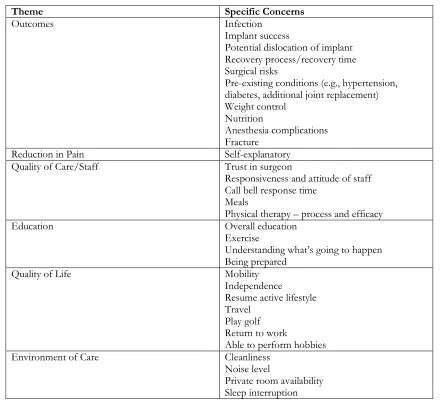
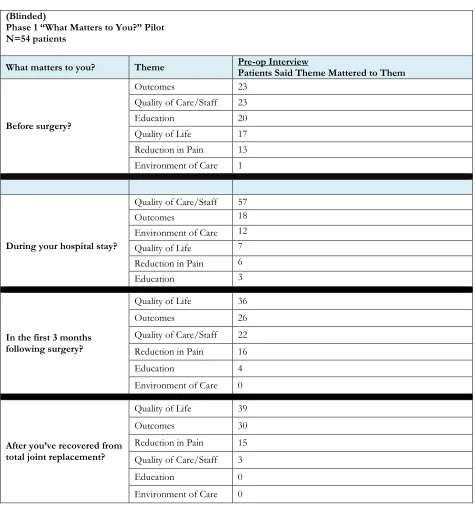
Phase 1 pre-surgical responses were grouped into 6 overarching themes: outcomes, reduction in pain, quality of care/staff, education, quality of life, and environment of care (Table 1). Phase 1 4-week post-surgical interview responses (Table 2) included several new areas of concern (all of which still fit within the 6 themes): side effects of pain medication and allergies; timely administration of pain
medication; receiving education on effects of anesthesia; risk of fracture; quality of food; connection with staff; mobility limitations; equipment needs; and response time to call bell.
When the Phase 1 patients were asked at their 4-week post-surgical visit whether they would give the same answer to the question “What matters to you moving forward after you’ve recovered from your joint
replacement?” 98% of patients responded that they would give the same answers they did during their pre-surgical interview. The 2% of patients who reported feeling differently about that question post-operatively included those who reported greater than expected surgical pain: some of these patients decided to delay the other necessary joint replacement as originally planned, and some no longer needed to proceed with an additional joint replacement because they no longer experienced pain in the second joint.
Table 1. Phase 1 Pre-Surgical Thematic Responses
Theme Specific Concerns
Outcomes Infection
Implant success
Potential dislocation of implant Recovery process/recovery time Surgical risks
Pre-existing conditions (e.g., hypertension, diabetes, additional joint replacement) Weight control
Nutrition
Anesthesia complications Fracture
Reduction in Pain Self-explanatory Quality of Care/Staff Trust in surgeon
Responsiveness and attitude of staff Call bell response time
Meals
Physical therapy – process and efficacy Education Overall education
Exercise
Understanding what’s going to happen
Being prepared Quality of Life Mobility
Independence
Resume active lifestyle Travel
Play golf Return to work
Able to perform hobbies Environment of Care Cleanliness
Noise level
“What Matters to You?”, DiGioia, Clayton, and Giarrusso
133 Patient Experience Journal, Volume 3, Issue 2 – Fall 2016
Overall, 92% of patients responded that their expectations were met throughout the joint replacement process. Excerpts of patient comments from the 8% whose expectations were not met are presented in Table 3, broken down into the corresponding parts of the continuum of care–before surgery, during your hospital stay, in the first 3 months following surgery, and after recovery from your total joint replacement.
Phase 2
The mean of each category indicated the average ranking the category received. Because “1” was the most important ranking to patients, the category with the lowest mean was the one that was ranked most important by the population of patients in this phase of the project (n=49). Using Excel to do the analysis, the top three categories most important to patients both preoperatively and postoperatively (in Table 2. Phase 1 Post-Surgical Thematic Responses
(Blinded)
Phase 1 “What Matters to You?” Pilot N=54 patients
What matters to you? Theme Pre-op Interview Patients Said Theme Mattered to Them
Before surgery?
Outcomes 23
Quality of Care/Staff 23
Education 20
Quality of Life 17 Reduction in Pain 13 Environment of Care 1
During your hospital stay?
Quality of Care/Staff 57
Outcomes 18
Environment of Care 12 Quality of Life 7 Reduction in Pain 6
Education 3
In the first 3 months following surgery?
Quality of Life 36
Outcomes 26
Quality of Care/Staff 22 Reduction in Pain 16
Education 4
Environment of Care 0
After you’ve recovered from total joint replacement?
Quality of Life 39
Outcomes 30
Reduction in Pain 15 Quality of Care/Staff 3
Education 0
“What Matters to You?”, DiGioia, Clayton, and Giarrusso
Patient Experience Journal, Volume 3, Issue 2 – Fall 2016 134
order of importance) were Surgical Results (infection or problems with the new joint, quick recovery time, no issues with anesthesia), Quality of Life (mobility, independence, resume active lifestyle, travel, exercise, return to work, ability to walk, participation in usual hobbies), and Reduction in Pain. Education (overall education, exercise education, knowing what will happen through the process) and Environment (cleanliness, noise
level, private room, sleep interruption) were ranked second to last and last, respectively, for both preoperative and postoperative patients. Quality of Care/Staff (trust in MD, responsiveness and attitude of staff, response time of providers, meals, physical therapy) and controlling other Medical Conditions (weight control, nutrition, other conditions like hypertension and diabetes, needing another Table 3. Phase 1 Patient Comments Related to Unmet Expectations*
Represents 8% of Surveyed Patients
*92% of patients responded that their expectations were met.
Relevant
Segment of Care Patient Comments
Pre-Operative Segment of Care
• I never thought I would be this limited after surgery. I wish that there was a
better explanation of the “do’s” and “don’ts”.
• I was not told that there was an option to be placed in a private room. I guess
my insurance isn’t good.
I didn’t really understand how long it would take to recover. Maybe have the
patient understand that it may take 3-6 months to recover beforehand.
During Hospital Stay • Felt disconnected with staff.
• Call bell response wasn’t prompt and accidents happened.
• Room was right across from the nurses’ station and was very noisy.
• I had some difficulty with pain medicine. I should’ve taken more Oxycodone
than Tylenol.
• I don’t feel better after surgery.
• My room was across from the nurses’ station and it was noisy.
• There were one or two nurses that weren’t attentive.
• My pain was not controlled well. The nurses didn’t reposition me in bed during
the night and was told the next morning by the therapist that nurses should’ve
repositioned every two hours.
• Since the pain medications made me nauseous, the physician wrote an order
that I need to take the medication with food.
• I had a reaction to the anesthesia and couldn’t keep anything down because of
my pain meds. I didn’t know to expect a reaction to the pain meds. In the First 3 Months
Following Surgery
• Can’t hardly wait to walk around and go places.
• There was reluctance from staff to switch my pain medication from oxycodone
to hydrocodone.
• It has been rough getting around the past month with a walker.
• I’m unhappy that I developed a small fracture and I’m worried when I will be
able to get back to normal activities. I also, was told by the doctor to stop my exercises.
• Both legs aren’t the same, yet. It’s still too early to see if my expectations were met.
• My foot won’t go flat and I still need to use my wheelchair to go to the
bathroom.
• The scheduling of home therapy left little to be desired.
After You’ve Recovered
from Total Joint Replacement
• I didn’t know that I was going to have this much pain in recovery, so I will get my left knee operation on down the road a little more.
“What Matters to You?”, DiGioia, Clayton, and Giarrusso
135 Patient Experience Journal, Volume 3, Issue 2 – Fall 2016
joint replacement) consistently remained in the middle of the category rankings.
Discussion
If a good outcome can be defined in terms of what is meaningful and valuable to patients themselves, then asking questions about what matters to them and how they would rank what matters is of signal importance.
For example, the need to focus on recovery time in all aspects of care delivery design is underscored by patient responses ranking quick recovery time among their top 3 concerns. For example, patients’ responses will influence the surgical protocols used and the design of pre-surgical educational materials, which will set patient expectations and let patients and families know how they can speed recovery times. The development of educational processes and tools needed to help patients participate as fully as possible in their recovery takes on even greater urgency since patients also ranked “independence” and “resume active lifestyle” among their top 3 concerns.
In terms of designing the WMTY pilot project itself, it was necessary to move from an open-ended response format to a response and rank format from Phase 1 to Phase 2. After first analysis showed that patients’ pre-surgical responses to “what matters to you?” over the pre-surgical, surgical, and post-surgical segments of care could be grouped into six themes, having patients rank their responses gave deeper insight into what truly matters to them rather than using a simple multiple choice or open-ended question. Ranking enabled the respondents to distinguish the relative importance among multiple
options. Even if the differences in importance were subtle, the questions prompted patients to give further thought as they ranked their choices, thus highlighting even the smallest distinctions. Ranking the responses also gave care providers insight into the relative importance of different categories. This information will be valuable in developing Phase 3 of this pilot project, in which the results could be acted upon both for an entire patient population or for individual patients.
To begin an improvement project based on what matters most to patients undergoing TJR, it is important to consider and understand factors that may cause a shift in ranking. The rankings of our patients did not shift between the pre-surgical phase and the post-surgical phase of care delivery in this pilot project (Figure 1). Had there been a shift, recognizing this would have allowed for additional fine-tuning of care delivery design in the affected segments of care. Furthermore, if two elements had tied in the rankings, a deeper dive into the patient comments might have been warranted and the percentage of responses to each ranking might also have been of value. For example, reduction in pain and quality of care/staff tied as the third most important theme for patients responding pre-surgically. However, a percentage breakdown (Figures 2 and 3) shows that more than one-half of the patients (66% preoperatively and 74% postoperatively) selected surgical results as the most important category. Only 8% and 6%, respectively, responded that reduction in pain and quality of care/staff were most important pre-surgically; but post-surgically, those percentages decreased to 4% and 2%, respectively. This information has relevance for prioritizing efforts to address multiple factors that patients and families report as being important to them.
“What Matters To You?”, DiGioia, Clayton, and Giarrusso
Patient Experience Journal, Volume 3, Issue 2 – Fall 2016 136
Figure 2. What Matters to You? – Phase 2 Percentage Rankings for Most Important
Figure 3. What Matters to You? – Phase 2 Percentage Rankings for Least Important
Moving forward, the information gathered in Phases 1 and 2 can be used to help others implementing a WMTY project that replicates this one. First, it is important that Phase 1 and 2 be conducted with different patient populations and in different healthcare facilities. The
results noted in Phases 1 and 2 should then be used as starting points for redesigning care delivery for patient populations focusing on the seven themes and the specific responses within each theme. Redesign may take the form of developing additional educational materials, providing
n = 49
n =
49
“What Matters to You?”, DiGioia, Clayton, and Giarrusso
137 Patient Experience Journal, Volume 3, Issue 2 – Fall 2016
educational materials at different times and in different ways, increasing attention to setting expectations, revising pain protocols, and so forth. Second, the responses can be individualized so that each patient’s pre-surgical concerns are shared throughout each subsequent step of their healthcare experience, enabling the entire care team to understand each patient’s concerns and address them.
While the WMTY pilot project was undertaken in a specific clinical setting with a specific patient population (those requiring total knee and total hip replacement), the project shows how care providers and organizations can operationalize “what matters to you” in any care setting to better understand what matters to their patients and families, both individually and collectively.
Because this project was conducted only with the patients of one orthopaedic surgeon and not all of the surgeons in the practice, these results may not be generalizable to the entire population undergoing total hip or knee
replacement surgery in this facility. In addition, because sociodemographic information on these patients was not available (e.g., age, ethnicity, or educational level), it should be recognized that such data could have an impact on patients’ responses and may limit the generalizability of the findings. While Phases 1 and 2 did not account for such individual-level differences that may explain what matters most to patients, Phase 3 will include such information. Furthermore, given that this is a pilot project, the empirical analyses are not robust enough from either a qualitative or a quantitative research perspective to be generalizable to patients in other settings.
Conclusion
The WMTY project and similar interventions may be effective in increasing patient engagement in their care and in helping surgeons to better focus their pre-operative plans; in guiding us to develop appropriate Patient Reported Outcomes; and in helping hospital staff to address the needs and concerns of patients during the hospital stay and post-operatively. In addition, this project may help surgeons to understand their patients’ concerns and to define outcomes more broadly.
While evidence for the benefits of patient centered care is strong and continues to increase, the practice of patient centered care in healthcare organizations remains the exception rather than the rule. Asking patients, “What Matters to You?” is one way to forge a partnership between doctors and patients while operationalizing the good communication4and respect for patients’
preferences and needs3 that is a hallmark of patient
centered care.
References
1. Hudon C, Fortin M, Haggerty JL, Lambert M, Poitras M-E. Measuring patients’ perceptions of patient -centered care: a systematic review of tools for family medicine. Ann Fam Med. 2011;9(2):155-164.
2. Barry MJ and Edgman-Levitan S. Shared decision making—the pinnacle of patient-centered care. New Engl J Med. 2012;366(9):780-781.
3. Institute of Medicine. Crossing the Quality Chasm: A New Health System for the 21st Century. Washington, DC: National Academies Press, 2001.
4. Rickert J. Patient-centered care: what it is and how to get there. Health Affair. blog, January 24, 2012. http://healthaffairs.org/blog/2012/01/24/patient-centered-care-what-it-means-and-how-to-get-there/ 5. Bisognano M, Kenney C. Pursuing the Triple Aim: Seven
Innovators Show the Way to Better Care, Better Health, and Lower Costs. San Francisco: Jossey-Bass, 2012. 6. Langel S. Pioneering new ways to engage the disabled.
Health Affairs 2013;32(2):216-222.
7. Cosgrove DM, Fisher M, Gabow P, et al. Ten strategies to lower cost, improve quality, and engage patients: the view from leading health system CEOs. Health Affair. 2013;32(2):321-327.
8. Roseman D, Osborne-Stafsnes J, Amy CH, Boslaugh S, Slate-Miller K. Early lessons from four ‘Aligning Forces for Quality’ communities bolster the case for patient-centered care. Health Affair. 2013;32(2):232-241.
9. Carman KL, Dardess P, Maurer M, et al. Patient and family engagement: a framework for understanding the elements and developing interventions and policies. Health Affair. 2013;32(2):223-231.
10. Barrio P, Gual A. Patient-centered care interventions for the management of alcohol use disorders: a systematic review of randomized controlled trials. Patient Prefer Adherence. 2016;10:1823-1845. 11. Epstein RM, Duberstein PR, Fenton JJ, Fiscella K,
Hoerger M, Tacredi DJ, et al. Effect of a patient-centered communication intervention on oncologist-patient communication, quality of life, and health care utilization in advanced cancer: the VOICE
randomized clinical trial. Jama Oncol. 2016; Sep 9. Doi:10.1001/jamaoncol.2016.4373 (Epub ahead of print).