Iranian Rehabilitation Journal, Vol. 12, No. 19, March 2014
Original Article
Auditory Lateralization Ability in children with (Central) Auditory
Processing Disorder
Abdollah Moosavi, MD.
Iran University of Medical Sciences, Tehran, Iran
Zahra Hosseini Dastgerdi*; Yones Lotfi, MD.; Saiedeh Mehrkian ; Enayatollah Bakhshi, PhD.; Bahare Khavar Ghazalani University of Social Welfare and Rehabilitation Sciences, Tehran, Iran
Objectives: The aim of the present study was to assess the auditory lateralization ability in children with (central) auditory processing disorder.
Methods: Participants were divided in two groups: 15 children with Central Auditory Processing Disorder (8-10 years) and 80 normal children (8-11 years) from both genders with pure-tone air-conduction thresholds better than 20 dB HL bilaterally and interaural pure tone threshold difference better than 5 dB . All subjects had normal IQ and normal otoscopy: In the present study 9 imaginary positions were simulated in horizontal plane by Interaural Time Difference (ITD) and Interaural Intensity Difference (IID) to evaluate the auditory lateralization performance in normal and children with (central) Auditory Processing Disorder (C)APD. Lateralization performance were determined by ITD ranging from -880 to +880 microsecond and IID ranging from -10 to +10 dB for high pass and low pass noise(2 kHz cut off point). Boltzmann function was used to describe the auditory lateralization performance and Independent Samples T-test was used to compare the two groups.
Results: according to Boltzmann function two major types of abnormalities were revealed in the lateralization performances: 1- completely disoriented, 2- side-oriented. 86.6% of (C)APD children showed significant increase in mean of test errors compared with normal ones (p<0.001.(
Discussion: The study supports the hypothesis that most children with (C)APD have poor auditory lateralization and abnormal processing of binaural cues.
Key words: Auditory Processing Disorder, Localization, lateralization, binaural hearing
Submitted: 20 January 2014 Accepted: 5 March 2014
Introduction
Central auditory processing disorder (C)APD has been defined as a difficulty in auditory perception and comprehension (1), and is a heterogeneous deficit with involvement of several aspects of auditory processing such as temporal, spectral, binaural processing and grouping of sequence of sounds (2). Patients with this disorder have significant difficulty in understanding speech and language in real and challenging listening situations despite normal intelligence capacity and hearing threshold. (C)APD can lead to learning impairment, academic failure and social problems without early diagnosis and intervention (3).
Lateralization of sounds (especially in horizontal plane) is based on the central auditory system ability in detection, perception and comparing small
location of stimulus is defined by amplitude envelope instead of fine structures (3). The normal central auditory processing system uses these spatial cues with other auditory information such as temporal and spectral information as the most important factors for auditory objects streaming , selective attention, speech perception and hence detection of desirable sounds from undesirable one are facilitated (8-10).
The mechanisms underlying auditory processing disorder are different among (C)APD children and most likely the lateralization and the binaural processing disorder exist at least in some children and can be the major factor in auditory difficulties, speech perception and learning deficits in school(11, 12). By using ITD and IID methods, poor binaural auditory processing skills were observed in patients with auditory cortex and brainstem lesions, various hearing losses and children with a history of recurrent Otitis media and elderly in the earlier studies(3, 13, 14). Zakaria and his colleague (3) used the behavioral headphone lateralization test (ITD , IID methods), just noticeable difference (JND) and masking level difference(MLD) to investigate the auditory lateralization abilities in (C)APD children and adults. According to their results most children with (C)APD displayed deficits in these tests. Cameron and colleague (11) reported that children with (C)APD have difficulties in using spatial cues (ITD, IID) for auditory streaming, segregation and perception of speech in background noise.
Manipulating of binaural time and intensity cues in the headphone sound source movement inside the head can be simulated and lead to auditory lateralization to left and right. It's better to use lateralization term instead of localization in testing by headphone, because lateralization is the ability to perceive and imagine sound source movement inside the head (internalization) while localization is the ability to define the exact location of sounds in free
field by using binaural (ITD, IID) and monaural spectral cues (externalization)(3).
The headphone lateralization test has high sensitivity in identifying auditory brainstem lesions and processing disorders and also can localize brainstem lesions (3, 5). Based on previous studies ITD is more vulnerable to central auditory disorder than IID, and since both cues have different processing mechanisms in the brainstem level, assessment of each mechanism independently provides useful information about the binaural processing ability (2). Since there are few studies in the field of the lateralization and the localization abilities in children with (C) APD, the necessity of extensive research in these fields is obvious. Therefore the main goal of this study was to precisely assess the auditory lateralization ability in children with (C) APD with ITD and IID method by means of headphones and to compare the results with normal ones.
Methods
This study was a comparative cross –sectional one. Participants were divided in to two groups, 15 children with Central Auditory Processing Disorder (2 eight years old boys, 9 boys and 2 girls aged 9 years, one boy and one girl age 10 years old) and 80 normal children (8-11 years) from both genders table (1). Normal children were recruited randomly among students of schools of district 5 Tehran (Iran) and children with (C) APD were students with academic failure and learning disorders who were referred to 'Akhavan and Rofeide rehabilitation
center' of Social Welfare and Rehabilitation
Sciences University and also Navid e asr rehabilitation center in Tehran (Iran). All the participants signed a written consent and were volunteers.
Table 1. Number of participants in the central auditory processing disorders and normal children
sex Age
Number Groups
9 boys,6 girls
14 boys,4 girls
10 boys,16 girls
5 boys,16 girls
2 boys
9 boys, 2 girls
1 boy and 1 girl 8 Y
9 Y
10Y
11Y
8 Y
9 Y
10Y 80
15 Normal
All normal and (C) APD children had normal IQ (higher than 85 according to children Wechsler intelligence test results in school health profiles) and normal otoscopy. Pure-tone air-conduction thresholds were better than 20 dB HL bilaterally in 500 to 8000 Hz and interaural pure tone threshold differences better than 5 dB. Normal children had no history of recurrent Otitis media and neurological, developmental, behavioral and attentional disorder and metabolic disease, and also with no academic failure. Children with(C) APD had listening difficulties and academic failure and were failed in at least two auditory processing tests such as Dichotic Digit (DD), Pitch Pattern Sequence Test (PPST), Monaural Selective Auditory Attention Test (MSAAT), and Random Gap Detection Test (RGDT). This test battery has high sensitivity in (C) APD diagnosis (more than 93%)(15, 16). In the present study two or three of these tests were executed because of poor cooperation of some suspected (C) APD children and selection was based on these test results and behavioral symptoms.
The instruments used in the present study include: 1-Heine mini 3000 2-. Clinical MAICO MA 53 Audiometer and headphone TDH-39p of Telephonic was used for the lateralization and auditory processing tests. All the tests were executed in quiet room and in the Most Comfortable Level of hearing (MCL) (3). The outputs of the headphones were calibrated using an "artificial ear" coupler. Biological calibration was done before each test to ensure that all the stimuli were presented correctly. Headphone lateralization tests were implemented by
using ITD and IID method for high pass and low
pass filtered noises (2 kHz cut off point). the cutoff point of 2 kHz is proper because in the range of 1500 to 3000 hertz especially in 2000 hertz binaural time and intensity cues are vague and cannot be used properly (7). In the ITD task, the stimuli were presented binaurally. The interaural time delay varied in 220 µs steps which produced -880 , -660 , -440 , -220 , 0 , +220 , +440 , +660 , +880 µs and in the IID task, interaural intensity difference varied in the 2.5 dB steps which produced -10 , -7.5 , -5 , -2.5 , 0 ,+ 2.5 ,+ 5 , +7.5 ,+ 10 dB. Negative and positive symbols correspond to preponderance towards the left and right respectively, and 0 represents center position. By these interaural cues 9 imaginary positions were simulated in horizontal plane (schematic diagram of 9 speakers that were drawn in
semicircular plane from 1 to 4 on the left side and 6 to 9 on the right side and 5 in the center figure (1).
Fig.1. Arrangement of imaginary sound sources
Two pairs of stimuli were presented for each position, the first pair (standard signal) with no time and intensity differences that should be perceive centrally and the second pairs (test signal) presented with the binaural cues that lead to perceive some locations as in the diagram. Children should ignore the standard signal but should point to the speakers corresponding to the test signal and if not sure about the positions they could guess. Before the main stage of the headphone lateralization tests, appropriate training was given to each child. During this period first the child listened to a moving stimulus from center (speaker 5) to extreme right (speakers 6 to 9) that return to center followed by a stimulus moving toward extreme left ( speakers 4 to 1). The main stage contained 4 tests including the ITD low pass noise (ITD LPN), the ITD high pass noise (ITD HPN) , the IID low pass noise (IID LPN) ,the IID high pass noise (IID HPN). In each test 36 randomized stimuli were presented (16).
Statistical analysis: description and pattern of the lateralization performance was obtained by Boltzmann function (which is a sigmoid function that fits properly with lateralization data). Independent Samples T- test was used for comparison between two groups.
Right side
Results
In this study, Lateralization ability was compared between 15(C) APD and 80 normal children by ITD and IID methods. The ITD and IID stimuli were presented 36 times in each test which totally each participant answered to 144 stimuli. The ITDs (from -880 to +-880 µs) and IIDs (from -10 to +10 dB) are
shown through a scatter diagram in the X- axis and children's responses to the stimulus positions (speaker 1-9) are defined in the y- axis. The tests normal functions obtained by Boltzmann function. Each test error was calculated. Mean value for each position obtained and sum of standard deviations was considered as an error value for each test table (2).
Table 2. Means and Standard Deviations of test errors in (C) APD and normal group.
SD IID HPN SD IID LPN SD ITD HPN SD ITD LPN Groups 2.30427 5.7941 2.37430 5.9955 2.26773 7.5750 2.17598 7.2042 Normal 6.50050 14.7877 5.43380 15.6790 8.10324 15.8003 6.42031 15.0797 (C)APD <0.001 <0.001 0.002 <0.001 P.Value* Significant p<0.05
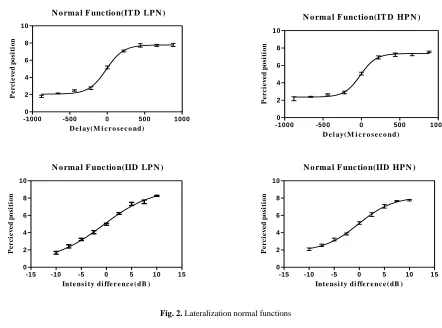
Within an asymptotic range, despite increases of ITD (extreme left and right position), perception of locations doesn’t change and the ability to distinguish
between positions decreases figure (2) . The normal cut-off range was set to 2SD of error values table (3).
Fig. 2. Lateralization normal functions
Table 3. The Normal cut-off ranges of errors
2SD Tests 2.85224-11.55616 ITD LPN 3.03954-12.11046 ITD HPN 1.2469-10.7441 IID LPN 1.18566-10.40274 IID HPN
N o rma l F unc tio n(IT D LP N )
D e l ay(M i c r o s e c o nd)
P e rci e v ed p o si ti on
-1000 -500 0 500 1000
0 2 4 6 8 10
N o rma l F unc tio n(IT D HP N )
D e l ay(M i c r o s e c o nd)
P e rci ev ed p o si ti on
-1000 -500 0 500 1000
0 2 4 6 8 10
N o rma l F unc tio n(IID LP N )
Inte ns i ty di ffe r e nc e (dB )
P e r c ie v e d po si ti o n
-15 -10 -5 0 5 10 15
0 2 4 6 8 10
N o rma l F unc tio n(IID HP N )
Inte ns i ty di ffe r e nc e (dB )
P e r c ie v e d po si ti o n
-15 -10 -5 0 5 10 15
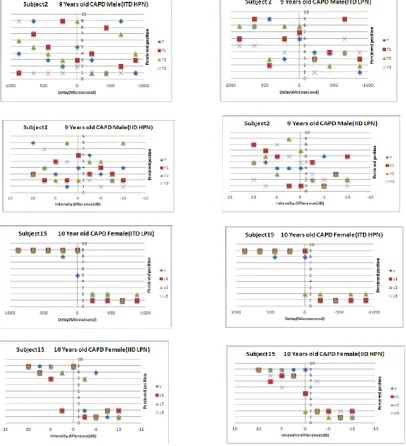
Each (C) APD subject was considered to fail if his/her performance was outside the normal range for each test. 11, 10, 13 and 8 (C) APD children were outside the normal range for the ITD LPN, ITD
HPN, IID LPN and IID HPN tasks respectively figure (3) , Examples of the lateralization functions for two (C) APD children.
Fig. 3 . Lateralization patterns in children with (C) APD. Examples: Disoriented pattern for Child No.2. Side-oriented pattern for child No.15
The Independent Samples T-test shows that mean error variances of the ITD LPN, IID LPN, IID HPN and ITD HPN (P<0.001) are different between normal and (C) APD children and there are statically significant differences of mean error value (p<0.001 for ITD LPN, IID LPN, IID HPN and p=0.002 for
ITD HPN) between two groups.
Discussion
of IID tests (for both high pass and low pass noises) are almost straight line shaped in normal children. This pattern indicates that as the interaural intensity increases (extreme left and right position) perception of positions changes and with 10 dB interaural difference and greater lateralization of stimulus continues. The normal lateralization patterns based on ITD values (from -880 to +880 µs) are S-shaped (for both high pass and low pass noises). ITD functions indicate that lateralization from -220 to +220 µs (central positions) have linear growth and from -440 to -880 µs and +440 to +880 µs will tend to an asymptotic range. Within an asymptotic range, despite increases of ITD (extreme left and right position), perception of locations doesn’t change and the ability to distinguish between positions decreases (fig. 2). These results are in agreement with Zakaria's study in children (3) and Bobkoff (13) and Aharonson et al (14) and Furst et al (5) and Levine et al (4) studies in adults
The majority of (C) APD children had different auditory lateralization patterns in all tests while normal children responses were nearly the same. In (C) APD group except one child, the lateralization patterns of all children were significantly unfavorable in all tasks especially in ITD ones. In general, two abnormal lateralization patterns were revealed in (C) APD group performances: 1- disoriented (figure 3.examples: child No.2); 2- side-oriented (figure 3.examples: child No.15). These results are in agreement with Zakaria’s study (3). Responses of the disoriented pattern were completely scattered which indicates the poor performance of lateralization and inability to distinguish between right and left sound sources. Responses of the side- oriented pattern were limited to one or both sides indicating impaired perception of the central positions. These results were present to some degrees in both ITD and IID tasks but more in ITD ones(2). In present study most (C) APD subjects had increased error values in comparison to normal children, these results are in agreement with Zakari and Patuzzi (3) study. In a study by Cameron and Dillon in 2008, spatial cues processing ability of (C) APD children were assessed by Listening in spatialized noise sentence –test (LISN-S test) and compared with normal children and children with learning disabilities and dyslexia. Their results indicated that the majority of children with (C) APD cannot use spatial cues (ITD and IID) effectively to auditory stream segregation and percept target stimulus from disturbing auditory stimuli. Results of present study were in agreement with Cameron and Dillon's study. According to these
results, it seems that the ability of lateralization and binaural processing is defective in most (C) APD children, so it can be a major cause of listening and learning difficulties in them (11).
In this study all the lateralization tests were sensitive to identify (C) APDs (more than 50% sensitivity) and the most sensitive was the IID LPN (86.6% sensitivity). In Zakaria and Patuzzi’s (3) study, the ITD was more sensitive than other tasks to detect (C) APD children who had difficulties in discriminating binaural cues. In Zakaria and Patuzzi’s (3) study, the ITD was more sensitive than other tasks to detect (C) APD children who had difficulties in discriminating binaural cues.
Levine et al in 1993 , Aharonson et al in 1998, Furst et al in 2000 and Bobkoff et al in 2000 reported that ITD tasks are more sensitive than IID ones to detect subjects with brainstem lesions and who had processing disorder. This inconsistency might be for differences in the calculation of error values In present study, some (C) APD children could have an abnormal pattern but a normal error (fig. 3, child No.15) because error value shows degree of scattering of responses. In present study, if auditory lateralization performance of (C) APD children is compared based on lateralization pattern of ITD test with normal children, 93/3 percent of (C) APD children are identified and sensitivity of lateralization tests increase, so it is recommended that pattern value of tests especially the ITD task be a criteria for clinical diagnosis of children with (C) APD (3).
Conclusion
In present study 9 positions were simulated with a complete semicircular arrangement by the ITD and IID methods to assess the auditory lateralization ability in (C) APD children. Abnormal lateralization pattern and significant increase in test errors indicated poor lateralization ability and binaural processing in most (C) APD children. According to the results the headphone lateralization tests have good sensitivity to detect children with (C) APD.
Acknowledgements
References
1. Iliadou V, Bamiou DE, Kaprinis S, Kandylis D, Kaprinis G. Auditory processing disorder in children suspected of learning disabilities: a need for screening. International Journal Of Pediatric Otorhinolaryngology. 2009;73(7): 1029-34.
2. Moore DR. Auditory processing disorder(APD): definition, diagnosis, neural basis, and intervention. Audiol Med. 2006;4(1):4-11.
3. Zakaria MN, Pattuzi RB. Auditory localization abilities in subjects with central auditory processing disorder(CAPD). Australia: the University of Western Australia; 2008.
4. Levine RA, Gardner JC, Fullerton BC, Stufflebeam SM, Carlisle EW, Furst M, et al.Effect of multiple sclerosis brainstem lesions on sound lateralization and brainstem auditory evoked potensials. Hearing Research. 1993;68(1):73-88.
5. Furst M, Aharonson V, A.Levine RA, C.Fullerton CB, Tadmor R, Pratt H, et al. Sound lateralization and interaural discrimination: effect of brainstem infarcts and multiple sclerosis lesions. Hearing Research. 2000;143(1-2):29-42.
6. Matthew N, Todd J, W.Budd T, Cooper G, T.Michie P. Auditory lateralization in achizophrenia-mismatch negativity and behavioral evidence of a selective impairment in encoding interaural time cues. Clinical Neurophysiology. 2007;118(4):833-44.
7. Sams M, Hamalainen M, Hari R, McEvoy L. Human auditory cortical mechanisms of sound lateralization: interaural time difference within sound. Hearing Research. 1993;67(1-2):89-97.
8. Alain C. Breaking the Wave: effect of attension and learning on concurent sound perception. Hearing Research. 2007;229(1-2):225-36.
9. Bellmann Thiron A, Clarke S. Perserved use of spatial cues for sound segregation in a case of SPATIAL deafness. Neurosychologia. 2003;41(9):1254-61.
10. Saupe K, Koelsch S, Rubsamen R. Spatial selective attention in a complex auditory environment such as polyphonic music. Acoustic Society Of America. 2010;127(1):472.
11. Cameron S, Dillon H. The listening in spatialized noise-sentence test(LISN-S): comparison to the prototype LISN and results from children with either a suspected (central) auditory processing disorder or a confirmed language disorder. Journal Of The American Academy Of Audiology. 2008;19(5):377-91.
12. Cameron S, Dillon H, Newall P. The listening in spatialized noise test: an auditory processing disorder study. Jurnal Of American Academy Of Audiology. 2006;17(5):304-18.
13. Bobkoff H, Muchnik C, Ben-David N, Furst M, Even-Zohar S, Hildesheimer M. Mapping lateralization of click trains in younger and older populations. Hearing Research. 2002;165(2-1):27-117.
14. Aharonson V, Furst M, Levine RA, Chaigrecht M, Korczyn AD. Lateralization and binaural discrimination of patients with ponting lesions. Acoustic Society Of America. 1998;103(5):2624-33.
15. M.Domitz DC, Schowel R. A new CAPD battery-multiple auditory processing assessment: factor analysis and comparison with SCAN. American Journal Of Audiology. 2000;5(2):41-54.