Volume 4, Issue 1, 2017
219
Available online at www.ijiere.com
International Journal of Innovative and Emerging
Research in Engineering
e-ISSN: 2394 – 3343 p-ISSN: 2394 – 5494
EXPERIMENTAL ANALYSIS OF HELICAL COIL HEAT
EXCHANGER BY USING DIFFERENT COMPOSITIONS
OF NANO FLUIDS
Kevin Kunnassery, Rishabh Singh, Sameer Jackeray
Department of Mechanical EngineeringLokmanya Tilak College of Engineering, Koparkhairne, Navi Mumbai-400709, Maharashtra, India. Email: [email protected], [email protected],, [email protected]
Vijoy Kumar
Department of Mechanical Engineering
Asst. Professor Lokmanya Tilak College of Engineering, Koparkhairne, Navi Mumbai-400709, Maharashtra, India. Email: [email protected]
ABSTRACT:
Nanoparticles have been a topic of interest to many researchers.The wide range applications and advantages of these materials give them a superior edge over conventional materials.They have surpassing thermo physical properties with a negligible pressure drop. Nanoparticles have higher heat transfer rates which makes them an apt choice where a higher heat transfer rate is required for smooth functioning.common nanoparticles such as aluminium oxide and titanium di oxide have been studied.Heat exchanger are devices that have been used for transferring heat from one medium to another medium.In this paper, we have focussed on the use of helical shaped heat exchanger.The effectiveness of this type of heat exchanger is augmented using screw inserts which help in creating additional turbulence.We have prepared a review of some researchers who have used helical coil with screw inserts as their setup and used nanoparticles as the working fluid to augment the heat transfer rates.The various results and conclusion have been stated.The objective of this review is to provide information on the use of nanoparticles to increase heat transfer rates and study various properties.
Keywords: Nanoparticles, heat exchangers, helical coils, screw fits, heat transfer rate
I. INTRODUCTION
In recent times, there is a rapid demand to increase the heat transfer rates due to high heat flow processes. Various techniques have been incorporated for the enhancement of heat transfer rates in heat exchangers. The principle idea of using various techniques for increasing the rate of heat transfer is to achieve higher heat fluxes, reduced cost of capital, reduction in size, rise in 2nd law efficiency etc.
We have seen that the thermal conductivities of conventional heat transfer fluids are very poor which do not give us the required results. Hence, modern technologies have paved paths for materials that have different characteristics as compared to conventional heat transfer fluids. These materials are called as nano particles. Nano materials posses larger surface area, small size etc.
Let us consider the example of a carrot. When a carrot is cut into half, its surface area increases and further when it is cut into slices, the surface area again increases. The number of atoms or the amount of carrot is always constant, however the number of atoms in contact with the surface increases which leads to increase in the surface area. Nano particles can be considered to behavelike carrots. The number of atoms of nano particles in contact with the surface is very high, hence the surface area of the nano particles is larger.
The size of the nano particles ranges from 1 to 100 nanometers in size. The changes in properties dependent on size include surface Plasmon resonance in metal particles, super-paramagnetism in particles with magnetic nature etc.
The following review shows that how nano particles play an important role in increasing the heat transfer rates of helical oil heat exchanger and its various applications.
Volume 4, Issue 1, 2017
220 themselves in various applications like heat exchangers, engine cooling management, grinding etc. Nanofluids also posses various acoustical properties.
Figure 1: Properties of Nano Fluids
B) USE OF NANO FLUIDS IN HELICAL COIL HEAT EXCHANGER:
A study was carried out for pressure drop and heat transfer characteristics of CuO-water nano fluids in helically coiled heat exchangers in horizontal and vertical positions. The results concluded that for high concentration nano fluids, heat transfer and friction factor is high irrespective of the position of heat exchanger. Also with the use of Al2O3-water nano fluid, the performance of helical heat exchanger was enhanced to a greater level and saving in energy consumption had been achieved.
Helical coiled heat exchangers are usually given the priority over double pipe heat exchangers. The main reason for this is its efficiency in making use of space. Helical coiled heat exchangers have high heat transfer rates and are economical even at low flow rates. Hence, they find their application even when pressure in a fluid is at a minimal.
II. M.A.KHAIRUL et al [1]
A. INTRODUCTION
Heat Exchangers, highly used in industries like food, pharmaceuticals as well as in air conditioners and heat ventilation systems, are incorporated not just as an heating device but also as a cooling device. They work on the principle of convective heat transfer by separating the two medium having a finite temperature difference. However, various heat exchangers with conventional design have proved to be lesser efficient and bulky thereby bringing a need for a compact and efficient design of heat exchanger leading to the discovery of Helical Coil Heat Exchanger (HCHE). Study shows that these coiled heat exchanger are capable of attaining large heat transfer area per unit volume and an increased heat transfer coefficient (h) of the internal surface. The efficiency of HCHE can be further by using nano fluids as a heat transfer medium rather than conventional ones like water, oil or ethylene glycol. These nano fluids, formed by quantitative dispersion of nano particles (>100nm) in base fluids, provide significant improvement in features like convective heat transfer coefficient and thermal conductivity. The nano fluids used in this paper are CuO, Al2O3 and ZnO.
Volume 4, Issue 1, 2017
221
Table 1: Thermo-physical properties of Nano-Fluids
B. MATERIAL SPECIFICATION
• Helical Coil Heat Exchanger • Nanoparticles
1. Al2O3
2. CuO
3. ZnO
• Base Fluid: Water
SR. NO. PARAMETER PROPERTIES
1] VISCOSITY • Effect on particle size- For small volume concentration, it is seen that the viscosity of
Al2O3 nano fluid with small particles is the same as compared to that with larger particles.
However, as the concentration increases, the viscosity gradually starts reducing for smaller sized nano particles.
• Effect on volume concentration- Viscosity of nano fluids is a function of concentration of volume. For low volume concentration,Al2O3-water nano fluid behaves like a Newtonian
fluid. Hence, it is concluded that the viscosity ratio is more for water based nano fluids as compared to ethylene glycol based nano fluids.
• Effect on temperature- Usually, viscosity of nano fluids is inversely proportional to temperature.Al2O3, CuO and graphite nano fluids show the same behaviour.
2] THERMAL
CONDUCTIVITY
• Effect of volume concentration- It is seen that nano fluids having low concentration of nano particles have better thermal conductivity as compared to water. The thermal conductivity of CuO-water with low concentration is more than that of water and the conductivity is improved by 24%.
• Effect on particle size- It is seen that the thermal conductivity increases with decrease in particle size.
• Effect on temperature- The change in temperature plays an important role in the change in thermal conductivity of the nano particles. It is seen that for most of the nano fluids, the thermal conductivity decreases with increase in temperature except forAl2O3-water and
CuO-water for which the thermal conductivity increases with increase in temperature.
3] CONVECTIVE
HEAT TRANSFER
• Laminar flow-results have shown that like thermal conductivity, heat transfer rate also increases with increase in particle loading. In a horizontal straight tube, the convective heat transfer characteristics of copper-water nano fluids were studied and copper nano particles played an important role in increasing the performance of the nano fluid.
Volume 4, Issue 1, 2017
222
Table 2: HCHE Specifications
SR.NO. SPECIFICATIONS DIMENSIONS
1] Outer Tube Diameter 12.7
2] Inner Tube Diameter 9
3] Coil Pitch 18
4] Coil Diameter 116
5] No. of Turns 10
•
C. PROCEDURE
Heat transfer rate and thermodynamic analysis of HCHE with incorporating the nano fluids was being studied. The various nano fluids mentioned above were added by 1-4% of the particle volume concentration with the base fluid. The experiment involved firstly calculating the thermophysical properties of the nano fluids with the help of existing formulas.
The parameters required were: • Density of Nano fluids • Dynamic Viscosity
• Effective Thermal Conductivity • Static Thermal Conductivity • Brownian Thermal Conductivity • Reynolds No.
• Deans No. • Prandtl No. • Nusselt No. • Santon No.
• Entropy generation rate
Volume flow rate of the three nano fluids were varied from 3-6 L/min with four diverse particle volume fraction. various assumptions were made like thermo-physical properties of nano fluids being constant throughout the system with a turbulent flow regime and incompressible fluid, whereas the HCEH having constant boundary heat flux. The temperature difference was kept constant at 40K.
D. CONCLUSION
Variation of different properties with the Volume flow rate were noted.
Firstly heat transfer coefficient of nano fluids with four distinct particle volume concentration were obtained for the volume flow rate. It was observed to be increasing with the volume flow rate and nanoparticle volume concentration. Among themselves CuO proved to be more efficient as compared to ZnO and Al2O3. The reason stated was the ability of nano particles to enhance the the thermal as well as flow field. As Nusselt’s no. and heat transfer coefficient are proportional, Nusselt no. can well be a criteria for choosing a correct nano fluid.
Secondly, a connection with Nusselt no. and Reynolds no. brings us to a conclusion that the fluids with higher Reynolds no. can well be used to obtain an increased heat transfer coefficient.
Thirdly, Reynolds no. has a connection with the mass flow rate and as CuO has a higher one as compared to the other nano fluids concerned, it naturally will give an effective heat transfer rate. This is so as density of CuO is higher than ZnO and Al2O3.
Volume 4, Issue 1, 2017
223 proved that CuO to be better than the other two. Decreased entropy generation are agrees with the second law of thermodynamics. This is related with the hope of the nano fluids.
Graph was plotted for each parameter stated above with the Volume flow rate.Thus, the entire analysis proved that heat transfer coefficient of the Helical Coil Heat Exchanger can well be increased by using the nano fluids. Also the comparative study of the various nano fluids was also studied.
III. R. SAIDUR et al [2]
A. INTRODUCTION
With the ever growing industrial era and its dependency on the thermal energy as a source, the need for devices to make a comfortable transport of heat energy became quite necessary. Once these devices formed were brought to use, a craving need to increase its efficiency became important. Once such development was done in case of heat exchangers. Conventional heat exchangers were meant to be bulky in size, occupy large floor space with less efficiency. This drawback is now being overcome by incorporating a Helical shaped coil which is compact and has proved to have a higher efficiency.
Along with the development of an geometrically efficient heat exchanger, compositional changes of conventional base fluids with incorporation of appropriate nano fluids has made it an even efficient heat exchanger.
The nano fluids used in this paper are ZnO, CuO, Al2O3 and SiO2. the paper attempted to show the relationship between % Nanoparticle Volume Concentration with parameters like Reynolds No., Nusselt No., Friction factor, Pressure drop and Heat Transfer Coefficient.
B. MATERIAL SPECIFICATION
• Helical Coil Heat Exchanger • Base Fluid: Water
• Nanoparticles
1. CuO
2. ZnO
3. SiO2
4. Al2O3
C. PROCEDURE
The experiment was carried out on the Helical Coil Heat exchanger (HCHE) of the given dimension. The various nano fluids stated above were used as the working fluid with water being the common base fluid. The permissible volume fraction of these nano fluids was made between 1% to 4% with the fluid flow rate was kept at 3 L/min.
The thermo physical properties, were all measured at 300K, like thermal conductivity, viscosity, density and specific heat were found by the empirical formulas available.
The calculation of the following parameters was necessary: • Effective Thermal Conductivity of nano Fluid
• Viscosity of Nano Fluid • Density and specific heat
• Nusslet No., Dean No., Prandtl No. • Frictional Factor oh HCHE
Once the values were obtained, Graphs were plotted taking various parameters with % Nanoparticle Volume Concentration.
D. CONCLUSION
Firstly, the trend showed that as the % Nanoparticle Volume Concentration increased, the reynolds no. increased too in case of CuO and ZnO whereas changed almost negligible in case of Al2O3. It decreases for SiO2.
Secondly, relationship between Heat Transfer Coefficient and % Nanoparticle Volume Concentration was found out and analysed. Once again CuO proved to be most effective followed by ZnO and Al2O3 with increase in heat transfer coefficient with % Nanoparticle Volume and decreased for SiO2.
Friction Factor was seen to increase with % Nanoparticle Volume Concentration for all the taken Nano Fluids.
Volume 4, Issue 1, 2017
224
IV. MILAD RAKSHA et al [3]
A. INTRODUCTION
The following study was performed for numerical and experimental comparison of CuO nanofluid that developed forced convection flow at constant wall temperature in helically coiled tubes. A comparison was made between pure water and CuO nano fluid for their pressure drops and heat transfer rates. The study made use of heat exchanger which made provisions for different helical tubes keeping the wall temperature constant. It was seen that there was an increase of 9.11% and 68% in pressure drop and heat transfer rates respectively for numerical results whereas experimental results showed an increase of 14.16% and 15.17% in heat transfer rates and pressure drop respectively.
B. SYSTEM DESCRIPTION
• Thermocouples • Data Logger • Heat Exchanger • Reservoir
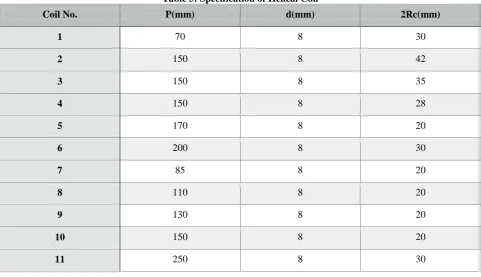
Table 3: Specification of Helical Coil
Coil No. P(mm) d(mm) 2Rc(mm)
1 70 8 30
2 150 8 42
3 150 8 35
4 150 8 28
5 170 8 20
6 200 8 30
7 85 8 20
8 110 8 20
9 130 8 20
10 150 8 20
11 250 8 30
C.RESULTS
The centrifugal force is inversely proportional to radius of curvature and directly proportional to velocity square. When radius of curvature increases, centrifugal force decreases whereas pressure force increases. Vice versa, when radius of curvature decreases, centrifugal force increases and pressure force reduces.
D.CONCLUSION
Experimental and numerical investigations were conducted
Experimental measurement of thermo-physical properties of nano fluids were carried out.
According to the results, Nu number was able to reach outer wall because of centrifugal forces and helical pipes geometry.
V. MILAD TAJIK JAMAL ABAD et al [4] A. INTRODUCTION
Volume 4, Issue 1, 2017
225 with use of spiral coil. Also, for different nano fluids, the results showed various Nusselt number oscillations as a result of secondary flow.
B. MATERIAL SPECIFICATIONS
• Heating unit • Cooling unit
• Control and Measuring unit
• K-type thermocouplesFor measurement of wall temperature distribution PT100type thermocouplesFor measurement of bulk temperature of nano fluids.
B.1Thermal conductivity
• As nano fluid concentration increases, thermal conductivity also increases.
• Also, as temperature increases, thermal conductivity increases.
B.3 Heat transfer
• Experimental measurement of Nu number was carried out for both nano fluids. • The Nu number increases, as Gz number increases.
• The Nu number oscillations are caused due to secondary flow.
B.4 Pressure drop
• With the increase in concentration of nano particles, the friction factor increases, but the increaseis negligible. • This is because the behaviour of flow of base fluid is not affected by nano particles.
C. CONCLUSION:
• Thermal conductivity increases to almost 25% and 22% for Cu-water and Al-water respectively. • Higher Nu numbers are obtained with the use of higher concentration of nano particles.
• Apart from distilled water, all nano fluids have high Nu numbers.
VI. ESMAEILZADEH et al [5] A. INTRODUCTION
Helical or circular tubes are a common type of heat exchangers that are used to increase the heat transfer rate. Fluids are made to pass through the coil and due to its circular shape, it provides sufficient turbulence .An experiment was carried out using Al2O3 nanofluid. This increases the heat transfer rate. Further, inserting twisted plates inside the coil increases the effectiveness. The experiment was carried out by keeping the twist ratio common and by the varying the thickness. The plate thickness varied from 0.5mm, 1mm to 2mm. Also the concentration of nanofluid varied from 0.5% to 1% by volume. The procedure included of various trials including different combinations for the maximum output. The inner surface of the tube had grooves so as to further increase the turbulence .The setup is covered in glass wool so as to prevent any radial heat loss. The nanofluid is passed through the coil. The twisted copper coils are fitted to increase the heat transfer rate. Various factors such as Nusselt number, Reynolds number and convective heat transfer coefficient play an important role while validating the results. A thermocouple was used to measure the temperature every 5 seconds. The heat flux was kept constant and the data was collected by a computer. Graphs showing variations in Reynolds number, Nusselt number, thermal performances, convective heat transfer co-efficient and friction factor were plotted. On the basis of these results, the best combination was stated.
B. MATERIAL SPECIFICATION
1. The Helical coil is made of copper which is about 1000mm in length with 9mm diameter 2. The twisted plates are made using copper strings.
3. The nanofluid used is made of Al2O3. It is made by dispersing the nano
particle in distilled water by 0.51% of volume
4. The instruments used are manometers, thermocouples and source is AC
supply
C. RESULT AND CONCLUSION
• The experiment is performed using various combinations of the volume of nanofluid andthickness of plates. • The graphs are plotted for various factors.
• Twisted tapes enhance the convective transfer rates. • Thickness also increases the efficiency
Volume 4, Issue 1, 2017
226
VII. E.Z. IBRAHIM et al [6] A. INTRODUCTION
Helical or circular tubes have now been used for a long time owing to their effective heat transferrates. This paper deals with augmentation of heat transfer in tubes with the use of twisted coils at certain places. Experiment is carried out for a wide range of Reynolds number. Also a variation is caused by creating twisted coils with different spacing and different twist ratios. A direct effect on Nusselt number and friction factor is recorded. The circular tube is made of copper which is 1500 mm long and has an outer diameter of 63 mm and inner diameter of 38.1 mm. The rods inserted have spacing ranging from 100mm to 500 mm while the twist ratio varies from 2.17, 3.33, 4.4 and 5. The procedure consists of passing both hot water and cold water and using them as counter flow heat exchanger. The pressure drop is calculated using manometers and various thermocouples are fitted at different points to calculate the temperature and checking the effectiveness. Using the twisted fits causes swirls in the flow giving further turbulence and increasing heat transfer rates. The graphs for friction factor versus Reynolds number for different spacing and twist ratios is calculated and plotted. This experiment thus concludes that the friction factor decreases with increase in Reynolds number and as a result, the heat transfer rate increases. The swirl created by the helical fit increases turbulence and disrupts the laminar flow, thus
increasing the heat transfer rate.
B. MATERIAL SPECIFICATIONS
1. The setup consists of helical tube made of copper
2. The screw fits are made of copper with different spacing and twist ratios 3. Instruments such as manometer, flow meter and thermocouple
C. RESULTS AND CONCLUSIONS
• The variation in twist ratio and spacing of the helical screw inserts has an effect on the friction factor • The average Nu number increases with increase in Re number and decrease in spacing and twist ratio
• With the help of graphs plotted, it can be concluded that there is an increase in heat transfer
VIII. A. TOHIDI et al [7] A. INTRODUCTION
In the recent years, there has been a lot of efforts taken and research done to make an efficient heat exchanger so that raw material and energy could be saved. For a specific heat load the size of the heat exchanger should be reduced and also increase the capacity of the existing one was the main idea. In this experiment two different techniques, nanofluids and chaotic advection are investigated simultaneously to examine any increase in the heat transfer rate. The performance is analysed and a comparison is made between water and nanofluid as fluid. Different parameters like types of nanofluids, Reynolds number, geometry, nanoparticle volumetric configuration, etc and their effects on heat transfer rate were studied. Base water nanofluids like CuO and Al2O3 having different nanoparticle concentration from 1-3% were checked. Equations obtained of momentum and energy, mass conservation were discretised using FEA technique and were solved with the help of ANSYS. Results showed that the heat transfer rate using helical coil was more than that in a normal coil, and further with the use of nanofluids there was further increase in the heat transfer rate.
B. MATERIALS SPECIFICATION
1. Helical coil heat exchanger. 2. Base water nanofluids. 3. Normal coil.
4. ANSYS software for analysing results. 5. Water.
C. RESULT AND CONCLUSION
• There were two types of nanofluids which were used in this experiment, CuO and Al2O3, andthe comparativelystudy lead to the results that the nanofluid CuO gave more heat transfer rate as compared to Al2O3.
• In the normal coil there was 1% increase in heat transfer rate when CuO was used as compared to Al2O3, whereas when a helical coil was used there was about 3-6% increase in heat transfer rate when CuO nanofluid was used as compared to Al2O3.
• In helical coil setup there was a higher friction factor as compared to the normal coil.
• Thus we can clearly conclude that the use of nanoparticles along with the fluid increased the heat transfer rate.
• With the increase of concentration of nanofluids there was an increase in the heat transfer rate.
Volume 4, Issue 1, 2017
227
IX. NAGHMEH JAMSHIDI et al [8] A. INTRODUCTION
There are different types of pipelines and tubes such as coiled, curved and straight tubes which are widely used in industrial applications. Out of these, coiled tubes are used in condensers, evaporators and compact heat exchangers. In this particular experiment Al2O3 nanofluid is used in helical coiled tubes. In copper helical tubes the fluid flow is laminar and the wall temperature is constant. Thermal properties of nanofluids are dependent on temperature and particle volume fraction. We require parameters like friction factor, Nusselt number to study the pressure drop and heat transfer rate of nanofluids. To find out the geometrical parameters JF factor and the effect of fluid flow the Taguchi method and numerical stimulation is used. For finding out optimum condition for desired parameters Taguchi method is used after stimulation. To ensure proper results proposed optimum conditions are simulated accordingly. The thermo hydraulic performance in helical tube is increased by the use of nanofluids. The optimum shape factors are not altered by the use of nanofluids. A pair of longitudinal vortices is formed due to the centrifugal force in the coiled tube which leads to the increase in the heat transfer coefficient.
B. MATERIAL SPECIFICATION
1. Copper helical tubes. 2. Al2O3 nanofluid. 3. Normal fluid (water).
4. Measuring instruments for pressure as well as temperature at different points.
C. RESULTS AND CONCLUSION
On using of Al2O3 in water and as the particle volume fraction is increased the following results were seen: • Nusselts number increases.
• Reynolds number increases.
• And when there was increase in particle volume fraction and decrease in Reynolds number the friction factor increased.
• ∑ Increase in Nusselts number is good for practical engineering problems.
• ∑ Increase in friction factor is not that desirable as it lead to the increase in pumping power.
An overall conclusion is that by using nanofluids in a helical tube the thermo-hydraulic properties were improved.
X. MILAD RAKSHA et al [9] A. INTRODUCTION
In today’s world, heat transfer as a particular field is of high importance and very active. There are plenty of studies going by engineering researchers regarding increase of heat transfer rate. In this particular study, there was numerical and experimental investigation of steady state forced convection in helical coiled tubes when CuO nanofluid was added. Convective heat transfer and pressure drop details were studies and compared with the results of pure water. We the help of pressure drop and temperature measurement at inlet and outlet of the pipes, friction factor and Nusselt number were obtained both for CuO and water. Finite volume method was used to solve the governing equations which were done in openFOAM. There was a 9-10% increase in pressure drop and 6-7% in convective heat transfer when CuO nanofluid was used as compared to water. We also get to know that when the Re number and the curvature ratio increases, the pressure drop and heat transfer rate increases. Lastly using experimental and numerical results, specific models of Nusselt number and friction factor can be proposed.
B. MATERIAL SPECIFICATION
1. CuO nanofluids. 2. Helically coiled tubes. 3. Heating tank.
4. Stainless steel paper. 5. Flow meter.
C. RESULT AND CONCLUSION
Experimental results are accurately predicted by numerical results.
• Dissipation rate, turbulence kinematic energy is more when closer to the outer wall. • The outer wall is the region where most of the physics is happening.
• Increase in curvature ratio and Re leads to increase in heat transfer rate.
• Efficiency of using helical pipes is greater than that of efficiency of using nanofluids.
• Thus we can conclude by saying that using helical pipes help to increase the heat transfer ratein agreat way and also the use of nanofluids adds to it.
Volume 4, Issue 1, 2017
228
XI. REVIEW CONCLUSION
•
Through all the analysis of the work of various authors, we find that the incorporation of nano fluids do enhance various properties such as heat transfer coefficient, Reynold’s no., Nusselt’s no., etc.•
Frictional factor and pressure drop were also analysed. Taking all these aspects into consideration, the use of nano particles is favourable whether the use of the heat exchanger is to cool a hot fluid or to heat a cold fluid. • Helical coil offer a lot more efficiency than other conventional fluid and compact size with easy manufacturing andinstallation.
XII. Figure 2: GRAPHICAL REPRESENTATION
Volume 4, Issue 1, 2017
229
REFERENCES
[1] Milad Tajik Jamal-Abad a,⇑, Amirhossein Zamzamian a, Maziar Dehghan b.“Experimental studies on the heat transfer and pressure drop characteristics of Cu–water and Al–water nano fluids in a spiral coil”.Experimental Thermal and Fluid Science 47 (2013) 206–212
[2] N. Kannadasan a,1, K. Ramanathan b, S. Suresh.“Comparison of heat transfer and pressure drop in horizontal and verticalhelically coiled heat exchanger with CuO/water based nano fluids”. Experimental Thermal and Fluid Science 42 (2012) 64–70
[3] Milad Rakhsha 1, Farzan Akbaridoust, Abbas Abbassi ⁎, Saffar-Avval Majid.“Experimental and numerical investigations of turbulent forcedconvection flow of nano-fluid in helical coiled tubes at constant surface temperature”. Powder Technology 283 (2015) 178–189
[4] Experimental studies on the heat transfer and pressure drop characteristicsof Cu–water and Al–water nano fluids in a spiral coil.
[5] N. Acharya, M. Sen, H.-C. Chang,” Analysis of heat transfer enhancement incoiled-tube heat exchangers, Int. J. Heat Mass Transfer”. 44 (2001) 3189e3199
[6] S. Choi, Z. Zhang, W. Yu, F. Lockwood, E. Grulke, Anomalous thermal conductivity enhancement in nanotube suspensions, Appl. Phys. Lett. 79 (2001) 2252e2254.
[7] S.M.S. Murshed, K.C. Leong, C. Yang, A combined model for the effective thermal conductivity of nano fluids, Appl. Therm. Eng. 29 (2009) 2477e2483.
[8] A.N. Dravid, K.A. Smith, E.W. Merrill, P.L.T. Brain, Effect of secondary fluid on laminar flow heat transfer in helically coiled tubes, American Institute of Chemical Engineers Journal 17 (5) (1971) 1114–1122.
[9] C. Lin, M. Ebadian, Developing turbulent convective heat transfer in helical pipes, Int. J. Heat Mass Transf. 40 (16) (1997) 3861–3873.
[10]M.A. Khairul1,a, R. Saidur 1,b
, Altab Hossain1,c, M.A. Alim 1,d
, I.M. Mahbubul1,eHeat Transfer Performance of Different Nanofluids Flows in a Helically Coiled Heat Exchanger.Advanced Materials Research Vol. 832 (2014) pp 160-165
[11]M.A. Khairul a,⇑, R. Saidur a, M.M. Rahman b, M.A. Alim a, A. Hossain a, Z. Abdin b “Heat transfer and thermodynamic analyses of a helically coiled heat exchanger using different types of nanofluids".
[12]Saurabh Kumar1, Neha Maheshwari2, Dr. Brajesh Tripathi3 Computational Analysis of Different Nanofluids effect on Convective Heat Transfer Enhancement of Double Tube Helical Heat Exchanger.
[13]S.U.S. Choi, Enhancing thermal conductivity of fluids with nanoparticle, ASMEFluids Eng. Div. 231 (1995) 99. [14]S.U.S. Choi, Z.G. Zhang, W. Yu, F.E. Lockwood, E.A. Grulke, “Anomalous thermalconductivity enhancement in
nanotube suspensions”, Appl. Phys. Lett. 79(2001) 2252e2254.
[15]Bergles AE. “Techniques to augment heat transfer. In: Rohsenow VM, HartnettJP, Ganie E, editors. Handbook of heat transfer amplification”. NewYork: McGraw-Hill; 1985.