ISSN 2374-2666 (Print) 2374-2658 (Online) Copyright © The Author(s). All Rights Reserved. Published by American Research Institute for Policy Development DOI: 10.15640/jibf.v4n1a6 URL: https://doi.org/10.15640/jibf.v4n1a6
Islamic Finance, Financial Crisis, and Determinants of Financial Stability: Empirical
Evidence throughout the Two Approaches
Amine Nafla
1& Amine Hammas
2Abstract
In our paper we will address two major empirical components, using a sample of fifty six banks, divided into four groups belonging to eight countries for a period of ten years (2003-2012) divided into three phases before, during, and after the subprime crisis. First, we would compare the efficiency of Islamic and conventional banks by using data envelopment analysis (DEA). Then we will use the parametric approach (Tobit model) to determine the impact of determinants of financial stability on banking solidity. To sum up, the stability of Islamic banks, especially investment essentially amounts to their asset quality that have a positive and remarkable effect during the crisis, but the weakness of their counterpart returns to the negative leverage and liquidity.
Keywords: Islamic finance, financial crisis, financial stability, DEA, Tobit model
JEL classification: C14, G21, N20, Z12
1. Introduction
The international economy has experienced profound and rapid changes, since the eighties when the subprime crisis was the prototype. This disaster attacked not only developed countries but also developing ones. In fact, many phenomena explain these changes, among these we can cite the main determinants of financial stability that have affected differently on the financial system. For this reason, we will try in our article, through our analysis, to give the key determinants of financial stability and that have really affected significantly the stability or efficiency of banks of two industries (Islamic and conventional). Here we incorporate as conventional banks to compare them with their Islamic counterparts and know if they show a good efficiency score and if they are able to resist facing the financial crisis better than ordinary banks. To do this, we try to explain the distinction between commercial banks and Islamic banks to ensure transparency and accuracy of our results.
Indeed, in our empirical work, first, we will use the data envelopment analysis method (DEA) under the assumption of variable returns to scale, for ten years. This period is certainly not chosen arbitrarily, yet it is crucial to show the evolution of Islamic finance and if it keeps its stability, after the financial crisis. In the second part, we try, by adopting the Tobit model to determine the variables or determinants that allowed the resistance and also have significant effects on the stability and efficiency of banks, during, before, and after the crisis. This model is already used by (Ronzier, Nor Azlina.AW, Zairy.Z, 2013), but we will incorporate several changes in our work. These essentially concern the sample size, duration, and also the techniques used. Please note that we will add a new input (interest expense). Through this article, we are also trying to elucidate the relationship between Islamic finance and determinants of financial stability in relation to the subprime crisis. In addition, to analyze the financial stability, we have integrated three basic pillars of financial stability in an econometric model (Tobit model).
1
Researcher in management at Higher Institute of Management of Sousse, Tunisia.
1. Literature review
Few are the work has addressed the impact of determinants of financial stability on banking solidity and especially using two approaches (DEA and Tobit model). Indeed, (Houcem.S Ines BS and support the idea of bashir, 2000), they discussed in their paper the impact of the economic environment and the specific characteristics of banks on bank profitability with the use of panel data from 44 major Islamic banks belonging to the GCC region (gulf cooperation Council) during the period from 1995 to 2009. The results indicate that the capital has better asset quality and a larger size generate better profitability, whenever the cost is heavier on income, this results in a decrease in profitability. This investigation has taken as a way of synthesizing that the good macroeconomic conditions affect positively and significantly the profitability of Islamic banks. This can help fortify the importance and weight of capital and asset quality in the profitability and stability of Islamic banking in particular and their counterpart in general. (Abdus Samad 2004) has examined the comparative performance between conventional commercial banks and Islamic banks in Bahrain during the period after the Gulf War respecting profitability, profitability, liquidity risk and credit risk, using new ratios for performance measurement.
The outputs are given as a conclusion, there is no great difference in stability and performance compared to the profitability and liquidity, but the study shows that there is significant diversity in the credit performance. (Mr. Kabir. H, 2006), using the panel for six years, indicate that, on average, the Islamic banking industry is relatively less efficient compared to their conventional counterpart in other parts of the world. The results also show that these efficiency measures are highly correlated with ROA and ROE, suggesting that efficiency measures can be used together with traditional accounting ratios in determining the performance of Islamic banks. In the work (Thorsten.B, Asli. Ouarda.M and DK, 2013), which tests banking stability and asset quality by highlighting conventional and Islamic banks in 22 countries with (the two types of banks). These researchers found that Islamic banks are less efficient, but they have better asset quality and better capitalized. In fact, the best stock market performance of Islamic banks during the recent crisis is also due to their greater capitalization and better asset quality. Not to mention, the intermediation rate followed an increasing pace even to the existence of a crisis. So the idea here consolidates the work that asserts that Islamic banks do not have all the benefits of efficiency and stability (Kuran, 2004). (Remzie .R, Nor Azlina Abdul W and Zairy. Z, 2013) also showed that the profitability and capitalization were the main determinants of the efficiency of Islamic finance. Therefore, the results of this study have implications and make a contribution to policy development by providing empirical evidence on the performance of Islamic banks and their levels of efficiency.
2. Methodology
3.1 Nonparametric method (DEA)
In our paper we will adopt the DEA in the index of variable returns to scale (VRS), from which we seek the maximization of profit under constraints the costs. In fact, this index is developed by the famous (Charnes and Cooper, 1984) that inspire constant returns to scale extension (CRS), to explain the situation to VRS. If some DMU's do not operate at the optimal scale, then the use of CRS results from measures of technical efficiency "TE" that are affected by the efficiency of scale. Indeed, the use of VRS would focus on the calculation of TE stripped of these efficiencies of scale. To justify the VRS, the problem of the linear CRS program can be easily solved by the addition of constraints of convexities: N1’ג = 1:
minӨ,ג Ө,
St - yj + Yג ≥ 0, Ө xi - Xג≥ 0, N1’ג = 1 ג ≥ 0,
3.2 Sample, period, input and output 3.2.1 Sample and period
Our sample is divided fifty six banks, belong to the MENA region and Malaysia (table 1), divided equally into four groups (conventional commercial banks, commercial Islamic bank, conventional investment banks and Islamic investment banks) and for a period of ten years (2003-2012) divided into three sub period before, during and after the subprime crisis.
Table 1: Sample countries
Countries
Bahrain Jordan Malaysia Saudi Arabia Kuwait United Arab Emirates Yemen Sudan Created by the author 3.2.2 input and output
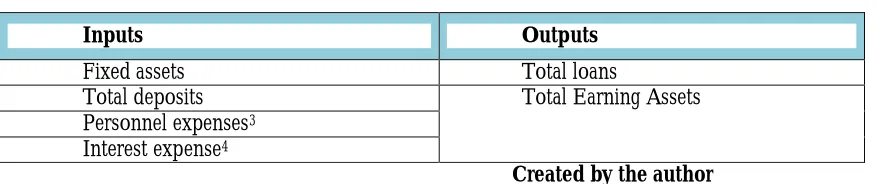
The originality of this empirical part is manifested by the integration of a new input "interest expense''. In fact the inputs and outputs are shown in table 2.
Table 2: Outputs and Inputs
Inputs Outputs
Fixed assets Total loans
Total deposits Total Earning Assets
Personnel expenses3 Interest expense4
Created by the author 3.3 Analysis and results
By using the DEAP 2.1 software, under variable returns to scale assumptions, the results are as follows:
Ordinary investment banks are less stable than Islamic investment banks.
Indeed, conventional commercial banks are not affected in a meaningful way and maintain its rate of efficiency throughout the three periods.
While, the conventional commercial banks are more stable than their Islamic counterparts.
Islamic investment banks are more efficient than conventional investment banks and commercial banks as Islamic.
We see an outstanding recovery on the financial stability of conventional banks after the subprime crisis (from 2011).
Indeed, we will use the efficiency scores in the following section, as endogenous variables to explain the impact of key determinants of financial stability on the strength of banks before, during and after the subprime crisis. 3.4 Tobit model : censored regression model
In 1958 James Tobin proposed a statistical model to describe the relationship between a dependent variable yi "non negative" and one independent (or vector) xi. In fact, our model assumes the existence of an unobservable variable yi (or latent). The latter is linearly dependent on xi, via a vector which helps to determine the relationship between the two variables, as in a linear model. In addition, there is a term normally distributed error Ui where their role is manifested by the detection of existing random influences in this relationship. Unobservable variable yi is defined as being equal to a latent variable when the latter is greater than zero and zero otherwise.
3
Includes salaries, social security contributions, pension costs and other staff costs, including expenses related to employee stock options.
4
Hence, the structural equation in the Tobit model can be written as follows:
yi = yi * si yi * 0
0 si yi 0
Where yi is a latent variable:
yi * =
If the relationship parameter is estimated by an observed regression of yi on , the estimator of the ordinary least squares regression results is inconsistent. It provides a biased estimate downward of a slope coefficient and an upward biased estimate of interception. (Takeshi Amemiya, 1973) showed that the maximum likelihood estimator proposed by Tobin for this model is coherent. About our empirical part, we will use in a second stage, after measuring the efficiency, Tobit method is used to know the impact of the determinants of financial stability on the banking efficiency. This brings us to detect the main pillar which has a significant weight on the development and soundness of the financial system. We will take into account the macroeconomic factor by adding the inflation. In many applications containing likelihood functions, it is best to work with the natural logarithm of the likelihood function (log-likelihood). Moreover, the logarithm is a monotonically increasing function, which reaches its maximum value, by applying in this function, at the same points as the function itself. For this reason, the log-likelihood can be used instead of the probability of the estimate of maximum likelihood and related techniques. So in our work, we will take consideration the log-likelihood grade. The latter or log-likelihood is used in a test ratio The chi-square law (χ2), in which all the regression coefficients in the model preachers are simultaneously zero.
LR chi2 (2): This is the likelihood ratio (LR) Chi-Square test at least one of the explanatory variable regression coefficients is not zero. The number in parentheses indicates the degrees of freedom of the chi-square distribution used to test the LR Chi-Square statistic and is defined by the number of preachers in the model. The Tobit regression coefficients are interpreted in the same way as in ordinary least squares (OLS).
Prob> chi2: This is the probability of obtaining a LR test statistic as extreme as, or more, that the observed statistic under the null hypothesis; the latter is that all regression coefficients are simultaneously equal to zero. In other words, it is the probability of this chi-square statistic (70.93), or more, if there is in fact no effect of the predictor variables. This probability (p-value) is compared with an alpha level specified, our willingness to accept a type I error, which is usually set at 0.05 or 0.01.
The small p-value of the test of LR, <0.0001, lead us to conclude that at least one of the regression coefficients in the model is not zero. The parameter of the chi-square distribution used to test the null hypothesis is defined by the degrees of freedom in the forward line, chi2 (2). Pseudo R2 - is the pseudo R square of McFadden's. In fact, in Tobit model doesn't exist the equivalent of R2, which is in the ordinary least square regression. Sigma: It is the estimated standard error of regression. This can be compared to the mean squared error that would result in an OLS regression.
3.5 Data and Variables
Data
Our data are taken from the bankscoop. The variables used in the Tobit model:
Dependent variables
- Technical Efficiency : ET
- Pure Technical Efficiency : ETP
Explained variables
Profitability
NI/ATA: Net Income /Total Assets
Rentability
ROAA : Return on Average Assets
Efficacity
CI : Cost / Income
Asset quality
LLR/GL: Loan loss Reserves / Gross Loans
ILE: Impaired Loans less Reserves for Impaired Loans / Equity
Liquidity
LAD : liquid Assets / Deposits & Short-Term Funding
NLD : Net Loans / Deposits & Short-Term Funding
Capital Adequacy
FT : Equity / Total Assets
- Monetary variable
INF : Inflation rate
3.6 Econometric model and evaluation method
The main purpose of the empirical part is to elucidate the ability of conventional and Islamic banks to resist, especially before, during and after the financial crisis and to determine the impact of different variables of the financial stability on the banking efficiency. In fact, we take the work of (Romzie.R, Norazlina.AW, Zairy.Z, 2013) as a base. While, in our model, several variables are integrated and also the duration is different. The sample selected is well balanced. The contribution of our model is characterized by the use of three Tobit models to explain the impact of financial stability determinants on sound banking, which is previously determined by the DEA. These three models each contain in the endogenous part three latent variables of efficiency. These are, respectively: technical efficiency (TE), scale efficiency (EE) and pure technical efficiency (ETP). Therefore, our models are5 :
According to technical efficiency (ET):
Selon l’efficience technique pure (ETP) :
Selon l’efficience d’échelle (EE) :
With:
i and t : are respectively the group of banks (i) and the period (t) EEi,t : scale efficiency of the bank (i) of county j and the period (t) ETi,t : technical efficiency of the bank (i) of county j and the period (t)
5
ETPi,t : pure technical efficiency of the bank (i) of county j and the period (t)
In our estimation, we will take into account the difference between investment banks and commercial ones. That is why in the first place, we try to illustrate and explain the effects of different variables of financial stability on technical efficiency, scale efficiency and pure technical efficiency of Islamic banks and their conventional counterparts. Second, we will make a comparison between all groups of banks.
3.7 Analysis and interpretation
3.7.1 Before the onset of the subprime crisis
First, our estimate comprises three models, where we find as an endogenous variable respectively, technical efficiency, scale efficiency and pure technical efficiency. On the other hand, we find the variables that represent financial stability, based on their main pillars (profitability, capital adequacy, liquidity). At the macro level, in our estimate we have only one variable that is manifested by the rate of inflation.
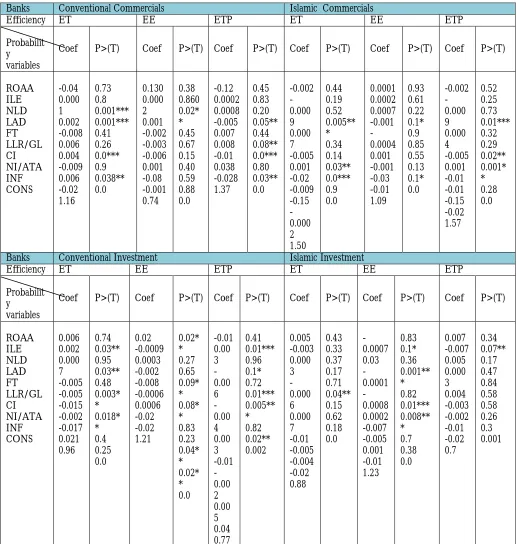
Building on our empirical outputs (see table 3), we note that, before the subprime crisis, the determinants of financial stability have a crucial role in determining performance in commercial conventional banks, to ensure, in particular, microeconomic stability and economic growth in general . Indeed, the liquidity factor, during the study period (four years), has attacked the banks, because a lack of liquid assets. That is to say, in a sudden and massive money withdrawal, the bank is in a failure condition. In fact, the increase in liquid assets and short and medium-term deposits are in an opposite manner. The capital adequacy pillar has participated in technical efficiency before the crisis, where banks have a capital level that ensures resistance against the failure shock. The determinants effects seem clear also in the quality of the assets in which there is a negative influence, since the reserve financing, decrease proportionally with the increase of non-performing loans and also percentage of this determinant continues to augment to the total loan. The asset size still remains in effect (positive), because every time the size of the bank increases, their capital bases changes and their sensitivity to the crisis decreases. While conventional investment banks are not affected by the determinants of financial stability, except by a single variable that represents the efficiency (CI), where this has damaged the bank performance, since costs increase to a rate which exceeds that of income. So, the impact of the financial stability of Islamic banks on technical efficiency and pure technical efficiency of the commercial category is clear.
Table 3: The evaluation of the impact of financial stability determinants on banks performance before the subprime crisis (Tobit model)
Banks Conventional Commercials Islamic Commercials
Efficiency ET EE ETP ET EE ETP
Probabilit y variables
Coef P>(T) Coef P>(T) Coef P>(T) Coef P>(T) Coef P>(T) Coef P>(T)
ROAA ILE NLD LAD FT LLR/GL CI NI/ATA INF CONS -0.04 0.000 1 0.002 -0.008 0.006 0.004 -0.009 0.006 -0.02 1.16 0.73 0.8 0.001*** 0.001*** 0.41 0.26 0.0*** 0.9 0.038** 0.0 0.130 0.000 2 0.001 -0.002 -0.003 -0.006 0.001 -0.08 -0.001 0.74 0.38 0.860 0.02* * 0.45 0.67 0.15 0.40 0.59 0.88 0.0 -0.12 0.0002 0.0008 -0.005 0.007 0.008 -0.01 0.038 -0.028 1.37 0.45 0.83 0.20 0.05** 0.44 0.08** 0.0*** 0.80 0.03** 0.0 -0.002 -0.000 9 0.000 7 -0.005 0.001 -0.02 -0.009 -0.15 -0.000 2 1.50 0.44 0.19 0.52 0.005** * 0.34 0.14 0.03** 0.0*** 0.9 0.0 0.0001 0.0002 0.0007 -0.001 -0.0004 0.001 -0.001 -0.03 -0.01 1.09 0.93 0.61 0.22 0.1* 0.9 0.85 0.55 0.13 0.1* 0.0 -0.002 -0.000 9 0.000 4 -0.005 0.001 -0.01 -0.01 -0.15 -0.02 1.57 0.52 0.25 0.73 0.01*** 0.32 0.29 0.02** 0.001* * 0.28 0.0
Banks Conventional Investment Islamic Investment
Efficiency ET EE ETP ET EE ETP
Probabilit y variables
Coef P>(T) Coef P>(T) Coef P>(T) Coef P>(T) Coef P>(T) Coef P>(T)
ROAA ILE NLD LAD FT LLR/GL CI NI/ATA INF CONS 0.006 0.002 0.000 7 -0.005 -0.005 -0.015 -0.002 -0.017 0.021 0.96 0.74 0.03** 0.95 0.03** 0.48 0.003* * 0.018* * 0.4 0.25 0.0 0.02 -0.0009 0.0003 -0.002 -0.008 -0.0006 0.0006 -0.02 -0.02 1.21 0.02* * 0.27 0.65 0.09* * 0.08* * 0.83 0.23 0.04* * 0.02* * 0.0 -0.01 0.00 3 -0.00 6 -0.00 4 0.00 3 -0.01 -0.00 2 0.00 5 0.04 0.77 0.41 0.01*** 0.96 0.1* 0.72 0.01*** 0.005** * 0.82 0.02** 0.002 0.005 -0.003 0.000 3 -0.000 6 0.000 7 -0.01 -0.005 -0.004 -0.02 0.88 0.43 0.33 0.37 0.17 0.71 0.04** 0.15 0.62 0.18 0.0 -0.0007 0.03 -0.0001 -0.0008 0.0002 -0.007 -0.005 0.001 -0.01 1.23 0.83 0.1* 0.36 0.001** * 0.82 0.01*** 0.008** * 0.7 0.38 0.0 0.007 -0.007 0.005 0.000 3 0.004 -0.003 -0.002 -0.01 -0.02 0.7 0.34 0.07** 0.17 0.47 0.84 0.58 0.58 0.26 0.3 0.001
* , **, ***, significant respectively at 10%, 5% et 1% created by the author
3.7.2 During the subprime crisis
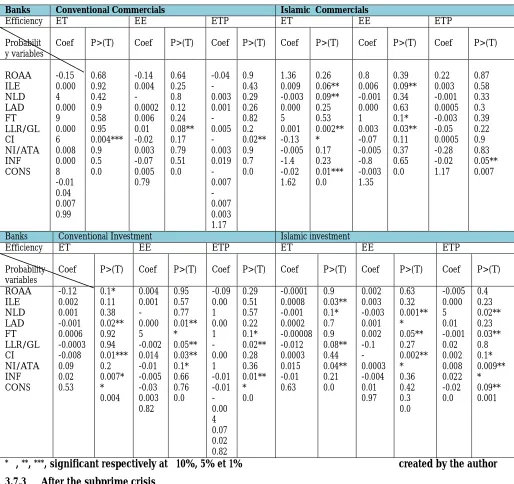
It is true that before the financial crisis, the efficiency touched the majority of conventional banks, especially the commercial group. The effect of stability on efficiency seems clear in this category. But at birth the financial maelstrom, the imbalance emerges in principle in conventional investment banks (table 4).
According to our results, financial stability does appear clear only at the level of Islamic investment banks. By cons, the conventional investment banks point a weakness on all indicators. In fact, the massive withdrawals of deposits, the distrust of lending agents, bankruptcies of some banks internationally, where banks belonging to our sample of actions in these large financial institutions. Moreover, the recourse to the stock exchange of certain investors in order to avoid losing their money because of the subprime crisis is a major reason for the destruction of the investment banks. In addition, we note that inflation has a positive effect during the crisis on conventional investment banks and it essentially returns to the following circuit: the borrowers are in a situation where inflation is increasing, so the real value to repay will be lower than the borrowing, this can help investors to honor its commitments and encourage them to invest more.
Hence, the number of investments increases, both revives liquidity in banks. About ROAA, it has an almost negative impact in the majority of cases. This negative impact essentially amounts to the economic profitability, because it is less than the cost of debt, where the leverage exerted an extremely negative impact: it is called "boomerang effect". Leverage is a good way to help shareholders to obtain high financial returns. However, the increasing of practiced of lever can increase the threat of the ''boomerang effect''. To better explain this is an ordinary example, which coincides with our results. When we buy a property reserved to renting. This property will be paid as follows: 75% by the credits and the remainder through our own contributions. Here the lever is 3 (75/25). If we receive a rent that can support our expenses, so leverage is positive. Otherwise, when the financial crisis (subprime), that we enthusiasm to explain it is a prototype, the leverage will be totally negative.
Table 4: The evaluation of the impact of financial stability determinants on banks performance during the subprime crisis (Tobit model)
Banks Conventional Commercials Islamic Commercials
Efficiency ET EE ETP ET EE ETP
Probabilit y variables
Coef P>(T) Coef P>(T) Coef P>(T) Coef P>(T) Coef P>(T) Coef P>(T)
ROAA ILE NLD LAD FT LLR/GL CI NI/ATA INF CONS -0.15 0.000 4 0.000 9 0.000 6 0.008 0.000 8 -0.01 0.04 0.007 0.99 0.68 0.92 0.42 0.9 0.58 0.95 0.004*** 0.9 0.5 0.0 -0.14 0.004 -0.0002 0.006 0.01 -0.02 0.003 -0.07 0.005 0.79 0.64 0.25 0.8 0.12 0.24 0.08** 0.17 0.79 0.51 0.0 -0.04 -0.003 0.001 -0.005 -0.003 0.019 -0.007 -0.007 0.003 1.17 0.9 0.43 0.29 0.26 0.82 0.2 0.02** 0.9 0.7 0.0 1.36 0.009 -0.003 0.000 5 0.001 -0.13 -0.005 -1.4 -0.02 1.62 0.26 0.06** 0.09** 0.25 0.53 0.002** * 0.17 0.23 0.01*** 0.0 0.8 0.006 -0.001 0.000 1 0.003 -0.07 -0.005 -0.8 -0.003 1.35 0.39 0.09** 0.34 0.63 0.1* 0.03** 0.11 0.37 0.65 0.0 0.22 0.003 -0.001 0.0005 -0.003 -0.05 0.0005 -0.28 -0.02 1.17 0.87 0.58 0.33 0.3 0.39 0.22 0.9 0.83 0.05** 0.007
Banks Conventional Investment Islamic investment
Efficiency ET EE ETP ET EE ETP
Probability variables
Coef P>(T) Coef P>(T) Coef P>(T) Coef P>(T) Coef P>(T) Coef P>(T)
ROAA ILE NLD LAD FT LLR/GL CI NI/ATA INF CONS -0.12 0.002 0.001 -0.001 0.0006 -0.0003 -0.008 0.09 0.02 0.53 0.1* 0.11 0.38 0.02** 0.92 0.94 0.01*** 0.2 0.007* * 0.004 0.004 0.001 -0.000 5 -0.002 0.014 -0.01 -0.005 -0.03 0.003 0.82 0.95 0.57 0.77 0.01** * 0.05** 0.03** 0.1* 0.66 0.76 0.0 -0.09 0.00 1 0.00 1 -0.00 1 -0.01 -0.01 -0.00 4 0.07 0.02 0.82 0.29 0.51 0.57 0.22 0.1* 0.02** 0.28 0.36 0.01** * 0.0 -0.0001 0.0008 -0.001 0.0002 -0.00008 -0.012 0.0003 0.015 -0.01 0.63 0.9 0.03** 0.1* 0.7 0.9 0.08** 0.44 0.04** 0.21 0.0 0.002 0.003 -0.003 0.001 0.002 -0.1 -0.0003 -0.004 0.01 0.97 0.63 0.32 0.001** * 0.05** 0.27 0.002** * 0.36 0.42 0.3 0.0 -0.005 0.000 5 0.01 -0.001 0.02 0.002 0.008 0.022 -0.02 0.0 0.4 0.23 0.02** 0.23 0.03** 0.8 0.1* 0.009** * 0.09** 0.001
* , **, ***, significant respectively at 10%, 5% et 1% created by the author
3.7.3 After the subprime crisis
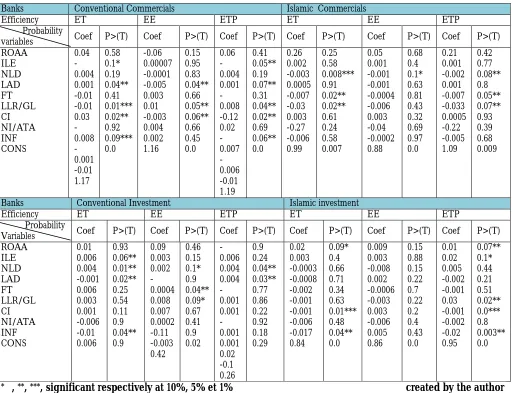
If we cast an eye on the impact of various determinants of the stability of the banking efficiency (tables 4 and 5), we find that there is a difference before and during the crisis. This relates to Islamic and conventional banks, including two groups. In fact, we are dealing with following the impact of financial stability on efficiency after the crisis. Table 5 gives us a clear idea about that period and helping us to distinguish between three periods.
That is why we see a significant improvement in the effect of several determinants of technical efficiency, pure technical efficiency and scale efficiency, especially of conventional investment banks. In fact, improving the liquidity effect comes mainly the injection of money required by the state, or by several donors who keep their faith in conventional banks and find its objectives, according to them, only in this group of banks. Regarding asset quality, it is quite logical, since the main goal after the crisis is to strengthen asset quality, either by studies of loans, either by reducing the number of loans granted. Moreover, in the period that follows the crisis, conventional investment banks have tried as much as possible to respect the thresholds of liquidity ratios. However, conventional commercial banks, despite their efficiency scores from the DEA are acceptable; we note that the effect of most of the determinants of financial stability on the three types of efficiency is totally unfavorable. This appears especially in CI variable level (cost / income) and liquidity. This basically amounts to the distrust of many investors to such banks and fear of these that these banks go bankrupt. The consequence of distrust, obviously the massive withdrawal of money, which reduces the level of liquidity in banks. In addition, all banks are trying to overcome this situation, so they do not have the ability to help its counterparts. In addition, the appearance of a hard competitor, which appears solid and profitable during the crisis, reduces the percentage of potential customers. In fact, for conventional banks, the period after crisis allowed the investment banks to somewhat rectify the situation, which explains the change in any determinant of the negative to the positive. But commercial banks are still in the same situation.
Table 5: The evaluation of the impact of financial stability determinants on banks performance after the subprime crisis (Tobit model)
Banks Conventional Commercials Islamic Commercials
Efficiency ET EE ETP ET EE ETP
Probability
variables Coef P>(T) Coef P>(T) Coef P>(T) Coef P>(T) Coef P>(T) Coef P>(T)
ROAA ILE NLD LAD FT LLR/GL CI NI/ATA INF CONS 0.04 -0.004 0.001 -0.01 -0.01 0.03 -0.008 -0.001 -0.01 1.17 0.58 0.1* 0.19 0.04** 0.41 0.01*** 0.02** 0.92 0.09*** 0.0 -0.06 0.00007 -0.0001 -0.005 0.003 0.01 -0.003 0.004 0.002 1.16 0.15 0.95 0.83 0.04** 0.66 0.05** 0.06** 0.66 0.45 0.0 0.06 -0.004 0.001 -0.008 -0.12 0.02 -0.007 -0.006 -0.01 1.19 0.41 0.05** 0.19 0.07** 0.31 0.04** 0.02** 0.69 0.06** 0.0 0.26 0.002 -0.003 0.0005 -0.007 -0.03 0.003 -0.27 -0.006 0.99 0.25 0.58 0.008*** 0.91 0.02** 0.02** 0.61 0.24 0.58 0.007 0.05 0.001 -0.001 -0.001 -0.0004 -0.006 0.003 -0.04 -0.0002 0.88 0.68 0.4 0.1* 0.63 0.81 0.43 0.32 0.69 0.97 0.0 0.21 0.001 -0.002 0.001 -0.007 -0.033 0.0005 -0.22 -0.005 1.09 0.42 0.77 0.08** 0.8 0.05** 0.07** 0.93 0.39 0.68 0.009
Banks Conventional Investment Islamic investment
Efficiency ET EE ETP ET EE ETP
Probability
Variables Coef P>(T) Coef P>(T) Coef P>(T) Coef P>(T) Coef P>(T) Coef P>(T)
ROAA ILE NLD LAD FT LLR/GL CI NI/ATA INF CONS 0.01 0.006 0.004 -0.001 0.006 0.003 0.001 -0.006 -0.01 0.006 0.93 0.06** 0.01** 0.02** 0.25 0.54 0.11 0.9 0.04** 0.9 0.09 0.003 0.002 -0.0004 0.008 0.007 0.0002 -0.11 -0.003 0.42 0.46 0.15 0.1* 0.9 0.04** 0.09* 0.67 0.41 0.9 0.02 -0.006 0.004 0.004 -0.001 0.001 -0.001 0.001 0.02 -0.1 0.26 0.9 0.24 0.04** 0.03** 0.77 0.86 0.22 0.92 0.18 0.29 0.02 0.003 -0.0003 -0.0008 -0.002 -0.001 -0.001 -0.006 -0.017 0.84 0.09* 0.4 0.66 0.71 0.34 0.63 0.01*** 0.48 0.04** 0.0 0.009 0.003 -0.008 0.002 -0.0006 -0.003 0.003 -0.006 0.005 0.86 0.15 0.88 0.15 0.22 0.7 0.22 0.2 0.4 0.43 0.0 0.01 0.02 0.005 -0.002 -0.001 0.03 -0.001 -0.002 -0.02 0.95 0.07** 0.1* 0.44 0.21 0.51 0.02** 0.0*** 0.8 0.003** 0.0
Concerning Islamic banks, usually, we can confirm the efficiency results found by the DEA. If we exclude inflation, other determinants of financial stability exert their positive effects on the banking efficiency. This result says that this bank group is strong in terms of asset quality and liquidity, where the deterioration of the latter two factors is the main cause of the financial crisis. While the results in Table 9, admit that three variables significantly affected the pure technical efficiency and technical efficiency of commercial Islamic banks are: NLD, FT and LLR / GL representing liquidity, capital adequacy, and asset quality. We note that the effect of the pillars of stability is negative. This basically returns to the religious challenges.
The main resources of commercial banks are the transactions (mainly Murabaha contract). In fact, they play their normal mission, we are talking of intermediation. Because, the rules of Sharia have reduced multiple financing channels because of their illegitimacy and absence of several other sources that apply to their conventional counterparts such as derivatives and interest rate, this type of bank has not many ways of attraction. But the privilege of Sharia law is still respected, but not in all situations. Liquidity risk in Islamic banking returns especially, at the inability to mobilize funds (borrowing) at a logical cost and also the ban on sale of financial assets, as the standards of Islamic finance prohibit these transaction genres. These two causes involve in some cases a lack of liquidity, which injures no doubt the stability and efficiency of banks. Fiduciary risk is a threat not to ignore that may affect the financial stability of Islamic banks, in the first place, and banking efficiency in the second place. whereas if the specification of Islamic banks to contracts respecting the Shariah is a bonus for them in attracting interest from several customers who are mainly pious and devout, they may be at the illiquidity origin by the massive withdrawals, such in case of doubt this type of customers that the bank does not comply with Sharia rules in its transactions.
In addition, the low rate yield can be understood by depositors or investors as a lack of skills and poor money management (AAOIFI, 1999). Several other faults that are related, especially, to operational risks that have prevented the development of asset quality and manage liquidity. In fact, commercial Islamic banks lack the IT systems to manage their own operations. Moreover, the majority of banks, if we do not say all, use the classic banking system. Indeed, unexpected withdrawals of some depositors or investors their deposits are a liquidity problem that can even attack the performance of Islamic banks. In fact, fear of failure, in some cases, to protect the financial assets against the threat deposit depreciation in case of doubt a loss mainly due to the low rate of return, all these points leads to massive withdrawals of money to look for an alternative that guarantees a respectable level of profitability. Similarly, to manage the rate of return applied by their counterparts, commercial Islamic banks are forced to get rid of part of their profit to investors, otherwise the risk of a massive withdrawal of money and loss of a large number of clients. The application of this method has created a disturbance at the level of capital adequacy. This is why the value of this key continues to deteriorate and their effect on efficiency moves towards negativity.
Conclusion
This can be stated in one side of the work (Romzie.R, Norazlina.AW, Zairy.Z, 2013). In fact, some economists explain the bank failure, rather, the crisis itself through the absence of ethical phenomenon in conventional banks.
Appendix
The order of banks analyzed by the DEAP
Islamic Commercials
Islamic Investment
Conventional Commercials
Conventional Investment 1. Jordan Islamic Bank
2. Islamic International Arab Bank 13. Albaraka Banking Group B.S.C. 14. Shamil Bank of Bahrain B.S.C. 21. Kuwait Finance House 27. RHB Islamic Bank Berhad 34. Islamic Development Bank 35. Islamic Corporation for the Development of the Private Sector 41. Dubai Islamic Bank plc 42. Abu Dhabi Islamic Bank - Public Joint Stock Co 45. Shamil Bank of Yemen & Bahrain
449. Tadamon Islamic Bank 52. Boubyan Bank ksc 53. Kuwait International Bank
7. Jordan Dubai Islamic Bank 10. unicorne investment bank BSC
11. investor bank BSC 12. Citi islamic bank 22. Aref Investment Group 23. Ayan leasing &
investment company 24. International investor company KSC
25. First Investment Company K.S.C.C 26. Al Rajhi Banking & Investment
33. Al Rajhi Banking & Investment Corporation 43. Emirates Islamic Bank PJSC
44. slamic Bank of Yemen for Finance & Investment 48. Industrial Development Bank
54. Sharjah Islamic Bank
3. Arab Bank Group 4. Jordan Commercial Bank
15. Arab Banking Corporation BSC 16. National Bank of Bahrain
19. National Bank of Kuwait S.A.K. 20. Ahli United Bank KSC
28. Alliance Bank Malaysia Berhad 29. Bank Pembangunan Malaysia Berhad
36. National Commercial Bank
39. National Bank of Abu Dhabi
40. Abu Dhabi Commercial Bank 46. National Bank of Yemen
50. Sudanese French Bank
55. Saudi investment Bank
5. Invest Bank
6.Arab Jordan Investment Bank
8. United Gulf Bank.( BSC) EC
9. Investcorp Bank. BCS 17. Gulf Investment Corporation
18. global investment house 30. Aminve Bank
31. BerhadMIDF Amanah Investment Bank Berhad 32. Maybank Investment Bank
37. Arab Petroleum Investments 38. Arab investment company
47. Yemen Kuwait Bank for Trade and Investment 51. Export Development Bank
56. Abu Dhabi Investment Company
References
Abdus, S. (2004), « performance of interest-free Islamic banks vis-à-vis interest-based conventional banks of Bahrain», IIUM Journal of Economics and Management, no 2.
Ahmed, B., Chaouki, B., Karima,S. (2013), « Islamic Finance and Financial Stability: A Review of the Literature», 9ème conférence pour l’économie et la finance Islamique, Istanbul.
Banker, R, D., Charnes A., et Cooper W.W. (1984), « Some Models For Estimating Technical and Scal Inefficience in DEA », Management Science, vol 30, pp.1078-1092.
Bashir, H. (2000), «Determinants of profitability in Islamic Banks: Some evidence from the Middle East», Islamic Eco. Stud, vo1: pp. 31-57.
Chawki, EM., Hassan, O. (2011), « Evaluating the Productive Efficiency of Islamic Banking in GCC: A Non- Parametric Approach », International Management Review, Vol 7, n°1.
D, Yudistira. (2004), « Efficiency in Islamic banking: An empirical analysis of eighteen banks », Islamic Economic Studies, pp. 1-20.
Houcem, S., et Ines B. (2012), « Profitability of Islamic Banks in the GCC Region », Global
M, Čihák., H, Hesse. (2008), “Islamic Banks and Financial Stability: An Empirical Analysis”, International Monetary Fund, WP/08/16
M, Kabir H. (2006), « The x-efficiency in Islamic Banks », Islamic Economic Studies, Vol 13, n° 2.
Romzie, R., Norazlina, A,W., et Zairy Z. (2013), « Efficiency of islamic banks during the financial crisis: an analysis of Middle Eastern and Asian country », Pacific-Basic finance journal, pacfin 661.
T, Beck., A Demirguç-Kunt et O Merrouche. (2013), « Islamic vs. conventional banking: Business model, efficiency and stability », Journal of Banking and Finance, pp.433-447.