International Journal of Inventions in Computer Science and Engineering, Volume 5 Issue 1-2 Jan/Feb 2018
S. Malathi, S. Anitha
16
Improving the Energy Efficiency in Wireless Sensor
Network
S. Malathi1, S. Anitha2
1Assistant Professor, NSN College of Engineering and Technology, Tamilnadu, India.
1Centre for Mathematics, Karupa foundation education and Research Centre, Tamilnadu, India.
ABSTRACT—We propose localized, self-organizing, robust, and energy-efficient data aggregation for sensor networks, which we call Localized Power-Efficient Data Aggregation Protocols (L-PEDAPs) and the modified Gpsr for better efficiency in energy consumption. Greedy Perimeter Stateless Routing (GPSR) is a proven efficient geographical routing protocol for wireless adhoc network which is symmetric in nature. It also offers routing support for Wireless Sensor Network (WSN). However, GPSR was designed for the symmetric links (bidirectional reachable), but sensor networks are often asymmetric in nature. In the traditional approach, nodes advertise their availability to update the routing table. We eliminate this to reduce energy consumption. We introduce Modified Greedy Perimeter Stateless Routing (GPSR) routing protocol for efficient communication among sensor nodes, which identifies optimal route based on energy utilization. The implementation of GPSR in sensor networks faces many challenges due to limited memory and battery energy. Power-Efficient Data Aggregation Protocols (L-PEDAPs) are based on topologies, such as LMST and RNG,that can approximate minimum spanning tree and can be efficiently computed using only position or distance information of one-hop neighbors.
KEYWORDS- GPSR, WSN, AODV,Routing Protocol, Network Topology, Sensor nodes, Near-optimal communication
1. Introduction
A wireless sensor network is composed of numerous nodes distributed over an area to collect information. The sensor nodes communicate among themselves through the wireless channel to self-organize into a multi-hop network and forward the collected data towards one or more base stations Each node has one or more sensors, embedded processors and low- power radios, and is normally battery operated. Typically, these nodes coordinate to perform a common task. Low power capacities of sensor nodes result in very limited coverage and communication range compared to other mobile devices. Hence, to successfully cover the target area, sensor networks are composed of large number of nodes. Sensor networks are multi hop wireless networks formed by a large number of resource-constrained sensor nodes. Each sensor node typically generates a stream of data items that are readings obtained from the sensing devices on the node. Motivated by the above , we develop efficient GPSR routing protocol, since each sensor node has limited battery energy and message communication is the
main consumer of energy, distributed. Implementation of GPSR must minimize the communication cost. In particular, we are interested in in-network implementation strategies since routing all sensor data to a central server would incur prohibitive communication costs. In addition, load-balanced implementation strategies are highly desirable, because unbalanced strategies are likely to result in a much shorter network lifetime. Design of communication -efficient and load-balanced in-network implementations of join in sensor networks is particularly challenging due to limited memory available at each node and arbitrary network topologies.
2. GPSR
International Journal of Inventions in Computer Science and Engineering, Volume 5 Issue 1-2 Jan/Feb 2018
S. Malathi, S. Anitha
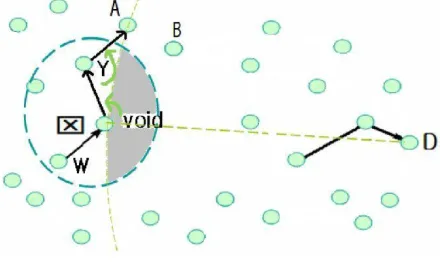
17 GPSR recovers by forwarding in perimeter mode, in which a packet traverses successively closer faces of a planar sub graph of the full radio network connectivity graph, until reaching a node closer to the destination, where greedy forwarding resumes.
GPSR will allow the building of networks that cannot scale using prior routing algorithms for wired and wireless networks. Such classes of networks include Rooftop networks, Ad hoc networks, Sensor networks, Vehicular networks.
GPSR protocol [6] is the earliest geographical routing protocols for Ad hoc networks which can also be used for WSN environment. The GPSR adapts a greedy forwarding strategy and perimeter forwarding strategy to route messages. It makes uses of a neighborhood beacon that sends a node’s identity and its position. However, instead of sending this beacon periodically and add to the network congestion, GPSR
[6] piggybacks the neighborhood beacon on every message that is sent or forwarded by the node. Every node in GPSR has a neighborhood table of its own. We will show that geographic routing allows routers to be nearly stateless, and requires propagation of topology information for only a single hop: each node need only know its neighbors’ positions. The self-describing nature of position is the key to geography’s usefulness in routing. The position of a packet’s destination and positions of the candidate next hops are sufficient to make correct forwarding decisions, without any other topological information.
Figure 2. Greedy forwarding example. A is x’s closest neighbor to D.
GPSR is an algorithm which combines two different methods of routing. The first method is the Greedy Packet Forwarding method! This method will be used as long as possible, in some case till the Destination. But when the packet arrives on a node, where the node can't find with the Greedy Packet Forwarding a next node, nearer to the destination, and then will be used the second algorithm, the Perimeter forwarding. On the GPSR
Protocol, all node of the network has a local table, in which all neighbour of the node is listed by name (ID) and position. A proactive Broadcast refreshes this table of each node in a regular time interval. The source node gives the packet a destination address. This address will not be changed by any node who forwards the packet. In the header of the GPSR Packets are many more data.
3. MODIFIED GPSR
The proposed routing scheme is based on the fact that the energy consumed to send a message to a distant node is greater than the energy needed for a short range transmission. GPSR protocol is extended using aggregation node or head set node. Aggregation node is responsible for Transmitting messages to the distant base station and routing is decided using the respective head set members. The head set is decided on a routine basis with reference to the energy level of the signal received to the base station at the time of reception of “Data packets”.
Figure 3. Perimeter forwarding by Right hand rule.
International Journal of Inventions in Computer Science and Engineering, Volume 5 Issue 1-2 Jan/Feb 2018
S. Malathi, S. Anitha
18 choose their cluster heads based on the signal strengths of the advertisement messages.
figure 4. modified GPSR
Each sensor node sends an acknowledgment message to its cluster head. Moreover, the cluster heads choose a set of associates based on the signal analysis of the acknowledgments. A head- set has both cluster head and the associates. The head set, which is responsible to send Messages to the base station, is chosen for each time based on the energy level of the signal received to the base station. The non-cluster head nodes collect the sensor data and transmit the data to the cluster head, in their allotted time slots. The cluster head node must keep its radio turned on to receive the data from the nodes in the cluster. The associate Members of the head set remain in the sleep mode and do not receive any messages. After, some pre-determined time interval, the next associate becomes a cluster head and the current cluster head becomes a passive head set member.
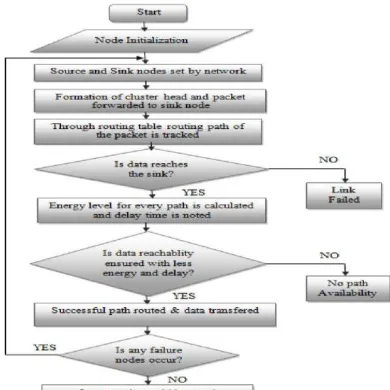
figure 5. flowchart of the modified algorithm
For a sensor network of n nodes, the optimal number of clusters is given as k. All nodes are assumed to be at the same energy level at the beginning. The amount of consumed energy is same for all the clusters. At the start of the election phase, the base station randomly selects a given number of cluster heads. The cluster heads broadcast messages to all the sensors in their neighborhood .Then the sensors [14-16] receive messages from one or more cluster heads and choose their cluster head using the received signal strength. Later, the sensors transmit their decision to their corresponding cluster head. Finally, the cluster heads receive messages from their sensor nodes and remember their corresponding nodes. Energy consumption of each node during data transfer varies with respect to the distance from their respective head sets and head set to the base station via other nodes involved in the network. When the clusters are being formed by the network, head sets are also allocated to decide the optimal number of clusters.
Cluster is being optimized based on the energy level consumption in the network. Head set size and energy consumption are directly proportional to each other, such that the head set size optimization in turn decides the power consumption of the network. Once the cluster is being decided with their respective headsets then the source and destination is being decided from the base station. The network is being monitored from the base station to have entire control over it. The “hello packet” is sent from the source to the destination by means of partial flooding using the right hand rule. The flooded packet is being tracked by the base station to form the routing table, to decide the optimal route with respect to energy consumption, shortest path and less delay. The optimal route decision is based on the shortest delay path and less energy consumption in the network as shown in flowchart represented in. The routing table is used to decide the path for the transmission of data in the network. The processed information reaches the base station where the signal is being efficiently used to monitor the physical changes the environment.
4.Algorithm Details For Energy Efficient packet data Aggregation
International Journal of Inventions in Computer Science and Engineering, Volume 5 Issue 1-2 Jan/Feb 2018
S. Malathi, S. Anitha
19 send the data to in order to reach the sink, and the child nodes that it will receive the data from before it sends the fused or aggregated packet to its parent node. Our solution consists of three parts: Route Computation, Data Gathering, and Route Maintenance.
4.1. Topology and Route Computation
The main goal in this phase is to find a sparse topology and set up the routes over it, which means determining the children and parent nodes for each node. At the end of this phase, a data aggregation tree rooted at sink is constructed. The pseudocode for this phase is given in
Algorithm 1. Topology and Route Computation 1:Send HELLO message
2:Collect HELLO messages for thello 3:Reset Parent (_ null)
4:Compute neighbors on the sparse topology 5:while ROUTE-DISCOVERY packet RD received in tdiscovery do
6:if update required for RD then 7:Update parent (_ sourceðRDÞ) 8:Broadcast ROUTE-DISCOVERY 9:end if
10:end while
11:Inform _ to construct its child-list
Initially, the nodes and the sink are not aware about the environment. In the setup phase, all nodes and the sink broadcast HELLO messages, which include their location and remaining energy, using their maximum allowed transmit power. The remaining energy level is advertised only when dynamic (power-aware) protocols are used. We give a time threshold the hello for waiting advertisements, which must be long enough to hear all possible advertisements. After receiving HELLO messages, all nodes are informed about their one-hop neighbors and their locations and energy levels. Each node can then locally compute its neighbors in the desired sparse topology (static and dynamic versions of RNG and LMST). After finding its neighbors in the sparse topology, a node can join the distributed route computation process in order to find its parent and children on the aggregation tree.
4.2 Data Gathering
After the parent and children nodes for an individual sensor node are determined, the node can join the data Gathering process. In data
gathering phase, each sensor node periodically senses its nearby environment and generates the data to be sent to the sink. However, before sending it directly to the parent node, it will wait all the data from its child nodes and aggregate the data coming from them together with its own data, and then, send the aggregated data to the parent node. Thus, at the beginning of data gathering step, only leaf nodes can transmit their data to their corresponding parent nodes. At each step, the data are gathered upward in the tree and reaches the sink after h steps, where h is the height of the aggregation tree.
The reason for waiting to receive data from child nodes is to use the advantage of the aggregation. In this way, each sensor only transmits once in a round, and as a result, saves its energy.
4.3 Route Maintenance
After setting up the routes, three events can cause a change in the routing plan: route recomputation, node failure, and node addition. We will discuss them separately. Recomputation of the aggregation tree is required when power-aware (dynamic) cost functions are used. In poweraware methods, the tree must be recomputed at specified intervals. Since the computation depends on the remaining energy of nodes, each time the computation takes place and a different and more power-efficient plan is yielded. In our case, we handle this requirement by broadcasting a new ROUTE-DISCOVERY packet with a new sequence ID.
Apparently, in order to utilize the power-aware methods, each node must know the remaining energy levels of its neighbors. In order to exchange the remaining energy levels, we use HELLO messages. So, at the beginning of each recomputation phase, the nodes advertise their remaining energy levels. After that, ROUTE-DISCOVERY packet with a new sequence ID can be broadcasted by the sink. It is worth to mention that in order to achieve recomputation, each node must know the predefined time (in terms of rounds) to send HELLO messages.
5. Results And Discussion
International Journal of Inventions in Computer Science and Engineering, Volume 5 Issue 1-2 Jan/Feb 2018
S. Malathi, S. Anitha
20 tracked and a routing table is found through right hand flooding techniques, data reachablity is at the base station.
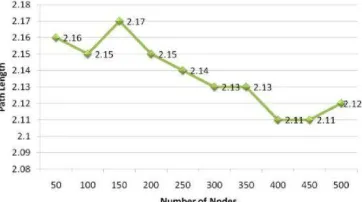
figure 6. optimum path length for various node densities
Different path to deliver the packet is found through right hand flooding techniques, data reachablity is ensured and a routing table is formed with all the successful routes to target node. Once the routing table is formed, the optimal route is selected based on packet delivery delay, less energy consumption and number of hops. Fig .6 illustrates the variation in optimum number of nodes with respect to the path length variation from 50 to 500 nodes [17-18]. As the graph shows, more number of nodes would lead to less path length, which in turn consumes less power in the network. The node sizes are randomly changed because of the consideration of both power and time taken for a packet to reach the target node. By using number of hops and delay in each wireless sensor node the time factor has been calculated. The path length decreases when number of nodes are highly similarly the path length will increase when using few number of nodes.
6. CONCLUSION
As we all know efficient energy consumption plays a very important role in the functioning of wireless sensor nerworks we have tried to improve the energy efficieny by power efficient data aggregation and using modified Gpsr algorithm that could route packets in a scalable and effectivemanner has been built. Modified GPSR algorithm provides energy efficient routing protocol with the ability to route data from event tracking node (source) to event requesting node (destination) and assures reliable delivery of packets. Due to large amount of data generated in the network, assortment of efficient routes can have great impact on the life time of sensor network..
References
[1] S.Basagni, I.Chlamtac, V.Syrotiuk, and B.Woodward, “A distance routing effect algorithm for mobility (DREAM),” in Proceedings of the Fifth Annual International Conference on Mobile Computing and Networking (Mobicom 98), Dallas, Texas, October
[2] J.Gao, L.Guibas, J.Hershberger, L.Zhang, and A.Zhu, “Geometric spanner for routing in mobile networks,” in Proceedings of the 7th ACM International
Conference on Computing and Networking (MobiCom ’01), July 2010, pp. 45–55.
[3] D. B. Johnson and D. A. Maltz, “Dynamic source routing in ad hoc wireless networks,” in Mobile Computing, Imielinski and Korth, Eds. Kluwer Academic Publishers, 2008, vol. 353. [4] Pour, Najmeh Kamyab. "Energy
efficiency in wireless sensor
networks." arXipreprint arXiv:1605.02393 (2016).
[5] Pour, N. K. (2016). Energy efficiency in wireless sensor networks. arXiv preprint arXiv:1605.02393.
]6] Pour, Najmeh Kamyab. "Energy
efficiency in wireless sensor
networks." arXiv preprint
arXiv:1605.02393 (2016).
[7] Pour, N.K., 2016. Energy efficiency in wireless sensor networks. arXiv preprint arXiv:1605.02393.
[8] Pour NK. Energy efficiency in wireless
sensor networks. arXiv preprint
arXiv:1605.02393. 2016 May 9.
[9] Rault, Tifenn, Abdelmadjid
Bouabdallah, and Yacine Challal. "Energy efficiency in wireless sensor networks: A top-down survey." Computer Networks 67 (2014): 104-122.
[10] Rault, T., Bouabdallah, A., & Challal, Y. (2014). Energy efficiency in wireless
sensor networks: A top-down
survey. Computer Networks, 67, 104-122.
[11] Rault, Tifenn, Abdelmadjid
Bouabdallah, and Yacine Challal. "Energy efficiency in wireless sensor networks: A top-down survey." Computer Networks 67 (2014): 104-122.
International Journal of Inventions in Computer Science and Engineering, Volume 5 Issue 1-2 Jan/Feb 2018
S. Malathi, S. Anitha
21 wireless sensor networks: A top-down survey. Computer Networks, 67, pp.104-122.
[13] Sampath, R., and A. Saradha. "Alzheimer's Disease Image Segmentation
with Self-Organizing Map
Network." JSW 10.6 (2015): 670-680. [14] Sampath, R., and Dr A. Saradha. "Classification of Alzheimer Disease Stages Exploiting an ANFIS Classifier." International Journal of
Applied Engineering
Research.[Electronic] 9.22 (2014): 16979-16990.
[15] Sampath, R., and J. Indumathi. "Earlier detection of Alzheimer disease using N-fold cross validation approach." Journal of medical systems 42.11 (2018): 217.
[16] Sampath, R., et al. "STUDY OF CONNECTIVITY PROPERTIES AND
NETWORK TOPOLOGY FOR
NEUROIMAGING CLASSIFICATION BY USING ADAPTIVE NERO-FUZZY INFERENCE SYSTEM." (2006).
[17] Sampath, R., and Dr A. Saradha. “A Hybrid approach for Alzheimer’s disease Classification using 2D Gabor Wavelet transform and Extreme Machine Learning Classifier” JOURNAL OF PURE AND APPLIED MICROBIOLOGY Vol9. 5 .2015
International Journal of Inventions in Computer Science and Engineering, Volume 5 Issue 1-2 Jan/Feb 2018
S. Malathi, S. Anitha