THEORETICAL STUDY OF THE PH
3-ASSISTED MIGRATION OF A COORDINATED ARYL GROUP TO A
COORDINATED CO IN THE COMPLEXES RhCpI(CO)(p-XC
6H
4)
NASRIN SADEGHI
1, REZA GHIASI
2,*, SAEID JAMEHBOZORGI
31Department of Chemistry, Faculty of science, Arak Branch, Islamic Azad University, Arak, Iran 2Department of Chemistry, East Tehran Branch, Islamic Azad University, Qiam Dasht, Tehran, Iran 3Department of chemistry, Faculty of Basic Science, Hamedan Branch, Islamic Azad University, Hamedan, Iran
ABSTRACT
We report the results of theoretical mechanistic studies on PH3-assisted migration of a coordinated aryl group to a coordinated CO in the complexes RhCpI(CO)
(p-XC6H4). The X-substituent effect on thermodynamic and kinetic parameters was explored. The progress of the reaction was quantitatively studied using the
bond orders of the Rh-CO bond, and the percentages of bond cleavage (BCij) of Rh-CO bond at the transition state were described. This theoretical study indicates
good relationships between barrier energy (∆E), bond distances variations (Rh-CO and Rh-Ph), activation energy (∆H‡), activation free energy (∆G‡) values with
Hammett constants of X-substituents. Linear relationship between ln(k) and the 103Rh magnetic shielding tensors of the product was explored.
Keyword: Insertion reaction, Substituent effect, Thermodynamic parameters, Kinetic parameters.
INTRODUCTION
Migratory insertion reactions have enormous value in organometallic chemistry [1] and are concerned in a variety of catalytic processes, both homogeneous and heterogeneous. The migration of a coordinated organic group R onto a co-ordinated carbonyl of a metal promoted by an entering ligand (nucleophile) has been widely studied for systems such as [RMn(CO)5] [2-4],
[(Cp)FeR(CO)2] [5-8] or [(Cp)MoR(CO)3] [9-12]. Also, theoretical studies
have given important information on the nature of the migratory insertion process [13-18].
The PPh3-assisted migration of a coordinated aryl group to a coordinated
CO in the complexes RhCp*I[(CO)(p-XC6H4]PPh3 reported [19]. It was found
that the mechanism was associative and solvent independent [20], and it is also possible that ring slippage is not involved [21,22]. Also, correlation of the transition-metal chemical shifts of the product with reaction rates has been reported and leads to the postulate that such reactions are characterized by a product-like (late) transition state [23].
On the basis of the major effects that substituents afford to a wide range of chemical properties, e.g. reaction rates, structural parameters, thermodynamic parameters and so on, it is proper to visualize a situation where the thoughtful selection of a proper substituent could make the variation between an effective and ineffective receptor. Hence, an in depth exploring of substituent effects and their origins might allow the proposing of a new receptor that has been warily tuned for the best preferred performance.
In this study, we investigate theoretically the PH3-assisted migration of
a coordinated aryl group to a coordinated CO in the complexes RhCpI(CO) (p-XC6H4) and hope to clarify the substitution effect on their activation barriers
and thermodynamics of these insertion reactions.
Computational Methods
All calculations were performed with the Gaussian 09 suite of program [24]. The calculations of systems contain C, H, P, N, F, Cl , I and O described by the standard 6-311G(d,p) basis set [25-28]. For Rh element standard Def2-TZVPPD basis set [29] was used and Rh described by effective core potential (ECP) of Wadt and Hay pseudo-potential with using the Def2-TZVPPD
basis set [30]. Geometry optimization was varied out with Modified
Perdew-Wang Exchange and Correlation (mpw1pw91) [31]. To verifying that the optimization structures are minima, harmonic vibrational frequencies were calculated. All the transition states were checked by IRC (Intrinsic Reaction Coordinate) analysis [32-35].
103Rh magnetic shielding tensors are calculated using the Gauge
independent atomic orbital (GIAO) [36] method at the same method and basis sets for optimization.
RESULTS AND DISCUSSION
Figure 1 exhibits the mechanism of insertion reaction in CpRh(CO)(I) (p-XC6H4) (I) complex in the presence of PH3. Mechanistic studies on the
reaction of CpRh(CO)(I)(p-XC6H4) with PH3 suggest it proceeds through
an initial five-coordinate PH3 adduct from which intramolecular migratory
insertion can then occur.
Figure1. Mechanism of migration insertion reaction in CpRh(CO) (I)
1. Energetic aspects.
The absolute, Zero-point correction, andrelative energies values of reactants, transition states and products complexes in gas phase are gathered in Tables 1a-b.
Table 1. (a)Energy (Hartree), Zero-point correction (Hartree) and (b) energy barrier (kcal/mol), corrected relative energy (kcal/mol) values of the I, Ts and II
structures and Hammett constant of substituents (σp). For PH3, E=-343.1633323 (Hartree), and Zero-point correction 0.024125 (Hartree).
(a)
E Zero-point correction
X σp I TS II I TS II
NH2 -0.66 -7624.5298 -7967.6497 -7967.7199 0.201692 0.227990 0.231466
OH -0.37 -7644.3948 -7987.5124 -7987.5835 0.189285 0.215738 0.219060
Me -0.17 -7608.4883 -7951.6035 -7951.6753 0.212351 0.238599 0.241990
H 0.00 -7569.1702 -7912.2842 -7912.3564 0.185011 0.211248 0.214688
F 0.06 -7668.4118 -8011.5263 -8011.5981 0.176826 0.203055 0.206410
Cl 0.23 -8028.8009 -8371.9140 -8371.9864 0.175436 0.201594 0.205122
CHO 0.42 -7682.4956 -8025.6060 -8025.6791 0.194416 0.220404 0.223924
COOH 0.45 -7757.7549 -8100.8660 -8100.9391 0.200424 0.226565 0.230111
NO2 0.78 -7773.6771 -8116.7864 -8116.8601 0.187905 0.213927 0.217496
(b)
X I TS II
NH2 0.00 28.617759 -13.2521849
OH 0.00 30.1582948 -12.3730441
Me 0.00 31.5356782 -11.3916192
H 0.00 32.281787 -10.8657662
F 0.00 31.9630121 -10.9868756
Cl 0.00 32.7969723 -10.420862
CHO 0.00 34.3845713 -9.27753971
COOH 0.00 34.0413236 -9.60447215
NO2 0.00 35.0961671 -8.91170167
Hessian calculations illustrate positive vibrational frequencies for reactants and products species given in Figures S1, signifying that they locate on minima in the potential energy surface.
Transition state shown in Figure 1 has only one imaginary vibrational frequency, verifying that it is a first-order saddle point in the PES. The calculated
imaginary frequency of transition states are gathered in Table 2. The IRC calculations displayed that the TSs connected the reactants and the product.
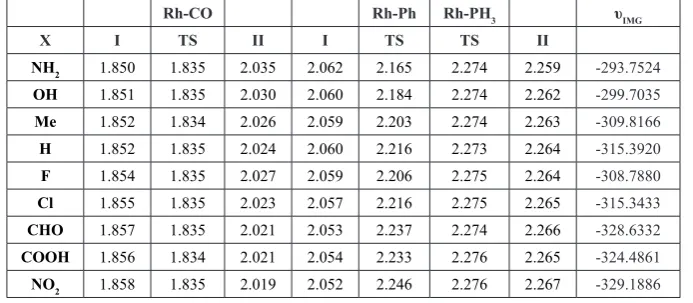
Table2. Selected bond distances in I, Ts and II structures (in Å) and Imaginary frequency of transition states (υIMG in cm-1).
Rh-CO Rh-Ph Rh-PH3 υIMG
X I TS II I TS TS II
NH2 1.850 1.835 2.035 2.062 2.165 2.274 2.259 -293.7524
OH 1.851 1.835 2.030 2.060 2.184 2.274 2.262 -299.7035
Me 1.852 1.834 2.026 2.059 2.203 2.274 2.263 -309.8166
H 1.852 1.835 2.024 2.060 2.216 2.273 2.264 -315.3920
F 1.854 1.835 2.027 2.059 2.206 2.275 2.264 -308.7880
Cl 1.855 1.835 2.023 2.057 2.216 2.275 2.265 -315.3433
CHO 1.857 1.835 2.021 2.053 2.237 2.274 2.266 -328.6332
COOH 1.856 1.834 2.021 2.054 2.233 2.276 2.265 -324.4861
NO2 1.858 1.835 2.019 2.052 2.246 2.276 2.267 -329.1886
As we can see from Table 1(b), the energy barrier values, ∆E=E(TS)-[E(I)+E(PH3)], of insertion reaction decrease in the presence of donor-electron
groups.
The Hammett equation (and its extended forms) is the most extensively used means for the investigation and explanation of reactions and their mechanisms. Hammett constants σm and σp (for substituent in m and
p-positions, respectively) provided from ionization of organic acids in solutions can commonly successfully predict equilibrium and rate constants for many reactions [37]. The study of energy and Hammett constant in this insertion reaction show that a good linear relationship between two parameters:
2. Geometrical parameters
Selected bond distances of reactant, transition state, and products complexes are gathered in Table 2. The bond distances values reveal in the optimized geometry of the transition state TS the Rh-Ph bond is weakened. The range of weakness of this bond increases in the presence of withdrawing electron substitutions. A good linear relationship is observed between ∆r Rh-Ph=r(Rh-Ph)TS- r(Rh-Ph)I and Hammett constant:
∆rRh-Ph= 0.064σp + 0.149; R² = 0.963
On the other hand, the optimized geometry of the transition state TS
reveals that Rh-CO bond length decreases. There is a good linear relationship between ∆rRh-CO =r(Rh-CO)I- r(Rh-CO)TS and Hammett constant:
∆rRh-CO= 0.006 σp + 0.018; R² = 0.933
The variations of Rh-CO bond lengths are less than Rh-Ph bond. The range of reinforce of this bond increases in the presence of withdrawing electron substitutions.
The progress of the reaction has been quantitatively monitored using the bond orders of the above bonds. The percentages of bond formation (BFij) and cleavage (BCij) at the transition state have been described by Manoharan and
Venuvanalingam as [38,39]:
In this equation, is the bond order at the transition state, and and P correspond to the bond orders at the reactant and the product stages, respectively.
The computed Wiberg bond indices [40], of Rh-CO bond are summarized in Table 3. The bond order values of Rh-CO are 1.0487, 0.9733, and 0.7483 in I, TS, and II structures, respectively. Therefore, in the transition state TS, the cleavage of π-bonding along the Rh-CO bond is 25.1%. On the other
hand, these values decrease in the presence of donor and withdrawing electron groups.
Table 3. Bond order and percentages of cleavage (BCij) of Rh-CO at the
transition state in insertion reaction.
X I TS II BCRh-CO
NH2 1.0511 0.9767 0.7346 23.51
OH 1.0509 0.9754 0.7412 24.38
Me 1.0498 0.9741 0.7457 24.89
H 1.0487 0.9733 0.7483 25.10
F 1.0470 0.9744 0.7468 24.18
Cl 1.0458 0.9734 0.7501 24.48
CHO 1.0419 0.9717 0.7528 24.28
COOH 1.0442 0.9735 0.7526 24.25
NO2 1.0408 0.9728 0.7563 23.90
3. Thermodynamic parameters
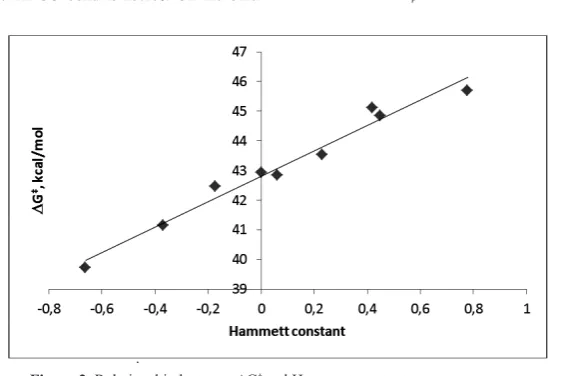
The values of free energies of insertion reaction are gathered in Table 4. These values indicate activation free energy values (∆G‡) increase in the
presence of withdrawing electron groups (X=COOH, CHO, NO2). Figure 2
shows a good relationship between ∆G‡ and Hammett constant of substituents.
∆G‡ = 4.283 σ
p + 42.79; R² = 0.972
Figure 2. Relationship between ∆G‡ and Hammett constant.
Table 4. Free energy values in the I, Ts and II structures (in a.u), activation free energy (∆G‡, kcal/mol), rate constant (k, s-1), free energy of insertion reaction
(∆G insertion, kcal/mol).
G ∆G‡ k ∆G insertion
X I TS II TS II
NH2 -7624.3752 -7967.4711 -7967.5377 39.72 4.63×10⁻¹⁷ -2.09
OH -7644.2522 -7987.3459 -7987.4136 41.14 4.22×10⁻¹⁸ -1.34
Me -7608.3243 -7951.4159 -7951.4848 42.47 4.46×10⁻¹⁹ -0.80
H -7569.0301 -7912.1209 -7912.1901 42.91 2.10×10⁻¹⁹ -0.54
F -7668.2815 -8011.3724 -8011.4410 42.87 2.26×10⁻¹⁹ -0.14
Cl -8028.6727 -8371.7625 -8371.8312 43.55 7.20×10⁻²⁰ 0.48
CHO -7682.3493 -8025.4366 -8025.5060 45.13 4.93×10⁻²¹ 1.59
COOH -7757.6040 -8100.6918 -8100.7609 44.84 8.02×10⁻²¹ 1.45
The free energies change values of insertion reaction (∆G insertion) illustrates
that insertion reaction is more favorable thermodynamically in the presence of donor electron groups (X=OH, NH2, Me). On the other hand, these values
exhibit that insertion reaction is more unfavorable thermodynamically in the presence of withdrawing electron groups (X= COOH, CHO, NO2).
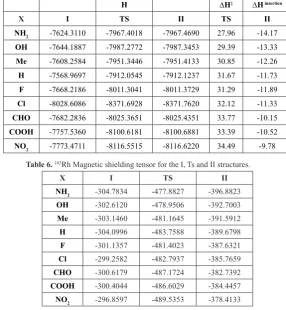
The values of activation enthalpy (∆H‡) of insertion reaction are presented
in Table 5. One can see form Table 5, these values increase in the presence of withdrawing electron groups (X=COOH, CHO, NO2). Figure 3 shows a good
relationship between ∆H‡ and Hammett constant of substituents.
∆H‡ = 4.657 σ
p + 31.27; R² = 0.972
Figure 3. Relationship between ∆H‡ and Hammett constant.
Table 5.Enthalpy values in the I, Ts and II structures (in a.u), activation enthalpy (∆G‡, kcal/mol), enthalpy of insertion reaction (∆G insertion, kcal/mol).
H ∆H‡ ∆H insertion
X I TS II TS II
NH2 -7624.3110 -7967.4018 -7967.4690 27.96 -14.17
OH -7644.1887 -7987.2772 -7987.3453 29.39 -13.33
Me -7608.2584 -7951.3446 -7951.4133 30.85 -12.26
H -7568.9697 -7912.0545 -7912.1237 31.67 -11.73
F -7668.2186 -8011.3041 -8011.3729 31.29 -11.89
Cl -8028.6086 -8371.6928 -8371.7620 32.12 -11.33
CHO -7682.2836 -8025.3651 -8025.4351 33.77 -10.15
COOH -7757.5360 -8100.6181 -8100.6881 33.39 -10.52
NO2 -7773.4711 -8116.5515 -8116.6220 34.49 -9.78
Table 6. 103Rh Magnetic shielding tensor for the I, Ts and II structures.
X I TS II
NH2 -304.7834 -477.8827 -396.8823
OH -302.6120 -478.9506 -392.7003
Me -303.1460 -481.1645 -391.5912
H -304.0996 -483.7588 -389.6798
F -301.1357 -481.4023 -387.6321
Cl -299.2582 -482.7937 -385.7659
CHO -300.6179 -487.1724 -382.7392
COOH -300.4044 -486.6029 -384.4457
NO2 -296.8597 -489.5353 -378.4133
The enthalpy change values of insertion reaction (∆Hinsertion) illustrates
that these values are less in the presence of withdrawing electron groups (X=COOH, CHO, NO2).
4. Rate constant values
Rate constants are estimated by canonical TS theory using Eyring equation [41-43]:
In this equation, kb is the Boltzmann’s constant, h is the Planck’s constant,
T is the temperature, R is the ideal gas constant, ∆G‡ is the activation barrier
at 298 K.
The rate constant values of insertion reactions are gathered in Table 4. These values show that rate constant values are more in the presence of donor electron groups (X=OH, NH2, Me). These values show linear dependence
ln(k) = -7.235 σp - 42.80; R² = 0.972
5.103Rh Magnetic shielding tensor
103Rh Magnetic shielding tensors (σ) of the I, Ts and II structures are given
in Table 6. One can see from Table 6, these values decrease in transition state rather than reactant complex. A good linear relationship between σTS - σI values
and the Hammet constant of the substituents is observed: σTS - σI = -13.35 p - 180.7; R² = 0.974
On the other hand, there is a good linear relationship between ln(k) and the
103Rh magnetic shielding tensors (σ
Rh) of the product rather than of the reactant:
Product: σRh = 1.152 ln(k) - 433.2; R² = 0.931
Reactant: σRh = - 0.623 ln(k) - 328.4; R² = 0.661
Therefore, the aryl migration proceeds via a late transition state, which is structurally more similar to the product than the reactant [23]. This illustrates in the transition state the Ph-C(O) and Rh-P bonds are already formed to an
significant amount with simultaneous breaking of the Rh-Ph bond. Thus,
complete breakage of the Rh-Ph bond and formation of the Rh-P bond leads to
the final product.
CONCLUSION
In this paper, we investigated the insertion reactions of the PH3-assisted
migration of a coordinated aryl group to a coordinated CO in the complexes RhCpI(CO)(p-XC6H4) by computational method. The theoretical calculations
predicted:
1. The character of X-substituents influences energetic, thermodynamic
and kinetic parameters of the reaction.
2. The energy barriers (E=E(TS)-E(I)) in the presence of withdrawing electron groups are higher than those in donor electron groups.
3. There are good linear relationships between variation of Rh-Ph, and Rh-CO bond distances with Hammett constants.
4. The free energies change values of insertion reaction (∆G insertion)
show that insertion reaction is more favorable thermodynamically in the presence of donor electron groups (X=OH, NH2, Me).
5. In the transition state TS, the cleavage of π-bonding along the
Rh-CO bond decrease in the presence of donor and withdrawing electron groups.
6. Rate constant values increase in the presence of donor electron groups (X=OH, NH2, Me).
7. A good linear relationship between ln(k) and the 103Rh magnetic
shielding tensors of the product explores aryl migration proceeds via a transition state, which is structurally more similar to the product than the reactant.
REFERENCES
1. G. L. Meissler,D. A. Tarr: Inorganic Chemistry; Prentice Hall: Upper Saddle River, 2004.
2. R. J. Mawby,F. Basolo,R. G. Pearson, J. Am. Chem. Soc. 1964, 86, 3994. 3. J. D. Cotton,R. D. Markwell, Organometallics 1985, 4, 937.
4. J. N. Cawse,R. A. Fiato,R. L. Pruett, J. Organornet. Chem. 1979, 172, 405. 5. I. S. Butler,F. Basolo,R. G. Pearson, Inorg. Chem 1967, 6, 2074. 6. K. Nicholas,S. Raghu,M. Rosenblum, J. Organomet. Chem. 1974, 78, 133. 7. J. D. Cotton,G. T. Crisp,L. Latif, Inorg. Chim. Acta. 1981, 47, 171. 8. C. R. Jablonski,Y. P. Wang, Inorg. Chim. Acta. 1983, 69, 147. 9. P. J. Craig,M. Green, J. Chem. Soc. A 1968, 1978.
10. M. J. Wax,R. G. Bergman, J. Am. Chem. Soc. 1981, 103, 7028. 11. J. D. Cotton,H. A. Kimlin, J. Organomet. Chem. 1985, 294, 213. 12. J. D. Cotton,G. T. Crisp,V. A. Daly, Inorg. Chim. Acta. 1981, 47, 165. 13. H. Berke,R. Hoffmann, J. Am. Chem. Soc. 1978, 100, 7224.
14. S. Sakaki,K. Kitaura,K. Morokuma,K. Ohkubo, J. Am. Chem. Soc. 1983, 105, 2280.
15. C. D. Montgomery, J. Chem. Educ. 2013, 90, 1396.
16. W.-Z. Li,B.-F. Yan,Q.-Z. Li,J.-B. Cheng, Journal of Organometallic Chemistry 2013, 724, 163.
17. X. Wang,E. Weitz, Journal of Organometallic Chemistry 2004, 689, 2354. 18. X. Wang,E. Weitz, J. Phys. Chem. A 2002, 106, 11782.
19. M. Bassetti,G. J. Sunley,F. P. Fanizzi,P. M. Maitlis, 1990, 1799.
20. M. Bassetti,G. J. Sunley,P. M. Maitlis, J. Chem. Soc., Chem. Commun.
1988, 1012.
21. M. Bassetti,L. Mannina,D. Monti, Organometallics 1994, 13, 3293.
22. D. Monti,M. Bassetti, J. Am. Chem. Soc. 1993, 115, 4658. 23. V. Tedesco,W. v. Philipsborn, Organometallics 1995, 14, 3600.
24. M. J. Frisch,G. W. Trucks,H. B. Schlegel,G. E. Scuseria,M. A. Robb,J. R. Cheeseman,G. Scalman,V. Barone,B. Mennucci,G. A. Petersson,H. Nakatsuji,M. Caricato,X. Li,H. P. Hratchian,A. F. Izmaylov,J. Bloino,G. Zheng,J. L. Sonnenberg,M. Hada,M. Ehara,K. Toyota,R. Fukuda,J. Hasegawa,M. Ishida,T. Nakajima,Y. Honda,O. Kitao,H. Nakai,T. Vreven,J. A. Montgomery,Jr.,J. E. Peralta,F. Ogliaro,M. Bearpark,J. J. Heyd,E. Brothers,K. N. Kudin,V. N. Staroverov,R. Kobayashi,J. Normand,K. Raghavachari,A. Rendell,J. C. Burant,S. S. Iyengar,J. Tomasi,M. Cossi,N. Rega,J. M. Millam,M. Klene,J. E. Knox,J. B. Cross,V. Bakken,C. Adamo,J. Jaramillo,R. Gomperts,R. E. Stratmann,O. Yazyev,A. J. Austin,R. Cammi,C. Pomelli,J. W. Ochterski,R. L. Martin,K. Morokuma,V. G. Zakrzewski,G. A. Voth,P. Salvador,J. J. Dannenberg,S. Dapprich,A. D. Daniels,O. Farkas,J. B. Foresman,J. V. Ortiz,J. Cioslowski,D. J. Fox: Gaussian 09. Revision A.02 ed.; Gaussian, Inc.: Wallingford CT, 2009. 25. R. Krishnan,J. S. Binkley,R. Seeger,J. A. Pople, J. Chem. Phys. 1980, 72,
650.
26. A. J. H. Wachters, J. Chem. Phys. 1970, 52, 1033. 27. P. J. Hay, J. Chem. Phys. 1977, 66, 4377.
28. A. D. McLean,G. S. Chandler, J. Chem. Phys. 1980, 72, 5639. 29. D. Rappoport,F. Furche, J. Chem. Phys. 2010, 133, 134105.
30. D. Andrae,U. Haeussermann,M.Dolg,H.Stoll,H.Preuss, Theor.Chim.Acta
1990, 77, 123.
31. C. Adamo,V. Barone, J. Chem. Phys. 1998, 108, 664. 32. K. Fukui, Acc. Chem. Res. 1981, 14, 363.
33. K. Fukui, J. Phys. Chem. 1970, 74, 4161. 34. C. Gonzalez,H. B. Schlegel, 1990, 94, 5523.
35. C. Gonzalez,H. B. Schlegel, J. Chem. Phys. 1989, 90, 2154. 36. K. Wolinski,J. F. Hinton,P. Pulay, J. Am. Chem. Soc. 1990, 112, 8251. 37. C. Hansch,A. Leo,R. W. Taft, Chem. Rev. 1991, 91, 165.
38. M. Manoharan,P. Venuvanalingam, J. Mol. Struct. (THEOCHEM) 1997, 394, 41.
39. M. Manoharan,P. Venuvanalingam, J. Chem. Soc., Perkin Trans 1997, 1799.
40. K. B. Wiberg, Tetrahedron 1968, 24, 1083. 41. H. J. Eyring, Chemical Physics 1935, 3, 107.