RESEARCH
Optimizing a CRISPR-Cpf1-based genome
engineering system for
Corynebacterium
glutamicum
Jiao Zhang
1, Fayu Yang
1, Yunpeng Yang
1,2, Yu Jiang
3and Yi‑Xin Huo
1,2*Abstract
Background: Corynebacterium glutamicum is an important industrial strain for the production of a diverse range of chemicals. Cpf1 nucleases are highly specific and programmable, with efficiencies comparable to those of Cas9. Although the Francisella novicida (Fn) CRISPR‑Cpf1 system has been adapted for genome editing in C. glutamicum, the editing efficiency is currently less than 15%, due to false positives caused by the poor targeting efficiency of the crRNA.
Results: To address this limitation, a screening strategy was developed in this study to systematically evaluate crRNA targeting efficiency in C. glutamicum. We quantitatively examined various parameters of the C. glutamicum CRISPR‑ Cpf1 system, including the protospacer adjacent motif (PAM) sequence, the length of the spacer sequence, and the type of repair template. We found that the most efficient C. glutamicum crRNA contained a 5′‑NYTV‑3′ PAM and a 21 bp spacer sequence. Moreover, we observed that linear DNA could be used to repair double strand breaks. Conclusions: Here, we identified optimized PAM‑related parameters for the CRISPR‑Cpf1 system in C. glutamicum. Our study sheds light on the function of the FnCpf1 endonuclease and Cpf1‑based genome editing. This optimized system, with higher editing efficiency, could be used to increase the production of bulk chemicals, such as isobu‑ tyrate, in C. glutamicum.
Keywords: Corynebacterium glutamicum, CRISPR‑Cpf1, PAM, crRNA, Linear template, Isobutyrate
© The Author(s) 2019. This article is distributed under the terms of the Creative Commons Attribution 4.0 International License (http://creat iveco mmons .org/licen ses/by/4.0/), which permits unrestricted use, distribution, and reproduction in any medium, provided you give appropriate credit to the original author(s) and the source, provide a link to the Creative Commons license, and indicate if changes were made. The Creative Commons Public Domain Dedication waiver (http://creat iveco mmons .org/ publi cdoma in/zero/1.0/) applies to the data made available in this article, unless otherwise stated.
Background
Corynebacterium glutamicum is a facultatively anaerobic Gram-positive asporogenic bacterium with short rod-like cells that is widely distributed in soil. Generally recog-nized as safe, C. glutamicum is non-pathogenic and does not produce endotoxins [1, 2]. It has been used in fer-mentation for over 50 years. Under anaerobic conditions, C. glutamicum can efficiently convert glucose to various amino acids [3, 4], organic acids [5], higher alcohols [6], and polymers [7]. Traditional genetic engineering strate-gies in C. glutamicum rely on a SacB-based suicide vec-tor [8]. This process is time-consuming and inefficient,
with a false-positive rate of 20–40% [8–11]. CRISPR-Cpf1 has attracted much attention in the field of genome editing because it is easy to manipulate and has a low off-target rate. However, gene deletion or insertion in C. glutamicum using CRISPR-Cpf1 reaches editing efficien-cies of only 5–15% [12]. Hence, it is of great importance to improve the editing efficiency of CRISPR-Cpf1 in C. glutamicum.
Double-strand breaks (DSBs) introduced by the CRISPR-Cpf1 system are lethal to most bacteria, includ-ing C. glutamicum [13], which lacks a non-homologous end joining mechanism. Therefore, DSBs serve as a selec-tion pressure to enrich mutaselec-tions repaired using the arti-ficial donor DNA templates in this organism [14–18]. Since CRISPR-Cpf1-induced DSBs are lethal in C. glu-tamicum, the targeting efficiencies of crRNA are reflected by survival rates. crRNAs with low targeting efficiencies
Open Access
*Correspondence: [email protected]
1 Key Laboratory of Molecular Medicine and Biotherapy, School of Life Sciences, Beijing Institute of Technology, No. 5 South Zhongguancun Street, Beijing 100081, China
Page 2 of 13 Zhang et al. Microb Cell Fact (2019) 18:60
cause a high rate of false positives during genome edit-ing, which result in the survival of many wild-type cells within the population [17, 19–21].
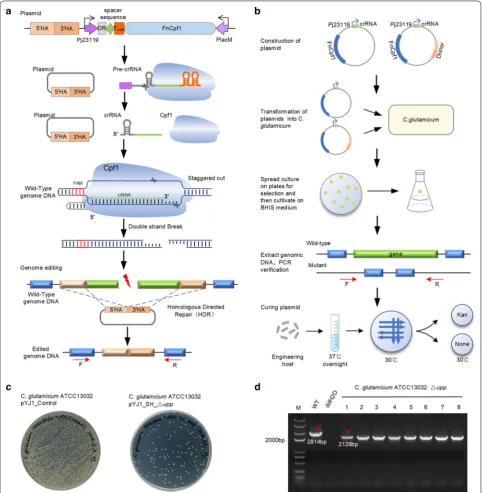
FnCpf1 requires a single crRNA and a thymine-rich PAM. crRNA contains a 19 bp direct repeat sequence and a 23–25 bp spacer sequence [22–25]. PAM is a 2–6 bp protospacer-adjacent DNA sequence (Fig. 1a), which is recognized by Cpf1 and plays an important role in both Cpf1 binding and cleavage [26]. In the presence of a PAM, the Cpf1-crRNA complex can bind the tar-get DNA and induce DSBs. The cleavage site of Cpf1 is affected by the length of the spacer sequence. When the spacer length is greater than or equal to 20 bp, Cpf1 tends to cut the 18th nucleotide of the non-complementary strand and the 23rd nucleotide of the target DNA com-plementary strand. When the spacer length is less than 20 bp [27], Cpf1 tends to cut the 14th nucleotide of the non-complementary strand. The cohesive end introduced by Cpf1 facilitates homologous recombination (HR) [28]. Taken together, the PAM and the length of the spacer sequence are key determinants of the efficiency of Cpf1-dependent genome editing.
Editing efficiency is also influenced by the type of repair template. In C. glutamicum, the plasmid-borne dsDNA template can be utilized to repair the DSBs via HR [29]. Although linear DNA templates could be used to repair DSBs in the genomes of C. elegans [30], mouse, and human cells [31] with high efficiency, the repair of DSBs in C. glutamicum via linear DNA has, to the best of our knowledge, not been reported.
Here, we describe a CRISPR-Cpf1 based method for iterative genome editing and metabolic engineering of C. glutamicum. We established a lethal reporter system to verify the targeting efficiency of the crRNA and con-structed a series of crRNA plasmids to characterize their cleavage activities in C. glutamicum. We optimized this system with respect to PAM sequence, the length of the spacer sequence, and the type of repair templates. Finally, the central metabolic pathways of C. glutamicum were modified by our genome editing method to improve isobutyrate production. The findings of this study will facilitate engineering of metabolic networks for the syn-thesis of value-added products using C. glutamicum.
Results
Establishing a CRISPR‑Cpf1‑mediated genome editing system in C. glutamicum
Our CRISPR-Cpf1 system contained three elements: a constitutive Cpf1 expression cassette, a crRNA expres-sion cassette and a donor DNA template for repairing the DSBs introduced by the Cpf1-crRNA complex (Fig. 1a). As shown in Fig. 1b, each cycle of editing started with the transformation plasmid, pYJ1_S_∆gene, expressing
crRNA or the plasmid, pYJ1_SH_∆gene, expressing the crRNA and donor DNA template in competent C. glu-tamicum cells. Unless repaired by HR in the presence of donor DNA templates, cells that took up a plasmid with functional crRNA were killed by Cpf1-mediated diges-tion. Eight colonies from a culture plate were picked and incubated in BHIS culture medium overnight and their genomic DNA was extracted individually. Gene knockout was verified by PCR, using primers that bind upstream of the 5′ homologous arm and downstream of the 3′ homol-ogous arm. Mutants with the designed gene knockout were incubated at 37 °C in BHIS medium without antibi-otics for plasmid curing and were then streaked on plates without antibiotics and grown at 30 °C (Fig. 1b). After confirming the loss of the plasmid, colonies were picked to prepare electrocompetent cells for the next round of editing.
To investigate the editing efficiencies of our system for gene deletion in C. glutamicum, the upp gene was chosen as the target gene, since its deletion leads to a 5-fluoro-uracil (5-FU)-resistant phenotype, which is convenient for screening [10]. We designed a crRNA targeting the upp gene and generated the plasmid, pYJ1_S_∆upp. The repair template was inserted into pYJ1_S_∆upp to create pYJ1_SH_∆upp. After engineering and plating, all 5-FU-resistant colonies on the plate were assumed to be upp knockouts. Eight colonies were confirmed to have the upp gene deleted by both PCR screening and sequencing, as shown in Fig. 1c, d. The efficiency of upp deletion was 100%. To further evaluate the efficiency of the system, we constructed pYJ1_SH_∆crtYe/f to delete the crtYe/f gene, since its deletion leads to a color change from yellow to red [32–34]. When the pYJ1_SH_∆crtYe/f plasmid was introduced into competent C. glutamicum cells, approx-imately 17% of single colonies were correctly edited, according to their color.
Generation of a lethal reporter system and optimization of PAM sequence for the Cpf1‑mediated genome editing system
Page 4 of 13 Zhang et al. Microb Cell Fact (2019) 18:60
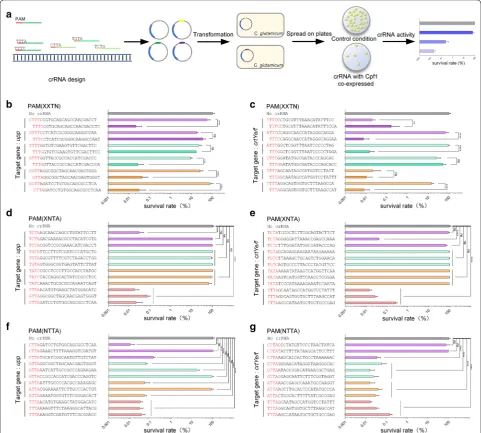
various PAM sequences was verified by the lethality rate of Cpf1-mediated gene editing.
The middle T is essential in the 5′-TTN-3′ PAM recog-nized by Cpf1 [25], and crRNAs with the PAM sequence, 5′-TTT-3′, have low activity in eukaryotes [35]. In order
to investigate the influence of the final “T” in the PAM on the efficiency of CRISPR-Cpf1 in prokaryotes, we targeted chromosomal upp or crtYe/f. For each gene, six sets of crRNAs were designed to contain the four-nucle-otide PAM sequence, 5′-XXTN-3′, where X represents
an unchanged nucleotide in a given set and N represents any nucleotide. Each crRNA set contained two crRNAs, most of which were unchanged at the first three nucle-otides and differed at the fourth nucleotide in the PAM sequence. In the first and second sets, the fourth nucleo-tides were T and C, respectively. In the third and fourth sets, the fourth nucleotides were T and G, respectively. In the fifth and sixth sets, the fourth nucleotides were T and A, respectively. Among the spacer sequences of the two crRNAs within each crRNA set, only one nucleotide was different. crRNA spacer sequences are shown in Fig. 2b. All 12 crRNAs targeting upp and all 12 crRNAs targeting crtYe/f were tested in the first round of experiments.
When the last nucleotide of the PAM sequence was T, the survival rates of cells with crRNAs targeting upp were 53.49 ± 17.65%, 17.03 ± 2.50%, 21.86 ± 6.23%, 8.64 ±
1.48%, 25.18 ± 7.74%, and 76.69 ± 23.95%. When the last nucleotide of the PAM sequence was C, G, or A, the sur-vival rates of cells with crRNAs targeting upp were 0.021
± 0.015%, 33.53 ± 8.67%, 16.27 ± 1.58%, 0.02 ± 0.01%, 0.04 ± 0.03%, and 0.03 ± 0.02%. When the last nucleo-tide of the PAM sequence was T, the survival rates of cells with crRNAs targeting crtYe/f were 0.02 ± 0.005%, 65.7
± 21.77%, 91.17 ± 11.62%, 23.28 ± 12.35%, 0.02 ± 0.02%, and 13.98 ± 3.25%. When the last nucleotide of the PAM sequence was C, G, or A, the survival rates of cells with crRNAs targeting crtYe/f were 0.16 ± 0.19%, 0.007 ±
0.005%, 0.014 ± 0.008%, 50.06 ± 17.05%, 0.01 ± 0.007%, and 0.007 ± 0.005% (Fig. 2b, c). These results showed that when the last nucleotide of PAM was T, the efficiencies of that crRNA were the lowest compared with other corre-sponding nucleotides. This was consistent with previous studies in human cells [35]. Therefore, we avoided using T as the last nucleotide of the PAM sequence. Furthermore, the highest efficiencies were observed for crRNAs when the last PAM sequence nucleotide was A or C. Therefore, subsequent experiments were carried out using the PAM sequences with A or C as the last nucleotide.
We then tested the role of the second nucleotide of the PAM sequence. We designed, assembled, and tested crR-NAs with 5′-XCTA/C-3′, 5′-XGTA/C-3′, 5′-XATA/C-3′, and 5′-XTTA-3′ PAM sequences. The survival rates of cells with the 5′-XCTA/C-3′ PAM sequence targeting upp were 0.29 ± 0.0001%, 94.42 ± 0.02%, and 93.37 ± 0.05% and targeting crtYe/f were 89.86 ± 0.09%, 0.03 ± 0.0002%, and 66.05 ± 0.08%. The survival rates of cells with the 5′-XGTA/C-3′ PAM sequence targeting upp were 97.51
± 0.02%, 89.81 ± 0.09%, and 98.21 ± 0.02% and targeting crtYe/f were 94.7 ± 0.03%, 97.69 ± 0.02%, and 96.84 ±
0.01%. The survival rates of cells with the 5′-XATA/C-3′ PAM sequence targeting upp were 98.59 ± 0.004%, 97.69
± 0.02%, and 66.62 ± 0.2% and targeting crtYe/f were 99.11 ± 0.008%, 96.84 ± 0.02%, and 96.84 ± 0.01%. The
survival rates of cells with the 5′-XTTA-3′ PAM sequence targeting upp were 0.01 ± 0.0008%, 0.07 ± 0.002%, and 0.02 ± 0.001% and targeting crtYe/f were 0.01 ± 0.0003%, 0.02 ± 0.0006%, and 0.2 ± 0.0004%. Meanwhile, the sur-vival rate of control cells was 100 ± 13.48% (Fig. 2d, e). These results showed that when T or C was the second nucleotide in the PAM sequence, the crRNA had a rela-tively high efficiency.
We next sought to test the effect of changing the first nucleotide using the PAM sequences, 5′-CTTA-3′, 5′-GTTA-3′, 5′-ATTA-3′, and 5′-TTTA-3′ (Fig. 2f, g). When the first nucleotide of the PAM sequence was T, the survival rates of cells with crRNAs were as low as 0.032 ± 0.007%, 0.030 ± 0.01%, 0.038 ± 0.01%, 0.014 ±
0.002%, 0.015 ± 0.002%, and 0.031 ± 0.008%, indicating that the crRNA containing the PAM sequence, 5′ -TTTA-3′, had the highest targeting efficiency. When the first nucleotide of the PAM sequence was C, the survival rates of cells with crRNAs were 94.06 ± 5.84%, 73.10 ±
6.68%, and 96.78 ± 4.23%, indicating that the crRNA had a low targeting efficiency when the PAM sequence was 5′-CTTA-3′.
Taken together, these data clearly showed that FnCpf1 required a PAM sequence defined as 5′-NYTV-3′, where N represents any nucleotide, Y represents T or C, and V represents A, C, or G. Among these sequences, 5′-TTTA/C-3′ was the preferred design.
The effect of spacer sequence length on Cpf1‑mediated genome editing
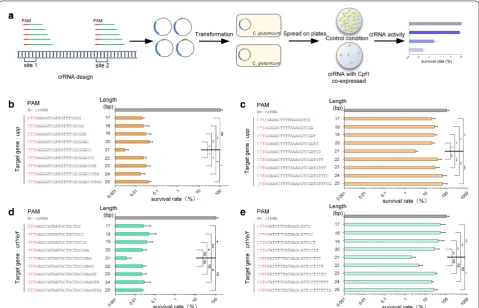
To determine the optimal length of the crRNA spacer sequence, 18 crRNAs targeting C. glutamicum upp and crtYe/f genes were constructed with 17–25 bp spacers (Fig. 3). A series of crRNAs, that could be functional in the presence of the preferred 5′-TTTA-3′ PAM sequence, were designed to cleave upp or crtYe/f. As shown in Fig. 3b, the survival rate of cells with the crRNA target-ing upp was 0.003 ± 0.001% when the spacer length was 21 bp, while survival rates of cells with other crRNAs containing 17–20 bp or 22–25 bp spacer sequences were 0.016–0.042%. Similarly, the survival rate of cells with the crRNA targeting crtYe/f was 0.003 ± 0.002%, when the spacer length was 21 bp, while survival rates of cells with other crRNAs containing 17–20 bp or 22–25 bp spacer sequences were 0.021–0.048% (Fig. 3d).
To further confirm the effect of spacer sequence length on targeting efficiency, a series of crRNAs that could be functional in the presence of the relatively low-efficient 5′-CTTA-3′ PAM sequence, were designed to cleave upp or crtYe/f. The survival rate of cells with the upp-targeting crRNA containing a 21 bp spacer sequence was 2.91 ±
Page 6 of 13 Zhang et al. Microb Cell Fact (2019) 18:60
containing 17–20 bp or 22–25 bp spacer sequences were much higher, ranging from 17.75 to 62.37% (Fig. 3c). Sim-ilarly, the survival rate of cells with the crRNA contain-ing a 21 bp spacer sequence targetcontain-ing crtYe/f was 1.89 ±
0.85%, while the survival rates of cells with the other crR-NAs containing 17–20 bp or 22–25 bp spacer sequences ranged from 4.23 to 50.07% (Fig. 3e). These results showed that a 21 bp spacer sequence had the highest effi-ciency for gene editing using FnCpf1.
The effect of repair template type on Cpf1‑mediated genome editing
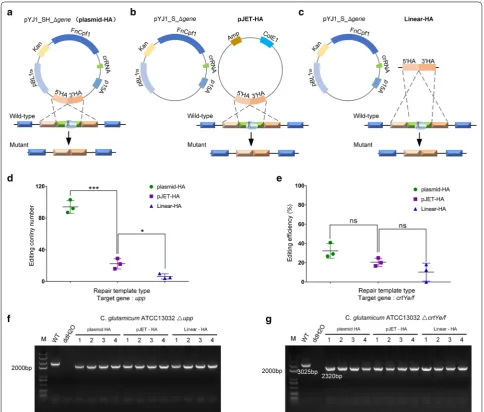
A DSB induced by CRISPR-Cpf1 in vivo can be repaired through HR in the presence of a plasmid-borne tem-plate [21, 36, 37]. In this study, we investigated whether another type of DNA could be used as a repair template. Two target genes, upp and crtYe/f, were chosen because C. glutamicum cells would undergo an obvious pheno-type change if any of these two genes were deleted. Dif-ferent repair templates were used to determine their effect on editing efficiencies. When upp was edited, the colonies became resistant to 5-FU and when crtYe/f was
edited, the colonies turned red. The editing efficiency could be calculated by dividing the number of edited sin-gle colonies on the selection plate by the total number of colonies on the control plate.
The types of DNA tested in our study were plasmid-HA, pJET-HA and linear-HA. The repair template was first ligated into the pYJ1_S_∆gene vector, which has a replicon of C. glutamicum (Fig. 4a) and the pJET blunt vector, which cannot replicate in C. glutamicum (Fig. 4b). The linearized donor was then used to determine whether it was applicable in C. glutamicum (Fig. 4c). The number of upp-edited colonies when using the lin-ear-HA template was 6.73 ± 0.02% of the number when using the plasmid-HA template. The average number of colonies with the plasmid-HA, pJET-HA, and linear-HA templates was 94 ± 6.68, 22 ± 5.31, and 6 ± 2.62, respectively (Fig. 4d). Further, we assessed the effect of different repair templates on crtYe/f-editing efficiency. When using plasmid-HA, pJET-HA, and linear-HA tem-plates, the crtYe/f-editing efficiencies were 32.30 ± 6.18%, 20.56 ± 3.42%, and 10.23 ± 7.59%, respectively (Fig. 4e). The same gene knockout efficiencies were obtained with
in vitro linearized DNA obtained by either PCR-ampli-fication or restriction-enzyme digestion of the donor plasmid (data not shown). These results showed that the plasmid-HA template gave the highest gene editing effi-ciency and the pJET-HA template gave an intermediate level of efficiency.
Application of the CRISPR–Cpf1 method to modify multiple genes for microbial production of isobutyrate
Our CRISPR–Cpf1 mediated genome editing procedure significantly enhanced the ability to iteratively introduce
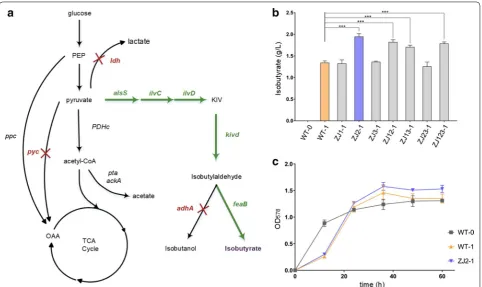
well-designed genomic mutations in C. glutamicum. To illustrate its potential application in metabolic engineer-ing, we used our system to modify C. glutamicum for the production of isobutyrate. We applied a strategy of over-expressing the 2-keto acid biosynthesis pathway (Fig. 5), which has also been engineered into Escherichia coli. The yield of isobutyrate in engineered E. coli has been reported to be approximately 4.8 g/L [38]. The 2-keto acid biosynthesis pathway includes alsS (Bacillus subti-lis) and ilvCD (C. glutamicum), along with downstream genes for the subsequent decarboxylation (kivD from
Page 8 of 13 Zhang et al. Microb Cell Fact (2019) 18:60
Lactococcus lactis) and oxidation (feaB from E. coli) of 2-ketoisovalerate to isobutyrate. The expression of these five genes was driven by the strong constitutive promoter, Peftu, in the plasmid, pKJ1. The empty vector, pKJ0, was used as a negative control.
The wild-type (WT) strain C. glutamicum with pKJ1 (WT-1) produced 1.34 ± 0.03 g/L of isobutyrate in 60 h (Fig. 5b). We then attempted to increase isobutyrate pro-duction by using the CRISPR-Cpf1 system to inactivate several enzymes that may consume precursors of the isobutyrate pathway. The genes, pyc (encoding pyruvate carboxylase), ldh (encoding lactate dehydrogenase), and adhA (encoding alcohol dehydrogenase) were chosen to block the competitive pathways (Fig. 5a). We constructed three single-knockout strains, named ZJ1, ZJ2, ZJ3; three double-knockout strains, named ZJ12, ZJ13, ZJ23; and one triple-knockout strain, named ZJ123 (Table 1). The ∆pyc and ∆adhA knockout strains (ZJ1 and ZJ3) and the ∆ldh∆adhA strain (ZJ23) did not show increased isobu-tyrate production compared with the WT strain. By contrast, isobutyrate production in the ∆ldh strain (ZJ2)
increased to 2.01 ± 0.05 g/L (Fig. 5b), while the ∆pyc∆ldh
(ZJ12), ∆pyc∆adhA (ZJ13), and ∆pyc∆ldh∆adhA (ZJ123) strains, containing pKJ1, produced 1.82 ± 0.04, 1.70 ±
0.03, and 1.78 ± 0.03 g/L of isobutyrate, respectively.
Interestingly, the isobutyrate-producing strains also reached a higher cell density than the control strain (Fig. 5c).
Discussion
Recently, CRISPR-Cpf1 was investigated as a leading-edge tool for genome editing in many bacteria. It was reported to be suitable for C. glutamicum, but the effi-ciency of gene editing was ~ 15% when targeting a 705 bp gene [12]. Effective gene editing requires the formation of a functional complex between Cpf1, crRNA, and the target DNA strand. In this study, we systematically inves-tigated various parameters of a C. glutamicum CRISPR-Cpf1 system, including the PAM sequence, the length of the spacer sequence, and the type of repair template.
FnCpf1 requires only a single crRNA, without a trac-rRNA, and it recognizes thymine-rich PAM sequences.
The PAM sequence is a key sequence regulating the accu-rate binding of crRNA to the genome. FnCpf1 may rec-ognize the PAM sequence via shape- and base-readout mechanisms [40]. The PAM-binding channel of Cpf1 has conformational flexibility, which allows the recognition
of different PAM sequences. However, the optimal PAM sequence for the manipulation of C. glutamicum has not yet been reported.
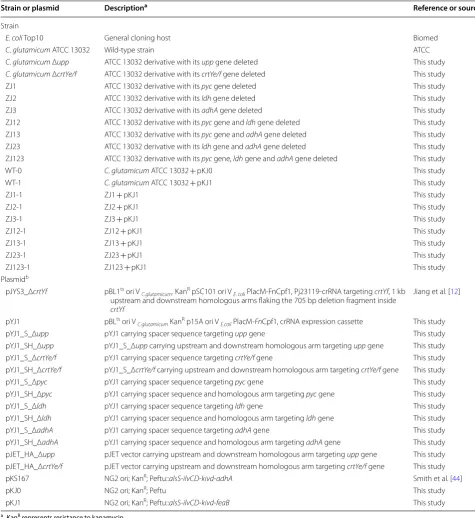
Therefore, we constructed a lethal reporter system and used it to examine the PAM sequence preference Table 1 Strains and plasmids used in this study
a KanR represents resistance to kanamycin
b crRNA expression plasmids with changed spacer sequences are not listed here. A full list of spacer sequences used in this study is shown in Additional file 1: Table S2
Strain or plasmid Descriptiona Reference or source
Strain
E. coli Top10 General cloning host Biomed
C. glutamicum ATCC 13032 Wild‑type strain ATCC
C. glutamicum Δupp ATCC 13032 derivative with its upp gene deleted This study C. glutamicum ΔcrtYe/f ATCC 13032 derivative with its crtYe/f gene deleted This study
ZJ1 ATCC 13032 derivative with its pyc gene deleted This study
ZJ2 ATCC 13032 derivative with its ldh gene deleted This study
ZJ3 ATCC 13032 derivative with its adhA gene deleted This study
ZJ12 ATCC 13032 derivative with its pyc gene and ldh gene deleted This study
ZJ13 ATCC 13032 derivative with its pyc gene and adhA gene deleted This study
ZJ23 ATCC 13032 derivative with its ldh gene and adhA gene deleted This study
ZJ123 ATCC 13032 derivative with its pyc gene, ldh gene and adhA gene deleted This study
WT‑0 C. glutamicum ATCC 13032 + pKJ0 This study
WT‑1 C. glutamicum ATCC 13032 + pKJ1 This study
ZJ1‑1 ZJ1 + pKJ1 This study
ZJ2‑1 ZJ2 + pKJ1 This study
ZJ3‑1 ZJ3 + pKJ1 This study
ZJ12‑1 ZJ12 + pKJ1 This study
ZJ13‑1 ZJ13 + pKJ1 This study
ZJ23‑1 ZJ23 + pKJ1 This study
ZJ123‑1 ZJ123 + pKJ1 This study
Plasmidb
pJYS3_ΔcrtYf pBL1ts ori V
C.glutamicum. KanR pSC101 ori V E. coli PlacM‑FnCpf1, Pj23119‑crRNA targeting crtYf, 1 kb upstream and downstream homologous arms flaking the 705 bp deletion fragment inside crtYf
Jiang et al. [12]
pYJ1 pBLts ori V
C.glutamicum KanR p15A ori V E.coli PlacM‑FnCpf1, crRNA expression cassette This study
pYJ1_S_Δupp pYJ1 carrying spacer sequence targeting upp gene This study
pYJ1_SH_Δupp pYJ1_S_Δupp carrying upstream and downstream homologous arm targeting upp gene This study
pYJ1_S_ΔcrtYe/f pYJ1 carrying spacer sequence targeting crtYe/f gene This study
pYJ1_SH_ΔcrtYe/f pYJ1_S_ΔcrtYe/f carrying upstream and downstream homologous arm targeting crtYe/f gene This study
pYJ1_S_Δpyc pYJ1 carrying spacer sequence targeting pyc gene This study
pYJ1_SH_Δpyc pYJ1 carrying spacer sequence and homologous arm targeting pyc gene This study
pYJ1_S_Δldh pYJ1 carrying spacer sequence targeting ldh gene This study
pYJ1_SH_Δldh pYJ1 carrying spacer sequence and homologous arm targeting ldh gene This study
pYJ1_S_ΔadhA pYJ1 carrying spacer sequence targeting adhA gene This study
pYJ1_SH_ΔadhA pYJ1 carrying spacer sequence and homologous arm targeting adhA gene This study pJET_HA_Δupp pJET vector carrying upstream and downstream homologous arm targeting upp gene This study pJET_HA_ΔcrtYe/f pJET vector carrying upstream and downstream homologous arm targeting crtYe/f gene This study
pKS167 NG2 ori; KanR; Peftu::alsS‑ilvCD‑kivd‑adhA Smith et al. [44]
pKJ0 NG2 ori; KanR; Peftu This study
Page 10 of 13 Zhang et al. Microb Cell Fact (2019) 18:60
of CRISPR-Cpf1 in C. glutamicum. Using two different target genes, T was the found to be preferred at the first nucleotide position, although all nucleotides were func-tional at this position. T or C was the preferred at the second nucleotide position. At the third nucleotide of the PAM sequence, T is generally believed to optimal [25] and therefore, we did not test an alternative nucleotide at this position. When the last nucleotide of the PAM sequence was T, the efficiency of the crRNA was the low-est compared with other nucleotides at this position, which agreed with the results reported by Tu et al. [35]. However, crRNA had the highest efficiency of cutting target sites within the upp and crtYe/f genes when the last nucleotide of the PAM sequence was A or C. Based on these results, we concluded that the PAM sequence, 5′-NYTV-3′ (N=T/A/G/C, Y=T/C, V=A/C/G) was pre-ferred for FnCpf1 to achieve a high targeting efficiency in the C. glutamicum genome. These results shed light on the PAM sequence requirements of FnCpf1 and the molecular basis of PAM recognition in C. glutamicum.
We further investigated the effect of different crRNA spacer sequence lengths on the efficiency of Cpf1-dependent editing. We found that FnCpf1 had the highest activity in C. glutamicum when a 21 bp crRNA spacer sequence was used. Structural studies have shown that only a 20 bp RNA–DNA heteroduplex is formed between the target DNA strand and a 24 bp crRNA spacer sequence [41, 42]. It was speculated that a 21 bp spacer sequence may form a complex with its target DNA strand and FnCpf1 in human cells, in which FnCpf1 has improved activity and higher fidelity [35]. This was an unexpected result which requires further investiga-tion. When we attempted to cleave another target DNA sequence within the upp gene using the 5′-TTTC-3′ PAM sequence, a 20 bp crRNA spacer sequence (5′ -cgt-gcagcagccaacgacct) completely lost its activity, whereas other crRNAs with 17–19 bp or 21–25 bp spacer sequences showed high activity (data not shown).
If the plasmids containing the crRNA and template could be constructed independently, the speed of genome editing would be accelerated. We attempted to introduce the repair template into the pJET vector, which cannot replicate and therefore, introduces a lower metabolic bur-den on the host. Although the repair efficiency of pJET derivatives was not as high as that of replicable plasmid-borne templates, it was sufficient for gene editing. Finally, we assessed whether a linear repair template could be used in C. glutamicum. For the first time, we showed that a linear repair template could be successfully utilized to edit genomic DNA in C. glutamicum. However, the edit-ing efficiency was relatively low, likely because a restric-tion repair system may have degraded the linear repair template prior to the genome repair process.
C. glutamicum is an important amino acid produc-tion strain and is highly suitable for the producproduc-tion of isobutyrate, which is an acid with high market demand. Here, we introduced an isobutyrate synthesis pathway into C. glutamicum and confirmed that the transgenic strain produced isobutyrate successfully, albeit at low rates. To further engineer a potential industrial isobu-tyrate production strain, we used our genome edit-ing system to knock out the pyc, ldh, and adhA genes from the genome of C. glutamicum. Among all the host strains we constructed, the ∆ldh strain, ZJ2, containing pKJ1 produced the highest yield of isobutyrate. Knock-ing out ldh blocks the production of acetic acid, which increases the pyruvate pool available for isobutyrate production. However, pyc knockout did not significantly increase isobutyrate production in C. glutamicum, prob-ably due to a reduction in the supply of oxaloacetate in the citric acid cycle, resulting in unbalanced redox levels. Similarly, adhA knockout did not significantly increase isobutyrate production, indicating that other enzymes with alcohol dehydrogenase activity may also be present in C. glutamicum. The same changes in the host genome were previously successfully introduced into E. coli [38,
39], but except the knockout of ldh, the knockout of pyc and adhA didn’t work efficiently in C. glutamicum. The metabolic engineering of production hosts requires mul-tiple rounds of genome editing to optimize production. The high efficiency of the crRNA in our study helps avoid the additional workload due to false positives caused by poor crRNA design. Using linear-HA or pJET-HA can decrease the time required for plasmid construction and can potentially facilitate multiplex gene editing when constructing engineered C. glutamicum.
Conclusions
In summary, we have comprehensively and quantitatively assessed the effects of PAM sequence, spacer sequence length, and repair template type on the efficiency of the CRISPR-Cpf1 system in C. glutamicum. Our study offers insights into FnCpf1 endonuclease function and Cpf1-based genome editing.
Methods
Strains and culture conditions
All bacterial strains used in this work are listed in Table 1. The Top10 E. coli strain was used for routine cloning procedures. C. glutamicum ATCC13032 was used as the parent strain for genetic modifications. All engineered strains were transformed by electroporation. All strains were kept at − 80 °C as glycerol stocks prepared in Luria-Bertani (LB) or BHIS broth containing 15% glycerol.
at 37 °C, with shaking at 200 rpm. C. glutamicum ATCC 13032 strains were routinely cultivated in BHIS medium (37 g/L brain heart infusion medium and 91 g/L sorbi-tol) at 30 °C, with shaking at 200 rpm. Antibiotics were added at the following concentrations: 50 μg/mL kana-mycin, 100 μg/mL ampicillin, and 25 μg/mL chloram-phenicol for E. coli and 25 μg/mL kanamycin and 10 μg/ mL chloramphenicol for C. glutamicum. Colonies with successful knockout of upp were selected on plates of CGXII medium (20 g/L [NH4]2SO4, 5 g/L urea, 1 g/L KH2PO4, 1 g/L K2HPO4, 0.25 g/L MgSO4·7H2O, 10 mg/L CaCl2, 10 mg/L FeSO4·7H2O, 10 mg/L MnSO4·H2O, 1 mg/L ZnSO4·7H2O, 0.2 mg/L CuSO4·5H2O, 0.02 mg/L NiCl2·6H2O, 0.2 mg/L biotin, 42 g/L 3-morpholinopro-panesulfonic acid [MOPS], and 40 g/L glucose), con-taining 100 μM 5-FU (from a 100 mM stock in dimethyl sulfoxide). C. glutamicum fermentations were also per-formed in CGXII medium.
Plasmid constructions
All plasmids used in this study are listed in Table 1. The sequences of the primers, crRNAs, and oligonucleotides are listed in Additional file 1: Tables S1 and S2. Plasmids and genomic DNA were extracted using the TIANamp Mini Plasmid Kit (TIANGEN BIOTECH, Beijing, China) and TIANamp Bacteria DNA Kit (TIANGEN BIO-TECH), according to the manufacturer’s instructions. PCR was performed using TransStart FastPfu Fly DNA Polymerase (TransGen Biotech, Beijing, China). DNA was extracted from agarose gels using the HiPure Gel Pure DNA Micro Kit (Magen, Guangzhou, China). Clon-ing was performed usClon-ing commercially available restric-tion endonucleases, T4 DNA ligase, the CloneJET PCR Cloning Kit (Thermo Scientific, Waltham, MA, USA), and the Gibson assembly method [43].
The plasmid, pYJ1, was constructed via Gibson assem-bly using the following three DNA fragments: a Cpf1 expression cassette with a temperature-sensitive repli-con; pBLts with a kanamycin resistance gene fragment, originally constructed by Jiang et al. [12]; a E. coli repli-con p15A and a crRNA expression cassette. The plasmid, pJYS3_∆crtYf [12], was used as a template to amplify the fragment using F1/R1 primers and an ApaI restric-tion enzyme cutting site was added to the primers to insert homologous arms. The crRNA expression cas-sette consisted of the constitutive promoter, pJ23119; a 19 bp direct repeat sequence of the crRNA; a 25 bp sequence with an AarI restriction enzyme site to insert the spacer sequence, and an rrnB terminator. The nucleo-tide sequences of the crRNA expression cassettes used in this study are listed in Additional file 1: Table S3. To generate pYJ1_S_∆gene, pYJ1 was linearized with AarI and a pair of primers (such as F4/R4) was annealed to
form a dsDNA fragment with cohesive ends, which was then ligated to pYJ1 using T4 DNA ligase. To gener-ate pYJ1_SH_∆gene, pYJ1_S_∆gene was linearized with ApaI. The C. glutamicum ATCC13032 genome was used as a template to amplify 500 bp upstream and down-stream homologous arms using corresponding prim-ers (such as F5/R5 and F6/R6, respectively). The ApaI restriction enzyme site was introduced by the primers and the two fragments were assembly via another round of PCR. The purified PCR product was then cut using ApaI and inserted into the linearized pYJ1_S_∆gene plas-mid. To construct pJET_HA_∆gene, homologous arms were amplified using the primers pairs like F15/R15 and the PCR products were ligated to the vector, pJET1.2 (CloneJET PCR Cloning Kit, Thermo Fisher Scientific). To construct the plasmid, pKJ0, the backbone of pKS167 was amplified using the primer pair, F33/R33 [44] and the PCR product was used directly to transform com-petent E. coli cells. The plasmid was verified by PCR and sequencing. To construct the plasmid, pKJ1, the back-bone of pKS167 was amplified using the primer pair, F35/ R35. The feaB gene was amplified from the E. coli genome using the primer pair, F36/R36. The two fragments were then assembled using the Gibson assembly method.
Iterative genome editing procedure
Electrocompetent cells were generated as described previously [45]. In the plasmid-borne template system, 500 ng of pYJ1_S_∆gene or pYJ1_SH_∆gene was used for each electroporation. For the linear-HA and pJET-HA templates, 500 ng of pYJ1_S_∆gene and 1 μg of the repair template were mixed together to co-transform competent cells. Electroporation was performed using a Gene Pulser system (Bio-Rad, Hercules, CA, USA) set to 25 μF, 1.25 kV/cm, and 200Ω. Following exposure to a single electric pulse, the cell suspension was immedi-ately transferred into 1 mL of pre-warmed (46 °C) BHIS medium and incubated for 6 min at 46 °C without shak-ing. Subsequently, C. glutamicum cells were incubated with shaking at 200 rpm for 2 h at 30 °C. Finally, cells were spread on selective BHIS agar plates containing 25 μg/mL kanamycin. Transformants were confirmed by PCR amplification.
Page 12 of 13 Zhang et al. Microb Cell Fact (2019) 18:60
To verify these editing events by Sanger sequencing, colonies were picked and the target region was ampli-fied by PCR. The primers used for PCR amplification and sequencing are listed in Additional file 1: Table S1.
Determining crRNA targeting efficiency by measuring Cpf1‑induced lethality
Plasmids carrying the crRNA expression cassette were introduced into competent cells (500 ng plasmid/100 μL of competent cells). After transformation, cells were incubated in BHIS medium for 1 h at 30 °C for recov-ery. The culture was then streaked on BHIS agar plates containing kanamycin. The colonies were counted after 36–48 h of cultivation and the survival rates for each crRNA were calculated by counting the colonies that formed. To minimize the impact of differences in elec-troporation efficiency during the preparation of com-petent cells, the survival rates were further normalized by determining the colony number after transformation with a negative control crRNA plasmid. All transfor-mations were performed in triplicate. The survival rate was calculated according to the following formula:
Shake‑flask fermentation
Five milliliters of BHIS medium was inoculated with a single colony of the desired C. glutamicum strain from a fresh BHIS agar plate and the culture was incubated on a rotary shaker at 30 °C overnight. For isobutyrate production, 200 μL of the overnight culture was trans-ferred into a 250-mL anaerobic shake flask with 20 mL of CGXII medium, containing 40 g/L glucose. Fermen-tation was performed at 30 °C, with shaking at 200 rpm. Samples were drawn every 12 h to determine metabo-lite concentrations and perform OD578 measurements. All experiments were performed in at least three bio-logical replicates.
Metabolic analysis
Organic acids in the culture supernatants were quan-tified using an Agilent 1260 Infinity HPLC system, equipped with an RID detector and an Aminex HPX-87H cation exchange column (BioRad). The samples were first filtered through a 0.22-μm filter, then loaded onto the column operated at 60 °C, eluted with 5 mM H2SO4 at a flow rate of 0.5 mL/min, and detected via refractive index. The data are presented as mean values, with error bars indicating standard deviation.
Survival rate =[read count]selective/average[read count]control
×100%.
Additional file
Additional file 1. Additional Figures S1, S2 and Tables S1–S3.
Abbreviations
CRISPR: clustered regularly interspaced short palindromic repeats; FnCpf1: Cpf1 derived from F. novicida (NC_008601)); crRNA: CRISPR RNA; tracrRNA: trans‑activating CRISPR RNA; PAM: protospacer adjacent motif; DSBs: double‑ strand breaks; dsDNA: double strand DNA; HR: homologous recombination; OD578: optical density at 578 nm; HPLC: high‑pressure liquid chromatography detector; RID: refractive index detector; Kan: kanamycin; PCR: polymerase chain reaction; 5‑FU: 5‑fluorouracil; PEP: phosphoenolpyruvate; KIV: 2‑ketois‑ ovalerate; OAA: oxaloacetate.
Authors’ contributions
JZ, FY and YH conceived this study, designed and conducted the experiments. JZ, FY and YY performed the experiments. JZ, FY, YJ and YH analyzed the data, JZ, FY and YH wrote the manuscript. All authors read and approved the final manuscript.
Author details
1 Key Laboratory of Molecular Medicine and Biotherapy, School of Life Sci‑ ences, Beijing Institute of Technology, No. 5 South Zhongguancun Street, Beijing 100081, China. 2 UCLA Institute of Advancement (Suzhou), 10 Yueli‑ angwan Road, Suzhou Industrial Park, Suzhou 215123, China. 3 Key Laboratory of Synthetic Biology, Institute of Plant Physiology and Ecology, Shanghai Insti‑ tutes for Biological Sciences, Chinese Academy of Sciences, Shanghai 200032, China.
Acknowledgements
The authors wish to thank Beijing Institute of Technology for the supply of microplate reader (BioTek Cytation 3).
Competing interests
The authors declare that they have no competing interests.
Availability of data and materials
All data generated or analyzed during this study are included in this published article and its additional files. The authors are willing to provide any additional data and materials related to this research that may be requested for research purposes.
Consent for publication Not applicable.
Ethics approval and consent to participate Not applicable.
Funding
The author would like to acknowledge financial support of the National Natural Science Foundation of China (Grant No. 2167026), the National Key Research and Development Plan (Grant No. 2017YFD0201400), and Funda‑ mental Research Funds for the Central Universities.
Publisher’s Note
Springer Nature remains neutral with regard to jurisdictional claims in pub‑ lished maps and institutional affiliations.
Received: 17 October 2018 Accepted: 19 March 2019
References
•fast, convenient online submission
•
thorough peer review by experienced researchers in your field
• rapid publication on acceptance
• support for research data, including large and complex data types
•
gold Open Access which fosters wider collaboration and increased citations maximum visibility for your research: over 100M website views per year
•
At BMC, research is always in progress.
Learn more biomedcentral.com/submissions
Ready to submit your research? Choose BMC and benefit from:
Isomerase from geobacillus thermodenitrificans. J Agric Food Chem. 2016;64(43):8146–53.
2. Srivastava P, Deb JK. Gene expression systems in corynebacteria. Protein Expr Purif. 2005;40(2):221–9.
3. Blombach B, Seibold GM. Carbohydrate metabolism in Corynebacterium glutamicum and applications for the metabolic engineering of l‑lysine production strains. Appl Microbiol Biotechnol. 2010;86(5):1313–22. 4. Hou X, et al. l ‑Valine production with minimization of by‑products’ syn‑
thesis in Corynebacterium glutamicum and Brevibacterium flavum. Amino Acids. 2012;43(6):2301–11.
5. Mckinlay JB, Vieille C, Zeikus JG. Prospects for a bio‑based succinate industry. Appl Microbiol Biotechnol. 2007;76(4):727–40.
6. Siebert D, Wendisch VF. Metabolic pathway engineering for production of 1,2‑propanediol and 1‑propanol by Corynebacterium glutamicum. Biotechnol Biofuels. 2015;8(1):1–13.
7. Song Y, et al. Engineered Corynebacterium glutamicum as an endotoxin‑ free platform strain for lactate‑based polyester production. Appl Micro‑ biol Biotechnol. 2012;93(5):1917–25.
8. Schäfer A, et al. Small mobilizable multi‑purpose cloning vectors derived from the Escherichia coli plasmids pK18 and pK19: selection of defined deletions in the chromosome of Corynebacterium glutamicum. Gene. 1994;145(1):69.
9. Hu J, et al. Construction and application of an efficient multiple‑ gene‑deletion system in Corynebacterium glutamicum. Plasmid. 2013;70(3):303–13.
10. Ma W, et al. Development of a markerless gene replacement system in
Corynebacterium glutamicum using upp as a counter‑selection marker. Biotech Lett. 2015;37(3):609–17.
11. Suzuki N, et al. New multiple‑deletion method for the Corynebacterium glutamicum genome, using a mutant lox sequence. Appl Environ Micro‑ biol. 2005;71(12):8472–80.
12. Yu J, et al. CRISPR‑Cpf1 assisted genome editing of Corynebacterium glutamicum. Nat Commun. 2017;8:15179.
13. Shuman S, Glickman MS. Bacterial DNA repair by non‑homologous end joining. Nat Rev Microbiol. 2007;5(11):852–61.
14. Jiang W, et al. RNA‑guided editing of bacterial genomes using CRISPR‑ Cas systems. Nat Biotechnol. 2013;31(3):233–9.
15. Li H, et al. CRISPR‑Cas9 for the genome engineering of cyanobacteria and succinate production. Metab Eng. 2016;38:293–302.
16. Oh JH, van Pijkeren JP. CRISPR‑Cas9‑assisted recombineering in Lactoba-cillus reuteri. Nucleic Acids Res. 2014;42(17):e131.
17. Tong Y, et al. CRISPR‑Cas9 based engineering of actinomycetal genomes. ACS Synth Biol. 2015;4(9):1020.
18. Xu T, et al. Efficient genome editing in Clostridium cellulolyticum via CRISPR‑Cas9 nickase. Appl Environ Microbiol. 2015;81(13):4423–31. 19. Garst AD, et al. Genome‑wide mapping of mutations at single‑nucleotide
resolution for protein, metabolic and genome engineering. Nat Biotech‑ nol. 2017;35(1):48–55.
20. Lun C, Bikard D. Consequences of Cas9 cleavage in the chromosome of Escherichia coli. Nucleic Acids Res. 2016;44(9):4243–51.
21. Zerbini F, et al. Large scale validation of an efficient CRISPR/Cas‑based multi gene editing protocol in Escherichia coli. Microb Cell Fact. 2017;16(1):68.
22. Dong D, et al. The crystal structure of Cpf1 in complex with CRISPR RNA. Nature. 2016;532(7600):522–6.
23. Endo A, et al. Efficient targeted mutagenesis of rice and tobacco genomes using Cpf1 from Francisella novicida. Sci Rep. 2016;6:38169. 24. Sun B, et al. A CRISPR‑Cpf1‑assisted non‑homologous end joining
genome editing system of Mycobacterium smegmatis. Biotechnol J. 2018;9:e1700588.
25. Zetsche B, et al. Cpf1 Is a single RNA‑guided endonuclease of a class 2 CRISPR‑Cas system. Cell. 2015;163(3):759–71.
26. Mojica FJM, Diez‑Villasenor C, Garcia‑Martinez J, Almendros C. Short motif sequences determine the targets of the prokaryotic CRISPR defence system. Microbiology. 2009;155(Pt 3):733–40.
27. Lei C, et al. The CCTL (Cpf1‑assisted Cutting and Taq DNA ligase‑assisted Ligation) method for efficient editing of large DNA constructs in vitro. Nucleic Acids Res. 2017;45(9):e74.
28. Tóth E, et al. Cpf1 nucleases demonstrate robust activity to induce DNA modification by exploiting homology directed repair pathways in mam‑ malian cells. Biol Direct. 2016;11(1):46.
29. Cho JS, et al. CRISPR/Cas9‑coupled recombineering for metabolic engi‑ neering of Corynebacterium glutamicum. Metab Eng. 2017;42:157–67. 30. Paix A, Folkmann A, Seydoux G. Precision genome editing using
CRISPR‑Cas9 and linear repair templates in C. elegans. Methods. 2017;121–122:86–93.
31. Yao X, et al. Tild‑CRISPR allows for efficient and precise gene knockin in mouse and human cells. Dev Cell. 2018;45:526–36.
32. Krubasik P, Sandmann G. A carotenogenic gene cluster from Brevibacte-rium linens with novel lycopene cyclase genes involved in the synthesis of aromatic carotenoids. Mol Gen Genet MGG. 2000;263(3):423–32. 33. Krubasik P, et al. Detailed biosynthetic pathway to decaprenoxanthin
diglucoside in Corynebacterium glutamicum and identification of novel intermediates. Arch Microbiol. 2001;176(3):217.
34. Netzer R, et al. Biosynthetic pathway for γ‑cyclic sarcinaxanthin in
Micrococcus luteus: heterologous expression and evidence for diverse and multiple catalytic functions of C(50) carotenoid cyclases. J Bacteriol. 2010;192(21):5688.
35. Tu M, et al. A ‘new lease of life’: FnCpf1 possesses DNA cleav‑ age activity for genome editing in human cells. Nucleic Acids Res. 2017;45(19):11295–304.
36. Paquet D, et al. Efficient introduction of specific homozygous and het‑ erozygous mutations using CRISPR/Cas9. Nature. 2016;533(7601):125. 37. Richardson CD, et al. Enhancing homology‑directed genome editing by
catalytically active and inactive CRISPR‑Cas9 using asymmetric donor DNA. Nat Biotechnol. 2016;34(3):339–44.
38. Zhang K, et al. A synthetic metabolic pathway for production of the platform chemical isobutyric acid. Chemsuschem. 2011;4(8):1068–70. 39. Xiong M, et al. Improving engineered Escherichia coli strains for high‑level
biosynthesis of isobutyrate. Aims Energy. 2015;2(2):60–74.
40. Yamano T, et al. Structural basis for the canonical and non‑canonical PAM recognition by CRISPR‑Cpf1. Mol Cell. 2017;67(4):633.
41. Gao P, et al. Type V CRISPR‑Cas Cpf1 endonuclease employs a unique mechanism for crRNA‑mediated target DNA recognition. Cell Res. 2016;26(8):901.
42. Yamano T, et al. Crystal structure of Cpf1 in complex with guide RNA and target DNA. Cell. 2016;165(4):949–62.
43. Gibson DG, et al. Enzymatic assembly of DNA molecules up to several hundred kilobases. Nat Methods. 2009;6(5):343.
44. Smith KM, Cho KM, Liao JC. Engineering Corynebacterium glutamicum for isobutanol production. Appl Microbiol Biotechnol. 2010;87(3):1045–55. 45. Tauch A, et al. Efficient electrotransformation of corynebacterium