Microbial Cell Factories 2002,
1 x
Review
Stress responses and replication of plasmids in bacterial cells
Grzegorz Wegrzyn†*
1,2
and Alicja Wegrzyn†
3
Address: 1Department of Molecular Biology, University of Gdansk, Kladki 24, 80-822 Gdansk, Poland, 2Institute of Oceanology, Polish Academy of Sciences, Sw. Wojciecha 5, 81-347 Gdynia, Poland and 3Laboratory of Molecular Biology (affiliated with the University of Gdansk), Institute of Biochemistry and Biophysics, Polish Academy of Sciences, Kladki 24, 80-822 Gdansk, Poland
E-mail: Grzegorz Wegrzyn* - [email protected]; Alicja Wegrzyn - [email protected] *Corresponding author †Equal contributors
Abstract
Plasmids, DNA (or rarely RNA) molecules which replicate in cells autonomously (independently of chromosomes) as non-essential genetic elements, play important roles for microbes grown under specific environmental conditions as well as in scientific laboratories and in biotechnology. For example, bacterial plasmids are excellent models in studies on regulation of DNA replication, and their derivatives are the most commonly used vectors in genetic engineering. Detailed mechanisms of replication initiation, which is the crucial process for efficient maintenance of plasmids in cells, have been elucidated for several plasmids. However, to understand plasmid biology, it is necessary to understand regulation of plasmid DNA replication in response to different environmental conditions in which host cells exist. Knowledge of such regulatory processes is also very important for those who use plasmids as expression vectors to produce large amounts of recombinant proteins. Variable conditions in large-scale fermentations must influence replication of plasmid DNA in cells, thus affecting the efficiency of recombinant gene expression significantly. Contrary to extensively investigated biochemistry of plasmid replication, molecular mechanisms of regulation of plasmid DNA replication in response to various environmental stress conditions are relatively poorly understood. There are, however, recently published studies that add significant data to our knowledge on relations between cellular stress responses and control of plasmid DNA replication. In this review we focus on plasmids derived from bacteriophage λ that are among the best investigated replicons. Nevertheless, recent results of studies on other plasmids are also discussed shortly.
Review
Introduction
Stable maintenance in the host cells is the most important process for any bacterial plasmid. There are different mechanisms used by various plasmids to achieve this. First, plasmids must replicate often enough to produce their copies in amounts allowing their distribution to both daughter cells after division of a mother cell. On the other hand, to prevent energetic exhaustion of the host
leading to cell death, the frequency of plasmid replication should not be too high. Second, after a replication round, daughter plasmid molecules should be partitioned effi-ciently. Third, emergence of plasmid-less cells in a popu-lation of bacteria that originally carried plasmids is a serious disadvantage from the point of view of these extra-chromosomal genetic elements, as cells devoid of plas-mids usually grow faster than those bearing such 'additional' molecules. Thus, plasmid-less cells would win
Published: 13 May 2002
Microbial Cell Factories 2002, 1:2
Received: 25 April 2002 Accepted: 13 May 2002
This article is available from: http://www.microbialcellfactories.com/content/1/1/2
the competition with plasmid-harboring bacteria in the absence of an environmental pressure favoring cells that bear plasmid DNA. Therefore, some plasmids developed mechanisms of killing bacteria that have lost them.
Genetic structures of plasmid replicons, biochemistry of replication initiation of different plasmids, mechanisms of partitioning of plasmid molecules, and processes of post-segregation regulation of plasmid stability in bacteri-al cell lines were reviewed recently in severbacteri-al excellent ar-ticles [1–7]. Therefore, these problems will not be discussed in detail in this review. Here, we focus on regu-lation of plasmid replication in response to different cel-lular stresses. As a model, we have chosen plasmids derived from bacteriophage λ, called λ plasmids. Recently published results provided new data allowing us to under-stand better the replication of these plasmids in cells growing under various environmental conditions. Moreo-ver, some other recent studies on this type of regulation in other plasmid replicons will be discussed.
λ plasmids
Bacteriophage λ is a temperate virus that infects
Es-cherichia coli cells. This phage played a crucial role in the development of molecular biology and still is an extreme-ly useful model in studies on molecular mechanisms of regulation of basic cellular functions, serving as a para-digm for many general biological processes [8–11]. More-over, genetically modified λ phages and fragments of their genomes are widely used tools in genetic engineering and biotechnology [12–17].
Typical λ plasmid consists of a fragment of bacteriophage
λ genome which contains all genes and regulatory
se-quences necessary for initiation of its replication in E. coli. The first plasmids of this type were isolated as derivatives of bacteriophage λ genome, produced by in vivo recombi-nation events [18]. Currently, such plasmids are con-structed using genetic engineering methods, and often
contain, apart from the λ replication region, a genetic
marker, e.g. an antibiotic-resistance gene. Since the struc-ture of λ plasmids, basic functions of λ replication genes and mechanism of replication initiation from oriλ were re-viewed recently [19–22], in this article we provide only basic information about initiation of λ DNA replication, which is necessary to understand regulatory mechanisms operating under various stress conditions.
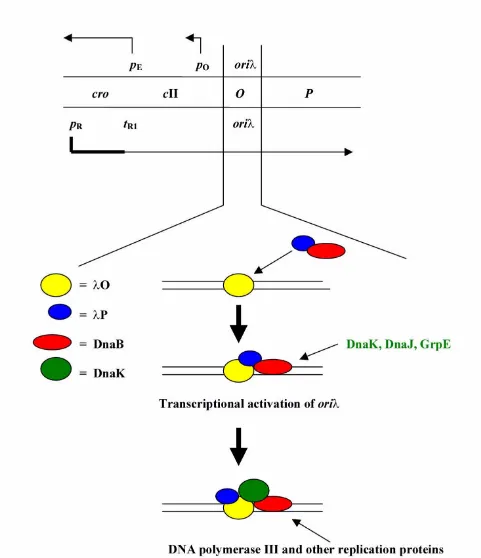
Replication of λ plasmid DNA is initiated at the oriλ re-gion, located in the middle of the O gene (Fig. 1). This gene codes for the replication initiator protein, which binds to the replication origin, forming the nucleoprotein structure called 'O-some'. The host-encoded DnaB heli-case is delivered to the O-some by another λ replication protein, the P gene product. The oriλ-O-P-DnaB structure,
called 'pre-primosome' is stable but inactive in promoting DNA replication, as strong interactions between P and DnaB proteins prevent helicase activity of the latter com-ponent. Action of the heat shock proteins: DnaK, DnaJ and GrpE, is necessary to liberate DnaB from P-mediated inhibition, though the P protein seems to be still present in the complex. Recent studies (see next chapter) suggest
that DnaK also remains bound to the oriλ-O-P-DnaB
com-plex. The process of chaperone-dependent pre-primo-some remodeling is coupled with transcriptional activation of oriλ, a transcription proceeding in the repli-cation origin region. Transcriptional activation of the
ori-gin is necessary for efficient initiation of λ DNA
replication in vivo even if all the replication proteins are provided. It seems that changes in DNA topology caused by movement of RNA polymerase during transcription play a crucial role in stimulation of the replication initia-tion. λpR promoter is a natural start site of transcription
that produces mRNA for synthesis of λ replication
pro-teins (O and P) and acts to activate oriλ. The final step in
the initiation of λ DNA replication is binding of DNA
polymerase III holoenzyme and accessory replication pro-teins (DNA gyrase, SSB and other) encoded by the host to the oriλ region.
Replication of λ plasmids in amino acid-starved cells
Amino acid starvation induces specific response of bacte-rial cells called the stringent response [23]. Under these conditions, product of the relA gene is activated to pro-duce specific signal nucleotides, guanosine triphos-phate-3'diphosphate (pppGpp) and guanosine 5'-diphosphate-3'-diphosphate (ppGpp). These nucleotides interact with RNA polymerase causing dramatic changes in the efficiency of transcription from various promoters. Promoters for synthesis of stable RNAs are the most sensi-tive promoters to (p)ppGpp. Some promoters are not af-fected by this nucletide, whereas other promoters can be either inhibited or stimulated in amino acid-starved wild-type bacteria [23].
λpR promoter was found to be negatively regulated by
ppGpp [24–26]. Decrease in the activity of pR results in impaired transcriptional activation of oriλ and inhibition of λ plasmid DNA replication. Such a regulation is logical, as one can imagine that inhibition of processes that re-quire extensive energy consumption (like DNA replica-tion) should be an advantage for the host cell endangered by starvation.
Figure 1
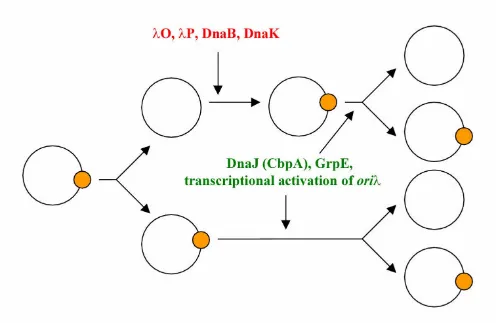
that the initiator of DNA replication, λ-encoded O pro-tein, is extremely unstable in E. coli cells. It was proposed that after each replication round this protein is degraded and synthesis of new O protein molecules is necessary for initiation of subsequent plasmid replication [31]. There-fore, one could predict that inhibition of O protein syn-thesis in amino acid-starved cells, which was demonstrated experimentally [32], should result in pre-vention of replication initiation from oriλ. Such an inhibi-tion occurred in amino acid-starved wild-type cells, but not in relA mutants. λ plasmid replication during the re-laxed response is strongly dependent on the activity of the O protein [28,33], so this replication initiator must still function while its synthesis is blocked. More detailed studies revealed that O protein is protected from proteol-ysis (performed by ClpP/ClpX protease [34,35]) by other components of the λ replication complex, formed at oriλ
[32,36,37]. Such a complex is a stable structure, inherited by one of two daughter plasmid DNA copies after each replication round, and may function in subsequent repli-cation events [32,38].
Studies on replication of λ plasmids in amino acid-starved cells, summarized above, led to a new model for regula-tion of replicaregula-tion of these replicons (Fig. 2). According to this model, there are two pathways of λ plasmid replica-tion. The first pathway is based on the activity of the her-itable replication complex present only on one daughter copy after a replication round. On the plasmid copy de-void of the heritable complex, a new replication complex must be assembled. Both heritable and newly assembled complexes require activities of heat shock proteins (DnaK, DnaJ or its homologue CbpA [39], and GrpE) and tran-scriptional activation of the origin to initiate a new repli-cation round (see ref [22] for detailed review). Heritable replication complexes exist in both wild-type cells and
relA mutants. However, in amino acid-starved bacteria
able to produce (p)ppGpp, activity of the pR promoter is significantly decreased, which results in inefficient tran-scriptional activation of oriλ and inhibition of the replica-tion initiareplica-tion. On the other hand, during the relaxed response, in the absence of high (p)ppGpp amounts the
pR promoter is fully active, and replication carried out by the heritable replication complex can proceed.
Figure 2
Results of previous in vivo[36] and in vitro[40] experi-ments suggested that the heritable λ replication complex contains O, P and DnaB proteins. Recent studies revealed that this complex consists of these proteins and in addi-tion of the DnaK protein [41]. Replicaaddi-tion carried out by the heritable complex may proceed either bidirectionally or unidirectionally (leftward or rightward), similarly to the replication driven by a newly assembled complex [42]. The replication complex is inherited randomly after a rep-lication round in an equal extent by a copy containing pa-rental DNA l strand or parental r strand [43].
Studies on regulation of λ plasmid replication in amino
acid-starved cells had also biotechnological implications. Lack of amino acids causes inhibition of cell growth. Therefore, under these conditions, efficient replication of
λ plasmid molecules results in amplification of plasmid
DNA in cells. In fact, efficient amplification of λ plasmids
was observed in relA mutants, both during amino acid
starvation and limitation [44,45]. Since derivatives of λ plasmids are used as cloning vectors [15,16], their ampli-fication may be useful in biotechnological laboratories.
Growth rate-dependent regulation of λ plasmid copy number
Bacteria can be cultivated in various media supporting dif-ferent growth rates. Plasmid copy number in bacterial cells depends mainly on the frequency of plasmid replica-tion initiareplica-tion, which may vary considerably depending on cellular growth rate. It was found that λ plasmid copy number is higher in cells growing faster [46]. It seems that in slowly growing cells, O protein level is the limiting fac-tor for replication initiation at oriλ. This hypothesis is based on experiments which indicated that dysfunction of
clpP, clpX or both of these genes (coding for components of the O-degrading ClpP/ClpX protease) completely
abol-ishes differences in λ plasmid copy number observed in
wild-type host growing in various media, supporting dif-ferent growth rates [46]. Artificially increased levels of the O protein also resulted in more efficient replication initi-ated at oriλ, but only in bacteria growing slowly in poor media [47]. Clearly, the pathway of λ plasmid replication based on newly assembled replication complexes (com-pare Fig. 2) must be affected under these conditions.
The mechanism of this regulation is not clear. Activity of the pR promoter, from which the O gene is transcribed, was found to be dependent on cellular growth rate, though differences in the transcription efficiency between various growth rates were less pronounced than those in λ plasmid copy number [46]. One might speculate that DnaA and SeqA proteins, which are regulators of bacterial chromosome replication initiation and also stimulators of the pR promoter [48–52], play a role in response of this promoter activity to different growth rates. Perhaps less
ef-ficient translation in slowly growing bacteria might also account for lower O protein levels under these conditions.
Heat shock and λ plasmid replication
Heat shock proteins DnaK, DnaJ (which may be replaced by its homologue CbpA) and GrpE are absolutely neces-sary for initiation of DNA replication from oriλ (for re-views see refs. [19–22]). These proteins remodel the preprimosome to liberate DnaB helicase from the P-medi-ated inhibition, and perhaps are also involved in proper installment of the helicase in the replication forks. Recent results indicate that one of these proteins, DnaK, is a com-ponent of the λ heritable replication complex [41].
On the basis of the facts presented above, one could pre-dict that heat shock might stimulate replication of λ plas-mids. However, this is not the case as it was demonstrated that λ plasmid copy number is decreased at 42°C relative
to lower temperatures (e.g. 30 or 37°C) [44]. More
tailed studies revealed that the replication pathway de-pendent on the function of the heritable replication complex is impaired by heat shock. Namely, the heritable replication complex, which under standard laboratory conditions is a stable structure able to function for many cell generations, is disassembled relatively shortly after transfer of bacteria from 30 to 43°C [53]. This disassembly was found to be dependent on GroEL and GroES heat shock proteins [53]. In fact, this was the first demonstra-tion, supported by subsequent studies [54], that the GroEL/GroES molecular chaperone system is engaged in an in vivo disassembly of a highly organized protein struc-ture.
The mechanism of the GroEL/GroES-dependent, heat shock-induced disassembly of the heritable λ replication complex has been elucidated. Heat shock causes partial and transient relaxation of supercoiled plasmid DNA. Subsequent DNA gyrase-dependent re-supercoiling pro-vokes dissociation of the replication complex, which is then disassembled by the GroEL/GroES chaperone system [55]. Under specific conditions (e.g. absence of the λ Cro
repressor, which is coded by a gene present on most λ
plasmids), the heritable replication complex may survive heat shock due to formation of a more stable structure as a result of interaction with other proteins [55]. One of them is the host-encoded DnaA protein [56].
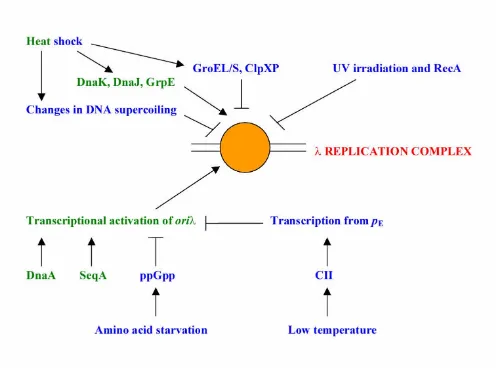
In summary, heat shock proteins have both positive and negative functions in the regulation of λ plasmid replica-tion. Interestingly, the re-supercoiling of plasmid DNA af-ter its partial relaxation caused by heat shock, which is required for the heritable replication complex to dissoci-ate from DNA, is dependent on DnaK function [57]. This makes the influence of heat shock proteins on the
(compare Fig. 3). Furthermore, ClpP and ClpX proteins, which form a protease that degrades the O replication in-itiator protein, belong also to heat shock protein family.
Combination of prolonged (several hours) cultivation of
bacteria at increased temperature (42–43°C) and amino
acid starvation has deleterious effects on plasmids. Name-ly, plasmid DNA degradation was observed under these conditions [58]. This degradation was discovered in the course of studies on λ plasmid replication, but was then demonstrated to be independent of the plasmid replicon [58]. Mechanism of this phenomenon remains unknown, though one might speculate that some bacterial addiction modules that are activated upon amino acid starvation, like mazEF[59], could be involved.
Replication of λ plasmids at low temperatures
Lytic development of bacteriophage λ is blocked at a tem-perature as low as 20–25°C [60,61]. In fact, the burst size of this phage in E. coli cells increases gradually over the
temperature range from 20 to 37°C [62]. At low
tempera-tures, phage DNA replication was found to be inhibited [62,63]. Unexpectedly, it was demonstrated that plasmids derived from bacteriophage λ replicate normally at 25°C [62].
What is the mechanism of different λ phage and λ plasmid DNA replication regulation at low temperatures? It was
demonstrated that λ phage-encoded CII protein activates
the pE promoter (see Fig. 1) more efficiently at lower than at higher temperatures [62,63]. Enhanced transcription from pE may interfere with initiation of transcription from
pR, which is oriented in opposite direction relative to pE
Figure 3
(Fig. 1). Low activity of pR results in inefficient production of λ replication proteins. Therefore, formation of new rep-lication complexes is impaired. Note that in the case of phage infection, naked viral DNA is injected into a host
cell, and all replication complexes must be assembled de
novo. When λ plasmids were investigated,
plasmid-bear-ing cells were transferred from standard temperature
(usu-ally 37°C) to low temperatures. Therefore, previously
assembled heritable λ replication complexes existed at the time of the temperature shift, and could function at low temperatures irrespectively of the new replication com-plex formation inhibition [62].
Effect of the SOS response on formation and stability of λ replication complexes
DNA damage induces specific bacterial stress response, called the SOS response [64]. UV irradiation is one of the factors effectively inducing the SOS response. It was dem-onstrated that UV irradiation of the host cells prevents for-mation of the stable λ replication complex, while it does
not inhibit λ DNA replication [65]. Stable replication
complexes could be formed in UV-irradiated recA mutants
[65] suggesting that the SOS response, rather than UV ir-radiation per se, is responsible for changes in the process of the λ replication complex assembly. Interestingly, ex-posure of bacteria to UV light did not affect stability of the replication complex assembled prior to the irradiation [65]. These results indicate that the stable (heritable) λ replication complex, although sensitive to heat shock, is resistant to some other environmental stresses, like cold shock (see the preceding paragraph) or factors causing DNA damage.
Efficient replication of λ DNA under normal growth
con-ditions and in UV-irradiated cells suggests that formation of at least two types of λ replication complexes is possible. The stable (heritable) complex can be assembled under normal growth conditions and an unstable (though still functional for single replication initiation) complex may be assembled in UV-irradiated cells. Interestingly, consid-erable differences in initiation of DNA replication from
oriλ between cells cultivated under normal growth condi-tions and after UV irradiation were reported previously [66]. Normally, the oriλ region has to be under superheli-cal tension to be a suitable substrate for replication initia-tion machinery [19,20]. Therefore, once a round of replication is in progress, the daughter oriλ sequences would not be under such a tension, and thus they would be inactive. However, in UV-irradiated bacteria the re-quirement for supercoiled origin region to initiate replica-tion appears to be alleviated, as re-initiareplica-tion of replicareplica-tion from oriλ at relaxed, still replicating, daugther molecules was observed [66]. These results may support the idea pre-sented above that at least two different kinds of replica-tion complexes can effectively operate at oriλ.
Some recent studies on replication of other plasmids under various stresses
Plasmids derived from bacteriophage λ were described in
this article as models in studies on effects of stress condi-tions on the regulation of replication of extrachromosom-al genetic elements. However, it is obvious that cellular stress responses significantly affect replication of most, if not all, kinds of plasmids. For example, similarly to λ rep-licons, many plasmids require functions of the heat shock proteins [1]. Biochemical aspects of requirements of vari-ous stress proteins for replication of different plasmids have recently been reviewed [1–6], and will not be dis-cussed in detail here. Nevertheless, we are still far from complete understanding of regulatory processes that con-trol replication of different plasmids under stress condi-tions. Below we discuss briefly some recent studies that addressed this problem and added significant informa-tion to our still incomplete knowledge about plasmid physiology.
Replication of several plasmids (derivatives of ColE1-like replicons, pSC101, R1, RK2, R6K, F, and phage P1-derived plasmids) was investigated in amino acid-starved bacteri-al cells. These studies were reviewed recently in detail [67] and here they will be only summarized briefly. In most cases, inhibition of plasmid DNA replication was ob-served in amino acid-starved wild-type cells. However, different phenomena were observed during the relaxed re-sponse, i.e. replication of some replicons was inhibited in
amino acid-starved relA mutants, whereas replication of
other replicons proceeded efficiently under these condi-tions. Such a replication led to amplification of plasmids in bacteria. Interestingly, in many cases efficiency of plas-mid DNA replication during the relaxed response depend-ed on the nature of lacking amino acid (for details see ref. [67] and references therein). Suggestions about possible regulatory mechanisms of replication control of some
plasmids in amino acid-starved relA mutants were
pre-sented [67].
It has been demonstrated that plasmid pSY10, which is present in marine cyanobacteria belonging to the genus
Synechococcus, is maintained at a high copy number when host cells grow in seawater and at low copy number in cells cultured in freshwater [68]. Therefore, regulation of replication of this plasmid must depend on salinity of en-vironment. More detailed experiments revealed that
tran-scription of the repA gene, coding for the plasmid
candidate for the main regulator of pSY10 replication in response to changes in salinity of environment.
Some plasmids encode their own stress proteins. For ex-ample, genes of small heat shock proteins are expressed from plasmids pER16, pER35 and pER36, naturally occur-ring in Streptococcus thermophilus strains [69]. These pro-teins enhance the viability of bacteria in extreme environments and it was suggested that the presence of plasmid-encoded heat shock proteins may enhance sur-vival of cells under specific conditions.
Interesting combined effects of temperature upshift and high-level production of recombinant proteins on replica-tion of ColE1-like plasmids were observed [70]. Namely, under conditions normally causing amplification of plas-mid DNA at increased temperatures, simultaneous over-expression of recombinant proteins that form inclusion bodies attenuated plasmid DNA amplification [70]. In fact, effects of enhanced production of recombinant pro-teins on stability of ColE1-like plasmids in E. coli strains were reported previously [71], and more recent studies re-vealed that features of recombinant proteins produced in bacteria affect efficiency of plasmid maintenance [72]. Molecular mechanisms of these regulations remain to be elucidated.
As discussed above, contrary to plasmids derived from bacetriophage λ (see the preceding paragraphs), tempera-ture upshift causes amplification of ColE1-like plasmids [70]. Increased rate of initiation of bacterial chromosme replication under such conditions was also observed pre-viously [73]. More recent studies demonstrated that this
heat-induced chromosome replication is initiated at oriC
(normal site for initiation of nucleoid replication) and re-quires RNaseH1 and RecA proteins but not RNA
polymer-ase activity and de novo protein synthesis [74]. It was
suggested that this phenomenon might be explained by a
heat-inducible thermodynamic alteration of the oriC
structure and/or of membrane fluidity [74].
As mentioned in preceding paragraphs, overexpression of recombinant genes may inhibit plasmid DNA replication [70]. Such an inhibition may be the triggering signal for the cellular SOS response [75]. In fact, the SOS response may be induced by a single plasmid-encoded protein, for example the replication initiator protein of plasmid pSC101, RepA [76]. It was proposed that such an induc-tion of the SOS response may be helpful in detecting an imbalance between the cellular level of the RepA protein and plasmid-borne RepA-binding sites [76]. This mecha-nism should lead to inhibition of the host chromosome replication and should delay host cell division when RepA is in relative excess. This may help to limit variation in
plasmid copy number and to prevent formation of plas-mid-less cells.
Conclusions
Bacterial stress responses influence replication of various plasmids in host cells. Although biochemical roles of some specific stress proteins in replication of certain mids were elucidated, mechanisms of responses of plas-mid regulatory systems to many environmental stresses remain largely unknown. However, elucidation of these mechanisms is necessary to understand physiology of plasmids and to use these extrachromosomal genetic ele-ments more effectively in genetic engineering and
bio-technology. Plasmids derived from bacteriophage λ
provide examples of replicons whose mechanisms con-trolling frequency of their replication initiation under var-ious stress conditions have been partially explained. We hope that further studies will allow us to understand these mechanisms even in more detail and that they will pro-vide new and important information about physiology of replication of other plasmids.
Acknowledgments
We thank Katarzyna Potrykus for critical reading of the manuscript. This work was supported by the Polish State Committee for Scientific Research (projects 6 P04A 016 16 to G.W. and 3 P04A 029 22 to A.W.) and Institute of Oceanology of the Polish Academy of Sciences (task grant to G.W.). G.W. acknowledges financial support from the Foundation for Polish Sci-ence (subsidy 14/2000).
References
1. Helinski DR, Toukdarian A, Novick RP: Replication control and other stable maintenance mechanisms of plasmids. In: Es-cherichia coli and Salmonella: cellular and molecular biology (Edited by: Neidhardt FC, Curtiss III R, Ingraham J, Lin ECC, Low KB, Magasanik B, Reznikoff WS, Riley M, Schaechter M, Umbarger H) Washington DC, American Society for Microbiology 1996, 2295-2324
2. Del Solar G, Giraldo R, Ruiz-Echevarria MJ, Espinosa M, Diaz-Orejas R: Replication and control of circular bacterial plasmids. Microbiol Mol Biol Rev 1998, 62:434-464
3. Chattoraj DK: Control of plasmid DNA replication by iterons: no longer paradoxical.Mol Microbiol 2000, 37:467-476
4. Del Solar G, Espinosa M: Plasmid copy number control: an ever-growing story.Mol Microbiol 2000, 37:492-500
5. Gerdes K, Moller-Jensen J, Jensen RB RB: Plasmid and chromo-some partitioning: surprises from phylogeny. Mol Microbiol 2000, 37:455-466
6. Khan SA: Plasmid rolling-circle replication: recent develop-ments.Mol Microbiol 2000, 37:477-484
7. Zielenkiewicz U, Ceglowski P: Mechanisms of plasmid stable maintenance with special focus on plasmid addiction sys-tems.Acta Biochim Pol 2001, 48:1003-1023
8. Ptashne M: A genetic switch: phage λ and higher organisms. Cambridge (Mass), Cell Press and Blackwell Scientific Publications 1992 9. Thomas R: Bacteriophage λ: transactivation, positive control
and other odd findings.BioEssays 1993, 15:285-289
10. Gottesman M: Bacteriophage λ: the untold story.J Mol Biol 1999,
293:177-180
11. Friedman DI, Court DL: Bacteriophage lambda: alive and well and still doing its thing.Curr Opin Microbiol 2001, 4:201-207 12. Murray NE: Lambda vectors.In: Lambda II (Edited by: Hendrix RW,
Roberts JW, Stahl FW, Weisberg RA) Cold Srping Harbor, Cold Spring Har-bor LaHar-boratory Press 1983, 677-684
14. Chauthaiwale VM, Therwath A, Deshpande VV: Lambda as a clon-ing vector.Microbiol Rev 1992, 56:577-591
15. Boyd AC, Sherratt DJ: The pCLIP plasmids: versatile cloning vectors based on the bacteriophage lambda origin of replica-tion.Gene 1995, 153:57-62
16. Herman-Antosiewicz A, Obuchowski M, Wegrzyn G: A plasmid cloning vector with precisely regulatable copy number in Es-cherichia coli.Mol Biotechnol 2001, 17:193-199
17. Christensen AC: Bacteriophage lambda-based expression vec-tors.Mol Biotechnol 2001, 17:219-224
18. Matsubara K, Kaiser AD: λdv : an autonomously replicating DNA fragment.Cold Spring Harbor Symp Quant Biol 1968, 33: 769-775
19. Taylor K, Wegrzyn G: Replication of coliphage lambda DNA. FEMS Microbiol Rev 1995, 17:109-119
20. Taylor K, Wegrzyn G: Regulation of bacteriophage λ replica-tion.In: Molecular Microbiology (Edited by: Busby SJW, Thomas CM, Brown NL) Berlin-Heidelberg, Springer Verlag 1998, 81-97
21. Wegrzyn G, Wegrzyn A, Baranska S, Czyz A: Regulation of bacte-riophage lambda development.Recent Res Dev Virol 2001, 3: 375-386
22. Wegrzyn A, Wegrzyn G: Inheritance of the replication com-plex: a unique or common phenomenon in the control of DNA replication?Arch Microbiol 2001, 175:86-93
23. Cashel M, Gentry DR, Hernandez VJ, Vinella D: The stringent re-sponse.In: Escherichia coli and Salmonella: cellular and molecular biology (Edited by: Neidhardt FC, Curtiss III R, Ingraham J, Lin ECC, Low KB, Ma-gasanik B, Reznikoff WS, Riley M, Schaechter M, Umbarger H) Washing-ton DC, American Society of Microbiology 1996, 1458-1496
24. Szalewska-Palasz A, Wegrzyn A, Herman A, Wegrzyn G: The mech-anism of the stringent control of λ plasmid DNA replication. EMBO J. 1994, 13:5779-5785
25. Szalewska A-Palasz, Wegrzyn G: Inhibition of transcription start-ing from bacteriophage λpR promoter during the stringent response in Escherichia coli: implications for λ DNA replica-tion.Acta Biochim Pol 1995, 42:233-240
26. Wrobel B, Murphy H, Cashel M, Wegrzyn G: Guanosine tetra-phosphate (ppGpp)-mediated inhibition of the activity of the bacteriophage λpR promoter in Escherichia coli.Mol Gen Genet 1998, 257:490-495
27. Wegrzyn G, Kwasnik E, Taylor K: Replication of λ plasmid in ami-no acid-starved strains of Escherichia coli.Acta Biochim Pol 1991,
38:181-186
28. Wegrzyn G, Neubauer P, Krueger S, Hecker M, Taylor K: Stringent control of replication of plasmids derived from coliphage λ. Mol Gen Genet 1991, 225:94-98
29. Lipinska B, Podhajska A, Taylor K: Synthesis and decay of λ DNA replication proteins in minicells.Biochem Biophys Res Commun 1980, 92:120-126
30. Gottesman S, Gottesman M, Shaw JE, Pearson ML: Protein degra-dation in E. coli: the lon mutation and bacteriophage lambda N and cII protein stability.Cell 1981, 24:225-233
31. Matsubara K: Replication control system in λdv.Plasmid 1981,
5:32-52
32. Wegrzyn G, Pawlowicz A, Taylor K: Stability of coliphage λ DNA replication initiator, the λO protein.J Mol Biol 1992, 226: 675-680
33. Wegrzyn G, Taylor K: Inheritance of the replication complex by one of two daughter copies during λ plasmid replication in Escherichia coli.J Mol Biol 1992, 226:681-688
34. Wojtkowiak D, Georgopoulos C, Zylicz M M: Isolation and char-acterization of ClpX, a new ATP-dependent specificity com-ponent of the Clp protease of Escherichia coli.J Biol Chem 1993,
268:22609-22617
35. Gottesman S, Clark WP, de Crecy-Lagard V, Maurizi MR: ClpX, an alternative subunit for the ATP-dependent Clp protease of Escherichia coli.J Biol Chem 1993, 268:22618-22626
36. Wegrzyn A, Wegrzyn G, Taylor K: Protection of coliphage λO in-itiator protein from proteolysis in the assembly of the repli-cation complex in vivo.Virology 1995, 207:179-184
37. Wegrzyn A, Wegrzyn G, Taylor K: Plasmid and host functions re-quired for λ plasmid replication carried out by the inherited replication complex.Mol Gen Genet 1995, 247:501-508
38. Wegrzyn A, Wegrzyn G, Herman A, Taylor K: Protein inheritance:
λ plasmid replication perpetuated by the heritable replica-tion complex.Genes Cells 1996, 1:953-963
39. Wegrzyn A, Taylor K, Wegrzyn G: The cbpA chaperone gene function compensates for dnaJ in λ plasmid replication dur-ing amino acid starvation of Escherichia coli.J Bacteriol 1996,
178:5847-5849
40. Zylicz M, Liberek K, Wawrzynow A, Georgopoulos C: Formation of the preprimosome protects λO from RNA transcription-dependent proteolysis by ClpP/ClpX.Proc Natl Acad Sci USA 1998, 95:15259-15263
41. Potrykus K, Baranska S, Wegrzyn A, Wegrzyn G: Composition of the λ plasmid heritable replication complex.Biochem J 2002,
364:857-862
42. Baranska S, Konopa G, Wegrzyn G: Directionality of λ plasmid DNA replication carried out by the heritable replication complex.Nucleic Acids Res 2002, 30:1176-1181
43. Wegrzyn A, Wegrzyn G: Random inheritance of the replication complex by one of two daughter λ plasmid copies after a rep-lication round in Escherichia coli.Biochem Biophys Res Commun 1998, 246:634-639
44. Wegrzyn G: Amplification of λ plasmids in Escherichia coli relA mutants.J Biotechnol 1995, 43:139-143
45. Wrobel B, Wegrzyn G: Replication and amplification of λ plas-mids in Escherichia coli during amino acid starvation and lim-itation.FEMS Microbiol Lett 1997, 153:151-157
46. Wegrzyn A, Czyz A, Gabig M, Wegrzyn G: ClpP/ClpX-mediated degradation of the bacteriophage λO protein and regulation of λ phage and λ plasmid replication. Arch Microbiol 2000,
174:89-96
47. Gabig M, Obuchowski M, Wegrzyn A, Szalewska-Palasz A, Thomas MS, Wegrzyn G: Excess production of phage λ delayed early proteins under conditions supporting high Escherichia coli growth rates.Microbiology 1998, 144:2217-2224
48. Wegrzyn G, Szalewska-Palasz A, Wegrzyn A, Obuchowski M, Taylor K: Transcriptional activation of coliphage λ DNA replication is regulated by the host DnaA initiator function.Gene 1995,
154:47-50
49. Szalewska-Palasz A, Wegrzyn A, Blaszczak A, Taylor K, Wegrzyn G:
DnaA-stimulated transcriptional activation of oriλ: Es-cherichia coli RNA polymerase β subunit as a transcriptional activator contact site.Proc Natl Acad Sci USA 1998, 95:4241-4246 50. Glinkowska M, Konopa G, Wegrzyn A, Herman-Antosiewicz A, Weigel C, Seitz H, Messer W, Wegrzyn G: The double mecha-nism of incompatibility between λ plasmids and Escherichia coli dnaA (ts) host cells.Microbiology 2001, 147:1923-1928 51. Slominska M, Wegrzyn A, Konopa G, Skarstad K, Wegrzyn G: SeqA,
the Escherichia coli origin sequestration protein, is also a spe-cific transcription factor.Mol Microbiol 2001, 40:1371-1380 52. Baranska S, Gabig M, Wegrzyn A, Konopa G, Herman-Antosiewicz A,
Hernandez P, Schvartzman JB, Helinski DR, Wegrzyn G: Regulation of the switch from early to late bacteriophage λ DNA repli-cation mode.Microbiology 2001, 147:535-547
53. Wegrzyn A, Wegrzyn G, Taylor K: Disassembly of the coliphage
λ replication complex due to heat shock induction of the groE operon.Virology 1996, 217:594-597
54. Chatellier J, Hill F, Lund PA, Fersht AR: In vivo activities of GroEL minichaperones.Proc Natl Acad Sci USA 1998, 95:9861-9866 55. Wegrzyn A, Herman-Antosiewicz A, Taylor K, Wegrzyn G:
Molecu-lar mechanism of heat shock-provoked disassembly of the coliphage λ replication complex.J Bacteriol 1998, 180:2475-2483 56. Herman-Anotsiewicz A, Wegrzyn A, Taylor K, Wegrzyn G: DnaA-mediated regulation of phage λ-derived replicons in the ab-sence of pR and Cro function.Virology 1998, 249:98-107
57. Ogata Y, Mizushima T, Kataoka K, Kita K, Miki T, Sekimizu K: DnaK heat shock protein of Escherichia coli maintains the negative supercoiling of DNA against thermal stress.J Biol Chem 1996,
271:29407-29414
58. Neubauer P, Wrobel B, Wegrzyn G: DNA degradation at elevat-ed temperatures after plasmid amplification in amino acid-starved Escherichia coli cells.Biotechnol Lett 1996, 18:321-326 59. Aizenman E, Engelberg-Kulka H, Glaser G: An Escherichia coli
chromosomal "addiction module" regulated by 3',5'-bispyro-phosphate: a model for programmed bacterial cell death. Proc Natl Acad Sci USA 1996, 93:6059-6063
61. Giladi H, Goldenberg D, Koby S, Oppenheim AB: Enhanced activi-ty of the bacterophage λ PL promoter at low temperature. FEMS Microbiol Rev 1995, 17:135-140
62. Gabig M, Obuchowski M, Srutkowska S, Wegrzyn G: Regulation of replication of λ phage and plasmid at low temperature.Mol Gen Genet 1998, 258:494-502
63. Obuchowski M, Shotland Y, Koby S, Giladi H, Gabig M, Wegrzyn G, Oppenheim AB: Stability of CII is a key element in the cold stress response of bacteriophage λ infection.J Bacteriol 1997,
179:5987-5991
64. Little JW, Mount DW: The SOS regulatory system of Es-cherichia coli.Cell 1982, 29:11-22
65. Wegrzyn A, Wegrzyn G: Formation and stability of bacteri-ophage λ replication complexes in UV-irradiated Escherichia coli.Curr Microbiol 2000, 41:157-160
66. Schnos M, Inman RB: Reinitiation of the λ DNA origin accom-panies the host SOS response.Virology 1987, 158:294-299 67. Wegrzyn G: Replication of plasmids during bacterial response
to amino acid starvation.Plasmid 1999, 41:1-16
68. Takeyama H, Nakayama H, Matsunaga T: Salinity-regulated repli-cation of the endogenous plasmid pSY10 from the marine cyanobacterium Synechococcus sp.Appl Biochem Biotechnol 2000,
84-86:447-453
69. Solow BT, Somkuti GA: Comparison of low-molecular-weight heat stress proteins encoded on plasmids in different strains of Streptococcus thermophilus.Curr Microbiol 2000, 41:177-181 70. Hoffmann F, Rinas U: Plasmid amplification in Escherichia coli
after temperature upshift is impaired by induction of recom-binant protein synthesis.Biotechnol Lett 2001, 23:1819-1825 71. Benito A, Vidal M, Villaverde A: Enhanced production of
pL-con-trolled recombinant proteins and plasmid stability in Es-cherichia coli RecA+ strains.J Biotechnol 1993, 29:299-306
72. Corchero JL JL, Villaverde A: Plasmid maintenance in Escherichia coli recombinant cultures in dramatically, steadily, and spe-cifically influenced by features of the encoded proteins. Bio-technol Bioeng 1998, 58:625-632
73. Guzman EC, Jimenez-Sanchez A, Orr E, Pritchard RH: Heat stress in the presence of low RNA polymerase activity increases chromosome copy number of Escherichia coli.Mol Gen Genet 1988, 212:203-206
74. Botello E, Jimenez-Sanchez A: A temperature upshift induces in-itiation of replication at oriC of the Escherichia coli chromo-some.Mol Microbiol 1997, 26:133-144
75. Aris A, Corchero JL, Benito A, Carbonell X, Viaplana E, Villaverde A:
The expression of recombinant genes from bacteriophage lambda strong promoters triggers the SOS response in Es-cherichia coli.Biotechnol Bioeng 1998, 60:551-559
76. Ingmer H, Miller C, Cohen SN: The RepA protein of plasmid pSC101 controls Escherichia coli cell division through the SOS response.Mol Microbiol 2001, 42:519-526
Publish with BioMed Central and every scientist can read your work free of charge
"BioMedcentral will be the most significant development for disseminating the results of biomedical research in our lifetime."
Paul Nurse, Director-General, Imperial Cancer Research Fund
Publish with BMC and your research papers will be:
available free of charge to the entire biomedical community
peer reviewed and published immediately upon acceptance
cited in PubMed and archived on PubMed Central
yours - you keep the copyright
[email protected] Submit your manuscript here:
http://www.biomedcentral.com/manuscript/