338
Chapter 8
1. THINK A compressed spring stores potential energy. This exercise explores the relationship between the energy stored and the spring constant.
EXPRESS The potential energy stored by the spring is given by 2 / 2,
Ukx where k is the spring constant and x is the displacement of the end of the spring from its position when the spring is in equilibrium. Thus, the spring constant is k2 /U x2.
ANALYZE Substituting U 25 J and x7.5 m0.075 cm into the above expression, we find the spring constant to be
3
2 2
2 2(25 J)
8.9 10 N/m. (0.075 m)
U k
x
LEARN The spring constant k has units N/m. The quantity provides a measure of stiffness of the spring, for a given x, the greater the value of k, the greater the potential energy U.
2. We use Eq. 7-12 for Wg and Eq. 8-9 for U.
(a) The displacement between the initial point and A is horizontal, so = 90.0° and
0 g
W (since cos 90.0° = 0).
(b) The displacement between the initial point and B has a vertical component of h/2 downward (same direction as Fg), so we obtain
2 5
1 1
(825 kg)(9.80 m/s )(42.0 m) 1.70 10 J
2 2
g g
W F d mgh .
(c) The displacement between the initial point and C has a vertical component of h downward (same direction as Fg), so we obtain
2 5
(825 kg)(9.80 m/s )(42.0 m) 3.40 10 J
g g
W F d mgh .
(d) With the reference position at C, we obtain
2 5
1 1
(825 kg)(9.80 m/s )(42.0 m) 1.70 10 J
2 2
B
(e) Similarly, we find
2 5
(825 kg)(9.80 m/s )(42.0 m) 3.40 10 J
A
U mgh .
(f) All the answers are proportional to the mass of the object. If the mass is doubled, all answers are doubled.
3. (a) Noting that the vertical displacement is 10.0 m – 1.50 m = 8.50 m downward (same direction as Fg), Eq. 7-12 yields
2
cos (2.00 kg)(9.80 m/s )(8.50 m) cos 0 167 J.
g
W mgd
(b) One approach (which is fairly trivial) is to use Eq. 8-1, but we feel it is instructive to instead calculate this as U where U = mgy (with upward understood to be the +y direction). The result is
2
( f i) (2.00 kg)(9.80 m/s )(1.50 m 10.0 m) 167 J. U mg y y
(c) In part (b) we used the fact that Ui = mgyi =196 J.
(d) In part (b), we also used the fact Uf = mgyf = 29 J.
(e) The computation of Wg does not use the new information (that U = 100 J at the
ground), so we again obtain Wg = 167 J.
(f) As a result of Eq. 8-1, we must again find U = –Wg = –167 J.
(g) With this new information (that U0 = 100 J where y = 0) we have Ui = mgyi + U0 = 296 J.
(h) With this new information (that U0 = 100 J where y = 0) we have Uf = mgyf + U0 = 129 J.
We can check part (f) by subtracting the new Ui from this result.
4. (a) The only force that does work on the ball is the force of gravity; the force of the rod is perpendicular to the path of the ball and so does no work. In going from its initial position to the lowest point on its path, the ball moves vertically through a distance equal to the length L of the rod, so the work done by the force of gravity is
2
(0.341 kg)(9.80 m/s )(0.452 m) 1.51 J
(b) In going from its initial position to the highest point on its path, the ball moves vertically through a distance equal to L, but this time the displacement is upward, opposite the direction of the force of gravity. The work done by the force of gravity is
2
(0.341 kg)(9.80 m/s )(0.452 m) 1.51 J.
W mgL
(c) The final position of the ball is at the same height as its initial position. The displacement is horizontal, perpendicular to the force of gravity. The force of gravity does no work during this displacement.
(d) The force of gravity is conservative. The change in the gravitational potential energy of the ball-Earth system is the negative of the work done by gravity:
2
(0.341 kg)(9.80 m/s )(0.452 m) 1.51 J
U mgL
as the ball goes to the lowest point.
(e) Continuing this line of reasoning, we find 2
(0.341 kg)(9.80 m/s )(0.452 m) 1.51 J
U mgL
as it goes to the highest point.
(f) Continuing this line of reasoning, we have U = 0 as it goes to the point at the same height.
(g) The change in the gravitational potential energy depends only on the initial and final positions of the ball, not on its speed anywhere. The change in the potential energy is the same since the initial and final positions are the same.
5. THINK As the ice flake slides down the frictionless bowl, its potential energy changes due to the work done by the gravitational force.
EXPRESS The force of gravity is constant, so the work it does is given by W F d , where Fis the force and d is the displacement. The force is vertically downward and has magnitude mg, where m is the mass of the flake, so this reduces to W = mgh, where h is the height from which the flake falls. The force of gravity is conservative, so the change in gravitational potential energy of the flake-Earth system is the negative of the work done: U = –W.
ANALYZE (a) The ice flake falls a distance h r 22.0 cm0.22 m. Therefore, the work done by gravity is
(b) The change in gravitational potential energy is U = –W = – 4.31 10–3 J.
(c) The potential energy when the flake is at the top is greater than when it is at the bottom by |U|. If U = 0 at the bottom, then U = + 4.31 10–3 J at the top.
(d) If U = 0 at the top, then U = – 4.31 10–3 J at the bottom.
(e) All the answers are proportional to the mass of the flake. If the mass is doubled, all answers are doubled.
LEARN While the potential energy depends on the reference point (location where
0
U ), the change in potential energy, U, does not. In both (c) and (d), we find 3
4.31 10 J.
U
6. We use Eq. 7-12 for Wg and Eq. 8-9 for U.
(a) The displacement between the initial point and Q has a vertical component of h – R downward (same direction as Fg), so (with h = 5R) we obtain
2 2
4 4(3.20 10 kg)(9.80 m/s )(0.12 m) 0.15 J
g g
W F d mgR .
(b) The displacement between the initial point and the top of the loop has a vertical component of h – 2R downward (same direction as Fg), so (with h = 5R) we obtain
2 2
3 3(3.20 10 kg)(9.80 m/s )(0.12 m) 0.11 J
g g
W F d mgR .
(c) With y = h = 5R, at P we find
2 2
5 5(3.20 10 kg)(9.80 m/s )(0.12 m) 0.19 J
U mgR .
(d) With y = R, at Q we have
2 2
(3.20 10 kg)(9.80 m/s )(0.12 m) 0.038 J
UmgR .
(e) With y = 2R, at the top of the loop, we find
2 2
2 2(3.20 10 kg)(9.80 m/s )(0.12 m) 0.075 J
U mgR .
(f) The new information (vi 0) is not involved in any of the preceding computations; the above results are unchanged.
swing) h = L – L cos (for angle measured from vertical as shown in Fig. 8-34). Once this relation (which we will not derive here since we have found this to be most easily illustrated at the blackboard) is established, then the principal results of this problem follow from Eq. 7-12 (for Wg ) and Eq. 8-9 (for U ).
(a) The vertical component of the displacement vector is downward with magnitude h, so we obtain
2
(1 cos )
(5.00 kg)(9.80 m/s )(2.00 m)(1 cos 30 ) 13.1 J.
g g
W F d mghmgL
(b) From Eq. 8-1, we have U = –Wg = –mgL(1 – cos ) = –13.1 J.
(c) With y = h, Eq. 8-9 yields U = mgL(1 – cos ) = 13.1 J.
(d) As the angle increases, we intuitively see that the height h increases (and, less obviously, from the mathematics, we see that cos decreases so that 1 – cos increases), so the answers to parts (a) and (c) increase, and the absolute value of the answer to part (b) also increases.
8. (a) The force of gravity is constant, so the work it does is given by W F d , where F is the force and d is the displacement. The force is vertically downward and has magnitude mg, where m is the mass of the snowball. The expression for the work reduces to W = mgh, where h is the height through which the snowball drops. Thus
2
(1.50 kg)(9.80 m/s )(12.5 m) 184 J
W mgh .
(b) The force of gravity is conservative, so the change in the potential energy of the snowball-Earth system is the negative of the work it does: U = –W = –184 J.
(c) The potential energy when it reaches the ground is less than the potential energy when it is fired by |U|, so U = –184 J when the snowball hits the ground.
9. We use Eq. 8-17, representing the conservation of mechanical energy (which neglects friction and other dissipative effects).
(a) In Problem 9-2, we found UA = mgh (with the reference position at C). Referring
again to Fig. 8-29, we see that this is the same as U0, which implies that KA = K0 and thus that
vA = v0 = 17.0 m/s.
K U K U
mv mgh mv mg h
B B
B
0 0 0
2 2
1 2
1
2 2
F
HG
I
KJ
which leads to
2 2 2
0 (17.0 m/s) (9.80 m/s )(42.0 m) 26.5 m/s.
B
v v gh
(c) Similarly, vC v022gh (17.0 m/s)22(9.80 m/s )(42.0 m)2 33.4 m/s.
(d) To find the “final” height, we set Kf = 0. In this case, we have
K U K U
mv mgh mgh
f f
f
0 0 0 2
1
2 0
which yields
2 2
0
2 (17.0 m/s)
42.0 m 56.7 m.
2 2(9.80 m/s )
f
v h h
g
(e) It is evident that the above results do not depend on mass. Thus, a different mass for the coaster must lead to the same results.
10. We use Eq. 8-17, representing the conservation of mechanical energy (which neglects friction and other dissipative effects).
(a) In the solution to Problem 9-3 (to which this problem refers), we found Ui = mgyi =
196 J and Uf = mgyf = 29.0 J (assuming the reference position is at the ground). Since
Ki = 0 in this case, we have
0 196 J Kf 29.0 J
which gives Kf 167 J and thus leads to
2 2(167 J)
12.9 m/s. 2.00 kg
f
K v
m
(b) If we proceed algebraically through the calculation in part (a), we find Kf = – U =
mgh where h = yi – yf and is positive-valued. Thus, 2
2 f K
v gh
m
(c) IfKi 0 , then we find Kf = mgh + Ki (where Ki is necessarily positive-valued). This
represents a larger value for Kf than in the previous parts, and thus leads to a larger value
for v.
11. THINK As the ice flake slides down the frictionless bowl, its potential energy decreases (discussed in Problem 8-5). By conservation of mechanical energy, its kinetic energy must increase.
EXPRESS If Ki is the kinetic energy of the flake at the edge of the bowl, Kf is its kinetic
energy at the bottom, Ui is the gravitational potential energy of the flake-Earth system
with the flake at the top, and Uf is the gravitational potential energy with it at the bottom,
then
f f i i
K U K U .
Taking the potential energy to be zero at the bottom of the bowl, then the potential energy at the top is Ui = mgr where r = 0.220 m is the radius of the bowl and m is the mass of the
flake. Ki = 0 since the flake starts from rest. Since the problem asks for the speed at the
bottom, we write Kf mv2/ 2.
ANALYZE (a) Energy conservation leads to 2
1
0 0
2
f f i i
K U K U mv mgr.
The speed is v 2gr 2.08 m/s.
(b) Since the expression for speed is v 2gr, which does not contain the mass of the flake, the speed would be the same, 2.08 m/s, regardless of the mass of the flake.
(c) The final kinetic energy is given by Kf KiUiUf. If Ki is greater than before,
then Kf will also be greater. This means the final speed of the flake is greater.
LEARN The mechanical energy conservation principle can also be expressed as
mech 0
E K U
, which implies K U, i.e., the increase in kinetic energy is equal to the negative of the change in potential energy.
12. We use Eq. 8-18, representing the conservation of mechanical energy. We choose the reference position for computing U to be at the ground below the cliff; it is also regarded as the “final” position in our calculations.
(a) Using Eq. 8-9, the initial potential energy is given by Ui = mgh where h = 12.5 m and 1.50 kg
1 2
K U K U
mv mgh mv
i i f f
i
1
2 0
2 2
which leads to the speed of the snowball at the instant before striking the ground:
v
m mvi mgh vi gh 2 1
F
HG
I
KJ
2 2
2 2
where vi = 14.0 m/s is the magnitude of its initial velocity (not just one component of it).
Thus we find v = 21.0 m/s.
(b) As noted above, vi is the magnitude of its initial velocity and not just one component
of it; therefore, there is no dependence on launch angle. The answer is again 21.0 m/s. (c) It is evident that the result for v in part (a) does not depend on mass. Thus, changing the mass of the snowball does not change the result for v.
13. THINK As the marble moves vertically upward, its gravitational potential energy increases. This energy comes from the release of elastic potential energy stored in the spring.
EXPRESS We take the reference point for gravitational potential energy to be at the position of the marble when the spring is compressed. The gravitational potential energy when the marble is at the top of its motion is Ug mgh. On the other had, the energy
stored in the spring is Us kx2/ 2. Applying mechanical energy conservation principle
allows us to solve the problem.
ANALYZE (a) The height of the highest point is h = 20 m. With initial gravitational potential energy set to zero, we find
3 2
(5.0 10 kg)(9.8 m/s )(20 m) 0.98 J.
g
U mgh
(b) Since the kinetic energy is zero at the release point and at the highest point, then conservation of mechanical energy implies Ug + Us = 0, where Us is the change in
the spring's elastic potential energy. Therefore, Us = –Ug = –0.98 J.
(c) We take the spring potential energy to be zero when the spring is relaxed. Then, our result in the previous part implies that its initial potential energy is Us = 0.98 J. This must
be 1 2
2
kx , where k is the spring constant and x is the initial compression. Consequently,
2
2 2
2 0.98 J
3.1 10 N/m 3.1 N/cm. (0.080 m)
s
U k
x
LEARN In general, the marble has both kinetic and potential energies:
2 2
1 1
2kx 2mv mgy
At the maximum height ymax h, v0 and mghkx2/ 2, or
2 2
kx h
mg .
14. We use Eq. 8-18, representing the conservation of mechanical energy (which neglects friction and other dissipative effects).
(a) The change in potential energy is U = mgL as it goes to the highest point. Thus, we have
top
K U K K mgL
0 0 0
which, upon requiring Ktop = 0, gives K0 = mgL and thus leads to
2 0
0 2
2 2(9.80 m/s )(0.452 m) 2.98 m/s K
v gL
m
.
(b) We also found in Problem 9-4 that the potential energy change is U = –mgL in going from the initial point to the lowest point (the bottom). Thus,
bottom
K U
K K mgL
0 0
0
which, with K0 = mgL, leads to Kbottom = 2mgL. Therefore,
2 bottom
bottom 2
4 4(9.80 m/s )(0.452 m) 4.21 m/s K
v gL
m
.
(c) Since there is no change in height (going from initial point to the rightmost point), then U = 0, which implies K = 0. Consequently, the speed is the same as what it was initially,
right 0 2.98 m/s
v v .
(d) It is evident from the above manipulations that the results do not depend on mass. Thus, a different mass for the ball must lead to the same results.
EXPRESS We ignore any work done by friction. In SI units, the initial speed of the truck just before entering the escape ramp is vi = 130(1000/3600) = 36.1 m/s. When the truck
comes to a stop, its kinetic and potential energies are Kf = 0 and Uf = mgh. We apply
mechanical energy conservation to solve the problem.
ANALYZE (a) Energy conservation implies Kf Uf KiUi. With Ui = 0, and
2
1 2
i i
K mv , we obtain
2 2
2
2
1 (36.1 m/s)
0 0 66.5 m.
2 2 2(9.8 m/s )
i i
v
mv mgh h
g
If L is the minimum length of the ramp, then Lsin h, or L sin 15° = 66.5 m so that
(66.5 m) / sin15 257 m.
L That is, the ramp must be about 2.6102 m long if friction is negligible.
(b) The minimum length is
2
sin 2 sin
i
v h
L
g
which does not depend on the mass of the truck. Thus, the answer remains the same if the mass is reduced.
(c) If the speed is decreased, then h and L both decrease (note that h is proportional to the square of the speed and that L is proportional to h).
LEARN The greater the speed of the truck, the longer the ramp required. This length can be shortened considerably if the friction between the tires and the ramp surface is factored in.
16. We place the reference position for evaluating gravitational potential energy at the relaxed position of the spring. We use x for the spring's compression, measured positively downward (so x > 0 means it is compressed).
(a) With x = 0.190 m, Eq. 7-26 gives 2
1
7.22 J 7.2 J
2 s
W kx
for the work done by the spring force. Using Newton's third law, we see that the work done on the spring is 7.2 J.
(b) As noted above, Ws = –7.2 J.
(c) Energy conservation leads to
2 0
1 0
2
i i f f
which (with m = 0.70 kg) yields h0 = 0.86 m.
(d) With a new value for the height h0 2h0172. m , we solve for a new value of x using the quadratic formula (taking its positive root so that x > 0).
mgh mgx kx x mg mg mgkh
k
0
2
2
0 1
2
2
b g
which yields x = 0.26 m.
17. (a) At Q the block (which is in circular motion at that point) experiences a centripetal acceleration v2/R leftward. We find v2 from energy conservation:
K U K U
mgh mv mgR
P P Q Q
0 1
2
2
Using the fact that h = 5R, we find mv2 = 8mgR. Thus, the horizontal component of the net force on the block at Q is
F = mv2/R = 8mg=8(0.032 kg)(9.8 m/s2)= 2.5 N. The direction is to the left (in the same direction as a).
(b) The downward component of the net force on the block at Q is the downward force of gravity
F = mg =(0.032 kg)(9.8 m/s2)= 0.31 N.
(c) To barely make the top of the loop, the centripetal force there must equal the force of gravity:
2
2
t
t
mv
mg mv mgR
R .
This requires a different value of h than what was used above.
2
1 0
2 1
( ) (2 )
2
P P t t
t t
K U K U
mgh mv mgh
mgh mgR mg R
(d) The normal force FN, for speeds vt greater than gR (which are the only
possibilities for nonzero FN — see the solution in the previous part), obeys
2
t N
mv
F mg
R
from Newton's second law. Since vt2 is related to h by energy conservation KPUP Kt Ut gh 1vt gR
2 2
2
then the normal force, as a function for h (so long as h 2.5R — see the solution in the previous part), becomes
2
5 N
mgh
F mg
R
.
Thus, the graph for h 2.5R = 0.30 m consists of a straight line of positive slope 2mg/R (which can be set to some convenient values for graphing purposes). Note that for h 2.5R, the normal force is zero.
18. We use Eq. 8-18, representing the conservation of mechanical energy. The reference position for computing U is the lowest point of the swing; it is also regarded as the “final” position in our calculations.
(a) The potential energy is U = mgL(1 – cos ) at the position shown in Fig. 8-34 (which we consider to be the initial position). Thus, we have
K U K U
mgL mv
i i f f
0 1 1
2 0
2
( cos )
which leads to
v mgL
m gL
Plugging in L = 2.00 m and = 30.0° we find v = 2.29 m/s.
(b) It is evident that the result for v does not depend on mass. Thus, a different mass for the ball must not change the result.
19. We convert to SI units and choose upward as the +y direction. Also, the relaxed position of the top end of the spring is the origin, so the initial compression of the spring (defining an equilibrium situation between the spring force and the force of gravity) is y0 = –0.100 m and the additional compression brings it to the position y1 = –0.400 m. (a) When the stone is in the equilibrium (a = 0) position, Newton's second law becomes
net spring
F ma
F mg
k
0 0100 8 00 9 8 0 ( . ) ( . ) ( . )
where Hooke's law (Eq. 7-21) has been used. This leads to a spring constant equal to
784 N/m
k .
(b) With the additional compression (and release) the acceleration is no longer zero, and the stone will start moving upward, turning some of its elastic potential energy (stored in the spring) into kinetic energy. The amount of elastic potential energy at the moment of release is, using Eq. 8-11,
2 2
1
1 1
(784 N/m)( 0.400) 62.7 J
2 2
U ky .
(c) Its maximum height y2 is beyond the point that the stone separates from the spring (entering free-fall motion). As usual, it is characterized by having (momentarily) zero speed. If we choose the y1 position as the reference position in computing the gravitational potential energy, then
K U K U
ky mgh
1 1 2 2 1
2
0 1
2 0
where h = y2 – y1 is the height above the release point. Thus, mgh (the gravitational potential energy) is seen to be equal to the previous answer, 62.7 J, and we proceed with the solution in the next part.
(d) We find hky12 2mg0.800 m, or 80.0 cm.
mgy = mgL(1 – cos).
When = 0º (the string at its lowest point) we are told that its speed is 8.0 m/s; its kinetic energy there is therefore 64 J (using Eq. 7-1). At = 60º its mechanical energy is
Emech = 1 2 mv
2
+ mgL(1 – cos) .
Energy conservation (since there is no friction) requires that this be equal to 64 J. Solving for the speed, we find v = 5.0 m/s.
(b) We now set the above expression again equal to 64 J (with being the unknown) but with zero speed (which gives the condition for the maximum point, or “turning point” that it reaches). This leads to max = 79.
(c) As observed in our solution to part (a), the total mechanical energy is 64 J.
21. We use Eq. 8-18, representing the conservation of mechanical energy (which neglects friction and other dissipative effects). The reference position for computing U (and height h) is the lowest point of the swing; it is also regarded as the “final” position in our calculations.
(a) Careful examination of the figure leads to the trigonometric relation h = L – L cos when the angle is measured from vertical as shown. Thus, the gravitational potential energy is U = mgL(1 – cos 0) at the position shown in Fig. 8-34 (the initial position). Thus, we have
K U K U
mv mgL mv
f f
0 0 0
2
0
2
1
2 1
1
2 0
b
cosg
which leads to2 2
0 0 0 0
2 2
2 1
(1 cos ) 2 (1 cos )
2
(8.00 m/s) 2(9.80 m/s )(1.25 m)(1 cos 40 ) 8.35 m/s.
v mv mgL v gL
m
(b) We look for the initial speed required to barely reach the horizontal position — described by vh = 0 and = 90° (or = –90°, if one prefers, but since cos(–) = cos , the
sign of the angle is not a concern).
K U K U
mv mgL mgL
h h
0 0 0
2
0
1
2 1 0
b
cosg
which yields2
0 2 cos 0 2(9.80 m/s )(1.25 m) cos 40 4.33 m/s.
(c) For the cord to remain straight, then the centripetal force (at the top) must be (at least) equal to gravitational force:
mv
r mg mv mgL
t
t
2
2
where we recognize that r = L. We plug this into the expression for the kinetic energy (at the top, where = 180°).
1 2 1 2
K U K U
mv mgL mv mg
mv mgL mgL mg L
t t
t
0 0 0
2
0
2
0 2
0 1
2 1 1 180
1
2 1 2
cos cos
cos ( ) ( )
b
g
b
g
b
g
which leads to
2
0 (3 2cos 0) (9.80 m/s )(1.25 m)(3 2cos 40 ) 7.45 m/s.
v gL
(d) The more initial potential energy there is, the less initial kinetic energy there needs to be, in order to reach the positions described in parts (b) and (c). Increasing 0 amounts to increasing U0, so we see that a greater value of 0 leads to smaller results for v0 in parts (b) and (c).
22. From Chapter 4, we know the height h of the skier's jump can be found from vy2 0 v02y2gh where v0 y = v0 sin 28° is the upward component of the skier's “launch velocity.” To find v0 we use energy conservation.
(a) The skier starts at rest y = 20 m above the point of “launch” so energy conservation leads to
mgy 1mv v gy
2 m s
2
2 20
which becomes the initial speed v0 for the launch. Hence, the above equation relating h to v0 yields
h v g
0
2 sin 28
4.4 m 2
b
g
.(b) We see that all reference to mass cancels from the above computations, so a new value for the mass will yield the same result as before.
mgL 1mv v gL
2 2
2
.
With L = 1.20 m we obtain v 2gL 2(9.80 m/s )(1.20 m)2 4.85 m/s. (b) In this case, the total mechanical energy is shared between kinetic 1
2 2 mvb and potential mgyb. We note that yb = 2r where r = L – d = 0.450 m. Energy conservation
leads to
mgL 1mvb mgyb 2
2
which yields vb 2gL2g r
b g
2 2.42 m s.24. We denote m as the mass of the block, h = 0.40 m as the height from which it dropped (measured from the relaxed position of the spring), and x as the compression of the spring (measured downward so that it yields a positive value). Our reference point for the gravitational potential energy is the initial position of the block. The block drops a total distance h + x, and the final gravitational potential energy is –mg(h + x). The spring potential energy is 1
2 2
kx in the final situation, and the kinetic energy is zero both at the beginning and end. Since energy is conserved
K U K U
mg h x kx
i i f f
1
2
0 ( ) 2
which is a second degree equation in x. Using the quadratic formula, its solution is
x mg mg mghk k
b g
22
.
Now mg = 19.6 N, h = 0.40 m, and k 1960 N m , and we choose the positive root so that x > 0.
x19.6 19.6 2 19.6 0.40 1960 0.10 m .
2
b gb gb g
1960
25. Since time does not directly enter into the energy formulations, we return to Chapter 4 (or Table 2-1 in Chapter 2) to find the change of height during this t = 6.0 s flight.
yv t0y gt
2
1 2
26. (a) With energy in joules and length in meters, we have U U x
b g b g
U 0 z
xb
6x 12g
dx0 .
Therefore, with U (0) = 27 J, we obtain U(x) (written simply as U) by integrating and rearranging:
U 27 12 x3x2 .
(b) We can maximize the above function by working through the dU dx/ 0condition, or we can treat this as a force equilibrium situation — which is the approach we show.
F 0 6xeq120
Thus, xeq = 2.0 m, and the above expression for the potential energy becomes U = 39 J.
(c) Using the quadratic formula or using the polynomial solver on an appropriate calculator, we find the negative value of x for which U = 0 to be x = –1.6 m.
(d) Similarly, we find the positive value of x for which U = 0 to be x = 5.6 m.
27. (a) To find out whether or not the vine breaks, it is sufficient to examine it at the moment Tarzan swings through the lowest point, which is when the vine — if it didn't break — would have the greatest tension. Choosing upward positive, Newton's second law leads to
T mg mv r
2
where r = 18.0 m and m W g 688 9 8. 70 2. kg. We find the v2 from energy conservation (where the reference position for the potential energy is at the lowest point).
2 2
1
2 2
mgh mv v gh
where h = 3.20 m. Combining these results, we have
T mg m gh
r mg
h r
2
F
HG
12I
KJ
which yields 933 N. Thus, the vine does not break.
28. From the slope of the graph, we find the spring constant
k F
x
010. N cm 10N m.
(a) Equating the potential energy of the compressed spring to the kinetic energy of the cork at the moment of release, we have
1 2
1 2
2 2
kx mv v x k m
which yields v = 2.8 m/s for m = 0.0038 kg and x = 0.055 m.
(b) The new scenario involves some potential energy at the moment of release. With d = 0.015 m, energy conservation becomes
1 2
1 2
1 2
2 2 2 2 2
kx mv kd v k
m x d
c
h
which yields v = 2.7 m/s.
29. THINK As the block slides down the inclined plane, it compresses the spring, then stops momentarily before sliding back up again.
EXPRESS We refer to its starting point as A, the point where it first comes into contact with the spring as B, and the point where the spring is compressed by x0 0.055 m as C (see the figure below). Point C is our reference point for computing gravitational potential energy. Elastic potential energy (of the spring) is zero when the spring is relaxed.
Information given in the second sentence allows us to compute the spring constant. From Hooke's law, we find
k F
x
270 N
0.02 m 1.35 10 N m
4
The distance between points A and B is l0 and we note that the total sliding distance 0 0
l x is related to the initial height hA of the block (measured relative to C) by
0 0
sin hA
l x
, where the incline angle is 30°.
ANALYZE (a) Mechanical energy conservation leads to
2 0
1 0
2
A A C C A
K U K U mgh kx
which yields
2 4 2
0
2
(1.35 10 N/m)(0.055 m)
0.174 m.
2 2(12 kg)(9.8 m/s )
A kx h
mg
Therefore, the total distance traveled by the block before coming to a stop is
0 0
0.174 m
0.347 m 0.35 m.
sin 30 sin 30
A h
l x
(b) From this result, we find l0 x0 0.347 m 0.055 m 0.292 m, which means that the block has descended a vertical distance
0
| y| hAhB l sin(0.292 m)sin 30 0.146 m
in sliding from point A to point B. Thus, using Eq. 8-18, we have
2 2
1 1
0 | |
2 2
A B B B
mgh mv mgh mv mg y
which yields vB 2 |g y| 2(9.8 m/s )(0.146 m)2 1.69 m/s 1.7 m/s .
LEARN Energy is conserved in the process. The total energy of the block at position B is
2 2 2
1 1
(12 kg)(1.69 m/s) (12 kg)(9.8 m/s )(0.028 m) 20.4 J,
2 2
B B B
E mv mgh
which is equal to the elastic potential energy in the spring:
2 4 2
0
1 1
(1.35 10 N/m)(0.055 m) 20.4 J
30. We take the original height of the box to be the y = 0 reference level and observe that, in general, the height of the box (when the box has moved a distance d downhill) is
sin 40 y d .
(a) Using the conservation of energy, we have
Ki Ui K U 0 0 1mv mgy kd 2
1 2
2 2
.
Therefore, with d = 0.10 m, we obtain v = 0.81 m/s. (b) We look for a value of d 0 such that K = 0.
KiUi K U 0 0 0 mgy kd 1 2
2 .
Thus, we obtain mgd sin 40 1kd
2 2
and find d = 0.21 m.
(c) The uphill force is caused by the spring (Hooke's law) and has magnitude kd = 25.2 N. The downhill force is the component of gravity mgsin 40= 12.6 N. Thus, the net force
on the box is (25.2 – 12.6) N = 12.6 N uphill, with
a = F/m =(12.6 N)/(2.0 kg) = 6.3 m/s2. (d) The acceleration is up the incline.
31. The reference point for the gravitational potential energy Ug (and height h) is at the
block when the spring is maximally compressed. When the block is moving to its highest point, it is first accelerated by the spring; later, it separates from the spring and finally reaches a point where its speed vf is (momentarily) zero. The x axis is along the incline,
pointing uphill (so x0 for the initial compression is negative-valued); its origin is at the relaxed position of the spring. We use SI units, so k = 1960 N/m and x0 = –0.200 m. (a) The elastic potential energy is 1
2 0 2
39 2 kx . J .
(b) Since initially Ug = 0, the change in Ug is the same as its final value mgh where m =
2.00 kg. That this must equal the result in part (a) is made clear in the steps shown in the next part. Thus, Ug = Ug = 39.2 J.
(c) The principle of mechanical energy conservation leads to
K U K U
kx mgh
f f
0 0 0 2
0 1
2 0
which yields h = 2.00 m. The problem asks for the distance along the incline, so we have d = h/sin 30° = 4.00 m.
32. The work required is the change in the gravitational potential energy as a result of the chain being pulled onto the table. Dividing the hanging chain into a large number of infinitesimal segments, each of length dy, we note that the mass of a segment is (m/L) dy and the change in potential energy of a segment when it is a distance |y| below the table top is
dU = (m/L)g|y| dy = –(m/L)gydy
since y is negative-valued (we have +y upward and the origin is at the tabletop). The total potential energy change is
U mg
L y dy
mg
L L mgL
L
z
12 4 32
2 4
0
( ) .
/
The work required to pull the chain onto the table is therefore
W = U = mgL/32 = (0.012 kg)(9.8 m/s2)(0.28 m)/32 = 0.0010 J.
33. All heights h are measured from the lower end of the incline (which is our reference position for computing gravitational potential energy mgh). Our x axis is along the incline, with +x being uphill (so spring compression corresponds to x > 0) and its origin being at the relaxed end of the spring. The height that corresponds to the canister's initial position (with spring compressed amount x = 0.200 m) is given by h1 (Dx)sin, where
37
.
(a) Energy conservation leads to
2 2
1 1 2 2 2
1 1
0 ( ) sin sin
2 2
K U K U mg Dx kx mv mgD
which yields, using the data m = 2.00 kg and k = 170 N/m,
v2 2gxsinkx m2 2 40. m s. (b) In this case, energy conservation leads to
1 1 3 3
2 2
3
1 1
0 ( ) sin 0
2 2
K U K U
mg D x kx mv
34. LetFN be the normal force of the ice on him and m is his mass. The net inward force is mg cos – FN and, according to Newton's second law, this must be equal to mv2/R,
where v is the speed of the boy. At the point where the boy leaves the ice FN = 0, so g cos
= v2/R. We wish to find his speed. If the gravitational potential energy is taken to be zero when he is at the top of the ice mound, then his potential energy at the time shown is
U = –mgR(1 – cos ).
He starts from rest and his kinetic energy at the time shown is1 2
2
mv . Thus conservation of energy gives
0 1 1
2 2
mv mgR( cos ) ,
or v2 = 2gR(1 – cos ). We substitute this expression into the equation developed from the second law to obtain g cos = 2g(1 – cos ). This gives cos = 2/3. The height of the boy above the bottom of the mound is
2 2
cos (13.8 m) 9.20 m
3 3
hR R .
35. (a) The (final) elastic potential energy is U = 1
2 kx 2
= 1
2 (431 N/m)(0.210 m) 2
= 9.50 J.
Ultimately this must come from the original (gravitational) energy in the system mgy (where we are measuring y from the lowest “elevation” reached by the block, so
y = (d + x)sin(30º). Thus,
mg(d + x)sin(30º) = 9.50 J d = 0.396 m.
(b) The block is still accelerating (due to the component of gravity along the incline, mgsin(30º)) for a few moments after coming into contact with the spring (which exerts the Hooke’s law force kx), until the Hooke’s law force is strong enough to cause the block to begin decelerating. This point is reached when
kx = mgsin30º
which leads to x = 0.0364 m = 3.64 cm; this is long before the block finally stops (36.0 cm before it stops).
distance to the point where the marble lands. Then x = v0 t and h 21gt 2
(since the vertical component of the marble's “launch velocity” is zero). From these we find xv0 2 h g. We note from this that the distance to the landing point is directly proportional to the initial speed. We denote v01 be the initial speed of the first shot and D1 = (2.20 – 0.27) m = 1.93 m be the horizontal distance to its landing point; similarly, v02 is the initial speed of the second shot and D = 2.20 m is the horizontal distance to its landing spot. Then
02
02 01
01 1 1
v D D
v v
v D D
When the spring is compressed an amount, the elastic potential energy is 1 2
2
k . When the marble leaves the spring its kinetic energy is 1
2 0 2
mv . Mechanical energy is conserved: 1
2 0 2 1
2 2
mv k , and we see that the initial speed of the marble is directly proportional to the original compression of the spring. If 1 is the compression for the first shot and 2 is the compression for the second, then v02
b
2 1g
v01. Relating this to the previous result, we obtain2 1
1
2.20 m
(1.10 cm) 1.25 cm 1.93 m
D D
.
37. Consider a differential element of length dx at a distance x from one end (the end that remains stuck) of the cord. As the cord turns vertical, its change in potential energy is given by
( )
dU dx gx
where m h/ is the mass/unit length and the negative sign indicates that the potential energy decreases. Integrating over the entire length, we obtain the total change in the potential energy:
2 0
1 1
2 2
h
U dU gxdx gh mgh
.
With m = 15 g and h = 25 cm, we have U 0.018 J.
38. In this problem, the mechanical energy (the sum of K and U) remains constant as the particle moves.
(a) Since mechanical energy is conserved, UBKB UAKA, the kinetic energy of the particle in region A (3.00 m x 4.00 m) is
12.0 J 9.00 J 4.00 J 7.00 J
A B A B
K U U K .
2 2(7.00 J)
8.37 m/s. 0.200 kg
A A
K v
m
(b) At x6.5 m, U0 and KUBKB 12.0 J4.00 J16.0 J by mechanical
energy conservation. Therefore, the speed at this point is
2 2(16.0 J)
12.6 m/s. 0.200 kg
K v
m
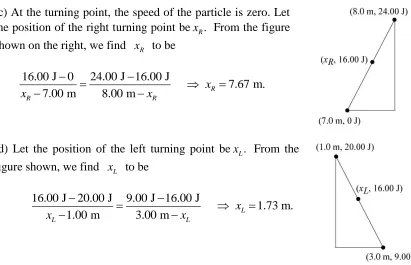
(c) At the turning point, the speed of the particle is zero. Let the position of the right turning point bexR. From the figure shown on the right, we find xR to be
16.00 J 0 24.00 J 16.00 J
7.67 m.
7.00 m 8.00 m R
R R
x
x x
(d) Let the position of the left turning point bexL. From the figure shown, we find xL to be
16.00 J 20.00 J 9.00 J 16.00 J
1.73 m.
1.00 m 3.00 m L
L L
x
x x
39. From the figure, we see that at x = 4.5 m, the potential energy is U1 = 15 J. If the speed is v = 7.0 m/s, then the kinetic energy is
K1 = mv2/2 = (0.90 kg)(7.0 m/s)2/2 = 22 J. The total energy is E1 = U1+ K1 = (15 + 22) J = 37 J.
(a) At x = 1.0 m, the potential energy is U2 = 35 J. By energy conservation, we have K2 = 2.0 J > 0. This means that the particle can reach there with a corresponding speed
2 2
2 2(2.0 J)
2.1 m/s. 0.90 kg
K v
m
x
U F
x
From the figure we have 35 J 15 J 10 N 2 m 4 m
x
F
.
(c) Since the magnitudeFx 0, the force points in the +x direction.
(d) At x = 7.0 m, the potential energy is U3 = 45 J, which exceeds the initial total energy E1. Thus, the particle can never reach there. At the turning point, the kinetic energy is zero. Between x = 5 and 6 m, the potential energy is given by
( ) 15 30( 5), 5 6. U x x x
Thus, the turning point is found by solving 37 15 30( x5), which yields x = 5.7 m. (e) At x = 5.0 m, the force acting on the particle is
(45 15) J
30 N (6 5) m
x
U F
x
.
The magnitude is |Fx| 30 N .
(f) The fact that Fx0indicated that the force points in the –x direction. 40. (a) The force at the equilibrium position r = req is
13 7
eq eq eq
12 6
0 0
dU A B
F
r r
dr r r
which leads to the result
r A
B
A B
eq
F
HG
I
KJ
F
HG
I
KJ
2
112 1 6
1 6
. .
(b) This defines a minimum in the potential energy curve (as can be verified either by a graph or by taking another derivative and verifying that it is concave upward at this point), which means that for values of r slightly smaller than req the slope of the curve is negative (so the force is positive, repulsive).
(c) And for values of r slightly larger than req the slope of the curve must be positive (so the force is negative, attractive).
(b) A plot of the potential energy curve (SI units understood) and the energy E (the horizontal line) is shown for 0 x 10 m.
(c) The problem asks for a graphical determination of the turning points, which are the points on the curve corresponding to the total energy computed in part (a). The result for the smallest turning point (determined, to be honest, by more careful means) is x = 1.3 m. (d) And the result for the largest turning point is x = 9.1 m.
(e) Since K = E – U, then maximizing K involves finding the minimum of U. A graphical determination suggests that this occurs at x = 4.0 m, which plugs into the expression E – U = –3.7 – (–4xe–x/4) to give K2.16 J 2.2 J. Alternatively, one can measure from the graph from the minimum of the U curve up to the level representing the total energy E and thereby obtain an estimate of K at that point.
(f) As mentioned in the previous part, the minimum of the U curve occurs at x = 4.0 m. (g) The force (understood to be in newtons) follows from the potential energy, using Eq. 8-20 (and Appendix E if students are unfamiliar with such derivatives).
F dU
dx x e
x
4 4
b g
/(h) This revisits the considerations of parts (d) and (e) (since we are returning to the minimum of U(x)) — but now with the advantage of having the analytic result of part (g). We see that the location that produces F = 0 is exactly x = 4.0 m.
42. Since the velocity is constant, a0 and the horizontal component of the worker's push F cos (where = 32°) must equal the friction force magnitude fk = k FN. Also, the
vertical forces must cancel, implying
applied (8.0N)(0.70m) 5.6 J
W
(a) The work done on the block by the worker is, using Eq. 7-7,
W Fdcos
b gb
71 N 9.2 m cos32g
5 6 10. 2J .(b) Since fk = k (mg + F sin ), we find Eth f dk (60 N)(9.2 m)5.6 10 J. 2
43. (a) Using Eq. 7-8, we have Wapplied(8.0 N)(0.70 m)5.6 J.
(b) Using Eq. 8-31, the thermal energy generated isEth f dk (5.0 N)(0.70 m)3.5 J.
44. (a) The work is W = Fd = (35.0 N)(3.00 m) = 105 J.
(b) The total amount of energy that has gone to thermal forms is (see Eq. 8-31 and Eq. 6-2)
Eth = k mgd = (0.600)(4.00 kg)(9.80 m/s2)(3.00 m) = 70.6 J.
If 40.0 J has gone to the block then (70.6 – 40.0) J = 30.6 J has gone to the floor.
(c) Much of the work (105 J) has been “wasted” due to the 70.6 J of thermal energy generated, but there still remains (105 – 70.6 ) J = 34.4 J that has gone into increasing the kinetic energy of the block. (It has not gone into increasing the potential energy of the block because the floor is presumed to be horizontal.)
45. THINK Work is done against friction while pulling a block along the floor at a constant speed.
EXPRESS Place the x-axis along the path of the block and the y-axis normal to the floor. The free-body diagram is shown below. The x and the y component of Newton's second law are
x: F cos – f = 0 y: FN + F sin – mg = 0,
The work done on the block by the force in the rope is WFdcos. Similarly, the increase in thermal energy of the block-floor system due to the frictional force is given by Eq. 8-29, Eth fd.
ANALYZE (a) Substituting the values given, we find the work done on the block by the rope’s force to be
cos (7.68 N)(4.06 m) cos15.0 30.1 J.
W Fd
(b) The increase in thermal energy is Eth fd(7.42 N)(4.06 m)30.1 J.
(c) We can use Newton's second law of motion to obtain the frictional and normal forces, then use k = f/FN to obtain the coefficient of friction. The x-component of Newton’s law
gives
f = F cos = (7.68 N)cos15.0= 7.42 N. Similarly, the y-component yields
FN = mg – F sin = (3.57 kg)(9.8 m/s2) – (7.68 N)sin15.0= 33.0 N.
Thus, the coefficient of kinetic friction is
7.42 N
0.225. 33.0 N
k N f F
LEARN In this problem, the block moves at a constant speed so that K 0, i.e., no change in kinetic energy. The work done by the external force is converted into thermal energy of the system, W Eth.
46. We work this using English units (with g = 32 ft/s), but for consistency we convert the weight to pounds
1 1b
(9.0) oz 0.56 lb
16 oz mg
which implies m 0.018 lb s /ft 2 (which can be phrased as 0.018 slug as explained in Appendix D). And we convert the initial speed to feet-per-second
vi
F
HG
I
KJ
( .818
3600 120
mi h) 5280 ft mi
s h ft s
2 2 2 2 th
1 1
( ) ( ) (0.018)(120 110 ) 0 20 ft lb.
2 i f i f 2
E m v v mg y y
47. We use SI units so m = 0.075 kg. Equation 8-33 provides Eth = –Emec for the energy “lost” in the sense of this problem. Thus,
2 2 th
2 2 2
1
( ) ( )
2 1
(0.075 kg)[(12 m/s) (10.5 m/s) ] (0.075 kg)(9.8 m/s )(1.1 m 2.1 m) 2
0.53 J.
i f i f
E m v v mg y y
48. We use Eq. 8-31 to obtainEth f dk (10 N)(5.0 m)50 J, and Eq. 7-8 to get
(2.0 N)(5.0 m) 10 J.
W Fd
Similarly, Eq. 8-31 gives
W K U E
U
th
10 35 50
which yields U = –75 J. By Eq. 8-1, then, the work done by gravity is W = –U = 75 J. 49. THINK As the bear slides down the tree, its gravitational potential energy is converted into both kinetic energy and thermal energy.
EXPRESS We take the initial gravitational potential energy to be Ui = mgL, where L is
the length of the tree, and final gravitational potential energy at the bottom to be Uf = 0.
To solve this problem, we note that the changes in the mechanical and thermal energies must sum to zero.
ANALYZE (a) Substituting the values given, the change in gravitational potential energy is
2 3
(25 kg)(9.8 m/s )(12 m) 2.9 10 J.
f i
U U U mgL
(b) The final speed is vf 5.6 m/s. Therefore, the kinetic energy is
2 2 2
1 1
(25 kg)(5.6 m/s) 3.9 10 J.
2 2
f f
K mv
(c) The change in thermal energy is Eth = fL, where f is the magnitude of the average frictional force; therefore, from Eth K U 0, we find f to be
2 3
2 3.9 10 J 2.9 10 J
2.1 10 N. 12 m
K U
f
L
LEARN In this problem, no external work is done to the bear. Therefore,
th mech th 0,
W E E E K U
which implies K U Eth U fL. Thus, Eth fL can be interpreted as the additional change (decrease) in kinetic energy due to frictional force.
50. Equation 8-33 provides Eth = –Emec for the energy “lost” in the sense of this problem. Thus,
2 2 th
2 2 2
4 1
( ) ( )
2 1
(60 kg)[(24 m/s) (22 m/s) ] (60 kg)(9.8 m/s )(14 m) 2
1.1 10 J.
i f i f
E m v v mg y y
That the angle of 25° is nowhere used in this calculation is indicative of the fact that energy is a scalar quantity.
51. (a) The initial potential energy is
Ui mgyi (520 kg) 9.8 m s (300 m) 1.53 10 J
2 6
d
i
where +y is upward and y = 0 at the bottom (so that Uf = 0).
(b) Since fk = k FN = k mg cos we haveEth f dk kmgdcos from Eq. 8-31.
Now, the hillside surface (of length d = 500 m) is treated as an hypotenuse of a 3-4-5 triangle, so cos = x/d where x = 400 m. Therefore,
E mgd x
d mgx
k k
th ( . ) (0 25 520 9 8 400) ( . ) ( )51 10. J . 5
(c) Using Eq. 8-31 (with W = 0) we find
6 6 6
th 0 (1.53 10 J) 0 (5.1 10 J) 1.02 10 J
f i i f
K K U U E . (d) FromKf mv2/ 2, we obtain v = 63 m/s.
52. (a) An appropriate picture (once friction is included) for this problem is Figure 8-3 in the textbook. We apply Eq. 8-31, Eth = fk d, and relate initial kinetic energy Ki to the
"resting" potential energy Ur:
Ki + Ui = fkd + Kr + Ur 20.0 J + 0 = fkd + 0 +
1 2kd
where fk = 10.0 N and k = 400 N/m. We solve the equation for d using the quadratic
formula or by using the polynomial solver on an appropriate calculator, with d = 0.292 m being the only positive root.
(b) We apply Eq. 8-31 again and relate Ur to the "second" kinetic energy Ks it has at the
unstretched position.
Kr + Ur = fkd + Ks + Us
1 2kd
2
= fkd + Ks+ 0
Using the result from part (a), this yields Ks = 14.2 J.
53. (a) The vertical forces acting on the block are the normal force, upward, and the force of gravity, downward. Since the vertical component of the block's acceleration is zero, Newton's second law requires FN = mg, where m is the mass of the block. Thus f = k FN
= k mg. The increase in thermal energy is given by Eth = fd = k mgD, where D is the
distance the block moves before coming to rest. Using Eq. 8-29, we have Eth
b gb
0 25 35. . kggd
9 8. m s2ib g
7 8. m 67J.(b) The block has its maximum kinetic energy Kmax just as it leaves the spring and enters the region where friction acts. Therefore, the maximum kinetic energy equals the thermal energy generated in bringing the block back to rest, 67 J.
(c) The energy that appears as kinetic energy is originally in the form of potential energy in the compressed spring. Thus,Kmax Ui 1kx
2 2
, where k is the spring constant and x is the compression. Thus,
x K
k
2 2 67
640 0 46
max
. .
J
N m m
b g
54. (a) Using the force analysis shown in Chapter 6, we find the normal force cos
N
F mg (where mg = 267 N) which means fk =kFN=k mg cos .
Thus, Eq. 8-31 yields
Eth f dk kmgdcos 010 267 61. . cos2015 10. J.
2
b gb gb g
(b) The potential energy change is
The initial kinetic energy is
2 2
2
1 1 267 N
(0.457 m/s ) 2.8 J.
2 2 9.8 m/s
i i
K mv
Therefore, using Eq. 8-33 (with W = 0), the final kinetic energy is
Kf Ki UEth 2 8 5 6 10 2 15 10 2 4 1 10 2J
.
c
.h
. . .Consequently, the final speed is vf 2Kf m55. m s.
55. (a) With x = 0.075 m and k 320 N m, Eq. 7-26 yields Ws 1kx
2 2
0 90. J. For later reference, this is equal to the negative of U.
(b) Analyzing forces, we find FN = mg, which means fk kFN kmg. With d = x, Eq.
8-31 yields
Eth f dk kmgx( . ) ( . ) ( . ) ( .0 25 2 5 9 8 0 075)0 46. J.
(c) Equation 8-33 (with W = 0) indicates that the initial kinetic energy is Ki UEth0 90 0 46. . 136. J
which leads to vi 2K mi 10. m s.
56. Energy conservation, as expressed by Eq. 8-33 (with W = 0) leads to 2
th
2 2
1
0 0 0
2 1
(200 N/m)(0.15 m) (2.0 kg)(9.8 m/s )(0.75 m) 2.25 J 2
i f i f k
k k
E K K U U f d kx
mgd
which yields k = 0.15 as the coefficient of kinetic friction.
57. Since the valley is frictionless, the only reason for the speed being less when it reaches the higher level is the gain in potential energy U = mgh where h = 1.1 m. Sliding along the rough surface of the higher level, the block finally stops since its remaining kinetic energy has turned to thermal energyEth f dk mgd , where
0.60
. Thus, Eq. 8-33 (with W = 0) provides us with an equation to solve for the distance d:
Ki UEth mg h
b
dg
d v g
h
i
2 2 12. m.
58. This can be worked entirely by the methods of Chapters 2–6, but we will use energy methods in as many steps as possible.
(a) By a force analysis of the style done in Chapter 6, we find the normal force has magnitude FN = mg cos (where = 40°), which means fk = kFN = k mg cos where
k = 0.15. Thus, Eq. 8-31 yields
Eth = fk d = k mgd cos .
Also, elementary trigonometry leads us to conclude that U = mgd sin . Eq. 8-33 (with W = 0 and Kf = 0) provides an equation for determining d:
K U E
mv mgd
i
i k
th
1 2
2
sin cos
b
g
where vi 14. m s. Dividing by mass and rearranging, we obtain
2
0.13m.
2 (sin cos )
i
k v d
g
(b) Now that we know where on the incline it stops (d' = 0.13 + 0.55 = 0.68 m from the bottom), we can use Eq. 8-33 again (with W = 0 and now with Ki = 0) to describe the
final kinetic energy (at the bottom):