T. Zykova-Timan,1, 2 U. Tartaglino,1, 2, 3 D. Ceresoli,1, 2 and E. Tosatti†1, 2, 4 1International School for Advanced Studies (SISSA),
via Beirut 2, 34014 Trieste, Italy 2INFM Democritos National Simulation Center,
via Beirut 2, 34014 Trieste, Italy 3IFF, FZ-J¨ulich, 52425 J¨ulich, Germany
4International Center for Theoretical Physics (ICTP),
Strada Costiera 11, 34014, Trieste, Italy
The high temperature surface properties of alkali halide crystals are very unusual. Through molec-ular dynamics simulations based on Tosi-Fumi potentials, we predict that crystalline NaCl (100) should remain stable without any precursor signals of melting up to and even above the bulk melt-ing pointTm. In a metastable state, it should even be possible to overheat NaCl (100) by at least
50 K. The reasons leading to this lack of surface self-wetting are investigated. We will briefly dis-cuss the results of calculations of the solid-vapor and liquid-vapor interface free energies, showing that the former is unusually low and the latter unusually high, and explaining why. Due to that the mutual interaction among solid-liquid and liquid-vapor interfaces, otherwise unknown, must be strongly attractive at short distance, leading to the collapse of any liquid film attempting to nucleate at the solid surface. This scenario naturally explains the large incomplete wetting angle of a drop of melt on NaCl (100).
Keywords: Surface stress; Surface thermodynamics; Wetting; Alkali halides; Molten salt surfaces; Molecular dynamics simulation.
I. INTRODUCTION
Interest is increasing toward adhesion, the structure and physics of solid-liquid interfaces, and the structure of solid-liquid surfaces, particularly of com-plex and molecular systems. In order to gain more insight into these prob-lems, there is a strong need for good case studies, to use as well-understood starting points.
One of the easiest starting points may be to study the relationship and contact of a liquid with its own solid, a clear situation where there will be no ambiguity of physical description, no uncertainty in chemical composi-tion, no segregation phenomena, all of them complications present in the study of adhesion between different substances.
Adhesion of a liquid onto the surface of its own solid usually materializes spontaneously with temperature. Most solid surfaces are known to wet
∗to appear in: “Highlights in the quantum theory of condensed matter”(in honor of Mario Tosi), Edizioni della Scuola Normale Superiore, Pisa, Italy (2005).
themselves spontaneously with an atomically thin film of melt, when their temperature T is brought close enough to the melting point Tm of the bulk solid. The phenomenon whereby the thicknessl(T) of the liquid film diverges continuously and critically asT → Tm is commonly referred to
as (complete) surface melting[1, 2].
There are actually a number of exceptions to this behavior. Some solid surfaces in particular remain fully crystalline as T → Tm. This
sur-face non-melting phenomenon, originally discovered in molecular dynam-ics simulations of Au(111)[3] and independently observed experimentally in Pb(111)[4], is known for the close-packed face of other metals too, such as Al(111)[5].
Here we are concerned with the surface of alkali halides, crystals well known for their unusually stable neutral (100) faces. Addressing a long time ago the NaCl (100) surface, bubble experiments by Mutaftschiev and coworkers revealed incomplete wetting of the solid surfaces by their own melt[6, 7], moreover with an extraordinarily large partial wetting angle of 48◦. This kind of incomplete wetting, as is physically clear, and as was demonstrated on metals surfaces[2, 8], is associated with non-melting of the crystal surface.
In this paper we will review our recent theory work, where we showed by direct simulation the surface non-melting of NaCl (100)[9, 10]. The reasons leading to this kind of surface non-melting are investigated. First, we will show the solid surface free energy calculated by thermodynamic integration, and see that at high temperature it drops due to a larger anharmonicity than in most other solid surfaces. Next, we will examine the surface tension of the liquid NaCl surface, we will find unusually large, owing to a surface entropy deficit, connected with the local surface short range molecular order. The solid-liquid interface free energy will finally be argued to be large, due to a 26% density difference. We will also discuss qualitatively – were hypothetically the solid-vapor interface to split into a pair of solid-liquid and liquid-vapor interfaces, with a thicknesslof liquid in between – the interaction free energyV(l) expected between them. This interaction is here strongly attractive at short range, leading to the collapse of any liquid film attempting to nucleate at the solid-vapor interface, and causing surface non-melting.
II. SIMULATIONS WITH TOSI-FUMI POTENTIALS
The high temperature properties of solid NaCl bulk and NaCl (100) slabs were studied by classical molecular dynamics (MD) simulations. NaCl was described with the potential of Tosi and Fumi[12] who accurately parametrized a Born-Mayer-Huggins form. The Coulomb long-range in-teractions were treated by the standard three dimensional (3D) Ewald method applied to a geometry consisting of infinitely repeated identical crystal slabs. Simulated systems generally comprised about 2000–5000 molecular units, with a time-step of 1 fs, and a typical simulation time of 200 ps. Long-range forces severely limit size and time in these simula-tions by comparison with the order-of-magnitude larger sizes and longer times typically affordable for systems with short range forces[8, 13]. We took explicit care to ensure that all our results are not crucially affected by small sizes, and that full equilibration was achieved in all cases. We checked that 80 ˚A of vacuum between repeated slabs are sufficient to pre-vent the interaction of a liquid slab with its own replicas[10]. Calculations were done at constant cell size and with periodic boundary conditions. Thermal expansion was taken care of by readjusting the (x, y) size of the cell at each temperature so as to cancel the (x, y) stress in the bulk solid. The theoretical thermal expansion was 4.05×10⁻⁵K−1, compared with
3.83×10⁻⁵K−1 in experiment. The theoretical bulk melting temperature
TM of NaCl was calculated by two phase coexistence to be 1066±20 K. Remarkably, this Tosi-Fumi melting temperature is extremely close to the experimental melting temperature of 1073.8 K. The volume expansion at melting is about (27±2)%, also in excellent agreement with the
experi-mental value of 26%.
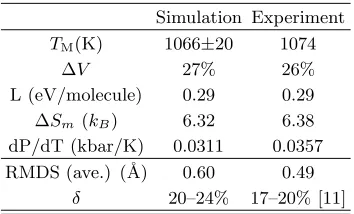
Tab. I lists some of the calculated thermodynamical quantities at high temperature, close to the melting point. These results provide an indepen-dent confirmation of the outstanding quality of the Tosi-Fumi description of thermodynamics of NaCl, even at very high temperatures and as we shall see even at surfaces, where it was by no way guaranteed.
III. SURFACE FREE ENERGIES AND NON-MELTING OF NACL(100)
High temperature simulations of crystalline NaCl(100) slabs directly showed the full stability of the dry, solid surface up to TM. Moreover, a well pronounced metastability of the slab solid faces above the melting pointTMindicated a clear surface non-melting behavior. We found that a much higher (“surface spinodal”) temperatureTS≈TM+ 150 K needs to be reached before the crystalline NaCl (100) surface spontaneously melts.
Simulation Experiment
TM(K) 1066±20 1074
∆V 27% 26%
L (eV/molecule) 0.29 0.29 ∆Sm (kB) 6.32 6.38
dP/dT (kbar/K) 0.0311 0.0357 RMDS (ave.) (˚A) 0.60 0.49
δ 20–24% 17–20% [11]
TABLE I: High temperature properties of NaCl. TMis the melting temperature;
∆V is the volume jump at the melting point; L is the latent heat of melting; ∆Sm
is the entropy variation at the melting point; dP/dT is the resulting Clausius-Clapeyron ratio at the melting point. RMSD is the averaged root mean square displacement of atoms at the melting point; δ is the RMSD over the Na–Cl
distance, for the Lindemann melting criterion.
At any temperature betweenTMandTS, bulk melting can only originate through nucleation. Even though nucleation of the melt is in reality likely to proceed from a localized surface droplet or defect, it is instructive to consider a very idealized nucleus consisting of a uniform liquid film of thicknessl. As a function of temperature, there will be a critical nucleation thickness lcrit decreasing from ∞to zero between TM andTS[3, 13]. The free energy difference per unit area between a surface with a liquid film of thicknessl and the same surface in its full crystalline state is
G(l) =−ρλl
T TM
−1
+ (γSL+γLV−γSV) +V(l) (1)
The first term is the gain due to the melting of the solid atT > TM. Here
λ is the latent heat per unit mass andρ is the liquid mass density. The second term ∆γ∞≡(γSL+γLV−γSV), is the free energy imbalance caused by replacing the SV interface with the SL+LV pair of interfaces, supposed to be non-interacting. The last term V(l) is an interface interaction, rep-resenting the correction toγSL+γLV when the two interfaces are at close distance. This definition impliesV(+∞) = 0 andV(0) =−∆γ∞. At very
large distance the interaction disappears. The solid-vapor crystal surface is instead recovered when the SL and LV interfaces collapse, and the liquid film disappears at l= 0. The non-melting condition γSL+γLV> γSV, or ∆γ∞>0 implies that here the interactionV(l) is mainly attractive.
This formulation indicates three possible origins for non-melting: an exceptionally low free energyγSV of the solid surface; an unusually large free energyγSLof the solid-liquid interface; a relatively high surface tension
γLVof liquid NaCl. As detailed elsewhere[9, 10], all three mechanisms are actually relevant to NaCl(100).
0
200
400
600
800 1000 1200
80
120
160
200
γ
(mJ/m
2
)
T
m(a)
NaCl(100)
γ
SV
γ
SV
harm
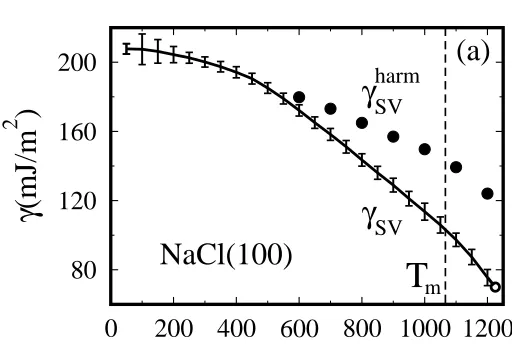
FIG. 1: The solid surface free energy of NaCl(100) calculated from thermody-namic integration (circles: effective harmonic approximation).
through standard thermodynamic integration, using
∂(F/T)
∂(1/T)
N,V
=E, (2)
where E is the surface internal energy, extracted from simulation of the crystalline NaCl(100) slab and the corresponding bulk at increasing T from 50 K to 1200 K. The surface free energy in Fig. 1 shows a large drop at high temperatures, with an increasing deviation from an effective harmonic behavior above 600 K, indicating very strong surface anharmonicity in this regime. The main source of this anharmonicity is connected with large root mean square thermal fluctuations of the surface Cl and Na ions above 20% of the Na–Cl distance, largely exceeding the canonical Lindemann values. [10]
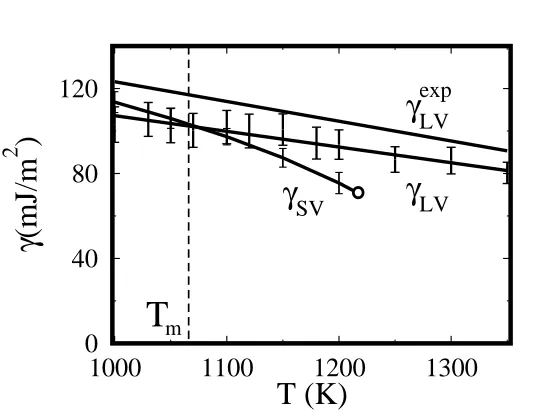
The liquid-vapor free energy, equal to the liquid surface tension, was evaluated from simulations of liquid NaCl slabs via the standard Kirkwood-Buff formula[14]. The first thing we note in the result, shown in Fig. 2 is that right at Tm the solid and liquid surface free energies are essentially identical, 103±4 and 104±8 mJ/m2respectively. This is very unusual, and
implies directly surface non-melting, because clearly ∆γ∞≡(γSL+γLV−
γSV) > 0. In fact, even though we did not calculate γSL, this interface free energy has no reason to be very small, owing to the large solid-liquid density difference. We independently estimated a lower bound forγSL to be 36±6 mJ/m2[10].
1000
1100
1200
1300
T (K)
0
40
80
120
γ
(mJ/m
2
)
γ
LV
exp
γ
LV
γ
SV
T
mFIG. 2: The calculated liquid surface free energy calculated. The NaCl (100) surface free energy is also shown in the temperature range from 1000 K to 1250 K.
−20 −10 0
z (A) z (A)
−20 −10 0
−20 −10 0
0.0 0.5 1.0
0.0
0.0 0.5 0.5
1.0 1.0
ρ/ρ
bulk
ρ/ρ
bulk
−20 −10 0
0.0 0.5 1.0
Ar
Al
Pb
NaCl
o o
(a)
(b)
(c)
(d)
An important clue is provided by surface entropy (per unit area)
Ssurf =−dγ/dT. The temperature dependence of two surface free ener-gies of Fig. 2 shows a factor 2.6 lower surface entropy SLV of the liquid surface compared with that of the solid surface. This liquid surface en-tropy deficit (SED) strongly suggests some underlying surface short range order. Short range order can in turn also explain why the surface tension is here as high as the solid surface free energy. The surface profile indicates that the order is clearly not layering: so what is it instead?
The answer we find is that charge order, already very important in bulk, plays a newer and enhanced role at the molecular liquid surface. If surface thermal fluctuations are indeed very large, we find them revealingly
correlated. For a Na+ ion that instantaneously moves e.g., out of the surface, there is at least one accompanying Cl−, also moving out; and vice versa. So on one hand the large fluctuations smear the average liquid vapor density profile, bridging very gently between the liquid and essentially zero in the vapor, (Fig. 3). On the other hand the two body correlations, described e.g., by the the Na-Cl pair correlation function, or by its integral, the ion coordination numberN, do not vanish identically in the vapor, but tend to a typical value corresponding to the NaCl molecule, (plus in fact a large concentration of dimers, Na2Cl2). The lack of freedom implied by the incipient molecular bond explains the entropy deficit, and the consequent large surface tension of the molten salt surface. To confirm if this is true, we recalculatedγSLmodifying the forces in the Kirkwood-Buff formula by removing all contributions from surface ions whose coordination is between zero and 1.3, the average NaCl vapor value, which amounts to suppress the molecular order at the liquid-vapor interface [9]. This construction, meant to provide a qualitative estimate of where would the surface tension drop if surface molecular order were absent, gives a surface tension of about 50 mJ/m2[9]. With a surface tension this low, surface non-melting would in fact disappear, and wetting of the solid surface by the molten salt would be complete. Hence the high surface tension of liquid NaCl can indeed be ascribed to surface molecular short range order, ultimately due to charge neutrality. This result confirms an early surmise by Goodisman and Pastor[16].
IV. INTERFACE INTERACTION
In this short speculative section we further rationalize the results above within the phenomenological framework of Eq.(1), where besides the bare interface free energies just calculated, an interaction V(l) appears. We will not present a calculation of V(l), but simply discuss it on physical grounds, in the light of our new microscopic understanding gained through simulations, and calculations of interface free energies just reviewed[9]. The definition of interface interactionV(l) given earlier impliedV(+∞) =
0 and V(0) =−∆γ∞. At very large distance the interaction disappears.
and merge at very close quarters, they will eventually yield the SV interface upon their collapse, when the liquid film disappears altogether at l = 0. The non-melting conditionγSL+γLV> γSV, or ∆γ∞>0 implies here that the interactionV(l) is attractive at short range.
In non-melting metal surfaces, a source of finite-range attraction was described as the result of a constructive interference between two equal-period damped density oscillations, one entering the liquid film from the solid side, the other, due to surface layering, from the vacuum side. Here, one of the two oscillations, namely that on the vacuum side, is missing, because there is no layering at the molten salt surface. At large dis-tance the main interaction between the SL and the LV NaCl interfaces will essentially be due to electrostatic forces and to dispersion forces. The latter in particular give rise to an additional long-range interface interaction Vdis(l) = H l−2 which is dominant at large distances. Here
H is the Hamaker constant, that can be estimated through the formula
H = (π/12)C6(ns−nl)(nl−nv) = 0.00119 eV, whereC6 = 72.5 eV ˚A6
is the coefficient of the Lennard-Jones interaction between chlorine ions,
ns, nl and nv are the number of Cl− ions per unit volume respectively in the solid, liquid and vapor phases[17]. Since the liquid density is only about 79% that of the solid, this constant is positive which implies a long range repulsion of the SL and LV interfaces. A simple estimate indicates however thatVdis< H/a2= 0.51 mJ/m2, a value that makes it irrelevant in practice.
Therefore we expect the effective interaction V(l) to be very weak in NaCl, everywhere except very close to zero range, l ≈ a. Here it will
suddenly turn strongly attractive, V(0) ≈ −∆γ∞. The physics of this
short range attraction has already been described, because it amounts to the free energy gained by replacing the two costly LV and SL interfaces, with the single and less costly SV interface.
V. CONCLUSIONS
Acknowledgments
We wrote this paper to honor Mario Tosi on his 72th birthday. The high accuracy and dependability which we found for his potentials is a tribute to his long-lasting work. This project was sponsored by the Italian Ministry of University and Research, through COFIN2003, COFIN2004 and FIRB RBAU01LX5H; and by INFM, through the“Iniziativa Trasversale Calcolo Parallelo”. Calculations were performed on the IBM-SP4 at CINECA, Casalecchio (Bologna). We are grateful to E. A. Jagla for his help and discussions about NaCl(100).
[1] J. F. van der Veen, B. Pluis and A. W. Denier van der Gon, in: R. Vanselow, R. F. Howe (Eds.), “Chemistry and Physics of Solid Surfaces VII”, Springer, Heidelberg, 1988.
[2] U. Tartaglino, T. Zykova-Timan, F. Ercolessi and E. Tosatti, Phys. Reps. 411, 291 (2005).
[3] P. Carnevali, F. Ercolessi, and E. Tosatti, Phys. Rev. B36(1987), 6701. [4] B. Pluis, A. W. Denier van der Gon, J. W. M. Frenken and J. F. van der
Veen, Phys. Rev. Lett.59(1987), 2678.
[5] A. W. Denier van der Gon, R. J. Smith, J. M. Gay, D. J. O’connor and J. F. van der Veen, Surf. Sci. 227, Issues 1-2 , 1 March 1990, Pages 143-149 [6] G. Grange and B. Mutaftschiev, Surf.Sci.47, 723 (1975).
[7] L. Komunjer, D. Clausse and B. Mutaftschiev, J. Cryst. Growth 182, 205 (1997).
[8] F. D. Di Tolla, F. Ercolessi and E. Tosatti, Phys. Rev. Lett.74, 3201 (1995). [9] T. Zykova-Timan, D. Ceresoli, U. Tartaglino and E. Tosatti, Phys. Rev.
Lett.94, 176105 (2005).
[10] T. Zykova-Timan, U. Tartaglino, D. Ceresoli and E. Tosatti, J. Chem. Phys. 123(2005).
[11] M. A. Viswamitra and K. Jayalakshmi, Acta Crystllogr. A28, S189, 1972. [12] M. P. Tosi and F. G. Fumi, J. Phys. Chem. Solids25, 45 (1964).
[13] F. di Tolla, E. Tosatti, and F. Ercolessi, Interplay of melting, wetting, overheating and faceting on metal surfaces: theory and simulation, in: K. Binder, G. Ciccotti (Eds.), “Monte Carlo and Molecular Dynamics of Con-densed Matter Systems”, Italian Physical Society, Bologna, 1996, p. 345 [14] N. H. March and M. P. Tosi,Atomic dynamics in liquids (Macmillan,
Lon-don, 1976).
[15] T. Zykova-Timan, U. Tartaglino, D. Ceresoli, W. Sekkal-Zaoui and E. Tosatti, Surf. Sci.566-568(2004) 794
[16] R. W. Pastor and J. Goodisman, J. Chem. Phys.68, 3654 (1978)