M E T H O D O L O G Y
Open Access
The application of high-throughput
sequencing technology to analysis of
amoA
phylogeny and environmental niche
specialisation of terrestrial bacterial
ammonia-oxidisers
Axel Aigle, James I. Prosser and Cécile Gubry-Rangin
*Abstract
Background:Characterisation of microbial communities increasingly involves use of high throughput sequencing methods (e.g. MiSeq Illumina) that amplify relatively short sequences of 16S rRNA or functional genes, the latter including ammonia monooxygenase subunit A (amoA), a key functional gene for ammonia oxidising bacteria (AOB) and archaea (AOA). The availability of these techniques, in combination with developments in phylogenetic methodology, provides the potential for better analysis of microbial niche specialisation. This study aimed to develop an approach for sequencing of bacterial and archaealamoAgenes amplified from soil using bioinformatics pipelines developed for general analysis of functional genes and employed sequence data to reassess phylogeny and niche specialisation in terrestrial bacterial ammonia oxidisers.
Results:amoArichness and community composition differed with bioinformatics approaches used but analysis of MiSeq sequences was reliable for both archaeal and bacterialamoAgenes and was used for subsequent assessment of potential niche specialisation of soil bacteria ammonia oxidisers. Prior to ecological analysis, phylogenetic analysis ofNitrosospira, which dominates soil AOB, was revisited using a phylogenetic analysis of 16S rRNA andamoAgenes in available AOB genomes. This analysis supported congruence between phylogenies of the two genes and increased previous phylogenetic resolution, providing support for additional gene clusters of potential ecological significance. Analysis of environmental sequences using these new sequencing,
bioinformatics and phylogenetic approaches demonstrated, for the first time, similar niche specialisation in AOB to that in AOA, indicating pH as a key ecological factor controlling the composition of soil ammonia oxidiser communities.
Conclusions:This study presents the first bioinformatics pipeline for optimal analysis of Illumina MiSeq sequencing of a functional gene and is adaptable to any amplicon size (even genes larger than 500 bp). The pipeline was used to provide an up-to-date phylogenetic analysis of terrestrial betaproteobacterialamoAgenes and to demonstrate the importance of soil pH for their niche specialisation and is broadly applicable to other ecosystems and diverse microbiomes.
Keywords:Nitrification,amoA, 16S rRNA, Archaea, Bacteria, Illumina MiSeq, pH
© The Author(s). 2019Open AccessThis article is distributed under the terms of the Creative Commons Attribution 4.0 International License (http://creativecommons.org/licenses/by/4.0/), which permits unrestricted use, distribution, and reproduction in any medium, provided you give appropriate credit to the original author(s) and the source, provide a link to the Creative Commons license, and indicate if changes were made. The Creative Commons Public Domain Dedication waiver (http://creativecommons.org/publicdomain/zero/1.0/) applies to the data made available in this article, unless otherwise stated. * Correspondence:[email protected]
Background
Despite advances in our understanding of niche special-isation of ammonia oxidisers during the past 20 years, the successive discoveries of archaeal ammonia oxidisers (AOA) [1] and complete ammonia oxidisers (comam-mox) [2, 3] have focussed recent research activities on these organisms. In particular, in terrestrial environ-ments, pH has been described as the most important soil factor regulating the AOA ecological and evolution-ary adaptation [4,5] and, while there is currently insuffi-cient information on which to assess comammox growth or adaptation in this environment, the ecophysiology of soil comammox appears to differ from that of strains that have been cultivated and described to date [6]. In contrast, the modern technological and methodological advances have not benefited analysis of the longer-known bacterial ammonia oxidisers (AOB), despite dem-onstration of their significant role in nitrification, par-ticularly in managed and heavily fertilised agricultural soils [7–9]. In particular, phylogenetic analyses have gained in complexity and consequent accuracy, and finer phylogenetic analyses of soil AOB [10–14] would benefit from increases in knowledge of the diversity of soil AOB since previous in-depth studies (e.g. [15]). In particular, reassessment of the terrestrial Nitrosospiraphylogeny is required using more advanced phylogenetic methods, as this genus dominates soil AOB communities.
Increased phylogenetic resolution improves the ability to assess microbial niche specialisation, at least in organ-isms whose phylogenetic structure reflects their eco-logical niche [16]. Several environmental factors have been proposed as important for controlling the commu-nity structure of terrestrial AOB, including the nature and quantity of organic matter [17], mean annual temperature [18], amount of nitrogen fertilisation [19] and soil pH [20]. However, understanding of the niche differentiation of these microorganisms in natural unfer-tilised environments remains limited and the role of ter-restrial Nitrosospira in nitrous oxide emissions [8, 9] justifies the need for an improved analysis of their niche specialisation to clarify their ecological adaptation and environmental impact. This analysis would specifically test the extent to which pH is a key factor controlling the ecological distribution of AOB in soils, as previously demonstrated for AOA in natural environments [4, 5], by using a soil pH gradient of several unfertilised land management (grassland, forest, agricultural or moor-land) soils.
Many studies target the 16S rRNA gene to charac-terise phylogenetic diversity within a sample, while others target genes involved in specific ecosystem functions, facilitating ecological and evolutionary pre-dictions within a functional group. The ammonia monooxygenase subunit A (amoA) gene targets an
ecosystem function, ammonia oxidation, which is the rate-limiting step in nitrification, a key process in bio-geochemical cycling of nitrogen. The amoA gene has been extensively used to estimate the abundance and diversity of bacterial (AOB) and archaeal ammonia oxidisers (AOA) and has provided evidence for their high phylogenetic diversity in natural environments, including soil [21]. Therefore, the amoA gene was chosen as the optimal functional gene to analyse soil AOB diversity and two sets of primers have been mainly employed in terrestrial environments, amoA-1F/amoA-2R [22] and CrenamoA23f/CrenamoA616r [23], amplifying 429-bp and 629-bp fragments of bacterial and archaeal amoA genes, respectively. De-velopments in high-throughput sequencing (HTS) technologies have greatly increased our ability to characterise natural microbial communities, through significant increases in the depth and accuracy of se-quencing of genes of interest, amplified from environ-mental DNA (see [24] for a recent review). Currently, one of the most commonly applied approaches is short-read sequencing (e.g. Illumina) technology, pro-ducing a high number of sequences (> 15 Gbp per Illumina MiSeq V3 run) with high accuracy (99.9% at QC30) but short sequence length (< 500 bp). Surpris-ingly, this approach has not been applied to terrestrial ammonia oxidisers using the above primers [21, 22], probably due to the large size of the amplicons (mainly for the AOA). Therefore, this study provided the opportunity to develop a bioinformatics pipeline for amplicons of various size (including those > 500-bp) and its validity was assessed by comparison with a previously acquired 454 sequencing dataset with known phylogenetic resolution [4].
The aims of this study were, therefore, i) to revisit the amoA phylogeny of terrestrial Nitrosospira and improve its phylogenetic resolution; ii) to improve the analysis of niche specialisation of terrestrial Nitrosospira to clarify their ecological adaptation and test the extent to which pH is a key factor in their ecological distribution; and iii) to provide an Illumina MiSeq V3 sequencing approach for environmental analysis of the ammonia monooxy-genase subunit A (amoA) gene present in both bacterial and archaeal ammonia oxidisers, applicable to other functional genes.
Results and Discussion
Nitrosospiraclassification
Two genera of betaproteobacterial ammonia oxidisers have been described, Nitrosomonas and Nitrosospira [25], the latter including two previously described
gen-era, Nitrosolobus[26] andNitrosovibrio [27]. This study
focused on the Nitrosospira genus, which dominates betaproteobacterial ammonia oxidiser communities in soil. The 16S rRNA gene sequences from cultivated
Nitrosospira isolates and those amplified from
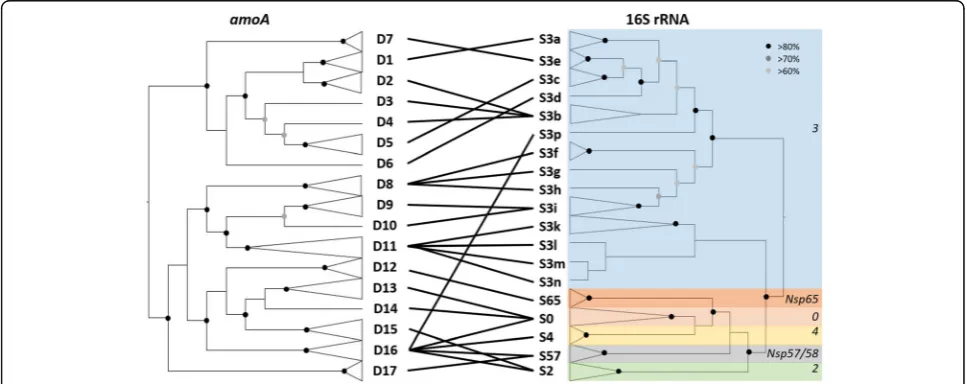
environ-mental samples have previously been classified within seven lineages, for which phylogenetic node support was not high [10–14]. Sequences of six of these lineages were retrieved in the present study at a high taxonomic rank-ing (sub-clades) usrank-ing 56 available Nitrosospira strains (Fig. 1 and Additional file 1: Figure S1), the exception being cluster 1 [10], for which no cultured isolate has yet been obtained. Analysis ofamoAand 16S rRNA gene sequences of these Nitrosospira strains, employing a Maximum-Likelihood phylogenetic framework, delin-eated 17 and 19 phylogenetic clusters, respectively (Fig. 1and Additional file 1: Figure S1, Table1), with most of the diversity being within the previously defined cluster 3. The majority of the 56 AOB strains analysed here contained a single amoA gene copy (Additional file 1: Table S1), but severalNitrosospiraspp. genomes contain > 1 different but highly homologousamoA genes, which probably originated from duplication events rather than horizontal gene transfer [30–32]. This finding, along with the presence of > 1 amoA gene copy in most de-scribedNitrosomonas genomes [33], has important con-sequences for quantification of terrestrial AOB in environmental communities using quantitative PCR
analysis ofamoA genes. Most nodes at the roots of indi-vidual clusters in both phylogenetic trees were strongly supported (> 80%), while support for more ancestral phylogenetic branching was supported for most of the nodes in both the 16S rRNA gene and the amoA gene phylogenies, even if some paraphyletic branching could not be resolved (Fig.1and Additional file1: Figure S1).
The present phylogenetic approach demonstrates that the previous 16S rRNA gene phylogenetic clustering for lineage 3 requires future refinement, as this previously described cluster is paraphyletic and contains numerous distinct clusters. While the present phylogenetic analysis did not aim to represent the extent ofNitrosospira diver-sity (on neither 16S rRNA or amoA genes), it provides evidence for the existence of clear and distinct lineages using both marker genes of cultivated strains (Fig. 1; Table 1and Additional file 1: Table S1) and, in contrast to earlier analysis [34], demonstrated a strong phylogen-etic congruence between amoA and 16 rRNA genes using a tanglegram approach (Fig. 1 and Additional file 1: Figure S2).
Niche specialisation of terrestrial bacterial ammonia oxidisers
A large majority (99.98% of the 199,295 sequences) of the environmental sequences obtained from the 33 soils amplified using bacterial primers affiliated to the
Nitro-sospira genus, which has been described as the most
abundant AOB genus in unfertilised soils, while
Nitroso-monas phylotypes are more frequently retrieved from
fertilised or ammonia-rich environments [30]. These amoA sequences were affiliated to ecologically coherent
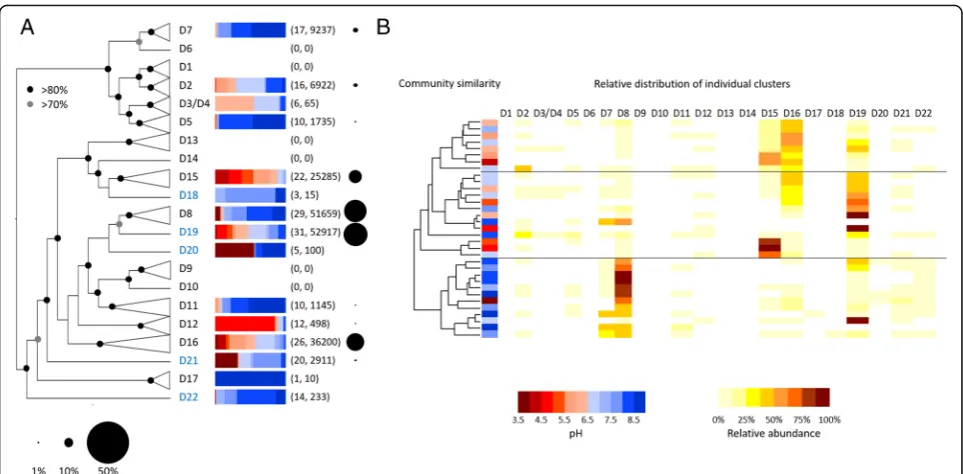
phylogenetic AOB clusters (Fig. 2a) and multivariate statistical analysis of their ecological distribution demon-strated greatest correlations with soil pH and, to a lesser extent, C:N ratio across a range of phylogenetic scales (Table 2, see Additional file 1: Table S2 for detailed re-sults). There is strong evidence for pH specialisation of AOA [4], but this strong influence of pH on AOB phylo-type distribution over multiple phylogenetic scales has not been described previously, suggesting a role for pH in determining community composition of all terrestrial ammonia oxidisers. A heatmap representing the relative abundance of each phylogenetic cluster in each soil indi-cated higher relative abundance of four clusters (D8, D15, D16 and D19) (Fig. 2b) and dominance of these clusters strongly influenced the general pH association with overall community similarity pattern. Sequences af-filiating to the cluster D8 were particularly abundant in neutro-alkaline soils. In contrast to such classical AOB ecological niche distribution, most AOB sequences in neutro-acidic soils affiliated with the D15, D16 and D19 clusters, but more genomes and cultures representative of these clusters are required for characterisation of their phenotypes. For example, AOB ureolytic activity has been proposed, among others, as a growth strategy in acidic conditions [21]. Other less abundant phylogenetic clusters would also benefit from further genomic and cultivation efforts (see Fig.2a).
Comparison of sequencing technologies
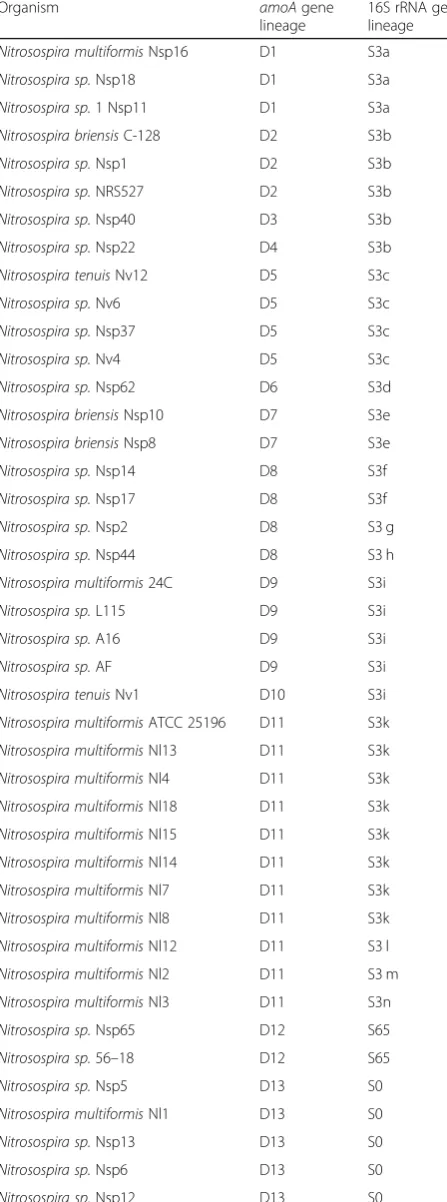
Comparisons of the diversity of environmental amoA gene sequences were made using both OTU richness Table 1TerrestrialNitrosospiraAOB strains used in this study
with relatedamoAand 16S rRNA gene phylogenetic affiliations (based on the phylogenetic trees presented in Fig.1)
Organism amoAgene
lineage
16S rRNA gene lineage
Nitrosospira multiformisNsp16 D1 S3a
Nitrosospira sp.Nsp18 D1 S3a
Nitrosospira sp.1 Nsp11 D1 S3a Nitrosospira briensisC-128 D2 S3b
Nitrosospira sp.Nsp1 D2 S3b
Nitrosospira sp.NRS527 D2 S3b
Nitrosospira sp.Nsp40 D3 S3b
Nitrosospira sp.Nsp22 D4 S3b
Nitrosospira tenuisNv12 D5 S3c
Nitrosospira sp.Nv6 D5 S3c
Nitrosospira sp.Nsp37 D5 S3c
Nitrosospira sp.Nv4 D5 S3c
Nitrosospira sp.Nsp62 D6 S3d
Nitrosospira briensisNsp10 D7 S3e Nitrosospira briensisNsp8 D7 S3e
Nitrosospira sp.Nsp14 D8 S3f
Nitrosospira sp.Nsp17 D8 S3f
Nitrosospira sp.Nsp2 D8 S3 g
Nitrosospira sp.Nsp44 D8 S3 h
Nitrosospira multiformis24C D9 S3i
Nitrosospira sp.L115 D9 S3i
Nitrosospira sp.A16 D9 S3i
Nitrosospira sp.AF D9 S3i
Nitrosospira tenuisNv1 D10 S3i Nitrosospira multiformisATCC 25196 D11 S3k Nitrosospira multiformisNl13 D11 S3k Nitrosospira multiformisNl4 D11 S3k Nitrosospira multiformisNl18 D11 S3k Nitrosospira multiformisNl15 D11 S3k Nitrosospira multiformisNl14 D11 S3k Nitrosospira multiformisNl7 D11 S3k Nitrosospira multiformisNl8 D11 S3k Nitrosospira multiformisNl12 D11 S3 l Nitrosospira multiformisNl2 D11 S3 m Nitrosospira multiformisNl3 D11 S3n
Nitrosospira sp.Nsp65 D12 S65
Nitrosospira sp.56–18 D12 S65
Nitrosospira sp.Nsp5 D13 S0
Nitrosospira multiformisNl1 D13 S0
Nitrosospira sp.Nsp13 D13 S0
Nitrosospira sp.Nsp6 D13 S0
Nitrosospira sp.Nsp12 D13 S0
Table 1TerrestrialNitrosospiraAOB strains used in this study with relatedamoAand 16S rRNA gene phylogenetic affiliations (based on the phylogenetic trees presented in Fig.1)
(Continued)
Organism amoAgene
lineage
16S rRNA gene lineage
Nitrosospira sp.40KI D13 S0
Nitrosospira sp.NpAV D14 S0
Nitrosospira lacusAPG3 D16 S0
Nitrosospira sp.Ka4 D16 S4
Nitrosospira sp.Ka3 D16 S4
Nitrosospira sp.Nsp41 D16 S3p
Nitrosospira sp.Nsp58 D16 S57
Nitrosospira sp.B6 D16 S2
Nitrosospira sp.III7 D15 S2
Nitrosospira sp.O13 D15 S2
Nitrosospira sp.O4 D15 S2
Nitrosospira sp.AHB1 D15 S2
Nitrosospira sp.Nsp57 D17 S57
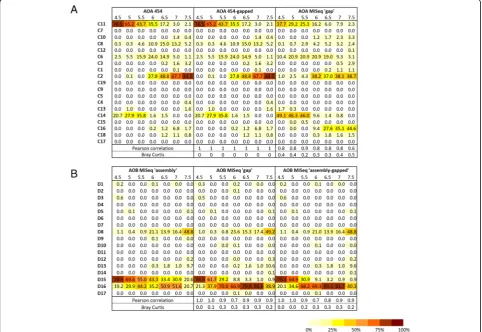
(at 100% sequence similarity) and microbial community composition for archaea and bacteria independently using the different sequencing approaches, 454 (only available for AOA and previously described in [4]) and Illumina MiSeq sequencing. Both measures varied with sequencing technology and associated bioinformatics pipeline (Fig. 3; Additional file 1: Table S3). Despite a low error rate for Illumina sequencing, the read length (2 × 300 bp) limited the number of cleaned sequences (Additional file 1: Table S3). Two bioinformatics pipe-lines (‘assembly’vs.‘gap’) were used to analyse the AOB amoA amplicons (490-bp), due to overlapping of the paired-end sequences. Rarefied richness was similar or higher for the ‘gap’ pipeline than the ‘assembly’ pipe-line, due to the higher restrictive size selection in the latter (Additional file 1: Table S3). Despite detection of similar to greater richness, phylogenetic assignment of sequences was differentially affected by the pipeline used (Bray-Curtis≥0.3 for 4 soils; Fig.3b). Community dissimilarity obtained using the full-length ‘assembly’ and ‘assembly-gapped’ sequences indicated that the
‘gapped’ region contains important phylogenetic infor-mation, especially for the sequences present in acido-neutral soils (Fig. 3b). However, a similar comparative analysis of AOAamoA sequences, using previously ob-tained 454 sequences (i.e. 454 full-length sequences vs
454-gapped sequences), indicated that deletion of the central archaeal amoA gene region did not impact significantly on estimated archaeal community compos-ition (Bray-Curtis = 0 for all 7 soils; Fig. 3a) or phylo-genetic reconstruction (Additional file 1: Figure S4; Euclidian distance between the 2 trees = 0.28). The dif-ference in community composition between the AOA 454 and the AOA MiSeq‘gap’(Fig.3a) certainly derives from different sampling dates for the 2 different technologies. Therefore, these analyses were used to validate the MiSeq ‘gap’ and ‘assembly’ bioinformatics pipelines for AOA and AOB amoA sequencing, respectively). These findings suggest that Illumina MiSeq sequencing can be successfully used to provide a good characterisation of AOA and AOB amoA amplicon sequences to infer their community structure. The sequencing bioinformatics pipelines presented here are freely available on GitHub (https://github.com/AigleAxel/ amoA_MiSeq_sequencing/) allowing their implementation for other functional genes of interest. Specific advantages and associated limitations of each bioinformatics pipeline (e.g. high recovered diversity for the ‘gap’ pipeline and high confidence of sequence phylogenetic affiliation for the ‘assembly’ pipeline) indicate the requirement for thorough comparison of approaches for cleaning of sequencing data for any novel analysed gene.
Conclusions
This study offers an optimal bioinformatics pipeline for high-throughput sequencing of functional genes, adaptable to any amplicon size and freely available on GitHub (https://github.com/AigleAxel/amoA_MiSeq_sequencing/).
This tool will be useful to the researchers interested in diverse microbiome communities, especially those working on functional genes of interest larger than 500 bp. The developed pipeline was used to provide a revisited and up-to-date phylogenetic analysis of terres-trial betaproteobacterial ammonia oxidiseramoAgenes and further analysis provided evidence for soil pH as a key ecological factor controlling the niche specialisation of those microbes.
Material and methods
Sample origin, DNA extraction andamoAamplification Bacterial and archaeal amoA sequences were obtained from 26 and 39 soils, respectively, selected from the UK Countryside Survey (http://www.countrysidesurvey.org. uk/) and from 7 soil samples from long-term experimen-tal field plots maintained for more than 60 years at a range of soil pH values (SRUC, Craibstone, Scotland, grid reference NJ872104). Soils were selected to include a wide range of characteristics (Additional file 1: Table S4), including pH (3.48–8.55), C:N ratio (8.5–22.1) and moisture content (14.2–75.1%), across several ecosystem Table 2Correlations between measured environmental factors
and relative abundance of bacterial ammonia oxidiser lineages (identified at different identity thresholds) in 33 soils used for analysis of bacterialamoAgene sequences
Environmental factors
Identity (%)
90 95 97 100
pH 0.001*** 0.001*** 0.001*** 0.001***
C 0.274 0.003** 0.006** 0.001***
N 0.166 0.016* 0.020* 0.001***
C:N 0.001*** 0.002** 0.003** 0.002**
Moisture 0.459 0.264 0.112 0.015*
LOI 0.139 0.198 0.032* 0.072.
Vegetation 0.406 0.172 0.083 . 0.106
Number of clusters 14 71 187 3868
Significance codes:p< 0.001 ***;p< 0.01 **;p< 0.05 *
managements (agricultural, forest, grassland, moorland), and a previous study [4] suggests that they contain the full range of currently known mesophilic terrestrial AOA.
Soil DNA was extracted as described by [35] and modified by [36] and bacterial and archaealamoA genes were amplified, respectively, using primers amoA-1F/ amoA-2R [22] and CrenamoA23f/CrenamoA616r [23] containing additional specific MiSeq-tailed sequences, following manufacturers’ recommendations. All amplifi-cations were performed in a 25-μl reaction using the KAPA HiFi HotStart ReadyMix (Kapa Biosystems) with 0.4μM of each primer and 40–60 ng of template. Ther-mal cycling conditions were 95 °C for 3 min followed by 35 cycles of 98 °C for 20 s, 58 °C for 15 s, 72 °C for 15 s or 20 s for bacterial and archaeal amoA respectively, followed by 72 °C for 5 min. Bacterial amoA MiSeq se-quencing was performed on all 33 soil samples, allowing the construction of a non-redundant database of repre-sentative soil AOB amoA sequences to complement an equivalent database of AOA amoA sequences obtained using 454 sequencing on 46 soils [4].
High throughput sequencing
Prior to MiSeq Illumina sequencing, PCR-amplified se-quences were cleaned using AMPure® XP beads (Beck-man Coulter) and PCR-indexing was performed using the Nextera XT Index Kit according to the manufac-turer’s protocol. Following further cleaning, library quantification, normalisation and pooling of 144 samples per sequencing run were performed prior to paired-end V3 MiSeq sequencing, enabling production of 2 × 300-bp reads.
Sequence analysis bioinformatic pipelines
The different read lengths of archaeal and bacterial amoA genes generated by Illumina MiSeq sequencing necessitated use of two read assembly strategies. The first, with overlapping reads and termed the ‘assembly’ pipeline, was used for bacterial amoA only. The second, with non-overlapping reads and termed the ‘gap’ pipe-line, was used for both archaeal and bacterialamoA. For the ‘assembly’ pipeline, reads were demultiplexed using NextGENe software and, for each sample, paired-end raw reads were trimmed (−- paired) with very low qual-ity filtration (−q 15) using Trim Galore (V0.4.5, [37]) and further filtered using the filterAndTrim command from the DADA2 package (maxEE = c(2,2), maxN = 0) [38]. Minimal size selection and read truncation (trun-cLen = c(229,229), minLen = 229) were applied to allow overlap of 10 bases between the paired-end reads. As-sembly was performed using the paired-end assembler PEAR with default parameters [39] and assembled reads were size-selected using usearch (−fastx_truncate
-trunclen 448) [40] and subsequently dereplicated at 100% sequence identity (while keeping the read abun-dance information) using usearch (−cluster_fast -cen-troids -sizeout). Finally, dereplicated reads were translated and any read that included a stop codon was deleted prior to removal of chimera and singletons using unoise3 [41].
Initial steps of the‘gap’pipeline were similar to the‘ as-sembly’ pipeline except that minimal size selection was modified (−length 200), as a compromise between selec-tion of high-quality reads (especially for reverse reads) and conservation of high-quality information (carried by higher number of nucleotides) to maximise the output number of reads. The reverse reads were reverse-complemented and concatenated with the forward reads (instead of being assembled via PEAR). The following steps (dereplication, amino acid translation, chimera and singleton removal) were the same as in the ‘assembly’ pipeline.
Phylogenetic tree analysis
Known terrestrial AOB are affiliated to theNitrosospira genus (including the previously namedNitrosolobusand
Nitrosovibriostrains). TheamoAand 16S rRNA gene
se-quences of 56 Nitrosospirastrains were recovered from NCBI and JGI databases (see Additional file1: Table S1), were considered as reference sequences and were used to build reference Maximum-Likelihood phylogenetic trees (see below). The AOB amoA reference sequences were also merged with the dereplicated AOB amoA MiSeq sequences (from the‘assembly’ pipeline) and an-other phylogenetic tree was constructed to assess global diversity in soil. Finally, the dereplicated AOAamoA se-quences previously produced on 46 UK soils using 454 were trimmed in the central sequence region (corre-sponding to the gap region of the MiSeq ‘gap’ pipeline and resulting in 264 bp) and a Bayesian phylogenetic tree was constructed to compare to a previously published phylogenetic tree [5].
All sequence datasets were aligned using Mafft [45] and further processed with TrimAl [46] with “- gappy-out” flag. For all amoA datasets, any sequence in which a recombination event was detected using at least 3 of 4 methods (RDP, Bootscan, GENECOV and MaxChi) im-plemented in RDP4 software [47] was removed after manual curation. Codon saturation was detected by comparing the maximum likelihood distance and the number of differences (Pairwise distance, MEGA 6.06, [48]) for each codon between each pair of sequences. This was statistically assessed using the Xia test imple-mented in DAMBE [49] and the third codon position was removed.
All AOB phylogenetic trees (both amoA and 16S rRNA trees) were constructed using IQ-TREE [50] (with partitioning of the 2 codon positions for theamoAtrees) by inferring the best-fit substitution model using Model-Finder [28] and estimating bootstrap supports using the SH-aLRT test [29]. Trees were visualised in FigTree (http://tree.bio.ed.ac.uk/software/figtree/) and phylogen-etic clusters were defined based on strong bootstrap values (> 80% in most cases). Visual assessment of con-gruence between the two reference trees (amoA vs 16S rRNA gene trees) was performed using phylo.io [51] and cluster correspondence was manually assessed based on individual strain correspondence.
For the AOA‘454-gapped’ Bayesian phylogenetic tree, the best substitution model per codon position esti-mated using PartitionFinder [52] was SYM + G and GTR + G for the codon position 1 and 2, respectively, and this partition was used to implement two independ-ent Bayesian relaxed molecular clock phylogenetic analyses in BEAST (Bayesian Evolutionary Analysis Sam-pling Trees) version 1.8 [53] with 5 108MCMC, using a Yule speciation prior and an uncorrelated lognormal
relaxed clock model. Convergence of the two runs was confirmed using Tracer version 1.5 (tree.bio.ed.ac.uk/ software/tracer/) and maximum clade credibility trees from converged MCMC runs were generated using TreeAnnotator version 1.7 [53] after 50% of the MCMC steps were removed. Both AOA 454 and AOA 454-gapped tree were compared using phylo.io [51] and tree-compare in the DendroPy library [44].
AOB putative environmental specialisation
Environmental factors (pH, nitrogen and carbon con-tents, C:N ratio, organic matter content (LOI), moisture content and vegetation type) associated with AOBamoA sequence composition were identified by canonical cor-respondence analysis followed by permutation tests per-formed on relative abundance matrices using the vegan package [43] in R. Relative abundance matrices were built by blasting each AOB amoA sample sequence ob-tained from the 50 soils against the bacterial non-redundant database clustered at different cut-offs (usearch id 0.9, 0.95, 0.97 and 1), as performed for the archaeal dataset [54]. As pH appeared to be the most significant factor for niche specialisation in this AOB dataset, relative abundance of sequences in the CEH and Craibstone soil samples affiliating within each phylogen-etic cluster, based on the MiSeq ‘assembly’ pipeline se-quencing technology, were represented using a heatmap.
Additional file
Additional file 1:Figure S1.FullamoA(A) and 16S rRNA (B) gene trees for the bacterial ammonia oxidiser reference sequences.Figure S2. Congruence ofamoAand 16S rRNA gene phylogenetic trees for the bacterial ammonia oxidiser reference sequences. Shades of blue indicate similarity between the most common nodes between the two trees.Figure S3. Full bacterialamoAgene tree including the environmental sequences (assembled using the MiSeq‘Assembly’pipeline) and the reference sequences. Figure S4.Congruence between two phylogenetic trees of 370 archaealamoA sequences (see Gubry-Rangin et al., 2015) with (A) or without (B) the sequence gap corresponding to the MiSeq AOA gap pipeline. Branch colour corresponds to congruence between the two trees.Table S1.Identification of sequences of the 56 terrestrialNitrosospiraAOB strains used in this study. For strains with > 1 copy, only the sequences used in this study presented. n.a.–not applicable. Table S2.Statistical results of the canonical correspondence and permutation analyses performed on the AOBamoAcommunities clustered at different iden-tity cut-offs.Table S3.Number of sequences and richness of AOA and AOB amoAsequences retrieved in each Craibstone soil sample with different sequen-cing technologies, with or without rarefaction to the smallest number of se-quences obtained in one of the two technologies.Table S4.Characteristics of the 33 UK soils (26 CEH followed by 7 Craibstone soils) used in the multivariate statistics analysis. (DOCX 1560 kb)
Acknowledgements
We would like to thank Tony Travis for his support on Linux. We thank Rob Griffiths and Tim Goodall for providing the UK DNA samples and associated contextual data.
Authors’contributions
Funding
AA was supported by a Natural Environmental Research Council grant (NE/ L006286/1) and CGR by a Royal Society University Research Fellowship (UF150571).
Availability of data and materials
Scripts developed in this work can be found on GitHub (https://github.com/ AigleAxel/amoA_MiSeq_sequencing/). Read data have been submitted to the Sequence Read Archive (SRA) under the accession number PRJNA548755.
Ethics approval and consent to participate Not applicable.
Consent for publication Not applicable.
Competing interests
The authors declare that they have no competing interests.
Received: 21 May 2019 Accepted: 6 June 2019
References
1. Könneke M, Bernhard AE, de la Torre JR, Walker CB, Waterbury JB, Stahl DA. Isolation of an autotrophic ammonia-oxidizing marine archaeon. Nature. 2005;437:543–6.
2. Daims H, Lebedeva EV, Pjevac P, Han P, Herbold C, Albertsen M, Jehmlich N, Palatinszky M, Vierheilig J, Bulaev A, Kirkegaard RH, von Bergen M, Rattei T, Bendinger B, Nielsen PH, Wagner M. Complete nitrification by Nitrospira bacteria. Nature. 2015;528:504–9.
3. van Kessel MA, Speth DR, Albertsen M, Nielsen PH, Op den Camp HJ, Kartal B, Jetten MS, Lücker S. Complete nitrification by a single microorganism. Nature. 2015;528:555–9.
4. Gubry-Rangin C, Hai B, Quince C, Engel M, Thomson BC, James P, Schloter M, Griffiths RI, Prosser JI, Nicol GW. Niche specialization of terrestrial archaeal ammonia oxidizers. PNAS. 2011;108:21206–11.
5. Gubry-Rangin C, Kratsch C, Williams TA, McHardy AC, Embley TM, Prosser JI, Macqueen DJ. Coupling of diversification and pH adaptation during the evolution of terrestrial Thaumarchaeota. PNAS. 2015;112:9370–5.
6. Orellana LH, Chee-Sanford JC, Sanford RA, Löffler FE, Konstantinidis KT. Year-round shotgun metagenomes reveal stable microbial communities in agricultural soils and novel Ammonia oxidizers responding to fertilization. Appl Environ Microbiol. 2018;84:e01646–17.
7. Di HJ, Cameron KC, Shen JP, Winefield CS, O’Callaghan M, Bowatte S, He JZ. Nitrification driven by bacteria and not archaea in nitrogen-rich grassland soils. Nat Geosci. 2009;2:621–4.
8. Hink L, Nicol GW, Prosser JI. Archaea produce lower yields of N2 O than bacteria during aerobic ammonia oxidation in soil. Environ Microbiol. 2017; 19:4829–37.
9. Hink L, Gubry-Rangin C, Nicol GW, Prosser JI. The consequences of niche and physiological differentiation of archaeal and bacterial ammonia oxidisers for nitrous oxide emissions. ISME J. 2018;12:1084–93.
10. Stephen JR, McCaig AE, Smith Z, Prosser JI, Embley TM. Molecular diversity of soil and marine 16S rRNA gene sequences related toβ-subgroup ammonia-oxidizing bacteria. Appl Environ Microbiol. 1996;62:4147–54. 11. Kowalchuk GA, Stephen JR, De Boer W, Prosser JI, Embley TM, Woldendorp
JW. Analysis of ammonia-oxidizing bacteria of theβ-subdivision of the class Proteobacteria in coastal sand dunes by denaturing gradient gel electrophoresis and sequencing of PCR amplified 16S ribosomal DNA fragments. Appl Environ Microbiol. 1997;63:1489–97.
12. Purkhold U, Pommerening-Röser A, Juretschko S, Schmid MC, Koops H-P, Wagner M. Phylogeny of all recognized species of ammonia oxidizers based on comparative 16S rRNA andamoAsequence analysis: implications for molecular diversity surveys. Appl Environ Microbiol. 2000;66:5368–82. 13. Purkhold U, Wagner M, Timmermann G, Pommerening-Röser A, Koops
HP. 16S rRNA andamoA-based phylogeny of 12 novel
betaproteobacterial ammonia-oxidizing isolates: extension of the dataset and proposal of a new lineage within the nitrosomonads. Int J Syst Evol Microbiol. 2003;53:1485–94.
14. Prosser JI, Head IM, Stein LY. The familyNitrosomonadaceae. In: Rosenberg E, DeLong EF, Lory S, Stackebrandt E, Thompson F, editors. The prokaryotes. Heidelberg: Springer Berlin/Heidelberg; 2014. p. 901–18.
15. Urakawa H, Garcia J, Nielsen J, Le V, Kozlowski J, Stein L, Lim C, Pommerening-Röser A, Martens-Habbena W, Stahl D, Klotz M.Nitrosospira lacussp. nov., a psychrotolerant, ammonia-oxidizing bacterium from sandy lake sediment. Int J Syst Evol Microbiol. 2015;65(1):242–50.
16. Losos JB. Phylogenetic niche conservatism, phylogenetic signal and the relationship between phylogenetic relatedness and ecological similarity among species. Ecol Lett. 2008;11:995–1003.
17. Wessén E, Nyberg K, Jansson JK, Hallin S. Responses of bacterial and archaeal ammonia oxidizers to soil organic and fertilizer amendments under long-term management. Appl Soil Ecol. 2010;45:193–200.
18. Fierer N, Carney KM, Horner-Devine MC, Megonigal JP. The biogeography of ammonia-oxidizing bacterial communities in soil. Microb Ecol. 2009;58:435–45. 19. Yao H, Campbell CD, Chapman SJ, Freitag TE, Nicol GW, Singh BK.
Multi-factorial drivers of ammonia oxidizer communities: evidence from a national soil survey. Environ Microbiol. 2013;15:2545–56.
20. Stephen JR, Kowalchuk GA, Bruns MAV, McCaig AE, Phillips CJ, Embley TM, Prosser JI. Analysis of beta-subgroup proteobacterial ammonia oxidizer populations in soil by denaturing gradient gel electrophoresis analysis and hierarchical phylogenetic probing. Appl Environ Microbiol. 1998;64:2958–65. 21. Prosser JI, Nicol GW. Archaeal and bacterial ammonia oxidisers in soil: the
quest for niche specialisation and differentiation. Trends Microbiol. 2012;20: 523–31.
22. Rotthauwe JH, Witzel KP, Liesack W. The ammonia monooxygenase structural gene amoA as a functional marker: molecular fine-scale analysis of natural ammonia-oxidizing populations. Appl Environ Microbiol. 1997;63: 4704–12.
23. Tourna M, Freitag TE, Nicol GW, Prosser JI. Growth, activity and temperature responses of ammonia-oxidizing archaea and bacteria in soil microcosms. Environ Microbiol. 2008;10:1357–64.
24. Besser J, Carleton HA, Gerner-Smidt P, Lindsey RL, Trees E. Next-generation sequencing technologies and their application to the study and control of bacterial infections. Clin Microbiol. 2017;24:335–41.
25. Head I, Hiorns WD, Embley TM, McCarthy AJ, Saunders JR. The phylogeny of autotrophic ammonia-oxidizing bacteria as determined by analysis of 16S ribosomal RNA gene sequences. J Gen Microbiol. 1993;139:1147–53. 26. Watson SW, Mandel M. Comparison of the morphology and
deoxyribonucleic acid composition of 27 strains of nitrifying bacteria. J Bacteriol. 1971;107:563–9.
27. Harms H, Koops HP, Wehrmann H. An ammonia-oxidizing bacterium, Nitrosovibrio tenuisnov. gen. Nov. sp. Arch Microbiol. 1976;108:105–11. 28. Kalyaanamoorthy S, Minh BQ, Wong TKF, von Haeseler A, Jermiin LS.
ModelFinder: fast model selection for accurate phylogenetic estimates. Nat Methods. 2017;14:587–9.https://doi.org/10.1038/nmeth.4285.
29. Guindon S, Dufayard J-F, Lefort V, Anisimova M, Hordijk W, Gascuel O. New algorithms and methods to estimate maximum-likelihood phylogenies: assessing the performance of PhyML 3.0. Syst Biol. 2010;59:307–21. 30. Norton JM, Alzerreca JJ, Suwa Y, Klotz MG. Diversity of ammonia
monooxygenase operon in autotrophic ammonia-oxidizing bacteria. Arch Microbiol. 2002;177:139–49.
31. Klotz MG, Norton JM. Multiple copies of ammonia monooxygenase (amo) operons have evolved under biased AT/GC mutational pressure in ammonia-oxidizing autotrophic bacteria. FEMS Microbiol Lett. 1998; 168:303–11.
32. Khadka R, Clothier L, Wang L, Lim CK, Klotz MG, Dunfield PF. Evolutionary history of copper membrane monooxygenases. Front Microbiol. 2018;9: 2493.
33. Stein LY, Sayavedra-Soto LA, Hommes NG, Arp DJ. Differential regulation of amoAandamoBgene copies inNitrosomonas europaea. FEMS Microbiol Lett. 2000;192:163–8.
34. Koops H-P, Purkhold U, Pommerening-Röser A, Timmermann G, Wagner M. The lithoautotrophic ammonia-oxidizing bacteria. In: Dworkin M, Falkow S, Rosenberg E, Schleifer K-H, Stackebrandt E, editors. The prokaryotes– volume 5: Proteobacteria: alpha and Beta subclasses. New York: Springer; 2006. p. 778–811.
36. Nicol GW, Leininger S, Schleper C, Prosser JI. The influence of soil pH on the diversity, abundance and transcriptional activity of ammonia oxidizing archaea and bacteria. Environ Microbiol. 2008;10:2966–78.
37. Krueger F. Trim galore: a wrapper tool around Cutadapt and FastQC to consistently apply quality and adapter trimming to FastQ files. 2015.http:// www.bioinformatics.babraham.ac.uk/projects/trim_galore/
38. Callahan BJ, McMurdie PJ, Rosen MJ, Han AW, Johnson AJA, Holmes SP. DADA2: high-resolution sample inference from Illumina amplicon data. Nat Methods. 2016;13:581–3.
39. Zhang J, Kobert K, Flouri T, Stamatakis A. PEAR: a fast and accurate Illumina paired-end reAd mergeR. Bioinformatics. 2014;30:614–20.
40. Edgar RC. Search and clustering orders of magnitude faster than BLAST. Bioinformatics. 2010;26:2460–1.
41. Edgar RC. UNOISE2: improved error-correction for Illumina 16S and ITS amplicon sequencing. BioRxiv. 2016.https://doi.org/10.1101/081257. 42. R Core Team. R: a language and environment for statistical computing: R
Found Stat Comput; 2018.https://www.R-project.org/
43. Oksanen J, Blanchet FG, Kindt R. Vegan: community ecology package. R Package Ver. 2013;2:0–10.
44. Sukumaran J, Holder MT. DendroPy: a Python library for phylogenetic computing. Bioinformatics. 2010;26:1569–71.
45. Katoh K, Kuma K, Toh H, Miyata T. MAFFT version 5: improvement in accuracy of multiple sequence alignment. Nucleic Acids Res. 2005;33:511–8. 46. Capella-Gutierrez S, Silla-Martinez JM, Gabaldon T. trimAl: a tool for
automated alignment trimming in large-scale phylogenetic analyses. Bioinformatics. 2009;25:1972–3.
47. Martin DP, Lemey P, Lott M, Moulton V, Posada D, Lefeuvre P. RDP3: a flexible and fast computer program for analyzing recombination. Bioinformatics. 2010;26:2462–3.
48. Tamura K, Stecher G, Peterson D, Filipski A, Kumar S. MEGA6: molecular evolutionary genetics analysis version 6.0. Mol Biol Evol. 2013;30:2725–9. 49. Xia X, Xie Z. DAMBE: software package for data analysis in molecular
biology and evolution. J Hered. 2017;92:371–3.
50. Nguyen LT, Schmidt HA, von Haeseler A, Minh BQ. IQ-TREE: a fast and effective stochastic algorithm for estimating maximum likelihood phylogenies. Mol Biol Evol. 2015;32:268–74.
51. Robinson O, Dylus D, Dessimoz C. Phylo.Io: interactive viewing and comparison of large phylogenetic trees on the web. Mol Biol Evol. 2016;33: 2163–6.
52. Lanfear R, Calcott B, Ho SYW, Guindon S. PartitionFinder: combined selection of partitioning schemes and substitution models for phylogenetic analyses. Mol Biol Evol. 2012;29:1695–701.
53. Drummond AJ, Suchard MA, Xie D, Rambaut A. Bayesian phylogenetics with BEAUti and the BEAST 1.7. Mol Biol Evol. 2012;29:1969–73.
54. Vico Oton E, Quince C, Nicol GW, Prosser JI, Gubry-Rangin C. Phylogenetic congruence and ecological coherence in terrestrial Thaumarchaeota. ISME J. 2016;10:85–96.
Publisher’s Note