77
Article Information
Abstract
Keywords
Fitness Test, MADLC, Mobile Health, Mobile Apps, Smartphone Apps
The advent of mobile technology and applications are transforming the way health information is accessed, delivered and managed. Therefore, it is essential to have a mobile application for Sport Science students to measure their fitness scoring norm in a flexible way. One of the suggested alternatives is to develop the specific mobile application for the fitness test practiced in diploma and degree level in Universiti Teknologi MARA (UiTM) Pahang in order to reduce the errors made due to human error such as miswriting the numbers and misplacing the score sheets. This study focuses on the design of mobile application known as Fitness Test (FiTest). The motivation of the mobile application development is to be visible in providing the scoring norm of each fitness test given and improve the student engagement with the course. Assisted by the Mobile Application Development Life Cycle (MADLC) methodology, FiTest is hoped will cater and able to manage the teaching and learning process. Therefore, this paper discusses the mobile application design development of FSR-FiTest in details from the identification phase until the prototyping phase.
INTRODUCTION
The introduction of information and communication technologies (ICTs) brings a new hope for patients with more accessible and affordable healthcare solutions. There are a lot of mobile applications listed in any mobile platform such as SapoFitness, Time to Eat, Patient-Centered Assessment and Counseling Mobile Energy Balance (PmEB), StepUp, Mobile Personal Trainer (MOPET), CardioTrainer, MyFitnessPal and CalorieCounter which are free or with fee.Currently, hospitals and health systems are relying on ICT as a mean for improving quality, safety, and productivity of health care services (Silva, Rodrigues, Diez, Lopez-Coronado, & Saleem, 2015). In education field recently, the teaching and learning (T&L) process can be done through portable devices such as smartphones and tablets. Mobile learning is one of the famous educational trends for the coming years, so the institution of higher learning (IHL) need to embrace with this matter by encouraging the academicians to develop more mobile applications as tools for students to learn ubiquitously.
The Development of FiTest for institution of higher learning using Mobile
Application Development Lifecycle Model (MADLC): From Identification
Phase to Prototyping Phase
Mohd. Ikhsan Md. Raus1, Roger Canda2 , Mohd Zulkhairi Bin Mohd Azam3, Mohd Hanifa bin Sariman4, Wan Mohd Norsyam Bin Wan Norman5
1,2 Faculty of Computer & Mathematical Sciences, Universiti Teknologi MARA Pahang 3,4,5 Faculty of Sport Science & Recreation, Universiti Teknologi MARA Pahang
Corresponding email: [email protected]; [email protected]; [email protected]; [email protected];
78
Historically, the internet access to ICT for academicians and students in some countries is limited. However, now, with the economical internet access offered by the telecommunication provider allows students to learn interactively and they are willing to learn via mobile application without attending any classes. The advancement of smartphones has provided a platform for freelance developers to design third-party applications (mobile application), which greatly expand the functionality and utility of these mobile devices.Many users are actively seeking health-related information applications for these mobile devices (Smith, 2011). App developers have responded by producing thousands of health-related apps (Dolan, 2010). According to Fox (2010), nearly 1 over 10 smartphone users has downloaded a health-related app. The rapidly expanding category of health-related mobile application raises important public health among the smartphone users these days. Research conducted by Stragier & Mechant (2013) proved that online social networking and Mobile Fitness Apps (MFAs) may just provide a way of promoting physical activity as many smartphone applications enable people to track fitness workouts and share these with online peers.
The rest of the paper is organized as follows. Section II and Section III presents the related work focusing on mobile health technology and the emergence of mobile application. Section IV addresses the conventional method of conducting fitness test in UiTM Pahang for Faculty Sport Science & Recreation (FSR). The methodology on constructing the FiTest including the system architecture and user interface is addressed on Section V. Finally, Section VI concludes the paper and pinpoints possible future works.
MOBILE HEALTH TECHNOLOGY
The introduction of mobile device in the 90s has enabled physicians to easily download medical records, lab results, medical images, and drug information (Silva et al., 2015). Smartphones have gained acceptance as target devices for e-health applications (Liu, Zhu, Holroyd, & Seng, 2011), turning them into mHealth (mobile-health) applications. mHealth is a general term for mobile devices that are used in healthcare. In recent development of this field, attractive and innovative mobile applications has been developed to be used in smartphones or tablets (Yahmed, Bounenni, Chelly, & Jlassi, 2013). World Health Organization (WHO) defines mHealth as “medical and public health practice supported by mobile devices, such as mobile phones, patient monitoring devices, personal digital assistants (PDAs), and other wireless devices”.
Yahmed et al. (2013) defines mHealth as wireless telemedicine involving the use of mobile telecommunications and multimedia technologies and their integration with mobile healthcare delivery systems. mHealth is a promising tool for engaging patients in their own health care because most people own and regularly use a mobile phone (Schnall et al., 2016) and mostly it is free downloadable (Royston et al., 2015). It helps patients to improve their health in real time (Silva et al., 2015) or intermittently (Royston et al., 2015), enable them to personalize healthcare options and monitor progress (Silva et al., 2015; Handel, 2011; Varshney, 2014a; Silva, Lopes, Rodrigues, & Ray, 2011; Turner-McGrievy et al., 2013) and have a significant prevention of disease or in the treatment of patients with chronic disease such as diabetes (Silva et al., 2015; Schnall et al., 2016; Sama, Eapen, Weinfurt, Shah, & Schulman, 2014; Varshney, 2014a) and obesity (Cowan et al., 2012; Pagoto, Schneider, Jojic, Debiasse, & Mann, 2013; Lopes & Silva, 2011), as they are ubiquitous.
Therefore, it is necessary for FSR to have a mobile application on its own purpose to ease the work of academician and to give transparent scores to students based on the fitness test conducted.
WHY MOBILE APPLICATION?
A mobile application is a specialized software program that can run on platforms, such as smartphones, tablets, computers or other types of electronic devices (Schnall et al., 2016; Weinstein et al., 2014; Inukollu, Keshamon, Kang, & Inukollu, 2014) and be produced with adequate consideration of the needs of their intended users so that they are easy to use and perceived as useful (Royston et al., 2015). There is clearly a huge and growing opportunity for citizens to have health-care information on their phones, available offline as and when they need it. Health applications are often equipped with the capability to link to internet resources and services, including social networks, fitness, and healthcare providers (Sama et al., 2014) in improving the health outcomes.
79
2013; Silva et al., 2011; Hussain et al., 2015; Varshney, 2014b; Vithani & Kumar, 2014). This is to ensure that the new mHealth services have to be available anytime, anywhere and anyhow through a single point of access entry (Yahmed et al., 2013; Varshney, 2014b).The other reason for the mobile application development growth is due to reducing the cost of mobile application development (Varshney, 2014a; Silva et al., 2011) by the developers and to reach out the maximum users that can use the application in several mobile platforms (Royston et al., 2015; Dalmasso, Datta, Bonnet, & Nikaein, 2013). The market of mobile health applications is directed toward patients, clinicians, and healthcare professionals (Silva et al., 2015).
mHealth services are even becoming popular in developing countries where healthcare facilities are frequently remote and inaccessible. This is to ensure that the existance of mHealth can expand the healthcare coverage via online or offline (Varshney, 2014a). At the same time, the growth and the diversification of area in mHealth have outpaced the governmental efforts in regulation (Hussain et al., 2015).
As being emphasized in previous section, the advantages of having mobile application completely will ease the work academician and it will be accessible for FSR students in engaging with the course or program taken, either in diploma level or degree level.
CONVENTIONAL METHOD
The common practice nowadays when conducting any fitness testing is it requires a detailed and thorough preparation. The most important thing to consider is the scoring norm of the desired testing and it needs to be a valid and recognized norm that is vital to generate data from the testing results. Before deciding to use the right norm, generally, the academician must determine the age group and the gender that is going to be involved in the testing. Finding the norm can be difficult and time consuming as the academicians have to find a scoring norm that meets all the requirements.
Once the academicians have selected the correct scoring norm, which can be found in any fitness testing textbooks or related websites, the academicians now have to develop a scoring chart or score sheet. The score sheet needs to be precised and must have certain columns which include the subjects’ general information such as name, age, gender or affiliation. Other than that, the score sheet table must also include the test results so that the academician can write down the results in it. When the score sheets are finalized, the academicians have to print them out according to the total number of athletes. If the athletes are too many, then lots of paper and printer ink have to be in place before printing and this practice is time consuming depending on the type and quality of the printer and there will be lots of money required. The academicians need to prepare for the fitness testing in terms of equipment (cones, stopwatch, measuring tape, audio system, pen, etc), and the testing area.
On the testing day, the athletes must undergo their fitness testing and the academician needs to be alert and write down the results on the score sheet. However, data collection can be complicated depending on the weather because if it rains; the score sheets need to be protected from being wet or damaged. Once the paper gets wet, most probably the ink on the paper will wear out and results written can’t be seen clearly. If this happen, then the athletes have to go through the testing again in fatigue condition and surely they won’t produce the same results. This will affect the validity of the data itself. Worst case scenario, the results on the damaged paper can’t be considered and have to be set aside.
When the testing has completed, the academicians now have to analyze and interpret the results based on the scoring norm selected previously. Interpreting the results from the scoring norm usually is a time consuming and tiring process as the academician has to do it manually which need to refer the scoring norm and subjects’ results back and forth without making any mistake. During this process, most errors are made due to human error because of lots of factors such as miswrite the numbers, humans get tired and do not able to focus properly, misplace the score sheets and many more.
METHODOLOGY
80
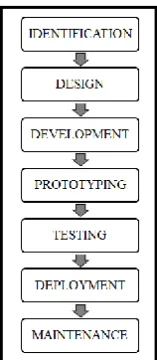
It is notable that these days, traditional information system is undergoing a process of adaptation to this new computing context. So, it is not possible to simply transferring the models of traditional software development to mobile application development (Inukollu et al., 2014) without making significant amendments. The prototype of FiTest is developed merely to satisfy the scoring norm calculated for each training and exercise without giving any information related to on how to construct the training, the benefits of the training and so forth, compared to the research done by Conroy, Yang, & Maher (2014).Mobile Application Development Lifecycle Model (MADLC) which has been proposed by Vithani & Kumar (2014) is used to develop FiTest, as depicted in Figure 1. The reason of choosing MADLC is the activities and tasks listed in each phase was clearly defined and elaborated by Vithani & Kumar (2014). Researchers also adapted several steps emphasized by Inukollu et al. (2014) to ensure the development of FiTest will succeed with minimum risks. MADLC involves seven (7) phases; identification phase, design phase, development phase, prototyping phase, testing phase, deployment phase and maintenance phase.
Fig. 1. Mobile Application Development Lifecycle Model (MADLC) (Vithani & Kumar, 2014)
Identification Phase
Identification phase is the first and foremost phase of mobile application development life cycle, which deals with functional and non- functional aspects of the application (Kendall & Kendall, 2014). In this phase, ideas are collected and categorized. The main objective is to come out with a new idea or improvement to the existing application. The ideas can come from the customer (also known as client) or from the developers.
The idea of FiTest came from Head of School of FSR, UiTM Pahang who requested to develop a simple mobile application of fitness test for their courses. Below are the courses related to the fitness tests which need to be done frequently during their course, either in diploma or degree level:
SPS564 - Advanced Conditioning
SPS451 - Physical Fitness And Wellness
SPS217 - Test, Measurement And Evaluation In Exercise And Sport
SPS240 - Exercise Methodology And Physical Conditioning For Sport
SPS280 - Methodology Of Sport Training N Coaching
SPS615 - Applied Sport Coaching
The fitness test that will be covered in this mobile application development consists of six (6) fitness test:
Bleep Test
The bleep test is a multi-stage fitness test in which the athlete must do 20 meter shuttle runs in time with the bleeps until the bleeps get too quick for the athlete.
Illinois Agility Run Test
The objective of the test is to monitor the development of the athlete's agility.
Push Up Test
81
Hand Grip Strength TestThe purpose of this test is to measure the maximum isometric strength of the hand and forearm muscles.
Sit and Reach Test
The sit and reach test is a common measure of flexibility, and specifically measures the flexibility of the lower back and hamstring muscles.
Standing Long Jump Test
The objective of the test is to measure the explosive power of the legs.
Researchers have done a review on the existing mobile application for each fitness test. Mostly, the applications are purposely to assist the athletes on how to perform the training via phone, provided with sound and voice instruction. The differences with the existing applications are documented. The other important task in this phase is to define the time required to develop FiTest. The work done by the mobile application idea team should then be documented and forwarded to the design team.
Design Phase
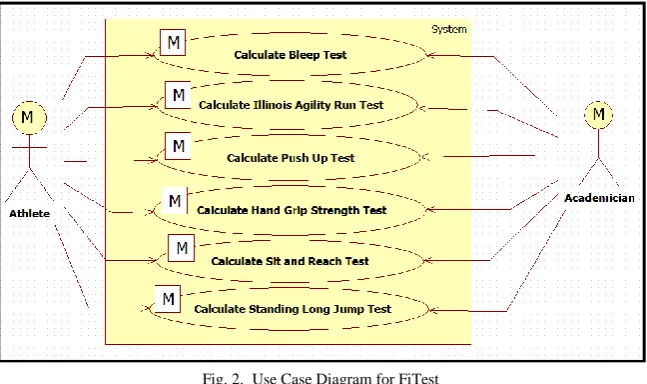
In this phase, the idea from the mobile application team is developed into an initial design of the application. Mobile Unified Modeling Language (M-UML) introduced by Saleh & El-Morr (2004) is adopted in the project management and system modeling respectively. The main advantage of UML is that, it creates visual models of system or application to be developed. UML contains a large set of graphical representation techniques. M-UML is the extension of existing UML used for system or web development and it is more feasible due to the advancements in remote evaluation, process mitigation, distributed object computing and mobility (Inukollu et al., 2014). Logical design was developed to satisfy the functional requirements of the proposed FiTest in the form of use case diagram (UCD) as depicted in Figure 2.
Fig. 2. Use Case Diagram for FiTest
The team has also identified the input data, which need to be entered by the student or academician, process involved for each fitness test such as the norm calculation and lastly the output or scoring norm for each test performed.
The example below shows the scoring norm calculation for Push Up Test. The input needed is (1) age, (2) gender and (3) repetitions of push up completed. The process to be calculated is shown in 0 below. For instances, if the athlete is female, age of 22 and capable to do 18 times push up, then the grading would be “Fair”. The scoring norm output is crucial to student or academician on notifying them which level they are currently in.
TABLE 1:NORMS FOR MUSCLE ENDURANCE USING THE STANDARD PUSH-UP TEST (Canadian Society for Exercise Physiology, 2003)
Age
(years) Poor Fair Good
Very
Good Excellent
82
15-19 ≤17 18-22 23-28 29-38 ≥39
20-29 ≤16 17-21 22-28 29-35 ≥36
Female
15-19 ≤11 12-17 18-24 25-32 ≥33
20-29 ≤9 10-14 15-20 21-29 ≥30
Development Phase
In this phase, the application is coded using Android Studio with JDK 1.8. Coding has been done parallel for different fitness tests, or known as module of the FiTest prototype. The code is developed first for the core functionalities, such as the development of Bleep Test module, Push Up Test module and so forth which are independent of each other. Subsequently, these modules can be integrated.
FiTest User Interface (UI)
In the second stage, user interface (UI) is designed so that it can be supported on as many mobile operating system platforms as possible. Figure 4 as shown above is the example of the UI designed for FiTest. Scoring norm or grading will be given by highlighting the stars as above with grading status as an output of each test module. For the time being, researchers are not focusing on the UI due to the lack of unexperienced mobile team members and time constraints. The FiTest only focuses on the scoring norm as the output for users. Finally, the documentation of the development phase is then forwarded to the prototyping phase.
Prototyping Phase
In this phase, the functional requirements of each prototype will be analyzed, tested and sent to the client for feedback. FiTest was given to the academician and students from FSR for their feedback. Each feedback was documented and requires changes through the development phase. The development, prototyping and testing phases are repeated until the final FiTest prototype is ready. The final prototype is sent to the academician and students for a final feedback. The work done in this prototyping phase is documented and then forwarded to the testing phase.
Testing Phase
Testing is one of the most important phases of any development lifecycle model. The testing of the FiTest prototype is performed on an emulator followed by testing on the real device. In future, the students of FSR UiTM Pahang will need to install FiTest into their mobile device for the purpose of User Acceptance Testing (UAT). The test cases are documented and forwarded to the academician for feedback.
Deployment Phase
83
process will require the research team to follow several guidelines outlined by the Google and telecommunication service provider.Maintenance Phase
The maintenance is the final phase of this model and this maintenance is a continuous process. Any feedback provided from the academician and student from FSR UiTM Pahang will be documented and fix for improvements. Academicians from FSR will also marketing the FiTest by advertising and highlighting its unique features to others.
CONCLUSION
This paper presents FiTest, a mobile application for calculating scoring norm based on six (6) fitness test chosen to be used in FSR, either in diploma level or degree level. This application is very intuitive and easy to use. Its main goal is to motivate the academician on producing an efficient report for athlete or students assessments. FiTest will be continuously enhanced in the future so that its existing and usage are acceptable in FSR T&L process. It is demonstrated and validated, and it is ready for use. Future improvements include running a UAT to seek for the acceptance from the academician and students. Any feedback will be documented and research team will make changes based on the user’s need. Furthermore, it is important to include the use of a Web service that will connect to a server database that will support the current local database freeing storage space from the mobile device. This Web service may also have a Web interface with FiTest user or users statistics.
ACKNOWLEDGEMENT
The authors would like to acknowledge the support of this research by a research grant from Research Acculturation Grant Scheme (600-RMI/RAGS 5/3 (199/2013)) and Suzaini Harmiruslin Supian in proofreading this article.
REFERENCES
Ben Yahmed, M. A., Bounenni, M. A., Chelly, Z., & Jlassi, A. (2013). A new mobile health application for an ubiquitous information system. Proceedings of 2013 6th Joint IFIP Wireless and Mobile Networking Conference, WMNC 2013. http://doi.org/10.1109/WMNC.2013.6548955
Canadian Society for Exercise Physiology. (2003). The Canadian Physical Activity, Fitness and Lifestyle Approach (CPAFLA): CSEP - Health and Fitness Program’s Health-Related Appraisal and Counselling Strategy (3rd ed.). Canadian Society for Exercise Physiology.
Conroy, D. E., Yang, C. H., & Maher, J. P. (2014). Behavior change techniques in top-ranked mobile apps for physical activity. American Journal of Preventive Medicine, 46(6), 649–652. http://doi.org/10.1016/j.amepre.2014.01.010
Cowan, L. T., Wagenen, S. A. Van, Brown, B. A., Hedin, R. J., Seino-stephan, Y., Hall, P. C., & West, J. H. (2012). Apps of Steel: Are Exercise Apps Providing Consumers With Realistic Expectations? A Content
Analysis of Exercise Apps for Presence of Behavior Change Theory.
http://doi.org/10.1177/1090198112452126
Dalmasso, I., Datta, S. K., Bonnet, C., & Nikaein, N. (2013). Survey, comparison and evaluation of cross platform mobile application development tools. 2013 9th International Wireless Communications and Mobile Computing Conference (IWCMC), 323–328. http://doi.org/10.1109/IWCMC.2013.6583580 Dolan, B. (2010). Number of smartphone health apps up 78 percent. Retrieved June 13, 2016, from
http://mobihealthnews.com/9396/number-of-smartphone-health-apps-up-78-percent
Fox, S. (2010). Mobile Health 2010. Retrieved June 13, 2016, from
http://www.pewinternet.org/2010/10/19/mobile-health-2010/
Handel, M. J. (2011). MHealth (mobile health)-Using Apps for health and wellness. Explore: The Journal of Science and Healing, 7(4), 256–261. http://doi.org/10.1016/j.explore.2011.04.011
Hussain, M., Al-Haiqi, A., Zaidan, A. A., Zaidan, B. B., Kiah, M. L. M., Anuar, N. B., & Abdulnabi, M. (2015). The landscape of research on smartphone medical apps: Coherent taxonomy, motivations, open challenges and recommendations. Computer Methods and Programs in Biomedicine, 122(3), 393–408. http://doi.org/10.1016/j.cmpb.2015.08.015
Kaur, A., & Kaur, K. (2015). Suitability of Existing Software Development Life Cycle (SDLC) in Context of Mobile Application Development Life Cycle (MADLC). International Journal of Computer Applications, 116(19), 1–6. Retrieved from http://www.ijcaonline.org/archives/volume116/number19/20441-2785 Kendall, K. E., & Kendall, J. E. (2014). Systems Analysis and Design (Ninth Edit). United States of America:
Pearson Education Limited.
84
devices: A developer’s perspective. Journal of Systems and Software, 84(11), 2022–2033. http://doi.org/10.1016/j.jss.2011.06.049Lopes, I., & Silva, B. (2011). A mobile health monitoring solution for weight control. Ieee. Retrieved from http://ieeexplore.ieee.org/xpls/abs_all.jsp?arnumber=6096926
Martinez-Perez, B., De La Torre-Diez, I., & Lopez-Coronado, M. (2013). Mobile health applications for the most prevalent conditions by the world health organization: Review and analysis. Journal of Medical Internet Research, 15(6). http://doi.org/10.2196/jmir.2600
N Inukollu, V., Keshamon, D. D., Kang, T., & Inukollu, M. (2014). Factors Influncing Quality of Mobile Apps: Role of Mobile App Development Life Cycle. International Journal of Software Engineering & Applications, 5(5), 15–34. http://doi.org/10.5121/ijsea.2014.5502
Othman, M., Ismail, S., & Raus, M. (2009). The development of the web-based Attendance Register System (ARS) for higher academic institution: From feasibility study to the design phase. IJCSNS International Journal of …, 9(10), 203–208. Retrieved from http://paper.ijcsns.org/07_book/200910/20091027.pdf Pagoto, S., Schneider, K., Jojic, M., Debiasse, M., & Mann, D. (2013). Evidence-based strategies in weight-loss
mobile apps. American Journal of Preventive Medicine, 45(5), 576–582.
http://doi.org/10.1016/j.amepre.2013.04.025
Raus, M. I. M., Janor, R. M., Sadjirin, R., & Sahri, Z. (2014). The development of i-QuBES for UiTM: From feasibility study to the design phase. Proceedings - 2014 5th IEEE Control and System Graduate Research Colloquium, ICSGRC 2014, 96–101. http://doi.org/10.1109/ICSGRC.2014.6908703
Royston, G., Hagar, C., Long, L.-A., McMahon, D., Pakenham-Walsh, N., Wadhwani, N., & mHIFA Working Group, the. (2015). Mobile health-care information for all: a global challenge. The Lancet Global Health, 3(7), e356–e357. http://doi.org/10.1016/S2214-109X(15)00054-6
Saleh, K., & El-Morr, C. (2004). M-UML: An extension to UML for the modeling of mobile agent-based
software systems. Information and Software Technology, 46(4), 219–227.
http://doi.org/10.1016/j.infsof.2003.07.004
Sama, P. R., Eapen, Z. J., Weinfurt, K. P., Shah, B. R., & Schulman, K. a. (2014). An Evaluation of Mobile Health Application Tools. JMIR mHealth and uHealth, 2(2), e19. http://doi.org/10.2196/mhealth.3088 Schnall, R., Rojas, M., Bakken, S., Brown, W., Carballo-Dieguez, A., Carry, M., … Travers, J. (2016). A
user-centered model for designing consumer mobile health (mHealth) applications (apps). Journal of Biomedical Informatics, 60, 243–251. http://doi.org/10.1016/j.jbi.2016.02.002
Silva, B. M. C., Rodrigues, J. J. P. C., de la Torre Diez, I., Lopez-Coronado, M., & Saleem, K. (2015). Mobile-health: A review of current state in 2015. Journal of Biomedical Informatics, 56, 265–272. http://doi.org/10.1016/j.jbi.2015.06.003
Silva, B. M., Lopes, I. M., Rodrigues, J. J. P. C., & Ray, P. (2011). SapoFitness: A mobile health application for dietary evaluation. 2011 IEEE 13th International Conference on E-Health Networking, Applications and Services, HEALTHCOM 2011, 375–380. http://doi.org/10.1109/HEALTH.2011.6026782
Smith, A. (2011). 35% of American adults own a smartphone. Pew Research Center, July. Retrieved from http://scholar.google.com/scholar?hl=en&btnG=Search&q=intitle:35+%+of+American+adults+own+a+s martphone#0
Stragier, J., & Mechant, P. (2013). Mobile fitness apps for promoting physical activity on Twitter: the# RunKeeper case. Etmaal van de Communicatiewetenschap, (2010). Retrieved from https://biblio.ugent.be/publication/3129098/file/3153471.pdf
Turner-McGrievy, G. M., Beets, M. W., Moore, J. B., Kaczynski, A. T., Barr-Anderson, D. J., & Tate, D. F. (2013). Comparison of traditional versus mobile app self-monitoring of physical activity and dietary intake among overweight adults participating in an mHealth weight loss program. Journal of the American Medical Informatics Association : JAMIA, 20(3), 513–8. http://doi.org/10.1136/amiajnl-2012-001510 Varshney, U. (2014a). A model for improving quality of decisions in mobile health. Decision Support Systems,
62, 66–77. http://doi.org/10.1016/j.dss.2014.03.005
Varshney, U. (2014b). Mobile health: Four emerging themes of research. Decision Support Systems, 66, 20–35. http://doi.org/10.1016/j.dss.2014.06.001
Vithani, T., & Kumar, A. (2014). Modeling the Mobile Application Development Lifecycle. Proceedings of the
International MultiConference of Engineers and Computer Scientists 2014 (IMECS 2014), I, 1–27.
http://doi.org/10.1109/ITPRO.2014.7029289