http://www.sciencepublishinggroup.com/j/ajtas doi: 10.11648/j.ajtas.20190805.11
ISSN: 2326-8999 (Print); ISSN: 2326-9006 (Online)
Adaptive Partially Linear Regression Models by Mixing
Different Estimates
Magda Mohamed Mohamed Haggag
Department of Statistics, Mathematics, and Insurance, Faculty of Commerce, Damanhour University, Damanhour, Egypt
Email address:
To cite this article:
Magda Mohamed Mohamed Haggag. Adaptive Partially Linear Regression Models by Mixing Different Estimates. American Journal of Theoretical and Applied Statistics. Vol. 8, No. 5, 2019, pp. 157-168. doi: 10.11648/j.ajtas.20190805.11
Received: June 24, 2019; Accepted: July 26, 2019; Published: September 4, 2019
Abstract:
This paper proposes adapting the semiparametric partial model (PLM) by mixing different estimation procedures defined under different conditions. Choosing an estimation method of PLM, from several estimation methods, is an important issue, which depends on the performance of the method and the properties of the resulting estimators. Practically, it is difficult to assign the conditions which give the best estimation procedure for the data at hand, so adaptive procedure is needed. Kernel smoothing, spline smoothing, and difference based methods are different estimation procedures used to estimate the partially linear model. Some of these methods will be used in adapting the PLM by mixing. The adapted proposed estimator is found to be a square root-consistent and has asymptotic normal distribution for the parametric component of the model. Simulation studies with different settings, and real data are used to evaluate the proposed adaptive estimator. Correlated and non-correlated regressors are used for the parametric components of the semiparametric partial model (PLM). Best results are obtained in the case of correlated regressors than in the non-correlated ones. The proposed adaptive estimator is compared to the candidate model estimators used in mixing. Best results are obtained in the form of less risk error and less convergence rate for the proposed adaptive partial linear model (PLM).Keywords:
Backfitting Method, Combining Regression Procedures, Difference Based Method, Partially Linear Models, Profile Likelihood Method, Semiparametric Regression, Spline Smoothing1. Introduction
Different methods are used for combining regression models. Most combinations are imposed to parametric or nonparametric candidate models (see for example, [14, 29, 30, 3, 20, 31]). Yang (2001) proposed a method for combining nonparametric regression procedures, this method is called adaptive regression procedures by mixing (ARM). This method worked under Gaussian errors, and can be used where there are multiple candidate error distributions.
Partially linear models have been first considered by these researchers [7, 4, 23, 27]. A partial linear model (PLM) is a semiparametric regression model which contains two components, one is parametric and the other is nonparametric. Parametric estimation methods are used to estimate the parametric component, and the nonparametric estimation methods are used to estimate the nonparametric one [9, 19].
This paper proposes adapting the partial linear model
(PLM) by combining different estimation procedures and the resulting regression model called adaptive partial linear model (APLM). Different estimation schemes are used in estimating PLM, such as kernel smoothing, spline smoothing, and difference-based method. Robinson, Speckman, profile likelihood, backfitting are different estimation procedures based on kernel regression [23, 27]. In this work, different estimation procedures based on using kernel regression, spline smoothing regression methods are used in adapting the PLM.
2. The Partially Linear Regression Model
(PLM)
2.1. The Model
A partially linear model (PLM) takes the following form:
( )
T
Y =X β+m Z +ε , (1)
where X is an (nxp) matrix of regressors in the parametric component of the model, Z is an (nxq) matrix of regressors in the nonparametric component, β is a (px1) vector of unknown parameters, m is an unknown function (a nonparametric function) from Rq to R, εis an independent vector of random errors with mean zero and finite variance
2
σ . A PLM in (1) is a semiparametric model since it contains parametric and nonparametric components. PLM is a preferred regression model than a fully parametric model and a fully nonparametric one, since PLM is a more flexible than the first one and combat the curse of dimensionality which is a well-known problem in nonparametric regression models.
2.2. Estimation Methods of PLM
Estimation of the PLM in (1) will be first started by estimating the parametric component, i.e., estimating the unknown parameter vector β. The resulting estimator of β will be then used to estimate the nonparametric function m (Z). Several methods are used to estimate PLM, which may be divided into three sections according to the method of estimating the nonparametric component:
a)Methods based on kernel regression [23, 27, 2, 11, 25, 19]. These methods will be presented in sections (2-2-1): (2-2-3).
b)Methods based on regression splines [5, 21, 26-28, 34]. The smoothing spline method will be presented in section (2-2-4).
c)Methods based on differences [32, 33, 17, 29].
Choosing an estimation method of PLM, from several estimation methods, is an important issue, which depends on the performance of the method and the properties of the resulting estimators. The interest in this work will be on presenting some estimation methods that will be used to form APLM.
The following assumptions are needed to hold through the paper.
Assumptions (2-2)
1.Assume that the set of {Xi, Yi}, i=1, 2,…, n are i. i. d. design inputs.
2.Assume that the random errors εi'sare independent of
(Xi, Zi), i.e., E
(
ε
\X Z,)
=0,and E(
ε2\X Z,)
≺∞.3.Assume that E X Z
(
\ =0)
, and the covariance matrix of X given Z, i.e., cov(
X Z\)
=E XX( )
ɶ ɶT is a p. d. matrix, where Xɶ =(
X−E X Z(
\)
)
.4.It is assumed that the two expectations, E X Z
(
\)
and(
\)
E Y Z have bounded and continuous second derivatives.
5.It is assumed that both E X Y Z
(
\ ,)
and E XX(
T \ ,Y Z)
have bounded first derivatives.
6.Assume that the first two derivatives of m(z) are Lipschitz continuous of order one.
7.If Ki(z) is a weight function defined as:
( )
1 i
n
i n
j
n j
z z k
h K z
z z k
h
=
−
=
−
∑
, i=1, 2,…, n,is a constant, then the following conditions are satisfied by Ki (z):
( )
1 1
max
n
i j i n
j
K z O
≤ ≤
∑
= =( )
1 1
max
n
i j j n
i
K z O
≤ ≤
∑
= =The kernel function k (z) is a symmetric density function with compact support and satisfies:
( )
1,k t dt=
∫
( )
0,tk t dt=
∫
( )
2 1.
t k t dt=
∫
1.The density function of Z and (Y, Z) are bounded away from zero and have bounded continuous second derivatives.
2.2.1. Least Squares Method (Robinson’s Estimator)
Robinson (1988) [23], proposed a feasible least squares estimator of β using a Nadaraya-Watson kernel estimator of the nonparametric function m (Z). Consider the conditional expectation of PLM in (1) given Z,
(
\) (
\)
( )
E Y Z =E X Z
β
+m Z (2)Since E m Z
(
( )
\Z)
=m Z( )
, and E(
ε
\X Z,)
=0 . Subtracting (2) from (1) result in:(
\)
(
\)
TY−E Y Z =X−E X Z β ε+ (3)
IF Y−E Y Z
(
\)
and X−E X Z(
\)
are replaced by(
\)
Yɶ=Y−E Y Z , Xɶ =X−E X Z
(
\)
. (4) Equation (3) is simply a version of the standard linear model. Robinson (1988) proposed replacing the unknown conditional expectations by their kernel estimates as follows:(
)
(
)
( )
1
1
ˆ ˆ \ n / ˆ
i i i j h j i i
j
Y E Y Z Y K Z Z m Z
n =
= =
∑
− , (5)(
)
(
)
( )
1
1
ˆ ˆ \ n / ˆ
i i i j h j i i
j
X E X Z X K Z Z m Z
n =
= =
∑
− , (6)where,
( )
(
)
1
1 ˆ
n
i h j i
j
m Z K Z Z
n =
=
∑
− , (7)and Kh(.) is a kernel function, with a bandwidth=h, defined as
follows:
(
)
1
1
q
j i h j i
l l
l
Z Z
K Z Z K
h h
=
−
− =
∏
. (8)So, β can be estimated by the standard linear regression. By subtracting E X Z
(
\)
β
from both sides of (2) and getting:(
T)
\( )
EY−X β Z=m Z , (9)
which means that βcan be estimated by least squares of Y on X, plugging XTβˆ in (9) a nonparametric regression estimate can be obtained for m (Z). The proposed least squares estimator of β will be as follows:
(
)(
)
1(
)(
)
1 1
1 1
ˆ n ˆ ˆ T1 n ˆ ˆ T1
R i i i i i i i i i i
i i
X X X X X X Y Y
n n
β
−
= =
= − − − −
∑
∑
(10)where 1i =1
(
m Zˆ(
i ≥b)
)
, and b is a trimming parameter, b>0 satisfies b→0 as n→∞. The least squares estimator, βˆis used in estimating the nonparametric component m (Z) as follows:( )
(
T ˆ \)
m Z =E Y −Xβ
Z,
then,
( )
(
)
(
)
(
)
1
1
1 ˆ
ˆ
1
n
T
i i h i i
n
h i i
Y X K Z Z
n m Z
K Z Z
n
β
=
=
− −
=
−
∑
∑
. (11)Theorem (1)
Under assumptions (2-2), the Robinson estimator βˆR defined in (10) has the following properties:
a) βˆR is a n-consistent estimator of β.
b) n
(
βˆR−β)
→d N(
0,Ω0)
, where,1 1
0 ˆ0− ˆ0ˆ0−
Ω = Φ Ψ Φ ,
(
)(
)
0 1
1
ˆ n ˆ ˆ T1
i i i i i i
X X X X
n =
Φ =
∑
− − ,(
)(
)
2 0
1
1
ˆ n ˆ ˆ ˆ T1
i i i i i i i
X X X X
n = ε
Ψ =
∑
− − ,and,
(
ˆ) (
ˆ)
ˆˆi Yi Yi Xi Xi T R
ε = − − − β . (12)
The proof of this theorem is given in Appendix (A). It is found that the asymptotic distribution of βˆR does not depend on the bandwidth h. So, βˆR does not provide a method for choosing h in practice [23, 16, 15].
2.2.2. The Speckman Estimator
Speckman (1988) [27] derived the parametric and nonparametric components estimators of PLM based on the modified variables of X and Y in (4). Using the sample values of (Yi, Xi, Ti), then:
ˆ
β,
11 1
1
p
n np
X X
X
X X
=
⋯
⋮ ⋱ ⋮
…
,
( )
( )
( )
1 2
( )
n m T m T m T
m T
=
⋮
Speckman considered the partial regression plots to form the estimators of the parametric and nonparametric components of (1).
The algorithm will be as follows:
a)Estimating the parametric component β:
( )
1ˆ T T
Speck X X X Y
β = ɶ ɶ − ɶ ɶ, (13)
where,
(
)
Xɶ = I−S X, Yɶ= −
(
I S Y)
,(
)
(
)
1
H i j ij n
H i j i
K Z Z
S
K Z Z
=
− =
−
∑
. (14)Estimating the nonparametric component m (T) as follows:
(
ˆ)
ˆ Speck
m=S Y−Xβ (15)
An updating step for both β and m can be used as an iteration step up to convergence for the estimation [27, 18].
Speckman (1988) [27] showed that the estimator βˆSpeck in (13) has asymptotic normality as Robinson estimator.
Theorem (2)
Under assumptions (2-2), the least squares estimator βˆ defined in (10) has the following properties:
a) βˆSpeck is a n-consistent estimator of β.
b)
(
ˆ)
(
0, 1)
d Speck
n β −β →N Ω ,
where,
1 1
1 ˆ1 ˆ1ˆ1
− −
Ω = Φ Ψ Φ ,
1
ˆ T
X X
Φ = ɶ ɶ
,
(
)(
)
2 1
ˆ T T
X I S I S X
σ
Ψ = ɶ − − ɶ
,
The proof of this theorem is in Appendix (A).
2.2.3. The Profile-Likelihood Method
Severini and Wong (1992) [25] proposed estimating the PLM based on the conditional distribution of Y given X and Z. They found that this conditional distribution is parametric. They started by fixing the parameter vector β to estimate the nonparametric function mβ (Z) which depends on the fixed β.
The resulting estimator
( )
Prof
ˆ
ˆ
mβ Z is then used to construct the profile likelihood for β. They found that their estimator
Prof
ˆ
β is estimated at n -rate and has an asymptotic normal distribution and is asymptotically efficient. Also, the resulting estimator
( )
Prof
ˆ
ˆ
mβ Z is a consistent estimator of m(Z). The procedure of the profile likelihood algorithm is abbreviated be as follows:
a)Estimating the parametric component β:
(
)
1Prof
ˆ X XT X YT
β = ɶ ɶ − ɶ ɶ, (16)
where,
(
)
Xɶ = −I S X , Yɶ= −
(
I S Y)
,And S is a smoother matrix defined by its elements as follows:
(
)
(
)
1
H i j ij n
H i j i
K Z Z
S
K Z Z
=
− =
−
∑
(17)b)Estimating the nonparametric component m (T) as follows:
(
ˆProf)
ˆ
m=S Y−Xβ (18)
The Speckaman and Profile-likelihood methods are coinciding for the estimation of PLM [2, 11, 18].
2.2.4. The Backfitting Method
The backfitting method is referred to the studies [2, 11] as an iterative algorithm for estimating an additive model. The procedure of the backfitting algorithm will be as follows:
a)Estimating the parametric component β:
( )
1ˆ T T
back X X X Y
β = ɶ − ɶ, (19)
where,
(
)
Xɶ = −I S X , Yɶ= −
(
I S Y)
. (20) b)Estimating the nonparametric component m (T) asfollows:
(
ˆ)
ˆ back
m=S Y−Xβ (21)
where S is a smoother matrix as defined in (14).
Opsomer, and Ruppert, 1999 showed that βˆbackis a n -consistent estimator of β for the right choice of the bandwidth. They proposed a method based the Empirical bias bandwidth selection of [24].
Theorem (3)
Under assumptions (2-2), the backfitting estimatorβˆback defined in (19) has the following properties:
a) βˆback is a n -consistent estimator of β. (The proof is in Theorem 2.2 of the study [22]).
b) n
(
βˆback−β)
→d N(
0,Ω3)
. (The proof is in Corollary 2.1 of study [22]).where,
(
)
1 2 1
3 ˆ3 ˆ3
T T T
I X SX X SS X
σ
− −
Ω = Φ + − Φ ,
(
)
3
ˆ X XT
Φ = ɶ
, and Xɶ is as defined in (20). and,
(
ˆ) (
ˆ)
ˆˆi Yi Yi Xi Xi T
ε = − − − β .
2.2.4. Smoothing Spline Based-Method
The estimation of the components of the PLM, based on smoothing spline, is performed by minimizing the following sum of square criterion (Q):
(
)
(
( )
)
2(
( )
2)
1
,
n b
T
i i i
a i
Q β m Y X β m z λ m z dZ
=
′′
=
∑
− − +∫
, (22)The objective of Equation (22) is to estimate the parameter vector β and the nonparametric smooth function m (z), where
( )
m′′ ⋅ is the second derivative of m
( )
⋅ , and λ is a smoothing parameter which controls the trade-off between having a linear function when λ→0 or having a wiggly function when λ→∞ [6, 8, 24].Applying the estimation scheme of [27], the spline smoothing algorithm will be as follows:
a)Given a smoothing parameter λ, find a smoothing matrix Sλ which depend on λ.
b)Estimate the parametric component β as:
( )
1ˆ T T
Spline X X X Y
β = ɶ ɶ − ɶ ɶ, (23)
where,
(
)
Xɶ = −I Sλ X, Yɶ= −
(
I Sλ)
Y, are the residuals of both X and Y, respectively.a)
Estimate the nonparametric component m (z) as follows:(
ˆ)
ˆ Spline
m=Sλ Y−Xβ (24)
b)Choosing different values of λ until minimizing function Q in (22). The studies [6, 4] suggested using a generalized cross-validation method as a way of choosing λ.
Theorem (4)
Under assumptions (2-2), smoothing spline estimator ˆ
Spline
β defined in (23) has the following properties:
a) βˆSpline is a n -consistent estimator of β.3
b) n
(
βˆSpline−β)
→d N(
0,Ω3)
. where,1 1 3 ˆ3− ˆ3ˆ3−
Ω = Φ Ψ Φ ,
and,
3
1 ˆ X XT
n
Φ = ɶ ɶ,
(
) (
2)
3
1
ˆ T ˆ T
X I S I S X
n λ ε λ
Ψ = ɶ − − ɶ,
and,
2 2 2 1
ˆ diag(ˆ ,...,ˆn)
ε
=ε
ε
.The proof of this theorem is in Appendix (A).
3. The Proposed Adaptive Partially
Linear Model (APLM)
3.1. The Model
Estimation methods of the PLM perform well under different conditions. Therefore, adaptive partial linear model (APLM) is proposed to handle the practical problems under any condition. Consider the ith copies (Yi, Xi, Zi) for the PLM in (1), where
( )
T
i i i i
Y =X β+m Z +ε , i=1, 2,…, n
where Xi is p-vector of covariates of the parametric part, Zi is
a q-vector covariates of the nonparametric part, and the error terms εi's are assumed to be independent with a conditional mean zero given the covariates X and Z.
3.2. APLM Algorithm
Let
δ
j , j=1, 2, 3 denotes the regression estimation procedures used in this work such that:1
δ : is the Speckman estimation procedure,
2
δ : is the backfitting estimation procedure, and
3
δ : the spline smoothing procedure.
The proposed APLM algorithm for mixing the three procedures is determined as follows:
1.The used data are splitted into two equal sections, the first section is used for estimation and the second is used for prediction evaluation.
2.The estimators of β and m Z
( )
are obtained for each method i.e., ˆβjand mˆj( )
Z , j=1, 2, 3, using the first section of data (i=1, 2,…, n/2).3.The error distribution is computed for each method j using the second section of data (i=n/2+1,…, n):
1 2
ˆ
ˆ
n
i ij j
j n
i
Y Y
Q f
σ
= + −
=
∏
, (25)where Yˆij =xTiβˆj+mˆj
( )
Zi , 1,..., 2n
i= + n, and j=1, 2, 3. If
the function f is normal, then the function Qjwill be as
follows:
( )
(
)
2 / 4 / 2
2 1 2
ˆ ˆ
2 exp
ˆ 2
n
i ij n n
j j
n j
i
Y Y
Q σ
σ
− −
= +
−
= Π −
∑
(26)3
1 j j
j j
Q W
Q
=
=
∑
. (27)5.The above four steps will be repeated many times to obtain the average of Wj, i.e. Wj. If Wj is the average weight for procedure
δ
j, then the adaptive predictionof PLM will be obtained as:
3
1
ˆ
ˆ ˆ T ˆ
APLM j j APLM APLM j
Y W Y X β m
=
=
∑
= + , (28)where,
( )
ˆ
ˆ T ˆ
j j j
Y =X β +m Z , (29)
1
ˆ n ˆ
APLM j j j
W
β β
=
=
∑
, (30)and
3
1
ˆAPLM jˆj
j
m W m
=
=
∑
(31)Theorem (5)
Under assumptions (2-2), the APLM estimator βˆAPLM of
βdefined in (30) has the following asymptotic properties: a) βˆAPLM is a n-consistent estimator of β.
b) n
(
βˆAPLM −β)
→d N(
0,Ωn)
,The proof of this theorem is in Appendix (A).
Corollary (1)
Let β βˆ1, ˆ2,...,βˆk be a sequence of independent estimators for the parametric componentβ in PLM. If the sequence of
ˆ
j j
W β , for j=1, 2,…, k, converges in distribution to
(
j , j)
N W β Ω , where Wj is a quantity such that 1
1
k
j j
W
=
=
∑
,and Ωj is a covariance matrix of Wjβˆj, then the linear
combination 1
ˆ
k
j j j
Wβ
=
∑
converges in distribution to(
, n)
N
β
Ω , where1
.
k
n j
j=
Ω =
∑
ΩThe proof of Corollary (1) is omitted, since this corollary is a generalization of Theorem (4).
4. Numerical Experiments
Simulation and real data will be used for comparing the proposed adaptive APLM with individual regression
procedures. The performance of APLM will be evaluated using the squared loss between in prediction betweenY and
ˆ j
Y as will be shown in (32).
4.1. Simulation Studies
4.1.1. Simulation Assumptions
Three regression estimation procedures δj’s, j=1, 2, 3 are
defined as follows:
δ1: for Speckman’estimator. δ2: for backfitting estimator. δ3: for smoothing spline estimator.
The following assumptions are used:
1.It is assumed that there are two regressors in the parametric component, X1 and X2, and one regressor, Z
in the nonparametric component of the model.
2.The bandwidth parameter, h, used in computing the Speckman and backfitting estimators is assumed equal 0.5.
3.The smoothing spline parameter,λ, used in computing the smoothing spline estimator is assumed equal 0.95. 4. X=
(
X X1, 2)
, X1 uniform( )
0,1 , X2 uniform( )
0,1 ,(
1, 1.5)
β
= − , Z uniform( )
0,1 , and ε N(
0,0.5)
. 5.Two cases with five true models will be used in thesimulation with different sample sizes: n=20, 50, 100, and 200 as follows:
Case One: Dependent Regressors:
In this case, it is assumed that there is a relation between X1, X2, and Z as follows:
(
1)
j
X =ρZ+ −ρ U, for j=1, 2,
where, ρ=0.75, and U uniform
( )
0,1 .Case Two: Independent Regressors:
In this case, it is assumed that there is no relation between X1, X2, and Z.
The Models:
Five models will be used in this study as follows: Model (1): Y = XTβ+2Sin
( )
3Z +εModel (2): Y =XTβ+
(
Z−0.5)
2+ε Model (3): Y = XTβ+exp 2(
Z−0.5)
+εModel (4): Y =XTβ+
(
Z−0.5)
2+exp 2(
Z−0.5)
+ε. Model (5): Y =XTβ+2Z2+exp 2(
Z−0.5)
2+ε.In each case the three regression estimation methods δ1,
2
δ , and δ3are computed and compared with APLM using different sample sizes n=10, 20, 50, 100, and 200. The average squared loss (ASL) in prediction is used as an evaluation criterion computed over 1000 replications as follows:
(
)
(
)
(
(
)
)
1 ˆ ˆ
\ , \ ,
1000
T
where, E Y X Zˆ
(
\ ,)
=XTβˆ+m Zˆ( )
.4.1.2. Simulation Results
a)Case One: (dependent regressors):
Tables 1-5 shows the average squared loss (ASL) in (32) for the five models. Best results (bold and italic numbers) are obtained for all model in the form of less ASL. In Table 3 for model (3), the ASL for smoothing spline estimator equals that of APLM when the sample size n=200.
Table 1. The average squared loss (ASL) for Model (1)-dependent case.
N Speckman’ estimator
Backfitting Estimator
Smoothing Spline estimator
APLM Estimator
10 0.0032530 0.0313660 0.0050805 0.0032259
20 0.0064236 0.0313868 0.0077545 0.0063990
50 0.0144990 0.0913750 0.0094870 0.0044983
100 0.0374200 0.2010470 0.0216320 0.0374200
200 0.0673550 0.4504880 0.0389500 0.0373550
Table 2. The average squared loss (ASL) for Model (2)-dependent case.
N Speckman’ estimator
Backfitting Estimator
Smoothing Spline estimator
APLM Estimator
10 0.001376 0.001378 0.001444 0.001366
20 0.002481 0.002798 0.002562 0.002454
50 0.009949 0.019527 0.009439 0.009429
100 0.022103 0.023630 0.021530 0.021529
200 0.041432 0.041650 0.038870 0.038317
Table 3. The average squared loss (ASL) for Model (3)-dependent case.
N Speckman’ estimator
Backfitting Estimator
Smoothing Spline estimator
APLM Estimator
10 0.001622 0.002988 0.001740 0.001621
20 0.001522 0.001773 0.001484 0.001422
50 0.013325 0.013379 0.011973 0.011435
100 0.024988 0.025734 0.024012 0.024011
200 0.051800 0.055376 0.051038 0.051038
Table 4. The average squared loss (ASL) for Model (4)-dependent case.
N Speckman’ estimator
Backfitting Estimator
Smoothing Spline estimator
APLM Estimator
10 0.003179 0.0035487 0.003090 0.003063
20 0.004414 0.0061213 0.004483 0.004410
50 0.011674 0.0220990 0.011160 0.011151
100 0.025925 0.0290460 0.055310 0.025755
200 0.053093 0.0554160 0.050940 0.050660
Table 5. The average squared loss (ASL) for Model (5)-dependent case.
N Speckman’ estimator
Backfitting Estimator
Smoothing Spline estimator
APLM Estimator
10 0.020710 0.223490 0.012223 0.020600
20 0.088107 0.814354 0.037381 0.037101
50 0.210667 3.237850 0.015437 0.012106
100 0.618449 5.150950 0.033938 0.031844
200 1.106305 9.119636 0.040787 0.000400
b)Case Two: (independent regressors):
Tables 6-10 shows the average squared loss (ASL) in (32) for the five models. Best results (bold and italic numbers) are obtained for all model in the form of less ASL. Some best results are obtained for smoothing spline estimator, in Table 6 for model (1) when n=50, in Table 7 for model (2) when
n=200, in Table 9 for model (4) when n=100, and in Table 10 for model (5) when n=100 and n=200.
Table 6. The average squared loss (ASL) for Model (1)-Independent case.
n Speckman’ estimator
Backfitting Estimator
Smoothing Spline estimator
APLM Estimator
10 0.003253 0.031366 0.005080 0.003250
20 0.006423 0.031386 0.007754 0.006399
50 0.014449 0.091375 0.009487 0.014498 100 0.037420 0.201047 0.021632 0.037420
200 0.067355 0.450488 0.038950 0.067355
Table 7. The average squared loss (ASL) for Model (2)-Independent case.
n Speckman’ estimator
Backfitting Estimator
Smoothing Spline estimator
APLM Estimator
10 0.001376 0.001378 0.001444 0.001366
20 0.002481 0.002798 0.002562 0.002445
50 0.009949 0.019527 0.009439 0.009390
100 0.022103 0.023630 0.021530 0.021499
200 0.041432 0.041650 0.038870 0.040317
Table 8. The average squared loss (ASL) for Model (3)-Independent case.
n Speckman’ estimator
Backfitting Estimator
Smoothing Spline estimator
APLM Estimator
10 0.006857 0.001601 0.007170 0.000685
20 0.002290 0.005615 0.002289 0.002235
50 0.016869 0.016980 0.016083 0.016868
100 0.023635 0.023631 0.021648 0.021635
200 0.052850 0.054238 0.053467 0.051751
Table 9. The average squared loss (ASL) for Model (4)-Independent case.
n Speckman’ estimator
Backfitting Estimator
Smoothing Spline estimator
APLM Estimator
0.001621 0.002988 0.001740 0.001620
0.001522 0.001773 0.001484 0.001512
0.013325 0.013379 0.011973 0.011325
0.024988 0.025734 0.024012 0.024988 0.051800 0.055376 0.050609 0.050606
Table 10. The average squared loss (ASL) for Model (5)-Independent case.
n Speckman’ estimator
Backfitting Estimator
Smoothing Spline estimator
APLM Estimator
10 0.051370 0.086246 0.038444 0.006900
20 0.032373 0.697480 0.013787 0.013684
50 0.034683 4.805047 0.013186 0.013146
100 0.400107 5.507278 0.022834 5.507278 200 0.961307 9.199111 0.056496 9.199111
4.2. Real Data Examples
The APLM is illustrated using a real data example called the current population survey (CPS). The CPS data are taken from a population survey in 1985 in USA. (See Berndt, 1991). The CPS data contains 534 observations on 11 variables to study the determinants of wages. The variables are wage, education, experience, age, ethnicity, region, gender, occupation, sector, union, and married. In this work, the interest will be in the effect of gender and education variables (parametrically), and experience variable (nonparametrically) on the person’s wage.
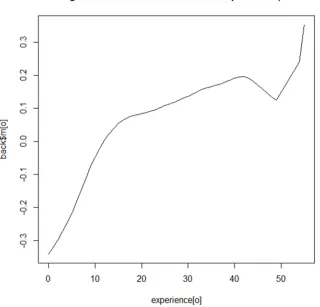
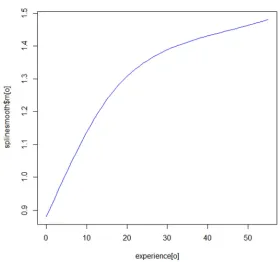
for APLM in the form of less ASL compared to the other methods. Figures 1-3 shows the estimated nonparametric functions using Speckman, backfitting, and smoothing spline estimator for the variable experience of the partial linear model (PLM).
Table 11. The average squared loss (ASL) for CPS data.
N Speckman’ estimator
Backfitting Estimator
Smoothing Spline estimator
APLM estimator
534 103.3909 913.8942 104.4412 103.0753
Figure 1. Speckman estimator of PLM for CPS data.
Figure 3. Smoothing Spline estimator for CPS data.
5. Conclusions
In this work, the semiparametric partial linear model (PLM) is adapted by mixing different estimation procedures defined under different conditions. Kernel smoothing, spline smoothing, and backfitting methods are different estimation procedures used to estimate the partially linear model. These methods are used in adapting the PLM by mixing. Theoretically, the adapted proposed estimator APLM is found to be a n -consistent and has asymptotic normal distribution for the parametric component of the model. Also practically, best results are obtained for APLM in the form of less average squared loss (ASL) in prediction. In the simulation studies, best results are obtained when the regressors in both the parametric and nonparametric components are related (dependent) than that in the case of independency. This means that the proposed APLM is more appropriate in the case of dependent regressors.
Appendix
Proof of Theorem (1)
To prove that βˆR is a n -consistent estimator of
β :Suppose that: Xi*= −xi xˆi , and Yi*= −yi yˆi. Consider ˆ
R
β as defined in (10):
(
)(
)
(
)(
)
( )
(
)
1
1 1
1
* * * *
1 1
1 1
ˆ ˆ ˆ 1 ˆ ˆ 1
1 1
1 1
n T n T
R i i i i i i i i i i
i i
n n
T T
i i i i i i i i
i i
X X X X X X Y Y
n n
X X X X m z
n n
β
β ε
−
= =
−
= =
= − − − −
= + +
∑
∑
∑
∑
For simplicity, the indicator 1iwill be removed and ˆβR will be written as follows:
( )
( )
1
* * * * * *
1 1 1 1
1 1
* * * * * *
1 1 1 1
1 1 1 1
ˆ
1 1 1 1
n n n n
T T
R i i i i i i i i
i i i i
n n n n
T T
i i i i i i i i
i i i i
X X X X X m z X
n n n n
X X X m z X X X
n n n n
β β ε
β ε
−
= = = =
− −
= = = =
= + +
= + +
∑
∑
∑
∑
∑
∑
∑
∑
(A1)
If the matrix * * 1
1 n T
i i i
X X n =
∑
has an inverse (nonsingular),
then the limit of ˆβR as n→∞ (plim) will be as:
( )
( )
1 1
* * * * * *
1 1 1 1
1 * 1 *
0 0
1 1
1 1 1 1
ˆ
plim plim plim
1 1
ˆ plim ˆ plim
n n n n
T T
R i i i i i i i i
i i i i
n n
i i i i
i i
X X X m z X X X
n n n n
X m z X
n n
β
β
ε
β
ε
β
− −
= = = =
− −
= =
= + +
= + Φ + Φ
=
∑
∑
∑
∑
∴ ˆ
R
β is a consistent estimator of β .
Also, it can be shown that βˆR is a n -consistent estimator of β as follows:
(
)(
)
1(
)(
)
1 1
1
* * * *
1 1
1 1
ˆ ˆ ˆ ˆ ˆ
cov( ) cov 1 1
1 1
cov 1 1
n T n T
R i i i i i i i i i i
i i
n n
T
i i i i i i
i i
X X X X X X Y Y
n n
X X X Y
n n β − = = − = = = − − − − =
∑
∑
∑
∑
∵For simplicity, the indicator 1iwill be removed and cov( ˆβR) will be written as follows:
( )
(
)
1 * * * * 1 1 1 * * * 1 1 1* * 2 * * * *
1 1 1
1 1
ˆ
cov( ) cov
1 1
cov
1 1 1
ˆ
n n
T
R i i i i
i i
n n
T
i i i i i
i i
n n n
T T T
i i i i i i i
i i i
X X X Y
n n
X X X m z
n n
X X X X X X
n n n
β ε ε − = = − = = − = = = = = + =
∑
∑
∑
∑
∑
∑
∑
−1
(A2)
Since the covariance of ˆβR is O (1/n), then the convergence rate of ˆβR is n−1/2, i.e. ˆβR is n -consistent estimator of β .
To prove that
(
ˆ)
(
0,ˆ01ˆ0ˆ01)
dR
n β −β →N Φ Ψ Φ− − :
From (A-1),
( )
( )
1
* * * * * *
1 1 1 1
1 1
* * * * * *
1 1 1 1
1 1 1 1
ˆ
1 1 1 1
n n n n
T T
R i i i i i i i i
i i i i
n n n n
T T
i i i i i i i i
i i i i
X X X X X m z X
n n n n
X X X m z X X X
n n n n
β β ε
β ε − = = = = − − = = = = = + + = + +
∑
∑
∑
∑
∑
∑
∑
∑
(
)
( )
( )
1 * * * *1 1 1
1
* * * *
1 1 1
1 1 1
ˆ
1 1
n n n
T
R i i i i i i
i i i
n n n
T
i i i i i i
i i i
n n X X X m z X
n n n
X X X m z X
n n
β β ε
ε − = = = − = = = − = + = +
∑
∑
∑
∑
∑
∑
Since ˆβR→p β, and conider (A2), then:
* * * *
1
1 n T p T
i i i i
i
X X E X X
n
∑
= → , and2 * * 2 * * 1 1 ˆ ˆ n p T T
i i i i i i i
X X E X X
n = ε ε
→
∑
.The following inequality holds from the Cauchy-schwarz inequality:
( )
1/22 1/2
2 * * * * 4
ˆ T T ˆ
i i i i i i
E
ε
X X ≤E X X Eε
.
Also, from the Schwarz matrix inequality, it can be shown that:
( )
( )
1/2 1/2
2 1/2 4 1/2
* *T ˆ4 * ˆ4
i i i i i
E X X E
ε
≤E X Eε
,
and,
( )
1/ 2 4
* 4
ˆ
i i
E X E ε ∞
≺ .
Using the central limit theorem, it is found that:
(
)
* 0 1 1 0, n d i i i X Nn
∑
= ε → Ω .Given that: * *
0 1
1 n T p i i i
X X
n
∑
= →Φ , and2 * *
0 1 1 ˆ n p T i i i i
X X
n
∑
= ε →Ψthen using Slutsky’s theorem, we have:
(
ˆ)
(
0, 0)
d
n β β− →N Ω ,
where,
(
1 1)
0 ˆ0− ˆ0ˆ0− Ω = Φ Ψ Φ
Proof of Theorem (2)
a)To prove that βˆSpeck is a n-consistent estimator of β:
the proof is similar to that βˆRin Theorem (1).
b)To prove that
(
ˆ)
(
0, 1)
d Speck
n β −β →N Ω : See
Theorem (4) of Speckman (1988).
Proof of Theorem (3)
a)To prove that βˆback is a n -consistent estimator of β: the proof is in Theorem 2.2 of Opsomer and Ruppert (1999).
b)To prove that
(
ˆ)
(
0, 2)
d back
n β −β →N Ω : See
Corollary 2.1 of Opsomer and Ruppert (1999).
Proof of Theorem (4)
a)To prove that ˆβSpline is a n -consistent estimator of
β: the proof is similar to that βˆRin Theorem (1).
b)To prove that
(
ˆ)
(
0, 3)
d Spline
n β −β →N Ω : the
proof is similar to that βˆRin Theorem (1).(See also, Holland 2017).
Proof of Theorem (5)
a)To prove that βˆAPLM is a n -consistent estimator of
β:
3
1 1 2 2 3 3 1
ˆ ˆ ˆ ˆ ˆ
APLM j j j
W W W W
β β β β β
=
=
∑
= + + , (A3)(backfitting estimator), and βˆ3=βˆSpline (spline smoothing estimator). In Theorems (1:4), it is shown that the Robinson estimator
( )
βˆR , the Speckman estimator(
βˆSpeck)
,backfitting estimator
( )
βˆback , and the spline smoothingestimator
(
βˆSpline)
are all n -consistent estimators of β .Since βˆAPLM is a linear combination of three independent estimators βˆ1, βˆ2, and βˆ3, then βˆAPLM in (A3) can be proved as a consistent estimator as follows:
3 1
1 1 2 2 3 3 3
1
ˆ ˆ
plim plim
ˆ ˆ ˆ
plim plim plim .
APLM j j j
j j
W
W W W
W
β β
β β β
β β
=
=
=
= + +
= =
∑
∑
Then βˆAPLM is a consistent estimator of β. Also, It can be proved that βˆAPLM is a n-consistent estimator of β as follows.
(
ˆ)
(
ˆ ˆ ˆ)
( )
ˆ(
ˆ)
(
ˆ)
cov βAPLM =cov βR+βSpeck+βSpline =cov βR +cov βSpeck +cov βSpline
since the three estimators are independent. As it is proved in theorems (1:4), that each of the three estimators is a n -consistent estimator of β, then from (A2) it is found that the covariance of βˆR is O(1/n), and the convergence rate of βˆR is n−1/2, i.e. βˆR is n-consistent estimator of β. Also, the same is true for βˆSpeck , βˆback , and βˆSpline , and so the
(
ˆ)
cov βAPLM is O(1/n), with convergence rate of n−1/2, and ˆ
APLM
β is a n-consistent estimator of β . b)To prove that n
(
βˆAPLM−β)
→d N(
0,Ωn)
:From Theorem (2), it is shown that:
(
ˆ)
(
0, 1)
d Speck
n β −β →N Ω ,
from Theorem (3), it is shown that:
(
ˆ)
(
0, 2)
d back
n β −β →N Ω , and from Theorem (4), it is
shown that:
(
ˆ)
(
0, 3)
d Spline
n β −β →N Ω ,
Since βˆAPLM =W1 1βˆ +W2βˆ2+W3 3βˆ from (A3), then n
(
βˆAPLM −β)
→d N(
0,Ωn)
,where 3
2 1
n j j
j W
=
Ω =
∑
Ω .References
[1] Berndt, E. R. (1991). The practice of econometrics, The: classic and contemporary, Addison-Wesley Pub. Co.
[2] Buja, A., Hastie, T. J., and Tibshirani, R. j. (1989). “Linear smoother and additive models (with discussion), Annals of Statistics, 17, 453-555.
[3] Castillo, E.; Castillo, C.; and Hadi, A. S. (2009). “Combining estimates in regression and classification”, Journal of the American Statistical Association, 91, 1641-1650.
[4] Denby, L. (1986). “Smooth regression function”, Statistical Research Report 26. AT&T, Bell Laboratories, Princeton,
New Jersy.
[5] Eilers, P. H. C.; and Marx, B. D. 0 (1996). “Flexible smoothing with b-splines and penalities”, Statistical Science, 11, 89–121. [6] Engle, R.; Granger, C.; Rice, J.; and Weiss, A. (1986).
“Nonparametric estimates of the relation between weather and electricity sales”, Journal of the American Statistical Association, 81, 310-320.
[7] Green, P., and Yandell, B. S. (1985). Semi-parametric Generalized Linear Models. Part of the Lecture Notes in Statistics book series (LNS, volume 32).
[8] Green, P., Jennison, C., and Seheult, A. (1985). “Analysis of field experiments by least squares smoothing”, Journal of the Royal Statistical Society, Series B., 47, 299-315.
[9] Hardle, W., Liang, H., and Gao, J. (2000). Partially linear models, Springer Verlag.
[10] Hardle, W., Muller, M., Sperlich, S., and Werwatz, A. (2004). Nonparametric and Semiparametric Modeling: An Introduction, Springer, New York.
[11] Hastie, T. J., and Tibshirani, R. j. (1990). Generalized additive models, Vol. 43 of Monographs on statistics and applied probability, Chapman and Hall, London.
[12] Heckman, N. E., (1986). “Spline smoothing in a partly linear model”, Journal of the Royal Statistical Society, Series B., 48, 244-248.
[13] Holland, A. (2017). “Penalized spline estimation in the partially linear model”, Journal of Multivariate Analysis, 153, 211-235. [14] LeBlanc, M., and Tibshirani, R. (1996). “Combining estimates
in regression and classification”, Journal of the American Statistical Association, 91, 1641-1650.
[15] Li, Q. (1996).”Semiparametric estimation of partially linear panel data models”, Journal of Econometrics, Volume 71, Issues 1–2, 389-397.
[16] Linton, O. B. (1995). “estimation in semiparametric models: A review”. In: Phillips, P. C. B., Maddala, G. S. (Eds.), a Volume in Honor of C. R. Raw. Blackwell.
[18] Muller, M. (2000). Generalized Partial Linear Models, XploRe –Application Guid, 145-170.
[19] Muller, M. (2001). “Estimation and testing in generalized partial linear models- a comparative study, Statistics and comuting, 11, 299-309.
[20] Nkurnziza, S. (2015). “On combining estimation problems under quadratic loss: A generalization”, Windsor Mathematics Statistics Report, University of Windsor, Ontario, Canada. [21] O’Sullivan, F. (1986). “A statistical perspective on ill-posed
inverse problems (with discussion)”, Statistical Science, 1, 505–527.
[22] Opsomer, and Ruppert, 1999. “A root-n consistent backfitting estimator for semiparametric additive modelling”.
[23] Robinson, P. M. (1988). “Root n-consistent semiparametric regression”, Econometrica, 56, 931-954.
[24] Ruppert; D. Wand M. P.; Carroll, R. J. (2003). Semiparametric regression, New York, Cambridge University press.
[25] Severini, T.; and Wong, W (1992). “Generalized profile likelihood and condtional parametric models”, Annals of Statistics, 20, 1768-1802.
[26] Silverman, B. W. (1985). “Some Aspects of the Spline Smoothing Approach to Non-Parametric Regression Curve Fitting”, Journal of the Royal Statistical Society. Series B Vol. 47, No. 1, 1-52.
[27] Speckman, P. (1988). “Kernel smoothing in partial linear models”, Journal of the Royal Statistical Society, Series B., 50, 413-436.
[28] Wahba, G. (1990). Spline models for observational data, Society for Industrial and applied mathematics (Siam), Philadelphia, Pennsylvania.
[29] Wang L.; Brown, L.; and Cai, T. (2011). “A difference based approach to the semiparametric partial linear model”, Electronic Journal of Statistics, 5, 619-641.
[30] Yang, Y. (1999). “Regression with multiple candidate models: selecting or mixing?” Technical report no. 8, Department of Statistics, Iowa state University.
[31] Yang, Y. (2001). “Adaptive regression by mixing”, Journal of the American Statistical Association, 96, 574-588.
[32] Yatchew, A. (1997). “An Elementary Estimator of the Partial Linear Model, Economics Letters, 57, 135-43.
[33] Yatchew, A. (2003). Semiparametric regression for the applied econometrician, New York, Cambridge University press.