_____________________________________________________________________________________________________
*Corresponding author: E-mail: [email protected];
(Past name: British Journal of Pharmaceutical Research, PastISSN: 2231-2919, NLM ID: 101631759)
Effect of Group Counseling on the Identity Crisis of
Middle-aged Women as Health Promotion Behavior
Marzieh Ebrahimi
1,2, Samira Barjasteh
2and Nasim Tolooyi Kashtiban
3*1
Faculty of Midwifery, Nursing and Midwifery School, Urmia University of Medical Sciences, Urmia, Iran.
2Department of Reproductive Health, School of Nursing and Midwifery, Tehran University of Medical
Sciences, Tehran, Iran. 3
Department of Midwifery Consultation, Student Research Committee, Urmia University of Medical Sciences, Urmia, Iran.
Authors’ contributions
This work was carried out in collaboration among all authors. Author ME designed the study, performed the statistical analysis, wrote the protocol and wrote the first draft of the manuscript. Authors SB and NTK managed the analyses of the study. Author NTK managed the literature searches. All authors read and approved the final manuscript.
Article Information
DOI: 10.9734/JPRI/2019/v28i430209
Editor(s):
(1) Dr. Jinyong Peng, Professor, College of Pharmacy, Dalian Medical University, Dalian, China.
Reviewers:
(1) Marzanna Farnicka, University of Zielona Góra, Poland. (2)Vijaya Krishnan, MGM College of Physiotherapy, India. (3) Mustapha Alhassan, University for Development Studies, Ghana. Complete Peer review History:http://www.sdiarticle3.com/review-history/50151
Received 02 May 2019 Accepted 10 July 2019 Published 17 July 2019
ABSTRACT
Objectives: This study aimed to determine the effect of group counseling on the identity crisis of middle-aged women referred to outskirt health centers of Urmia, Iran in 2018.
Methods: This randomized, pre-test and post-test control study was conducted on 90 middle-aged women registered in Iranian Registry of Clinical Trials (IRCT). A researcher visited selected health centers of Urmia randomly divided into three groups according to their social, economic and cultural status (26 health centers at high level, 19 health centers at average level, and 20 health centers at low level). The subjects were those who referred to the family health unit for receiving health care. The demographic characteristics questionnaire (such as age, marital status, number of children, educational level, body mass index, employment status and economic situation, which was designed by the researcher), and middle aged Identity Crisis Questionnaire (ICQ) including
aimlessness, futility, hopelessness, lack of self-confidence, worthlessness, dissatisfaction with life, anxiety, sadness, aggression and anger subscales. The intervention (counseling group) was conducted for six weeks held weekly and each session for 60-90 minutes. Independent t-test, Chi-square test and Fisher's exact test were performed and analyzed through SPSS software. A P value less than of 0.05 was considered significant.
Results: Mean age of women in the intervention group (50. 93 ± 5.38 years) and in the control group (50.55 ± 6.23 years) was 50 years. Also, in the intervention and control groups, the mean number of children was 2.43 ± 1.47 and 2.44 ± 1.49, respectively. In this study, the two groups were homogeneous regarding BMI, education level, husband's education level, economic status, marital status, occupation and dwelling situation (P> 0.05). Mean score of identity crisis and its ten dimensions before and after the intervention in the two groups were significantly different (P<0.001). There was no significant difference in any of the dimensions of identity crisis in the control group (P>0.05).
Conclusion: According to the results, the use of group counseling intervention has been able to improve the identity crisis of middle-aged women in the most dimensions of identity crisis including aimlessness, futility, hopelessness, lack of self-confidence, worthless, dissatisfaction with life and anxiety.
Keywords: Group counseling; identity crisis; middle-aged women.
1. INTRODUCTION
Middle-age is defined as a phase of
psychological transformation in the range of life
or transitional period that encompasses
biological, psychological, and social changes [1]. One of the transitional stages in the human life cycle resulting in changes in different aspects is the middle-age transition. These changes in the person's life affect on overall function and may cause problems in daily activities [2,3]. The evolutionary events of the middle ages are largely based on the concept of the identity crisis. In this regard, Berk in 2008, by presentation of various views of others in this regard, has confirmed the identity crisis of middle-aged people as internal chaos, self-doubt, and general rehabilitation of personality during the transition to middle age. The middle-aged crisis is an emotional state of doubt and anxiety in which a person is unhappy because he realizes that half of life has passed. This situation usually involves reflections of the way a person has lived so far, and is often accompanied by an emotion that life has not been sufficiently achieved and has not significant results [4].
In this case, the person may feel tired of his or her life, occupation, or partner, and feel a strong desire to change in these cases [1]. A group of treatments that seem to have worked better in improving mental health among middle-aged
people than other treatments is group
counseling. Group counseling is a bipartisan process in which a counselor and a group of peers deal with problems, feelings, attitudes and
values, and is an attempt to modify the attitudes and perceptions of a person so that people can better understand the problems of themselves evolutionary problems more effective [5]. People in a group with similar problems feel more secure and more relaxation and willing to discuss their personal, family and objective issues and take advantage of the experience of others in a trust venue, as well as the outcome of the consultation. Group counseling with middle-aged people reduces their psychological tensions, in such a way that they can help others with their emotions [6,7].
Nevertheless, a few studies have been carried out on the identity crisis in Iran. Identity crisis of middle-aged people can be seen as a turning point in life, resulting in a new insight about self and reformation in the plan and path of life. This review may cause the person to regret for failing to achieve his/her wishes, or to get him/her to know more precisely about the social clock. The person realizes that the deadline is about to end e.g. it is not time to get marriage or have other baby [8]. If people remain confused for a long time in this crisis, many aspects of their psychological life will be affected and there is a risk of widespread psychological damage, such as depression and anxiety [9]. Therefore, it is necessary to consider the psychological state of middle-aged people who experience identity crisis and to test the methods that are useful in improving these symptoms.
quality of life behaviors, in particular to promote their physical and mental health, and since today many governments and policy makers at the macro level consider health promotion as an
integral part of social development and
because of the fact that midwives as health care providers have the privilege of close communication with middle-aged women in health care centers, the research team aimed to
determine the effect of group counseling on the identity crisis of middle-aged women referred to outskirt health centers of Urmia, Iran in 2018.
2. METHODS AND MATERIALS
This randomized, pre-test and post-test control study was conducted as a clinical trial registered in Iranian Registry of Clinical Trials (IRCT) with code IRCT20180926041148N1 and approved by Ethics committee of Urmia University of Medical Sciences with code IR.UMSU.REC.1396.398. A researcher visited five selected health centers of Urmia to conduct research in selected research setting. The health centers of Urmia city were divided into three groups according to the viewpoint of health experts based on their social, economic and cultural status (26 health centers at high level, 19 health centers at average level, and 20 health centers at low level). This study was conducted on five outskirt health centers in Urmia which were selected randomly including Al-Mahdi, Ali Abad, Shohada, Hakim, Badekey health centers. The subjects were those who referred to the family health unit for receiving health care.
The researcher, after referring to the relevant centers and coordinating with the authorities of centers, selected one person from the staff of the centers as a collaborator for the research implementation. According to the inclusion criteria, sampling was started at each center. Sampling was done randomly based on the population covered by each center and the list provided by one of the contributors to the health centers that were eligible to participate in the study, so that the list of names in each center was poured into a bowl and, the paper A and B was assigned to the intervention and control groups, respectively. During a telephone call, those who expressed their willingness verbally were invited to visit their respective centers for more information. After introducing the research and expressing the goals and method of the work, subjects were invited to cooperate in the study. The confidentiality of the responses was
described to subjects and they were asked to
complete informed consent form, the
demographic characteristics questionnaire
(such as age, marital status, number of children, educational level, body mass index,
employment status and economic
situation, which was designed by the
researcher), and middle aged identity crisis questionnaire.
In the second part of the questionnaire was Identity Crisis Questionnaire (ICQ) consisting of 50 questions, which in total has ten subscale based on RCET's theory including aimlessness, futility, hopelessness, lack of self-confidence, worthlessness, dissatisfaction with life, anxiety, sadness, aggression and anger. The validity of this questionnaire has been confirmed by experts in this field. In addition, Cronbach's alpha method was used to calculate the internal consistency of 0.93 was obtained showing high internal consistency of this test [10].
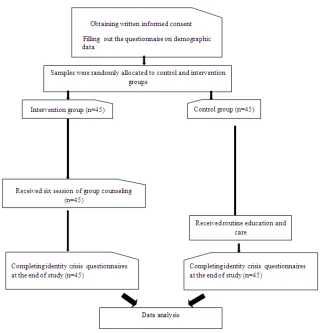
Finally, all selected samples (n=90) were assigned randomly to the two groups of intervention (n=45) and control (n=45) (Fig. 1). The inclusion criteria of the study included age between 40-60 years old, lack of stressful events (such as death or severe illness of close relatives) in the past six months, lack of specific disease history, and exclusion criteria were development of acute disease during the study and not attending more than two sessions of counseling. The intervention (counseling group) was conducted for six weeks held weekly and each session for 60-90 minutes, and the number of people in each group was 7-10. Control group had not counseling session with FGD design and just followed the routine care program of centers such individual counseling session if needed. Counseling sessions were held with the following content:
The first session was held by focusing to establish communication with an emphasis on the current status and environment, and the goals of counseling sessions. The used strategy was to establish a good relationship with the client and run a pre-test to find out the current situation and problem.
The second session devoted to the responsibility for physical changes (including menopause, hot flashes, hypertension, fatigue, muscle cramp
and insomnia, increased or decreased
Fig. 1. CONSORT flowchart
for information from specialist and health care providers, and how to take care of the unusual
physical and mental symptoms) and
psychological changes (including cope with the onset of negative thoughts about your health and friends' health concerns, anxiety of fatal and deadly diseases, worries about the future of children, fear of poverty and so on.
The third session devoted to nutrition and its importance, nutritional needs of the middle-aged women, right nutrition principles including restrictions on the consumption of sugar and confectionery, coffee and carbonated beverages, fruits and vegetables, dairy products, cereals and grains, and attention to the importance of breakfast meals.
The fourth session devoted to managing stress, anger and physical activity including having adequate sleep and rest, familiarity with stress control methods such as relaxing and muscle relaxation and having regular exercise and stretching exercises, deep breathing, enhancing
good listening skills, and consulting on using some problem solving techniques and counting numbers and traffic light technique.
The fifth session devoted to counseling about internal balance, one of the ways to eliminate tensions and anxieties, including an invitation to explore spiritual issues, to improve and maintain health, to emphasize counseling on prayer and thinking and self-meditation.
The sixth session devoted to interpersonal relationships and useful employment including creating a positive attitude towards others and the ability to communicate effectively and excellently despite interpersonal differences, setting plans to take advantage of opportunities and creating useful hobbies, and attention to personal needs.
immediately after the end of the intervention, post-test was done in the both groups. The
venue for counseling sessions was in a quiet room in the selected health centers.
Independent t-test was used for comparing the quantitative effects between the intervention and control groups. Qualitative variables were compared between the two groups using Chi-square test and Fisher's exact test. The data analysis was performed through SPSS software. A P value less than of 0.05 was considered significant.
3. RESULTS
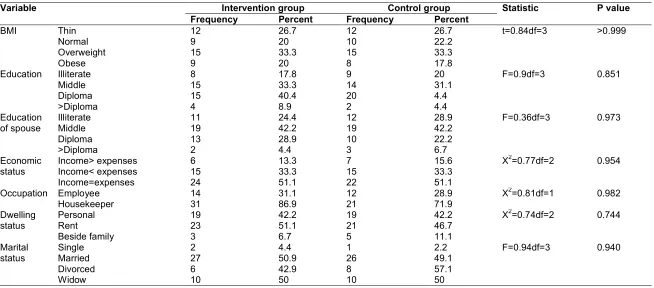
In this study, the two groups were homogeneous in terms of the mean age of women (P = 0.756), height of women (P = 0.741), weight (P = 0.977), and the number of children (P = 0.951). The mean age of women in the intervention group (50. 93 ± 5.38 years) and in the control group (50.55 ± 6.23 years) was 50 years. Also, in the intervention and control groups, the mean number of children was 2.43 ± 1.47 and 2.44 ± 1.49, respectively. In this study, the two groups were homogeneous regarding BMI (P> 0.999), education level (P = 0.851), husband's education level (P = 0.973), economic status (P = 0.954), marital status (P = 0.940), occupation (P = 0.982), and dwelling situation (P = 0.744).
The majority of women in the intervention and control groups (33.3%) were in the overweight category in terms of body mass index. Regarding education of middle-aged women, the majority of subjects in the control group (31.1%) and in the intervention group (33.3%) had a middle education. The majority of female participants in the both groups were housewives and their husband was worker.
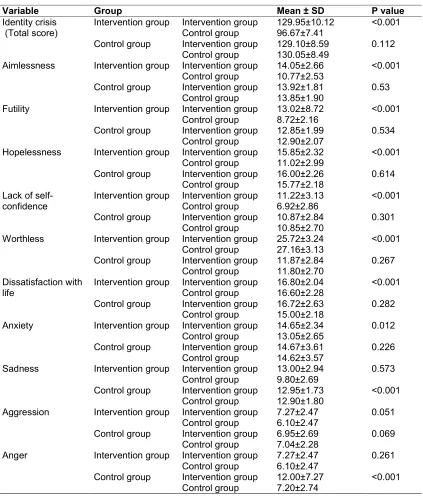
According to Table 3, the mean score of identity crisis and its ten dimensions before and after the intervention in the two groups were significantly different (P<0.001). The results of t-test showed that there was a significant difference between the mean score of identity crisis and its ten dimensions before and after the intervention in the two groups. This means that the use of group counseling intervention has been able to improve the identity crisis of middle-aged women in the mentioned dimensions in the intervention group. Also, according to the results of t-test, there was no significant difference in any of the dimensions of identity crisis in the control group (P>0.05).
4. DISCUSSION
The present study was designed to determine the effect of group counseling on the identity crisis of middle-aged women. The results showed a significant difference between the intervention and control groups in the post-test about the level of women's health promotion behaviors. In other word, the mean score of the identity crisis in subjects undergoing group counseling has decreased than those who did not receive this intervention. This suggests the effectiveness of group counseling on the reduction of the identity crisis in middle-aged women. The results of the present study were consistent with some studies such as Asoodeh et al. [11] Javadivala et al. [12] Ghaedi et al. [13] Parvin et al. [14] Heidarinasab et al. [15] Elias et al. [16] Amodeo et al. [17] Cardoso et al. [18] Wiley et al. [19] and Malott et al. [20] showing the positive effects of group counseling and psychotherapy on reducing middle-age identity crisis and increasing the mental health of middle-aged people.
Studies have shown that when individuals experience age-related changes and major changes in the environment, they may weaken their self-confidence, although not everyone experiences this phenomenon. Expected events that have not occur yet, and wishes that have not been able to achieve, or a child who has never been able to give birth, become very important and anxious in middle age. These events, through the social comparison mechanism, are capable of influencing individual self- confidence, which provides grounds for the emergence of middle-age identity crisis [3].
Middle age research has shown that middle-aged people can only be survived middle-aged identity crisis if they can adapt to mid-life changes. Middle-aged people who are always flexible and do not learn from their experiences in the face of the changes, may try hard to avoid accepting their weaknesses and thus experience more frustration. They may also turn into weak people who are easily affected; they are very vulnerable to criticism and have a very fragile identity. The best and most healthy adaptation for middle aged people is a situation in which identity is so flexible that it changes if necessary, but it is also not lacking in a structure that any new
experience will cause the underlying
middle-age identity crisis, the adaptation of
individuals to these changes should be
considered. The issue of adaptation to the changes in the middle age in psychotherapy has been taken into account by strengthening the
middle-aged defense mechanisms and
encouraging the abandonment of the raw defense mechanisms [22]. In various studies, the
relationship between the suppression of
unresolved issues related to the physical and psychological changes of middle age and the inhibition of the expression of negative and unpleasant emotions due to socio-economic problems of this period has been proven with low adaptability and the avoidance of problem solving in middle aged people. On the other hand, research has shown that positive emotional expression and the use of relaxation techniques are associated with improved coping styles [4].
been taken into account by strengthening the
middle-aged defense mechanisms and
encouraging the abandonment of the raw defense mechanisms [22]. In various studies, the
relationship between the suppression of
unresolved issues related to the physical and psychological changes of middle age and the inhibition of the expression of negative and unpleasant emotions due to socio-economic problems of this period has been proven with low adaptability and the avoidance of problem solving in middle aged people. On the other hand, research has shown that positive emotional expression and the use of relaxation techniques are associated with improved coping styles [4].
This issue was reflected in the present study. Participants of the intervention group showed a significant decrease in the severity of the middle-age identity crisis after participating in group meetings, advising them to abandon the vulnerable defense style, awareness of their emotions, tendency to accept their emotions and
behaviors, and gaining more advanced
defensiveness. From the perspective of the researcher of this study, the main factor in changing middle-aged identity crisis symptoms was adaptation to middle-age physical changes, changing in the style of defense, acceptance of negative emotions and gaining insight into changing their position in the community and in the minds of others.those who participated in group counseling sessions. The results showed that group counseling reduces middle aged identity crisis. The results of this research and previous studies support interventions and short-term psychiatric methods to improve the psychological and adaption status of the middle-aged women.
Another issue considered in group counseling was the person's thinking about other's point of view. The characteristics of people who experience middle age identity crisis are worrying about losing their position in the minds of others due to their physical disabilities and loss of appetite, and others do not care about them like before. The task of the therapist at the treatment sessions is to create a supportive and intimate
environment that one can express the
unpleasant emotions associated with conflicts of communication and concerns without feeling guilty. In our sessions, sympathy of the members of the group and the supportive and intimate environment were the main factor. In group counseling, one of the other areas was the frustration of having monotone life. This hopelessness relates to widespread issues in which one exaggerates the remorse and the
perception of disturbing wishes, feelings,
thoughts and experiences, and always feels
frustrated. These failures affect their
psychological status and life satisfaction. In group counseling, the therapist tried to alert people about frustration and its consequences to be encouraged to look at life with a more positive attitude and life satisfaction.
Table 1. Comparison of midwifery women in the two groups of intervention and control by quantitative demographic characteristics
Variable Intervention group Control group Statistic P value
Mean SD Mean SD
Age 50.92 5.38 50.55 6.23 t=-0.3 df=88 0.756*
Height 160.82 4.78 161.15 4.82 t=-0.33 df=26 0.741**
Weight 73.70 12.89 73.67 12.06 z=-0.14 0.977*
Child number 2.53 1.47 2.44 1.54 t=-0.25 df=87 0.951*
7
Table 2. Comparison of midwifery women in the two groups of intervention and control by qualitative demographic characteristics
Variable Intervention group Control group Statistic P value
Frequency Percent Frequency Percent
BMI Thin 12 26.7 12 26.7 t=0.84df=3 >0.999
Normal 9 20 10 22.2
Overweight 15 33.3 15 33.3
Obese 9 20 8 17.8
Education Illiterate 8 17.8 9 20 F=0.9df=3 0.851
Middle 15 33.3 14 31.1
Diploma 15 40.4 20 4.4
>Diploma 4 8.9 2 4.4
Education of spouse
Illiterate 11 24.4 12 28.9 F=0.36df=3 0.973
Middle 19 42.2 19 42.2
Diploma 13 28.9 10 22.2
>Diploma 2 4.4 3 6.7
Economic status
Income> expenses 6 13.3 7 15.6 X2=0.77df=2 0.954
Income< expenses 15 33.3 15 33.3
Income=expenses 24 51.1 22 51.1
Occupation Employee 14 31.1 12 28.9 X2=0.81df=1 0.982
Housekeeper 31 86.9 21 71.9
Dwelling status
Personal 19 42.2 19 42.2 X2=0.74df=2 0.744
Rent 23 51.1 21 46.7
Beside family 3 6.7 5 11.1
Marital status
Single 2 4.4 1 2.2 F=0.94df=3 0.940
Married 27 50.9 26 49.1
Divorced 6 42.9 8 57.1
Table 3. Comparison of mean scores of middle-aged women's identity crisis before and after intervention in the two groups
P value Mean ± SD
Group Variable <0.001 129.95±10.12 Intervention group Intervention group Identity crisis
(Total score) Control group 96.67±7.41
0.112 129.10±8.59 Intervention group Control group 130.05±8.49 Control group <0.001 14.05±2.66 Intervention group Intervention group Aimlessness 10.77±2.53 Control group 0.53 13.92±1.81 Intervention group Control group 13.85±1.90 Control group <0.001 13.02±8.72 Intervention group Intervention group Futility 8.72±2.16 Control group 0.534 12.85±1.99 Intervention group Control group 12.90±2.07 Control group <0.001 15.85±2.32 Intervention group Intervention group Hopelessness 11.02±2.99 Control group 0.614 16.00±2.26 Intervention group Control group 15.77±2.18 Control group <0.001 11.22±3.13 Intervention group Intervention group
Lack of self-confidence
Control group 6.92±2.86
0.301 10.87±2.84 Intervention group Control group 10.85±2.70 Control group <0.001 25.72±3.24 Intervention group Intervention group Worthless 27.16±3.13 Control group 0.267 11.87±2.84 Intervention group Control group 11.80±2.70 Control group <0.001 16.80±2.04 Intervention group Intervention group Dissatisfaction with life
Control group 16.60±2.28
0.282 16.72±2.63 Intervention group Control group 15.00±2.18 Control group 0.012 14.65±2.34 Intervention group Intervention group Anxiety 13.05±2.65 Control group 0.226 14.67±3.61 Intervention group Control group 14.62±3.57 Control group 0.573 13.00±2.94 Intervention group Intervention group Sadness 9.80±2.69 Control group <0.001 12.95±1.73 Intervention group Control group 12.90±1.80 Control group 0.051 7.27±2.47 Intervention group Intervention group Aggression 6.10±2.47 Control group 0.069 6.95±2.69 Intervention group Control group 7.04±2.28 Control group 0.261 7.27±2.47 Intervention group Intervention group Anger
Control group 6.10±2.47
<0.001 12.00±7.27 Intervention group Control group 7.20±2.74 Control group 5. CONCLUSION
According to the results of this study, awareness of emotions, the recognition of ineffective defense mechanisms, understanding the reason of the identity crisis, awareness of the general psychological changes in the middle age, providing emotional support, accepting the
excitement, sharing of experiences, discussing negative feelings about middle age and possible weaknesses, expressing unpleasant feelings,
and educating appropriate communication
patterns for middle-aged women can be achieved by reducing the symptoms of middle-age identity crisis, which is the basis for
increasing adaptability. The use of group counseling intervention has been able to improve the identity crisis of middle-aged women in the ten dimensions of identity crisis.
CONSENT
As per international standard, participant’s written consent has been collected and preserved by the author(s).
ETHICAL APPROVAL
This randomized, pre-test and post-test control study was conducted as a clinical trial registered in Iranian Registry of Clinical Trials (IRCT) with code IRCT20180926041148N1 and approved by Ethics committee of Urmia University of Medical Sciences with code IR.UMSU.REC.1396.398.
COMPETING INTERESTS
Authors have declared that no competing interests exist.
REFERENCES
1. Johnson KG. Serials. The constant midlife
crisis. Serials Review. 2006;32(1):35-9.
2. McCann L, Pearlman LA. Psychological
trauma and adult survivor theory: Therapy and transformation. Routledge; 2015.
3. Lachman ME. Development in midlife.
Annu. Rev. Psychol. 2004;55:305-331.
4. Baars J, et al. Aging, globalization and
inequality: The new critical gerontology; 2016.
5. Campbell J. Technical Working Group
Consultation Papers 1 to 8; 2014.
6. Sommers-Flanagan J, Sommers-Flanagan
R. Counseling and psychotherapy theories in context and practice: Skills, strategies, and techniques. John Wiley & Sons; 2018.
7. Siren R, Eriksson JG, Peltonen M,
Vanhanen H. Impact of health counselling on cardiovascular disease risk in middle aged men: influence of socioeconomic status. PloS One. 2014;9(2):e88959.
8. Heckhausen J, Wrosch C, Fleeson W.
Developmental regulation before and after a developmental deadline: The sample case of" biological clock" for childbearing. Psychology and Aging. 2001;16(3):400.
9. Zareipour MA, Valizadeh R, Abdolkarimi
M, Mahmoodi H, Ghelichi Ghojogh M, Khazir Z. Perceived stress and its relationship with spiritual health in patients with diabetes in the city of Urmia, Iran.
Biosci. Biotech. Res. Comm. 2016;9(4): 750-5.
10. Rajaei AR, Bayazi MH, Habibipour H.
Basic religious beliefs, Identity crisis and general health in young adults. Journal of Developmental psychology; 2010.
11. Asoodeh M, Mohsenzadeh F, Zahrakar K.
The effectiveness of life review based group counseling on meaning in life in the elderly. Journal of Aging Psychology. 2018;4(1):13-26.
12. Javadivala Z, Allahverdipour H,
Kouzekanani K, Merghati-Khoei E, Asghari Jafarabadi M, Mirghafourvand M. A
randomized trial of a
relationship-enhancement approach in improving
marital intimacy in middle-aged Iranian couples. Journal of Sex & Marital Therapy. 2019;1-1.
13. Ghaedi O, Rashidi Ali Reza, Karami
Jahangir. Effectiveness of short-term
psychodynamic Group therapy on self-esteem of people with social anxiety.
Rooyesh-e-Ravanshenasi.
2017;10:125-137.
14. Parvin N, Kazemian A, Alavi A, Safdari F,
Hasanpour DA, Hosseinzadeh S, et al. The effect of supportive group therapy on menopause mental health. Journal of Gorgan University of Medical Sciences. 2007;9:74-79.
15. Heidarinasab L, Khorianian M, Tayyebi Z.
Effectiveness of intensive short-term
dynamic psychotherapy in reducing
symptoms and changing defense styles in
patients with depression. Clinical
Psychology Studies. 2014;4(14):143-
168.
16. Elias SM, Neville C, Scott T. The
effectiveness of group reminiscence
therapy for loneliness, anxiety and
depression in older adults in long-term care: A systematic review. Geriatric Nursing. 2015;36(5):372-80.
17. Amodeo AL, Picariello S, Valerio P,
Bochicchio V, Scandurra C. Group
psychodynamic counselling with final-year undergraduates in clinical psychology: A clinical methodology to reinforce academic identity and psychological well-being. Psychodynamic Practice. 2017;23(2):161-80.
18. Cardoso P, Janeiro IN, Duarte ME. Life
19. Wiley RE, Berman SL. Adolescent identity development and distress in a clinical sample. Journal of Clinical Psychology. 2013;69(12):1299-304.
20. Malott KM, Paone TR, Humphreys K,
Martinez T. Use of group counseling to
address ethnic identity development:
Application with adolescents of Mexican descent. Professional School Counseling; 2010.
21. Hunt BR, Guindon MH. Alcohol and other
drug use and self-esteem in young adults. Self-esteem across the lifespan: Issues and interventions. 2010;219-29.
22. Driessen E, Cuijpers P, Hollon SD, Dekker
JJ. Does pretreatment severity moderate the efficacy of psychological treatment of adult outpatient depression? A meta-analysis. Journal of consulting and clinical psychology. 2010;78(5):668.
© 2019 Ebrahimi et al.; This is an Open Access article distributed under the terms of the Creative Commons Attribution License
(http://creativecommons.org/licenses/by/4.0), which permits unrestricted use, distribution, and reproduction in any medium,
provided the original work is properly cited.
Peer-review history: