INTRODUCTION
Nowadays, the CAD/CAM systems are used for the preparation of NC programs for manufac-turing on machine tools. They allow simulating whole manufacturing process and detecting all types of collisions. The main advantage is the ability to create NC programs for rugged parts with complex surfaces [1, 4].
The condition necessary to increase the ef-ficiency of manufacturing is optimization of the manufacturing processes. Optimization of manu -facturing is a complex process implemented in several stages with different methods. The ma -chining process can be optimized with regard to the workpiece, machine tools, tools, operations, technological conditions, toolpath and so on.
Besides the possibility to optimize the produc -tion process itself, there are opportunities to opti-mize the sub-processes within the pre-production stages. One of those possibilities is to optimize the process NC programs creation or manufacturing process creation in CAD/CAM system, in order to eliminate the repetitive tasks performed by
pro-grammers devising new manufacturing process-es. Some CAD/CAM systems allow us to develop the NC strategies that can be used to optimize the creation of manufacturing sequences [10].
OPTIMALIZATION IN CAD/CAM SYSTEMS
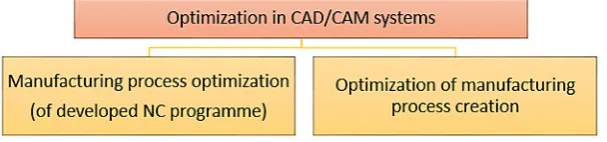
Optimization of machining is a complex task, which is a necessary condition for high-quality solutions to technological progress in CAD/CAM systems [2, 14]. The main tasks involve optimiz -ing the machin-ing process dur-ing preparation of NC programs or optimizing the finished NC programs. Optimization can be divided into two separate groups as shown in Figure 1.
The first group is focused on optimizing NC programs. This optimization is usually supported directly in the CAD/CAM systems or by external programs. CAD/CAM systems allow to optimize the NC programs according to several criteria: • Optimization based on workpiece.
• Optimization with regard to the shape, dimen -sions tooling and fixtures.
Implementation of Innovative Methods for the Creation of Strategy
Algorithms in CAD/CAM System Edgecam
Nadežda Čuboňová
1*, Tomáš Dodok
1, Ivan Kuric
1, Miroslav Císar
11 Faculty of Mechanical Engineering, Department of Automation and Production Systems, University of Žilina, Univerzitna 1, 010 26, Žilina, Slovak Republic
* Corresponding author’s e-mail: [email protected]
ABSTRACT
The paper deals with the issue of the machining process optimization by using the algorithms that were proposed
for the creation of NC strategies in CAD / CAM systems. The possibilities to create NC strategy in CAD / CAM
systems using Feature Based Machining were analyzed using Edgecam’s Strategy Manager Module, Mastercam’s FBM Drill, and Machining Knowledge Editor in the Siemens NX10. Strategy Manager Module of CAD/CAM system Edgecam was suggested for experimental use. On the basis of the of NC strategy creation definition in this
system, the algorithms for creating of new NC strategies were proposed, and database application for this NC strat-egies were created. The use of created NC stratstrat-egies will eliminate the repetitive steps in creating the machining process and shorten the NC program creation.
Keywords: NC strategies, Strategy Manager, Feature Base Machining, Edgecam 2016 R2,
Volume 12, Issue 4, December 2018, pages 10–18
https://doi.org/10.12913/22998624/92100
Research Journal
Accepted: 2018.11.05• Optimization in terms of residual material. • Optimization using Spline interpolation.
Optimization of the machining process relates mainly to the three basic cutting conditions (in terms of optimized parameter):
• cutting speed (vc), • feed rate (f), • depth of cut (ap).
The second group consists of optimizing the manufacturing processes, before postprocessing of NC programs. The main focus of this optimi-zation is to reduce the time necessary to prepare manufacturing processes in CAD/CAM system and to eliminate repetitive tasks. This type of op-timization uses feature recognition and creation of NC strategies for manufacturing of the set of cognizable features [12, 15].
FEATURE BASED MACHNINIG
Feature Base Machining (i.e. FBM) allows to automate the process of NC program creation. Basically, FBM allows to recognize features on
component. The features (Figure 2) are standard -ized shape characteristics relevant for design and manufacturing. They allow to completely and uniformly describe geometry, topology, and functional information such as tolerances, surface roughness and so on.
The principle of FBM method is in the feature recognition of the components such as holes, pockets, slots, grooves, open or closed areas, and other features. It is also possible to assign an appropriate machining process for each feature. A suitable example to demon-strate this functionality is component with two types of holes. The system recognizes these two types of holes and assigns predefined ma -chining strategies (NC strategies) for manufac -turing those holes [3].
THE POSSIBILITY OF CREATION NC
STRATEGIES IN CAD/CAM SYSTEMS
Currently, there are several CAD/CAM sys-tems that are capable of feature recognition, as well as creating NC strategies. Each mentioned
Fig. 1. Optimization in CAD/CAM systems
CAD/CAM system offers different modules and therefore the approach to the creation of strate-gies also differs. The possibilities of creation of the NC strategies are processed in the following subsections. For the purposes of this article, the following CAD/CAM systems were compared: Edgecam 2016, Mastercam 2017, and Siemens NX 10 PLM system.
CAD/CAM SYSTEM EDGECAM 2016 R2
In order to create and edit NC strategy, the Edgecam contains a module called Strategy Man -ager (Figure 3). Strategy Man-ager allows to cre -ate new and edit older NC str-ategies. The user interface is divided into four main parts:
• Data – allows to insert information for NC strategies. This information is necessary for the development of conditions, such as defini -tion of tool dimensions. The data are divided into seven groups.
• Processes – determine which machining cy -cles are used in NC strategies, machining pro-cesses such as roughing and finishing.
• Properties – used for creation of algorithm. For example, definition of features for which will be NC strategy used.
• Flowchart – allows to create the algorithm of NC strategies. Each block of flowchart con -tains the conditions for the proper functioning of the algorithm.
CAD/CAM SYSTEM MASTERCAM 2017
Mastercam is one of most used CAD/CAM systems in world. Mastercam uses two modules for the creation of NC strategies: FMB Mill for milling and FBM Drill for drilling (Figure 4). The NC strategies are created by selecting the re-quired cycles and entering parameters. It is not necessary to handle any programming language or create flowchart of NC strategy.
PLM SYSTEM SIEMENS NX 10
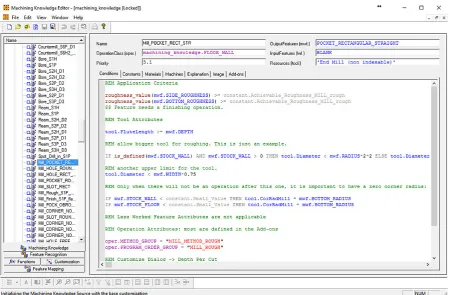
PLM system NX 10 features Machining Knowledge Editor (MKE) for creating and edit -ing the NC strategy (Figure 5). Work with this module requires programming in Visual Basic or TCL language for changing the system functions. The six basic conditions have to be defined in each NC strategy:
• InputFeatures • OutputFeatures
Fig. 4. FBM Drill in CAD/CAM system Mastercam 2017
• Name
• OperationClass • Priority
• Resources
After determining the basic conditions, other conditions and variables must be defined. The most important part is defining rules in the Conditions tab where it is necessary to create the conditions for use of the created NC strate-gies. Other tabs are used for the completion and clarification of rules. Material and Machines tabs are used to define the material and machine tools. Explanation tabs is used to explain the rules and Pictures tab allows to load additional pictures. The Appendices card inserts additional parameters of conditions.
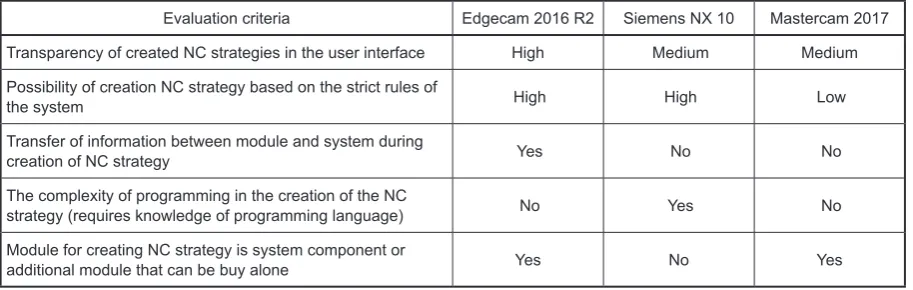
Table 1 compares all presented CAD/CAM systems based on the evaluation criteria. The cri-teria are focused on transparency, possibilities and transfer of information during creation of NC strategy. Last criteria focus on knowledge of programer and specified how the module is dis -tributed, as part of system or a separate module.
DEFINITION OF NC STRATEGIES
The NC strategy is defined as algorithm with the conditions that define the features on which the NC strategy will be used. The NC strategy contains also machining cycles. Those machin-ing cycles can be used for roughmachin-ing and finish -ing operations, drill-ing holes, thread mak-ing and so on. The NC strategy also contains conditions for the choice of tool base e.g. for machining holes [6, 8, 9, 13].
The process of creating the machining process consists of several steps, as shown in Figure 6.
The programmer has to go through all these steps in order to create the NC program. Part of this process can be automated by using NC strategies. Input information for NC strategies can be divid-ed into following three basic groups:
• Geometrical information – information defin -ing the features and their properties. Informa-tion on shape is used to design of the condi-tions necessary for the creation of algorithm of the NC strategy. It may include information such as dimensions of pocket, corner radius, the depth of the pocket or the tolerances. • Technological information – define machin
-ing cycles based on feature detection (drill-ing or milling), type of operation (e.g. roughing, finishing), information for choice of tool and conditions for selection of optimal cutting parameters.
• Additional information – commands to update the workpiece and for exchange of the tool. NC strategies enable to:
• Increase effectiveness of creation of machin
-ing processes – The main advantages of creat-ing strategies include speed of an NC program creation and also the versatility. Strategies can be used for number of components based on the similarity of geometric features.
• Reducing the time required to create machin
-ing processes – in terms of reducing the time required to prepare an NC program – Figure 7 and Figure 8.
• Preservation knowledge of the technologist
– NC strategies can be created from existing parts (machining processes) or for specific types of shape similar components.
Creation of strategies is presented in the fol-lowing chapter.
Table 1. Comparison of modules for creation of NC Strategies
Evaluation criteria Edgecam 2016 R2 Siemens NX 10 Mastercam 2017 Transparency of created NC strategies in the user interface High Medium Medium Possibility of creation NC strategy based on the strict rules of
the system High High Low
Transfer of information between module and system during
creation of NC strategy Yes No No
The complexity of programming in the creation of the NC
strategy (requires knowledge of programming language) No Yes No Module for creating NC strategy is system component or
CREATION OF EXPERIMENTAL NC
STRATEGIES IN EDGECAM 2016 R2
The process of NC Strategies creation con-sists of several steps in Strategy Manager [11, 7, 5]. Before the creation of an NC strategy, it is appropriate to create the machining cycle for a selected feature, for which the NC strategy is in-tended. Machining cycle contains the information
for choosing of tool, selecting cutting conditions or additional information such as the command to update the workpiece and command for change of tool. NC strategies can also be based on the fin -ished machining processes. The process of an NC strategy creation consists of the following steps:
• Defining the features – it is necessary to
choose the feature, for which the strategy will be used. There are several types of features, e.g. FT_2D milling, FT_Hole or FT_Pocket. Fig. 7. Time necessary to create of an NC program without NC strategies
• Selecting of the machining process – after selecting the feature, it is necessary to cre-ate machining cycle. Machining cycle is then inserted into NC strategy including the com-mand to “Move to Toolchange”. After inser-tion, the Machining cycle must be adjusted so that it can be used for the same types of fea-tures with different parameters.
• Definition of the flowchart – The decision block enablesto specify the conditions and decide how the strategy works. The decision block allows user to create complex strategies and by extension to use multiple processes within a single strategy. Each block must have a specific name.
• Inserting of additional commands –
com-mand to update the workpiece and comcom-mand for change of the tool.
• Connection between blocks and insertion
of ends – blocks must be connected and all branches of the algorithm should be ended with end block.
Experimental NC Strategies are shown in Figure 9. Figure 9 A shows an example of the NC strategy for rough milling. Figure 9 B and C show Sub-Strategies for manual tool selection and au-tomatic tool selection.
DATABASE APPLICATIONS
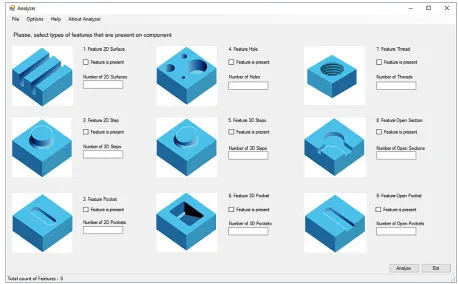
An important criterion for deciding to creation of the NC strategies is not only the time spent on its implementation but also sufficiency of compo -nents to which it can be applied. For this reason, a simple application was developed (Figure 10). The application helps with the decision concern-ing the usage of NC strategies. Before the use of application, a user must choose one component the part that represents production portfolio and
can acts as appropriate substitute for any given part. Afterwards, they must select the features and their number in application. The application processes the data and gives recommendation to use or does not use of the NC strategies. The ap-plication allows to import and export database with the NC strategies.
CONCLUSIONS
Deployment of NC strategies allow to opti-mize the process NC programs creation and re -move repetitive tasks. On the basis of the results achieved by solving this task, the following con-clusions can be formulated:
• Regarding the possibility of creating NC strat -egies in CAD/CAM system Edgecam it is pos -sible to see two main benefits. The first one is the possibility of storing knowledge and ex-perience of a technologist. The second one is reducing the time necessary to create the NC program.
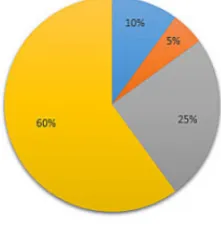
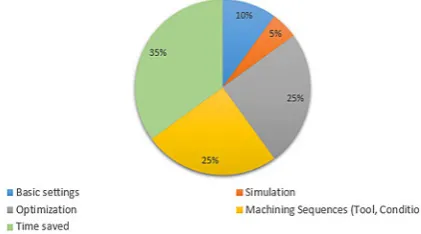
• Application of the experimental NC strate-gies allows to reduce the time of preparing machining processes in CAD/CAM system Edgecam 2016. Reduction of time depends on the complexity of manufactured component. Total time can be reduced about a 35% by im -plementation of experimental NC strategies, based on the comparison of Figure 7 and 8. That means the time necessary for the creation of machining sequences can be reduced by more that a 50%.
• Second advantage of creating the strategies beside the speed of an NC program creation is also the versatility. Strategies can be used for a number of the components based on the similarity of geometric features. Comprehen-sive strategies for specific components can also be created.
Fig. 10. Database applications for the analysis of components
Fig. 9. A – Example of NC Strategy A – RoughMill Strategy,
• The created database was based on the design algorithms for the creation of NC strategies. This database can be used for two purposes. The first purpose is storage of NC strategies. The second purpose is to determine the suit-ability of the NC strategies application for specific components.
Acknowledgement
This article was made under the support of KEGA projects – 024ŽU – 4/2016 Improving of education level and its international for students from technical study programmes based on WEB Based Training and 022ŽU – 4/2017 – Implemen -tation of on-line education in the area of precise technologies with an impact on educational pro-cess to increase skills and flexibility of students of engineering fields of study.
REFERENCES
1. Čuboňová N. and Císar M. Design of camera
mount and its application for monitoring machin-ing process. Advances in Science and Technology,
9(26), 2015, 34–40.
2. Čuboňová N.: Genetic algorithms implemented for optimization of technological processes. Chosen
applications of computer modelling in mechanical
engineering. Pearson Education Limited, 2015. 3. Dodok T., Čuboňová N. and Rudawska A. Anal
-ysis of shapes for the development of algo-rithms for strategies of machining process in the CAM system. Academic Journal of Manufacturing
Engineering, Editura Politehnica, 15(1), 2017, 6–10.
4. Dodok T., Čuboňová N. and Kuric I. Workshop Programming as a Part of Technological Prepara
-tion of Produc-tion. Advances in science and tech
-nology, 11(1), 2017, 111–116.
5. Krajcovic M., Bulej V., Sapietova A. and Kuric I. Intelligent manufacturing systems in cxoncept of
digital factory. Komunikacie, 15(2), 2013, 77–87.
6. Kumičáková D., Gorski F., Milecki A. and Grajew
-ski, D. Utilization of advanced simulation methods
for solving of assembly processes automation
par-tial tasks. Manufacturing Technology, 13(4), 2013, 478–486.
7. Kuric I., Zajačko I. and Císar M. Analytical intel -ligence tools for multicriterial diagnostics of CNC machines. Advances in Science and Technology,
10(32), 2016, 59–64.
8. Kuric I. Dynamic classification system. Chosen
applications of computer modelling in mechanical
engineering. Pearson Education Limited, 2015. 9. Legutko S. Materials for Cutting Tools. Devel
-opment of Mechanical Engineering as a Tool for the Enterprise Logistics progress, Poznan, Poland 2006, 33–49
10. Náprstková N. Students connecting to pro -duction problems resolutions in CAD/CAM
area. 9th International Scientific Konfer
-ence – Engineering for rural development 2010, Jelgava, Litvia 2010, 310–314.
11. Rudawska A., Čuboňová N., Pomaranska K., Stančeková D. and Gola A. Technical and Orga
-nizational Improvements of Packaging Produc
-tion Process. Advances Science and Technology, 10(30), 2016, 182–192.
12. Rudawska A., Reszka M., Warda T., Miturska I., Szabelski J., Stančeková D. and Skoczylas A. Mill -ing as a method of surface treatment in adhesive bonding. Journal of Adhesion Science and
Tech-nology, 30(23), 2016, 2619–2636.
13. Sadílek M., Kratochvíl J., Petrů J., Cep R., Zlámal T. and Stančeková, D. Cutting tool wear monitor -ing with the use of impedance layers. Tehnicki
Vjesnik, 21(3), 2014, 639 – 644.
14. Sága M., Vaško M., Čuboňová N. and Piekarska, W. Optimisation Algorithms in Mechanical Engi
-neering Applications. Pearson, 2016.
15. Stuchlý V., Poprocký R. and Kaczmarek M. Reliabil
-ity evaluation as a means of increasing the efficiency
of equipment maintenance. Advances in science and