
Software As A Service With Cloud Computing
Ms. Rashmi A. AkojwarMs. Reshma V. Kothari [email protected]
Mr. Sandip A. Kahate [email protected]
Ms. Ruchika D. Ganvir [email protected]
Abstract—Cloud Computing (CC) is a style of computing in which dynamically scalable and often virtualized resources are provided as a service over the Internet. Cloud is basically an extension to the object oriented programming concept of abstraction. It eliminates the complex working details from being visible to the users. What users can view is just an interface, which only involves receiving the inputs and providing the outputs. The process involved in generating the outputs is completely invisible. The cloud works on the concept of abstraction in a physical computing environment, which is done by simply hiding the actual processes from the users. In the cloud hosting environment, the data is placed over multiple servers in the cluster, though the credentials of the network connections are entirely hidden and the users cannot access anyone else’s data. The Cloud environment includes derivatives from the UNIX paradigm of having multiple elements, where every element is exceptional at any individual task, instead of having a single huge element that takes care of all the tasks.
One type of cloud service, Software as a Service (SaaS) is commonly utilized and it provides several benefits to service consumers. To realize these benefits, it is essential to evaluate the quality of SaaS and manage relatively higher level of its quality based on the evaluation result. Hence, there is a high demand for devising a quality model to evaluate SaaS cloud services. Conventional frameworks do not effectively support SaaS-specific quality aspects such as reusability and accessibility. Software as a Service is a software delivery paradigm in which the software is hosted off-premise and delivered via web. The mode of payment follows a subscription model. SaaS helps organizations avoid capital expenditure and let them focus on their core business instead of support services. Using the SaaS architecture, one can proactively assess applications. Implementing SaaS also eliminates the time spent for upgrades and maintenance. The SaaS model is helping to build provides a new way for Service Providers, ISVs, and end-user customers to interact in a way that will drive additional demand for software applications. By finding a good SaaS provider, you can eliminate the worry about purchasing, installing and maintaining software or hardware, focus on managing and expanding your business.
Key Words — Cloud Computing (CC), Software as a Service (SaaS), SaaS Provider (Hosting Provider), ASP, ISP, ISVs, IaaS, VM’s, Qos, Cluster, Platform as a Service (PaaS), Infrastructure as a Service (IaaS), Distributed Computing, Grid Computing.
I. I
NTRODUCTIONSaaS is the most mature category of cloud service [1].SaaS abbreviated for Software as a service (SaaS), sometimes referred to as "on-demand software," is a software delivery model in which software and its associated data are hosted centrally (typically in the (Internet) cloud) and are typically accessed by users using
a thin client, normally using a web browser over the Internet. By eliminating the need to install and run the application on the customer's own computer [7]. When a major disruptive change arrives on the IT scene, it is not always clear what the implications will be. Cloud computing is quickly beginning to shape up as one of these major changes.
SaaS has proven to be a universally accepted and trusted service to access application functionality through a browser without the need to own or install costly hardware or software. Usually, limited if any IT support staff is needed for SaaS and cloud computing. The data is stored securely off site "in the cloud" and end users get the functionality they need with none of the IT burden [5]. SaaS alleviates the customer's burden of software maintenance, ongoing operation, and support [3]. Using SaaS also can reduce the up-front expense of software purchases, through less costly, on-demand pricing [1]. Up until now, people have used a variety of computing devices in their professional lives, including desktops, laptops, handhelds, and smart phones. Each new device was essentially an island of capabilities, applications, communications, rich data, and content. Today's SaaS with cloud computing means that information is not stranded on individual machines in a fixed location; it is combined into one digital "cloud" available at the touch of a finger from thousands of different devices. However, there is still a great deal of work to be done to get all these technologies functioning seamlessly and reliably.
Tech companies have shifted many of the software applications that businesses typically handle for themselves over to the cloud, but many more have yet to be switched over. In addition, organizations need increased reassurance that their data and communications will be secure and the new services will be available whenever they need them [5].From the software vendor's standpoint, SaaS has the attraction of providing stronger protection of its intellectual property and establishing an ongoing revenue stream. The SaaS software vendor may host the application on its own web server, or this function may be handled by a third-party application service provider (ASP) [7]. Intel has successfully used a variety of SaaS applications [1].
II. O
THERS
ERVICESP
ROVIDEDB
YC
LOUDC
OMPUTINGoperation system on cloud. For example, user can put an optimized Linux for networking ability [19]. IaaS is at the other end of the cloud spectrum. In this scenario, you want to maintain control of your software environment, but you don't want to maintain any equipment. You don't want to have to buy servers and put them in a climate-controlled room or any of that. Instead, you go to an IaaS provider and request a virtual machine. You can put whatever software you want on it. On the back end, the provider gets you storage or other resources as you need them. This is made easier with virtualization technologies, which separate the physical drives and so forth from the virtual machine you're running in. IaaS is available from Amazon EC2, IBM and many others, but care should be taken in choosing a provider [20].
PaaS cloud providers deliver platforms, tools and other business services that enable customers to develop, deploy, and manage their own applications, without installing any of these platforms or support tools on their local machines. Google Apps and Microsoft Windows Azure are the most known PaaS [18]. PaaS is somewhere in between IaaS and SaaS. It's not a finished product, like SaaS, and it's not a tabula rasa, like IaaS. PaaS gives your application developers hooks and tools to develop to that particular platform. For example, Microsoft's Windows Azure gives you tools to develop mobile apps, social apps, websites, games and more. You build these things, but you use the APIs and tools to hook them into the Azure environment and run them there [20]. Clients can run their own applications on the platform provided; General platforms are Linux and Windows [19].
III. L
ITERATURER
EVIEWIn particular, several studies have revealed that only a fraction of on-premise software applications are deployed on schedule, with many experiencing delays of six months or more. More alarming, over 25% of purchased applications are never fully deployed. Moreover, on-premise applications often have high associated costs. These range from the costs to deploy an application, often as high as two times the license price, to the lifetime costs of maintaining and managing an application, often as high as 10 times the license price [14]. The concept of "software as a service" started to circulate in 2000/2001 and was included as a prominent part in the "SIIA Trends Report 2000" [1] of the non-profit Software & Information Industry Association. As a term, SaaS is generally associated with business software and is typically thought of as a low-cost way for businesses to obtain the same benefits of commercially licensed, internally operated software without the associated complexity and high initial cost [7].
As IT budgets stagnate, large vendors such as IBM, Oracle, Microsoft and SAP have a seeming stranglehold on them. The IT asset inventory applications that companies started using in early 2000 revealed what everybody had suspected up to that point but had not been able to prove: only a small percentage of the software
licenses purchased by a corporation are ever fully utilized. Finally, while new versions of “traditional” applications are often released every 1.5-2 years, customers are now demanding more frequent releases with new features soon after a business need arises. Problems customers have experienced with on-premise software fall in four categories: deployment challenges, high costs, low utilization rates, and slow release cycles. In addition to addressing these four problems, customers often prefer SaaS applications because they can be quickly deployed to a distributed workforce, they convert fixed IT costs to variable costs, and they enable the corporation to focus on its core competencies and business processes. The initial SaaS applications addressed areas are small and Medium sized Businesses (SMB), as well as individual departments within Global 2000 corporations. Today SaaS applications are also being used to address industry-specific needs in areas such as logistics, financial services, manufacturing, etc. and their use is expanding beyond the (SMB) [14].
IV. S
AAS A
RCHITECTUREAs use of SaaS increases, it must be able to scale the environment, be positioned to take advantage of standardization, and provide guidance to suppliers about how to integrate with enterprise applications. In addition, future solutions will likely require more frequent data exchange between Intel and SaaS providers, with lower tolerance for failure. One also looks to improve security and manageability, which currently require a great deal of work, due diligence, and carefully calculated risk.
These requirements led to develop a SaaS architecture that will help one shift to a more strategic view of SaaS and enable faster, more standardized implementations [1]. In SaaS portfolio, exploring opportunities to simplify our environment, gain faster access to new features, and reduce cost [8].
A. Key Features
1)Presentation: This includes all capabilities expose to the
user, such as:
Menu and navigation- These provide access to the
features and functionality within an application, organized
Fig. 1 Intel IT’s conceptual Architecture for SaaS include capabilities in five categories [8]
Reporting- Application-specific predefined reports.
2) Security: Security is one of the most important Categories of SaaS capabilities, given that Intel’sdata and user accounts are typically hosted by the SaaS provider. We considered the following capabilities:
Identity and federation- Identity uniquely identifies a user
or another entity such as an Intel application or system. An example is a user name. Federation describes the function of enabling users in one domain to securely and seamlessly access data within another domain.
Authentication- The process of identifying an individual
usually based on a user name and password across multiple cloud applications and services.
Authorization and role-based access control: After an identity has been confirmed, authorization is the process of giving individuals access to system objects based on their identities. Identities are usually assigned to roles for ease of managing access.
Entitlement- The process of granting access to a specific
resource. Tenants are usually responsible for maintaining their own user accounts using delegated administration.
Encryption- Data may need to be encrypted in transit
(between applications or between the layers within an application) and at rest (while stored).
Regulatory controls- Tracking and reporting who accessed
what, when, and why. It includes tracking access to application features and data, the security rating of the data, and the implementation of a data retention policy. 3) Application: These represent the typical business layer or middle tier of a SaaS application:
User profile- The attributes and information that describe
a user, such as name, e-mail address, and role.
Metadata services-Information about which data is
contained and exposed within an application and about how content is organized.
Workflow- The defined series of user based tasks within a
process to produce a final outcome. An example is creating a purchase order.
Exception handling- The process of raising and managing
exceptions within an application. This includes how application errors are exposed to the user and how error messages are logged.
Orchestration-The series of technical tasks performed
within a process to produce a final outcome. An example is an extract, transform, and load sequence to move data between business applications.
Data synchronization- The capabilities for synchronizing
data held within the application with external data. 4) Operations: These are the capabilities needed to efficiently keep the SaaS application running:
Monitoring and alerting: Poling application components, services, and infrastructure to detect failures. On detection, an alert is sent to the appropriate support group.
Performance and availability- Performance describes how
the application performs under load, both in terms of the number of users and the transaction volume. In the context of SaaS, this should allow applications to dynamically scale based on runtime usage and demand. Availability is a measure of how much of the time the application is
available to users and is represented as a percentage.
5) Infrastructure: The underlying technical capabilities required for storing data and moving it around the network:
Database- In multi-tenant data architecture, there could be
one database per tenant or one database shared by multiple tenants with the data indexed by specific tenant identification.
Compute- The physical clients, servers, or virtual
machines that execute code.
Metering and indicators- Tracking and reporting items
specifically related to the service-level agreement, such as usage, availability, number of failures, and meantime to respond to and fix problems [8].
V. S
AAS M
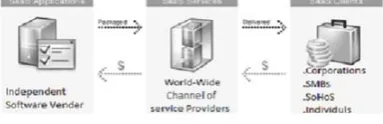
ODELSaaS is described as software applications deployed as a hosted service and accessed over the Internet via a Standard web browser. This can include basic IIS or Apache software, but typically Software as a Service means delivering business applications, including collaboration software and line-of-business applications, to companies that require them to run their business.
In the Software as a Service model above, customers (end-users) subscribe to applications versus purchasing them, typically on a per-month basis. In this pay-as-you-go method, customers are afforded a flexible, low-cost, no-hassle model so they can concentrate on running their core business rather than spending capital to purchase applications and time/resources on software patches and updates. Hosting Providers and ISVs revenue-share the resulting subscription fee paid by the end-user customer.
Fig. 3 SaaS model
VI. I
MPLEMENTATIONWhatever the actual origin, SaaS has become a major force in the IT industry with an increasing number of companies providing SaaS‐only solutions, and by the introduction of “On‐Demand” or on‐premise software
vendors. Whilst there might be arguments about the technical differences between SaaS, ASP or On‐Demand and the majority of Learning & Talent professionals, they are effectively equivalent concepts [6].
The software is hosted and available for use through the Internet, allowing many companies to use it while providing segregation of, and security for, each company's data.
A. Instructions for SaaS Implementation
1) Prepare the implementation plan. Create detail tasks and schedules for the other steps.
2) Activate the software through the vendor and their hosting facilities so it can be accessed over the Internet. Set up and define users, login criteria and which areas of the system will be used.
3) Configure the software according to how the business will use it. Choose which functionality will apply in each business area and select from any alternative approaches available.
4) Integrate with relevant systems. Choose which systems will be integrated, how they will be integrated, and perform the integrations.
5) Clean up and enhance the data as required. This can be done before or after loading. Map previous data fields to the new system data fields. Load the data either manually, through file loads, or through automated programs.
6) Train users on how to use the system. Schedule training to coincide with actual use of the system, whether it is for normal business use or for testing and pilot situations that support configuration and integration phases.
7) Use the system to run the business. Audit use of the system on a regular basis depending on the potential for misuse and errors uncovered in audit reports [15].
VIII. S
AAS P
ROVIDERSFig. 5 Users and Providers of Cloud Computing [10]
SaaS is now a term in common use in the IT industry, with thousands of software vendors providing SaaS solutions across the complete spectrum of business applications. Our view is that SaaS evolved from two main sources.
A. Application Service Providers (ASPs), a class of Companies who were hosting and running business applications as a publicly available service, normally over the Internet.
B. Software companies that recognized the potential to create recurring revenue streams by providing their software solution as an ongoing service, managed by them on their servers, or by a third‐party Internet service Provider (ISP) [6].
The benefits of SaaS to both SaaS users and SaaS providers are well documented, so we focus on CC effects on Cloud Providers and SaaS Providers/Cloud users. The top level can be recursive, in that SaaS providers can also be SaaS users [10].
A. Selecting a SaaS provider
SaaS is less costly since payment is on a subscription basis (e.g., monthly), hardware and upgrades to software are eliminated, and IT resources for loading and testing software are reduced. SaaS availability can be quicker and at higher levels due to high performance hosting capabilities. Implementation approaches vary with the complexity of a SaaS solution but are similar to other software approaches. A key difference is that SaaS can be implemented in less time because of reduced hardware and IT resources [9].
There are a number of elements to consider while selecting a SaaS provider.
Industry expert – Ideally you want to choose a provider
who is familiar with the industry which you belongs. Familiarity with your specific vertical market ensures the solution that is tailored to your needs.
Experience – Finding a SaaS provider with a solid
customer base who can prove their capabilities.
Team – Ensure the team who will be servicing your business knows the ins and outs of your industry.
Support – Make sure your SaaS provider includes
implementation support, help desk, and training in your agreement.
Security – Always check security services are included.
This includes backup, recovery, encrypted data, firewalls, and unique ID and password access.
B. SaaS provider handles
SaaS providers lease enterprise software as hosted services to customers. They are interested in maximizing profit and ensuring QoS for customers to enhance their reputation in the marketplace. The business process between a SaaS provider and a customer is where a service provider (SaaS X) offers CRM or ERP software packages, which are offered as three types of products (for example, Standards, Professional and Enterprise) and accounts (for example, Group, Team and Department). When a customer (Company X) submits its first time rent request with product type (Standards), account type (Group), and the required number of accounts (m), the provider will allocate resources to serve this customer. At anytime,
Company X may require an upgrade in the service by
adding more accounts or software editions. Customers can request an upgrade of services dynamically at any time in practice.
Thus a SaaS provider has to handle these requests intelligently in line with the requirements as set out in the Service Level Agreement (SLA). From a SaaSprovider’s
SaaS provider pre-defined parameters and the customer specified QoS parameters [13]. They perform Implementation, Updating, Troubleshooting, Patching, Monitoring & administration, Backup and storage, Upgrades and everyday support, Eliminates need for software or hardware purchases including server [3]. Some example of SaaS Providers is Yahoo, Google [7]. Providers with prices to fit various budgets are Microsoft, Sun Microsystems, SalesForce CRM, Impel CRM, Wipro w-SaaS, DeskAway [7], [9].
VII. S
ERVINGC
USTOMERS INC
LOUDpay-per-use basis, or subscription based on usage, this further reduces corporate expenditures. The right SaaS provider offers a business approach to ease your decision-making regarding IT and will reduce your budget. When you subscribe to a software service instead of purchasing a software license, you to save money, save time, Focus your technology budgets on competitive advantage rather than infrastructure, gain immediate access to the latest innovations and join a community of interest.
X. F
EATURESA SaaS model for serving customers in Cloud is shown in Fig. A customer sends requests for utilizing enterprise software services offered by a SaaS provider, who uses three layers, namely application layer, platform layer and infrastructure layer, to satisfy the customer’srequest. The application layer manages all application services that are offered to customers by the SaaS provider. The platform layer includes mapping and scheduling policies for translating the customer’s Quality of Service (Quos) requirements to infrastructure level parameters and allocating Virtual Machines (VMs) to serve their requests. The infrastructure layer controls the actual initiation and removal of VMs. The VMs can be leased from IaaS providers such as Amazon EC2 or private virtualized clusters owned by the SaaS provider. In both cases, the minimization of the number of VMs will deliver savings. The savings are greater when SaaS providers use the third party IaaS providers since no capital expenditure is required [12].
Fig.4 SaaS model for serving customers in Cloud [12]
IX. B
ENEFITS OFS
AAS
Software as a Service is a service that allows you to outsource the technical aspects of your business. The SaaS model is expected to become an important alternative especially during a financial crunch not only for larger companies but also for small and medium businesses with low budgets for IT. Since a traditional IT budget is made up of an IT Team, SW licenses, and equipment such as servers, SaaS offers a significantly reduced TCO (total cost of ownership). This is due to low cost of deployment, no expensive equipment purchases, and the ease and speed of implementation. As SaaS is often put into service on a
A. Reliability
This attribute measures the ability of a SaaS to keep operating with specified level of performance over time. Several aspects of reliability are important within a cloud computing, particularly the reliability of the messages that
Are exchanged between the service consumers and the services, and the reliability of the services themselves. The rationale for defining this attribute is explained by three folds. First fold is that SaaS are reusable and are used in various users. That is, if an unexpected fault occurs in a SaaS, it propagates failures to service consumers who utilize the SaaS. Second fold is that most data utilized in SaaS is managed on server side in CC. That is, the reliability of SaaS has an effect on service consumers themselves. Thus the company might have a serious obstacle in terms of economy or opportunity if faults occur in the SaaS. Third fold is that running SaaS are performed onthe service provider’s side. That is, service consumers have less belief due to their limited controllability [13].
Informally, reliability is the level of accuracy in which an application provides its intended services, usually dictated by user documentation or application specifications. Reliability is about providing correct results and handling error detection and recovery in order to avoid failures. More formally, the mean time between failures (MTBF), that is, the average length of time the application runs until a failure occurs, defines reliability [17].
B. Reusability
In software engineering, reusability is the ability of software elements to serve for the construction of many different applications. The fundamental underlying of CC is to reuse various types of internet based services. In case of SaaS, software itself is a target of reuse and it is delivered to service consumers over the Internet. That is, one-to-many relationships are often used when delivering SaaS services. For example, Google map service provides a set of operations to utilize shared information on map and local, which can be used by various customers [13].
C. Scalability
of servers to a larger configuration of more robust servers, while taking full advantage of the additional server resources and/or processing power in terms of performance (quicker response times) and handling a larger number of simultaneous customers. Typically, it is easier to have scalability upward rather than downward since developers must often use available resources efficiently when an application is initially coded. Therefore, scaling an application downward may mean trying to achieve the same results in a more constrained environment [17].
D. Availability
In CC, the service consumers are able to access SaaS service from a Web browser via the Internet. Also, the consumers do not have any ownership for the SaaS which is deployed and runs on the provider’s server. Because of these natures, many SaaS vendors focus their attentions to achieve high availability of services. If a SaaS is not available, service consumers cannot use the functionality of the SaaS. For example, Gmail service was down completely at September 1st, 2009. Because of that, many Gmail users could not use the service which the users read or write email [13].
E. Efficiency
This attribute measures the amount of resource used for SaaS when providing the required functionality and the level of performance, under stayed condition. That is, it is a measure of how well SaaS utilizes resources. The rationale for defining this attribute is that the expense for SaaS is estimated not about purchasing an ownership of the service, but about the amount of usage of the service. That is, a typical business model of cloud computing depends the amount of utilized resource or time use [13].
XI. O
THERC
OMPUTINGT
ECHNIQUESThough the name itself gives an idea about what it would mean. The Distributed computing involves the computing elements of a network that are set-up across wide areas. This concept is followed by both cloud and grid computing. The primary benefit of such an environment is the capability of tapping into multiple areas of expertise with use of just a single resource. In the environment of Cloud Computing, users get a single interface for multiple servers. There are different sets of requirements such as the storage, security and maintenance that are required for carrying out the computing activities. Various enterprises adopt different architectures for Distributed computing. But here we are primarily focusing on the Grid and Cloud Computing.
A Grid is basically the one that uses the processing capabilities of different computing units for processing a single task. This task though is managed by a single primary computing machine. What this machine does is, it divides the task into numerous tasks and gets processed from difference computing machines in the cluster. As soon as these tasks are completed by the machines, they
send the result back to the primary machine which takes care of controlling all the tasks. All the results are clubbed together and a single output is provided. Cloud as well as grid computing are newer concepts as compared to the other computing techniques. They also have a difference in their networks and the way they process the tasks. The concepts encapsulate the actual complex processes that are undertaken by the system and presents a user with a simplified interface. Hence simplifying the interaction between the users and the system. The basic intention behind this is to making the system user-friendly but without disturbing the functionality of the overall processes. The fundamental concepts of Cloud and Grid computing are varied. Still it is possible to have a cloud cluster within a computational grid and vice-versa
The only differentiating factor between the two is the method it adopts for computing the tasks within their individual environments. In grid computing, a single big task is split into multiple smaller tasks which are further distributed to different computing machines. Upon completion of these smaller tasks, they are sent back to the primary machine which in return offers a single output.
Whereas a cloud computing architecture is intended to enable users to use difference services without the need for investment in the underlying architecture. Though, grid too offers similar facility for computing power, but cloud computing isn’t restricted to just that. With a cloud users can avail various services such as SaaS, website hosting etc.
XII. I
MPACT ONIT R
OLES ANDR
ESPONSIBILITIESAs mentioned earlier, adding SaaS to the enterprise IT mix can cause a fundamental shift in the IT department's role as a provider of information services. Business units are sometimes caricatured as being afraid of change, but IT departments are not immune to organizational politics, either, and institutional resistance to SaaS can come from IT itself, as easily as from elsewhere in the company. In the past, the nature of software deployment has put chief information officers (CIOs) and their staffs into the role of gatekeepers who could exercise a veto over any proposed software deployment by simply declaring that they would not host it in the data center.
XIII. C
ONCLUSIONSaaS is one type of cloud services is emerged as an effective reuse paradigm. It provides benefits to service consumers; no initial cost to purchase software, free of maintenance/updates, accessibility through Internet, high availability, and pay-per-use pricing. Hence, evaluating the quality of SaaS becomes more important activity to a successful SaaS management. It presents some important aspects for evaluating SaaS. Firstly, it extracted Layering in SaaS model, SaaS Architecture, and then explains how to implement SaaS and SaaS providers, six features of SaaS from various references. Then it gives brief idea about its impact on IT Roles and Responsibilities. It covers essential features of SaaS and provides a way to evaluate the SaaS in quantitative manner. Moreover, service consumers can refer features and benefits to discover, subscribe, and utilize SaaS.
According to survey experience of Cloud Computing Of those replying to the statement “My experience of cloud
computing has been a positive one”, 7 out of 9 either
agreed (3) or strongly agreed (4) with this statement, with the remaining 2 neither agreeing nor disagreeing. This
Computing”,2009 Seventh ACIS International Conference of Software.Engineering Research, Management and Applications. [14] Trident Capital,“Investing in Companies that Deliver Software as a
Service”,[email protected].
[15] How to Implement a SaaS Solution | eHow.com,http://www.ehow.com/how_7538126_implement-saa-solution.html#ixzz1WEgTXA9M.
[16] Wikipedia (2011) “Software as a Service,”
www.wikipedia.com,2011.http://en.wikipedia.org/wiki/Software_as _a_Service.
[17] Daniil Fishteyn, Chief Technology Officer WebApps, Inc. a.k.a. SaaS.com,”Deploying Software as a Service (SaaS)”.
[18] Mohamed Al Morsy, John Grundy and Ingo Müller, Computer Science & Software Engineering, Faculty of Information & Communication Technologies, Swinburne University of Technology, Hawthorn, Victoria,Australia,”An Analysis of The Cloud Computing Security Problem”,In Proceedings of APSEC 2010 Cloud Workshop, Sydney, Australia, 30th Nov 2010. [19] Chu Yan Shing ,Wu Bing Chuan ,Supervised by Prof. Michael R.
Lyu.”Cloudcomputing technologies and applications”,Department of Computer Science and Engineering the Chinese University of Hong Kong.
[20] http://www.networkworld.com/news/2011/102511-tech-argument-iaas-paas-saas-252357.html
AUTHOR’SPROFILE
Ms.Rashmi Ashok Akojwarwas born rd
indicates that those responding to the survey/activity at Nagpur, Maharashtra, India on 23 April 1. She review and currently using cloud computing have an
overwhelmingly positive view of cloud computing on a personal level.
R
EFERENCESis pursuing her B.E degree in Information Technology, from Jawaharlal Darda Institute of Engineering & Technology Yavatmal (M.S.). Her area of interest includes web designing, Networking and computing.
[1] Jeremy Beck,“What is Software as a Service (SaaS)?”January 2009,
[2] http://www.sciodev.comManish Godse and Shrikant Mulik,“An
Approach for Selecting Software-as-a-Service (SaaS) Product”,
2009 IEEE International Conference on Cloud Computing. [3] Published by Galor Systems & Software Development,“The Value
of Software as a Service (SaaS) for the Travel Industry”, March 2009.
[4] Trumba Corporation,“Five Benefits of Software as a Service”,Part No. WP-001A, February 10, 2007.
[5] Stephen C. Hawald“Articleon Cloud Computing with Software as a Service (SaaS): How It Is Changing the Business and Organization Today”in IT Today.
[6] Elearnity,”Software as a Service: Impact on Learning & Talent Systems Core Insights”,V1.0, May 2009,http://www.elearnity.com [7] Erica Brasher-Sims,“SaaS Software as a Service”,2008
[8] Architecting Software as a Service for the Enterprise Intel Information Technology Cloud Computing, October 2009, www.intel.com/it.
[9] Cloud Computing for Beginners,http://www.techno-pulse.com/ [10] Michael Armbrust,Armando Fox,Rean Griffith, Anthony D.
Joseph,Randy H. Katz, Andrew Konwinski, Gunho Lee, David A. Patterson, Ariel Rabkin, Ion Stoica, Matei Zaharia,”Above the Clouds: A Berkeley View of Cloud Computing”, Technical Report No. UCB/EECS-2009-28, February 10, 2009. http://www.eecs.berkeley.edu/Pubs/TechRpts/2009/EECS-2009-28.html.
[11] Gianpaolo Carraro Fred Chong ,“Software as a Service (SaaS): An EnterprisePerspective”,Microsoft Corporation, October 2006. [12] Linlin Wu, Saurabh Kumar Garg and Rajkumar Buyya, “
SLA-based Resource Allocation for Software as a Service Provider (SaaS) in Cloud Computing Environments”,2011 11th IEEE/ACM International Symposium on Cluster, Cloud and Grid Computing. [13] Jae Yoo Lee, Jung Woo Lee, Du WanCheun†,and Soo Dong
king Department of Computer Science Soongsil University,”A Quality Model for Evaluating Software-as-a-Service in Cloud
Ms.Reshma Vijaykumar Kothari was born at wani, Maharashtra, India on 22nd February 1991. She is pursuing her B.E degree. Her area of interest includes hardware networking communication system, computing and web designing.
Mr. Sandip Adikumar Kahatewas born on 27st
July 1980. He received the B.E. degree in Computer Science and the Pursuing M.E degree in Wireless Communication and Computing from the G.H Raisoni college of Engineering, Nagpur, INDIA.
He currently works as an Assistant Professor of IT Department at from Jawaharlal Darda Institute of Engineering & Technology Yavatmal (M.S.). INDIA. Since 2011 to till date. He has 6.6 month experience in teaching. in Information Technology, from Jawaharlal Darda Institute of Engineering & Technology Yavatmal (M.S.).
Ruchika Durgeshwar Ganvir was
![Fig. 1 Intel IT’s conceptual Architecture for SaaSinclude capabilities in five categories [8]](https://thumb-us.123doks.com/thumbv2/123dok_us/8791784.1767078/2.612.358.523.545.671/fig-intel-conceptual-architecture-saasinclude-capabilities-five-categories.webp)
![Fig. 5 Users and Providers of Cloud Computing [10]](https://thumb-us.123doks.com/thumbv2/123dok_us/8791784.1767078/4.612.105.301.413.520/fig-users-providers-cloud-computing.webp)
