Investigating the Impact of Node deployment
models on the performance of OSPF Routing
Protocol in MANETS
A.V.N.C. Sekhar
#1, Dr.S.Pallam Shetty PhD
*2, Dr. D.Lalitha.Bhaskari PhD
#31Research Scholar, 2, 3 Professor, Department of Computer Science & Systems Engineering, Andhra University,
Visakhapatnam, A.P, India.
Abstract- Mobile Ad-hoc Networks (MANETs) are wireless network with mobile nodes. Mobile means the nodes are free to move themselves randomly, which may cause the rapid and unpredictable change of the network topology. Ad-hoc means that each node is willing to forward data for other nodes. In this paper we investigate the impact of three node deployment models namely grid, random and circular on the performance of Open shortest path first (OSPF) by using OPNET Simulator (v14.5). Simulation results show that Random deployment model perform better than grid and circular deployment models.
Keywords — MANET, OSPF, RANDOM, GRID, CIRCULAR.
I. INTRODUCTION
Mobile ad hoc network (MANET) [5] [2] [9][25][26] is self handled, easily deployable, extremely adaptable, dynamic network having autonomous mobile nodes. Each mobile node behaves as a transceiver. In this network any node may join and leave the network unexpectedly. Nodes in the network, communicate with each other if they are in the straight signal range. If they are not in the signal range communication done in multihop fashion. Due to the dynamic topology, effective protocol is required, which provides QoS by minimizing delay and power consumption while maximizing throughput. In MANETs all the nodes share the available resources. Therefore optimal way of utilizing resources is another challenging issue in MANETs. Since the range of wireless communication is limited, long distance communications between any two nodes has to depend on the forwarding of intermediate nodes.
II. LITERATURE REVIEW
Several researchers [1],[4],[12],[15],[16],[19] have done the performance analysis and classification of routing protocols qualitatively and quantitatively at different performance metrics and different mobility models. Effort of researchers is to identify the best suitable routing protocol which gives the desired result in a few seconds. Dr.S.P. Setty et. al.[19] presented the performance analysis of the AODV[17] at random waypoint mobility with varying environment like Grid, random and Uniform and
varying network density and showed that network density has no effect on the OLSR while AODV and DSR are affected. It also showed that reactive routing is better than proactive. [3] Presented comparison among AODV, PAODV, CBRP DSR and DSDV routing protocols using end to end delay, normalized routing overhead and throughput with varying no. of nodes, and workload. Samir R. Das et. al. [7] used DSR and AODV to show the performance of the reactive routing protocols in ad hoc networks. Both routing protocols were investigated in two configuration of random waypoint mobility model. Average end-to-end delay, PDR, Normalized routing load and Normalized MAC load were used with varying pause time and no. of sources. Effect of the mobility was shown by using different speed of nodes. They showed that the performance of the AODV and DSR varied with no. of nodes. For less no. of nodes, DSR had higher preference than AODV and for larger no of nodes; researchers are contributing in this area so that an effective and efficient routing can come into existence. The main motive behind this paper is to provide the effect of the mobility model as well as to give detailed comparative study of the adaptive routing protocols.
Anuj K. Gupta, Harsh and Anil K. Verma [2013], have made an attempt to compare different mobility models and provide an overview of their current research status. The main focus is on Random Mobility Models and Group Mobility Models. Firstly, they present a survey of the characteristics, drawbacks and research challenges of mobility modeling. At the last they present simulation results that illustrate the importance of choosing a mobility model in the simulation of an ad hoc network protocol. Also, they illustrate how the performance results of an ad hoc network protocol drastically change as a result of changing the mobility model simulated.
III. Routing Protocols of MANET
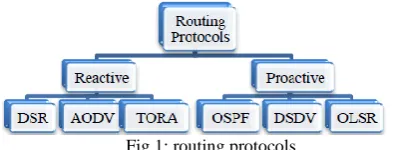
Routing is the process of selecting paths through which data packets move in network traffic. Intermediate nodes in a MANET can act as routers to forward data packets. Generally routing protocol represents the relation or formula that is being used by routers to find the suitable way through which data can be forwarded. Routing protocol for Mobile ad-hoc network can be categorized into three categories. These are Proactive, Reactive routing and Hybrid Routing protocols as shown in the following Fig 1. Pro-active routing is also called Table driven routing where as re-active routing is called On-demand & dynamic routing. OSPF, DSDV and OLSR are the pro-active routing protocols.
Fig 1: routing protocols
We mainly concentrated on OSPF Routing Protocol in this paper.
IV. OSPF
The OSPF (Open Shortest Path First) protocol development started in 1987 by the IETF (Internet Engineering Task Force) as a replacement to the RIP protocol. During that period, the Internet was evolving and broadened, resulting in more and larger networks resulting in bigger routing tables. The RIP updates in the new network environment were also wasting a lot of bandwidth. The OSPF working group of IETF managed to create a new hierarchical, classless link-state protocol that achieved higher convergence to adapt to the network changes faster, used a more descriptive metric than hop-count, and supported security and Type of Service. The first version of OSPF, named OSPFv1 was published in 1989, in the RFC 1131. Problems regarding the deletion of information in the routing tables, the performance of the network being destroyed by endless routing update loops, and the motivation to enhance the protocol interval times and routing lookup process, lead to the publication of the OSPFv2 in 1991, in the RFC 1247. (Moy, 1998) Finally, OSPFv2 was modified to support the new IPv6. The new version named OSPFv3 was published in 2008, in RFC 5340. [23] We used OPNet simulator for OSPFv3 in wireless network Deployment method as shown in the following fig 2.
Fig 2: Wireless deployment wizard in OPNET
V METHODOLOGY
simulation are used to model behaviors of a network. This method is called hybrid modeling. Test-bed emulation is implementing a new framework or protocol in small scale on real devices. This method is more expensive and almost always involves unexpected engineering problems.
VI OPNET Simulator & Process
OPNET (OPtimized Network Engineering Tools) is the leading commercial discrete event simulator [24], which is highly used in industry and academia. OPNET follows object-oriented principals. A hierarchy of models is used in a network model in order to simulate network behavior. In OPNET, network model contains node models and node models consist of processes, transmitters and receivers. A process model simulates behaviors of a node using a state transition diagram, in which transitions are conditions/events that occur in a network's life span. The OPNET library contains many predefined network devices and protocols such as: routers, switches, fixed and mobile wireless workstations, etc. OPNET combines C language with state transition diagram, and offers a new language called Porto-C which is being used for designing and implementing process models. Also, C++ can be used to extend OPNET preexisting models. OPNET offers debugging facilities through OPNET debugger (ODB), in which you can follow packets flow and movements of a mobile node in a simulated environment. The performance metrics are delay and throughput.
Delay: Represents the end to end delay of all the packets received by the wireless LAN MACs of all WLAN nodes in the network and forwarded to the higher layer.
This delay includes medium access delay at the source MAC, reception of all the fragments individually and transfers of the frames via AP, if access point functionality is enabled.
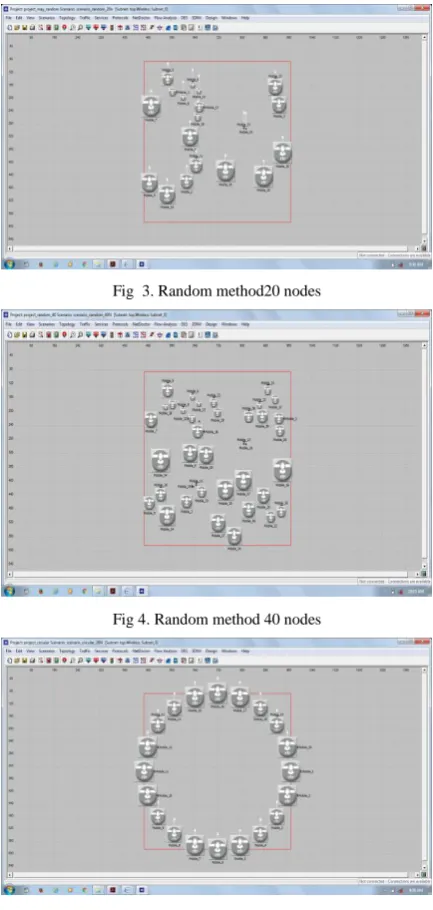
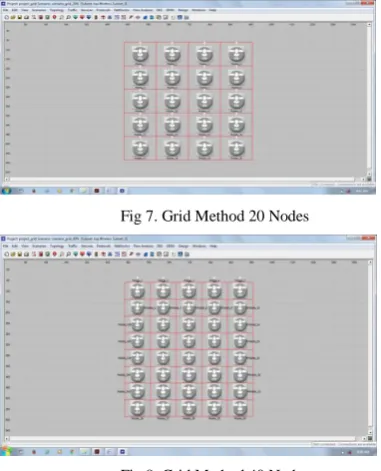
Throughput: Represents the total number of bits (in bits/sec) forwarded from wireless LAN layers to higher layers in all WLAN nodes of the network. The aim of this simulation study is to evaluate the performance of existing wireless routing protocol OSPF in various nodes placement models like Grid, Random and Circular i.e. the nodes are placed in various arrangements and move arbitrarily. The simulations have been performed using OPNet version 14.5,a software that provides scalable simulations of Wireless Networks. For this, the simulation is carried out within a 500m X 500m area by varying the number of nodes (one source and one destination) and keeping the speed and pause time constant. The Nodes placement in three models for 20 nodes, 40 for small and medium network purpose is as shown following figures 3,4,5,6,7,8
Fig 3. Random method20 nodes
Fig 4. Random method 40 nodes
Fig 5. Circular Method 20 Nodes
Fig 7. Grid Method 20 Nodes
Fig 8. Grid Method 40 Nodes
VII. SIMULATION ENVIRONMENT
Table I: Simulation Parameters
Area 500m x 500m
Nodes 20,40
Nodes Placement Random, Grid,Circular
Mobility Model Random Way Point
Node Transmission Power 0.005
Operational mode 802.11b
Data rate 11Mbps
Simulation time 300,600,900,1200,1500 sec
Defacto values set MANET
VIII. RESULTS AND DISCUSSION
To evaluate the performance of routing protocols, the following metrics are considered.
1) The variation of Average End-to- End Delay with varying the simulation time of mobile nodes is shown in the Figure a) 20 nodes, b) 40 nodes
a) Variation of End-to-end delay with simulation time for 20
nodes
From the graph we concluded that as simulation time increases delay decreases after 15 minutes it comes constant delay.
b) Variation of End-to-end delay with simulation time for 40
nodes
2) The variation of Throughput with varying the number of simulation time is shown in the Figure a) for 20 nodes, b) 40 nodes
a) Variation of Throughput with simulation time for 20
nodes
Based on different simulation times, the throughput varies from maximum to minimum when there is less simulation time throughput is more and vice versa. After comparing three models we observed high throughput in Grid model.
b) Variation of Throughput with simulation time for 40
nodes 0.00028
0.0003 0.00032 0.00034
random 20N Wireless LAN.Delay (sec)'
circular 20N Wireless LAN.Delay (sec)'
grid 20N Wireless LAN.Delay (sec)'
0.00028 0.0003 0.00032 0.00034 0.00036 0.00038
300 s 600 s 900 s 1200
s
1500
s
circular 40 n Wireless LAN. Delay sec
Grid 40 n Wireless LAN. Delay sec
random 40 n Wireless LAN. Delay sec
0.00 200,000.00 400,000.00 600,000.00 800,000.00 1,000,000.00
300
s
600
s
900
s
1200
s
1500
s
random 20N Throughput (bits/sec)'
circular
20N Throughput (bits/sec)'
grid
20N Throughput (bits/sec)'
0.00 1,000,000.00 2,000,000.00 3,000,000.00 4,000,000.00 5,000,000.00 6,000,000.00
300
s
600
s
900
s
1200
s
1500
s
circular 40 n Throughput (bits/sec)' Grid 40 nThroughput (bits/sec)'
random 40 n Throughput (bits/sec)'
Simulation time d
e l a y
Simulation time t
From the graph we concluded that as simulation time increases throughput decreases and maximum for circular, minimum for random and moderate for grid node deployment model
IX. CONCLUSION
From simulation results we conclude that the OSPF protocol exhibiting better performance for Random model particularly in the combination of metrics such as throughput and delay. When compare with grid and circular deployment model.
X. References:
[1] S. Ali and A. Ali, Performance analysis of aodv, dsr and olsr in manet, Doctoral dissertation, COM/School of Computing, BTH, 2010, Master’s Thesis.
[2] Sunil Taneja &AshwaniKush “PERFORMANCE
EVALUATION OF DSR AND AODV OVER UDP AND TCP CONNECTIONS” International Journal of Computing and Business Research (IJCBR), Volume 1, No. 1 December . 2010
[3] Azzedine Boukerche, Performance evaluation of routing protocols for ad hoc wireless networks, Mob.Netw. Appl. 9 (2004), no. 4, 333–342.
[4] Josh Broch, David A. Maltz, David B. Johnson, YihChun Hu, and Jorjeta Jetcheva, A performance comparison of multi-hop wireless ad hoc network routing protocols, Proceedings of the 4th annual ACM/IEEE international conference on Mobile computing and networking (New York, NY, USA), MobiCom ’98, ACM, 1998, pp. 85–97.
[5] Stefano Basagni, Marco conti, Silvia Giordano, Ivan Stojmenovic, “Mobile Ad Hoc Networking”, IEEE Press, A John Wiley & Sons, Inc., Publication.
[6] Tracy Camp, Jeff Boleng, and Vanessa Davies, A survey of mobility models for ad hoc network research, Wireless Communications and Mobile Computing (WCMC): Special Issue on Mobile Adhoc Networking: Research, Trends and Applications 2 (2002), 483–502.
[7] S.R. Das, C.E. Perkins, and E.M. Royer, Performance comparison of two on-demand routing protocols for adhoc networks, INFOCOM 2000. Nineteenth Annual Joint Conference of the IEEE Computer and Communications Societies. Proceedings. IEEE, vol. 1, 2000, pp. 3–12 vol.1. [8] Vanessa Ann Davies, Copyright Vanessa, A. Davies, and
Vanessa A. Davies, Evaluating mobility models within an ad hoc network, 2000.
[9] Donatas Sumyla, Mobile Ad-hoc Networks, 03/20/2006 [10] P. Jacquet, P. Muhlethaler, T. Clausen, A. Laouiti, A.
Qayyum, and L. Viennot, Optimized link state routing protocol for ad hoc networks, Multi Topic Conference, 2001.
IEEE INMIC 2001. Technology for the 21st Century.
Proceedings. IEEE International, 2001, pp. 62–68.
[11] David B. Johnson and David A. Maltz, Dynamic source routing in ad hoc wireless networks, Mobile Computing, Kluwer Academic Publishers, 1996, pp. 153–181.
[12] Sunil Kumar Kaushik, Kavita Chahal, Sukhbir Singh, and Sandeep Dhariwal, Performance evaluation of mobile ad hoc networks with reactive and proactive routing protocols and
mobility models, International Journal of Computer
Applications 54 (2012), no. 17, 28–35, Published by Foundation of Computer Science, New York, USA.
[13] Khaleel Ur Rahman Khan, Rafi U. Zaman, and A. Venugopal Reddy, Performance comparison of on demand and table driven ad hoc routing protocols using nctuns, Proceedings of the Tenth International Conference on Computer Modeling and Simulation (Washington, DC, USA), UKSIM ’08, IEEE Computer Society, 2008, pp. 336–341.
[14] Mirco Musolesi and Cecilia Mascolo, A community based mobility model for ad hoc network research, Proceedings of the 2nd international workshop on Multi-hop ad hoc networks: from theory to reality (New York, NY, USA), REALMAN ’06, ACM, 2006, pp. 31–38.
[15] Parma Nand and S.C. Sharma, Comparative study and performance analysis of fsr, zrp and aodv routing protocols for manet, IJCA Proceedings on International Conference and workshop on Emerging Trends in Technology (ICWET) (2011), no. 2, 14–19, Published by Foundation of Computer Science.
[16] YUAN Peiyan and LI Layuan, Performance evaluation and simulations of routing protocols in ad hoc networks, Proceedings of the 2006 workshop on Broadband wireless access for ubiquitous networking (New York, NY, USA), BWAN ’06, ACM, 2006.
[17] C.E. Perkins and E.M. Royer, Ad-hoc on-demand distance vector routing, Mobile Computing Systems and Applications, 1999. Proceedings. WMCSA ’99.Second IEEE Workshop on, 1999, pp. 90–100.
[18] Charles E. Perkins and Pravin Bhagwat, Highly dynamic destinationsequenced distance-vector routing (dsdv) for mobile computers, SIGCOMM Comput.Commun. Rev. 24 (1994), no. 4, 234–244.
[19] K. N. Raju S. P. Setty and K. N. Kumar, Performance evaluation of aodv in different environments, International Journal of Engineering Science and Technology 2 (2010), no. 7, 2976–2981.
[20] Hafiz Issaka Salima Hamma, Eddy Cizeron and Jean Pierre Guedon, Performance evaluation of reactive and proactive routing protocol in ieee 802.11 ad hoc network., In Proc. of SPIE, vol. 6387, Society of Photo-Optical Instrumentation Engineers, 2006, pp. 638709–1.
[21] G.Z. Santoso and Moonsoo Kang, Performance analysis of aodv, dsdv and olsr in a vanets safety application scenario, Advanced Communication Technology (ICACT), 2012 14th International Conference on, 2012, pp. 57–60.
[22] Subir Kumar Sarkar, TG Basavaraju, and C Puttamadappa. Ad hoc mobile wireless networks: principles, protocols and applications. CRC Press, 2007.
[23] Performance Comparison of OSPF and IS-IS Routing Protocols in Dual-Stack Enterprise Networks Paris – Alexandros Roussinos – 40134490 – MSc Advanced Networking.
[24] Zheng Lu and Hongji Yang.Unlocking the power of OPNET modeler.Cambridge University Press, 2012.
[25] T. H. Clausen, A MANET Architecture Model,
http://www.thomasclausen.org/Thomas eideClausens
Website/Research Reports files/RR-6145.pdf, 2007.