An Efficient Algorithm to obtain the optimal
solution for Fuzzy Transportation problems
S.Krishna Prabha,S.Devi,S.Deepa
Associate Professor,Department of Mathematics, PSNA CET-Dgl,Tamilnadu. Assistant Professor, Department of Mathematics, PSNA CET-Dgl,Tamilnadu.
Lecturer,Department of civil Engineering, PSNA CET-Dgl,Tamilnadu
Abstract:
In this paper we solve the Fuzzy Transportation problems by using a new algorithm namely EAVAM . We introduce an approach for solving a wide range of such problems by using a method which applies it for ranking of the fuzzy numbers. Some of the quantities in a fuzzy transportation problem may be fuzzy or crisp quantities. In many fuzzy decision problems, the quantities are represented in terms of fuzzy numbers. Fuzzy numbers may be normal or abnormal, triangular or trapezoidal or any LR fuzzy number. Thus, some fuzzy numbers are not directly comparable. First, we transform the fuzzy quantities as the cost, coefficients, supply and demands, into crisp quantities by using our method and then by using the EAVAM, we solve and obtain the solution of the problem. The new method is systematic procedure, easy to apply and can be utilized for all types of transportation problem whether maximize or minimize objective function.
Finally we explain this method with a numerical example.
Keywords: Optimization, Transportation
problem, ranking of fuzzy numbers, .Fuzzy sets, Fuzzy transportation problem,
1 . Introduction
Transportation models have wide applications in logistics and supply chain for reducing the cost. When the cost coefficients and the supply and demand quantities are known exactly, many algorithms have been developed for solving the transportation problem. But, in the real world, there are many cases that the cost coefficients and the supply and demand quantities are fuzzy quantities.
The transportation problem is one of the oldest applications of linear programming problems. The basic transportation problem was originally developed by Hitchcock [3]. Efficient methods of solution derived from the simplex algorithm were developed in 1947, primarily by Dantzig [4] and then by Charnes and Cooper [1]. The transportation problem can be modeled as a
standard linear programming problem that can be solved by the simplex method. We can get an initial basic feasible solution for the transportation problem by using the North-West corner rule, Row Minima, Column Minima, Matrix Minima or the Vogel’s Approximation Method. To get an optimal solution for the transportation problem, we use the MODI method (Modified Distribution Method).Charnes and Cooper [1] developed the Stepping Stone Method, which provides an alternative way of determining the optimal solution The LINDO (Linear Interactive and Discrete Optimization) package handles the transportation problem in explicit equation form and thus solves the problem as standard linear programming problem. Consider m origins (or sources) Oi (i
=1,....,m)and n destinations Dj (j = 1,...,n). At
each origin Oi, let ai be the amount of a
homogeneous product which we want to transport to n destinations Dj, in order to satisfy the
demand for bj units of the product there. A
penalty cij is associated with transport in a unit of
the product from source i to destination j. The penalty could represent transportation cost, delivery time, quantity of goods delivered, under-used capacity, etc. A variable xij represents the
unknown quantity to be transported from origin Oi to destination Dj. The transportation problem
In this problem we determine optimal shipping patterns between origins or sources and destinations. Many problems which have nothing to do with transportation have this structure. In many fuzzy decision problems, the data are represented in terms of fuzzy numbers. In a fuzzy transportation problem, all parameters are fuzzy numbers. Fuzzy numbers may be normal or abnormal, triangular or trapezoidal. Thus, some fuzzy numbers are not directly comparable. Comparing between two or multi fuzzy numbers and ranking such numbers is one of the important subjects, and how to set the rank of fuzzy numbers has been one of the main problems. Several methods are introduced for ranking of fuzzy numbers. Here, we want to use a method which is introduced for ranking of fuzzy numbers, by Basirzadeh et al. [3]. Now, we want to apply this method for the fuzzy transportation problems, where all parameters can be, triangular fuzzy numbers. This method is very easy to understand and to apply. At the end, the optimal solution of a problem can be obtained in a fuzzy number or a crisp number.
2. Terminology
Consider m origins (or sources) Oi (i = 1,...,m)
and n destinations Dj (j = 1,...,n). At each origin
Oi, let ai be the amount of a homogeneous
product that we want to transport to n destinations Dj, in order to satisfy the demand for
bj units of the product there. A penalty cij is
associated with transportation of a unit of the product from source i to destination j. The penalty could represent transportation cost, delivery time, quantity of goods delivered under-used capacity, etc. A variable xij represents the unknown quantity to be transported from origin Oi to destination Dj. However, in the real world,
all transportation problems are not single objective linear programming problems.
The mathematical form of the above said problem is as follows
Minimize Z = 𝑚𝑖=1 𝑚𝑗 =1 𝑐𝑖𝑗 𝑥𝑖𝑗 (1)
𝑥𝑖𝑗 𝑚
𝑗 =1 = 𝑎𝑖 , i=1,2,…m.
𝑥𝑖𝑗 𝑚
𝑖=1 = 𝑏𝑗 , j=1,2,…m. (2)
𝑥𝑖𝑗 ≥ 0 , i= 1,2,..m, j=1,2,..m.
where cij is the cost of transportation of an unit from the ith source to the jth destination, and the quantity xij is to be some positive integer or zero, which is to be transported from the ith origin to jth destination. An obvious necessary and sufficient condition for the linear
programming problem given in (1) to have a solution is that
𝑛𝑖=1𝑎𝑖= 𝑚𝑗 =1𝑏𝑗 (2)
i.e. assume that total available is equal to the total required. If not true, a fictitious source or destination can be added. It is has a feasible solution if and only if the condition (2) satisfied. Now, the problem is to determine xij , in such a way that the total transportation cost is minimum. Mathematically a fuzzy transportation problem can be stated as follows:
Minimize Z = 𝑚𝑖=1 𝑚𝑗 =1 𝑐𝑖𝑗 𝑥𝑖𝑗 (3)
𝑚𝑗 =1𝑥𝑖𝑗 = 𝑎𝑖 , i=1,2,…m.
𝑚𝑖=1𝑥𝑖𝑗 = 𝑏 𝑗 , j=1,2,…m. (5)
𝑥𝑖𝑗 ≥ 0 , i= 1,2,..m, j=1,2,..m.
in which the transportation costs 𝑐𝑖𝑗 , supply 𝑎𝑖 and demand 𝑏 𝑗 quantities are fuzzy quantities. An obvious necessary and sufficient condition for the fuzzy linear programming problem given in (2-3) to have a solution is that
𝑛𝑖=1𝑎𝑖 ≈ 𝑚𝑗 =1𝑏 𝑗 (4)
A considerable number of methods presented for fuzzy transportation problem. Some of them are based on ranking of the fuzzy numbers. Some of the methods for ranking of the fuzzy numbers for example, have limitations, are difficult in calculation, or they are non-intuitive, which makes them inefficient in practical applications, especially in the process of decision making. However, in some of these methods, as ones in which fuzzy numbers are compared according to their centeroid point (see [2], [15], [16]), the decision maker does not play any role in the comparison between fuzzy numbers. Nevertheless, there are certain methods in which fuzzy numbers are compared in a parametric manner
Two factors play significant roles in fuzzy decision systems:
1. Contribution of the decision-maker in the decision making process,
2. Simplicity of calculation.
This paper attempts to propose a method for ranking and comparing fuzzy numbers to account for the above-mentioned factors as much as possible.
2.1 Definition
A fuzzy number 𝑎 is a Triangular-Fuzzy number denoted (a1,a2,a3,) where a1,a2 and a3 and it’s
𝜇𝑎 (x) = 𝑥−𝑎1
𝑎2−𝑎 1 𝑎1 ≤ 𝑥 ≤ 𝑎2 𝑥−𝑎3
𝑎2−𝑎3 𝑎2 ≤ 𝑥 ≤ 𝑎3 0 𝑜𝑡ℎ𝑒𝑟𝑤𝑖𝑠𝑒
Consider the following fuzzy transportation problem (FTP),
(FTP) Minimize: Z = 𝑚𝑖=1 𝑚𝑗 =1 𝑐 𝑖𝑗 𝑥 𝑖𝑗 Subject to
𝑥 𝑖𝑗 𝑚
𝑗 =1 ≤𝑎𝑖 , i=1,2,…m.
𝑥 𝑖𝑗 𝑚
𝑖=1 ≥𝑏 𝑗 , j=1,2,…m.
𝑥 𝑖𝑗 ≥ 0 , i= 1,2,..m, j=1,2,..m.
Where 𝑎𝑖 = ( a1,a2,a3), 𝑏 𝑗 =( b1,b2, b3) and
𝑐 𝑖𝑗 =(cij,cij,cij) representing the uncertain supply
and demand for the transportation problems. 𝐴(r)
ω 𝐴 (r)
a b c
Figure 1: an arbitrary Fuzzy number (0 ≤ ω ≤ 1)
According to the above-mentioned definition of a triangular fuzzy number,
let 𝐴 = (𝐴(r),𝐴 (r)), (0 ≤ r ≤ 1) be a fuzzy number, then the value M(𝐴 ), is
assigned to 𝐴 is calculated as follows:
𝑀0𝑇𝑟𝑖 (𝐴 ) =12 𝐴 𝑟 + 𝐴 (𝑟) 01 dr = 4 1 2𝑎2+
𝑎1 + 𝑎3
which is very convenient for calculation.
ω
δ m β
A triangular fuzzy number
Definition let 𝐴 = (a1,a2, a3) and 𝐵 = (b1,b2,b3) be two triangular fuzzy numbers. Then
(1). 𝐴 ⊕ 𝐵 = (a1,a2, a3) ⊕ (b1,b2,b3) = (a1+b1,a2+b2,a3+b3)
(2). 𝐴 ⊖ 𝐵 = (a1,a2, a3) ⊖ (b1,b2,b3) = (a1+b1,a2-b2,a3+b3)
(3). 𝐴 ⊗ 𝐵 = (a1,a2, a3) ⊗ (b1,b2,b3) = (s1,s2,s3)
where
s1 = minimum{a1b1, a1b3, a3b1,a3b3}, s2 = mn
s3 = maximum{ a1b1, a1b3, a3b1,a3b3},
3. A new Algorithm for solving fuzzy transportation Problem
Now, we introduce a new method for solving a fuzzy transportation problem where the transportation cost, supply and demands are fuzzy numbers. The fuzzy numbers in this problem is triangular. The optimal solution for the fuzzy transportation problem can be obtained as a crisp or fuzzy form.
Step 1. Calculate the values M(.) for each fuzzy data, the transportation costs 𝑐 𝑖𝑗 supply 𝑎𝑖 and demand 𝑏 𝑗 quantities which are fuzzy quantities. Step 2. By replacing M(𝑐 𝑖𝑗 ), M(𝑎𝑖 ) and M(𝑏 𝑗) which are crisp quantities instead of the 𝑐 𝑖𝑗, 𝑎𝑖 and 𝑏 𝑗 quantities which are fuzzy quantities, define a new crisp transportation problem.
Step 3. Solve the new crisp transportation problem, by usual method , and obtain the crisp optimal solution of the problem.
Note Any solution of this transportation problem will contain exactly (m+n-1) basic feasible solutions. We note that the optimal solution Xij is to be some positive integer or zero, but the optimal solution Xij for a crisp transportation problem may be integer or non integer, because the RHS of the problem are the measure of fuzzy numbers which are real numbers. If you accept the crisp solution then stop. The optimal solution is in your hand. If you want fuzzy form of solution, go to the next step.
4.Numerical example
The following example may be helpful to clarify the proposed method:
Example:Consider the following fuzzy transportation problem .All the data in this problem are triangular fuzzy numbers. We want to solve it by our method, and then we will compare the results.
A company has two factories O1, O2 and two
retail stores D1, D2. The production quantities per
month at O1, O2 are (150, 201, 246) and (50, 99,
154) tons respectively. The demands per month for D1 and D2 are (100,150,200) and
(100,150,200) tons respectively. The transportation cost per ton 𝑐 𝑖𝑗 , i =1, 2; j=1, 2 are
𝑐 11 = (15,19,29), 𝑐 12= (22,31,34), 𝑐 21= (8,10,12) and 𝑐 22= (30,39,54).
Solution: Transportation table of the given fuzzy transportation problem is
Table 4.1 Fuzzy Transportation Problem
D1 D2 Supply
O1 (15,19,29) (22,31,34) (150,201,2
46)
O2 (8,10,12) (30,39,54) (50,99,154
)
Dema nd
(100,150,2 00)
(100,150,2 00)
(200,300,4 00) According to the above-mentioned definition of a triangular fuzzy number,
let 𝐴 = (𝐴(r),𝐴 (r)), (0 ≤ r ≤ 1) be a fuzzy number, then the value M(𝐴 ), is
assigned to 𝐴 is calculated as follows:
𝑀0𝑇𝑟𝑖 (𝐴 ) =12 𝐴 𝑟 + 𝐴 (𝑟) 01 dr = 4 1 2𝑎2+
𝑎1 + 𝑎3
which is very convenient for calculation.
Since 𝑀𝑜𝑇𝑟𝑖( 𝑆 ) = 𝑀𝑜𝑇𝑟𝑖( 𝐷 ), the given problem is a balanced one.
Now, by using our method we change the fuzzy transportation problem into a crisp transportation problem. So, we have the following reduced fuzzy transportation problem:
D1 D2 Supply
O1 20.5 29.5 199.5
O2 10 40.5 100.5
Demand 150 150 300
Table 4.2
As shown in the table 4.2, the result of defuzzification of the fuzzy numbers obtaining the measures which are not all integer. So, existing of a non integer value in a transportation
problem follows this fact that the solution of the crisp transportation problem is not integer. We note that the solution in a usual transportation problem is integer, because its matrix is an unimodular matrix
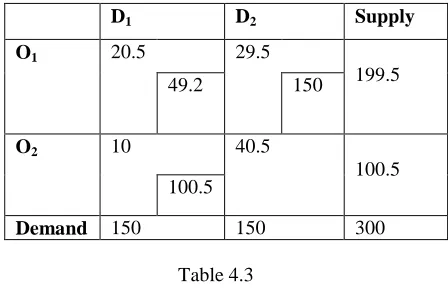
If we solve the new problem, we obtain the solutions as follows:
X11 = 49.5, X12 = 150, X21 = 100.5
D1 D2 Supply
O1 20.5 29.5
199.5
49.2 150
O2 10 40.5
100.5 100.5
Demand 150 150 300
Table 4.3
Now, we can return to initial problem and obtain the fuzzy solution of the
fuzzy transportation problem based on the data of table 4.3.
D1 D2 Supply
O1 (350,51,34
6)
(100,150,2 00)
(150,201,2 46)
O2 (50,99,154
)
(50,99,154 )
Dema nd
(100,150,2 00)
(100,150,2 00)
(200,300,4 00) Table 4.4
where the fuzzy optimal solution for the given fuzzy transportation problem is:
𝑥 11 = (350, 51,346)
𝑥 12 = (100,150,200)
𝑥 21 = (50, 99,154)
The crisp value of the optimum fuzzy transportation cost for the given problem by 6444.5
5. Conclusion
utilized for all types of transportation problem whether maximize or minimize objective function.
References
[1] A. Nagoor Gani and K. Abdul Razak, Two stage fuzzy
transportation problem, European Journal of
Operational Research, 153(2004), 661-674.
[2] C. H. Cheng, A new approach for ranking fuzzy
numbers by distance method, fuzzy sets and systems, 95
(1998) 307-317.
[3] H. Basirzadeh, R. Abbasi, A new approach for ranking
fuzzy numbers based on α−cuts, JAMI, Journal of
Appied Mathematics & Informatic,26(2008) 767-778. [4] H. Basirzadeh, R. Abbasi, An Approach for solving
fuzzy Transportation problems, Applied Mathematical
Sciences, Vol. 5, 2011, no. 32, 1549 - 1566
[5] H. J. Zimmermann, Fuzzy set theory and its Applications, second edition,kluwer Academic, Boston, 1996.
[6] H. W. Lu, C. B. Wang, An Index for ranking fuzzy
numbers by belieffeature, Information and management
science, 16(3) (2005) 57-70.
[7] M. Detyniecki, R. R. Yager, Ranking fuzzy numbers
using α−weightedValuations, International Journal of
uncertainty, Fuzziness and knowledge-Based systems,
8(5) (2001) 573-592.
[8] M. S. Bazarra, John J. Jarvis, Hanif D. Sherali, Linear programming and network flows, (2005).
[9] M. Shanmugasundari, K. Ganesan , A Novel Approach for the fuzzy optimal solution of Fuzzy Transportation
Problem, International Journal of Engineering Research
and Applications (IJERA) Vol. 3, Issue 1, January -February 2013, pp.1416-1424
[10] P. Grzegorzewski, E. Mr´owka, Trapezoidal
approximations of fuzzy numbers,fuzzy sets and systems,
153 (2005) 115-135.
[11] P. Pandian and G. Natarajan, A new algorithm for finding a fuzzy optimal solution for fuzzy transportation
problems, Applied MathematicalSciences, 4(2010),
79-90.
[12] S. Abbasbandy, B. Asady, The nearest trapezoidal fuzzy
number to a fuzzy quantity, Applied mathematics and
computation, 159 (2004) 381-386.[11]
[13] S. Abbasbandy, B. Asady, Ranking of fuzzy numbers by
sign distance,Information science, 176 (2006)
2405-2416.
[14] S. Chanas and D. Kuchta, A concept of the optimal solution of the transportation problem with fuzzy cost coefficients, , Fuzzy sets and Systems,82 (1996) 299-305.
[15] S. Chanas, W. Kolodziejczyk and A. Machaj, A fuzzy approach to the transportation problem, Fuzzy Sets and Systems, 13 (1984) 211-221.
[16] Shiang-Tai Liu and Chiang Kao, Solving fuzzy transportation problems based on extension principle, Journal of Physical Science, 10(2006), 63-69.