21
Multiple Input Multiple Output Antenna
Design
Nipun Singh Sahu
1, Mr. Rajiv Sharma
2, Ms. Seema
31
(M. Tech, C.S.E) Shri Baba Mastnath College of Engineering, CSE, Maharishi Dayanand University, Rohtak 1,2
(Asst. Prof) Shri Baba Mastnath College of Engineering, CSE, Maharishi Dayanand University, Rohtak
ABSTRACT
After 2001 there is tremendous advancement in remote correspondence and with appearance of time movement blockage issue is on the ascent, additionally ISP can't give great nature of administration. In our exploration paper we actualized recreation result CDMA, OFDM and UWB for various band pass method for instance BPSK, QPSK, QAM, 16 QAM, 64QAM and so forth. We figured Transmitter and beneficiary message of CDMA, OFDM and UWB for BPSK QPSK, QAM 16, QAM, 64 and QAM 256 tweak system. Bit Error Rate (BER) and Signal-to-Noise proportion (SNR) for BPSK QPSK, QAM 16, QAM, 64 and QAM 256 adjustment system. MSE Equalizer for BPSK QPSK, QAM 16, QAM, 64 and QAM 256 balance system. It is incomprehensible without the utilization of savvy receiving wire 4 by 8 which implies 4 transmitter and 8 recievers. Prior we utilized just single or double radio wire now we have utilized a variety of reception apparatus to give much proficient and great nature of administration or we can state MIMO (Multi input Multi Output).
INTRODUCTION
CDMA (code division multiple access), OFDM (orthogonal frequency division multiplexing) and UWB (ultra wide band) are the system which simulink with communication and DSP signal library with smart antennas for manifold transmits and receives system. Most third generation mobile communication systems are using CDMA as their modulation technique. Prior to the modern industry advanced, the most frequent UWB system implementation was impulse radio, where ultra-short baseband pulses were used with a diversity of modulation schemes to transfer data. Impulse radio has several benefit over OFDM, with its capacity to pass through materials and unravel multipath with route length variation on the order of a foot or less.
LITERATURE SURVEY
CDMA (code division multiple access), OFDM (orthogonal frequency division multiplexing) and UWB (ultra-wide band) are the most developed technologies in present day mobile communication. OFDM is a parallel transmission scheme, in which a high – rate serial data stream is divided into two low – rate sub streams, both of them are modulated onto a separate subcarrier. For this study a numerous number of research papers were analyzed because there are two principal problems. First problem was that no one has analyzed a proper pattern in which all of CDMA, OFDM and UWB are depicted so it was a difficult task to analyze these techniques and second problem was to design an adaptive antenna with the simulation blocks. In 1980,we had limited amount of resources to transmit intel via space with help of electromagnetic waves. Fewer technologies were used like aloha, packet radio, carrier sense technology. With the advent of time new technologies came into existence like TDMA, FDMA. After tremendous research being done out by scientists more advance technologies came into being. MC-CDMA could provide the qualities of service that the other system may not able to support. UWB system is apt for indoor wireless environment and due to this ,the channel suffers from frequency-selective fading. OFDM system is as complex as compared with the DS-CDMA, but it is unable to resolve power problem.
International Journal of All Research Education and Scientific Methods (IJARESM) ISSN: 2455-6211, Volume 6, Issue 5, May- 2018, Impact Factor: 2.287
22 cross-layer ultra wide band receiver architecture where it send and receive information with the physical layer for probable channel conditions before assigning links dynamically for the data transmission.
METHODOLOGY/PLANNING OF WORK
The main task of our research work was to make simulation block diagram which is backbone of this composition. First thing encountered was the design of an smart antenna 4*8 which is very difficult part. Smart antenna these days are also known as MIMO or group of antenna to spike up performances and if the order is increased then complexity also increases so much so that we have to trade of between expense and intricacy.
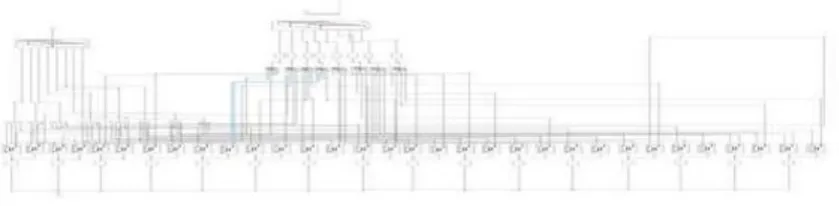
Figure 1: Smart Antenna 4*8
(a) CDMA:
The main concern was with the calculation performance of a CDMA in a multipath fading and a discrete set of Rayleigh faded paths that are modeling WGN channels
.
Figure 2: CDMA Transmitter
The received signal before getting converted digitally with a sampling rate is filtered and then being followed by a rake receiver. The rake receiver is absolute to combat multipath. After correlation, the power of all detected paths is combined and, lastly, FEC decoding and the de-mapping are performed to assure the data integrity.
(b) OFDM:
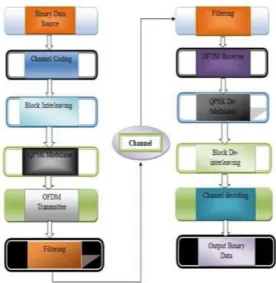
23 Figure 3: System Model of OFDM System
(c) UVB:
Figure 4: System Model of UWB System
RESULT
Software Requirement: MATLAB Version R2013a
International Journal of All Research Education and Scientific Methods (IJARESM) ISSN: 2455-6211, Volume 6, Issue 5, May- 2018, Impact Factor: 2.287
24 complex drawing and scientific graphics, Analysing of algorithmic designing, Mathematical and Computational functions, Modelling and simulating problems prototyping, GUI (graphical user interface) building environment but in our research work we implemented simulation library from a lot of simulation toolboxes and main toolbox used is communication toolbox. Now we put simulation result of different technology and then compare their respective result and after that we reach at a conclusion out of these technologies which one is superior. Simulation Block of CDMA: CDMA performance analysis presented in this section is based on computer simulations. The basic scenario of our simulation is represented by CDMA transmission system performing through multipath fading and AWGN transmission channel. The simulation results of CDMA are shown here:
Figure 5: Simulation block of CDMA System using QAM 256 modulation
Performance analysis of CDMA:
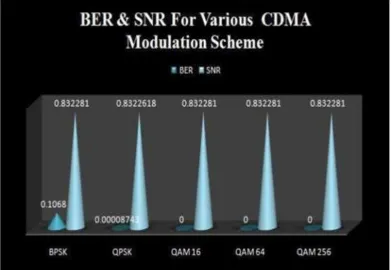
25 Figure 7: BER and SNR value representation of CDMA
Figure 8: CDMA QAM 256 Signal Constellations
The CDMA transmitted signal to the channel. This signal passed through the multipath fading and additive white Gaussian noise channel. After passing this signal from channel we get the CDMA received signal. The scatter plot illustrates the effect of fading on the signal constellation. For all the interleaving schemes the transmitted and received signal has same bandwidth but these schemes affect the transmission rate and bit error rate of CDMA system.
International Journal of All Research Education and Scientific Methods (IJARESM) ISSN: 2455-6211, Volume 6, Issue 5, May- 2018, Impact Factor: 2.287
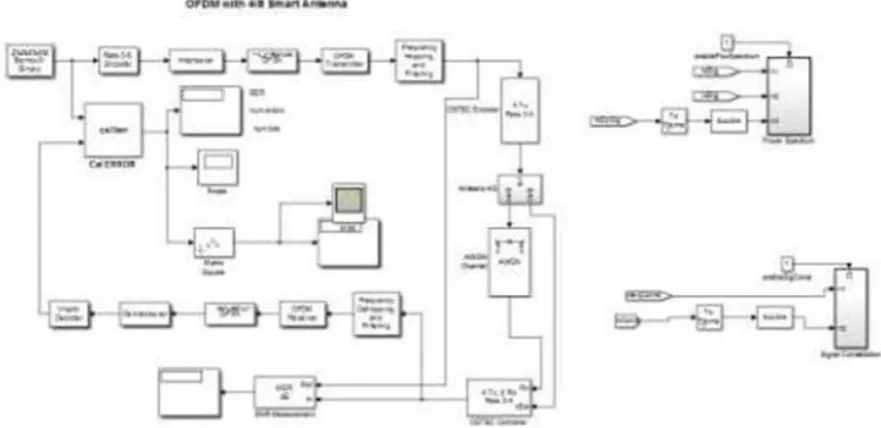
26 Figure 9: Simulation block of OFDM System using QPSK modulation
Performance analysis of OFDM:
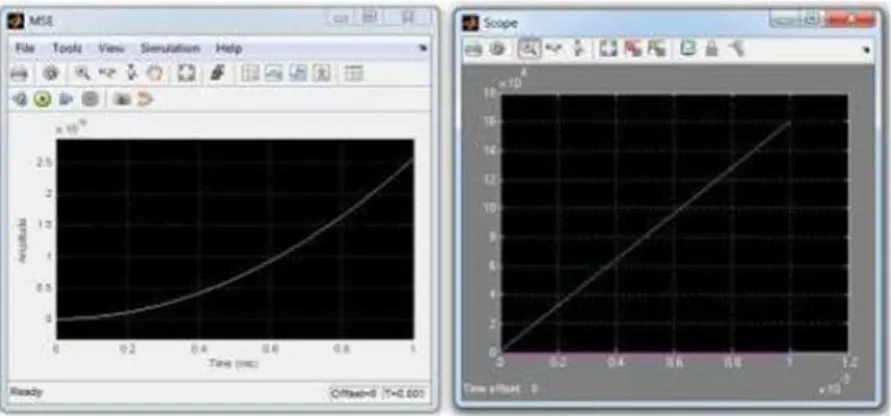
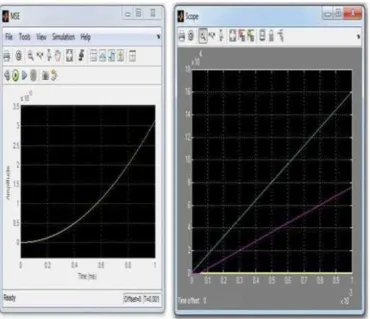
Figure 10: OFDM Mean Square Error (MSE) left & Total Bits (Blue), number of error (Magenta) and Bit error rate(yellow) in right side using QPSK Modulation.
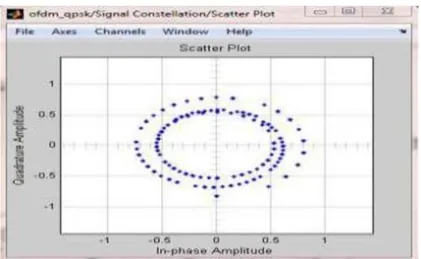
27 Figure 12: OFDM QPSK Signal Constellations
The Bit Error Rates (BER) of these performance analysis is shown below: First, simple OFDM system is modelled then we compare different type of modulation schemes with this system and get QPSK modulation scheme is best for OFDM system on the basis of BER as below.
Simulation Block of UVB: The basic scenario of our simulation is represented by the UWB transmission system performing through multipath fading and AWGN transmission channel. The encoder of UWB system uses CRC and RS Encoder schemes. The simulation results of UWB system is shown below:
International Journal of All Research Education and Scientific Methods (IJARESM) ISSN: 2455-6211, Volume 6, Issue 5, May- 2018, Impact Factor: 2.287
28 Performance analysis of UWB:.
Figure 14: UWB Mean Square Error (MSE) left & Total Bits (Blue), number of error (Magenta) and Bit error rate(yellow) in right side using BPSK Modulation.
29 Figure 16: UVB BPSK Signal Constellations
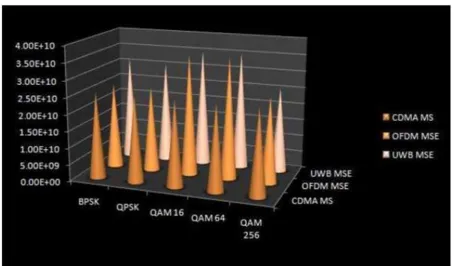
Figure 17: MSE of Different Modulation Schemes for CDMA, OFDM and UWB System
CONCLUSION
International Journal of All Research Education and Scientific Methods (IJARESM) ISSN: 2455-6211, Volume 6, Issue 5, May- 2018, Impact Factor: 2.287
30 OFDM and QAM is best for CDMA and UWB system with less BER. CDMA, OFDM and UWB are the well-known air interface technologies in modern mobile communication.
REFERENCES
[1]. Theodore S. Rappaport, “Wireless Communications Principles and Practice” 2nd ed., India: PHI Private Limited, pp. 458 – 459, 2008.
[2]. K. Fazel& S. keiser, “Multi Carrier and Spread Spectrum Systems” 1st ed., England: John Wiley and Sons Limited, 30 – 37, 2003.
[3]. LejiangGuo, Weijiang Wang, Guoshi Wang and Jian Cui, “Research and Implementation of Forest Fire Early Warning System Based on UWB Wireless Sensor Networks”, IEEE 2nd International Conference on Communication Systems, Networks and Applications, Vol. 1, pp. 176 – 179, 2010.
[4]. Namsuk Lee, Yongseouk Choi, Sookjin Lee and Nam Kim, “A New CDMA-Based Bandwidth Request Method for IEEE 802.16 OFDMA/TDD Systems”, IEEE 2010 Communications Letters, Vol. 14, pp. 124 – 126, 2010.
[5]. Wenshuo Zhang, WeixiaZou, Bin Li, Zheng Zhou, Feng Zhao and Zhiwei Wang, “On coexistence between UWB and OFDM-MIMO systems ”, IEEE International Conference on Ultra-Wideband, Vol. 2, pp. 1 – 4, 2010.
[6]. Xue Li, Ruolin Zhou, Chakravarthy V., Hong S. and Zhiqiang Wu, “Total Intercarrier Interference Cancellation for OFDM Mobile Communication Systems”, 7th IEEE Consumer Communications and Networking Conference, 1 – 5, 2010.
[7]. Fangni Chen, Shiju Li, “Proposal of a novel punctured LDPC coding scheme for Ultra Wide Band system”, IEEE 7th International Symposium on Antennas, Propagation and EM Theory, pp. 1 – 4, 2009.
[8]. Leonardo Betancu, Narcis Cardona, Andres Navarro and Lara Traver, “A Statistical Channel Model for On Body Area Networks in Ultra Wide Band Communications”, IEEE Latin – American Conference on Communications, 1 – 6, 2009.
[9]. Ali Kotti, Zouhair Ben Jemaa and SafyaBelghith, “Performance Of Asynchronous DS-UWB Communication System On Rayleigh Multipath And AWGN Channel Versus Spreading Sequences”, IEEE 6th International Multi Conference on Systems, Signals and Devices, pp. 1 – 6, 2009.
[10]. EunCheol Kim and Jin Young Kim, “Performance Analysis of UWB Systems with Non-Binary Turbo Code in Multi-User Environments”, IEEE 11th International Conference on Advanced Communication Technology, Vol. 3, pp. 1954 – 1958, February 2009.
[11]. Marco Di Renzo, Luca Alfredo Annoni, Fabio Graziosi and FortunatoSantucci, “A Novel Class of Algorithms for Timing Acquisition of Differential Transmitted Reference UWB Receivers: Architecture, Performance Analysis and System Design”, IEEE Transactions on Wireless Communications, VOL. 7, No. 6, pp. 2368 – 2387, June 2008. [12]. Maninder Singh and PrabhjotKaur, “Performance Analysis of OFDM and UWB Systems on Basis of BER Using
Simulink”, International Journal of Engineering Research and Technology, ISSN 0974 – 3154, Vol. 3, Number 3, pp. 711 – 719, 2010.
[13]. Maninder Singh, Rajiv Kumar, Vinod Kumar and SarlaKumari, “Comparison of CDMA and OFDM Using Simulink”, International Journal of Wireless Communication and Simulation, Vol. 2, Number 1, pp. 39 – 50, 2010.
[14]. Yong-Bae Park; Chol-Soon Kim; Kyung-Ku Cho ; Cheol-Jin Lee ; Hyung-Ki Lee ; Jae-Myung Kim ; Kyung-Sup
Kwak,“Performance of UWB DS-CDMA/OFDM/MC-CDMA system”, IEEE, DOI:
10.1109/MWSCAS.2004.1353891.