Relationship of Personality Characteristics with Impression Management
Components in Employees of Iranian Governmental Organizations
Research Article
Seyedeh Asrin Seyedoshohadaei
1*, Serveh Hejrat
21. Assistant Professor of Psychiatry, Kurdistan University of Medical Sciences, Sanandaj, Iran. 2. Ph.D. Scholar in Educational Psychology, Young Researchers and Elite Club,
Sanandaj Branch, Islamic Azad University, Sanandaj, Iran.
Abstract
In the present study, we investigated the role of personality in understanding impression management (IM) behaviors Effective employee behaviors are tangible and visible in organizational environments. In fact, many people in organizations try to impress their image on the minds of others. In this paper, we try to rank the level of application of impression management tactics (self-regulation, self-righteousness, example, support, and intimidation) based on personality traits of employees in government organizations in Kurdistan province. The present research is a research-applied research, and as a method of data collection, it is a descriptive-survey research. For data analysis, Friedman test was used. Finally, with caution, it has been shown that each of the personality characteristics of employees, which one of the impression management categories is most likely to be.
Keywords: Five Per sonality Factor s, impr ession Management Tactics, Government Or ganizations.
*Corresponding Author:
Seyedeh Asrin Seyedoshohadaei
Assistant Professor of Psychiatry,
Kurdistan University of Medical Sciences, Sanandaj, Iran.
Email: [email protected]
Introduction:
Impression management (IM) describes behaviors individuals engage to influence impressions others have of them (1). Past research had demonstrated that impression management behaviors can influence important outcomes on both the interview and workplace contexts. One of the political behaviors in organizations is the use of managing impression by individuals. The researchers acquired the theory of impression management from the field of social psychology and introduced it into organizational literature (2). The term impression management refers to the setting of actions or information to shape the perception of others (3). Given this, a great deal of research has sought on understand the antecedents of IM behavior, including who is likely to use such behavior, as well as the situational and contextual variables that can promote or constrain such behavior (4). Expanding on this tradition, the present study sought to enhance our understanding of impression management by examining these behavior through a dispositional lens, most notably with a focus on a personality dimension called Honesty-Humility. Specifically, the present research sought to determine the personality antecedents of the five types of impression management behaviors delineated by Jones and Pittman (5). We hypothesized that the personality trait of Honesty-Humility would play a central role in explaining impression management behaviors. Recent reviews of the impression management literature identifies that there is several frameworks for
understanding impression management, many of which overlap (6). In the present study, we use the five-factor model of IM behaviors described by Jones and Pittman (5), which includes ingratiation (doing favors and using flattery and opinion conformity to be seen as likeable by the target), self-promotion (playing up one’s own accomplishments to be seen as competent by the target),
exemplification (going above and beyond what is
expected to be seen as dedicated by the target),
intimidation (signaling power or potential to punish to
be seen as dangerous by the target), and supplication (advertising one’s weaknesses to be seen as needy by the target). Since being operationalized by Bolino and Turnley (7), this framework has received increasing attention (8). We chose to use that particular framework of impression management in the present research as it encompasses a wide array of impression management behaviors. It has an increased emphasis on specific behaviors versus broader concepts and it has been rigorously operationalized in the measure known as the IM-5 (9).
with increased counterproductive behaviors (11), unethical decision making and lower integrity test scores. Furthermore, Honesty-Humility has been useful in understanding why people engage in organizational citizenship behaviors for IM purposes (12). Adopting the EXACO model, equipped with may thus provide unique theoretical insight into the dispositional basis of impression management. Specifically, while we begin by arguing for the central roles of understanding impression management, we then discuss one potential
implication of low Honesty-Humility in regard the
impression management: namely, that co-workers may have difficulty detecting such behaviors. The five-factor dimensions of personality include extraversion, consistency, duty, neuroticism, and openness to experiences. Extroversion includes the amount and severity of interaction with other people and the level of sociality of a person. Consensus, the degree of agreement in thought, feelings and actions are shown to others. Task is the next that describes the level of responsibility, hard work and goal-orienteers in line with organizational behaviors. Neuroticism involves some characteristics such as anxiety, depression, aggression, and any unpleasant emotions. Openness to experience (experiencing) describes the imagination, aesthetics, emotions, ideas, actions, and values ( 13).
Research on the dispositional basis of impression management and related behaviors has demonstrated that such political behaviors are not simply a function of specific targets or situations but rather seem to be consistently more likely to be used by certain individuals (14). Beyond target and situational antecedents, examining the role of personality in IM can elucidate several keys issues related to impression management. First, we believe such an investigation can provide insight as to the common conceptual characteristics shared amongst impression management behaviors, as well as those components that make each impression management behavior unique. Second, we believe that understanding the dispositional underpinnings of impression management behaviors can inform as to the potential impact of impression management in the workplace and, importantly, the extent to which others can accurately detect IM impression management At a broad level, we propose that these answers and a more thorough understanding of impression management can be gained through the use of the EXACO model of personality, particularly the trait of Honesty-Humility (10). To date, studies examining personality and IM have typically focused on five-factor model–subsumed traits, including specific facets or on one or two of the broad dimensions (4).
Since the recognition of the personality of the staff, in addition to increasing the general level of organizational workforce (between the manager-employee, the employees with each other and the staff with the client), this research can help the managers of the organizations to decide on the personality characteristics of individuals, decisions Improvement of the recruitment, transfer and promotion of employees, thus improving performance and increasing the efficiency of the organization.
Research Method
This research is based on the view of classification of research according to the data collection method. Type of research is descriptive survey and according to purpose, is a type of applied research. The statistical population of this research includes all employees of one of the research organizations of Kurdistan province, which at the time of the research, a total of 247 people were estimated. The sample size was obtained using Cochran's formula of 150 people which was selected by stratified random sampling. In this research, for obtaining theoretical information and thematic literature, library resources were used for collecting field information, a questionnaire tool was used. Since the main tool for research data is a questionnaire designed for a number of questions for existing concepts the NEO-FF questionnaire for personality characteristics the Costa and McCrae (15) and impression management the Bolino & Turnley (6), which is shown in the 5-point Likert scale.
Research findings
The results of the analysis of variance (repeated measurements) showed that there is a significant difference between the different personality traits in the staff of the government agencies (Table 1), and the staff are more accountable and less likely to be socially responsible.
Table 1: Analysis of variance for comparison of personality dimensions
The results of Bonferroni post hoc test showed that there was a significant difference in extraversion characteristics with a sense of stability, responsibility and passion for new experiences. Also, there was a significant difference between the personality traits of sense of stability and the communicativeness of the passion for new experiences; between the characteristics of responsibility with socialization and the enthusiasm for new experiences; and socialization with a passion for new experiences. However, there was no significant difference between personality trait extraversion with socialization and stability of feeling with responsibility (Table 2).
Personality trait M±SD F df P
Extroversion 3.11 ±
0.47
37.68 8 0.05
*
Stability of feeling
3.69 ± 0.52
Responsibility 3.84 ±
0.64
Socializing 2.78 ±
0.64
A passion for fresh experiences
Table 2: Bonferroni post hoc test results for comparing personality dimensions of employees
Using the Friedman test, it has been determined that the average rank of impression management tactics for employees with different personality traits is not the same as in Steps (3 to 7).
Table 3: Average ratings in the Friedman test to rank the behavior of introverted and outsourcing staff
Using the Friedman test, it has been determined that the average rank of impression management tactics is not the same for both introverts and outsourcers, and the most important for outsourcing is related to intimidation, and the average ranking of the subsequent ones belongs to self-righteousness, Selflessness, Examples and Supportive. For the introverted individuals, the most tactics used by volunteering staff and their least tactical behavior is support (Table 3).
Table 4: Average ratings in the Friedman test to rank the behavior of employees with Emotional stability and emotional instability
Using the Friedman test, it has been determined that the average rank of impression management tactics is not the same for those with emotional stability and lack of emotional stability, and the most important for emotional stability is related to self-esteem, and the average ranking of the following is, in turn, Example, sponsorship, and intimidation. For those who are not emotionally stable, the most tactics used by volunteering staff and their least tactical behavior is sponsorship (Table 4).
Table 5: Average ratings in the Friedman test to rank the behavior of corporate and non-corporate employees
Using the Friedman test, it has been determined that the average rank of impression management tactics is not the same for social and non-business people, and the most important for the personality of employees is related to self-care, and the average ranking of the following is, respectively, volatile, Example, sponsorship and intimidation. For the personality of non-traffickers, the most tactics used by them are intimidation and their least tactical behavior is self-regulation (Table 5).
Compare personality dimensions Mean Differences P
Extroversion
Stability of feeling - 0.58 0.05 *
Responsibility - 0.73 0.05 *
Socializing 0.3 0.05 *
A passion for fresh experiences - 0.21 0.05 *
Stability of feeling
Responsibility - 0.14 0.78
Socializing 0.91 0.05 *
A passion for fresh experiences 0.37 0.05 *
Responsibility Socializing 1.06 0.05 *
A passion for fresh experiences 0.51 0.05 *
Socializing A passion for fresh experiences - 0.54 0.05 *
Variables Honey Selflessness Example Sponsorship Intimidation
Outsourcing
Average
Ratings 2.82 3.12 2.44 1.62 3.51
Ratings 3 2 4 5 1
Iintroverted
Average
Ratings 3.02 3.05 2.4 1.53 3.03
Ratings 3 1 4 5 2
Variables Honey Selflessness Example Sponsorship Intimidation
Emotional stability
Average
Ratings 3.33 3.69 2.56 1.51 1.42
Ratings 2 1 3 4 5
Lack of emotional
stability
Average
Ratings 2.82 3.52 2.44 1.72 2.75
Ratings 2 1 4 5 3
Variables Honey Selflessness Example Sponsorship Intimidation
Social affairs
Average
Ratings 3.84 3.51 3.41 3.05 3.08
Ratings 1 2 3 4 5
Non-corporate
Average
Ratings 2.14 2.78 3.18 2.45 3.41
Table 6: Average ratings in the Friedman test to rank the responsiveness and non-responsiveness of staff
Using the Friedman test, it has been determined that the average rank of impression management tactics is not the same for accountable and non-responsible individuals, and the most important for the personality of staff accountability is related to the example, and the average rating of the next is in the order To support, intimidate, self-help, and self-righteousness. For the personality of irresponsible individuals, the most tactics employed by them and their least tactical behavior is support (Table 6).
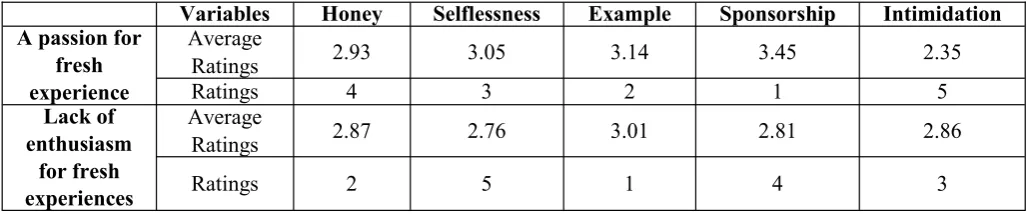
Table 7: Average ratings in the Friedman test to rank employees' behavior with enthusiasm for fresh experiences and lack of eagerness
Using the Friedman test, it has been determined that the average rank of impression management tactics is not the same for those who want to experience new experiences and lack of enthusiasm for new experiences, and the most important for the attribute of the desire for new experiences in employees is the support and average ratings The next, in turn, belongs to example, selflessness, self-harm, and intimidation. For the attribute of lack of eagerness to new experiences, the most tactics used by them are exemplary and their least tactical behavior is self-righteous (Table 7).
Variables Honey Selflessness Example Sponsorship Intimidation
Responsible
Average
Ratings 2.75 2.45 3.08 2.98 2.84
Ratings 4 5 1 2 3
Irresponsible
Average
Ratings 3.14 2.91 3.01 2.78 2.99
Ratings 1 4 2 5 3
Variables Honey Selflessness Example Sponsorship Intimidation
A passion for fresh experience
Average
Ratings 2.93 3.05 3.14 3.45 2.35
Ratings 4 3 2 1 5
Lack of enthusiasm
for fresh experiences
Average
Ratings 2.87 2.76 3.01 2.81 2.86
Ratings 2 5 1 4 3
Conclusion
Research on the relationship between personal characteristics and the many forms of impression management tactics has not made much progress. Experts who have investigated this relationship consider the factors constituting personal characteristics to be very diverse. For example, Mowday (16) achieved this result. People who have a high need for power use upward tactics to gain power. Mowday (16) also believes that political behaviors in the work environment have a significant relationship with the intensity of individual needs and personal perceptions of power. Bolin and Terry (17) argued that people who have a high self-control are more sensitive to the image they offer. For this reason, they refrain from using tactics of intimidation and intimidation. Instead, they usually use positive tactics, including hacking, self-righteousness, and example. Barrick et al (18) found that people who are less anxious use a wide range of impression management tactics, including hacking.
We know that people always pay attention to the judgment of others and pay attention to it. For example, many people in the United States and Europe spend billions of dollars on limb beauty, membership in clubs, plastic arts and surgery to make them look more attractive to others. If a person behaves in a way that favors others, he will benefit greatly from this path. For example, a person can take any job he wants to gain from the organization and, after hiring, will be gracious
to his chairman and supervisor, so that he will receive special privileges when assessing performance and raising salaries. It is also possible for him to distribute the benefits and benefits to his own interests. The process by which one tries to control the emotions that others have towards him is called impression management. Impression management often misread and use it as a means to deceive people referred to (19), but it should be noted that impression management necessarily lie and deceive people, but can the tactics of managing The impression on appropriate situations and observance of ethical standards achieved significant results.
threat to the malicious organization and management should try to prevent them from identifying the effective factors on it.
Reference
1. Rosenfeld, P. R & Riordan, C. A. (1995). Impression management in organizations: Theory, measurement, and practice. New York, NY: Routledge.
2. BozemanD. P., KacmarK. M.;"A cybernetic model of impression management processes in organizations"; Organizational Behavior and Human Decision Processes, Vol. 69, 1997, pp:9-30. 3. SchlenkerB. R., WeigoldM.; "Interpersonal process
involving impression management"; Annual Review of Psychology, Vol. 43, 1992, pp:133-168.
4. Weiss, B., & Feldman, R. S. (2006). Looking goods and lying to do it: Deception as an impression management strategy in job interview. Journal of Applied Social Psychology, 36, 1070–1086.
5. Jones, E. E., & Pittman, T. S. (1982). Toward a general theorys of strategic self-presentation. In J. Suls (Ed.), Psychological perspectives on the self , Vol. 1, pp. 231–262.
6. BolinoM. C., TurnleyW. H., KacmarK. M., GlistrapJ. B.; A multi-level review of impression management motives and behaviors; Journal of Management, Vol. 34, 2008, pp:1080-1109.
7. Bolino, M. C., & Turnley, W. H. (1999). Measuring impression management the organizations: A scale development based on the Jones and Pittman taxonomy. Organizational Research Methods, 1, 187–206.
8. Turnley, W. H., & Bolino, M. C. (2001). Achieving desired image while avoiding undesired images: Exploring the role of self-monitoring in impression management. Journal of Applied Psychology, 86, 351–360.
9. Kacmar, K. M., Harris, K. J., & Nagy, B. G. (2007). Further validation of the Bolino and Turnley
impression management scale. Journal of Behavioral and Applied Management, 9, 16–32.
10. Lee, K., & Ashton, M. C. (2008). The HEXACO personality factor in the indigenous personality lexicons of English and 11 other languages. Journal of Personality, 76, 1001–1054.
11. Zettler, I., & Hilbig, B. E. (2010). Honesty-Humility and a person-situation interaction at works. European Journal of Personality, 24, 569 582. 12. Bourdage, J. S., Lee, J.-H., Lee, K., & Shin, K.-H.
(2012). Motives for organizational citizenship behavior: Personality correlates and coworker ratings of OCB. Human Performance, 26, 179 –200. 13. Pervin, L., Cervone, D. (2010). “Personality theory
and research”. WILEY, eleventh edition, pp: 5-35. 14. Cable, D. M., & Judge, T. A. (2003). Managers’
upward influence tactic strategies: The role of manager personality and supervisor leaderships style. Journal of Organizational Behavior, 25, 197– 214.
15. Costa, P. T., Jr., & McCrae, R. R. (1985). The NEO Personality Inventory manual. Odessa, FL: Psychological Assessment Resources.
16. Mowday, R. T. (1978). "The exercise of upward influence in organizations". Administrative Science Quarterly, 23: 137- 156.
17. Bolino, M. C., & Turnley, W. H. (2003). "More than one way to make an impression: Exploring profiles of impression management". Journal of Management, 29: 141-161.
18. Barrick, M. R., Shaffer, J. A., & DeGrassi, S. W. (2009). What you seen may not be what you get: Relationships among self-presentation tactics and ratings of interview and jobs performance. Journal of Applied Psychology, 94, 1384–1411.
19. SchlenkerB. R.; "Impression management: The self-concept, social identityand interpersonal relations";Monterey, CA:Brooks/Cole, 1980.