ISSN 2319-7625 (Online) (An International Research Journal), www.chemistry-journal.org
Synthesis, Characterization and Antioxidant Study of Some
Pyrazolines Derivatives
Rajitha Sadashiva1, Damodara Naral2 and Jyothi Kudva3
1Sigma-Aldrich Chemical Pvt. Ltd.,
Bommasandra-Jigani link Road, Bengaluru, 560100, INDIA.
2Department of Chemistry,
Canara Engineering College, Benjanapadavu, Mangaluru, 574219, INDIA.
3Department of Chemistry,
St. Joseph Engineering College, Vamanjoor, Mangaluru, 575005, INDIA. email:[email protected].
(Received on: January 6, Accepted: February 16, 2017)
ABSTRACT
A series of Methyl 3-(4-substitutedphenyl)-5-(4-substitutedphenyl)-4,5-dihydro-1H-pyrazole-1-carboxylate and 2-(5-(4-substitutedphenyl)-3-phenyl-4,5-dihydro-1H-pyrazole-1-carbonyl)hydrazinecarbothioamidehave been synthesized by the reaction of substituted chalcones with methylhydrazinecarboxylate and hydrazine hydride. The structure of the synthesised compounds was elucidated by IR, 1H NMR, 13C NMR and mass spectra studies. The purity of the compounds was confirmed by
elemental analysis. All synthesized compounds were studied for the antioxidant activity by DPPH scavenging method. All the compounds have showed the effecting radical scavenging capacity. Especially, the compounds with halogen substituted phenyl ringhave shown the excellent radical scavenging activity, which was similar to that of standard BHT in all tested concentrations.
Keywords: Trisubstituted pyrazolines, Chalcones, Antioxidant.
1. INTRODUCTION
Pyrazolines are well known nitrogen containing five membered heterocyclic compounds, which possess many important biological activities. It has been reported that the substituted pyrazolines show antibacterial1-3, antidepressant4, anticonvulsant5-7,
antihypertensive8, antitumor9, antioxidant property10. Some pyrazoline derivatives reported to
possess anti-inflammatory11 and antidiabetic activity12.
superoxide anions, hydrogen peroxides, hydroxyl radical. These species have great reactivity and may cause lipid, protein and DNA oxidation and these are know to contribute to healthy functions in human health and development. Antioxidants significantly reduce or inhibit the oxidation of the substrates by neutralising the free radicals. Unfortunately, effective antioxidant drugs are rare and therefore much attention has been focused on the use of synthetic antioxidant in biological system.
In view of discovering new antioxidant species, we have synthesised series of trisubstituted pyrazolines. These compounds prepared by the reaction with substituted chalcones with methylhydrazinecarboxylate and hydrazine hydride. Antioxidant capacity of obtained compounds was studied by DDTP scavenging activity method.
2. RESULTS AND DISCUSSION
2.1 Chemistry
The series of trisubstituted pyrazoline derivatives have been synthesized by the reaction of substituted various chalcones 3(a-l). The substituted chalcones were prepared by Claisen-Schmidt condensation of appropriate para substituted aryl aldehyde (1) with para substituted acetophenone (2) in the presence of methanolic KOH. The obtained products were purified by recrystallization with ethanol.
In order to synthesise the desired substituted Pyrazoline, the suitable chalcone was refluxed with methylhydrazinecarboxylate in methanol using potassium carbonate as base. The reaction being monitored by TLC. It was observed that, the rate of reaction was influenced by the nature of the substitution on phenyl ring of the chalcones 3(a-l). Reaction with halogen substituted chalcones was completing within an hour, whereas unsubstituted chalcones and methyl and methoxy substituted chalcones were taking more than two hours for the completion of reaction. This could be due to the fact that cyclization rate enhanced by increase in electropositive charge of β-carbon of chalcones. As a result, in the presence of electron withdrawing halogens in chalcones increases the electro positivity of β-carbon and hence the increase in rate of reaction. In the similar way electron releasing group such as methyl, methoxy enhances the electron density over the β-carbon and hence decrease in rate of reaction. The carbazide derivatives of pyrazolines 4(m-r) were synthesised by heating the above reaction mixture for further one hour after adding hydrazine hydride.
R
O
R1
O
+ KOH, EtOH
R R1
O
NH2NHCOOCH3
K2CO3, MeOH
N N
OCH3
O
N N
NH-NH2
O
R
R1
R
R1
NH2NH2.H2O
(1) (2) 3(a-l)
Scheme 1: Synthesis of 1, 3, 5-trisubstituted pyrazolines.
2.2 Spectral analysis
The formation of desired product was confirmed by IR,1H NMR, 13C NMR and mass
spectral studies. The pyrazoline ring formation was interpreted by IR bands. The absorption bands in the region of 1583-1619 cm-1 indicates the C=N stretching bands. The bands in the
region of 1055-1096cm-1 and 1659-1733cm-1 are indicating the C-N and ester carbonyl
stretching frequency respectively13. For the compounds 4(m-r), the stretching frequencies for
primary and secondary amine were obtained in the region 2923- 3288 cm-1 and 3318-3411cm-1
respectively.
N N
Ha Hb O R2 Hc A B C
4(a-l): R2 = -OCH3
4(m-r): R2 = -NH-NH2
Figure 1: Atoms and rings were labelled to assign the spectral values.
Structural confirmation was further done by 1H and 13C NMR spectral analysis. The
pyrazoline ring has two methylene protons Ha and Hb, which are magnetically non-equivalent
due to the presence of chiral proton Hc in the adjacent carbon atom (Fig.1). These three protons
showed the ABX spin system. The trans proton Ha was resonated at δ, 2.90 to 3.17 ppm as a
doublet of doublet and the cis proton Hb was resonated at δ, 3.60 to 3.87 ppm as a doublet of
doublet14. The methine proton H
c resonated in the region δ, 5.50 to 6.00 ppm as a doublet of
doublet, which was due to vicinal coupling with adjacent two protons. The peak of methyl group of ester was merged with the peak of Hb proton. All other aromatic protons were
resonated in the region δ, 7.00 to 8.00 ppm. The primary and secondary amines of the compounds 4(m-r) were resonated in the region δ, 4.00 and 8.00 ppm respectively. The proton of secondary amine was resonated in the downfield due to presence of electron withdrawing carbonyl group adjacent to same. In 13C NMR, methylene and methine carbons of pyrazoline
ring were resonating at δ, 40.3-48.5 ppm and δ, 62.3-67.9 ppm respectively and the azomethine carbon of pyrazoline was appeared at δ, 153.2-154.0 ppm. Mass spectra of all synthesized pyrazolines were recorded and m/z value of all compounds was matching with the theoretical molecular weight of the compounds.
Compounds 3a, 4a, 4m 3b, 4b, 4n 3c, 4c, 4o 3d, 4d, 4p 3e, 4e, 4q 3f, 4f, 4r 3g, 4g 3h, 4h 3i, 4i 3j, 4j 3k, 4k 3l, 4l
R H F Cl Br CH3 SCH3 OCH3 F H Br OCH3 CF3
2.3 Antioxidant study
Diphenyl-1-1-picrylhydrazyl is a stable organic nitrogen radical used as a scavenger for other radicals. It was characterized by a deep purple colour and has maximum absorbance in the range of 515-520 nm. DPPH radical scavenging test evaluates in vitro antioxidant capacity of the test samples. In the presence of hydrogen/electron donor (free radical scavenging antioxidants), the absorption intensity was decreased and the radical solution was decolorized to pale yellow colour according to the number of electrons captured.
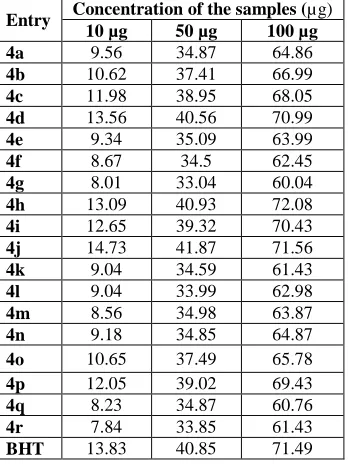
All the synthesized compounds were evaluated for the DPPH radical scavenging activity and the results were presented in the Table 1 and Figure 2. The results show that almost all compounds have good DPPH scavenging activity. The substituted pyrazolines were relatively unstable due to non-aromatic pyrazoline ring. In order to become more stable aromatic pyrazole, pyrazolines are having a tendency to give off two protons and two electrons. The stability of the test compounds was expected to be the driving force for their antioxidant activity.
The compounds 4c, 4d, 4h, 4i, 4j, 4k and 4p have shown the excellent radical
scavenging activity, which was similar to that of standard BHT in all tested concentration. The SAR study revealed that, compounds with electron withdrawing groups on aromatic ring A and C (Fig. 1) showed the higher percentage of DPPH radical scavenging activity than the compounds with electron donating groups. The compound with halogen groups on both the phenyl rings A and C have showed the radical scavenging activity more than that of BHT. On substituion of fluoro atom on phenyl ring C, the scavenging actvity of molecules was enchanced. The compound 4h with fluoro atom on both phenyl rings has showed the excellent actvity compared to the compound 4b, which has single fluoro atom on phenyl ring A. The compounds with O-CH3, S-CH3 and CH3 substitution on phenyl ring A, have showed the less
percentage of radical scavenging activity.
Table 1. Percentage of radical scavenging activity of pyrazoline molecules.
When the methoxy group was replaced with hydrazine group at R2 position (Fig.1),
the percentage of scavenging activity of the molecules was decreased. This is due to the fact that, electron rich hydrazine group provides more stability to the pyrazoline ring. The radical scavenging activity of molecules was depended on the nature of the substitution on the phenyl ring A and activity of the molecules was found in the order of substitution Br > Cl > F > H > SCH3 > OCH3.
3. EXPERIMENTAL
3.1 Materials and methods
All the reactions were carried out in oven dried glassware and under nitrogen atmosphere. Melting point was determined by an open capillary method and was uncorrected. The chemicals used for the reaction were from Sigma-Aldrich chemical Pvt. Ltd. Bengaluru, India. Thin layer chromatography was performed on recoated silica gel 60F254 plates. The
mobile phase used for TLC was ethyl acetate and petroleum ether. The elemental analysis and spectra were recorded in analytical lab, Sigma-Aldrich chemical Pvt. Ltd. Bengaluru, India. IR spectra were recorded in Perkin Elmer lambda spectrophotometer. The 1H NMR and 13C
NMR were taken in CDCl3 and DMSO-d6 at ambient temperature using Bruker amx 400 (400
MHz) and the chemical shift values were given in δ (ppm) scale. The mass spectra of compounds were recorded on Agilent LC/MVD XCT plus mass spectrometer.
Entry Concentration of the samples (µg) 10 µg 50 µg 100 µg 4a 9.56 34.87 64.86 4b 10.62 37.41 66.99 4c 11.98 38.95 68.05 4d 13.56 40.56 70.99 4e 9.34 35.09 63.99
4f 8.67 34.5 62.45
3.2 Synthesis of 1, 3, 5-trisubstituted pyrazolines 4(a-l) & 4(m-r)
The desired pyrazoline derivatives were synthesised from chalcones derivatives 3(a-l). The chalcones were prepared as follows. To the 50C cooled solution of methanolic KOH
(10%, 30ml), mixture of substituted benzaldehyde (1) (0.01mol) and substituted acetophenone (2) (0.01mol) in methanol was added slowly. The mixture was allowed to stir at room temperature. The reaction was being monitored by TLC. Obtained precipitate was filtered and washed with water. Finally, the product was purified by recrystallization using ethanol. To the solution of appropriate chalcone (3a-l) (5mmol) in methanol, added methylhydrazinecarboxylate (5mmol) and potassium carbonate (10mmol). The mixture was heated to reflux15. The reaction was monitored for every half an hour by TLC. The solvent was
removed under reduced pressure. Ethyl acetate was added to the obtained solid and potassium salt was removed by aqueous wash and organic layer was dried over MgSO4. The crude
product was obtained by removing solvent under reduced pressure. The pyrazoline derivative 4(a-l) was purified by Column chromatography.
The hydrazide derivatives of pyrazoline 4(m-r) were the synthesised as per above procedure and after completion of the reaction, the reaction mass was further heated for appropriate time after adding the hydrazine hydride. The physical properties, over all yields, spectral data of synthesised compounds were given in section 3.3.
3.3 Characterization data of the compounds 4(a-r).
Methyl 3,5-diphenyl-4,5-dihydro-1H-pyrazole-1-carboxylate (4a): Colourless crystals. Yield: 78%; m.p. 144-145 0C; FTIR (cm-1): C=O (1708.58), C=N (1596.91), Ar-H (3032.93),
CH-aliphatic (2954.91); 1H NMR δ (ppm): 3.18 (dd, 1H, pyrazoline CH
aH, J = 5.41 Hz, 17.72
Hz), 3.79 (dd, 1H, pyrazoline CHHb, J = 12.31 Hz, 17.2 Hz), 3.78 (s, 3H, CH3), 5.43 (dd, 1H,
pyrazoline CHc, J = 5.11 Hz, 12.31 Hz), 7.30 (m, 8H, Ar-H), 7.76 (m, 2H, Ar-H); 13C NMR δ
(ppm): 42.68, 53.21, 61.54, 125.62, 126.83, 127.85, 128.04, 128.64, 124.95, 130.28, 131.26, 142.17, 123.35, 153.70; Elem. Anal. Calcd. for C17H16N2O2: C, 72.84; H, 5.75; N, 9.99. Found:
C, 72.83; H, 5.72; N, 9.89; MS (m/z): 281.35 [M+H]+.
Methyl 5-(4-fluorophenyl)-3-phenyl-4,5-dihydro-1H-pyrazole-1-carboxylate (4b): White crystalline solid. Yield: 86%; m.p. 138-139 0C; FTIR (cm-1): C=O (1696.51), C=N (1603.89),
Ar-H (2954.95); 1H NMR δ (ppm): 3.08 (dd, 1H, pyrazoline CH
aH, J = 5.20 Hz, 17.60 Hz),
3.71 (dd, 1H, pyrazoline CHHb, J = 12.20 Hz, 17.40 Hz), 3.75 (s, 3H, CH3), 5.34 (dd,
Pyrazoline CHc, J = 5.20 Hz, 12.00 Hz), 6.95 (m, 2H, Ar-H), 7.14 (m, 2H, Ar-H), 7.33 (m,
3H, Ar-H), 7.66 (m, 2H, Ar-H) δ (ppm); 13C NMR: 42.61.53.29, 60.88, 115.74, 126.82, 127.14,
27.41, 127.459, 128.26, 128.69, 129.16, 130.41, 131.09, 137.94, 153.31, 153.66, 161.08, 161.53. Elem. Anal. Calcd. for C17H15FN2O2: C, 68.45; H, 5.07; N, 9.39. Found: C, 68.38; H,
5.05; N, 9.40; MS (m/z): 299.45 [M+H]+.
Methyl5-(4-chlorophenyl)-3-phenyl-4,5-dihydro-1H-pyrazole-1-carboxy late (4c): White solid. Yield: 89%; m.p. 131-132 0C; FTIR (cm-1): C=O (1689.13), C=N (1596.08), Ar-H
(2953.42); 1H NMR δ (ppm): 3.06 (dd, 1H, pyrazoline CH
(dd, 1H, pyrazoline CHHb, J = 12.00 Hz, 17.60 Hz), 3.72 (s, 3H, CH3), 5.33 (dd, Pyrazoline
CHc, J = 5.20 Hz, 12.00 Hz), 7.12 (d, 2H, J = 8.40 Hz, Ar-H), 7.22 (d , 2H, J = 8.40 Hz,
Ar-H), 7.33 (m, 3H, Ar-Ar-H), 7.67 (m, 2H, Ar-H); 13CNMR δ (ppm): 42.54, 53.33, 60.93, 126.82,
127.14, 128.70, 129.16, 130.44, 131.01, 133.68, 140.63, 153.29, 153.65. Elem. Anal. Calcd. for C17H15ClN2O2: C, 68.87; H, 4.80; N, 8.90. Found: C, 64.81; H, 4.75; N, 8.81; MS(m/z):
315.75 [M+H]+.
Methyl5-(4-bromophenyl)-3-phenyl-4,5-dihydro-1H-pyrazole-1-carboxylate (4d): Light
yellow crystals. Yield: 79%; m.p. 143-144 0C; FTIR (cm-1): C=O (1697.44), C=N (1597.84),
Ar-H (3027.92), CH-aliphatic (2959.91), C-Br (960.60); 1H NMR δ (ppm): 3.06 (dd, 1H,
pyrazoline CHaH, J = 5.47 Hz, 17.79 Hz), 3.72 (dd, 1H, pyrazoline CHHb, J = 12.04 Hz,
18.17 Hz), 3.73 (s, 3H, CH3), 5.32 (dd, Pyrazoline CHc, J = 5.36 Hz, 12.18 Hz), 7.07 (d, 2H,
J = 8.58 Hz, Ar-H), 7.35 (m, 5H, Ar-H), 7.68 (m, 2H, Ar-H); 13C NMR δ (ppm): 42.51, 53.32,
61.01, 121.78, 126.82, 127.48, 12.7, 130.44, 131.02, 132.1, 141.17, 153.28, 153.62; Elem. Anal. Calcd. for C17H15BrN2O2: C, 56.84; H, 4.21; N, 7.80. Found: C, 56.79; H, 4.32; N, 7.75;
MS(m/z): 360.15 [M+H]+.
Methyl5-(4-methylphenyl)-3-phenyl-4,5-dihydro-1H-pyrazole-1-carboxy late (4e): Faint yellow crystals. Yield: 86%; m.p. 115-116 0C; FTIR (cm-1): C=O (1702.32), C=N (1593.82),
Ar-H (3024.80), CH-aliphatic (2951.85); 1H NMR δ (ppm): 2.31 (s, 3H, CH
3), 3.16 (dd, 1H
pyrazoline CHaH, J = 5.09 Hz, 17.70 Hz), 3.75 (dd, 1H, pyrazoline CHHb, J = 11.71 Hz, 17.38
Hz), 3.78 (s, 3H, CH3), 5.40 (dd, Pyrazoline CHc, J = 4.93 Hz, 11.97 Hz), 7.13 (m, 4H,
Ar-H), 7.39 (m, 3H ,Ar-Ar-H), 7.74 (m, 2H, Ar-H); 13C NMR δ (ppm): 21.12, 42.68, 53.18, 61.34,
125.60, 126.82, 129.61, 130.24, 131.33, 137.54, 139.27, 153.35, 153.72; Elem. Anal. Calcd. for C18H18N2O2: C, 73.45; H, 6.16; N, 9.52. Found: C, 73.42; H, 6.60; N, 9.45; MS (m/z):
295.26 [M+H]+.
Methyl5-[4-(methylsulfanyl)phenyl]-3-phenyl-4,5-dihydro-1H-pyrazole-1-carboxylate 4(f): Yellow crystals. Yield: 83%; m.p. 151-152 0C; FTIR (cm-1): C=O (1694.37), C=N
(1598.31); 1H NMR δ (ppm): 2.42 (s, 3H, SCH
3), 3.08 (dd, 1H pyrazoline CHaH, J = 5.2 Hz,
17.6 Hz), 3.68 (dd, 1H, pyrazoline CHHb, J = 12.0 Hz, 17.6 Hz), 3.72 (s, 3H, CH3), 5.30 (dd,
Pyrazoline CHc, J = 5.2 Hz, 12.0 Hz), 7.13 (m, 4H, Ar-H), 7.33 (m, 3H, Ar-H), 7.69 (m, 2H,
Ar-H); 13C NMR δ (ppm): 15.78, 42.57, 53.28, 61.13, 126.24, 126.82, 127.02, 128.67, 130.34,
131.17, 138.16, 138.98, 153.32, 153.75; Elem. Anal. Calcd. for C18H18N2O2S: C, 66.23; H,
5.56; N, 8.58. Found: C, 66.69; H, 5.59; N, 8.51; MS(m/z): 327.42 [M+H]+.
Methyl5-(4-methoxyphenyl)-3-phenyl-4,5-dihydro-1H-pyrazole-1-carboxylate (4g): Light brown crystals. Yield: 79%; m.p. 122-123 0C; FTIR (cm-1): C=O (1698.38), C=N
(1612.80), Ar-H (2956.80), CH-aliphatic (2841.99), C-O (1122.43); 1H NMR δ (ppm): 3.09
(dd, 1H, pyrazoline CHaH, J = 5.30 Hz, 18.32 Hz), 3.67 (dd, 1H, pyrazoline CHHb, J = 12.0
Hz, 18.0 Hz), 3.70 (s, 3H, OCH3), 3.71 (s, 3H, CH3), 5.32 (dd, Pyrazoline CHc, J = 5.32 Hz,
114.29, 126.82, 126.99, 130.25, 131.33, 134.36, 153.34, 153.72, 159.21; Elem. Anal. Calcd. for C18H18N2O3: C, 69.66; H, 5.85; N, 9.03. Found: C, 69.59; H, 5.69; N, 9.10; MS(m/z):
311.32 [M+H]+.
Methyl3,5-bis(4-fluorophenyl)-4,5-dihydro-1H-pyrazole-1-carboxylate (4h): Light yellow crystals. Yield: 79%; m.p. 137-138 0C; FTIR(cm-1): C=O (1715.78), C=N (1602.19), Ar-H
(2950.99), C-O (1126.47); 1H NMR δ (ppm): 3.05 (dd, 1H pyrazoline CH
aH, J = 5.20 Hz,
17.60 Hz), 3.70 (dd, 1H, pyrazoline CHHb, J = 12.00 Hz, 17.60 Hz), 3.71 (s, 3H, CH3), 5.34
(dd, Pyrazoline CHc, J = 5.20 Hz, 12.00 Hz), 6.95 ( m, 2H, Ar-H), 7.03 (m, 2H, Ar-H), 7.16
(m, 2H, Ar-H), 7.67 (m, 2H, Ar-H); 13C NMR δ (ppm): 42.67, 53.26, 60.99, 115.76, 115.98,
127.37, 127.65, 128.75, 128.84, 137.83, 152.56, 153.44, 161.10, 162.76, 163.54, 165.26; Elem. Anal. Calcd. for C17H14F2N2O2: C, 64.55; H, 4.46; N, 8.86. Found: C, 64.49; H, 4.39;
N, 8.87; MS(m/z): 317.38 [M+H]+.
Methyl 3-(4-fluorophenyl)-5-phenyl-4,5-dihydro-1H-pyrazole-1-carboxylate (4i): Light brown solid. Yield: 86%; m.p. 106-107 0C; FTIR (cm-1): C=O (1714.27), C=N (1603.54),
Ar-H (2953.32), C-O (1125.11); 1H NMR δ (ppm): 3.08 (dd, 1H pyrazoline CH
aH, J = 5.20 Hz,
17.60 Hz), 3.71 (dd, 1H, pyrazoline CHHb, J = 11.60 Hz, 17.60 Hz), 3.71 (s, 3H, CH3), 5.36
(dd, Pyrazoline CHc, J = 5.20 Hz, 12.00 Hz), 7.01 (m, 2H, Ar-H), 7.19 (m, 3H, Ar-H), 7.28
(m, 2H, Ar-H), 7.68 ( m, 2H, Ar-H); 13C NMR δ (ppm): 42.75, 53.23, 61.38, 115.69, 115.91,
125.57, 127.56, 127.90, 128.75, 128.84, 128.98, 122.03, 152.64, 152.31, 162.72, 165.22; Elem. Anal. Calcd. for C17H15FN2O2: C, 68.45; H, 5.07; N, 9.39. Found: C, 68.40; H, 5.10; N,
9.40; MS(m/z): 299.38 [M+H]+.
Methyl5-(4-bromophenyl)-3-(4-fluorophenyl)-4,5-dihydro-1H-pyrazole-1-carboxylate (4j): Light brown crystals. Yield: 80%; m.p. 151-152 0C; FTIR (cm-1): C=O (1717.55), C=N
(1601.78), Ar-H (2952.92); 1H NMR δ (ppm): 3.04 (dd, 1H pyrazoline CH
aH, J = 5.32 Hz,
17.59 Hz), 3.73 (dd, 1H, pyrazoline CHHb, J = 12.59 Hz, 17.53 Hz), 3.72 (s, 3H, CH3), 5.31
(dd, Pyrazoline CHc, J = 5.32 Hz, 12.35 Hz), 7.04 (m, 4H, Ar-H), 7.39 (m, 2H, Ar-H), 7.67
(m, 2H, Ar-H); 13C NMR δ (ppm): 42.56, 53.33, 61.10, 114.11, 115.76, 115.96, 121.81,
127.31, 127.34, 128.76, 128.85, 132.14, 141.03, 152.53, 153.24, 162.79, 165.29; Elem. Anal. Calcd. for C17H14BrFN2O2: C, 54.13; H, 3.74; N, 7.43. Found: C, 54.19; H, 3.78; N, 7.50;
MS(m/z): 378.22 [M+H]+.
Methyl3-(4-fluorophenyl)-5-(4-methoxyphenyl)-4,5-dihydro-1H-pyrazole-1-carboxylate (4k): Light yellow colour crystals. Yield: 83%; m.p. 151-152 0C; FTIR (cm-1): C=O
(1720.23), C=N (1604.97), CH-aliphatic (2836.33). 1H NMR δ (ppm): 3.06 (dd, 1H pyrazoline
CHaH, J = 5.20 Hz, 17.60 Hz), 3.65 (dd, 1H, pyrazoline CHHb, J = 11.60 Hz, 17.60 Hz), 3.69
(s, 3H, OCH3), 3.70 (s, 3H, CH3), 5.31 (dd, Pyrazoline CHc, J = 5.20 Hz, 12.0 Hz), 6.77 (m,
2H, Ar-H), 7.0 (m, 2H, Ar-H), 7.11 (m, 2H, Ar-H), 7.68 (m, 2H, Ar-H); 13C NMR δ (ppm):
42.68, 53.21, 55.27, 61.13, 114.30, 115.68, 126.94, 127.59, 128.74, 128.82, 134.20, 153.30, 153.57, 159.22, 162.69, 165.18; Elem. Anal. Calcd. for C18H17FN2O3: C, 65.85; H, 5.22; N,
Methyl3-phenyl-5-[4-(trifluoromethyl)phenyl]-4,5-dihydro-1H-pyrazole-1-carboxylate 4(l): Colourless crystals. Yield: 82%; m.p. 106-107 0C; FTIR (cm-1): C=O (1723.01), C=N
(1619.18), CH-aliphatic (2958.04); 1H NMR δ (ppm): 3.06 (dd, 1H, pyrazoline CH
aH, J = 5.2
Hz, 17.6 Hz), 3.66 (dd, 1H, pyrazoline CHHb, J = 11.6 Hz, 17.6 Hz), 3.68 (s, 3H, CH3), 5.31
(dd, 1H, pyrazoline CHc, J = 5.2 Hz, 12.0 Hz), 6.78 (d, 2H, Ar-H, J = 8.4 Hz), 7.03 (m, 3H,
Ar-H), 7.11 (d, 2H, Ar-H, J = 8.4 Hz), 7.68 (m, 2H, Ar-H); 13C NMR δ (ppm): 42.54, 53.42,
61.11, 120.12 126.02, 126.09, 126.83, 128.73, 130.54, 130.88, 145.98, 153.32, 153.62; Elem. Anal. Calcd. for C18H15F3N2O2: C, 62.07; H, 4.34; N, 8.04. Found: C, 62.10; H, 4.39; N, 8.09;
MS (m/z): 349.35 [M+H]+.
2-(3,5-diphenyl-4,5-dihydro-1H-pyrazole-1-carbonyl)hydrazinecarbothioamide 4(m):
White solid. Yield: 73%; m.p. 106-107 0C; FTIR (cm-1): C=N (1633.24), C=O (1659.41),
N-H (3318.81), N-N-H (3367.13); 1H NMR δ (ppm): 3.06 (dd,1H, pyrazoline CH
aH, J = 5.6 Hz,
18.0 Hz), 3.79 (dd, 1H, pyrazoline CHHb, J = 11.6 Hz, 17.6 Hz), 4.08 (s, 2H, NH2), 5.42 (dd,
1H, pyrazoline CHc, J = 6.0 Hz, 12.4 Hz), 7.21 (m, 3H, Ar-H), 7.32 (m, 2H, Ar-H), 7.42 (m,
3H, Ar-H), 7.81 (m, 2H, Ar-H), 8.10 (s, 1H, NH); 13C NMR δ (ppm): 41.78, 60.41, 125.54,
126.52, 127.02, 128.48, 128.54, 129.66, 131.46, 143.38, 150.90, 156.02; Elem. Anal. Calcd. for C16H16N4O: C, 68.55; H, 5.75; N, 19.99. Found: C, 68.58; H, 5.69; N, 19.98; MS(m/z):
281.35 [M+H]+.
2-(5-(4-fluorophenyl)-3-phenyl-4,5-dihydro-1H-pyrazole-1-carbonyl)
hydrazinecarbothioamide 4(n): White solid. Yield: 68%; m.p. 139-140 0C; FTIR (cm-1):
C=N (1645.47), C=O (1669.92), Ar-H (2916.08), N-H (3045.45), N-H (3318.18): 1H NMR δ
(ppm): 3.07 (dd,1H, pyrazoline CHaH, J = 5.6 Hz, 18.0 Hz), 3.78 (dd, 1H, pyrazoline CHHb,
J = 12.0 Hz, 17.6 Hz), 4.05 (s, 2H, NH2), 5.43 (dd, 1H, pyrazoline CHc, J = 5.2 Hz, 11.6 Hz),
7.14 (t, 2H, Ar-H, J = 8.8 Hz), 7.24 (m, 2H, Ar-H),7.42 (m, 3H, Ar-H),7.82 (m,2H, Ar-H), 8.10 (s, 1H, NH); 13C NMR δ (ppm): 41.65, 59.85, 115.08, 126.54, 127.63, 127.71, 128.54,
129.69, 131.40, 139.51, 139.53, 150.97, 156.01, 160.00, 162.41; Elem. Anal. Calcd. for C16H15FN4O: C, 64.42; H, 5.07; N, 18.78. Found: C, 64.67; H, 5.09; N, 18.56; MS(m/z):
299.34 [M+H]+.
2-(5-(4-chlorophenyl)-3-phenyl-4,5-dihydro-1H-pyrazole-1-carbonyl)
hydrazinecarbothioamide 4(o): White powder. Yield: 81%; m.p. 131-132 0C; FTIR (cm-1):
C=N (1621.02), C=O (1659.67), Ar-H (2923.07), N-H (3335.66), N-H (3432.08); 1H NMR δ
(ppm): 3.07 (dd,1H, pyrazoline CHaH, J = 5.6 Hz, 17.6 Hz), 3.79 (dd, 1H, pyrazoline CHHb,
J = 12.0 Hz, 18.0 Hz), 4.06 (s, 2H, NH2), 5.42 (dd, 1H, pyrazoline CHc, J = 6.0 Hz, 12.4 Hz),
7. 23 (d, 2H, Ar-H, J = 8.4 Hz), 7.41 (m, 5H, Ar-H), 7.81 (d, 2H, Ar-H, J = 3.6 Hz), 8.13 (s, 1H, NH); 13C NMR δ (ppm): 41.54, 59.93, 126.56, 127.62, 128.44, 128.54, 129.72, 131.35,
131.54, 142.30, 151.01, 155.97; Elem. Anal. Calcd. for C16H15ClN4O: C, 61.05; H, 4.80; N,
17.80. Found: C, 61.09; H, 5.00; N, 17.45; MS(m/z): 315.70 [M+H]+.
2-(5-(4-bromophenyl)-3-phenyl-4,5-dihydro-1H-pyrazole-1-carbonyl)
C=N (1592.36), C=O (1660.17), N-H (3209.79), N-H (3429.88); 1H NMR δ (ppm): 3.12 (dd,
1H, pyrazoline CHaH, J = 6.0 Hz, 18.0 Hz), 3.85 (dd, 1H, pyrazoline CHHb, J = 12.4 Hz, 17.7
Hz), 4.11 (s, 2H, NH2), 5.46 (dd, 1H, pyrazoline CHc, J = 6.0 Hz, 12.0 Hz), 7.23 (m, 2H,
Ar-H), 7.52 (m, 5H, Ar-Ar-H), 7.86 (m, 2H, Ar-Ar-H), 8.17 (s, 1H, NH); 13C NMR δ (ppm): 41.49,
59.99, 120.09, 126.61, 128.06, 128.58, 129.69, 131.37, 142.77, 151.02, 156.05; Elem. Anal. Calcd. for C16H15BrN4O: C, 53.50; H, 4.21; N, 15.60. Found: C, 53.50; H, 4.67; N, 15.80;
MS(m/z): 360.60 [M+H]+.
2-(3-phenyl-5-p-tolyl-4,5-dihydro-1H-pyrazole-1-carbonyl)hydrazine carbothioamide
4(q): Light yellow solid. Yield: 70%; m.p. 127-128 0C; FTIR (cm-1): C=N (1621.02), C=O
(1663.01), N-H (3213.28), N-H (3321.67); 1H NMR δ (ppm): 2.26 (s, 3H, CH
3), 3.03 (dd,1H,
pyrazoline CHaH, J = 5.2 Hz, 17.6 Hz), 3.77 (dd, 1H, pyrazoline CHHb, J = 12.0 Hz, 17.6 Hz),
4.03 (s, 2H, NH2), 5.37 (dd, 1H, pyrazoline CHc, J = 5.6 Hz, 12.0 Hz), 7. 10 (d, 4H, Ar-H),
7.42 (m, 3H, Ar-H), 7.80 (m, 2H, Ar-H), 8.09 (s, 1H, NH); 13C NMR δ (ppm): 20.58, 41.79,
60.20, 125.48, 126.49, 128.54, 128.99, 129.62, 131.53, 136.21, 140.48, 150.98, 155.97; Elem. Anal. Calcd. for C17H18N4O: C, 69.37; H, 6.16; N, 19.03. Found: C, 69.45; H, 6.20; N, 19.09;
MS(m/z): 295.36 [M+H]+.
5-[4-(methylsulfanyl)phenyl]-3-phenyl-4,5-dihydro-1H-pyrazole-1-carbo hydrazide
4(r): Yellow solid. Yield: 79%; m.p. 145-146 0C; FTIR (cm-1): C=N (1638.48), C=O
(1677.72), N-H (3209.79), N-H (3325.17); 1H NMR δ (ppm): 2.44 (s, 3H, SCH
3), 3.05 (dd,1H,
pyrazoline CHaH, J = 5.6 Hz, 18.2 Hz), 3.74 (dd, 1H, pyrazoline CHHb, J = 12.2 Hz, 18.8 Hz),
4.02 (s, 2H, NH2), 5.37 (dd, 1H, pyrazoline CHc, J = 5.6 Hz, 12.1 Hz), 7.34 (m, 4H, Ar-H),
7.42 (m, 3H, Ar-H), 7.81 (m, 2H, Ar-H), 8.07 (s, 1H, NH); 13C NMR δ (ppm): 15.01, 41.61,
60.11, 126.24, 126.30, 126.51, 128.53, 129.64, 131.44, 136.73, 140.33, 151.12, 156.16; Elem. Anal. Calcd. for C17H18N4OS: C, 62.55; H, 5.56; N, 17.16. Found: C, 62.45; H, 5.45; N, 17.56;
MS(m/z): 327.45 [M+H]+
3.4 DPPH radical scavenging assay
The effect of the samples 4(a-r) in addition to the standard antioxidant butylated hydroxyl toluene (BHT) on DPPH radical was estimated according to the method of Lai et al.
16-17. The different concentrations of samples 4(a-r) along with the butylated hydroxyl anisole
were dissolved in dimethyl sulfoxide. The volumes were adjusted to 100μl by adding methanol. Five milliliters of a 0.1 mM methanolic solution of 1,1-diphenyl-2-picrylhydrazyl (DPPH) was added to each concentration. The mixture was shaken vigorously and left to stand for 20 min at room temperature in the dark. The absorbance of the resulting solution was measured spectrophotometrically at 517 nm. The capability to scavenge DPPH radical was calculated using the following equation.
4. CONCLUSION
In the present paper we report the synthesis, spectral studies and antioxidant evolution of series of pyrazolines derivatives. We established the relationship between the rate of reaction and nature of substitution on the phenyl rings of chalcones. The structures of all syntheised molecules were established using the spectral and elemental analysis. Many of the synthesised compounds have shown good antioxidant activity, compare to the standard BHT. The pyrazoline derivatives with halogen substitution have showed the excellent activity. So there is an ample scope for the detailed study of these compounds as good antioxidant drug.
ACKNOWLEDGEMENTS
The authors were thankful to Sigma-Aldrich Chemical Pvt. Ltd. Bengaluru, India, for providing necessary laboratory facilities for the research work and valuable support.
REFERENCES
1. Ali M. A., Shaharyar, M., Siddiqui, A. A., Sriram, D., Yogeeswari, P. and Clercq, E. D. Synthesis and anti-HIV activity of N1-nicotinoyl-3-(4ʹ-hydroxy-3ʹ-methyl
phenyl)-5-[substituted phenyl]-2-pyrazolones. Acta Pol. Pharma. Drug Res., 63, 435-439 (2007). 2. Shahar yar, M., Siddiqui, A. A., Ali, M. A. Synthesis and evaluation of phenoxy acetic acid
derivatives as antimycobacterial agents. Bioorg. Med. Chem. Lett., 16, 4571-4574 (2006). 3. Chimenti, F., Bizzarri, B., Manna, F., Bolasco, A., Secci, D., Chimenti, P., Granese, A., Rivanera, D., Lilli, D., Scaltritoc, M. M. and Brenciaglia, M. I. Synthesis and in vitro selective anti-Helicobacter Pylori activity of Pyrazoline derivatives Bioorg.Med. Chem. Lett., 15, 603-607 (2005).
4. Prasad, Y. R., Rao, A. L., Prasoona, L., Murali, K. and Kumar, P. R. Synthesis and antidepressant activity of some 1,3,5-triphenyl-2-pyrazolines and 3-(2ʹʹ-hydroxy naphthalene-1ʹʹ-yl)-1,5-diphenyl-2-pyrazolines. Bioorg. Med. Chem. Lett., 15, 5030-5034 (2005).
5. Parmar, S. S., Pandey, B. R., Dwivedi, C., and Harbinson, R. D. Anticonvulsant activity and monoamine oxidase inhibitory properties of 1,3-trisubstituted pyrazolines. J. Pharm. Sci., 63, 1152-1155 (1974).
6. Soni, N., Pande, K., Kalsi, R., Gupta, T. K., Parmar, S. S. and Barthwal, J. P. Inhibition of rat brain monoamine oxidase and succinic dehydrogenase by aniconvulsant pyrazolines.
Res. Commun. Chem. Pathol. Pharmacol., 56, 129-132 (1987).
7. Batulin, Y. M. On the mechanism of the anticonvulsant action of some derivatives of pyrazole. Farmakol Toksikol, 31, 533-538 (1968).
8. Turan-Zitouni, G., Chevallet, P., Kilic, F. S. and Erol, K. Synthesis of some thiazolyl-pyrazoline derivatives and preliminary investigation of their hypotensive activity. Eur. J. Med. Chem., 35, 635-641 (2000).
pyrazoline derivatives of combretastatin-A4. Bioorg. Med. Chem. Lett., 17, 5897-5901 (2007).
10. Piyush, N. K., Shailesh, P. S. and Dipak, K. R. Synthesis, identification and in vitro
biological evaluation of some novel 5-imidazopyrazole incorporated pyrazoline and isoxazoline derivatives. New J. Chem., 38, 2902-2910 (2014).
11. Bansal, E., Srivatsava, V. K. and Ashok, K. Synthesis and anti-inflammatory activity of 1-acetyl-5-substitutedaryl-3-(β-aminonaphthyl)-2-pyrazolines and β-(substituted aminoethyl)amidonaphthalenes. Eur. J. Med. Chem., 36, 81-92 (2001).
12. Ahn, J. H., Kim, H. M., Jung, S. H., Kang, S. K., Kim, K. R., Rhee, S. D., Yang, S. D., Cheon, H. G. and Kim, S. S. Synthesis and DP-IV inhibition of cyano-pyrazoline derivatives as potent anti-diabetic agents. Bioorg. Med. Chem. Lett.,14, 4461-4465 (2004). 13. Stuart, B. H. Infrared spectroscopy. Fundamentals and applications, Wiley (2004). 14. Levai, A. and Jeko, J. Synthesis of carboxylic acid derivatives of 2-pyrazolines.
ARKIVOC, 134-151 (2007).
15. Jiahui, W., Dengyou, Z., Lei, C., Li, J., Jianling, W., Chengqing, N., Niefang, Y., Fei, Z., Dongying, C., Xiaoyan, C., Kaixian, C., Hualiang, J., Hong L. and Dongxiang L. Discovery and mechanism study of SIRT1 activators that promote the deacetylation of fluorophore-labeled substrate. J. Med. Chem., 56, 761-780 (2013).
16. Lai, L. S., Chou, S. T. and Chao, W. W. Studies on the antioxidative activities of Hsian-tsao (Mesona procumbens Hemsl) leaf gum. J. Agri. Food Chem., 49, 963-968 (2001). 17. Ajay, K. K., Lokanatha Rai, K. M., Vasanth, K. G. and Mylarappa, B. N. A facile route