Maryam Soleimannejad 1, Mehdi Tehrani-Doost 2*, Anahita Khorrami 3, Mohammad Taghi Joghataei 1, Ebrahim Pishyareh 4
1. Department of Neuroscience, School of Advanced Technologies in Medicine, Iran University of Medical Sciences, Tehran, Iran. 2. Department of Psychiatry, School of Medicine, Tehran University of Medical Sciences, Tehran, Iran.
3. Department of Cognitive Neuroscience, Institute for Cognitive Science Studies, Tehran, Iran.
4. Departement of Occupational therapy, University of Social Welfare and Rehabilitation sciences (USWR). Tehran, Iran.
* Corresponding Author: Mehdi Tehrani-Doost, MD
Address: Department of Psychiatry, School of Medicine, Roozbeh Psychiatry Hospital, Tehran University of Medical Sciences, Tehran, Iran. Tel: +98 (21) 55412222
E-mail: [email protected]
Evaluation of Attention Bias in Morphine and Methamphetamine
Abusers towards Emotional Scenes during Early Abstinence:
An Eye-Tracking Study
Introduction: We hypothesized that inappropriate attention during the period of abstinence in individuals with substance use disorder can result in an inadequate perception of emotion and unsuitable reaction to emotional scenes. The main aim of this research was to evaluate the attentional bias towards emotional images in former substance abusers and compare it to healthy adults.
Methods: Paired images of general scenes consisting of pleasant, unpleasant, and neutral images were presented to subjects for 3 s while their attentional bias and eye movements were measured by eye tracking. The participants were 72 male adults consisting of 23 healthy control, 24 morphine former abusers, and 25 methamphetamine former abusers. The former abusers were recruited from a private addiction quitting center and addiction rehabilitation campus. The healthy individuals were selected from general population. Number and duration of first fixation, duration of first gaze, and sustained attention towards emotional scenes were measured as the main variables and the data were analyzed using the repeated measures ANOVA.
Results: A significant difference was observed between former morphine abusers and healthy control in terms of number and duration of first fixations and first gaze duration towards pleasant images.
Discussion: Individuals with morphine use disorder have more problems with attending to emotional images compared to methamphetamine abusers and healthy people.
A B S T R A C T
Key Words: Attention, Emotion, Morphine, Methamphetamine
1. Introduction
motions play a critical role in social re-lationship. There are three processes in-volving in inducing emotion: firstly, the emotional significance of a stimulus is rec-ognized, then an affective state in response to that stimulus is produced, and finally integration of a cognitive process and an appropriate emotional regu-lation happens (Phillips et al., 2003). In other words, emotion perception occurs after initial presentation of an
emotive stimulus, which then allows the generation of complex affective state, emotional experience, and be-havior (Clore & Ortony, 2000).
Attention to emotion is an important component of emotion perception (Thompson et al., 2011). The role of attention as a basic component in emotion perception has been evaluated in the study of Pessoa et al. (2002). They tried to answer this question that whether the emotional stimulants need to be attended or the emotional process happens automatically. They showed different emotional
E
Article info:
images to the participants using the eye-tracking system and functional Magnetic Resonance Imaging. The results showed the inevitable presence of attention components in different reactions towards the arousal of emotional images (Pessoa et el., 2002).
Individual differences in emotional system play an im-portant role in attention processing (Posner & Rothbart, 2007). For example, in a research conducted on young depressed patients using the eye-tracking system, it was reported that the patients spent much more time on fixa-tion towards unpleasant scenes than pleasant or neutral ones (Kellough et al., 2008).
Based on the conducted research in substance users, emotional response has been changed in these individu-als even after abstinence. In a research done by Kalech-stein et al. (2002), apathy was a significant finding in cocaine abusers, even after 5 days abstinence. In another study, conducted on individuals with methamphetamine use disorder using a facial emotion recognition task, de-creased ability of emotion identification was observed in the patient group (Kalechstein & Newton, 2002 ).
However, in one study, no difference was found in rec-ognizing emotional faces between cocaine abusers and normal people (Woicik et al., 2009). As there are some degrees of weakness in emotion recognition in substance abusers, there may be impairment in their attention to emotion. It is hypothesized that first this deficit will con-tinue after abstinence and second, there may be differ-ence between morphine and methamphetamine abusers in attention to emotional stimuli. Thus, this study was de-signed to evaluate the pattern of attentional bias toward emotional scenes in morphine and methamphetamine abusers while they are in abstinence phase in comparison to healthy individuals. To do this, we used eye-tracking system to investigate attentional bias towards different emotions, i.e. pleasant, unpleasant, and neutral scenes.
2. Methods
2.1. Participants
A total of 72 male volunteers older than 18 years par-ticipated in the study. Twenty-five of them were former methamphetamine abusers, who were in their abstinence period. The second group consisted of 24 ex-morphine abusers who were also on abstinence. Twenty-three healthy individuals were selected from general popula-tion as the control group. All patients were diagnosed as having substance use disorder based on Diagnostic and Statistical Manual (DSM IV). Duration of abstinence
was measured based on their length of staying in reha-bilitation campus (Min=10 and Max=110 days). The patients had been using just morphine or methamphet-amine for at least six months prior the study. There were no symptoms of withdrawal or intoxication at the time of experiment.
All participants were interviewed using the Schedule for Affective Disorders and Schizophrenia (SADS) to rule out any major psychiatric disorders such as schizo-phrenia or mood disorder. They should not have had any major neurological or medical problems interfering with the task based on interview. A urine toxicology screening test was also done for all patients to rule out any use of substance during the abstinence period.
All participants gave written informed consent to par-ticipate in the study. The study was approved by the Re-search and Ethics Committee of Neuroscience Depart-ment at Iran University of Medical Sciences (IUMS).
2.2. Measures and instruments
Hamilton Rating Scales for anxiety and depression: Since anxiety and depressive symptoms can affect at-tentional bias (Kellough et al., 2008), Hamilton Rating Scales for Anxiety and Depression were used to evalu-ate these symptoms in the participants (Hamilton, 1960). Hamilton Rating Scale for Depression contains 17 items and Hamilton Rating Scale for Anxiety consists of 14 items. These two rating scales have been validated for Iranian population with good results (Kaviani Mousavi, 2001).
Conners Continuous Performance Test (CPT): Since patients with substance use disorder may have some problems with response inhibition and vigilance (Hosak et al., 2011), we performed CPT to evaluate these prob-lems. Based on CPT performance, participants who were unable to complete the task or those with significant im-pairment in response inhibition and attentional control were excluded from the study.
2.3. Stimuli
cat-egorized in terms of valence and arousal based on the standard scores provided by the IAPS. The pictures with valence scores below 4.5 were considered as unpleasant, between 4.5 and 6 as neutral, and above 6 as pleasant. The pictures consisted of 48 neutral, 34 pleasant, and 36 unpleasant themes. There were no cues of substance use in selected pictures to avoid any attentional bias due to craving. Selection of images and designing the task was under permission of the first task designer (Pishyareh et al., 2012). In order to present the trials, a 19-inch moni-tor (AOC931) with a screen refresh rate of 75 Hz, color quality of 32 bit, and a resolution of 1400×900 pixels was used. The pictures were presented by the eye-track-ing device at the positions of 745.383 and 273.383, re-spectively. Moreover, during the study, the distance of pictures from the cross fixation point remained fixed. The size of the pictures was 425×397 mm. The back-ground was dark.
2.4. Eye tracking system
The Eye Link II video base tracker (SR research Ltd, Mississauga, Ontario, Canada) was used in this study. The system has a head mounted tracking device, which uses infrared. The distance between the participants’ eyes and the center of the monitor was 55 cm.
Before presenting the pictures, the participant was asked to fixate on a black spot at the center of the screen for 3s. Then he was instructed to follow the spot through nine random places twice to bring more attention. This procedure was done for drift correction, calibration, and validation. The participants were instructed just to look at the images without any response. In our study, the sampling rate of the eye tracker was 250 Hz. The right eye was used to follow the participant’s gaze. Tri-als were presented in a pseudorandom order and were initiated after participant fixated to a central cross for 5 s. Then, the paired pictures were presented for 3 s while the participant’s visual directions were recorded. Each trial was followed by a black spot for drift correction. The two blocks of 116 trials (232 trials in total) were used. The second block contained counterbalance pic-tures and randomized presentation unlike the first block, to avoid space-orientation bias. Between the two parts of the trials, the participants had a 10-15 min break during which they were nourished with caffeine-free drinks and cupcake.
An eye-position remaining within a 50 pixel area for more than 100 ms was considered as fixation in this study.
2.5. Statistical analysis
The variables of the analysis were as follow:
1. Number of first fixation: this is the average number of all first fixations on all images.
2. Duration of first fixation: this is the average time spent for the first fixation. Fixation typically lasts be-tween 200-300 ms and ranges bebe-tween 100 and over 500 ms (Eden et al., 1994). Fixations lasting at least 100 ms are considered as fixation in this study.
3. Duration of the first gaze; this is the average time of all fixations that are made on a picture before changing the direction of gaze to other paired picture in a single trial.
All fixations taken less than 100 ms or more than 3000 ms, and all blinks were eliminated. Data sets with more than 20% missed data during the eye tracking procedure, were excluded from the study. Eye Link Data viewer was used to export the data to Microsoft excel format. Statistical analyses were carried out with the Statistical Package for the Social Sciences (SPSS), version 20 for Windows. To compare the three groups in terms of de-mographic and neuropsychological variables, one-way ANOVA was used. We used repeated measures ANOVA to compare the three groups in terms of eye-tracking variables.
3. Results
Table 1 shows the comparison among the three groups in terms of demographics variables, Hamilton depres-sion and anxiety scores, and substance related data. There were no significant differences between the groups with regard to ages of onset of substance dis-order (F=1.13, P=0.29) and abstinence period (F=0.04, P=0.82). Scores of depression (F=2.24, P value=0.11) and anxiety were not significantly different among the groups (F=0.63, P=0.53). Duration of substance use was different between the groups (F=7.28, P=0.01). Signifi-cant differences between the groups were seen in terms of age and education level. Post Hoc evaluation (Bonfer-roni) revealed a higher mean age in the morphine group (F=5.56, P =0.006) and higher education years in healthy individuals (F=16.1, P=0.0001).
in each emotions was evaluated. The eye-tracking vari-ables consisted of number and duration of first fixation, duration of first gaze. Also sustained attention were con-sidered as the within subject variables. The interaction for each emotion with each group (group X emotion) was also evaluated.
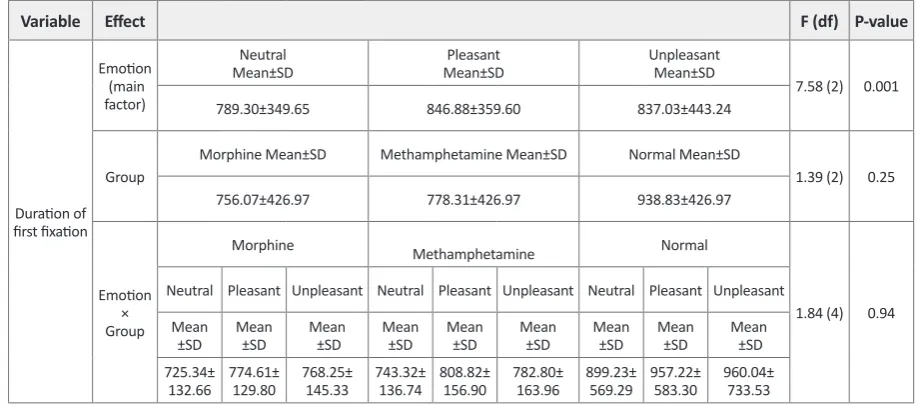
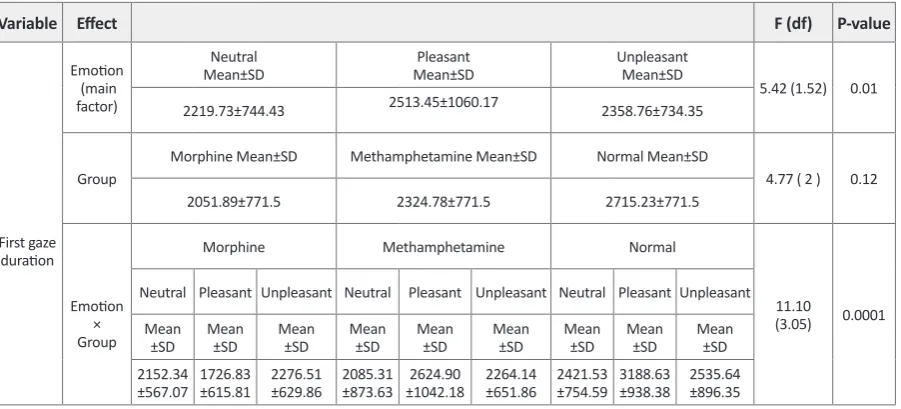
The results of the comparisons among the three groups in terms of number and duration of first fixation and du-ration of first gaze are presented in Tables 2, 3, and 4.
There was a significant main effect of emotion on dura-tion of first fixadura-tion (F=7.58, P=0.001). Pairwise compar-ison showed that the time spent to fixate on unpleasant images was more than that of neutral ones (P=0.0001). Moreover, duration of the first fixation on pleasant im-ages was more than that of the neutral scenes (P=0.01).
The repeated measures analysis showed no significant effect of group and group x emotion interaction with re-gard to duration of first fixation (Table 2).
The main effect of group x emotion interaction was significant in terms of number of first fixation (F=3.29, P=0.01). Normal group made more fixations on pleasant and fewer fixations on unpleasant images compared to the other two groups. The morphine group had the low-est number of first fixation to pleasant images (F=8.36, P=0.0001) while this number was higher in unpleasant images in the former methamphetamine abusers (Table 3).
The main effect of emotion on the number of first fixa-tion was significant (F=8.36, P=0001) (Table 3). The pairwise comparison showed that fixations on pleasant Table 1. Demographics and clinical characteristics of three groups.
Group Morphine(n=20) Methamphetamine(n=20) Healthy control(n=20)
Mean±SD Mean±SD Mean±SD F P
Age (year) 34.75±9.99 32.20±7.09 27.10±3.64 5.56 0.006
Education (year) 10.25±2.98 11.20±3.31 15±1.89 16.1 0.0001
Age of onset (year) 21.85±7.37 24.55±8.63 - 1.13 0.29
Duration of consumption
(month) 100.75±75.22 49.95±37.73 - 7.28 0.01
Abstinence (day) 26.20±19.48 27.70±23.35 - 0.04 0.82
HAM-D¹ 4.7±6.44 5.65±6.08 2.1±3.46 2.24 0.11
HAM-A² 2.8±4.47 1.85±2.7 1.7±2.51 0.63 0.53
1=Hamilton Rating Scale for Depression. 2= Hamilton Rating Scale for Anxiety
Table 2. Comparison between the three groups in terms of duration of first fixation variable using the repeated measure analysis.
Variable Effect F (df) P-value
Duration of first fixation
Emotion (main factor)
Neutral
Mean±SD Mean±SDPleasant UnpleasantMean±SD
7.58 (2) 0.001
789.30±349.65 846.88±359.60 837.03±443.24
Group
Morphine Mean±SD Methamphetamine Mean±SD Normal Mean±SD
1.39 (2) 0.25
756.07±426.97 778.31±426.97 938.83±426.97
Emotion × Group
Morphine Methamphetamine Normal
1.84 (4) 0.94 Neutral Pleasant Unpleasant Neutral Pleasant Unpleasant Neutral Pleasant Unpleasant
Mean
±SD Mean ±SD Mean ±SD Mean ±SD Mean ±SD Mean±SD Mean ±SD Mean ±SD Mean ±SD 725.34±
images were more than the neutral ones (P=0.0001). This analysis showed the higher number of first fixation on unpleasant scenes compared to the neutral images (P=0.03).
The analysis showed the significant main effect of group x emotion interaction in terms of first gaze dura-tion (F=11.10, P=0.0001) (Table 4). The pairwise com-parison revealed the significant difference just between the morphine and healthy groups (P=0.01). Individuals with a history of morphine use spent less time on their first gaze on pleasant scenes, while healthy people’s first gaze duration was longer on pleasant images (Table 4).
4. Discussion
In this study, we investigated the effect of substance use (morphine and methamphetamine) on attentional bias towards pleasant, unpleasant, and neutral images during abstinence period compared to healthy individu-als. Attention to emotion is a basic component of emo-tion percepemo-tion (Thompson et al., 2011) and its variaemo-tion is based on individual and emotional situations and dif-ferences (Bradley et al., 1992; Posner & Rothbart, 2007).
Several studies have emphasized the differences of emotional experiences in individuals with substance use disorder (Al-Zahrani & Elsayed, 2009; Dunning et al., 2011). The study aimed to evaluate visual attentional bias Table 3. Comparison between the three groups in terms of number of first fixation variable using the repeated measure analysis.
Variable Effect F (df) P-value
Number of first fixation
Emotion (main factor)
Neutral
Mean±SD Mean±SDPleasant UnpleasantMean±SD
8.36 (2) 0.0001
47.42±6.49 54.03±7.64 51.65±8.60
Group
Morphine Mean±SD Methamphetamine Mean±SD Normal Mean±SD
3.37 (2) 0.04
50.78±0.6 51.20±0.6 51.11±0.6
Emotion × Group
Morphine Methamphetamine Normal
3.29 (4) 0.01 Neutral Pleasant Unpleasant Neutral Pleasant Unpleasant Neutral Pleasant Unpleasant
Mean
±SD Mean±SD Mean±SD Mean±SD Mean±SD Mean±SD Mean±SD Mean±SD Mean±SD 48.4±
6.57 51.1±5.88 52.85±7.28 44.75±6.52 54.30±6.44 54.55±6.41 49.10±5.81 56.70±9.42 47.55±10.36
Table 4. Comparison between the three groups in terms of duration of first gaze variable using the repeated measure analysis.
Variable Effect F (df) P-value
First gaze duration
Emotion (main factor)
Neutral
Mean±SD Mean±SDPleasant UnpleasantMean±SD
5.42 (1.52) 0.01
2219.73±744.43 2513.45±1060.17 2358.76±734.35
Group
Morphine Mean±SD Methamphetamine Mean±SD Normal Mean±SD
4.77 ( 2 ) 0.12
2051.89±771.5 2324.78±771.5 2715.23±771.5
Emotion × Group
Morphine Methamphetamine Normal
11.10
(3.05) 0.0001 Neutral Pleasant Unpleasant Neutral Pleasant Unpleasant Neutral Pleasant Unpleasant
Mean
±SD Mean±SD Mean±SD Mean±SD Mean±SD Mean±SD Mean ±SD Mean ±SD Mean±SD 2152.34
towards emotional scenes in these patients during their abstinence phase. The findings of this study revealed that the number and duration of first fixations and also duration of first gazes towards emotional scenes were different between the groups. In both patient groups, the average number of first fixations to unpleasant images was more compared to pleasant and neutral images. It means that individuals with substance use disorder tend towards unpleasant pictures. However, the time spent on fixation was longer in pleasant images.
In morphine group, duration of the first gaze to pleas-ant images was shorter compared to neutral and unpleas-ant scenes. This pattern is in contrast to what was found in normal group whose first gaze duration to pleasant pictures was longer compared to neutral and unpleas-ant ones. This finding is in line with a study performed on patients with heroin use disorder using event related potential (ERP) technology (Marques-Teixeira, Barbosa, 2005). Pleasant, unpleasant, and neutral images were shown to the patients and during that time, an auditory oddball task was conducted to assess the effect of an in-terfering variable on the attention to emotional scenes. The results showed that the healthy group had more at-tention to pleasant images. However, the patient group had more attentional bias towards unpleasant and neutral pictures.
In our study, in methamphetamine group, duration of first gazes to pleasant images was longer compared to neutral and unpleasant scenes. This pattern is similar to what was found in healthy people and different from morphine group. A lower capacity of face emotion rec-ognition has been shown in a research conducted on methamphetamine abusers (Yang-Tae, Do-Hoon and Yongmin, 2011). One explanation for this difference is that our participants were in abstinence period while the mentioned study’s subjects were in active phase.
There are studies whose findings are in line with ours. For instance, difference in emotional perception in absti-nence phase was evaluated in a study showing emotion-al images to the patients while they were scoring their arousal and valence related to these pictures (Aguilar et al., 2005). Their results showed that individuals with substance use disorder had rated pleasant images with lower arousal scores compared to healthy group. Clini-cal feedbacks of the patients after a long period of absti-nence also showed that they had lower response to emo-tional and affective stimuli. They mentioned that their emotional life (such as family, sex partner, etc.) had not been an emotionally stimulating factor.
There is a research that compared patients in active and abstinence phases while evaluating apathy, execu-tive functions, and disinhibition (Verdejo-García et al., 2006). The results showed lower valence rating of pleas-ant images and higher arousal rating of unpleaspleas-ant pic-tures in patients during the active phase compared to the patients in abstinent phase and healthy individuals.
Our results showed that individuals with a history of methamphetamine use disorder gazed longer on pleas-ant pictures while patients with morphine use disorder attended more on unpleasant images. This difference can lead to the conclusion that morphine can influence more on emotion perception and emotion regulation compared to methamphetamine. One strong point of our study was selecting patients who had been using pure morphine and methamphetamine. This selection made the com-parison more precisely.
Our findings also indicate that emotion perception defi-cits found in patient groups are not due to active phase of substance use. However, we do not know whether these impairments are caused by long period of substance use or a primary deficit. To know that, we need to evaluate individuals at high risk of substance use disorder and compare them with patients in active and abstinence phases.
In summary our findings showed that patients with morphine use disorder have less attention towards pleas-ant images compared to methamphetamine and normal groups. Healthy individuals have higher tendency to look at pleasant pictures compared to other two groups. Based on our findings, it seems that patients with a his-tory of morphine use disorder have more problems with emotion perception and regulation and they need to be engaged more in treatments focusing on these compo-nents.
Acknowledgements
References
Aguilar de Arcos, F., Verdejo-García, A., Peralta-Ramírez, M. I., Sánchez-Barrera, M., & Pérez-García, M. (2005). Experience of emotions in substance abusers exposed to images containing
neutral, positive, and negative affective stimuli. Drug and
Al-cohol Dependence, 78(2), 159-67.
Al-Zahrani, M. A., & Elsayed, Y. A. (2009). The impacts of sub-stance abuse and dependence on neuropsychological
func-tions in a sample of patients from Saudi Arabia. Behavioral and
Brain Functions, 5, 48.
Bradley, M. M., Greenwald, M. K., Petry, M. C., & Lang P. J. (1992). Remembering pictures: Pleasure and arousal in
mem-ory. Journal of Experimental Psychology: Learning, Memory, and
Cognition, 18(2), 379-90.
Clore, G. L., & Ortony, A. (2000). Cognition in emotion: Always, sometimes, or never. In R. D. R. Lane, L. Nadel, G. L. Ahern, J.
Allen, & A. W. Kaszniak (Eds.), Cognitive Neuroscience of
Emo-tion (pp. 24-61). UK: Oxford University Press.
Dunning, J. P., Woicik, P. A., Parvaz Muhammad, A., Telang, F., Wang, G. J., Hajcak, G., et al. (2011). Motivated attention to cocaine and emotional cues in abstinent and current cocaine
users – an ERP study. European Journal of Neuroscience, 33,
1716–1723
Eden, G. F., Stein, J. F., Wood, H. M., & Wood, F. B. (1994). Dif-ferences in eye movements and reading problems in dyslexic
and normal children. Vision Research, 34(10), 1345-58.
Hamilton, M. (1960). A rating scale for depression. Journal of Neurology, Neurosurgery, and Psychiatry, 23, 56-62.
Hosak, L., Preiss, M., Bazant, J., Tibenska, A., Holub, D., Cer-makova, R., et al. (2011). Comparison of Continuous Perfor-mance Test results between subjects dependent on
metham-phetamine and healthy volunteers. Activitas Nervosa Superior
Rediviva, (53)4, 182-186
Kalechstein, A. D., Newton, T. F., & Leavengood, A. H. (2002).
Apathy syndrome in cocaine dependence. Psychiatry research,
109(1), 97-100.
Kaviani, H., Mousavi, A. (2001). Psychological tests and interview.
Tehran: Sana.
Kellough, J. L., Beevers, C. G., Ellis, A. J., & Wells, T. T. (2008). Time course of selective attention in clinically depressed
young adults: an eye tracking study. Behaviour Research and
Therapy, 46(11), 1238-43.
Lang, P. J., Bradley, M. M., & Cuthbert, B. N. (1999). International affective picture system (IAPS): Technical manual and affective rat-ings. Gainesville, FL: The Center for Research in Psychophysi-ology, University of Florida.
Marques-Teixeira, J. E., & Barbosa, M. F. S. (2005). Emotional states and informational brain processing in drug addicts free
of drugs: An ERPs study. International Journal of Psychiatry in
Clinical Practice, 9(3), 213-20.
Pessoa, L., McKenna, M., Gutierrez, E., & Ungerleider, L. G. (2002). Neural processing of emotional faces requires atten-tion. Proceedings of the National Academy of Sciences of the United States of America, 99(17), 11458-63.
Phillips, M. L., Drevets, W. C., Rauch, S. L., & Lane, R. (2003). Neurobiology of emotion perception I: The neural basis of
normal emotion perception. Biological Psychiatry, 54(5), 504-14.
Pishyareh, E., Tehrani-Doost, M., Mahmoodi-Gharaie, J., Khor-rami, A., Joudi, M., & Ahmadi, M. (2012). Attentional Bias towards Emotional Scenes in Boys with Attention Deficit
Hyperactivity Disorder. Iranian Journal of Psychiatry and
Behav-ioural Science, 7(2), 93-6.
Posner, M. I., & Rothbart, M. K. (2007). Research on attention networks as a model for the integration of psychological sci-ence. Annual Review of Psychology, 58, 1-23.
Thompson, R. J., Mata, J., Jaeggi, S. M., Buschkuehl, M., Jonides, J., & Gotlib, I. H. (2011). Concurrent and prospective relations between attention to emotion and affect intensity: an
experi-ence sampling study. Emotion, 11(6), 1489-94.
Verdejo-García, A., Bechara, A., Recknor, E. C., & Perez-Garcia, M. (2006). Executive dysfunction in substance dependent in-dividuals during drug use and abstinence: an examination of the behavioral, cognitive and emotional correlates of
ad-diction. Journal of the International Neuropsychological Society,
12(03), 405-15.
Woicik, P. A., Moeller, S. J., Alia-Klein, N., Maloney, T., Lukasik, T. M., Yeliosof, O., et al. (2009). The neuropsychology of
co-caine addiction: recent coco-caine use masks impairment.
Neu-ropsychopharmacology: official publication of the American College of Neuropsychopharmacology, 34(5), 1112-22.
Yang-Tae, K., Do-Hoon, K., & Yongmin, C. (2011). Impairments of facial emotion recognition and theory of mind in