1
TĂBĂCĂRIE LAKE – AN URBAN ECOSYSTEM AT RISK
Alexandru Luca, Mirela Arpenti, Ana Maria Buiculescu, Daniela Vasile
Ovidius University of Constanta, RO
Abstract
Tăbăcărie Lake represents an urban ecosystem which suffers from tremendous human pressures that change the quality and quantity of its values, functions and services. The study starts from the actual state of the lake, having the scope to establish a sustainable management plan, for the ecological restoration of Tăbăcărie Lake. In the context of a high anthropogenic impact, we have done observations and measurements in the field, related with the environmental quality of the water and for evaluation of the anthropic impact, measuring the main water quality parameters and calculating an index of shoreline development. We compared the ecological state of the year 2012-2013 with the one which had been determined with 4 years before.Based on the data obtained from field observations and determinations performed using a multiparameter device and the existing information on Tăbăcărie Lake water quality it was possible to sketch a sustainability management plan that would help restore ecological integrity of this urban ecosystem, given the socio-economical context.
Key words: urban lake, development index, sustainability, management
Introduction
Excessive urban development leads to a complex pollution of all environmental components. All the desire to achieve technical progress and welfare of mankind, have emerged pollutants, most of them by chemical synthesis processes. Thus emerged: pesticides, plastics, detergents, freons and so on, which are more harmful because they could not be recycled or stored in deposits (rocks) biogenic so they express the full potential destroyer on the environment (Tofan, L., 2005).
Coastal areas have always been chosen by humans for water and food resources, as well as for their settlements (Kullenberg, 2001). At global scale, these areas host billions of people, providing our society multiple intrinsic and economic ecosystem services (Mossinger et al., 2013)
Constanta area is characterized by tourism activities, especially during summer, harbor activities, industry and services sector. Thus, water resources experience a strong anthropogenic action. Urban area contributes in a great measure to the contamination of the water bodies by nutrient runoff, sewage discharges from land, becoming eutrophic (Bernes at al., 2013).
Tăbăcărie Lake falls under the six criteria of urban lakes described by Schueler and Simpson (2001) and the definition given by Birch and McCaskie (1999). Bordered by the main road arteries, this inner-city lake has an area of 99 hectares, reaching a maximum length of 1374 m, a maximum width of 825 m and a maximum depth of 4.4 m.
The lake was, for a long period of time, the natural receiving system for urban waste waters and runoff. Its surrounding landscape, Tăbăcărie Park, has changed in time, now covering only the western side of the lake. This led to growing environmental pressures that influence the quality and quantity of this ecosystem`s resources.
IJCC
S
EC Volum
e 2, Issu
e 2
2 It becomes necessary that the water resources managers and inhabitants of large cities to be trained and educated to respect and manage these resources that dictate the rhythm of daily life, both economically and socio-culturally (Romanescu, 2005).
The aim of this paper is to determine the current state of Tăbăcărie Lake ecosystem and formulate, based on data obtained, a management plan that is molded on the problems facing the lake and its surrounding areas.
Material and methods
The water samples were collected with a surface sampling device in sufficient amount, and transferred to sterile plastic bags (Whirl-Pak) and kept in a cooling chamber until the arrival at the laboratory, where they were filtered and subjected to processing procedures for determining nutrients using spectrometric methods. Also, the multiparametric sonde was used to achieve in-situ measurements on the physico-chemical quality parameters: temperature, pH, conductivity, dissolved oxygen, turbidity, chlorophyll.
In order to apply the calculation methodology of the shoreline development index (Tofan et al., 2008) a characterization of the main activities in the lake area was done. Human actions on the field cause changes in the aquatic area. The functional zones are connected by the shoreline of Tăbăcărie Lake.
A visual examination was performed for 96 locations around Tăbăcărie Lake. At each station an area of 10 m/10 m was evaluated at each point that was observed. Five components of the shoreline development index were considered: the aquatic zone, the shoreline zone, riparian area, a biotic and an aesthetic component. For each station it was used a 5 m depth in the aquatic transect, 10 m in the riparian zone, and for the coastal zone - one meter depth from the water's edge.
For the aquatic, seashore and riparian zone, the vegetation or land coverage and land use were visually estimated. Wildlife presence (birds, amphibians, etc.) at each station were noted as present, absent or abundant.
The aesthetic value was determined through a qualitative assessment of the landscape and buildings with a cultural or aesthetic importance, that are visible from these points, as shown in observations data sheet.
Data were introduced into Microsoft Excel and the statistical distribution of the different variables was examined. A positive score was given to the variables that contribute positively to the ecological integrity and at the end, these scores were summed to have a final positive score. For the negative variables, the procedure was the same.
The data and information obtained were integrated and analyzed in order to identify the main problems and potential solutions that might materialize in a sustainable management plan.
Results and discussions
Characterization of perilacustrine area
The territory defined above is Tăbăcărie Lake, which benefits from a very favorable settlement, beeing surrounded by major traffic arteries, the corresponding area being a bound zone with the tourist area of Mamaia.
The accelerated evolution of the anthropogenic activities in the analyzed area had marked differences in the organization of the territory in the corresponding area of the lake:
IJCC
S
EC Volum
e 2, Issu
e 2
3 The west side, near Lăpuşneanu Boulevard and an important residential area, is
predominantly a recreational park, with rich vegetation areas, arranged sites with games for children and rest-relaxation, as well as cultural endowments (summer Theatre), catering (restaurant "La Cetate", sweets shop, snack bar); this area is an important refuge and shelter for many creatures that find in the lake’s shore and reeds a suitable habitat both in winter and in summer.
In the eastern side (Mamaia Boulevard) the park function is less represented and the technical-utilitary function (the treatment plant - RAAC, the RENEL, military base) is predominant. We observed an accelerated development of commercial and entertainment buildings (Lake View, Outlet). An important territory is occupied by The Museum for Natural Sciences (Dolphinarium, Planetarium, micro-delta and Maramures wooden church).
The south side, delimited on the short park side by Soveja Street, having placed a sports objective: Diving Center, Gravity Park - Nautical Base for student training, representing an extension of the existing facilities in nearby Children's park. The northern side concentrates the most of tuorism profile constructions:
accommodation, catering (Holiday Village, Restaurant North); trade (Bazar); sports-leisure (Bowling Amusement Park); tourism services (Rent a Car, Service, ONT-Carpathians); cultural-commercial services (Exhibition Pavilion).
The current status of Tăbăcărie Lake
In Tăbăcărie Lake’s case we identified the following sources of pollution as well as the ways in which pollutants get into the lake:
• organized pollution sources (Fig. 1-A) - wastewater collected by sewerage systems, sewage coming from households, public institutions, commercial establishments and public catering, that have high content of: biological impurities, organic and mineral substances: oil, detergents, pesticides.
• agrozootechnical wastewater (Fig. 1-B) - containing manure, soil erosion products, natural or synthetic fertilizers, chemicals used against pests, biostimulators, animal infectious agents. (Microreserve and micro-delta)
• unorganized pollution sources (Fig. 1-C and 1-D) - storm water (rain or snow) and solid residues (Fig. 1-B and 1-D). They are intermittent, usually low flow and have a diverse composition, producing diffuse pollution, and is especially difficult to manage. These generally consist in organic or mineral suspensions, pathogens, parasites that come from the ground, certain toxic substances.
IJCC
S
EC Volum
e
2, Issu
e 2
4 Fig. 1 – Main sources of pollution in the field
Physical and chemical parameters
During the practical activities carried out in the field, we performed measurements of the major water quality parameters with the YSI multiparameter probe. Water temperature recorded normal values specific to the period in which measurements were made. Conductivity recorded averages of 1614 μS∙cm-3, values corresponding to
freshwater ecosystems, as indicated also by the salinity values, well knowing the fact that Tăbăcăriei Lake takes the freshwater in excess from Lake Siutghiol, located to the north, which is fed by two underground freshwater springs.
The water had a basic character, which is preferable for most aquatic organisms. For chlorophyll, recorded values exceeded 16 mg∙L-1 even during the cold season,
the values beeing higher in the areas where illegal discharge pipes existed, or in the areas of stormwater discharge from the southwestern corner of the lake.
Water oxygen saturation was higher in the warm months of the year, although the phenomenon of pollution is intense. This situation is explained by the presence of algae that grow excessively due to the nutrients arrived in the water in various ways, which perform photosynthesis. During the night, however, most likely the values for this parameter decrease because water organisms consume the oxygen produced during the day in the processes of respiration.
Nutrients recorded high values. Mean values recorded for phosphates fits Tăbăcărie Lake in fourth class of water quality, while those of nitrates, in the second class of water quality, according to the legislation in force (M.O. 161/2006). These correspond to the water bodies with poor chemical status.
Tăbăcărie Lake’s turbidity was within normal limits, corresponding to a shallow lake with thick sediment that return in suspension by wind action.
A B
C D
IJCC
S
EC Volum
e 2, Issu
e 2
5
Application of the Shoreline development index1
This index shows the connection between the shoreline and the riparian and aquatic zone. Human activity and its effect on the lake can be quantified, and interrelationships can be understood. Connectivity involves combining the component parts, which in this case are represented by the functional zones established all around the lake. Although these have different use, they also have a common component: the lake.
Data analysis in Microsoft Exel showed excellent or very good areas in micro-delta or in the bay of Tăbăcărie Park. The existence of large amounts of reeds along the shoreline and in the aquatic areas was correlated with higher abundance of wildlife. Areas including concrete walls have been found in many locations and have negatively affected the scores.
Excellent scores were received by the bay area and the micro-delta, which are characterized by several natural elements, while other stations received low or medium scores.
Micro-delta area, which received a maximum score, has the potential to be a model for the rehabilitation of the aquatic, shoreline and riparian areas of Tăbăcărie Lake. In the micro-delta we encountered many birds and amphibians, and a correlation was made between their large number and high abundance of shoreline vegetation.
The area that received "excellent" score was the bay next to Tăbăcărie Park. The high percentage of vegetation and reeds associated with a small percentage of concrete construction generates an example with positive potential of the lake system. (Tofan et al., 2008)
From the 96 analyzed stations, 36 were rated ''poor'', 40 stations obtained an ''average'' score and only a number 20 stations were classified as ''good''. A percentage of 37.5% from the shoreline area had poor integrity, 41.6% average integrity, and only 20.8% good integrity of the shoreline (Fig.2). Most stations with good score were those from the Micro-delta and on the western shore of the lake.
Fig. 2 - Distribution of sites by score
1Tofan et al., 2008; 0 10 20 30 40 50
Nr. Stations Percentage
IJCC
S
EC Volum
e 2, I
ssu
e 2
6
Plan elaboration and implementation
In the case of Tăbăcărie Lake of priority are the actions that favor achieving the goals related to the improving of environmental components' quality (water, substrate, shores) and also the structural and functional integrity of the ecosystem, that represent the base for ecosystem goods and services.
Analysis of management options regarding the remediation of water quality in Tăbăcărie Lake determines as highly important the actions for decreasing and stopping the influx of urban waste water that enter through the storm water discharge pipe. Located in the southwestern side of the lake, this represents the source of pollution with the greatest impact on the ecosystem. The most affected sector by the discharges seems to be an ideal site for implementing a “biopurification'' strategy through phytoremediation.
The treatment system using emerged macrophytes Eichhornia crassipes (water hyacinth) and Pistia stratiotes (water lettuce) was introduced in Romania by Mrs. Professor Mărioara Godeanu, from the Institute of Applied Ecology in Bucharest. In this sense, a series of experiments were made, the best results being achieved on municipal wastewater, wastewater from livestock farms, and from small households.
Such biological treatment systems of wastewater using emerged aquatic plants are efficient, economical, easy to build and maintain, being applicable all year long (Godeanu S., 2003)
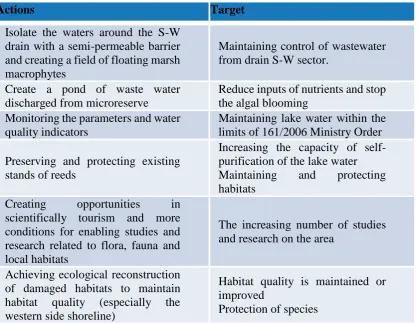
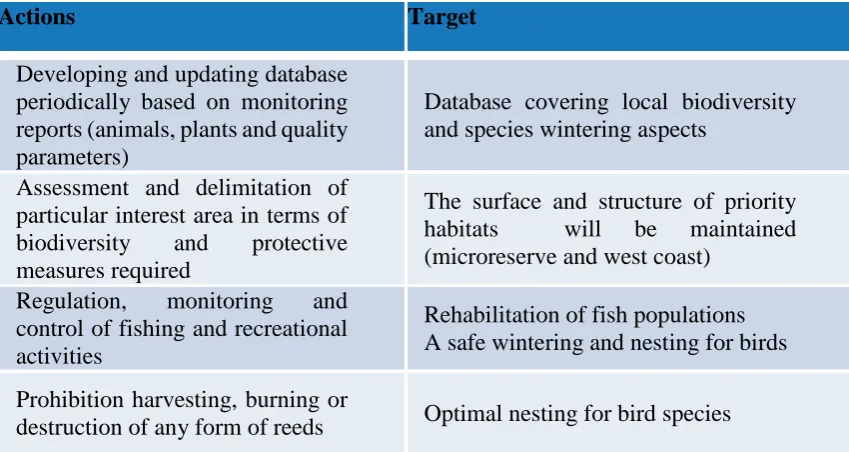
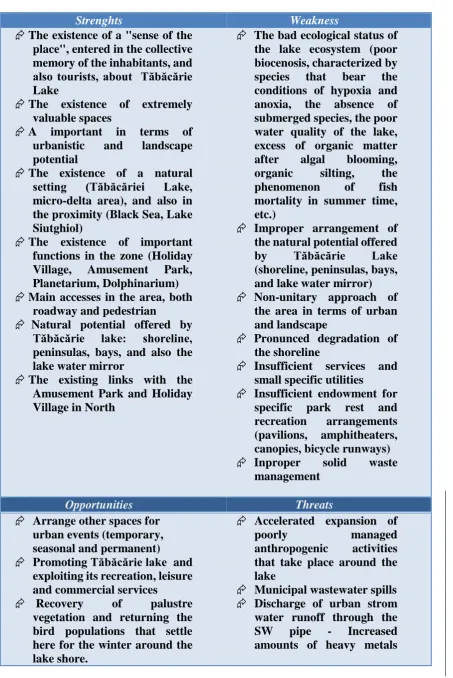
The management plan is organised on three sections, presented in Tables 1, 2, and 3, each section having its specific actions and targets, and finally the SWOT analysis was performed (Table no.4).
Table no. 1 - Improving Tăbăcărie Lake ecosystem
Actions Target
Isolate the waters around the S-W drain with a semi-permeable barrier and creating a field of floating marsh macrophytes
Maintaining control of wastewater from drain S-W sector.
Create a pond of waste water discharged from microreserve
Reduce inputs of nutrients and stop the algal blooming
Monitoring the parameters and water quality indicators
Maintaining lake water within the limits of 161/2006 Ministry Order Preserving and protecting existing
stands of reeds
Increasing the capacity of self-purification of the lake water Maintaining and protecting habitats
Creating opportunities in scientifically tourism and more conditions for enabling studies and research related to flora, fauna and local habitats
The increasing number of studies and research on the area
Achieving ecological reconstruction of damaged habitats to maintain habitat quality (especially the western side shoreline)
Habitat quality is maintained or improved
Protection of species
IJCC
S
EC Volum
e 2, Issu
e 2
,
7 Table no. 2 - Conservation and management of biodiversity
Actions Target
Developing and updating database periodically based on monitoring reports (animals, plants and quality parameters)
Database covering local biodiversity and species wintering aspects
Assessment and delimitation of particular interest area in terms of biodiversity and protective measures required
The surface and structure of priority habitats will be maintained (microreserve and west coast)
Regulation, monitoring and control of fishing and recreational activities
Rehabilitation of fish populations A safe wintering and nesting for birds Prohibition harvesting, burning or
destruction of any form of reeds Optimal nesting for bird species
Table no. 3 - Tourism - Education – Recreation
Actions Target
Enriching lake dendrological adjacent areas
Define policies to increase the quality of green spaces, public spaces, and equipment and services in the area
Forbidding access to conventional motorized vehicles on walkways Creating legal and institutional framework for the development of the area in terms of social, cultural and landscape
Protection of and micro-delta land area and mini zoo, and their integration into a pedestrian cultural circuit.
Developing the infrastructure necessary to support recreational tourism
Fitting existing public spaces and creating new ones (specific pedestrian amenities, landscaping, decorative purposes, paving, street furniture, specific works of art, special lighting,
Maintaining function of park Increased number of tourists
IJCC
S
EC Volum
e 2, Issu
e 2
8 Table no. 4 – SWOT Analysis for Tăbăcărie Lake area
Strenghts Weakness
The existence of a "sense of the place", entered in the collective memory of the inhabitants, and also tourists, about Tăbăcărie Lake
The existence of extremely valuable spaces
A important in terms of urbanistic and landscape potential
The existence of a natural setting (Tăbăcăriei Lake, micro-delta area), and also in the proximity (Black Sea, Lake Siutghiol)
The existence of important functions in the zone (Holiday Village, Amusement Park, Planetarium, Dolphinarium) Main accesses in the area, both
roadway and pedestrian
Natural potential offered by Tăbăcărie lake: shoreline, peninsulas, bays, and also the lake water mirror
The existing links with the Amusement Park and Holiday Village in North
The bad ecological status of the lake ecosystem (poor biocenosis, characterized by species that bear the conditions of hypoxia and anoxia, the absence of submerged species, the poor water quality of the lake, excess of organic matter
after algal blooming,
organic silting, the
phenomenon of fish
mortality in summer time, etc.)
Improper arrangement of the natural potential offered
by Tăbăcărie Lake
(shoreline, peninsulas, bays, and lake water mirror) Non-unitary approach of
the area in terms of urban and landscape
Pronunced degradation of the shoreline
Insufficient services and small specific utilities Insufficient endowment for
specific park rest and recreation arrangements (pavilions, amphitheaters, canopies, bicycle runways)
Inproper solid waste
management
Opportunities Threats
Arrange other spaces for urban events (temporary, seasonal and permanent) Promoting Tăbăcărie lake and
exploiting its recreation, leisure and commercial services
Recovery of palustre
vegetation and returning the bird populations that settle here for the winter around the lake shore.
Accelerated expansion of
poorly managed
anthropogenic activities that take place around the lake
Municipal wastewater spills Discharge of urban strom water runoff through the
SW pipe - Increased
amounts of heavy metals
IJCC
S
EC Volum
e 2, Issu
e 2
9 Capitalization of the local taxes
in order to implement a sustainable management of Tăbăcărie lake
Raise citizen awareness
regarding the lake’s ecological functions and importance
(Caraivan et al., 2011) and nutrients
Collaps and degradation og the shorelines
Clogging of certain portions of the lake
The growth of traffic in the City Park Mall area
The lack of actions and / or
delay in their
implementation can cause loss of the functions and services of the ecosystem (provisioning, regulating, cultural and supporting) (MA, 2005)
Conclusions
Summarizing the data cited, determined and observed, it can be concluded that both the waters and the adjacent area of Tăbăcărie Lake are affected by a number of invasive processes with an external cause, often anthropogenic.
Data analysis contained in this paper, shows that during a year, physico-chemical waters characteristics of Tăbăcărie Lake suffer severe transformations that are manifested through the algal blooming (eutrophication), silting of the lake’s basin, river banks degradation (sedimentation), heavy metals contamination. During the warm season, physico-chemical parameters of the lake water can be correlated to achieve an overview of the processes that take place in this lake. Thus, in summer time, the first parameter that change is the temperature. The temperature growth causes degradation of carbonates and bicarbonates that through the removal of OH- ion lead to the pH water increase. With the temperature increase, an acceleration of algal and microbial activity also takes place, which leads to the correlatation between temperature increase and dissolved oxygen decrease and growth of chemical oxygen demand. The excess of nutrients stimulates the growth of phytoplankton, the water becoming turbid, which causes reduced light penetration (Bernes et al., 2013), which in turn affects submerged macrophytes, which were found in very limited spots.
This mechanism is accelerated during the hot season by the increasing tourism activities in the north and west side of the lake. These tourism activities generate wastewaters that are discharged into the Siutghiol – Tăbăcărie channel; this activity has the greatest impact on the lake. Waste waters from the touristic area of the lake and discharges from rainfall and microreserve’s pond contain a high input of nutrients, fact that leads to an overgrowth of primary producers and the instalation of the eutrophication and hypoxia state of the lake.
The second big problem is the degradation of the shoreline, phenomenon that boosts its effects from year to year. This, together with the large amounts of organic matter that result from algal blooming, contribute to the sedimentation processes enhancement. The Shoreline Integrity Index showed this fact, the results showing that 80% of the shoreline is degraded or in course of degradation due to terrigenous substrate
erosion under the water’s action. IJCC
S
EC Volum
e 2, Issu
e 2
10 The sites administration, architectural and landscape design of Tăbăcărie Lake’s area is also required, this set of actions beeing a response to the state of Tăbăcărie Lake’s Park.
Along with the quality standards of tourism facilities and services, other regulations should be developed and adopted, especially related to health, safety and sanitation. These regulations should include operating conditions and verification procedures for hotels and other accommodation units, restaurants, travel and tour agencies and guides. It is also necessary to adopt some safety measures for cars and touristic boats. Technical standards of infrastructure and buildings should be reviewed to insure that they face the the standards in force.
Bibliography
1. Bernes, C., Carpenter, S. R., Gardmark, A., Larsson, P., Persson, L., Skov, C., Van Donk, E., 2013. What is the influence on water quality in temperate eutrophic lakes of a reduction of planktivorous and benthivorous fish? A systematic review protocol, Environmental Evidence, 2, 1-8.
2. Birch, S., McCaskie, Janice, 1999. Shallow urban lakes: a challenge for lake management, Hydrobiologia 395/396: 365–377.
3. Caraivan G., Secrieru D., Fulga Constantina, Păun F., Opreanu Priscila, 2011. Tăbăcărie Lake – A Model of Urban Pollution, Geo-Eco-Marina, 17: 81-94 4. Godeanu, Marioara, Godeanu, S.P., 2003. Mecanisme de epurare a apelor uzate
in Noi profesiuni de mediu - Educatie ecologica, 31-36.
5. Gunnar K., 2001. Contributions of marine and coastal area research and observations towards sustainable development of large coastal cities, Ocean &
Coastal Management 44: 283–291.
6. Millennium Ecosystem Assessment (MA), 2005. Ecosystems and Human Well-Being: Synthesis. Island Press, Washington DC.
7. Ministry Order 161/2006 for the approval of the Normative regarding the
classification of surface waters quality, in order to establish the ecological status of water bodies.
8. Mossinger, J., White, M., Goymer, P., 2013. Coastal regions, Nature, 504, 35. 9. Romanescu, Ghe., 2005. Caracteristicile fizico-chimice ale lacurilor litorale din
sectorul românesc al Mării Negre
10. Schueler, T., Simpson, J., 2001. Why urban lakes are different. Water Protection
tehniques, 3(4): 747-750
11. Tofan, L., Ehlinger, T.J., Helt-Baldwin, Megan, Cerjak, Diana, Vasile, Daniela, Shaker, R.R., Bucur, Mirela, Buiculescu, Ana Maria, 2008. Formulation of a shoreline development index to examine the relationship between development and ecological integrity, Ovidius University Annals of Biology-Ecology, ISSN-1453-1267, 12 (1): 144-152.
12. Tofan, L., 2005. Poluarea mediului, Ovidius Univ.. Press:197p.
IJCC
S
EC Volum
e 2, Issu
e 2