On Finding an Optimal TCAM Encoding Scheme
for Packet Classification
Ori Rottenstreich, Isaac Keslassy
Technion
{
or@tx, isaac@ee
}
.technion.ac.il
Avinatan Hassidim
Google Israel & Bar-Ilan University
[email protected]
Haim Kaplan
Tel Aviv University
[email protected]
Ely Porat
Bar-Ilan University
[email protected]
Abstract—Hardware-based packet classification has become an essential component in many networking devices. It often relies on TCAMs (ternary content-addressable memories), which need to compare the packet header against a set of rules. But efficiently encoding these rules is not an easy task. In particular, the most complicated rules are range rules, which usually require multiple TCAM entries to encode them. However, little is known on the optimal encoding of such non-trivial rules.
In this work, we take steps towards finding an optimal encoding scheme foreverypossible range rule. We first present an optimal encoding for all possible generalized extremal rules. Such rules represent 89% of all non-trivial rules in a typical real-life classification database. We also suggest a new method of simply calculating the optimal expansion of an extremal range, and present a closed-form formula of the average optimal expansion over all extremal ranges. Next, we present new bounds on the worst-case expansion of general classification rules, both in one-dimensional and two-one-dimensional ranges. Last, we introduce a new TCAM architecture that can leverage these results by providing a guaranteed expansion on the tough rules, while dealing with simpler rules using a regular TCAM. We conclude by verifying our theoretical results in experiments with synthetic and real-life classification databases.
I. INTRODUCTION
A. Background
Packet classification is the key function behind many net-work applications, such as routing, filtering, security, account-ing, monitoraccount-ing, load-balancaccount-ing, policy enforcement, differenti-ated services, virtual routers, and virtual private networks [1]– [4]. For each incoming packet, a packet classifier compares the packet header fields against a list of rules, e.g. from access control lists (ACLs), then returns the first rule that matches the header fields, and applies a corresponding action on the packet. Typically, a tuple of five fields from the packet header is used, namely the source IP address, destination IP address, source port number, destination port number, and protocol type.
Today, hardware-basedTCAMs(ternary content-addressable associative memories) are the standard devices for high-speed packet classification [5], [6]. They match the concatenation of the five-tuple from the packet header into a fixed-width ternary array composed of0s,1s, and∗s (don’t care bits). For each packet, a TCAM device checks all the rules in parallel, and therefore reaches higher rates than other software-based or hardware-based classification algorithms [1]–[3], [7], [8].
There are two types of rules: simple rules that specify a fixed value (or a specific prefix-range as defined formally below) for each field of the header, and range rules. Typically, a range
rule applies when the source port and/or the destination port are in specific intervals. Encoding range rules requires several TCAM entries (this is calledrange expansion), and therefore although most rules are simple rules, most entries are used to encode range rules [9]. In addition, there is evidence that the percentage of range-based rules is increasing [10].
TCAM devices have a large set of rules which can be encoded together. However, understanding how to do this efficiently (using as few TCAM entries as possible) requires us first to understand how a single rule can be encoded. Therefore, a large body of work has been devoted to this question. Still, no practical algorithm can give an optimal encoding for any arbitrary range rule, i.e. the encoding that minimizes the needed number of TCAM entries. Instead, because of the high complexity of devising such an optimal algorithm, past works have limited themselves to sub-optimal encoding. They have either restricted the degrees of freedom of the algorithm, e.g. by forcing it to be prefix [11] or only withacceptentries [12], or employed heuristic approaches [1]–[3], [13]–[15].
B. Our Contributions
In this paper we study the fundamental complexity of encoding a single rule, using bothacceptanddenyentries. We focus onthe optimal encoding of any single range, and explore the theoretical hardness of encoding one-dimensional and two-dimensional ranges. Then, we deduce practical results for providingguaranteed-expansionTCAM encoding algorithms.
As illustrated in Table I and Fig. 1, we mainly providethree new contributions in this paper.
We first provide a theoretical contribution. Consider a set
{0,1,· · ·,2W −1} of 2W points, also represented as a tree with 2W leaves. Extremal ranges in this set are ranges that cover the first or last leaves of the tree, i.e. ranges of the form
TABLE I
SUMMARY OF THE NOVEL PAPER RESULTS(IN BOXED BOLD). (A)PRESENTS IN THE LAST ROW AN OPTIMAL ALGORITHM FOR THE ENCODING OF ONE-DIMENSIONAL(GENERALIZED)EXTREMAL RULES(WITH RANGES LIKE[0, y]). AS SHOWN,THIS IS THE FIRST OPTIMAL RESULT WHEN THE DEGREES
OF FREEDOM OF THE ALGORITHM ARE NOT LIMITED. PREVIOUS PAPERS EITHER ASSUMED ADDITIONAL CONSTRAINTS ON THEIR ALGORITHMS OR DID NOT PROVIDE OPTIMAL ALGORITHMS.(B)PRESENTS THE NEW RESULTS OBTAINED BY THIS PAPER FOR GENERAL RANGES. AS SHOWN IN THE LAST ROW,
WHEN THE DEGREES OF FREEDOM OF THE ALGORITHM ARE NOT LIMITED,THE PAPER ACHIEVES A TIGHT BOUND OFWFOR ONE-DIMENSIONAL GENERAL RANGES. IN ADDITION,IN TWO-DIMENSIONAL RANGES,THE PAPER OBTAINS TIGHT BOUNDS OFW+ 1FOR EXTREMAL RULES(ASSUMING
EVENWFOR SIMPLICITY),AS WELL AS2WFOR GENERAL RULES.
(A) Optimal algorithm for any range
Constraints References Extremal Ranges General Ranges Nodeny Prefix Gray One Dimension Two Dimensions One Dimension Two Dimensions
entries code codes
x x - [16] √ - √
-x - x - - -
-x - - -
-- x - [11] √ √ √ √
- - - √ - -
-(B) Bounds on worst-case expansion over all ranges
Constraints References Extremal Ranges General Ranges
Nodeny Prefix Gray One Dimension Two Dimensions One Dimension Two Dimensions entries code codes
Upper Lower Upper Lower Upper Lower Upper Lower Bound Bound Bound Bound Bound Bound Bound Bound
x x - [16] W W W2 - 2W−2 2W−2 (2W−2)2
-x - x [9] - - - - 2W−4 W (2W−4)2
-x - - [12] W - W2 - 2W−4 2W−4 (2W−4)2
-- x - [11], [17] ⌈W2+1⌉ ⌈W2+1⌉ W+1 W+1 W W 2W 2W
- - - [17] ⌈W2+1⌉ ⌈W2+1⌉ W+1 W+1 W W 2W 2W
the degrees of freedom of our encoding does not affect its optimality. We can then use a simple dynamic programming algorithm to find the smallest TCAM that uses only prefix TCAM rules, based on an existing algorithm [11].
As shown in the last row of Table I(A), for the first time, we achieve optimal encoding for non-trivial ranges. Former results had to limit the degrees of freedom of the algorithms, e.g. by constraining the encoding to be prefix, and therefore achieved sub-optimal encoding.
This result is particularly appealing because the set of gener-alized extremal ranges is significant in practice. To estimate the potential impact of our results we consider a union of 120 real-life classification databases from [10]. It contains 214,941 rules. We find that97.2%of these rules are generalized extremal rules (i.e. 208,850 rules). Even after excluding the exact-match rules, which are trivial to encode,89.4%of the non-exact-match rules are generalized extremal(51,055 rules out of 57,146).
Our discovery of an optimal algorithm for extremal ranges also allows us to analyze the expected length of the optimal encodingover all extremal ranges. To our knowledge, this is the first formula known in the literaturefor the average encoding size of a non-trivial range set. We show that it is only 2/3 of the worst case.
Our second main contribution is thatwe find the exact worst-case expansions of the one-dimensional as well as the two-dimensional ranges(last rows of Table I(B)). In particular, we first present a simple algorithm that is optimal for general
one-dimensional ranges in the worst case. Specifically, we first show that it encodes any range in[0,2W −1]in at mostW entries and exhibit a range that cannot be encoded with less than W TCAM entries. Thus, our algorithm is optimal for the worst case, and it improves substantially on a best previously-known lower-bound of⌈(W+ 1)/2⌉[17]. In addition, we also present an algorithm that is optimal in the worst case for general two-dimensional range rules. Such rules include two ranges, one for the source port and the other for the destination port. If W is the length of each of the two fields, we present an algorithm that encodes any two-dimensional range with at most
2W entries and present again a matching lower bound, i.e. a tough two-dimensional range such that any TCAM encoding it will necessarily contain at least 2W entries. Therefore, our presented algorithm isoptimalagain in the worst case.
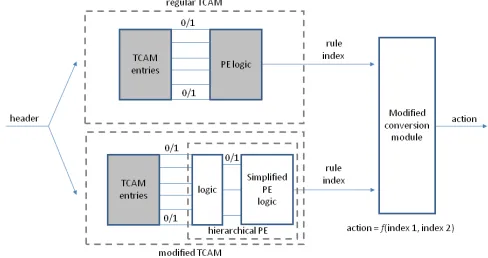
index of the first matching entry to its simplified PE (priority encoder), which corresponds to the index of its first matching rule. To do so, it decomposes its PE logic into a hierarchical structure, in which the first module determines whether there is a match on each rule, then the second one determines the first matching rule. Then, a modified conversion module considers both indices. From each index, it can deduce the respective rule index in the original classification list. Thus, it knows which rule has higher priority, and can output the corresponding action. It is therefore slightly more complex than a regular TCAM conversion module, which can be implemented using a simple SRAM with the action for each index. Here, the modified conversion module needs to use two SRAM-based memory tables, where each table entry may contain the original rule index and the associated action corresponding to each index.
This new architecture is especially interesting because the fraction of complex classification rules is increasing, and is expected to increase dramatically with the introduction of virtualization and the related flexible flow matching in SDN (Software-Defined Networking) [10], [18]. Therefore, this new architecture may help solve future scaling bottlenecks, since it provides tight guarantees on the worst-case number of entries needed for each rule. In addition, updates are easier to implement in the modified TCAM architecture [17], and therefore in the combined architecture. On the other hand, note that the modified TCAM involves additional logic, and is not an off-the-shelf component. Therefore, it is more costly, which may limit the current appeal of the new architecture.
We further simulate the new architecture on the set of 120 real-life rule files mentioned above. We encode two-dimensional rules in the modified TCAM using the schemes in our paper, and other rules in the regular one using a simple binary prefix scheme. We find that the number of entries needed to encode the two-dimensional rules decreases by73.4%, and the total number of entries needed decreases by19.5%.
Due to space limits, some proofs are fully presented in [19].
C. Related Work
As further illustrated in Table I, several previous papers have tried to find bounds on the worst-case expansion of a single rule. It is well-known that each range defined over a field of W bits can be encoded in at most 2W −2 prefix TCAM entries for W ≥ 2, where all TCAM entries have an action of accept [16]. For example, assume that W = 4, and that we want to encode the single range R = [1,14] ⊆
[
0,2W −1] so that packets in that range are accepted while others are denied (default action). Then we need the following
2W−2 = 6TCAM entries, not counting the last default entry:
(0001 → accept,001∗ → accept,01∗ ∗ → accept,10∗ ∗ →
accept,110∗ →accept,1110→accept,(∗∗∗∗→deny)).
Using a non-prefix TCAM encoding, the upper bound of
2W −2 was improved to 2W −4 [20]. To show that, the disjunctive normal form representation of a range function was studied. In addition, Gray codes can be used instead of binary
(a) Regular TCAM architecture. A priority encoder (PE) is used to select the first matching entry. Then, an action is selected based on the entry index.
[image:3.612.315.559.157.286.2](b) Suggested joint TCAM architecture. It includes a regular TCAM and a modified TCAM. In the modified TCAM, each range is encoded separately, and the regular PE is replaced by a hierarchical PE that is used to select the first matching range. Finally, the action is selected based on the indices sent by the two TCAMs.
Fig. 1. Comparison of a regular TCAM architecture with the suggested TCAM architecture. Components that also appear in the regular TCAM are presented in gray.
codes to reduce the worst-case TCAM size for any range from
2W −2 to2W−4 as well [9].
The previous examples only used entries with the action of accept. In general, we also allow entries with the action ofdeny. In this case, the order of the TCAM entries becomes significant and the first entry that applies to a given input determines the action on that input. When both actions are allowed, there is an upper bound of W entries [17]. For instance, the range R = [1,14] could be encoded using 3≤W entries: (0000→ deny, 1111→deny, ****→accept).
Other than the papers mentioned above, there is an extensive literature on efficient heuristics of how to encode ranges in TCAMs [1]–[3], [13]–[15], [21]–[24].
Some rules specify a range both for the source IP’s and for the destination IP’s. This motivates considering rules that are the product ofdranges defined on ddifferent fields ofW bits each. It is easy to see that they can be simply encoded using up to (2W −2)d prefix TCAM entries each accepting some part of the range. This gives a bound of 900 TCAM entries for a pair of (d= 2) port ranges of 16bits each [1].
There are not many known lower bounds on the number of TCAM entries required to encode a range. If the encoding is constrained to the use of only accepting entries, then there is a range for which the encoding length has to contain at leastW entries [9]. Furthermore, for binary codes, it was shown in [12] that there is a range whose encoding requires at least2W−4
When both denying and accepting entries are used, [17] presented a lower bound of⌈W2+1⌉for extremal ranges given in binary codes, even when the entries are not limited to be prefix. For general ranges, a lower bound ofW was suggested only when the entries are limited to be prefix.
Finally, an algorithm for finding an optimal prefix encoding for a given range is presented in [11]. However, its optimality is limited to encodings that contain only prefix entries.
II. MODEL ANDNOTATIONS
A. Terminology
We first formally define the terminology used in this paper. Unless mentioned otherwise, we assume a binary code rep-resentation. For simplicity, as long as there is no confusion, we also do not distinguish between a W-bit binary string (in
{0,1}W) and its value (in [0,2W −1]). We denote by xy the concatenation of the strings x and y, and by (x)k the concatenation ofk copies of the stringx.
Definition 1 (Range, prefix range, extremal range). A range R of width W is defined by two bit strings r1 and r2 of W
bits each, such thatr1≤r2. The rangeR is the set of all bit
strings x of W bits such that x ∈ [r1, r2]. A bit string xof
W bits is said to match the range (or be in the range) R if x∈[r1, r2].
In particular, a range R is a prefix range, with a prefix r′ ∈ {0,1}k of length k ∈ [0, W] if r1 = r′(0)W−k, and
r2=r′(1)W−k. It is a single point or an exact matchif r1=
r2. We say that the range is a general range when we want
to emphasize that it is not necessarily a prefix range. When r1= 0or r2= 2W−1 we call the range anextremal range.
Definition 2 (TCAM entry, prefix TCAM entry). A TCAM entry S of width W is a ternary string S = s1. . . sW ∈
{0,1,∗}W, where{0,1}are bit values and∗stands for don’t-care. A W-bit string b = b1. . . bW matches S, denoted as b ∈S, if and only if for all i ∈[1, W], si ∈ {bi,∗}. We will use S to denote also the set of strings that it matches, when no confusion will arise.
A TCAM entryS=s1. . . sW ∈ {0,1,∗}W is a prefix TCAM
entry if sj =∗ for some j ∈ [1, W] implies that sj′ =∗ for anyj′∈[j, W].
Note that prefix TCAM entries of widthW are in one-to-one correspondence with prefix ranges of width W. A range with a prefixrcorresponds to the prefix TCAM entry r(∗)W−k.
We assume that each TCAM entry S is associated with an action a that is either accept or deny. We denote a pair consisting of an entryS and an actionabyS→a. Depending on the context, we shall refer by aTCAM entryeither toS or to the pairS→a.
To simplify our presentation we assume at first that the packet header consists of a single field of widthW. We focus on a single classification rule defined by a general range over this field and its action is to accept all bit strings in the range. We call such a rule arange rule. Later we also discuss headers
with two fields of width W each, in which case the width of the header and of the TCAM entries would be2W.
Definition 3(TCAM Encoding of a range). ATCAM encoding ϕ of a range R of width W is a set of TCAM entries
(S1→a1, . . . , Sn→an) where each ai is either accept or
deny. Then, for each headerx∈ {0,1}W such thatx∈R, the first TCAM entrySjmatchingxis associated withaj=accept; and likewise, for each x̸∈R, either the first TCAM entrySj matching xis associated with aj =deny, or no TCAM entry matchesx(we assume a default action of deny). The number of rules, n, is calledthe size ofϕand denoted by |ϕ|.
A prefix TCAM encoding ϕ of a range R is a TCAM encoding ofR in which all entries are prefix TCAM entries.
B. Optimal Range Encoding Schemes
For each rangeRwe denote byOP T(R)a smallest TCAM encoding of R, and by OP Tp(R) a smallest prefix TCAM encoding of R. We also denote opt(R) = |OP T(R)| and optp(R) =|OP Tp(R)|. Letopt(R)be therange expansionof R, or just the expansionof R for short. Likewise let optp(R)
be theprefix range expansionofR, or just theprefix expansion of Rfor short.
We define r(W)to be the maximum expansion of a range in{0,1}W, that isr(W) = maxRopt(R). Similarly we define re(W) to be the maximum expansion of an extremal range, that isre(W) = max{opt(R)|R= [0, y]∨R= [y,2W−1]}. Analogously, we define the maximum expansion with prefix TCAM entries to berp(W) = maxRoptp(R), and for extremal rangesre
p(W) = max{optp(R)|R= [0, y]∨R= [y,2W−1]}. Our main goal is to find an algorithm that encodes a range R withopt(R)rules and to understand the expected value of opt(R)over all ranges. Another goal is to findr(W),re(W), rp(W), andre
p(W).
III. EXTREMAL1-D RANGES
In this section, we consider the expansion of one-dimensional extremal ranges over the set of prefix encoding schemes denoted by Φp, and over the set of all encoding schemes denoted by Φ.
Fory∈[0,2W−1], an extremal range may be a left-extremal range of the form RLE = [0, y], or a right-extremal range of the formRRE = [y,2W −1].
Given a TCAM encoding scheme ϕ that encodes a left-extremal range R = [0, y] with |ϕ| TCAM entries, we can obtain a TCAM encoding scheme ϕ′ that encodes the right-extremal range R′ = [2W −1−y,2W −1] in exactly |ϕ| TCAM entries. To do so, invert each of the bit values 0 and
1 (and ignore the don’t-cares) in all the|ϕ| entries. The range expansion of left-extremal ranges is the same as that of right-extremal ranges. In this section, we consider only left-right-extremal ranges.
A. Prefix Encoding Vs. General Encoding of Extremal Ranges
The next theorem compares, for anyextremal rangeR, the size of the smallest TCAM encoding ofRand the size of the smallest prefix TCAM encoding of R. It shows that they are actually identical.
Theorem 1. For any extremal range R = [0, y] (where y ∈
[0,2W −1]), the range expansion of R is exactly the prefix range expansion ofR, i.e.
optp(R) =opt(R). (1)
Proof: We consider an extremal range R = [0, y] = {(0)W, . . . , y
1. . . yW} and want to show that optp(R) =
opt(R).
AsΦp ⊆Φ, we trivially getoptp(R)≥opt(R). Therefore we need to prove that optp(R) ≤ opt(R). Consider all the encoding schemes inΦthat encode the extremal rangeRin the minimal number of entries. Among them, consider the schemes with the minimal number of non-prefix entries, and in this subset, the schemes with the minimal number of ∗s in their non-prefix entries. Let ϕ = (S1→a1, . . . , Sn →an)∈Φ be
such a minimal encoding scheme. We will show that we can encodeRin a prefix encoding scheme with at most|ϕ|entries. If all the TCAM entries of ϕ are prefix TCAM entries, we have that ϕ∈Φp is the required prefix encoding scheme.
Otherwise, among the non-prefix TCAM entries of ϕ, we look at the index of the left-most * in each entry. We then consider the entry with the minimal index among these indices. If there are several non-prefix entries with the same index of their left-most *, we consider the last one. We denote this entry by S → a such that S = (s1, . . . , sW) ∈ {0,1,∗}W and
distinguish two different cases depending on the action a ∈
A={accept,deny}. Letj∈[1, W]be the minimal index such that sj=∗. Further, let k∈[1, n] be the index of this TCAM entry such thatSk =S andak=a.
We first assume that a = accept. The case a = deny is similar and is discussed in [19]. For this rangeR= [0, y], we compare the first j−1 symbols ofy andS. By definition of j, we have that ∀i ∈ [1,(j −1)], si ∈ {0,1} and therefore y1. . . yj−1,s1. . . sj−1 are both binary strings. The proof now
splits into several cases:
(i)We haves1. . . sj−1> y1. . . yj−1. In this case, the entry
accepts strings which are not in the range, and therefore have been denied earlier on. Therefore, an equivalent encoding ofR, with one less entry, would be to remove the entrySk→accept. This is a contradiction to the selection ofϕ.
(ii)We have s1. . . sj−1< y1. . . yj−1. In this case, one can
replace Sk → accept withs1. . . sj−1(∗)W−j+1 → accept, to
get an encoding of Rwith less non-prefix entries.
(iii) We have s1. . . sj−1 =y1. . . yj−1 andyj = 0. In this case, replace Sk → accept with s1. . . sj−10sj+1. . . sW →
accept.
(iv)We haves1. . . sj−1=y1. . . yj−1andyj= 1, and there
exists an entrySℓthat begins withs1. . . sj−10. If the entrySℓ
is of the formSℓ→deny, deleting the entryℓwould leave us with a more efficient encoding of R. If the entry Sℓ is of the
formSℓ→accept, change the encoding ofRby removing the entry Sℓ, changing Sk tos1. . . sj−11sj+1. . . sW → ak, and add as a first entry the entrys1. . . sj−10(∗)W−j→accept.
(v) Finally, we have s1. . . sj−1 =y1. . . yj−1 and yj = 1,
and no entry that begins withs1. . . sj−10exists. LetAdenote
the set of2W−jstrings that begin withs1. . . sj−10. IfSkis not
the first matching entry for any string inAthen we can change Skto bes1. . . sj−11sj+1. . . sW →accept. We denote byℓthe
index of the first entry inSk+1→ak+1, . . . , Sn →an that at
least one of the strings in A matches. As described below, sometimes such an entry does not exist. There are two cases: (v.a)The entrySℓ is of the form Sℓ→accept. In this case, since there is no entry (anywhere) that begins withs1. . . sj−10,
it must be that the index of the leftmost∗inSℓis at mostj. As the entrykis the non-prefix entry with the minimal leftmost∗, and the last non-prefix entry among all the non-prefix entries with ∗ in place j, we have that Sℓ is a prefix entry, of the forms1. . . sr(∗)W−r withr < j. Then, for every string inA,
and in particular for such strings that are first matched bySk, the first matching entry inSk+1→ak+1, . . . , Sn→an isSℓ. Therefore, changing Sk to be s1. . . sj−11sj+1. . . sW → ak produces an encoding ofϕwith less *s in the non-prefix entries - strings that begin withs1. . . sj−10will be accepted by Sℓ.
(v.b) The entry Sℓ is of the form Sℓ → deny or it does not exist, i.e. any string in A is not matched by any of the entries after Sk. In [19], we show that in both cases we can change Sk to be s1. . . sj−1(∗)W−j+1 → accept while still
encoding R. This decreases the number of non-prefix entries in the encoding.
B. Optimal Encoding Scheme For Any Given Extremal Range
In this section we present an algorithm that computes, for any given extremal range R, an optimal encoding of R. By Theorem 1, it is sufficient to find the optimal encoding with prefix TCAM entries.
Let T be a subtree of the tree describing the entire space
[0,2W −1]. Each such subtree T corresponds to all binary strings starting with a particular prefix x(T). That is, all the strings matching the TCAM entry c(T) = x(T)(∗)W−|x(T)|.
Given a range R ⊆ [0,2W −1], and a subtree T, we call a prefix TCAM encoding of R∩T, such that all of its entries start withx(T),a prefix TCAM encoding ofT.
For a subtree T we define A(T) to be an optimal prefix encoding ofT in which the last entry is of the formc(T)→
accept, and letnA(T)be the number of entries in this encoding. If there are more than one possible optimal encodings with such last entry, A(T) is an arbitrary one of them. Similarly, let D(T) be an optimal prefix encoding of T with last entry c(T)→deny, and letnD(T)be the number of entries in such an optimal encoding.
Example 1. If a subtree T satisfies T ⊆ R then T can be encoded by A(T) = (c(T)→accept) in nA(T) = 1 entries or by D(T) = (c(T)→accept, c(T)→deny) withnD(T) = 2. Likewise, if T ⊆ Rc then T can be encoded by A(T) =
If a subtree T contains a single input header (i.e.|T|= 1), then eitherT ⊆RorT ⊆Rc. ThusA(T),n
A(T),D(T), and nD(T)can be computed as in Example 1. In preparation for our dynamic programming algorithm, the following propositions shows how we can computeA(T),nA(T),D(T), andnD(T) for |T| ≥2 based on the corresponding value for the left and the right subtrees ofT. They also relate the value ofoptp(R) and nD(T) for the complete tree T. Their simple proofs can be found in [19].
Proposition 1. LetT be the complete tree of[0,2W −1](i.e. c(T) = (∗)W). The prefix range expansion of a range R is nD(T)−1, i.e.
optp(R) =nD(T)−1. (2)
Proposition 2. LetT a subtree such that|T| ≥2. LetLT, RT be the left and right subtrees of T, respectively. Then,
nA(T) = min{nA(LT) +nA(RT)−1, nD(LT) +nD(RT)}
nD(T) = min{nA(LT) +nA(RT), nD(LT) +nD(RT)−1}.
Proposition 3. LetT be a subtree. Then,nD(T)≤nA(T) + 1 and nA(T)≤nD(T) + 1, i.e.|nA(T)−nD(T)| ≤1.
Based on Proposition 2, we suggest a simplified version of a dynamic-programming algorithm presented in [11] to compute an optimal encoding of any extremal range. Our suggested version is original in several ways. First, we demon-strate its optimality among all encoding schemes rather than just among prefix schemes. Second, it is significantly easier to compute. This is because we only consider the subtrees Ti = y1. . . yW−i(∗)i (for i ∈ [1, W]). In each step of the algorithm we calculate the parameters of a subtree based on its left and right subtrees, while the parameters of one of these two subtrees can be obtained immediately from Example 1. The full details can be found in [19].
Example 2. Fig. 2(a) illustrates the results of the algorithm for the range R= [0,22] ={(0)W, . . . , y1. . . yW} for W = 5 and y1. . . yW = 10110. First, for T0 = {y1. . . yW}, we clearly have nA(T0) = 1and nD(T0) = 2. Similarly, for i∈ [1, W], the valuesnA(Ti)andnD(Ti)of the subtreeTi where c(Ti) =y1. . . yW−i(∗)i are also presented. By Proposition 1, opt(R) =optp(R) =nD(TW)−1 = 4−1 = 3andRcan be encoded as(10111→deny,11∗∗∗ →deny,∗∗∗∗∗ →accept).
C. The Range Expansion of a Given Extremal Range
We derive from our algorithm a simple deterministic finite automata (DFA)that computes the optimal range expansion of a given extremal range R = [0, y] = {(0)W, . . . , y1. . . yW}.
This automata will be useful for analyzing the expected range expansion over all extremal ranges.
The DFA, shown in Fig. 2(b), consists of three states Q = {A, B, C}. These three states represent the three pos-sible values of nA(T)−nD(T) ∈ {−1,0,1} for a subtree T. The state A = (a, a + 1) represents a subtree T with nA(T) + 1 =nD(T), the state B= (b, b)represents a subtree
TwithnA(T) =nD(T), and the stateC= (c+1, c)represents a subtreeT withnA(T) =nD(T) + 1.
The input to the DFA would be the binary string y1. . . yW
in a right to left order. The starting state isAand the transition function δ : Q×Σ → Q is defined such that δ(A,0) = B, δ(A,1) = A, δ(B,0) = C, δ(B,1) = A, δ(C,0) = C, and δ(C,1) =B. (Since we are not interested in the language this DFA accepts we do not define accepting states.)
We want to show how to derive the expansion ofRfrom the computation of this DFA. To do so, we suggest the following:
Theorem 2. Let ny be the number of transitions of the form δ(B,1) = A or δ(C,1) = B while the DFA processed yW, . . . , y1. Then, the range expansion of the extremal range
R= [0, y] ={(0)W, . . . , y1. . . yW}satisfiesopt(R) =ny+ 1.
Proof Outline: We calculate the value of nD(Ti) by induction on i. We show its dependency on the number of transitions of the two specific forms in the DFA. Finally, by Proposition 1, optp(R) =nD(T)−1 = nD(TW)−1, which leads to the result.
D. Average Range Expansion For Extremal Ranges
We now use the DFA of Section III-C to derive a closed-form closed-formula for the average range expansion of an extremal range formally defined as
G(W) =Ey: 0≤y≤2W−1(opt([0, y]))
Theorem 3. The average extremal range expansion function G(W)satisfies
G(W) =4 9 +
W
3 + 4 9 ·
(1
2
)W
if W is odd, and
G(W) =4 9 +
W
3 + 5 9 ·
(1
2
)W
if W is even. (3)
Proof Outline: To calculateG(W), we derive a Markov chain from the DFA of Section III-C. This Markov chain is shown in Fig. 2(c). It has the same states as the DFA with the same interpretation. At each state it flips a coin and takes the transition that corresponds to an input of 1 with probability
1/2, and the transition that corresponds to an input of 0 with probability1/2. This simulates the DFA on an extremal range drawn uniformly at random. We then find that G(W) = 1 +
1 2·
∑W−1
i=0
(
1−(Pi)
(1,1)
)
, whereP is the transition matrix. Since for any j, (P2j−1)
(1,1) = (P2j)(1,1) = 13+ 2 3 ·
(1
2
)2j , we end up solving simple recursive equations and obtain the needed results.
To our knowledge, this is the first formula in the literature for the average encoding size of a non-trivial range set.
By [17], the worst case expansion for an extremal range is re(W) = re
p(W) = ⌈W+1
2
⌉
(a) Illustration of the algorithm (b) A Deterministic Finite Automaton (DFA) (c) The corresponding Markov Chain
Fig. 2. Illustration of the algorithm results for the extremal rangeR = [0,22]from Example 2. The parameters (nA(Ti), nD(Ti))of each tree Ti ∈ {T0, . . . , TW}are illustrated. The parameternA(Ti)is the number of entries in the smallest encoding ofTiwith a last entry of the formc(Ti)→accept.
Likewise,nD(Ti)is the size of the smallest encoding with a last entryc(Ti)→deny. The smallest encoding ofRhasopt(R) =nD(T5)−1 = 4−1 = 3
entries. (b) presents a Deterministic Finite Automaton (DFA), as discussed in Section III-C. It has three states representing the three possible values of (nA(T)−nD(T))∈ {−1,0,1}in a subtreeT. (c) shows the corresponding Markov Chain of the DFA with the same 3 states.
Corollary 4. The average extremal range expansion function G(W)satisfies
lim
W→∞
G(W)
W =
1
3. (4)
IV. BOUNDS ONWORST-CASEEXPANSION
A. General 1-D Ranges
The next theorem shows that the upper-bound on the max-imum range expansion r(W) ≤W is actually tight. Unlike the limited result from [17] that shows its tightness among only prefix encoding schemes, we show itstightness among all TCAM encoding schemes. Incidentally, this theorem answers the open question left in [17].
Theorem 5. For all W ≥1, the maximum range expansion satisfies
r(W) =rp(W) =W. (5)
Proof Outline: See [19] for the full proof. We first suggesta new analytical tool called aconflicting set of pairs. Intuitively, a conflicting set of pairs of size nis composed of n pairs of points, each with one point within the range and one outside the range. We show that the pairs are pairwise conflicting, so that we cannot encode together two points within the range or alternatively two points outside the range from two different pairs. We show that a rangeR(either1Dor2D) with a conflicting set of pairs of size n cannot be encoded in less than n TCAM entries. It is known from [17] that r(W)≤rp(W)≤W. To show thatr(W)≥W, we exhibit a range Rwith a conflicting set of pairs of sizeW.
B. General 2-D Ranges
We now consider the encoding of two-dimensional ranges. The input here is a pair of strings (a, b). A two-dimensional range is a product of two one-dimensional rangesR1×R2, and
the encoding of such a range should accept exactly the pairs of strings(a, b)such thata∈R1 andb∈R2.
We generalize the definition of r(W) to multi-dimensional ranges, and definerd(W) as the maximum expansion of ad -dimensional range in[0,2W−1]d. Likewise, definere,d(W)as
the maximum expansion of ad-dimensionalextremalrange, i.e. the maximum expansion of a range whose projection on each dimension is an extremal range. Finally, let rdp(W) (respec-tivelyre,d
p (W)) be the maximum expansion of a (an extremal) d-dimensional range when we use only prefix encodings.
Theorem 6. The worst-case expansion of a two-dimensional classification rule satisfies,
r2(W) =r2p(W) = 2W. (6)
Proof Outline: We first show that r2(W) ≤ r2p(W) ≤
2W. To do so, we consider for a two-dimensional rangeR2=
Rx ×Ry, two possible encodings. First, we can negatively encode the complementary of Rx (with don’t-cares for the second field) and then positively Ry. Alternatively, we can start by encoding negatively the complementary ofRyand then positively Rx. We show that at least one of these encodings has the required expansion. Finally, to show the tightness of this lower bound, we suggest a two-dimensional rangeRwith a conflicting set of pairs of size2W.
C. Extremal 2-D Ranges
As in the case of one-dimensional ranges, the upper bound for general two-dimensional ranges from Theorem 6 can be improved when only extremal ranges are considered.
Theorem 7. The worst-case expansion of a two-dimensional extremal classification rule satisfies
2·
⌈ W + 1
2
⌉
−1≤re,2(W)≤rpe,2(W)≤W+ 1. (7)
More specifically, if W is even,re,2(W) =re,2
p (W) =W + 1 and W ≤re,2(W)≤re,2
p (W)≤W + 1 ifW is odd.
(a) The average extremal range expansionG(W) presented in Theorem 3.
(b) The normalized average extremal range ex-pansion G(W)/W. We can see that indeed limW→∞
G(W)
W =
1
3 as stated by Corollary 4.
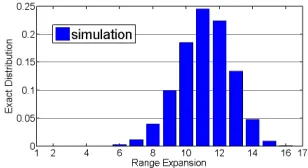
[image:8.612.230.383.62.144.2] [image:8.612.407.561.63.147.2](c) Extremal range expansion distribution for W = 32. The minimal expansion is1 and the maximal expansion is⌈W2+1⌉= 17.
Fig. 3. Simulations of extremal range expansion
V. EXPERIMENTALRESULTS
A. One-Dimensional Extremal Ranges
We conduct simulations to examine the results of the average range expansion for extremal ranges presented in Section III-D. Fig. 3(a) presents the functionG(W)forW ∈[1,32]. For each value ofW, the average expansion is calculated based on2W
extremal ranges. We can see that the simulated average expan-sion exactly matches the theory from Theorem 3. For instance, G(W = 3) = 1.5 since the ranges[0,0],[0,1],[0,3],[0,7]can be encoded in one TCAM entry while the encodings of the ranges[0,2],[0,4],[0,5],[0,6]requires 2 entries.
Next, Fig. 3(b) presents the function G(WW)for similar values of W. We can see that indeed limW→∞
G(W)
W =
1
3 as stated
by Corollary 4. For instance, forW = 16, G(W)/W ≈0.3611
and for W = 32, G(W)/W ≈0.3472.
Last, Fig. 3(c) presents the distribution of the extremal range expansion for W = 32. The minimal expansion is of course
1 and the maximal expansion is ⌈W2+1⌉ = 17, both with negligible probability. The most popular expansion is11, and there are about a billion (1,053,445,120) different extremal ranges with such an expansion, out of about 4 billion (232)
left-extremal ranges.
B. Two-Dimensional Ranges
We would like to examine the average expansion of two-dimensional ranges in[0,2W−1]×[0,2W−1]. We consider the suggested encoding scheme for two-dimensional ranges from Section IV (with an improved worst-case expansion of2W) in comparison with other well-known encoding schemes such as the Binary Prefix encoding [16], the SRGE encoding [9] and the external encoding for two-dimensional ranges from [17].
Table II summarizes the results. The improvement in the average expansion is more significant for larger values of W. For instance, forW = 8the average expansion of the suggested scheme is 4.85in comparison with 36.56,26.42 and12.98in the first three schemes, an improvement of86.7%,81.6%and
62.6%, respectively.
C. Real-Life Database Statistics
We examine the frequency of generalized extremal rules in a real-life database of 120 separate rule files with 214,941
TABLE II
RANGE EXPANSION FOR TWO-DIMENSIONAL RANGES IN[0,2W−1]×
[0,2W−1].
Encoding Worst-Case Average Expansion
Scheme Expansion W= 4 W= 5 W= 6 W = 7 W= 8
Binary Prefix (2W−2)2 6.14 10.72 17.26 25.86 36.56 SRGE (2W−4)2 4.03 6.96 11.51 17.95 26.42 External Encoding 4W−3 5.24 7.06 9.00 10.98 12.98 Suggested Scheme 2W 1.84 2.45 3.18 3.99 4.85
rules originating from various applications (such as firewalls, and ACL in routers). The same database was previously used in [1], [9], [10]. In this database, the source port and the destination port are W-bit fields (with W = 16). The rules might include ranges in these fields. We find that out of the 214,941 rules,97.2%(208,850) are generalized extremal rules, i.e. all their fields contain generalized extremal ranges. Even when excluding the exact-match rules,89.4%of the remaining rules are still generalized extremal(51,055 rules out of 57,146).
D. Effectiveness on Real-life Packet Classifiers
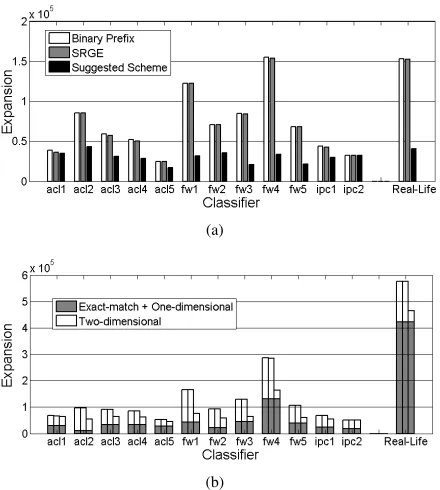
Fig. 4(a) presents the total expansion of the two-dimensional ranges in twelve artificial classifiers generated by the Class-Bench benchmark tool [25] and on the union of the 120 real-life rule files. It compares the expansion of the suggested encoding scheme for two-dimensional ranges (with the upper bound of
2W) versus Binary Prefix encoding [16] and SRGE encod-ing [9]. For the classifierfw4, for instance, the total expansion is 33,774 entries in comparison with 154,813 and 153,691 entries. An improvement of 78.2% and 78.0%, respectively. Likewise, for the real-life files, the improvement is 73.4% in comparison with Binary Prefix.
(a)
[image:9.612.64.284.52.297.2](b)
Fig. 4. Effectiveness of the suggested encoding scheme and the suggested joint TCAM architecture (illustrated in Fig. 1) on twelve artificial classifiers generated by ClassBench benchmark tool and on a real-life database. For each classifier, the two left bars present the expansion of Binary Prefix and of SRGE, while the third bar illustrates our suggested solution. In (a), we compare the total expansion of the two-dimensional ranges in the classifiers. In (b), we examine the expansion using the joint TCAM architecture when the two-dimensional ranges are encoded in the second (modified) TCAM, i.e. the white bars correspond to (a).
as in Binary Prefix encoding. Thus, the total improvement is less significant but still not negligible. For instance, for the real-life files, the improvement in the total expansion is 19.5% in comparison with Binary Prefix. This essentially serves as a proof of concept to our joint TCAM architecture.
VI. CONCLUSION
In this paper, we took a first step towards finding an optimal TCAM encoding algorithm for all classification rules. We presented an encoding algorithm that is optimal for all possible generalized extremal rules, which represent 89% of all non trivial rules in a typical real-life classification database. We also obtained new tight bounds on the worst case for general classification rules, both for one-dimensional and two-dimensional ranges. Finally we presented a novel combined TCAM architecture, composed of a regular TCAM and a modified TCAM, which can provide a guaranteed improved expansion for the tough classification rules.
VII. ACKNOWLEDGMENT
We would like to thank Noam Nisan, Danny Raz, Alex Shpiner and Aran Bergman for their helpful participation and suggestions. We would also like to acknowledge Anat Bremler-Barr for kindly accepting to run several simulations.
This work was partly supported by the European Research Council Starting Grant No. 210389, by the Israel Science Foun-dation grants No. 822/10 and 1241/12, by the United
States-Israel Binational Science Foundation project No. 2006204, by the German-Israeli Foundation for Scientific Research and Development, by the Israeli Centers of Research Excellence (I-CORE) program No. 4/11, by the Intel ICRI-CI Center, by the Hasso Plattner Center for Scalable Computing and by the Israel Ministry of Science and Technology. Ori Rottenstreich is the Google Europe Fellow in Computer Networking, an Andrew and Erna Finci Viterbi Fellow and a Jacobs-Qualcomm Fellow.
REFERENCES
[1] D. E. Taylor, “Survey and taxonomy of packet classification techniques,”
ACM Comput. Surv., vol. 37, no. 3, pp. 238–275, 2005. [2] G. Varghese,Network Algorithmics. Morgan Kaufmann, 2005. [3] J. Chao and B. Liu,High Performance Switches and Routers. Wiley,
2007.
[4] J. Naous, D. Erickson, A. Covington, G. Appenzeller, and N. McKeown, “Implementing an OpenFlow switch on the NetFPGA platform,” inACM ANCS, 2008.
[5] NetLogic Microsystems. [Online]. Available: www.netlogicmicro.com/ [6] Renesas. [Online]. Available: www.renesas.com/
[7] P. Gupta and N. McKeown, “Packet classification on multiple fields,” in
ACM SIGCOMM, 1999.
[8] S. Singh, F. Baboescu, G. Varghese, and J. Wang, “Packet classification using multidimensional cutting,” inACM SIGCOMM, 2003.
[9] A. Bremler-Barr and D. Hendler, “Space-efficient TCAM-based classifi-cation using gray coding,”IEEE Trans. Computers, vol. 61, no. 1, 2012. [10] K. Lakshminarayanan, A. Rangarajan, and S. Venkatachary, “Algorithms for advanced packet classification with ternary CAMs,” in ACM SIG-COMM, 2005.
[11] S. Suri, T. Sandholm, and P. R. Warkhede, “Compressing two-dimensional routing tables,”Algorithmica, vol. 35, no. 4, pp. 287–300, 2003.
[12] T. Sasao, “On the complexity of classification functions,” inISMVL, 2008. [13] Y.-K. Chang, C.-I. Lee, and C.-C. Su, “Multi-field range encoding for packet classification in TCAM,” inIEEE Infocom Mini-Conference, 2011. [14] C. R. Meiners, A. X. Liu, and E. Torng, “Bit weaving: A non-prefix approach to compressing packet classifiers in TCAMs,” IEEE/ACM Trans. Networking, vol. 20, no. 2, pp. 488–500, 2012.
[15] E. Spitznagel, D. E. Taylor, and J. S. Turner, “Packet classification using extended TCAMs,” inICNP, 2003.
[16] V. Srinivasan, G. Varghese, S. Suri, and M. Waldvogel, “Fast and scalable layer four switching,” inACM SIGCOMM, 1998.
[17] O. Rottenstreich, R. Cohen, D. Raz, and I. Keslassy, “Exact worst-case TCAM rule expansion,”IEEE Trans. Computers, 2012.
[18] W. Jiang and V. K. Prasanna, “Scalable packet classification on FPGA,”
IEEE Trans. VLSI Syst., vol. 20, no. 9, pp. 1668–1680, 2012.
[19] O. Rottenstreich, I. Keslassy, A. Hassidim, H. Kaplan, and E. Porat, “On finding an optimal TCAM encoding scheme,” Technion, Tech. Rep. TR12-04, 2012. [Online]. Available: http://webee.technion.ac.il/∼isaac/ papers.html
[20] B. Schieber, D. Geist, and A. Zaks, “Computing the minimum DNF rep-resentation of Boolean functions defined by intervals,”Discrete Applied Mathematics, vol. 149, no. 1-3, pp. 154–173, 2005.
[21] R. Wei, Y. Xu, and H. J. Chao, “Block permutations in boolean space to minimize TCAM for packet classification,” inIEEE Infocom Mini-Conference, 2012.
[22] Y. Ma and S. Banerjee, “A smart pre-classifier to reduce power con-sumption of TCAMs for multi-dimensional packet classification,” inACM SIGCOMM, 2012.
[23] C. R. Meiners, A. X. Liu, and E. Torng, “Topological transformation approaches to TCAM-based packet classification,” IEEE/ACM Trans. Networking, vol. 19, no. 1, pp. 237–250, 2011.
[24] H. Che, Z. Wang, K. Zheng, and B. Liu, “Dres: Dynamic range encoding scheme for TCAM coprocessors,”IEEE Trans. Computers, vol. 57, no. 7, pp. 902–915, 2008.
![Fig. 2.Illustration of the algorithm results for the extremal range R = [0, 22] from Example 2](https://thumb-us.123doks.com/thumbv2/123dok_us/8350487.309504/7.612.55.562.59.171/fig-illustration-algorithm-results-extremal-range-r-example.webp)