Integrated Science 3 Name ________________________ Lab – Speed and Acceleration Date _________
The Mechanics of Motion Period _________
Background Information:
We live in a dynamic, interacting, ever-changing world. From Earth revolving around the Sun to electrons flying around the nucleus of an atom, motion is a primary characteristic (Biggs et al., 2002). Whether by land, sea, or air, organisms are constantly on the move. Scientists often have reason to measure this motion.
Speed (or velocity) is one measure of motion. It is defined as the distance an object travels per unit time. In most cases, moving objects do not travel at a constant speed. The speed of an object often increases and decreases as it moves. It is then convenient to consider the object’s average speed to describe its motion. Average speed is a ratio between the total distance and the total time that the object traveled. The rate of speed can be expressed in kilometers per hour (km/h), meters per second (m/s), etc.
Average Speed = total distance / total time S = d/t
Acceleration is another way to measure motion. Acceleration is defined as the change in an object’s speed per unit time, or the rate at which an object’s speed increases, decreases, or changes direction. The rate of acceleration can be expressed in meters per second per second (m/s/s or m/s2), etc.
Acceleration = final speed – initial speed / time a = (sf – si) / t
This investigation will study speed and acceleration of different types of human motion. Subjects will walk, jog and run to generate data which will demonstrate the relationships between distance, time, speed, and acceleration.
Work cited:
Biggs, A., & Daniel, A. (2002). Motion, Forces, and Energy. Columbus: Glencoe.
PART 1: CALCULATING AVERAGE SPEEDFOR DIFFERENT TYPESOF MOTION (WALKING, JOGGING, ANDRUNNING)
Problem Statement: Refer to the EDR to write a problem statement below.
Hypothesis: A hypothesis is not required for this section of the lab. Design:
Materials
Stopwatch Subject to walk/jog/run
Safety. Runners should advise the instructor of any health issues (e.g., asthma, illness, etc.) prior to physical exertion. Inspect the running surface to identify potential hazards.
Procedure
1. From a standing start, walk for 10 seconds. Stop. Record the distance traveled (in meters). Repeat for a total of three trials.
2. Repeat step 1 for jogging. 3. Repeat step 1 for running. Results:
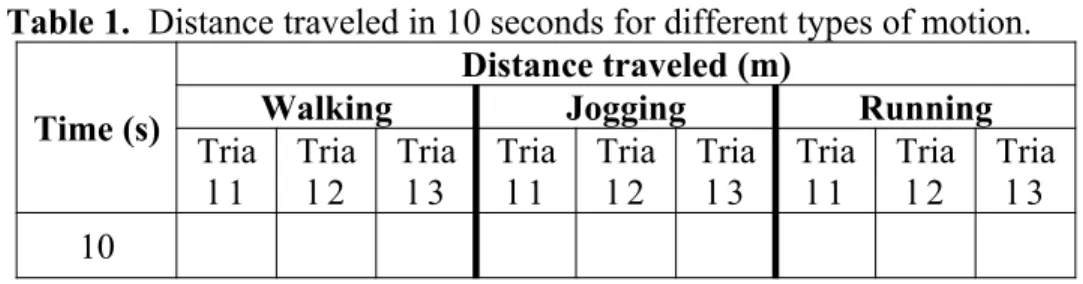
Table 1. Distance traveled in 10 seconds for different types of motion.
Time (s)
Distance traveled (m)
Walking Jogging Running
Tria l 1 Tria l 2 Tria l 3 Tria l 1 Tria l 2 Tria l 3 Tria l 1 Tria l 2 Tria l 3 10
Data Processing and Presentation:
Calculating Average Distance: Calculate the average distance traveled in 10 seconds for each type of motion (walking, jogging, and running). Refer to the EDR for writing calculations.
Average distance traveled in 10 seconds = distance trial 1 + distance trial 2 + distance trial 3
number of trials
Average distance for walking:
Average distance for jogging:
Average distance for running:
Calculating Average Speed: Calculate the average speed for each type of motion (walking, jogging, and running). To do this, use the average distance traveled (as calculated above) and 10 seconds for time.
Average Speed = average distance / time S = d/t Average Walking Speed =
Average Jogging Speed =
Graphing Average Speed: On the graph below, make a distance-time graph to determine the speed by plotting the time (x-axis) versus distance (y-axis) for walking. Draw a line from the origin to the final distance/time point. Do the same for jogging and running, on the same graph. Include a key identifying each set of data. Refer to the EDR for proper graphing guidelines.
Using Slope to Determine Average Speed: Look at your graph. Using your initial (x1, y1) and final (x2,
y2) ordered pairs for walking to calculate the slope of the line. Record your answer below. Repeat
calculations for jogging and running.
Formula for Slope: Slope= y2 – y1
x2 – x1
Slope of walking line:
Slope of jogging line:
Conclusion:
1. How does the calculated average speed for each type of motion (walking, jogging, or running) compare to the corresponding calculated slopes for each type of motion? Be specific by using data to make comparisons.
2. Look at your graph.
a. How can you identify the faster type of motion (walking, jogging, running)? Provide specific examples to make comparisons.
PART 2: CALCULATING ACCELERATIONOFARUNNER
Design: See Part 1 for materials and safety. Procedure
1. Form a group of seven. Choose one person as the runner, five people as timers, and one data recorder.
2. Measure the mass of the runner (in kilograms) and record the mass below.
3. Timers: Timers will be spaced at 5, 10, 15, 20, and 25 meters. When the starter (timer standing at the 5 meter line) yells “GO,” each timer will start their stop watches. As the runner passes a timer, that timer will press “stop.” Each timer will record the running time for his/her respective distance and then reset the stopwatch to “0.”
Runner: The runner will start, while standing still, at the zero yard line. When the starter yells “GO,” the runner will run as fast as possible for 25 meters. The runner will walk back to the starting line.
4. Repeat step 4, for a total of three trials.
Results:
Mass of runner: _____________________(kg) Note: there are 2.2lbs in 1 kg Table 2. Measuring the running time of a person over 25 meters.
Running
Distance (m) Trial 1 Running Time (s)Trial 2 Trial 3 Observations of the Runner
0 0 0 0
5
10
15
20
25
Calculations: Refer to the EDR for writing calculations.
Average Time: Calculate the average time for each 5 meter distance traveled by the runner. Show ALL of the work below, and record final answers in Table 3.
Average time at 0 meters =
Average time at 5 meters =
Average time at 10 meters =
Average time at 15 meters =
Average time at 20 meters =
Average time at 25 meters =
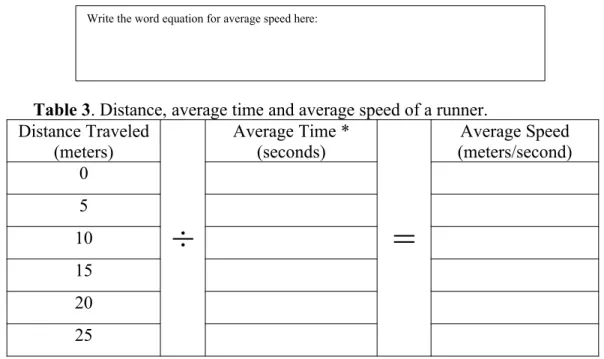
Average Speed: In Table 3 below, use the average times calculated above to calculate the average speed traveled by the runner for each five meter mark.
Table 3. Distance, average time and average speed of a runner. Distance Traveled
(meters)
÷
Average Time * (seconds)
=
Average Speed (meters/second) 0
5 10 15 20 25
*use average time calculations above
Write the word equation for average time here:
Conclusion:
1. Looking at the graph, describe the acceleration of the runner as he/she moved across the football field. Use data to explain your answer.
2. Look at this graph (speed-time) and your first graph (distance-time). How and why are these graphs different? Use specific examples and data to explain your answer.
Force causes objects to accelerate or change velocity. A force is a push or pull on an object. Gravity, for example, is a force between two objects. Gravity is the force which pulls you and the Earth toward each other. You probably didn’t know you were that strong! Force is one factor that determines how fast an object accelerates; the other factor is the object’s mass. This relationship can be seen in the formula:
Force = mass x acceleration F = ma
3. The formula for force is F = mass x acceleration = ma. How would the force of the runner change if he/she sped up? Why?
4. How would the force of the runner change if he/she ran with a backpack full of science books? Why?
Extension: