Please cite this article as: V. Modanloo, R. Hasanzadeh, P. Esmaili, The Study of Deep Drawing of Brass-steel Laminated Sheet Composite Using Taguchi Method,International Journal of Engineering (IJE), TRANSACTIONS A: Basics..Vol. 29, No. 1, (January 2016) 103-108
International Journal of Engineering
J o u r n a l H o m e p a g e : w w w . i j e . i rThe Study of Deep Drawing of Brass-steel Laminated Sheet Composite Using
Taguchi Method
V. Modanloo, R. Hasanzadeh*, P. Esmaili
Mechanical Engineering Department, Urmia University, Urmia, Iran
P A P E R I N F O
Paper history: Received 1 January 2016
Received in revised form 15 January 2016 Accepted in 28 January 2016
Keywords: Deep Drawing
Laminated Sheet Composite Finite Element Method Taguchi Method
A B S T R A C T
Deep drawing process is one of the most applicable methods in producing industrial parts. In this process, the initial blank deforms to final product using a rigid punch and die. In this investigation, the effect of deep drawing process parameters of brass/steel laminated sheet composites on required forming force has been investigated. The process simulated using finite element method (FEM) and then validated by using experimental results. Afterward, the effect of process parameters including friction coefficient between punch and sheet (punch friction), friction coefficient between die and sheet (die friction), blank holder force and the initial blank diameter all in three different levels investigated using design of experiments (DOE) by Taguchi method. Based on four selected parameters in three levels, experiments performed by Taguchi L9 orthogonal array and then the maximum punch force of each experiment was obtained using validated FE model. Signal to noise (S/N) analysis demonstrated that the die friction is the most important parameter in deep drawing of brass/steel laminated sheet that by its reduction, the maximum punch force decreases. Also, analysis of variance (ANOVA) results illustrated that the die friction and initial blank diameter are involved 53.1 and 43.4% of contribution on maximum punch force, respectively.
doi: 10.5829/idosi.ije.2016.29.01a.14
1. INTRODUCTION1
In some applications, a single material does not always meet the strict requirements of special circumstances. High-performance composite materials have been considered as the important approaches [1]. After nearly decades of development, the composite materials have been widely applied to many fields such as aerospace, oil, chemicals, metallurgy, machinery, automobiles, ships, nuclear, electrical, and the electronic industry. The composite materials have already become important research fields of materials science and engineering [2].
Laminated metal composites (LMC) are one of the most important composite materials which are fabricated using two or more metal sheets with different properties by special processes and manufacturing
1
*Corresponding Author Email: [email protected] (R. Hasanzadeh)
approaches [3]. LMC have the excellent particular performances in comparison with the single metal by the reasonable design and composition. It can dramatically improve many properties, including fracture toughness, fatigue behavior, impact behavior, wear, corrosion, and damping capacity or provide enhanced formability or ductility for otherwise brittle materials [4].
Design of experiment (DOE) techniques can
optimize process parameters with minimum
Over recent years, producing hollow sheet parts with desired quality and geometrical shape is an important challenge in automotive and aerospace industries. On the other hand, there was much interest to manufacture products with high strength to weight ratio in recent years. Deep drawing is one of the most applicable technologies to produce such parts in which a blank is drawn into a die using a solid punch. This process has some significant advantages including high rate production and simple procedure. Deep drawn parts are widely used in automotive, aerospace, gas, military industries and also in kitchen products [7-9]. Although, there are so many work on deep drawing process of single layer sheet but few studies have been reported on laminated sheet composites. Dwivedi and Agnihotri [10] studied deep drawing of aluminum/brass laminated sheets. They investigated the effects of punch nose radius and die entrance radius on limiting drawing ratio (LDR) and forming force numerically and by experiments. They could successfully achieve to LDR of 2.86. Pourmoghadam et al. [11] investigated the wrinkling of anisotropic composite sheets. The sandwich sheet in their work was produced by polyamide (PA) as the core and aluminum as the skins. They predicted the required blank holder force to prevent wrinkling in the flange area using analytical, numerical and experimental methods. Warm deep drawing of aluminum/steel laminated sheets was experimentally examined by Afshin and Kadkhodayan [12]. They found that the forming force changes by substituting the blank stacking sequence. For example, the forming force decreases when the steel sheet is the upper layer. Rajabi et al. [13] studied the forming of composite sheet using Taguchi method by experiment and simulation. In their analysis temperature, blank holder force, blank thickness and blank diameter were considered as input variables and wrinkling and required forming force considered being response functions. They concluded that the blank holder force is the most important parameter in occurrence of wrinkling meanwhile its influence on forming force is negligible compared to temperature.
However, optimization of process parameters on forming force in deep drawing of steel/brass laminated sheets using Taguchi method was not found in the literature. In present study, the effects of punch/blank coefficient, die/blank coefficient, blank holder force and initial radius of the blank on maximum punch force in deep drawing of steel/brass laminated sheets have been investigated and then optimized.
2.FINITE ELEMENT SIMULATION
The explicit finite element (FE) code ABAQUS is used to investigate drawing behavior of steel/brass laminated sheets. Due to axial symmetry, axisymmetric model was
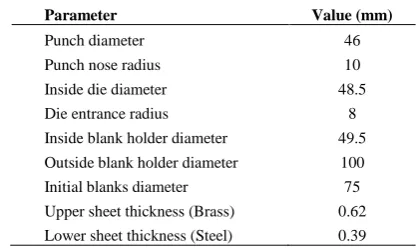
conducted. The sheets and the die set were modeled as deformable and analytical rigid, respectively. To mesh the sheets, the CAX4RT element by number of 200 elements in the radial direction and 2 elements in the thickness direction was used [14]. On the other hand, the die set was not meshed and analyzed because it was considered as analytical rigid. Figure 1 shows the FE model at the start of process. Geometrical dimensions of the die set and the initial sheets are given in Table1. The plastic deformation behavior of the sheets was introduced to the software according to the Figures 2 and 3. The properties of the brass and steel sheets are given in Table 2.
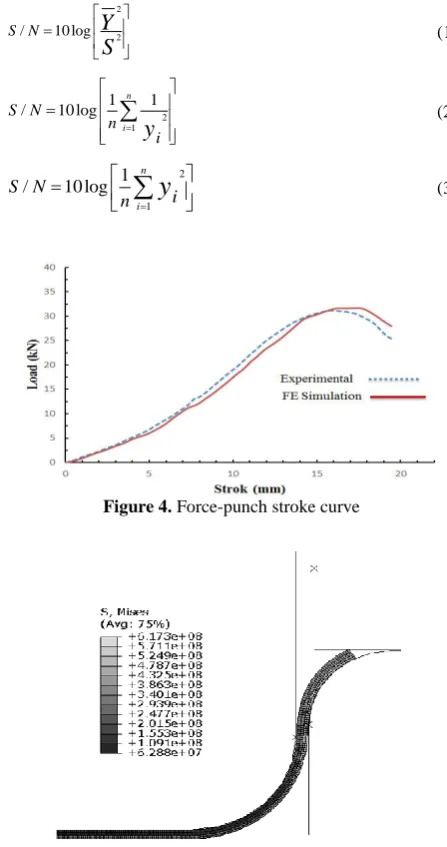
Coulomb friction model was used in the simulations. The friction coefficient was considered to be 0.31 at the upper sheet (brass) and punch interface and it was considered 0.29 for lower sheet (steel) and die [14]. It must be remembered that the average value of these friction coefficients was used as the friction coefficient between the steel and brass layers [14]. The blank holder force equal to 3.56 kN was applied to the blank holder. The simulation results are as reliable as they are validated by the experimental results. Figure 4 shows the punch force curve corresponding to the final cup. As it is depicted, there is a good correlation between the results of experiment and simulation. Differences between the experimental and simulation maximum punch force is almost 2%. Also, the FE model at the end of process is shown in Figure 5.
Figure 1. FE model at the start of process
TABLE 1. Geometrical dimensions of the die set and initial
blanks [14]
Parameter Value (mm)
Punch diameter 46
Punch nose radius 10
Inside die diameter 48.5
Die entrance radius 8
Inside blank holder diameter 49.5 Outside blank holder diameter 100
Initial blanks diameter 75
Figure 2. True stress-strain curve of steel sheet [14]
Figure 3. True stress-strain curve of brass sheet [14]
TABLE 2. Mechanical properties of brass and steel sheets
Parameter Yielding Stress (MPa)
Young's Modulus
(GPa)
Density
(kg/m3)
Poisson's Ratio
Value Brass 280 127 8670 0.32
Steel 140 193 7850 0.27
TABLE 3. Investigated processing parameters and their levels
Level
Parameter
1 2 3
Blank holder force (kN) 3.56 6.56 9.56
Initial blank diameter (mm) 37.5 41.25 45
Punch friction 0.03 0.31 0.59
Die friction 0.01 0.29 0.57
TABLE 4. L9 orthogonal array of Taguchi
Trial No.
Blank Holder Force (kN)
Initial Blank Diameter (mm)
Punch Friction
Die Friction
1 3.56 37.5 0.03 0.01
2 3.56 41.25 0.31 0.29
3 3.56 45 0.59 0.57
4 6.56 37.5 0.31 0.57
5 6.56 41.25 0.59 0.01
6 6.56 45 0.03 0.29
7 9.56 37.5 0.59 0.29
8 9.56 41.25 0.03 0.57
9 9.56 45 0.31 0.01
3. DESIGN OF EXPERIMENTS (DOE)
In the present study, effect of brass/steel laminated sheet composite deep drawing processing parameters including punch/blank friction coefficient (punch friction), die/blank friction coefficient (die friction), initial blank diameter and blank holder force investigated on required processing force. Selected parameters and their levels are given in Table 3.
According to selected parameters and their levels (Table 3.), Taguchi approach was performed based on L9 orthogonal array shown in Table 4 [15].
Taguchi method introduces a loss function which is presented as signal to noise ratio (S/N ratio). Depended on the test, each forms of Equations (1) to (3) can be used to determine S/N ratio which for nominal is best, larger is better and smaller is better states, respectively [16].
2
2
/ 10 log
S N
Y
S
(1)
2 1
1 1
/ 10 log n
i
S N
n i
y
(2)2
1
1 / 10 log
n
i
S N
i n
y
(3)Figure 4. Force-punch stroke curve
In each problem, regardless to kind of it, when the S/N is largest, the received response is optimal [15]. Since in the present study the minimum punch force is desirable, “smaller is better” method (Equation (3)) is used in Taguchi approach to analyzing data.
4. RESULTS AND DISSCUSION
Results of 9 different experiments according to L9 orthogonal array of taguchi design of experiments using FE simulation are presented in Table 5.
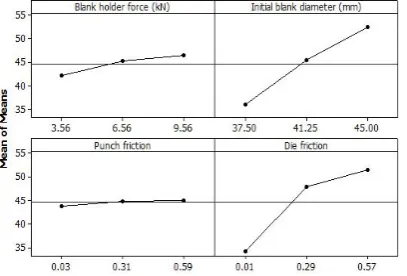
4.1. Signal to Noise (S/N) Analysis Importing data in Minitab software and analyzing them (according to smaller is better state) give the signal-to-noise ratio (S/N) values and importance rankings of the parameters respect to effect on maximum punch force according to Table6. Also, main effects plot for means are depicted in Figure 6.
According to S/N ratio results, friction coefficient between die and blank is the most effective parameter on required maximum punch force. The optimum level for die friction is level 1 i.e. 3.56 kN. Results demonstrated punch friction has not considerable effect on maximum punch force. Increasing die friction leads to increasing maximum punch force because of larger required punch force to overbear on larger friction between die and blank. Another important result obtained is that initial blank diameter is the second effective parameter which by increasing it due to the larger contact surface between blank and die, the maximum punch force increased.
TABLE 5. The results of maximum punch force
Run No. Maximum Punch Force (kN)
1 22.49
2 46.58
3 57.21
4 43.95
5 36.30
6 55.70
7 41.66
8 53.34
9 44.22
TABLE 6. S/N result of maximum punch force
Level Blank Holder Force (kN)
Initial Blank Diameter (mm)
Punch Friction
Die Friction
1 42.09 36.03 43.84 34.34
2 45.32 45.41 44.92 47.98
3 46.41 52.38 45.06 51.50
Delta 4.31 16.34 1.21 17.16
Rank 3 2 4 1
Figure 6. Main effects plot for means of maximum punch
force
Figure 7. Normality test of maximum punch force
The results demonstrated that blank holder force is the third effective parameter which by decreasing it required maximum punch force decreases due to lower force applied to sheet.
4.2. Analysis of Variance (ANOVA) Respect to normality test of maximum punch force (see Figure 7.) and the amount of P-value=0.447 (higher than value of error equal to 0.05) which shows the results are normal [15], the ANOVA results are shown in Table7.
ANOVA results indicated that die friction and initial blank diameter with contribution of 53.01 and 43.4% are the most effective parameters, respectively. On the other hand, blank holder force and punch friction with contribution of 3.2 and 0.3%, respectively, are almost ineffective parameters.
TABLE 7. ANOVA result of maximum punch force
Source Mean Square Contribution (%)
Blank holder force (kN) 15.09 3.2
Initial blank diameter (mm) 201.77 43.4
Punch friction 1.32 0.3
Die friction 246.56 53.01
Error - -
5. CONCLUSIONS
In present research work, the effect of process parameters including friction coefficient between punch and sheet, friction coefficient between die and sheet, blank holder force and the initial blank radius on maximum punch force in deep drawing of brass/steel laminated sheet was investigated using Taguchi method. In this regard, the process was simulated firstly using finite element method and then verified in comparison to experimental results which showed a good agreement between the experimental and simulated results. Afterwards, to evaluate the effects of mentioned parameters, experiments were performed using Taguchi L9 orthogonal array. S/N ratio and ANOVA results showed that die/blank friction coefficient is the most important parameter on maximum punch force and it has a contribution equal to 53.51%. Also, according to obtained results it was found that initial blank radius, blank holder force and punch/blank friction coefficient are other important parameters, respectively.
6. REFERENCES
1. Houshiar Sadeghian, M., "A novel, simple and cost effective al a356/al2o3 nano-composite manufacturing route with uniform distribution of nanoparticles", International Journal of
EngineeringTransactions C: Aspects, Vol. 28, No. 9,
(2015)1320-1327
2. Naceri, A., "Moisture diffusion properties of fabric composite (glass fiber/epoxy resin)", International Journal of
Engineering-Transactions B: Applications, Vol. 22, No. 2,
(2008), 205-210.
3. Kadkhodayan, M., "An investigation into the deep drawing of fiber-metal laminates based on glass fiber reinforced polypropylene", International Journal of
EngineeringTransactions C: Aspects,, Vol. 27, No. 3,
(2014)349-358.
4. Li, C., Chi, C., Lin, P., Zhang, H. and Liang, W., "Deformation behavior and interface microstructure evolution of al/mg/al
multilayer composite sheets during deep drawing", Materials & Design, Vol. 77, No., (2015), 15-24.
5. Weissman, S.A., "Application of design of experiments to process development", Organic Process Research &
Development, Vol. 19, No. 11, (2015), 1604-1604.
6. Afrasiabi, H., Khayati, G. and Ehteshamzadeh, M., "Studying of heat treatment influence on corrosion behavior of aa6061-t6 by taguchi method", International Journal of
Engineering-Transactions C: Aspects, Vol. 27, No. 9, (2014), 1423.
7. Gay, D., "Composite materials: Design and applications, CRC press, (2014) 236-270.
8. Gordon, S., "Design of experiments, in: Modeling and simulation in the systems engineering life cycle", Springer, Eds, (2015), 187-200.
9. Cavazzuti, M., "Design of experiments, in: Optimization methods", Springer, Eds, (2013), 13-42.
10. Dwivedi, R. and Agnihotri, G., "Numerical simulation of aluminum and brass material cups in deep drawing process",
Materials Today: Proceedings, Vol. 2, No. 4, (2015), 1942-1950.
11. Pourmoghadam, M.N., Esfahani, R.S., Morovvati, M. and Rizi, B.N., "Bifurcation analysis of plastic wrinkling formation for anisotropic laminated sheets (AA2024–polyamide–AA2024)",
Computational Materials Science, Vol. 77, (2013), 35-43.
12. Afshin, E. and Kadkhodayan, M., "An experimental investigation into the warm deep-drawing process on laminated sheets under various grain sizes", Materials & Design, Vol. 87, (2015), 25-35.
13. Rajabi, A., Kadkhodayan, M., Manoochehri, M. and Farjadfar, R., "Deep-drawing of thermoplastic metal-composite structures: Experimental investigations, statistical analyses and finite element modeling", Journal of Materials Processing
Technology, Vol. 215, (2015), 159-170.
14. Atrian, A. and Fereshteh-Saniee, F., "Deep drawing process of steel/brass laminated sheets", Composites Part B: Engineering, Vol. 47, (2013), 75-81.
15. Montgomery, D.C., "Design and analysis of experiments, Wiley New York, Vol. 7, (1984) 101-135.
16. Shishavan, S.M., Azdast, T. and Ahmadi, S.R., "Investigation of the effect of nanoclay and processing parameters on the tensile strength and hardness of injection molded acrylonitrile butadiene styrene–organoclay nanocomposites", Materials &
The Study of Deep Drawing of Brass-steel Laminated Sheet Composite Using
Taguchi Method
V. Modanloo, R. Hasanzadeh, P. Esmaili
Mechanical Engineering Department, Urmia University, Urmia, Iran
P A P E R I N F O
Paper history: Received 1 January 2016
Received in revised form 15 January 2016 Accepted in 28 January 2016
Keywords: Deep Drawing
Laminated Sheet Composite Finite Element Method Taguchi Method
هديكچ
شور زا یکی یم قیمع ششک دنیآرف ،یتعنص تاعطق دیلوت رد دربراکرپ یاه
و هبنس زا هدافتسا اب هیلوا قرو ،دنیآرف نیا رد .دشاب
یم لکش رییغت ییاهن لوصحم لکش هب تخس سیرتام قرو قیمع ششک دنیآرف یاهرتماراپ ریثات ،رضاح شهوژپ رد .دبای
جنرب هیلا ود یتیزوپماک
-لکش زاین دروم یورین یور رب دلاوف هنیهب و یسررب یهد
لدم زا هدافتسا اب دنیآرف .تسا هدش یزاس
هیبش ،دودحم یازجا تحص سپس و یزاس
رتماراپ راهچ ریثات سپس .تسا هدش دییات یبرجت جیاتن اب هسیاقم رد لدم یجنس
بنس کاکطصا( قرو و هبنس نیب کاکطصا بیرض قرو یورین ،)سیرتام کاکطصا( قرو و سیرتام نیب کاکطصا بیرض ،)ه
.تسا هتفرگ رارق هعلاطم دروم یچوگات شور هب شیامزآ یحارط طسوت فلتخم حطس هس رد مادکره ،هیلوا قرو عاعش و ریگ
شیامزآ دماعتم هیارآ ساسا رب اه
L9
لدم کمک هب شیامزآ ره هبنس یورین هنیشیب سپس و ماجنا یچوگات دودحم یازجا
تحص رتماراپ نیرترثوم ،سیرتام کاکطصا دیدرگ صخشم زیون هب لانگیس لیلحت زا هدافتسا اب .دیدرگ جارختسا ،هدش یجنس
جنرب هیلا ود یتیزوپماک قرو قیمع ششک دنیآرف رد
-یم دلاوف یم شهاک زین هبنس یورین هنیشیب ،نآ شهاک اب هک دشاب .دبای
ایراو زیلانآ جیاتن نینچمه نازیم هب بیترت هب هیلوا قرو عاعش و سیرتام کاکطصا هک داد ناشن سن
1 / 35 و 4 / 45 هنیشیب رد %
.دنراد تکراشم هبنس یورین