Seismic Performance of Low-ductility Precast Wall Structure with Base Isolation
P. L. Y. Tionga*, A. Adnana, A. B. A. Rahmana, A. K. Mirasab
a Department of Structure and Materials, Faculty of Civil Engineering, Universiti Teknologi Malaysia, 81310 Skudai, Malaysia
b Department of Civil Engineering, School of Engineering and Information Technology, University Malaysia Sabah, 88400 Kota Kinabalu, Malaysia
P A P E R I N F O
Paper history: Received 10 August 2012
Received in revised form 29 August 2012 Accepted 18 October 2012
Keywords: Seismic Isolation Precast Wall Low-ductility
Elastomeric Rubber Bearing Time History Analysis
A B S T R A C T
It is both impractical and uneconomic to design a structure that remains elastic throughout severe ground motions. The main seismic design philosophy of a fixed-base structure is that minor structural damages are acceptable as long as the structure does not collapse. Hence, seismic base isolation provides a better alternative in earthquake structural design. This paper presents finite element analysis carried out to investigate the feasibility of applying locally produced elastomeric rubber bearing base isolators in seismically isolating non-ductile precast concrete wall structures from earthquake excitations. The precast wall structures were analyzed in terms of in-plane and out-of-plane isolation effects due to dynamic lateral loads. Ground excitations from three classifications of acceleration history based on different a/v ratios were used in dynamic analyses of the structures. The results showed that although the base isolator had successfully reduced most of the critical structural responses such as floor acceleration and base shear demand, relative inter-story drift reduction as compared to fixed-base structure was not significant. Current design philosophy for seismic base isolation should be urgently revisited. Imperative discussion and review of the feasibility in utilizing base isolators as seismic mitigation plan for seismic prone areas are presented.
doi:10.5829/idosi.ije.2013.26.02b.06
NOMENCLATURE
g Gravity (m/s2) V Shear force
KH Lateral stiffness of isolation system (N/m) Greek Symbols
KV Vertical stiffness of isolation system (N/m) p Pi
M Bending moment
mf+i Mass above isolation system (kg) Subscripts
P Axial force f Fixed-base
PGA Peak ground acceleration (g) f+i Fixed-base plus isolation
PGV Peak ground velocity (m/s) H Horizontal
Tf Fixed-base period (s) I Isolation
Ti Isolation period (s) V Vertical
1. INTRODUCTION1
The apparent benefits demonstrated by Industrialized Building System (IBS) construction method since its introduction had led to the enforcement of new
*Corresponding Author Email: [email protected] (P. L. Y. Tiong)
government regulations which made it compulsory for all large government construction projects to utilize at least 70 percent of IBS components with effect from the year 2012 onwards [1]. Among some these benefits are faster completion of erection work, cleaner plus safer site, easier project management, improved quality control as well as reducing construction cost. According to the Construction Industry Development Board of
International Journal of Engineering
Malaysia (CIDB), the IBS is classified into 5 different categories, namely; precast concrete structural system; steel formwork system; steel structural system; timber structural system; and masonry block system. However, the precast concrete structural system was one of the most favored choices due to cost and durability factors compared to others.
The early design and construction of precast concrete structures were not idealized for high seismicity prone areas. This was true, until the year 1994 during which the first specific set of seismic design provisions for precast concrete structures were developed, namely the National Earthquake Hazards Reduction Program (NEHRP) Recommended Provisions [2]. Since then, the constructions of precast concrete structures in high seismicity area were evolving fast. Throughout these years, many other successor codes were developed and published to provide continuing improvements towards the seismic resistance of precast concrete structures, such as the 1997 Uniform Building Code [3], 2009 International Building Code [4] and Eurocode 8 [5]. Nevertheless, the basic approach underlying the conventional seismic resistance design within these codes remained the same; and that is to construct a strong, ductile building and secure it properly to the ground. The main setback in this design method is that it would be inappropriately costly and impractical to construct a building that was to remain elastic during a severe earthquake incident [6]. Apart from that, the conventional seismic resistance design approach caused a challenge for designers to redress the balance between minimizing both floor accelerations and inter-story drifts in the designed structures. It is understood that excessive inter-story drifts can be eliminated by constructing a stiffer building. However, a stiffer building, which is now becoming less flexible, will cause high floor accelerations. In the other way round, a flexible structure, though it will lead to lower floor accelerations, it causes large inter-story drifts. Therefore, the philosophy of design codes is to produce buildings that will; (a) resist minor earthquakes without damage; (b) resist moderate earthquake without structural damage but with some nonstructural damage and; (c) resist severe earthquake without collapse but with both structural and nonstructural damage.
Over the past decades, an alternative to the above mentioned conventional seismic design, termed as seismic base isolation had been proposed, studied and investigated by numerous researchers all over the world. Although the earliest recorded history of seismic base isolation was as early as 1909, the growth of its application was not too apparent only until the last 20 years with the development of multilayered elastomeric rubber bearing base isolators. The basic workout theory of seismic base isolation sounds uncomplicated – just detach the superstructure from the ground to eliminate,
or at least to reduce the earthquake forces from being transmitted up the superstructures. Nevertheless, it requires a lot more of extensive research and new technologies to be introduced in order to make the said seismic isolation really work in a safe, acceptable and reliable manner.
2. LITERATURE REVIEW
It should be noted that not all types of structures are suitable to be seismically base isolated. A structure is only considered suitable for seismic isolation if it fulfills the following conditions; (a) the subsoil type and geology condition of the site that does not produce predominant long period ground motion (usually due to occurrence of very soft subsoil layer beneath structure); (b) the structure is at least having 2 stories and is unusually heavy; (c) the site permits horizontal displacement at base level of more than 8 inches; (d) the structure is reasonably short and; (e) non-earthquake loads including wind loads that do not exceed 10% of the weight of the structure.
The principle function of seismic isolation is to prolong the period of the isolated structure. It works effectively for short structures as their period is usually very small, typically less than 1 second. Meanwhile, the natural period increases with increment of the height of the structure. For very tall structures where the natural period is long enough to attract low earthquake forces, seismic isolation is considered redundant. There are varieties of devices available for seismic isolation of structures such as rollers, friction slip plates, cable suspension, sleeved piles and rocking foundations. Nevertheless, an elastomeric rubber bearing appears to be one of the most practical and widely used seismic base isolation systems [6].
Nevertheless, the author did not discuss further on the influence of this achievement towards the relaxation of superstructure design requirements. The study did not cater for different structural configurations of steel structures such as the influence of overall structure height and connection stiffness.
Since 1970s’, researches of base isolation techniques for seismic mitigation has seemed to start booming, particularly with the introduction of elastomeric rubber bearing [8]. Some of the renowned research works into analytical or theoretical model of the elastomeric bearings were found in Kikuchi and Aiken [9], Fenves et al [10], Kelly [11], Chang [12], Doudoumis et al. [13] and Karbakhsh et al. [14]. Individual performance of the rubber bearing, especially its local stability and structural integrity was also widely investigated [15-20]. Nevertheless, implementation of such elastomeric rubber bearing in isolation of precast wall panel building against earthquake, up to the authors’ knowledge, is lacking currently.
One of the pioneer researches to investigate the seismic performance of precast concrete building was initiated during the USA-Japan coordinated Precast Seismic Structural Systems (PRESSS) program as presented by Tadros et al. [21]. The study investigated the behaviour of a six-storey precast concrete building under moderate seismicity. The gravity loads were supported by precast frame while lateral loads were resisted by precast cruciform shear wall panels. The shear wall panels were horizontally interconnected by using the grout-filled sleeves that spliced the protruding vertical reinforcements between panels. The shear strength of the connections was assumed to be contributed by the friction in the compression zone at ultimate flexural condition. At the time of the research, there were no building codes in the United States that governed the seismic design procedure and requirements for precast concrete buildings. Therefore, the study was geared to develop a design process for identification of areas where further research would be required.
At its final phase, the 10 years PRESSS research program had conducted a laboratory test on 60 percent scale of five stories precast prestressed concrete building under simulated seismic loading. During that time, the only available codes on precast concrete seismic systems were only applicable primarily to emulative systems. The major objective of the test was to develop seismic design guidelines for precast concrete systems in various seismic zones, which would later be incorporated into relevant building codes [22]. Most of the past researches regarding precast concrete frame structures were focusing on developing ductile and strong connections for the structural systems against seismic loading [23-29]. As mentioned earlier, the seismic forces being transmitted along the height of
superstructure would not be eliminated through application of these ductile connections.
3. RESEARCH SIGNIFICANCE
As presented in literature reviews previously, a significant gap still occurs in the field of seismic base isolation although the founding of such technology can be traced back to few decades ago. Adnan et al. [8] report that seismic base isolation does not hundred percent absorb and dissipate energy from ground motion as in theoretical perception. Komur et al. [30] revealed that hinging in frame members, particularly in longer duration structure occurs despite provision of base isolation. Such studies indicated the necessity for a more detail investigation of base isolated structure to be carried out, especially in a case-by-case analysis. Hence, this paper is targeted to generate significant finding in terms of effectiveness of rubber bearing system in providing seismic isolation for non-ductile precast concrete wall structures. Interested parameter such as the currently adopted period-based design of base isolation system recommended in Eurocode 8 is included in this study.
4. METHODOLOGY
This comprehensive piece of study comprises of two main analysis stages; the finite element modeling and analysis in the first stage; and laboratory shake table experimental testing for model verification in the next stage. This paper would however, be concentrating only on the finite element study stage.
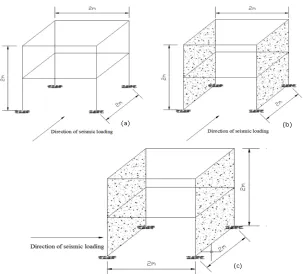
The preliminary modeling analysis was intended to investigate the feasibility of applying seismic base isolation onto both precast frame structures as well as load-bearing wall structures. For this purpose, a simple concrete frame and two wall structures were modeled using the commercial finite element software, SAP2000. Apart from having different structural components (i.e. beams and columns for frame structures, while beams and walls for wall structures), the three structures (as shown in Fig. 1) were identical in their total weight as well as material and element properties. The element properties of the rubber bearing base isolators were obtained from the previously completed research by Surnayati [7]. Details of the rubber bearing are listed in Table 1, designed according to procedure contained in Naeim and Kelly [31].
only the direction of earthquake ground excitations. For WS-1, the simulated seismic loading was acting towards the structure in the direction parallel to the wall panels’ alignment. In other words, the lateral force would cause in-plane bending towards the wall elements. On the other hand, the direction of seismic ground motion was acting perpendicular towards the surface of the wall panels. This lateral force would cause the out-of-plane bending of the wall panels.
TABLE 1. Design Detail of Rubber Bearing Base Isolator
Items Unit Value
Diameter (out) mm 98
Diameter (in) mm 40.8
Area mm2 6900
Rubber height mm 2.8
Rubber nos. nos. 12
Shim height mm 2
Shim nos. nos. 11
KH N/mm 84
KV N/mm 7589
Critical load kN 78.9
Safety factor - 3.15
KH= horizontal stiffness KV= vertical stiffness
All three structures were carrying total dead load of
100kN including self-weight of structural components. The foundations were modeled as fixed-base and isolated base separately. Time history data loading from the real 1980 Irpinia earthquake data in Italy, with peak ground acceleration value (PGA) of 0.202g was simulated in SAP2000 as the seismic induced forces towards the three structures. In order to investigate the influence of different seismicity effect onto the structural system, two other strong motion data having PGA/PGV ratio of 1.078 and 1.250 g/m.s-1 were selected in addition to the Italy’s (Table 2).
The beams and columns were modeled as frame elements having the properties of reinforced concrete sections designed to carry the vertical load imposed onto the structure only. No seismic or wind load design was considered in selecting the section member and reinforcement details. Such effort was to keep the superstructure in non-earthquake resistant capacity. The precast concrete wall panels were modeled with nonlinear shell element. Meanwhile, the fixed-base was restrained in all three directions in six degree-of-freedoms including three translational and remaining three other rotational constraints. The base isolator was modeled as representation by link element having nonlinear property of rubber isolator as listed in Table 1.
TABLE 2. Ground Motion Data and Classification used in Time History Analysis
Earthquakes PGA a/v Ratio Class
(g) (g/m.s-1)
Irpinia (1980) 0.202 0.631 Low
New Zealand (1987) 0.055 1.078 Normal
Kobe (1995) 0.345 1.250 High
TABLE 3. Classification of Earthquake Level by a/v Ratio
Classification a/v Ratio (g/m.s-1)
Low < 0.8
Normal 0.8 < a/v < 1.2
High > 1.2
TABLE 4. Natural Periods of Fixed-Base and Base-Isolated Models
No Structure Tf (s) Ti (s)
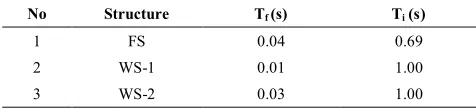
1 FS 0.04 0.69
2 WS-1 0.01 1.00
3 WS-2 0.03 1.00
Tf = fixed-base period
Ti = base-isolated period
Classification of the ground motion using ratio of peak ground acceleration to velocity (PGA-to-PGV ratio) was recommended by Zhu et al. [32], and is shown in Table 3.
5. RESULTS AND DISCUSSIONS
It is interestingly noted that despite the total vertical weight carried by all three models being the same 100kN, the dynamic properties of each model consisting same isolation stiffness would actually yield different effective natural period, as shown in Table 4. This reflects that the basic theory underlying isolation period determination through Equation (1) is actually incomplete. Effective stiffness of superstructure does play a significant role in either pro-longing or shortening the isolation period. As it is clearly shown in Table 4, the isolation period of FS was the shortest compared to WS-1 and WS-2 despite having same lateral stiffness of rubber bearing and total structural weight.
2 f i
i
H
m T
K
p +
= (1)
where
Ti=isolation period
mf+i=mass above isolation system
KH=effective horizontal stiffness of isolator
The finite element models revealed that although all the three structures were having the same total weights, the isolation system performed rather differently in each different case. The isolation system performed most optimal for frame structure. Effectiveness of the base isolation in mitigating effects of seismic loading onto the superstructure was identified through three main responses: namely acceleration; story-drift, and; base shear demand of the global structural system. Comparisons were made between these structural responses for fixed-base and the base isolated models.
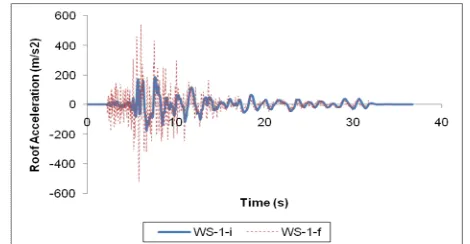
5. 1. Acceleration Response As compared to fixed-base structure (FS-f), the fixed-base isolated frame structure (FS-i) was able to reduce its floor acceleration at ground level by 1.7 to 54.1 percent for low earthquake (Irpinia time history). The floor acceleration reduction for mid and roof level were 5.1 to 24.6 and 24.0 to 64.7 percent, respectively. For WS-1 analysis, the floor acceleration reductions for all three levels were approximately the same, valued around 23 to 25 percent for time history under low classification. The wall structure is weaker in the WS-2 loading direction (out-of-plane behavior). This could be best proven by the percentage of seismic performance reduction was much greater in WS-2 contrasted to WS-1. Maximum floor acceleration was reduced up to 33.8% compared to the fixed-base structure. Results of roof acceleration in time domain are shown in Figure 2 to 10 for each wall models and different ground motion classification.
Figure 3. Roof Acceleration History of Frame Structure (FS) under Kobe Ground Motion
Figure 3. Roof Acceleration History of Frame Structure (FS) under New Zealand Ground Motion
Figure 5. Roof Acceleration History of Wall Structure 1 (WS-1) under Irpinia Ground Motion
Figure 6. Roof Acceleration History of Wall Structure 1 (WS-1) under Kobe Ground Motion
Figure 7. Roof Acceleration History of Wall Structure 1 (WS-1) under New Zealand Ground Motion
Figure 8. Roof Acceleration History of Wall Structure 2 (WS-2) under Irpinia Ground Motion
Figure 9. Roof Acceleration History of Wall Structure 2 (WS-2) under Kobe Ground Motion
Apart from identifying that base isolation provides better efficiency in reducing floor acceleration of precast wall panel structure in the out-of-plane direction (WS-2), the relationship between ground motion classification and the effectiveness of isolating floor acceleration was also investigated. As shown in Figures 2 to 10, the pattern of floor acceleration reduction among the three models also depended on the ground motion. It was observed that in Irpinia ground motion (which was classified as low); the reduction was lower compared to the other two time histories in normal and high group. Such observation revealed that base isolation might be under-utilized for regions having seismicity of lower intensity.
5. 2. Story-Drift Response The reduction of inter-story drift was noted to be significant in the bare frame structure having isolation system as compared to the fixed-base. The nature of the non-isolated frame structure was subjected to more flexibility compared to those wall structures having same vertical loading. Thus, these reductions in terms of story-drift between base isolated wall structures with those having fixed-base were noted to be insignificant than bare frame system.
Referring to insignificant story-drift reduction did not denote that base isolation had increased the drift response between floors of the structure. Due to the nature of relatively higher structural rigidity of fixed-base precast wall building compared to the bare-frame system, the story-drifts were smaller in the beginning even in fixed-base condition. That was, after all, the purpose of having precast wall within the building in the first place. Therefore, the reduction of such originally small story-drift values between fixed- and isolated-base structures was not significantly observed.
5. 3. Base Shear Demand Base shear demand was
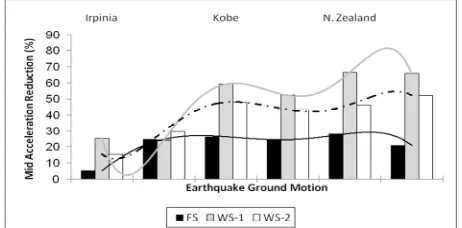
noted to be significantly reduced in all three models, with the highest rate of reduction by bare frame system that recorded 94.6 percent lesser than fixed-base model. For all three types of ground motions, base shear reduction ability of the isolation system for FS model was rather consistent. Besides that, the maximum axial force (P), shear force (V) and bending moment (M) of the most critical structural member was reduced respectively by 10.4, 35.2 and 1.3 percent compared to fixed-base frame. Interestingly, the results showed that applying base isolation concept for WS-1 in low seismicity class would increase the base shear of the global system by 28.4 percent. However, in other two ground motion cases, the reduction of base shear was apparent and ranged from 18.8 to 54.9 percent. The graphs showing comparisons of floor acceleration as well as base shear force reduction percentage are as illustrated in Figures 11 to 14 correspondingly.
Figure 11. Roof Acceleration Reduction for each Different Ground Motions
Figure 12. Mid Level Acceleration Reduction for each Different Ground Motions
Figure 13. Base Acceleration Reduction for each Different Ground Motions
The acceleration reduction at roof level and base was observed to be effective in terms of frame only structure such as FS. Nevertheless, such reduction was not observed at middle floor level. Highest degree of efficiency of acceleration reduction was provided by isolating in-plane direction of the precast wall superstructure. Denoted by grey lines in Figures 11 to 13, increment of ground shake intensity has witnessed vast acceleration reduction. Nonetheless, in the out-of-plane direction such as in the case of WS-2, the reduction was notably consistent, with lower values shown in ground motion type low (denoted by dotted line in the same figures).
5. 4. Discussion and Implication to Design The current design philosophy of base isolated building such as those recommended in International Building Code [4] and Eurocode 8 [5] require engineers to pre-determine the period of base-isolated structure prior to selecting the appropriate demand spectra. However, this study has shown that a similar wall structure will behave differently under base isolation effects, governed by orientation of the wall panels in the plan layout. Direction of seismic loading is hereby notably to have affected the isolation response. In-plane loading of seismic ground motion such as in WS-1 has witnessed more efficient isolation is provided compared to out-of-plane movement (WS-2). Therefore, the design approach should be cautiously reviewed.
The cost of installing base isolators which would often increase the construction’s expenditure had contributed to its low acceptance level among structural engineers and designers. A study on construction cost comparison by Sayani [33] revealed that although the usage of base isolation system could reduce the structural elements by 30.3%, the overall total budget increased by about 50%. Unless a more economical solution was found, the future of base isolation system seems to be much impeded.
6. CONCLUSION
Three different preliminary finite element models representing the seismic base isolated precast concrete frame and wall structures were successfully developed and analyzed in this paper. The models were analyzed in correspondence to dynamic time history analysis representing real earthquake ground motions obtained from the Irpinia, Kobe and New Zealand earthquake ground motions with different a/v ratio representing three different intensity level of the event.
The designed elastomeric rubber bearing base isolator systems were able to reduce significantly the values of floor accelerations, most internal forces of structural elements, base shear forces of the studied
prototype buildings. However, the result was not significant in reducing the inter-story drift of isolated structures. Current design philosophy for seismic isolated buildings based on period-estimation method needs to be urgently revisited. It was shown in this study that possessing similar isolation period, the effective stiffness of superstructure and earthquake intensity affected the isolation performance.
Generally, this preliminary investigation regarding the feasibility of applying locally produced elastomeric rubber bearing as base isolators had revealed positive results. Hence, the next stage of this research would be carrying out detailed study and investigation of the subject to produce more concrete data and creating better understanding in promoting seismic base isolation with elastomeric rubber bearings for precast concrete structures as alternative earthquake mitigation effort.
7.REFERENCES
1. Yee, P. T. L., Adnan, A. B., Mirasa, A. K. and Rahman, A. B. A., "Performance of IBS Precast Concrete Beam-Column Connections Under Earthquake Effects: A Literature Review",
American Journal of Engineering and Applied Sciences, Vol. 4, No. 1, (2011), 93-101.
2. Ghosh, S. and Hawkins, N. M., "Seismic Design Provisions for Precast Concrete Structures in ACI 318", Structure, National Council of Structural Engineers Association, Vol. 46, No. 1, (2001), 28-32.
3. Code, U. B., "Structural engineering design provisions", in International Conference of building officials.,(1997), 2-14. 4. Council, I. C., "2009 international building code, Delmar Pub,
(2009).
5. De Normalisation, C. E., "Eurocode 8:“Design of Structures for earthquake resistance-“Part 1: General rules, seismic actions and rules for buildings", EN, Vol. 1, No., (2004).
6. Naeim, F., "Seismic design of steel structures", The Seismic Design Handbook, (2001).
7. Sunaryati, J., Behaviour of Steel Structures with Base Isolator under Low Intensity Earthquake Effect., Universiti Teknologi Malaysia, (2008).
8. Adnan, A., Tiong, P. L. Y., Sunaryati, J., Ab malek, K. and Mohd ghazali, M. Z., "Seismic Base Isolation of Steel Frame Structure by Hollow Rubber Bearings", Gazi University Journal of Science, Vol. 24, No. 4, (2011), 841-853.
9. Kikuchi, M. and Aiken, I. D., "An analytical hysteresis model for elastomeric seismic isolation bearings", Earthquake engineering & structural dynamics, Vol. 26, No. 2, (1997), 215-231.
10. Fenves, G. L., Huang, W. H., Whittaker, A. S., Clark, P. W. and Mahin, S. A., "Modeling and characterization of seismic isolation bearings", in Proceedings of the US-Italy Workshop on Seismic Protective Systems for Bridges., (1998).
11. M Kelly, J., "Analysis of fiber-reinforced elastomeric isolators",
Journal of Seismology and Earthquake Engineering, Vol. 2, No. 1, (1999), 19-34.
13. Doudoumis, I., Gravalas, F. and Doudoumis, N., "Analytical Modeling of Elastomeric Lead-Rubber Bearings with the use of Finite Element Micromodels", in Proceedings of the 5th GRACM International Congress on Computational Mechanics Limassol., (2005).
14. Karbakhsh, A., Othman, I., Ibrahim, Z., Malek, K. and Hashamdar, H., "Variations of Horizontal Stiffness of Laminated Rubber Bearings with Different Boundary Conditions", in 5th Civil Engineering Conference in the Asian Region and Australasian Structural Engineering Conference 2010, The, Engineers Australia., 1400, (2010).
15. Derham, C., Kelly, J. and Thomas, A., "Nonlinear natural rubber bearings for seismic isolation", Nuclear Engineering and Design, Vol. 84, No. 3, (1985), 417-428.
16. Abe, M., Yoshida, J. and Fujino, Y., "Multiaxial behaviors of laminated rubber bearings and their modeling. I: experimental study", Journal of Structural Engineering, Vol. 130, No. 8, (2004), 1119-1132.
17. Burtscher, S., Dorfman, A. and Bergmeister, K., "Mechanical Aspects of High Damping Rubber", in Proceedings of the 2nd International PhD Symposium in Civil Engineering, Budapest, Citeseer., (1998).
18. Burtscher, S. and Dorfmann, A., "Compression and shear tests of anisotropic high damping rubber bearings", Engineering structures, Vol. 26, No. 13, (2004), 1979-1991.
19. Buckle, I., Nagarajaiah, S. and Ferrell, K., "Stability of elastomeric isolation bearings: experimental study", Journal of Structural Engineering, Vol. 128, No. 1, (2002), 3-11. 20. Kelly, J. M., "Tension buckling in multilayer elastomeric
bearings", Journal of Engineering Mechanics, Vol. 129, No. 12, (2003), 1363-1368.
21. Tadros, M. K., Einea, A., Low, S. G., Magaña, R. and Schultz, A., "Seismic behavior of a six-story precast office building", in Proceedings, XII FIP Congress, Washington, DC., (1994). 22. Nakaki, S. D., Stanton, J. F. and Sritharan, S., "An overview of
the PRESSS five-story precast test building", PCI journal, Vol. 44, No. 2, (1999), 26-39.
23. Institute, P. C., "PCI manual on design of connections for precast prestressed concrete, Prestressed Concrete Institute., (1973).
24. Englekirk, R., "An innovative design solution for precast prestressed concrete buildings in high seismic zones", PCI journal, Vol. 41, No. 4, (1996), 44-53.
25. Elliott, K. S., Davies, G. and Gorgun, H., "The stability of precast concrete skeletal structures", PCI journal, Vol. 43, No. 2, (1998), 42-61.
26. Vasconez, R. M., Naaman, A. E. and Wight, J. K., "Behavior of HPFRC connections for precast concrete frames under reversed cyclic loading", PCI journal, Vol. 43, No. 6, (1998), 58-71. 27. Priestley, M. J. N., Sritharan, S., Conley, J. R. and Pampanin, S.,
"Preliminary results and conclusions from the PRESSS five-story precast concrete test building", PCI journal, Vol. 44, No. 6, (1999), 42-67.
28. Ertas, O. and Ozden, S., "Behavior of Unbonded, Post-Tensioned, Precast Concrete Connections with Different Percentages of Mild Steel Reinforcement",.
29. Ozden, S. and Ertas, O., "Behavior of unbonded, post-tensioned, precast concrete connections with different percentages of mild steel reinforcement", PCI journal, Vol. 52, No. 2, (2007), 32-44.
30. Komur, M. A., Karabork, T. and Deneme, I. O., "Nonlinear Dynamic Analysis of Isolated and Fixed-Base Reinforced Concrete Structures", Gazi University Journal of Science, Vol. 24, No. 3, (2011), 463-475.
31. Kelly, J. M. and Naeim, F., "Design of seismic isolated structures: From theory to practice", Nueva York, John Wiley & Sons , (1999).
32. Zhu, T., Heidebrecht, A. and Tso, W., "Effect of peak ground acceleration to velocity ratio on ductility demand of inelastic systems", Earthquake engineering & structural dynamics, Vol. 16, No. 1, (1988), 63-79.
Seismic Performance of Low-ductility Precast Wall Structure with Base Isolation
P. L. Y. Tiong a, A. Adnan a, A. B. A. Rahman a, and A. K. Mirasa b
a Department of Structure and Materials, Faculty of Civil Engineering, Universiti Teknologi Malaysia, 81310 Skudai, Malaysia
b Department of Civil Engineering, School of Engineering and Information Technology, University Malaysia Sabah, 88400 Kota Kinabalu, Malaysia
P A P E R I N F O
Paper history: Received 10 August 2012
Received in revised form 29 August 2012 Accepted 18 October 2012
Keywords: Seismic Isolation Precast Wall Low-ductility
Elastomeric Rubber Bearing Time History Analysis
هﺪﯿﮑﭼ ياﺮﺑ ﯽﺣاﺮﻃ ﮏﯾ ،رﺎﺘﺧﺎﺳ ﯽﻠﻤﻋﺮﯿﻏ و يدﺎﺼﺘﻗاﺮﯿﻏ ﺖﺳا ﻪﮐ رد ﯽﻃ تﺎﮐﺮﺣ ﺪﯾﺪﺷ ﻦﯿﻣز ) هزﺮﻠﻨﯿﻣز ( ﺖﺑﺎﺛ ﯽﻗﺎﺑ ﺪﻧﺎﻤﺑ . ﻪﻔﺴﻠﻓ ﯽﻠﺻا ﯽﺣاﺮﻃ هزﺮﻟ يا ﮏﯾ رﺎﺘﺧﺎﺳ ﻪﯾﺎﭘ ﻦﯾاﺖﺑﺎﺛ ﺖﺳا ﻪﮐ ﯽﺋﺰﺟتارﺎﺴﺧ زا رﺎﺘﺧﺎﺳ ﯽﻧﺎﻣزﺎﺗ ﻪﮐ ﯽﻠﺻارﺎﺘﺧﺎﺳ ،ﺪﻨﮑﻧطﻮﻘﺳ ﻞﺑﺎﻗ ﺒﻗ لﻮ ﺪﻨﺘﺴﻫ . زا ﻦﯾا ،ور ﻦﺘﺷاﺬﮔرﺎﻨﮐ سﺎﺳا هزﺮﻟ ،يا ﮏﯾ ﻦﯾﺰﮕﯾﺎﺟ ﺮﺘﻬﺑ رد ﯽﺣاﺮﻃ هزﺎﺳ ) ياﺮﺑ (
ﻢﻫاﺮﻓ ﻪﻟﺰﻟز ﯽﻣ ﺪﻨﮐ . ﻦﯾا ﻪﻟﺎﻘﻣ ﻪﺑ ﻪﯾﺰﺠﺗ و ﻞﯿﻠﺤﺗ نﺎﻤﻟا يﺎﻫ ﯽﺳرﺮﺑ،دوﺪﺤﻣ نﺎﮑﻣا هدﺎﻔﺘﺳا زا ﮏﯿﺘﺳﻻ هﺪﺷﺪﯿﻟﻮﺗ ﯽﻠﺤﻣ ) ﻪﯾﺎﭘ يﺮﻣﻮﺘﺳﻻا ( ﻪﮐ ﺖﯿﻠﺑﺎﻗ ﻞﻤﺤﺗ ﮏﯾﺮﺤﺗ ﻪﻟﺰﻟز رد هزﺎﺳ يﺎﻫ ﺶﯿﭘ ﻪﺘﺧﺎﺳ راﻮﯾد ﯽﻨﺘﺑ ﯽﻣدراد دزادﺮﭘ .
زاهدﺎﻔﺘﺳاﺎﺑﯽﯾﺎﻫرﺎﺘﺧﺎﺳ راﻮﯾد ﺶﯿﭘ ﻪﺘﺧﺎﺳ رد ﻞﺧاد و جرﺎﺧ زا
دوﺪﺤﻣترﻮﺻﻪﺑنﺎﻤﺘﺧﺎﺳ
ﺎﺑو ﻪﺟﻮﺗ ﻪﺑ يﺎﻫرﺎﺑ ﯽﺒﻧﺎﺟ ﺎﯾﻮﭘ درﻮﻣ ﻪﯾﺰﺠﺗ و ﻞﯿﻠﺤﺗ راﺮﻗ ﺖﻓﺮﮔ . شزﺮﻟ ﻦﯿﻣزيﺎﻫ زا ﻪﺳ ﻪﺘﺳد سﺎﺳاﺮﺑ ﻪﭽﺨﯾرﺎﺗ بﺎﺘﺷ و ﺖﺒﺴﻧ ﻒﻠﺘﺨﻣيﺎﻫ
a/v a/v
، رد ﺰﺠﺗ ﻪﯾ و ﻞﯿﻠﺤﺗ ﯽﮑﯿﻣﺎﻨﯾد هزﺎﺳ ﺎﻫ درﻮﻣ هدﺎﻔﺘﺳا راﺮﻗ ﺖﻓﺮﮔ . ﺞﯾﺎﺘﻧ نﺎﺸﻧ داد ﻪﮐ ﺮﮔا ﻪﭼ زﺎﺳاﺪﺟ ﻪﯾﺎﭘ ﺎﺑ ﺖﯿﻘﻓﻮﻣ يرﺎﯿﺴﺑ زا ﺦﺳﺎﭘ يﺎﻫ ﻢﻬﻣ يرﺎﺘﺧﺎﺳ ﺪﻨﻧﺎﻣ بﺎﺘﺷ ﻒﮐ زﺎﯿﻧو ﻪﯾﺎﭘ ﯽﺷﺮﺑ ، ﺶﻧارﺖﺒﺴﻧ ﻦﯿﺑ ارتﺎﻘﺒﻃ ﺶﻫﺎﮐ ﯽﻣ ،ﺪﻫد ﺎﻣا ﻦﯾا ﺶﻫﺎﮐ رد رﺎﺘﺧﺎﺳﺎﺑﻪﺴﯾﺎﻘﻣ ﻪﯾﺎﭘ
ﺖﺑﺎﺛ
ﻪﺟﻮﺗﻞﺑﺎﻗﯽﻠﯿﺧ