R E S E A R C H A R T I C L E
Open Access
Is urinary density an adequate predictor of urinary
osmolality?
Ana Carolina P Souza
1, Roberto Zatz
1, Rodrigo B de Oliveira
1,2, Mirela A R Santinho
1, Marcia Ribalta
1,
João E Romão Jr
1and Rosilene M Elias
1*Abstract
Background:Urinary density (UD) has been routinely used for decades as a surrogate marker for urine osmolality (Uosm). We asked if UD can accurately estimate Uosmboth in healthy subjects and in different clinical scenarios of kidney disease.
Methods:UD was assessed by refractometry. Uosmwas measured by freezing point depression in spot urines obtained from healthy volunteers (N = 97) and in 319 inpatients with acute kidney injury (N = 95), primary glomerulophaties (N = 118) or chronic kidney disease (N = 106).
Results:UD and Uosmcorrelated in all groups (p < 0.05). However, a wide range of Uosmvalues was associated with each UD value. When UD was≤1.010, 28.4% of samples had Uosmabove 350 mOsm/kg. Conversely, in 61.6% of samples with UD above 1.020, Uosmwas below 600 mOsm/kg. As expected, Uosmexhibited a strong
relationship with serum creatinine (Screat), whereas a much weaker correlation was found between UD and Screat. Conclusion:We found that UD is not a substitute for Uosm. Although UD was significantly correlated with Uosm, the wide dispersion makes it impossible to use UD as a dependable clinical estimate of Uosm. Evaluation of the renal concentrating ability should be based on direct determination of Uosm.
Keywords:Kidney disease, Urinalysis, Urine density, Urine osmolality, Urine concentrating ability
Background
Measurement of urine osmolality (Uosm), the gold stand-ard in the evaluation of urine concentrating ability, is a valuable tool for the assessment of renal function in such distinct clinical conditions as acute kidney injury (AKI) and chronic kidney disease (CKD). However, since Uosmis not routinely measured, assessment of urine density (UD) by hydrometry, refractometry or semi-quantitative colori-metric reactions has long been employed instead.
Although a correlation does exist between UD and Uosm, at least under normal physiological conditions [1-4], the as-sumption that UD accurately reflects Uosm, which underlies any clinical decision based on UD, has not been formally tested and, in fact, has been recently challenged [5,6].
In the present study we examined the relation between UD (measured by refractometry) and Uosmin 97 normal
subjects as well as in a cohort of 319 patients with assorted renal disorders, to test the hypothesis that UD can be reli-ably used in routine clinical practice as a measure of Uosm.
Methods
Urine samples were consecutively obtained from 95 adult patients with AKI in intensive care unit, 118 patients with primary glomerulopathies, admitted to a Nephrology ward for investigation, 106 CKD outpatients, and 97 healthy volunteers. Urine samples were obtained from the first morning void, with no standardized water restriction. This study protocol was reviewed and approved by our Institu-tional Research Ethics Committee (Comissão de Ética para Análise de Projetos de Pesquisa, CAPPesq, #0045/08). A written informed consent was obtained.
UD was measured by refractometry, employing a bench-top refractometer (ATAGO CO.LTD SPR-T2, Tokyo, Japan). Results were corrected for the influence of protein and/or glucose according to conventional equations [6]: UD corrected for proteinuria = UD measured –[protein]
* Correspondence:[email protected] 1
Nephrology Service, University of Sao Paulo School of Medicine, São Paulo, SP, Brazil
Full list of author information is available at the end of the article
*0.0003; UD corrected for glucosuria = UD measured – [glucose] *0.0002, where both protein and glucose in the urine are given in g/L. Uosm was measured by freezing point depression using an advanced wide-range osmom-eter (Model 3 W2, Advanced Instruments Inc, Needham Heights, Massachusetts). SCreatwas measured with a con-ventional automated method (enzymatic colorimetric test, by the Jaffe reaction).
Serum sodium concentration was obtained in 203 pa-tients (63.3%). Hypernatremia was found in 3 papa-tients (147 to 149 mEq/l), whereas hyponatremia was observed in 8 patients (129 to 134 mEq/l). Since dysnatremia was infrequent, and never severe, this data was not further analyzed.
AKI was defined according to the current KDIGO clas-sification [7]. In nearly all patients with glomerulopathies, hospitalization was indicated for kidney biopsy and/or clinical management of nephritic or nephrotic syndrome.
Statistical analysis
Univariate correlation analysis between single variables was performed by calculating the Spearman coefficient. Data management was performed by Prism 6.0 statistical software (Graphpad, San Diego, CA, USA). A two-tailed p value < 0.05 was considered statistically significant.
Results
Spot urine samples from 97 subjects with normal renal function (Control Group) and from 319 inpatients with acute kidney injury (AKI, N = 95), glomerulopathies (GP, N = 118) or chronic kidney disease (CKD, N = 106) were analyzed.
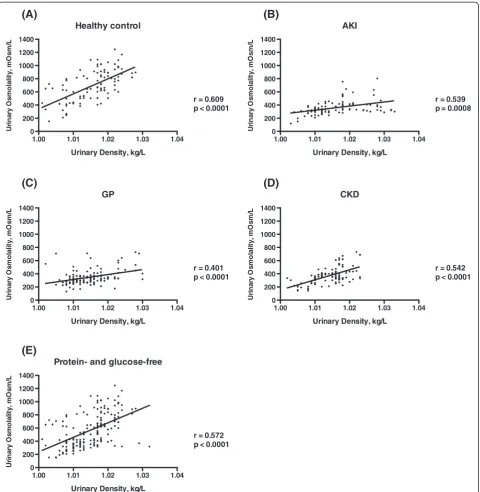
As expected, UD was consistently correlated to Uosm. Correlation was statistically significant when all groups were considered together (r = 0.462, p < 0.0001), as well as in the healthy control group (r = 0.609, p < 0.0001); in the AKI group (r = 0.539, p = 0.0008); in the GP group (r = 0.401, p < 0.0001); and in the CKD group (r = 0.542, p < 0.0001), as shown in Figure 1A, B, C and D, respect-ively. UD was corrected for proteinuria and glucosuria as described under Methods. Proteinuria was found in almost 60% of samples: overall, only 171 out of 416 samples were free from proteinuria or glucosuria (all 98 healthy volun-teers, 35 out of 95 in the AKI group, 35 out of 106 in the CKD group, and only 3 out of 118 in the GP group). Glu-cosuria was found in only 5 patients from the CKD group and in 4 patients from the GP group. These 9 samples also exhibited proteinuria, and therefore both equations were used for correction. When only urine samples with-out proteinuria or glucosuria were analyzed, the correl-ation between UD and Uosmwas even stronger (r = 0.572, p < 0.0001) (Figure 1E).
Despite the significant correlation between UD and Uosm, a wide range of Uosm values was associated with
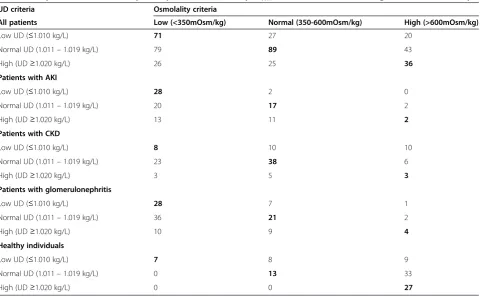
each UD value. This inconsistency was particularly strik-ing when extreme UD values were considered (Figure 2, shaded areas): 39.8% of samples with UD lower or equal to 1.010 exhibited Uosmin excess of 350 mOsm/kg. Con-versely, in 58.6% of samples with UD above 1.020, Uosm was below 600 mOsm/kg.
Low, normal and high renal concentration ability was defined as UD lower or equal to 1.010, between 1.010 and 1.020, and above or equal to1.020 kg/L, and Uosm lower than 350 mOsm/kg, between 350 and 600 mOsm/kg, and higher than 600 mOsm/kg, respectively. The number of patients classified in each criterion is plotted in Table 1. Agreement between UD and Uosmis highlighted in gray.
When analyzing healthy subjects, UD was an excellent predictor of Uosmwhen it was above 1.020: 100% of these samples exhibited Uosmabove 600 mOsm/kg. By sharp con-trast, UD failed to predict Uosm when UD was below or equal to 1.010: only 29.2% of samples had Uosmlower than 350 mOsm/kg, while Uosmwas higher than 600 mOsm/kg in 37.5% of the samples.
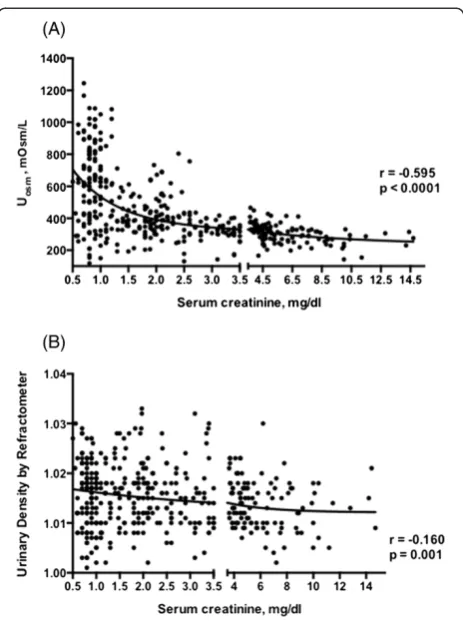
Figure 3A illustrates the relationship between Uosmand serum creatinine (Screat), for all subjects. Uosm and Screat followed a nonlinear relationship that could be fitted to a two-exponential curve (p < 0.01): Uosmwas expectedly dis-tributed across a wide range (118–1245 mOsm/kg) in sub-jects with Screatlower than 1.0 mg/dL and was confined to a narrow interval around 300 mOsm/kg as Screatincreased. The relationship between Uosmand Screat was still signifi-cant (p < 0.05), although much less conspicuous, when UD replaced Uosm as a measure of urine concentration (Figure 3B). When analyzing subgroups, the correl-ation between Uosm and Screat was significant in the AKI group (r =−0.451, p < 0.001), in the GP group (r =−0.533, p = 0.0001), and in the CKD group (r =−0.546, p = 0.0001). There was no significant correlation between Uosmand Screat in the healthy control group (r =−0.108, p = 0.289). A weaker but still significant correlation between UD and Screat was shown in the AKI group (r =−0.160, p = 0.001), in the GP group (r =−0.253, p = 0.026), and in the CKD group (r =−0.209, p = 0.031). There was no correlation between UD and Screat in the healthy control group (r =−0.102, p = 0.863).
Discussion
though statistically significant, was relatively weak (r = 0.462). A closer examination casts serious doubts about the clinical usefulness of UD. If an UD of 1.020 kg/L or higher were regarded as a test to detect individuals with an Uosmof at least 600 mOsm/kg [8-10], the sensitivity of such a test would be only 36%, whereas its specificity would be 81%. In other words, 64% of the subjects with concentrated urines would be missed by such test. On the other hand, good renal concentration ability might be
erroneously inferred in as many as 19% of the other cases. Conversely, if an UD equal to or less than 1.010 kg/L were assumed to detect urine osmolalities below 350 mOsm/kg (isosthenuric or diluted urine), the sensitivity of the test would be only 40%, although the corresponding specificity would approach a more acceptable 80%.
The inadequacy of UD as a measure of Uosm becomes even more evident when we consider that in about 2/3 of all samples UD values were ≥1.010 and ≤1.020 kg/L,
1.00 1.01 1.02 1.03 1.04
0 200 400 600 800 1000 1200 1400
Urinary Density, kg/L
Ur in a ry O s m ol al it y, m O s m/ L Healthy control
r = 0.609 p < 0.0001
(A)
1.00 1.01 1.02 1.03 1.04
0 200 400 600 800 1000 1200 1400
Urinary Density, kg/L
Ur in a ry O s m ol al it y ,m Os m /L GP
r = 0.401 p < 0.0001
(C)
1.00 1.01 1.02 1.03 1.04
0 200 400 600 800 1000 1200 1400
Urinary Density, kg/L
U ri n ar y Os m ol a li ty , m Os m/ L
Protein- and glucose-free
(E)
r = 0.572 p < 0.0001
1.00 1.01 1.02 1.03 1.04
0 200 400 600 800 1000 1200 1400
Urinary Density, kg/L
Ur ina ryO sm ol a lit y , mO s m/ L AKI
r = 0.539 p = 0.0008
(B)
1.00 1.01 1.02 1.03 1.04
0 200 400 600 800 1000 1200 1400
Urinary Density, kg/L
Ur in a ry Os m o la li ty , m Os m/ L CKD
r = 0.542 p < 0.0001
(D)
thus being irrelevant to major clinical decisions such as whether or not to administer IV saline to hypovolemic patients. When only UDs equal or higher than 1.020 kg/ L were analyzed, a mere 41.4% of the samples actually exhibited Uosm above 600 mOsm/kg, whereas in 29.9% Uosmwas even below 350 mOsm/kg. In the converse case, when exclusively UDs equal or lower than 1.010 kg/L were
considered, 60.2% of samples exhibited Uosmvalues lower than 350 mOsm/kg, whereas in 16.9% Uosmeven exceeded 600 mOsm/kg. These results indicate that UD cannot replace Uosm as a faithful measurement of urine con-centration. Although a high Uosm may not reflect the actual volume status, such as in cases of inappropriate antidiuretic hormone secretion, in many situations it
Table 1 Comparison between urinary density (UD) and osmolality (Uosm) classification of low and high concentration ability
UD criteria Osmolality criteria
All patients Low (<350mOsm/kg) Normal (350-600mOsm/kg) High (>600mOsm/kg)
Low UD (≤1.010 kg/L) 71 27 20
Normal UD (1.011–1.019 kg/L) 79 89 43
High (UD≥1.020 kg/L) 26 25 36
Patients with AKI
Low UD (≤1.010 kg/L) 28 2 0
Normal UD (1.011–1.019 kg/L) 20 17 2
High (UD≥1.020 kg/L) 13 11 2
Patients with CKD
Low UD (≤1.010 kg/L) 8 10 10
Normal UD (1.011–1.019 kg/L) 23 38 6
High (UD≥1.020 kg/L) 3 5 3
Patients with glomerulonephritis
Low UD (≤1.010 kg/L) 28 7 1
Normal UD (1.011–1.019 kg/L) 36 21 2
High (UD≥1.020 kg/L) 10 9 4
Healthy individuals
Low UD (≤1.010 kg/L) 7 8 9
Normal UD (1.011–1.019 kg/L) 0 13 33
High (UD≥1.020 kg/L) 0 0 27
Bold numbers show agreement between UD and Uosm.
AKI, acute kidney injury; CKD, chronic kidney disease.
does signal the need for fluid replacement. Therefore, an erroneous interpretation of a high UD as indicative of hypovolemia may lead to inadequate and even dan-gerous fluid administration.
As expected, there was a significant nonlinear correl-ation between Uosmand Screat, reflecting the expected rela-tionship between renal function and urine concentrating/ diluting ability: individuals with normal renal function can vary urine osmolality over a wide range, while renal func-tional impairment is accompanied by a progressive limita-tion of this capacity, until urine becomes permanently isosthenuric as most of the renal function is lost. This re-lationship between Uosmand Screatwas strongly attenuated when UD was used instead of Uosm, reinforcing the view that UD is a poor marker of renal concentrating/diluting ability.
The reasons why the relationship between UD and Uosm is less consistent than might be expected are unclear. In the present study, the effect of the possible presence of glucose and/or protein in urine was corrected by applying appropri-ate equations [6,13]. However, the association between UD and Uosm remained loose even after samples containing these solutes were excluded (r = 0.459, p < 0.05). It should be noted that a myriad of other solutes, commonly encoun-tered in the urine of patients with renal disorders, such as
drugs and iodinated radiocontrast agents, could in-crease urine density, leading to overestimation of the renal concentrating ability. Even “physiologic” solutes, such as sodium, potassium and urea, can appear in widely varying proportions in the urine of both healthy and diseased subjects, each of them exerting a different influence on urine density [9]. The unpredictability of these effects helps to explain the erratic relationship between UD and Uosm.
Conclusion
In summary, although UD correlates with Uosm, the rela-tionship between these two parameters is largely inconsist-ent, even in healthy subjects, indicating that UD is a poor marker of renal concentrating/diluting capability. Direct de-termination of Uosm, a relatively inexpensive procedure, should be performed if reliable information about this important aspect of renal function is to be obtained from urine.
Competing interests
The authors declare that they have no competing interests.
Authors’contributions
ACPS collected the data, participated in the design of the study and helped draft the manuscript; RZ participated in the design of the study, gave important intellectual contribution, revised and drafted the manuscript; RBO participated in the design of the study, revised and drafted the manuscript; MARS and MR performed all urinalysis and osmolality tests, revised and drafted the manuscript; JERJ participated in the in the design of the study, revised and drafted the manuscript; RME conceived the study, participated in its design, performed the statistical analysis, coordination, revised and drafted the manuscript. All authors read and approved the final manuscript.
Acknowledgements
We are grateful to all patients and medical staff who collaborated to this study. There is no financial support to declare.
Author details 1
Nephrology Service, University of Sao Paulo School of Medicine, São Paulo, SP, Brazil.2Nephrology Service, University of Campinas - UNICAMP, Campinas,
Brazil.
Received: 12 August 2014 Accepted: 24 March 2015
References
1. Czernichow P, Polak M. Testing Water regulation, vol. 1. 4th ed. Basel, Switzerland: Karger; 2011.
2. de Buys Roessingh AS, Drukker A, Guignard JP. Dipstick measurements of urine specific gravity are unreliable. Arch Dis Child. 2001;85(2):155–7. 3. Bakhshandeh S, Morita Y. Comparison of urinary concentration tests: osmolality,
specific gravity, and refractive index. Mich Med. 1975;74(21):399–403. 4. Imran S, Eva G, Christopher S, Flynn E, Henner D. Is specific gravity a good
estimate of urine osmolality? J Clin Lab Anal. 2010;24(6):426–30.
5. Oppliger RA, Magnes SA, Popowski LA, Gisolfi CV. Accuracy of urine specific gravity and osmolality as indicators of hydration status. Int J Sport Nutr Exerc Metab. 2005;15(3):236–51.
6. Chadha V, Garg U, Alon US. Measurement of urinary concentration: a critical appraisal of methodologies. Pediatr Nephrol. 2001;16(4):374–82.
7. Langham RG, Bellomo R, D’Intini V, Endre Z, Hickey BB, McGuinness S, et al. KHA-CARI guideline: KHA-CARI adaptation of the KDIGO Clinical Practice Guideline for Acute Kidney Injury. Nephrology. 2014;19(5):261–5. 8. Leech S, Penney MD. Correlation of specific gravity and osmolality of urine
in neonates and adults. Arch Dis Child. 1987;62(7):671–3.
9. Voinescu GC, Shoemaker M, Moore H, Khanna R, Nolph KD. The relationship between urine osmolality and specific gravity. Am J Med Sci. 2002;323(1):39–42. 10. Dorizzi R, Pradella M, Bertoldo S, Rigolin F. Refractometry, test strip, and
osmometry compared as measures of relative density of urine. Clin Chem. 1987;33(1):190.
11. Medler S, Harrington F. Measuring dynamic kidney function in an undergraduate physiology laboratory. Adv Physiol Educ. 2013;37(4):384–91. 12. NHS, Greater Glasgow and Clyde. Paediatrics: Clinical Guidelines.
[http://www.clinicalguidelines.scot.nhs.uk/]
13. Rose BD, Post TW. Clinical Physiology of Acid–base and Electrolyte Disorders. 5th ed. New York: McGraw-Hill; 2001.
Submit your next manuscript to BioMed Central and take full advantage of:
• Convenient online submission
• Thorough peer review
• No space constraints or color figure charges
• Immediate publication on acceptance
• Inclusion in PubMed, CAS, Scopus and Google Scholar
• Research which is freely available for redistribution