Page 1 of 7
Open Access
Research article
Are we drawing the right conclusions from randomised
placebo-controlled trials? A post-hoc analysis of data from a
randomised controlled trial
M Diana van Die*
1, Kerry M Bone
2,3, Henry G Burger
4and Helena J Teede
5,6Address: 1School of Health Sciences, RMIT University, Bundoora, Victoria, Australia, 2MediHerb Australia Pty Ltd, Warwick, Queensland, Australia , 3School of Health, University of New England, Armidale, New South Wales, Australia, 4Prince Henry's Institute of Medical Research, Clayton, Victoria, Australia, 5Jean Hailes Foundation for Women's Health, Clayton, Victoria, Australia and 6School of Public Health, Monash University, Clayton, Victoria, Australia
Email: M Diana van Die* - [email protected]; Kerry M Bone - [email protected]; Henry G Burger - [email protected]; Helena J Teede - [email protected] * Corresponding author
Abstract
Background: Assumptions underlying placebo controlled trials include that the placebo effect impacts on all study arms equally, and that treatment effects are additional to the placebo effect. However, these assumptions have recently been challenged, and different mechanisms may potentially be operating in the placebo and treatment arms. The objective of the current study was to explore the nature of placebo versus pharmacological effects by comparing predictors of the placebo response with predictors of the treatment response in a randomised, placebo-controlled trial of a phytotherapeutic combination for the treatment of menopausal symptoms. A substantial placebo response was observed but no significant difference in efficacy between the two arms.
Methods: A post hoc analysis was conducted on data from 93 participants who completed this previously published study. Variables at baseline were investigated as potential predictors of the response on any of the endpoints of flushing, overall menopausal symptoms and depression. Focused tests were conducted using hierarchical linear regression analyses. Based on these findings, analyses were conducted for both groups separately. These findings are discussed in relation to existing literature on placebo effects.
Results: Distinct differences in predictors were observed between the placebo and active groups. A significant difference was found for study entry anxiety, and Greene Climacteric Scale (GCS) scores, on all three endpoints. Attitude to menopause was found to differ significantly between the two groups for GCS scores. Examination of the individual arms found anxiety at study entry to predict placebo response on all three outcome measures individually. In contrast, low anxiety was significantly associated with improvement in the active treatment group. None of the variables found to predict the placebo response was relevant to the treatment arm.
Conclusion: This study was a post hoc analysis of predictors of the placebo versus treatment response. Whilst this study does not explore neurobiological mechanisms, these observations are consistent with the hypotheses that 'drug' effects and placebo effects are not necessarily additive, and that mutually exclusive mechanisms may be operating in the two arms. The need for more research in the area of mechanisms and mediators of placebo versus active responses is supported.
Trial Registration: International Clinical Trials Registry ISRCTN98972974.
Published: 23 June 2009
BMC Medical Research Methodology 2009, 9:41 doi:10.1186/1471-2288-9-41
Received: 3 December 2008 Accepted: 23 June 2009
This article is available from: http://www.biomedcentral.com/1471-2288/9/41
© 2009 van Die et al; licensee BioMed Central Ltd.
Background
The placebo-controlled trial is considered the gold stand-ard among clinical research designs. The challenge of rig-orous scientific research is to accurately determine the specific effect of an intervention over and above the pla-cebo effect, (also referred to as 'non-specific effects', or 'context effects'). Failure to do so may result in the rejec-tion of the intervenrejec-tion as ineffective as a potential treat-ment, as any benefits are ascribed to a placebo effect. We question this approach and suggest that inappropriate rejection of potentially viable treatments may be occur-ring.
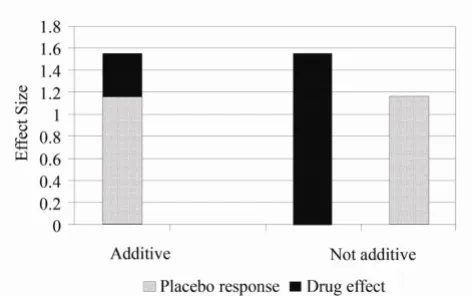
The underlying assumption of placebo-controlled trials is that, for participants blinded as to their group assignment, the placebo component affects all arms equally, with the specific effect of the active intervention/s being additional to the placebo effect in the intervention arm/s. This has been termed the 'additivity' of effects. However, this assumption has recently been challenged. It has been argued by Kirsch and colleagues [1] that it is not a logical necessity for the effects of the active treatment to be addi-tive, or composed of the two components – the placebo effect and the specific treatment effect (see Figure 1). In support of their position they suggest that, if drug effects and placebo effects are additive, then the pharmacological effect of antidepressant drugs must be quite small [1], since meta-analyses of antidepressant drugs have found that 65% – 80% of the response to the drug is duplicated in the placebo arm, including in long-term maintenance studies [2-4]. They thus proposed that the effects may be non-additive or only partially additive [1], suggesting
dif-ferent underlying mechanisms may be operating in the placebo and pharmacological treatment arms.
One obvious conclusion from this observation is that antidepressant medication does, in fact, exert a very small pharmacological effect. Another possible explanation that has been proposed is that different neurobiological mech-anisms may be operating in the two arms. The placebo may induce effects via psychological mechanisms only In the absence of a pharmacological effect, while the active treatment works through pharmacological mechanisms alone [5]. Some support for this hypothesis is derived from brain-imaging studies of depressed subjects, show-ing that placebo and active treatments induce quite differ-ent changes in brain function, despite exerting similar benefits [6-8]. Similarly, neurophysiological research on analgesia has suggested that expectation pathways, rather than pain pathways, may be stimulated by placebo treat-ment [9]. Expectation of reward has been shown to be at least partly mediated by the dopaminergic system [10-13], stimulation of which may be activated by the brain opioid system [9,14,15]. There is evidence that both endogenous opioids [16,17] and placebo-induced dopamine release may be relevant to the placebo effect [18-20]. Participant-related factors identified that may be responsible for the effects produced by placebos include Pavlovian condi-tioning resulting from prior exposure to the therapeutic intervention, and the expectation of reward (clinical ben-efit, in this case) [21].
In this setting, the current study analysed data from a pre-viously published double-blind, placebo-controlled, RCT that had found no significant effect over placebo on any of the endpoints [22] for the study treatment, which was therefore concluded to exert no more than placebo effects. A comparison was made between predictors of the response in the placebo arm and predictors of the response to the active treatment. It was hypothesised that, if the additivitiy assumption is correct, then the same var-iables would predict the response in both groups.
Methods
This study was a post hoc analysis of data from an investi-gation of 93 participants who completed a randomised, placebo-controlled, double-blind trial. We have previ-ously published the outcome data on efficacy of the ther-apy [22] and predictors of the placebo response in the placebo group only [23]. Here we extend this evaluation to examine whether these predictors are also relevant to the treatment arm, and include data from all study partic-ipants. The original RCT had investigated the effect of a phytotherapeutic combination, consisting of the herbs
Hypericum perforatum and Vitex agnus-castus, for menopau-sal symptoms in late-perimenopaumenopau-sal and postmenopau-sal women [22]. Following entry to the study, a two-week
'Drug effects and the placebo response: additive and nonaddi-tive models'[1]
Figure 1
'Drug effects and the placebo response: additive and nonadditive models'[1]. Reprinted by permission of Else-vier from 'Are drug and placebo effects in depression addi-tive? by Kirsch, I. Biological Psychiatry 47(8):733–5. Copyright 2000 by the Society of Biological Psychiatry.
Figure 1 ‘Drug effects and the placebo response: additive and nonadditive models.’ 1 Reprinted by
permission of Elsevier from ‘Are drug and placebo effects in depression additive? by Kirsch, I.
Page 3 of 7 non-treatment run-in preceded the 16-week treatment
phase. Endpoints included flushing, overall menopausal symptoms measured on the Greene climacteric scale (GCS) and depressive symptoms measured on the Hamil-ton Depression Inventory (HDI), both well-validated widely available tools. The trial was approved by the Human Research Ethics Committee at Royal Melbourne Institute of Technology University.
Study intervention
As previously described [22], two Vitex agnus-castus tablets or matching placebos were administered daily, in addi-tion to three Hypericum perforatum tablets or matching pla-cebos. The placebos were identical to the herbal tablets in size, colour, coating, weight and packaging. Placebo tab-lets comprised the excipients used in the active tabtab-lets; these were cellulose, modified starch, magnesium stearate and calcium hydrogen-phosphate. The daily dosage of the herbs was 1,000 mg Vitex agnus-castus, and 5,400 mg
Hypericum perforatum. All tablets were manufactured under the Code of Good Manufacturing Practice by Medi-Herb Australia Pty Ltd.
Participants
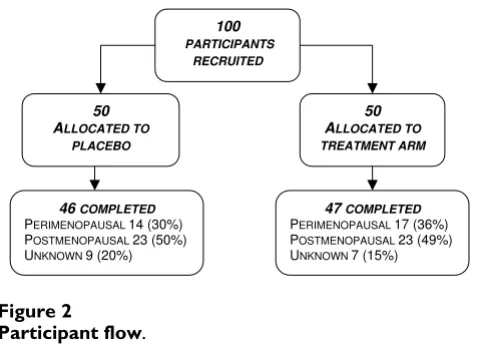
Of the 93 women completing the trial, 47 had been ran-domised to the active treatment group and 46 to the pla-cebo arm (see Figure 2). All were late-perimenopausal or postmenopausal women, aged 40 – 60 years. Details of the inclusion and exclusion criteria have been published previously [22]. Women were excluded if taking any med-ication known to interact with either study herb. Informed consent was obtained prior to study entry. Base-line visits were conducted in a clinic setting and follow-up contact by telephone. Medical clearance was obtained from a general practitioner prior to inclusion in the trial. Participants were requested to maintain their baseline die-tary phytoestrogen intake during the trial.
Baseline data were collected for a range of variables, as previously published [22]. These were tested individually for their predictive ability. Measures administered at study entry, baseline and end of treatment phase are shown in Figure 3.
Statistical Analyses
Data were analysed using Statistical Package for Social Sci-ence (SPSS) Version 16 with the assistance of a biostatisti-cian. Data were analysed in two ways:
Firstly, focused tests of the difference between betas were conducted for each of the three individual endpoints. To do this, a series of hierarchical linear regression analyses were conducted using grouping as a dichotomous varia-ble. An interaction variable was created for grouping × predictor for each potential predictor variable. The inter-action of grouping and predictor was examined. Secondly, independent variables were assessed individually for their ability to predict the response in each arm on the three separate outcome measures. In each analysis, hierarchical regression was conducted in order to control for the base-line scores for the relevant outcome measures.
Response was defined as change in a favourable direction, that is, decrease in severity of symptoms. Because total GCS scores and GCS anxiety subscale scores were not independent, these were not entered simultaneously into a multiple regression analysis.
Results
Overall
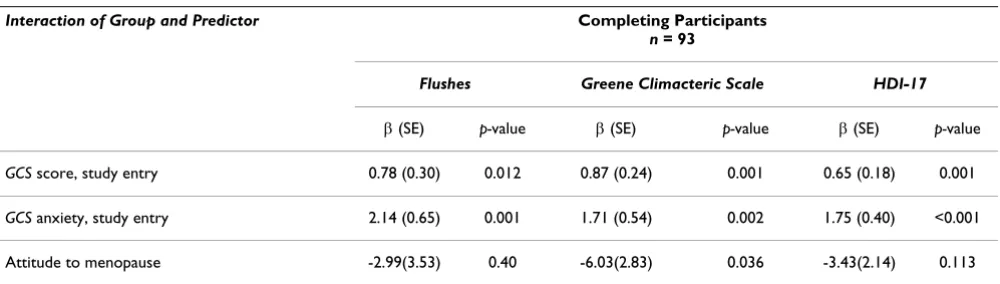
The results of focused tests examining the interaction of group and predictor are presented in table 1. A significant difference was found in the predictive ability of anxiety at study entry between the two arms for all three endpoints, flushes R2 = 0.41, Std. β = 0.43, p = 0.001; GCS R2 = 0.29,
Std. β = 0.45, p = 0.002; HDI-17 scale R2 = 0.30, Std. β =
0.63, p < 0.001. Similarly, total GCS scores at study entry as a predictor of the subsequent response varied signifi-cantly between the two arms for all three endpoints of flushing, R2 = 0.39, Std. β = -0.29, p = 0.012; overall
men-opausal symptoms measured on the GCS, R2 = 0.31, Std.
β = 0.43, p = 0.001; and depression measured on HDI-17,
R2 = 0.25, Std. β = 0.45, p = 0.001. Attitude to menopause
was found to differ significantly between the two groups as a predictor of GCS scores, after controlling for baseline scores, R2 = 0.27, Std. β = -0.34, p = 0.036.
Individual Arms
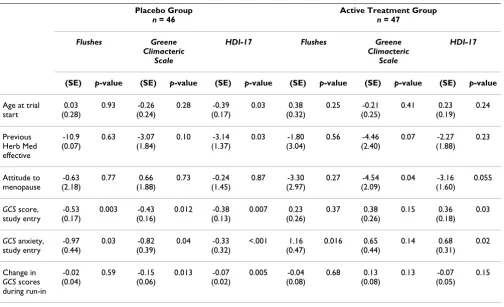
Variables found to have significant predictive ability in the individual hierarchical linear regression analyses for any of the three endpoints for the individual arms are pre-sented in Table 2. A negative β co-efficient indicates that more severe study entry scores were associated with
Participant flow
Figure 2
Participant flow.
50 ALLOCATED TO
PLACEBO
47COMPLETED
PERIMENOPAUSAL 17 (36%) POSTMENOPAUSAL 23 (49%) UNKNOWN7 (15%)
46COMPLETED
PERIMENOPAUSAL 14 (30%) POSTMENOPAUSAL 23 (50%) UNKNOWN9 (20%)
100
PARTICIPANTS RECRUITED
milder symptoms at week 16. The overall change observed in GCS scores during non-treatment run-in was in the direction of improvement in symptoms.
For the individual arms, predictors of response identified, after controlling for baseline scores, were as follows.
Anxiety at study entry
Anxiety at study entry significantly predicted placebo response on all the endpoints individually, with higher anxiety at entry associated with lower scores at end of treatment phase: flushes R2 = 0.33, Std. β = -0.28, p = 0.03; GCS R2 = 0.24, Std.
β = -0.29, p = 0.04; HDI-17 scale R2 = 0.34, Std. β = -0.66, p <
0.001. For the active treatment group, however, anxiety at study entry predicted lack of response for flushing, R2 = 0.45,
Std. β = 0.28 p = 0.02, and depression, measured on the HDI-17. R2 = 0.28, Std. β = 0.31, p = 0.03.
None of the other predictors of the placebo response was relevant to the response in the active treatment arm (see Table 2).
In the active treatment group, positive attitude to meno-pause predicted response on GCS, R2 = 0.34, Std. β = -0.27,
p = 0.036.
Baseline severity of scores
For the placebo group, Pearson's bivariate correlations revealed positive correlations between baseline scores and subsequent percentage improvement during the treat-ment phase for total GCS scores and anxiety subscale scores. No relationship between severity of scores and subsequent response was found for any of the endpoints for the active treatment group.
Discussion
In the current study, there was a significant interaction between predictors of the response to placebo and the study intervention. Anxiety at study entry and overall men-opausal symptoms at study entry (GCS scores) differed sig-nificantly between the two arms as predictors of the response on all three endpoints of flushing, overall meno-pausal symptoms and depression. Attitude to menopause
Timeline of data collection22
Figure 3
Timeline of data collection22.
Figure 3
Timeline of data collection
22STUDY ENTRY BASELINE END POST-TREATMENT
TREATMENT FOLLOW-UP
FLUSHES, HDI, GREENE
FLUSHES
GREENE
0 2 18 26
NO TREATMENT TREATMENT PHASE NO TREATMENT
HDI GREENE
FLUSHES
HDI GREENE WEEK
Table 1: Differences between groups for predictors of week 16 endpoint scores, after controlling for baseline scores
Interaction of Group and Predictor Completing Participants
n = 93
Flushes Greene Climacteric Scale HDI-17
β (SE) p-value β (SE) p-value β (SE) p-value
GCS score, study entry 0.78 (0.30) 0.012 0.87 (0.24) 0.001 0.65 (0.18) 0.001
GCS anxiety, study entry 2.14 (0.65) 0.001 1.71 (0.54) 0.002 1.75 (0.40) <0.001
Attitude to menopause -2.99(3.53) 0.40 -6.03(2.83) 0.036 -3.43(2.14) 0.113
Page 5 of 7 differed significantly in its predictive ability between the
two groups for the response on GCS scores. In terms of the individual arms, there were distinct differences in predic-tors of outcome observed between the placebo and active groups. Anxiety at study entry predicted placebo response for all the endpoints. In contrast, for flushing and depression in the treatment arm, study entry anxiety significantly pre-dicted a lack of response to treatment, and had no effect on the Greene Climacteric scale scores. None of the other var-iables that predicted the placebo response was relevant to the treatment response. Improvement during non-treat-ment run-in predicted subsequent improvenon-treat-ment during the treatment phase on GCS and HDI-17 depression scores for the placebo arm. This trend was not mirrored in the active treatment arm. For depression scores, older age at study entry predicted placebo response, as did prior positive experience with phytotherapy. However neither of these variables significantly impacted on outcomes in the active treatment arm. For the Greene Climacteric scale, baseline severity of symptoms was positively correlated with per-centage improvement across the treatment phase in the pla-cebo group, but not in the active treatment group.
Previous researchers of a range of other conditions have compared predictors of the responses in placebo and
active arms within the same study where effects between the two arms differed [24-27]. Severity of symptoms at baseline has been found to differentially predict the pla-cebo and treatment responses, with more severe depres-sion being less responsive to placebo but more responsive to the pharmacological intervention [28]. Another study on acute bipolar manic episodes found symptom severity, age, number of previous hospitalisations to similarly pre-dict the responses in both arms [25]. With regard to change in symptom severity during run-in, significant worsening of symptoms was associated with subsequent placebo response, but not "drug response" in an analysis of data from a functional dyspepsia study [29]. This con-trasts with observations from the current study that
improvement during run-in predicted subsequent response to placebo, but not to active treatment. However, to our knowledge, no previous studies have examined data from a RCT where superiority of 'active' treatment over placebo was not established to test the hypothesis that the predic-tors would be similar in the two arms.
In this study where efficacy of active and placebo were equivalent, the implications of the finding that the predic-tors of placebo response did not predict the treatment response are intriguing. As mentioned above, it has previ-Table 2: Predictors of week 16 endpoint scores for individual arms, after controlling for baseline scores
Placebo Group
n = 46
Active Treatment Group
n = 47
Flushes Greene Climacteric
Scale
HDI-17 Flushes Greene Climacteric
Scale
HDI-17
(SE) p-value (SE) p-value (SE) p-value (SE) p-value (SE) p-value (SE) p-value
Age at trial start 0.03 (0.28) 0.93 -0.26 (0.24) 0.28 -0.39 (0.17) 0.03 0.38 (0.32) 0.25 -0.21 (0.25) 0.41 0.23 (0.19) 0.24 Previous Herb Med effective -10.9 (0.07) 0.63 -3.07 (1.84) 0.10 -3.14 (1.37) 0.03 -1.80 (3.04) 0.56 -4.46 (2.40) 0.07 -2.27 (1.88) 0.23 Attitude to menopause -0.63 (2.18) 0.77 0.66 (1.88) 0.73 -0.24 (1.45) 0.87 -3.30 (2.97) 0.27 -4.54 (2.09) 0.04 -3.16 (1.60) 0.055
GCS score,
study entry -0.53 (0.17) 0.003 -0.43 (0.16) 0.012 -0.38 (0.13) 0.007 0.23 (0.26) 0.37 0.38 (0.26) 0.15 0.36 (0.18) 0.03
GCS anxiety,
study entry -0.97 (0.44) 0.03 -0.82 (0.39) 0.04 -0.33 (0.32) <.001 1.16 (0.47) 0.016 0.65 (0.44) 0.14 0.68 (0.31) 0.02 Change in
GCS scores
during run-in -0.02 (0.04) 0.59 -0.15 (0.06) 0.013 -0.07 (0.02) 0.005 -0.04 (0.08) 0.68 0.13 (0.08) 0.13 -0.07 (0.05) 0.15
Unstandardised β-coefficient (SE)
ously been suggested that the assumption of additivity of effects that underlies the practice of using placebos may not be a logical necessity [1]. It is possible that psycholog-ical mechanisms may operate in the placebo arm only in the absence of pharmacological effects, whereas effective interventions activate pharmacological mechanisms to the exclusion of psychological mechanisms [5]. Although it is generally accepted that there is a placebo component in the response to the active treatment when participants are blinded, the hypothesis of non-additivity implies that the pharmacological effects of an active intervention could override the psychologically-activated placebo com-ponent completely or partially. Essentially, the trial partic-ipants would experience either placebo or physiological intervention effects, but not both. If shown to be correct, this would invalidate the assumption that intervention effects are additive to placebo effects.
To our knowledge, no evidence exists from neurobiologi-cal studies of differential mechanisms operating in rela-tion to menopausal symptoms, although there is some support for this phenomenon in relation to depression [6-8]. As depression, measured on the Hamilton Depression Inventory and the Greene Climacteric subscale, was one of endpoints of the current study, different mechanisms operating in the two arms in the current study cannot entirely be ruled out.
It is interesting to note that higher anxiety at study entry was a significant predictor of the placebo response, but predicted lack of response to active treatment. This sup-ports the proposition that psychological factors are rele-vant to the placebo response, at least as moderators, if not mediators. The observation that improvement during non-treatment run-in predicted placebo response on two of the three endpoints, but did not predict treatment
response, is consistent with the proposal that placebo-induced mechanisms, such as the release of endogenous opioids, may be activated in the anticipatory phase of the placebo response [15] and hence during therapist-patient or investigator-participant interaction [9]. The variance in the predictors of placebo and active response observed in the current study is consistent with the hypothesis that different underlying mechanisms may be operating in pla-cebo and treatment arms.
Strengths of the study include the investigation of study entry scores (2 weeks prior to commencement of run-in), in preference to baseline scores, as potential predictors of the placebo response. The effect on psychological mecha-nisms of enrollment in a clinical trial would be expected to occur from the point of study entry, with the initiation of investigator-participant interaction and other context effects, rather than from initiation of the intervention [9]. However, because pharmacological effects of the interven-tion would only be observable from the point of
adminis-tration of the intervention (see Figure 3), baseline scores were controlled for in the analysis.
A limitation in the interpretation of these findings is that there is no evidence, to our knowledge, supporting this phytotherapeutic combination as an effective treatment for menopausal symptoms. Therefore, a known pharma-cological effect for this intervention in the treatment of menopausal symptoms has never been established. This study was a post hoc analysis of data from an RCT and as such, was not designed to explore neurobiological mech-anisms. Thus, no definite conclusions can be drawn regarding any different mechanisms of action. Other pos-sible limitations include the relatively small sample size, the use of exclusively subjective outcome measures, and the single scale of measurement for improvement during non-treatment run-in.
Conclusion
In randomised, placebo-controlled clinical trials, greater understanding of the placebo response is needed to accu-rately dissect out placebo versus intervention effects. In order to conclude that a pharmacological intervention is ineffective if found not to be superior to placebo, it is essential to be confident that i) the placebo has no specific effect for the condition being examined, and ii) that the effects of the placebo and active intervention are com-pletely additive, i.e. that subtracting the placebo effect from the treatment effect leaves the active intervention effect. The assumption of additivity has previously been questioned by other authors [1]. Early research on neuro-anatomical and neurobiological mechanisms, primarily in the area of analgesia, suggests that placebo and phar-macological interventions may activate mutually exclu-sive pathways. The current findings could be explained in light of the theory of non-additivity. Further research is warranted into the neurophysiological basis of the pla-cebo response to investigate the validity of the assump-tion of additivity. If this assumpassump-tion were shown to be incorrect, it would have significant implications for the interpretation of results from placebo-controlled RCTs.
Abbreviations
GCS: Greene Climacteric Scale; HDI-17: Hamilton Depression Inventory 17-item scale; SPSS: Statistical Pack-age for Social Science
Competing interests
Assoc. Prof. Kerry Bone was a co-founder of MediHerb, and is currently a consultant for MediHerb Australia Pty Ltd. He is related to Diana van Die (in-law). The other authors declare they have no competing interests.
Authors' contributions
integ-Page 7 of 7 rity of the data and the accuracy of the data analyses. DVD
participated in the study concept and design, acquisition of data, analysis and interpretation of data, manuscript preparation and obtaining funding. HT participated in the study concept and design, study supervision, interpreta-tion of data, critical revision of manuscript for important intellectual content and obtaining funding. HB partici-pated in the study concept and design, study supervision, interpretation of data, critical revision of manuscript for important intellectual content. KB participated in the study concept and design, study supervision, interpreta-tion of data, critical revision of manuscript for important intellectual content and obtaining funding. All authors read and approved the final manuscript.
Acknowledgements
MediHerb Australia Pty Ltd provided active and placebo formulations. Financial support was provided by the Australian College of Phytotherapy and the Jean Hailes Foundation for Women's Health for expenses relating to the RCT.
The authors are grateful to Eldho Paul and Dr John Reece for statistical sup-port, Prof Marc Cohen for co-supervision of the RCT, Dr Iggy Soosay for acting as trial safety monitor, Williamina van Die for data checking, Prof Ken Greenwood for manuscript review, the late Dr. J.G. Greene for permission to reproduce Greene Climacteric Scale, and all the women who partici-pated in the study.
Approval for the study was obtained from the RMIT University Human Research Ethics Committee.
References
1. Kirsch I: Are drug and placebo effects in depression additive?
Biol Psychiatry 2000, 47(8):733-735.
2. Kirsch I, Sapirstein G: Listening to prozac but hearing placebo: a meta-analysis of antidepressant medication. Prevention and Treatment 1998, 1: [http://journals.apa.org/prevention/volume1/ pre0010002a.html].
3. Montgomery SA, Reimitz PE, Zivkov M: Mirtazapine versus amitriptyline in the long-term treatment of depression: a double-blind placebo-controlled study. Int Clin Psychopharmacol 1998, 13(2):63-73.
4. Joffe R, Sokolov S, Streiner D: Antidepressant treatment of depression: a metaanalysis. Can J Psychiatry 1996,
41(10):613-616.
5. Wampold BE, Minami T, Tierney SC, Baskin TW, Bhati KS: The pla-cebo is powerful: estimating plapla-cebo effects in medicine and psychotherapy from randomized clinical trials. J Clin Psychol 2005, 61(7):835-854.
6. Leuchter AF, Cook IA, Witte EA, Morgan M, Abrams M: Changes in brain function of depressed subjects during treatment with placebo. Am J Psychiatry 2002, 159(1):122-129.
7. Mayberg HS, Silva JA, Brannan SK, Tekell JL, Mahurin RK, McGinnis S, Jerabek PA: The functional neuroanatomy of the placebo effect. Am J Psychiatry 2002, 159(5):728-737.
8. Leuchter AF, Morgan M, Cook IA, Dunkin J, Abrams M, Witte E: Pre-treatment neurophysiological and clinical characteristics of placebo responders in treatment trials for major depression.
Psychopharmacology (Berl) 2004, 177(1–2):15-22.
9. Colloca L, Benedetti F: Placebos and painkillers: is mind as real as matter? Nat Rev Neurosci 2005, 6(7):545-552.
10. Schultz W: Predictive reward signal of dopamine neurons. J Neurophysiol 1998, 80(1):1-27.
11. Benedetti F, Colloca L, Torre E, Lanotte M, Melcarne A, Pesare M, Bergamasco B, Lopiano L: Placebo-responsive Parkinson patients show decreased activity in single neurons of subtha-lamic nucleus. Nat Neurosci 2004, 7(6):587-588.
12. Franklin KB: Analgesia and the neural substrate of reward.
Neurosci Biobehav Rev 1989, 13(2–3):149-154.
13. Garris PA, Kilpatrick M, Bunin MA, Michael D, Walker QD, Wight-man RM: Dissociation of dopamine release in the nucleus accumbens from intracranial self-stimulation. Nature 1999,
398(6722):67-69.
14. Koshi EB, Short CA: Placebo theory and its implications for research and clinical practice: a review of the recent litera-ture. Pain Pract 2007, 7(1):4-20.
15. Wager TD, Scott DJ, Zubieta JK: Placebo effects on human mu-opioid activity during pain. Proc Natl Acad Sci USA 2007,
104(26):11056-11061.
16. Weihrauch TR: Placebo treatment is effective differently in different diseases–but is it also harmless? A brief synopsis. Sci Eng Ethics 2004, 10(1):151-155.
17. Benedetti F, Rainero I, Pollo A: New insights into placebo anal-gesia. Curr Opin Anaesthesiol 2003, 16(5):515-519.
18. De La Fuente-Fernandez R, Stoessl AJ: The biochemical bases for reward. Implications for the placebo effect. Eval Health Prof 2002, 25(4):387-398.
19. de la Fuente-Fernandez R, Schulzer M, Stoessl AJ: Placebo mecha-nisms and reward circuitry: clues from Parkinson's disease.
Biol Psychiatry 2004, 56(2):67-71.
20. de la Fuente-Fernandez R, Lidstone S, Stoessl AJ: Placebo effect and dopamine release. J Neural Transm Suppl 2006:415-418. 21. Amanzio M, Benedetti F: Neuropharmacological dissection of
placebo analgesia: expectation-activated opioid systems ver-sus conditioning-activated specific subsystems. J Neurosci 1999, 19(1):484-494.
22. Van Die MD, Burger HG, Bone KM, Cohen MM, Teede HJ: Hyperi-cum perforatum with Vitex agnus-castus in menopausal symptoms: a randomized, controlled trial. Menopause 2009,
16(1):156-163.
23. Van Die MD, Teede H, Bone K, Reece J, Burger H: Predictors of Placebo Response in a Randomised, Controlled Trial of Phy-totherapy in Menopause. Menopause 2009 in press.
24. Khan A, Brodhead AE, Kolts RL, Brown WA: Severity of depres-sive symptoms and response to antidepressants and placebo in antidepressant trials. J Psychiatr Res 2005, 39(2):145-150. 25. Welge JA, Keck PE Jr, Meinhold JM: Predictors of response to
treatment of acute bipolar manic episodes with divalproex sodium or placebo in 2 randomized, controlled, parallel-group trials. J Clin Psychopharmacol 2004, 24(6):607-612. 26. Heiligenstein JH, Faries DE, Rush AJ, Andersen JS, Pande AC,
Roffwarg HP, Dunner D, Gillin JC, James SP, Lahmeyer H, Zajecka J, Tollefson GS, Gardner DM: Latency to rapid eye movement sleep as a predictor of treatment response to fluoxetine and placebo in nonpsychotic depressed outpatients. Psychiatry Res 1994, 52(3):327-339.
27. Downing RW, Rickels K: Predictors of response to amitriptyl-ine and placebo in three outpatient treatment settings. J Nerv Ment Dis 1973, 156(2):109-129.
28. Khan A, Leventhal RM, Khan SR, Brown WA: Severity of depres-sion and response to antidepressants and placebo: an analy-sis of the Food and Drug Administration database. J Clin Psychopharmacol 2002, 22(1):40-45.
29. Enck P, Vinson B, Malfertheiner P, Zipfel S, Klosterhalfen S: The pla-cebo response in functional dyspepsia – reanalysis of trial data. Neurogastroenterol Motil 2009, 21(4):370-377.
Pre-publication history
The pre-publication history for this paper can be accessed here: