R E S E A R C H
Open Access
Metabolic network analysis and experimental
study of lipid production in
Rhodosporidium
toruloides
grown on single and mixed substrates
Rajesh Reddy Bommareddy
†, Wael Sabra
†, Garima Maheshwari and An-Ping Zeng
*Abstract
Background:Microbial lipids (triacylglycerols, TAG) have received large attention for a sustainable production of oleochemicals and biofuels.Rhodosporidium toruloidescan accumulate lipids up to 70% of its cell mass under certain conditions. However, our understanding of lipid production in this yeast is still much limited, especially for growth with mixed substrates at the level of metabolic network. In this work, the potentials of several important carbon sources for TAG production inR.toruloidesare first comparatively studiedin silicoby means of elementary mode analysis followed by experimental validation.
Results:A simplified metabolic network ofR.toruloideswas reconstructed based on a combination of genome and proteome annotations. Optimal metabolic space was studied using elementary mode analysis for growth on glycerol, glucose, xylose and arabinose or in mixtures. Thein silicomodel predictions of growth and lipid production are in agreement with experimental results. Both thein silicoand experimental studies revealed that glycerol is an attractive substrate for lipid synthesis inR. toruloideseither alone or in blend with sugars. A lipid yield as high as 0.53 (C-mol TAG/C-mol) has been experimentally obtained for growth on glycerol, compared to a theoretical maximum of 0.63 (C-mol TAG/C-mol). The lipid yield on glucose is much lower (0.29 (experimental) vs. 0.58 (predicted) C-mol TAG/C-mol). The blend of glucose with glycerol decreased the lipid yield on substrate but can significantly increase the overall volumetric productivity. Experimental studies revealed catabolite repression of glycerol by the presence of glucose for the first time. Significant influence of oxygen concentration on the yield and composition of lipids were observed which have not been quantitatively studied before.
Conclusions:This study provides for the first time a simplified metabolic model ofR.toruloidesand its detailed in silicoanalysis for growth on different carbon sources for their potential of TAG synthesis. Experimental studies revealed the phenomenon of catabolite repression of glycerol by glucose and the importance of oxygen supply on the yield and composition of lipids. More systematic studies are needed to understand the mechanisms which should help to further optimize the lipid production in this strain of industrial interest.
Keywords:Metabolic network analysis, Elementary mode analysis, Lipids, Glycerol, Biomass, Oleaginous yeast
Background
During the past years fuel production from biomass has gained enormous interest due to the escalating cost and scarcity of fossil fuels. Biodiesel industry has become important and the use of plant oils as raw materials is not ecologically sustainable because of the relatively high production costs and their competition with global
supply of food. Despite the expected high production capacity of biodiesel the anticipated target has increased at a slower rate [1], mainly due to its relatively high production cost. However, utilization of glycerol, a co-product from biodiesel co-production, is one of the promis-ing options for lowerpromis-ing its production cost [2,3]. In fact, biodiesel production generates about 10% (w/w) glycerol as the main byproduct. Therefore, many researchers have worked on valorization of glycerol and successfully produced value added chemicals which are industrially significant [4-8].
* Correspondence:[email protected]
†Equal contributors
Institute of Bioprocess and Biosystems Engineering, Hamburg University of Technology, Denickestrasse 15, D-21073 Hamburg, Germany
On the other hand, microbial lipids are being explored as raw materials for the production of biodiesel and functional oils with comparable properties of those pro-duced from plant oils [9-11]. Moreover, microbial substi-tutes of industrially important products like cocoa butter from oils produced by microorganism has been previ-ously reported [12]. An important advantage offered by the application of the oleaginous microorganisms is their ability to produce lipids from cheep substrates. Lignocel-lulosic biomass is considered as the only foreseeable, feasible and sustainable resource for renewable fuel, and large efforts have been implemented worldwide to re-place the first generation of fuels based on high-value sugars and oils with 2nd generation biofuels based on cheaper and more abundant lignocellulosic biomass. In fact, several oleaginous microorganisms were reported for efficient lipid production using industrial wastes and biomass hydrolysate [2,13-18]. Since glycerol is the back-bone of microbial lipids, it is of interest to examine if glycerol, especially glycerol from biodiesel production, can be effectively used together with biomass hydrolys-ate. Few studies have been reported on the use of mixed substrates for the synthesis of microbial lipids.
Several yeast strains are known for lipids production, which include Cryptococcus albidus, Lipomyces lipofera, Lipomyces starkeyi, Rhodosporidium toruloides, Rhodo-torula glutinis, Trichosporon pullulan, and Yarrowia lipolytica[19]. Ageitos et al. [19] compared the different yeast strains in terms of productivity and yield, of which R. toruloides andR. glutiniswere shown to be the most promising.Y. lipolyticawas also proven to be a potential lipid producer, especially after improvement with genetic tools.
The red yeast Rhodosporidium toruloides has a high capability for growth and lipid synthesis on a range of carbon sources from glucose, fructose and xylose to gly-cerol [20-22]. Lipids can accumulate to a concentration of 60% (w/w) in cell mass of R. toruloides. Its ability to simultaneously assimilate sugars, especially glucose and glycerol has not been studied in detail. Studies on a closely related species R. glutinis showed that glucose and glycerol can be utilized simultaneously with preference toward glycerol which is similar to Y. lipolytica[23].
With substrate cost and availability being continually changing, the utilization of multiple feed stocks is crucial for process viability. Therefore the aim of this study was to analyze the metabolic network and fluxes of R. toru-loides grown on different substrates and substrate mix-tures, using detailed biochemical knowledge on genome scale. Elementary mode analysis was used to elucidate the optimal pathway and the various fluxes for lipid ac-cumulation from different substrates. Validation experi-ments were then performed and the kinetics of growth,
lipid production and substrate uptake were evaluated. Experiments with biomass hydrolysate as pure substrates or with glycerol were also compared. Since lipid produc-tion is a process requiring intensive reducing power and energy, the control of oxygen supply on lipid accumula-tion and composiaccumula-tion is important and studied in a well-controlled bioreactor system. An understanding of these metabolic processes can open doors for metabolic engin-eering of this yeast and for process optimization.
Results and discussion
In silicoanalysis of triacylglycerol production on different substrates
The large quantity of information featured in public da-tabases, like details about genomes, pathways and pro-teins were first used for the reconstruction of the metabolic network and thein silico modeling ofR. toru-loides. With the genome annotation and other metabolic capacities in available literature and experiments, a draft metabolic network model was validated and curated manually until a high-quality metabolic network model of R. toruloides was constructed (see Methods section and Additional file 1: Table S1 for details). On that basis, the influence of different substrates on lipid production was first investigated. Elementary flux modes were esti-mated for the defined metabolic network ofR. toruloides grown on four different substrates (glucose, glycerol, xy-lose and arabinose). The numbers of elementary modes obtained from the metabolic network for each substrate are shown in Table 1. Maximum theoretical yields of TAG were found to be in the modes where there is no cell mass production. This can be meaningful as lipid production is induced by nitrogen limitation where growth limitation occurs. Among the substrates, the gly-cerol utilizing network yielded more EMs and a higher theoretical maximum yield of TAG whereas among the sugars glucose showed the highest yield. Comparison of the solution spaces spanned by elementary modes on these substrates is represented in Additional file 1: Figure S1.
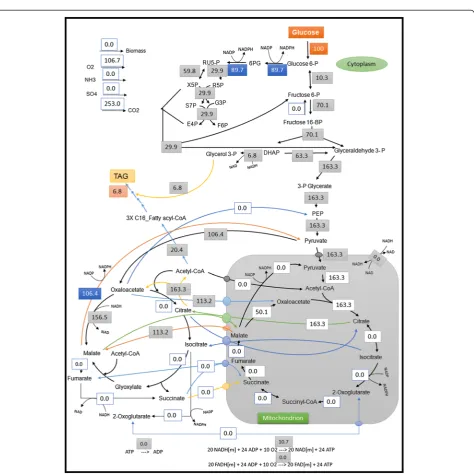
With glucose as the sole carbon and energy source, the computed optimum flux distribution is shown in Figure 1. The most common product found in 94% of the modes is cell mass whereas TAG production is found in 25% of the modes. Maximum theoretical yield of the TAG is found to be 0.07 mol.mol−1on the basis of an assumed TAG molecule size of 51 carbons (3X C16
palmitic acid + glycerol 3-phosphate). Taking the molecular weight of the assumed TAG (C51H92O6= 801.27 g.mol−1)
and partially by the cytosolic malic enzyme (values normal-ized to glucose uptake rate as shown in Figure 1). This high flux through the PP pathway might lead to carbon loss in form of CO2, but also for a better precursor availability and
growth. In fact, 37.2 mol CO2 would be released for the
synthesis of one mol TAG. Neither the malic enzyme in the cytosol nor the PP pathway alone can compensate for the required NADPH. The flux through the malic enzyme depends on the cytosolic NADH availability as the malic enzyme functions together with the pyruvate-oxaloacetate-malate cycle (POM cycle). About 10% ATP is generated by Table 1 Elementary modes (EMs) of the metabolic
network of Rhodosporidium toruloides for growth on different substrates with corresponding maximum TAG and cell mass yields
Carbon source
EMs Maximum yield of TAG [g.g−1substrate]
Maximum yield of TAG [C-mol.C-mol−1
substrate]
Maximum cell mass yield [C-mol.C-mol−1
substrate]
Glucose 14,164 0.30 0.58 0.67
Glycerol 33,970 0.32 0.63 0.73
Xylose 9,476 0.29 0.55 0.66
Arabinose 15,231 0.27 0.53 0.63
the respiratory chain reaction using the mitochondrial NADH.
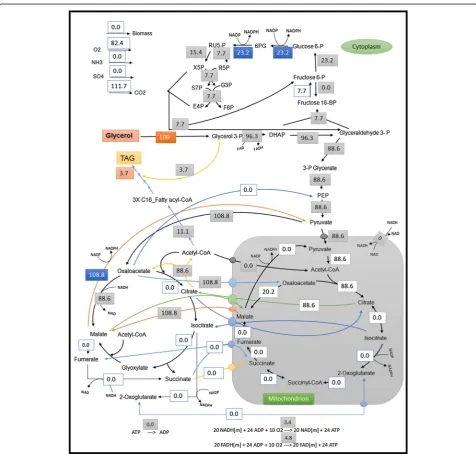
On the other hand, with glycerol as the sole substrate (Figure 2), the NADPH demand is mainly met by the cytosolic malic enzyme whereas there is a reduced PP pathway flux and hence reduced CO2 formation.
Glycerol is channeled into glycolysis via the dihydroxy-acetone to glyceraldehydes 3-phosphate. Most of the fluxes pass through the lower part of the glycolysis into the pyruvate dehydrogenase complex. Two more optimal modes (data not shown) were identified where similar maximum TAG yields were observed with a succinate to fumarate interconversion in the mitochondrion and
cytoplasm. The required ATP is also generated by both the respiratory chain reactions in the mitochondrion.
Similarly, the optimal flux distributions with xylose and arabinose as substrates are shown in Additional file 1: Figures S2 and S3, respectively in the Supplement. Higher numbers of EMs were observed on arabinose compared to xylose. About 96% of the modes produced cell mass and 23% of the modes showed TAG produc-tion on both the pentoses. A very high PP pathway fluxes is observed on both pentoses, obviously due to the requirement of NADPH for uptake of these sub-strates [24]. Xylose showed slightly higher theoretical yields of TAG than arabinose. Most of the fluxes are
channeled through the gluconeogenic glucose 6-phosphate isomerase reaction into the PP pathway on both the pentoses. Similar channeling of fluxes is ob-served towards the pyruvate dehydrogenase complex on both the substrates. Due to the high demand for NADPH on arabinose, the oxaloacetate transporter flux into the mitochondrion should be inactive whereas on all the other substrates it should be active for max-imal TAG synthesis. This accumulation of oxaloacetate may drive a high flux through the malate dehydrogen-ase (MDH) in the cytosol towards malate which in turn also increases the flux through the cytolsolic malic enzyme on arabinose than on xylose.
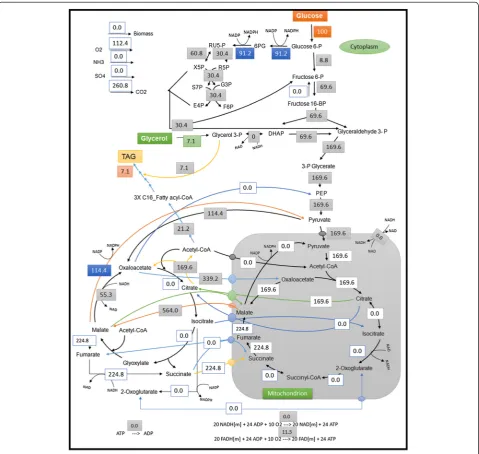
Using the same method, optimal flux distributions and EFM analysis with the proposed metabolic network ofR. toruloides were performed using blend of substrates. The maximum TAG yield obtained is 0.58 Cmol. Cmol−1
substrate with a blend of glucose and glycerol (Figure 3), compared to 0.55 Cmol. Cmol−1substrate with a blend of
xylose and glycerol (Additional file 1: Figure S4). The represented modes are the best modes consuming both the substrates. Comparing the yields from these analyses, similar maximum TAG yields are observed compared to the yields where single sugars are used (Table 1). Adding glycerol uptake did not show any effect on maximum TAG yields in thesein silicoanalyses. CO2produced per
Figure 3Optimal flux distribution on glucose and glycerol.All values are relative molar fluxes (mmol.g−1h−1) normalized to the
mole TAG on different carbon sources are compared from thein silicoanalyses, arabinose as a carbon source has the highest production of CO2 per TAG molecule
(45.6 mol/mol TAG), whereas glycerol as a sole carbon source has the lowest CO2 production (30.7 mol/mol
TAG), indicating that glycerol is a desirable substrate in terms of efficiency of carbon utilization. CO2production
is proportional to the flux entering into the PP pathway as clearly observed from thein silicopredictions.
Controlled bioreactor cultivations ofR. toruloidesand the utilization efficiency of different substrates
To compare thein silicopredictions regarding the use of different substrates an initial set of cultivations was per-formed using glucose and glycerol as the sole carbon and energy source. The time profiles of the cultivations are shown in Figure 4. Typically, in the medium used, and with a fixed aeration rate of 0.5 vvm, four distinct culture phases were observed for both substrates: a growth phase under excess of both nutrient and oxygen (10 h or 12 h for growth on glucose and glycerol, re-spectively), a growth phase under oxygen-limited condi-tion (last for about 10 and 20 h with glycerol and glucose respectively), and a phase with sufficient oxygen supply, presumably due to limitation by other nutrient(s) (which continued for almost 30 h or 40 h for glycerol and glucose respectively), and lastly a phase of oxygen
limitation again which continued till the end of the experiment.
The results shown that glucose supported a higher cell mass concentration with a maximum specific growth rate of 0.16 h−1 compared to 0.12 h−1 with glycerol as the sole carbon source. The lipid concentration on the other hand, was similar in both substrates (~8 g/L, Figure 4). As predicted form thein silicoanalysis, most of the carbon was wasted as CO2and cell mass if glucose was the sole
carbon source and lipid accumulation never exceeded 45% (w/w) of cell mass. On the other hand lower cell mass but higher lipid content was observed with glycerol and a max-imum lipid content of 57% (on cell mass basis) was achieved. Moreover, the lipid yield on glycerol consumed (0.27 g.g−1) is more closer to the theoretical maximum value (0.32 g.g−1) predicted than the lipid yield on glucose (0.12 g.g−1experimentally determined vs. 0.30 g.g−1of the-oretical maximum). It should be emphasized that the max-imum yield of TAG given in Table 1 was calculated for an optimal flux distribution where there is no cell mass pro-duction. Nevertheless, it is clear that an optimization of yield is especially needed for growth on glucose. Table 2 shows a comparison between the yields obtained by differ-entR. toruloidesstrains on different substrates and condi-tions. The lipid yield on glucose could be improved by proper process control, especially by applying nitrogen or phosphorous limitations as demonstrated in literature. We found in this work that the lipid yield on glucose can be sig-nificantly improved by using blend with glycerol.
ATP requirements for growth, lipid production and maintenance are supplied mainly through the TCA cycle in the mitochondria. In fact, ourin silicoanalysis was all done with a fixed P:O ratio of 1.2. The effects of oxida-tive phosphorylation (with varied P:O ratio) on TAG yields using glucose as a substrate were analyzed using the proposed model. The change in P:O ratios (from 1.2 to 2) neither showed significant effect on the TAG yields (from 0.58 to 0.60 Cmol.Cmol−1 glucose), nor cell mass
yield (0.67 to 0.71 Cmol.Cmol−1 glucose), respectively.
Hence, it can be concluded that ATP generated by oxi-dative phosphorylation is not a major limiting factor for TAG synthesis. In agreement with the in silico analysis, controlling the oxygen concentration at 50% air satur-ation in the fermentsatur-ation broth of R. toruloides grown either on glucose or glycerol throughout the cultivation process did not have any significant effect on the yield (Table 2). Similar to the cultivations without pO2control
(e.g. O2 limitation in phases 2 and 4, see Figure 4), the maximal growth rate with glucose was 0.23 h−1 com-pared to 0.13 h−1with glycerol in pO2controlled
cultiva-tions. The maximum lipid content on glycerol was 61% vs. 57% in pO2uncontrolled culture, whereas it was 48%
on glucose vs. 41% in pO2 uncontrolled culture. The
lipid productivity increased significantly in the pO2
controlled experiments, mainly because of the increased growth rates.
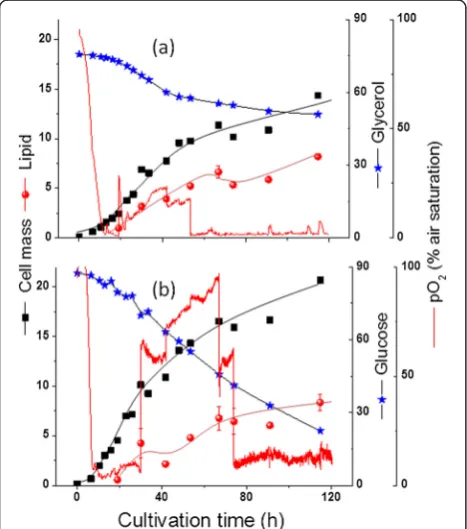
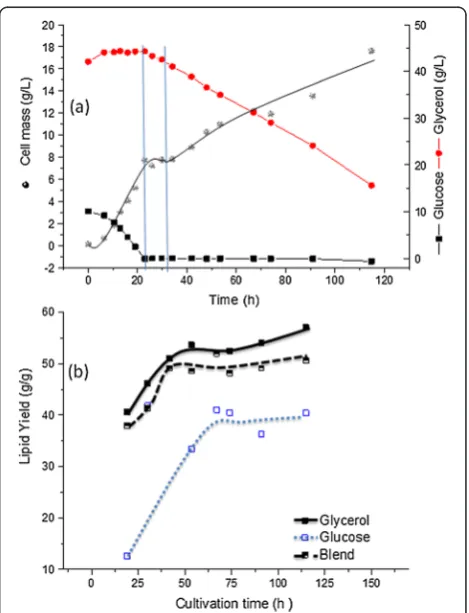
Blends of sugars and glycerol were also tested for the production of lipid by R. toruloides. Interestingly, this strain showed a catabolite repression in the pres-ence of glucose as depicted in Figure 5a. Catabolite repression was not observed before in certain oleagin-ous yeasts. Strains ofY. lipolytica and R. glutinis were shown previously to metabolize both carbon sources simultaneously [23,25,26].
As shown in Figure 5a, a clear diauxic growth was observed in the mixed substrate cultivations: glycerol was consumed only after glucose consumption in this case. Despite of the observed catabolite repression, the addition of glycerol enhanced the lipid yield on glucose significantly (Figure 5b), confirming the predictions from thein silicoanalysis. In fact, the mixed substrate cultiva-tion has the dual advantages of efficient cell mass pro-duction (normally maximized with glucose) with higher lipid content (obtained normally with glycerol). The lipid yields on the substrate consumed and the specific lipid productivities on cell mass are higher when glucose and glycerol are used in mixture rather than only glucose (Table 2).
In the above blend substrate fermentation experiments, glucose was used at a concentration of 10% of the added carbon source. The effect of different combinations of the substrates on the lipid yield was further investigated in flask experiments. As compared to mono-substrate fermentation with glucose, a 26% increase of lipid yield was observed if glycerol is added (Figure 6). Similarly to the above results from controlled bioreactors, glucose as mono-substrate
Table 2 Experimental lipid yields and productivity of differentR. toruloidesstrains grown on different substrates
Carbon source Lipid productivity Condition Lipid yield* (g/g substrate)
Lipid yield (C-mol.C-mol−1
substrate)
Reference (g/L/h)
glucose 0.15 Batch- N limiting, pO2 controlled 0.15 0.29 This work
glycerol 0.06 Batch- N limiting, pO2 controlled 0.24 0.47
glucose + glycerol 0.12 Batch- N limiting, pO2 controlled 0.17 0.33
glucose 0.07 Batch- N limiting, pO2 un-controlled 0.12 0.23
glycerol 0.06 Batch- N limiting, pO2 un-controlled 0.27 0.53
glucose + glycerol 0.07 Batch- N limiting, pO2 un-controlled 0.2 0.38
Glucose + glycerol + xylose 0.08 Batch- N limiting, pO2 controlled 0.22 0.42
(10:20:30)
Biomass hydrolysate + glycerol 0.09 Batch- N limiting, pO2 controlled 0.17 –
(glucose- xylose -glycerol =10:20:30)
glucose - Batch, phosphorous limiting 0.21 – [17]
glucose - Continuous- nitrogen limiting 0.19 – [38]
TAG molecule with 51 carbons and a molecular weight of 801.27 g/mol are used to calculate the yields in C-mol/C-mol. *lipid yield was calculated from the slope between lipid concentration against consumed sugar(s).
Figure 5pO2uncontrolled cultivation ofR. toruloidesand the
supported the highest cell mass production (13.7 g.L−1) with the lowest lipid content (32%). Similarly, with a closely related yeast strainR. glutinis, Easterling [23] reported that blend substrate fermentation produced more cell mass than when a single carbon source was provided. They also re-ported that the lipid content was minimum with glucose and significantly higher with either glycerol or blend of both. However, they did not report catabolite repression for R. glutinis. However, it should be stressed that, on mixtures of carbohydrates and with the sequential utilization of sugars, the sugar is being consumed with more nitrogen available (and hence more cell mass formation), followed by glycerol consumption during a period of nitrogen re-stricted growth which will have a positive effect on the lipid yield. Still, the mechanism of the positive role of glycerol for the lipid synthesis of cells grown in blends deserves more detailed studies. Glycerol can be utilized as a source of carbon and energy. But under certain conditions (e.g. in pO2-controlled culture with glucose as the sole carbon source), R. toruloides can produce glycerol extracellularly up to 5 g/L (data not shown). The two most important functions of glycerol synthesis in yeast are related to redox
balancing and the hyperosmotic stress response [27]. In Saccharomyces cerevisiae,production of glycerol occurs to maintain the redox balance. Interestingly, glycerol produc-tion is found to be higher in a minimal medium than in a complex medium [28]. It was concluded that in a minimal medium thede novosynthesis of amino acids from glucose and ammonia leads to an excess of NADH which is re-oxidized by glycerol formation. In osmotolerant yeasts, gly-cerol plays a crucial role in their survival [29]. Recently, Petelenz-kurdziel et al. [30] reported that S. cerevisiae adapts to hyperosmotic stress by activating the HOG sig-naling cascade, which controls glycerol accumulation, pro-duction and import. Moreover, it was also shown that glycerol transport depends on the strain and the growth conditions. Glycerol production has been never reported in R. toruloides, and hence transcriptomic analysis is being further performed in our laboratory.
The effects of different growth substrates and culture conditions on the fatty acid composition were also stud-ied (Figure 7). In oxygen controlled conditions at pO2of
50% of air saturation, and on all the substrates and blends used, palmitic, oleic and linoleic acid constitute more than 90% of the total fatty acids. In oxygen un-controlled cultivation (constant aeration and agitation, pO2 not controlled), about 65% of the fatty acid
measured is unsaturated (oleic acid and linoleic acid) if glycerol or blend are used, compared to 57% of saturated fatty acids (lauric acid, stearic acid and palmitic acid) if glucose is the sole carbon source. Oxygen limitation has significantly influenced the fraction of saturated and un-saturated fatty acid composition in the lipid produced by R.toruloides especially on glycerol or mixed substrates. Oxygen controlled conditions derived fatty acid compo-sitions that are suitable for biodiesel conversion [9] whereas oxygen un-controlled conditions produced sig-nificant amounts of saturated fatty acids which are close to be substitutes of certain important products like cocoa butter.
R. toruloidesis a known lipogenic yeast and the results presented here confirm its ability to accumulate over Figure 6Cell mass and lipid production byR. toruloides
grown on mono-substrate and on different variation of dual substrate fermentation.
60% of its cell mass as lipid. However, lipid accumula-tion was strongly affected by the nature of the carbon source provided. The recently sequenced and annotated genome of R. toruloides, its proteomic analysis and the available protein annotation have opened doors to understand the underlying mechanism of this organism for lipid production [31-33]. In this work, elementary modes were used to decompose the complex metabolic network into its basic functioning units and to identify the potentials of triacyglyceride production on different sub-strates in R. toruloides. Maximum theoretical TAG yields on hexoses (glucose), pentose (xylose and arabionse), glycerol and on mixture of hexoses & glycerol, pentose & glycerol have been estimated (Table 1) and were in general agreement with previously reported theoretical maximum yields [34,35]. As shown from the computed solution span in Additional file 1: Figure S1, the production is still far from the theoretical optimum and the distance between the actual production state on glucose or glycerol and the the-oretical optimum suggests an enormous potential for future optimization.In silico optimization, identification of limit-ing steps and finally suggestions for future genetic modifi-cation are discussed below.
One of the key processes for fatty acid biosynthesis is the provision of reducing power (e.g. NADPH) to reduce the acetyl group and channel it into the acyl chain of fatty acid. InY. lipolytica, the PP pathway is assumed to be the sole supplier of NADPH for lipid synthesis, since it does not possess a cytosolic malic enzyme [36] and the deletion of mitochondrial malic enzyme did not show any effect on lipid production [37]. In R. toru-loides, an alternative NADPH supplying reaction would be the cytosolic NADP-dependent isocitrate dehydro-genase (ICDH) which is inactive in the predicted optimal flux distribution of glucose (Figure 1). A single gene deletion study of our model was performed to remove the cytosolic malic enzyme from the reactions. A reduction in
maximum theoretical yield of TAG was observed (from 0.30 g.g−1to 0.27 g.g−1) on glucose and glycerol (0.32 g.g−1 to 0.27 g.g−1). However, the theoretical maximum yield retained to 0.30 g.g−1on glucose and 0.32 g.g−1on gly-cerol if a NADP-dependent acetaldehyde dehydrogen-ase (ALD6) is incorporated. This enzyme constitutively catalyzes the conversion of acetaldehyde to acetate, generating an NADPH in the cytoplasm. Another alter-nate route for supplying NADPH as proposed by Ratle-dge [34] can be a mitochondrial NAD-dependent ICDH acting in the reverse direction. EFM analysis and opti-mal flux distribution were done (Additional file 1: Figure S5) and the maximum theoretical yield of TAG on glucose is retained to 0.30 g.g−1 glucose. A third possible target could be a heterologous NADPH gener-ating enzyme or an endogenous engineered NADPH generating enzyme, both in the glycolytic pathway [38] which could be a potential source for NADPH. By changing GAPDH, which is a NAD-dependent glyceral-dehyde dehydrogenase in the glycolytic pathway, to an NADP-dependent enzyme can increase the theoretical TAG yields by 7% on glucose and 9% on glycerol.
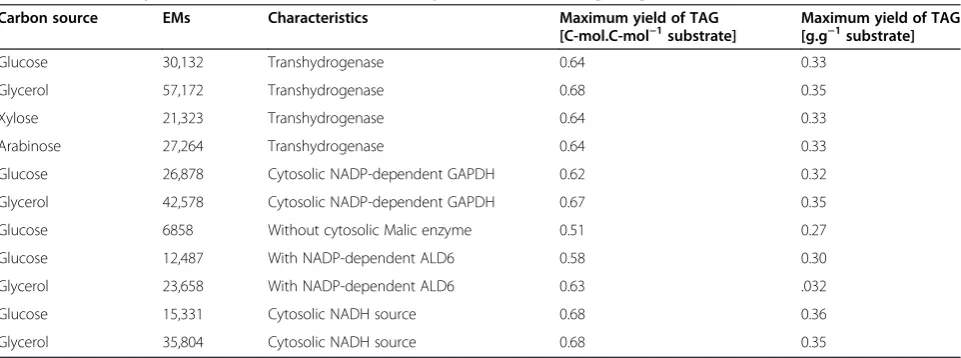
Transhydrogenases for converting NADH to NADPH could be another alternative source for enhancing the avail-ability of NADPH. Nevertheless, oleaginous yeasts or fungi have never been reported to harbor a transhydrogenase. Bacterial cells on the other hand, possess transhydrogenase activity. Recent genome sequencing and annotation has predicted a NADP-transhydrogenase like protein (RTG_ 03342) in Rhodotorula glutinis ATCC 204091 [39] with a UniProtKB idGOT2B1. This protein is 84% identical to an uncharacterized protein ofR. toruloides(RHTO_06438). A theoretical analysis of the metabolic implications of a trans-hydrogenase reaction was investigated using the R. toru-loides model. About 10% higher theoretical maximum yields were calculated on all the substrates when a transhy-drogenase activity was introduced (Table 3). The optimal
Table 3 Elementary modes (EMs) and theoretical TAG yields with heterologous genes/reactions
Carbon source EMs Characteristics Maximum yield of TAG
[C-mol.C-mol−1substrate] Maximum yield of TAG[g.g−1substrate]
Glucose 30,132 Transhydrogenase 0.64 0.33
Glycerol 57,172 Transhydrogenase 0.68 0.35
Xylose 21,323 Transhydrogenase 0.64 0.33
Arabinose 27,264 Transhydrogenase 0.64 0.33
Glucose 26,878 Cytosolic NADP-dependent GAPDH 0.62 0.32
Glycerol 42,578 Cytosolic NADP-dependent GAPDH 0.67 0.35
Glucose 6858 Without cytosolic Malic enzyme 0.51 0.27
Glucose 12,487 With NADP-dependent ALD6 0.58 0.30
Glycerol 23,658 With NADP-dependent ALD6 0.63 .032
Glucose 15,331 Cytosolic NADH source 0.68 0.36
modes with the highest lipid yield do not include PP pathway flux but a high flux through the glycolysis is found which generates the cytosolic NADH for con-version to NADPH through the transhydrogenase re-action. On all sugars about 10% of the flux is also observed for the cytosolic NADP-dependent ICDH providing NADPH other than the transhydrogenase for TAG synthesis. On glycerol the sole NADPH sup-plier is found to be the transhydrogenase reaction. With the aid of already established genetic engineering techniques [40] for R.toruloides, the predicted modifi-cations should facilitate the development of superior lipid producing strains.
Conclusions
The present work describes the successful application of reconstruction of metabolic network and it’s in silico analysis for determining and understanding the potential and metabolic pathways for lipid production in R. toruloides grown on different substrates, espe-cially for substrate blends. Cultivations ofR. toruloides were carried out with different substrates and in a well-controlled bioreactor system. The experimental results are in general agreement with model predic-tions in terms of lipid yield.
The constructed metabolic model can be used to guide further optimization of lipid synthesis in this strain. The maximal lipid yield experimentally achieved is still sig-nificantly below the theoretical maximum, especially for growth on glucose (0.29 vs. 0.58 C-Mol/C-Mol) and its blend with glycerol. Several strategies to increase the lipid yield are identified and discussed with the help of the metabolic model.
Methods
Microorganism and media
R. toruloidesDSMZ 4444 was used for the current study. The strain was maintained at −80°C on potato dextrose medium with 20% glycerol (v/v). The medium for seed cul-tures and main culcul-tures was a nitrogen limited medium which is similar to that reported previously [26]. Carbon sources (glucose, glycerol, xylose, arabinose or biomass hydrolysates) were autoclaved separately and added together with sterile FeCL3and CaCl2solutions and
in-oculated immediately. Spruce BH (Borregard, Norway) was also used in co-substrate fermentation with gly-cerol. An enzymatic hydrolysis of spruce was done without buffer. The hydrolysate was then heated at 80°C for 15–20 min to inactivate the enzymes. The supernatant was removed and filtered with a centrifuge with filter bag. The sample was then concentrated by vacuum evaporation at 60°C. The concentrated hydrol-ysate contained 550 g/L glucose and 35 g/L xylose.
Cultivations
Seed cultures and cultivations in flasks were performed in baffled shake flasks incubated at 30°C and 180 rpm for 24 h. Batch cultivations were performed in a 1.5 L well-equipped parallel bioreactor system (DASGIP paral-lel bioreactor system, Jülich, Germany) with 1 L initial working volume. Cultivations were started by inoculat-ing 30 mL (3%) from the seed cultures grown for 24 h. pH was maintained at 6.0 using 5 N NaOH and 2 M HCL. Dissolved oxygen was maintained at 50% air satur-ation. Carbon dioxide evolution rates and oxygen uptake rates were automatically evaluated by the online DAS-GIP off gas analyzing system equipped with sensors from Bluesens.
Analytical methods
Cell growth was recorded as optical density at 600 nm. Cell mass was harvested during the cultivations after centrifuga-tion (5000 rpm, 10 min at 4°C). Cell dry weight was deter-mined gravimetrically after drying the harvested cells in an oven at 80°C to a constant weight. Extraction of lipids was performed with a modified method described previously using Folsch solution (Chloroform: Methanol = 2:1 vol.vol-1, [41]. Non-lipid cell mass was calculated after subtraction of intracellular lipids from the total cell mass. Quantification of glucose, glycerol and organic acids was carried out using high-performance liquid chromatography (HPLC; Kontron Instruments, United Kingdom) with separation on an Aminex HPX-87H column at 60°C with 0.005 M H2SO4
and detection via refractive index or by UV absorption at 210 nm. Ammonia concentration in the supernatant was determined by photometric measurements using a kit from Macherey Nagel, Germany. GC analysis of the fatty acid methyl esters was performed as reported [42] with a Varian 3900 gas chromatograph equipped with a flame ionization detector (FID) and a TR-FAME column (Thermo Scientific, Germany, 50 m X 0.22 mm X 0.25μm).
Metabolic network and elementary mode analysis A metabolic network with the most important reactions of R. toruloides was reconstructed and is depicted in Figure 8. A complete list of the considered reactions is represented in the Additional file 1: Table S1. The metabolic network model was built manually by con-sidering the available genome sequence and proteomic evidences [33] from UniProtKB. Briefly, the model includes all relevant pathways of central carbon me-tabolism comprising of glucose, glycerol, xylose and arabinose uptakes. Triacylglycerol (TAG) synthesis is assumed to be formed from glycerol and C16
difference in the yields from that were observed based on C16palmitic acid assumption. So, C16palmitic acid
was used for analysis for all the considered in silico predictions. Cellular compartments mitochondrion and cytosol were considered together with respective transport reactions. For elementary mode analysis (EFM), the influx of substrates (glucose, glycerol, xylose, arabinose, oxygen, nitrogen and sulphur) and efflux of products (triacylglyceride, cell mass, carbon dioxide and ATP for maintenance) are considered. The P/O ratio is taken as 1.2 and the cell mass equation is taken from S. cerevisiae’sdata [43]. EFMs were calculated using the soft-ware tool CellNetAnalyzer [44] in MATLAB 2013a. The EFMs were sorted and the theoretical yields on different
substrates were calculated using Microsoft Excel. EFMs correspond to minimal functional pathways of a metabolic network and are useful to study various functional net-work properties [45,46].
Additional file
Additional fie 1: Table S1.In silicopathway analysis and lipid production ofRhodosporidium toruloideson mixed substrates.Figure S1.
The biomass yield [c-mol.c-mol-1] on corresponding substrates is plotted against the TAG yield on the substrate which is in c-mol.c-mol-1. Theoretical
maximum yields on each substrate with and without biomass formation are represented.Figure S2.Optimal flux distribution on xylose. All values are relative molar fluxes (mmol.g-1h-1) normalized to the xylose uptake rate.
Figure S3.Optimal flux distribution on arabinose. All values are relative molar fluxes (mmol.g-1h-1) normalized to the arabinose uptake rate.Figure S4.
Optimal flux distribution on xylose and glycerol. All values are relative molar fluxes (mmol.g-1h-1) normalized to the xylose uptake rate.Figure S5.
Optimal flux distribution on glucose with ICDH acting in reverse direction and without cytosolic malic enzyme. All values are relative molar fluxes (mmol.g-1h-1) normalized to the xylose uptake rate.
Competing interests
The authors declare that they have no competing interests.
Authors’contributions
RRB and WS contributed equally in the design and interpretation of the experiments and results. RRB constructed the metabolic pathway, did thein silicoanalysis and interpretations. RRB and WS designed the experiments and performed the experiments with GM. RRB and WS wrote and drafted the manuscript. APZ supervised the research. All authors read and approved the final manuscript.
Acknowledgements
The financial support of this investigation from the BMBF under the project ‘Bio4Oil project number: 03SF0467’is gratefully acknowledged. We thank the project partners Prof. Geoge Aggelis from the University of Patra und Prof. Seraphim Papanikoloau from Agricultural University of Athens for helpful discussion. We also thank Dr. Wei Wang for helping to set-up the GC method for lipid analysis.
Received: 24 December 2014 Accepted: 24 February 2015
References
1. Yang F, Hanna MA, Sun R. Value-added uses for crude glycerol–a byproduct of biodiesel production. Biotechnol Biofuels. 2012;5:13.
2. Xu J, Zhao X, Wang W, Du W, Liu D. Microbial conversion of biodiesel byproduct glycerol to triacylglycerols by oleaginous yeastRhodosporidium toruloidesand the individual effect of some impurities on lipid production. Biochem Eng J. 2012;65:30–6.
3. Kiran EU, Trzcinski A, Webb C. Microbial oil produced from biodiesel by-products could enhance overall production. Bioresour Technol. 2013;129:650–4.
4. Chatzifragkou A, Makri A, Belka A, Bellou S, Mavrou M, Mastoridou M, et al. Biotechnological conversions of biodiesel derived waste glycerol by yeast and fungal species. Energy. 2011;36:1097–108.
5. Dietz D, Zeng AP. Efficient production of 1,3-propanediol from fermentation of crude glycerol with mixed cultures in a simple medium. Bioprocess Biosyst Eng. 2014;37:225–33.
6. Kaeding T, DaLuz J, Kube J, Zeng AP. Integrated study of fermentation and downstream processing in a miniplant significantly improved the microbial 1,3-propanediol production from raw glycerol. Bioprocess Biosyst Eng. 2014, Nov 4. [Epub ahead of print]
7. Moore SJ, Mayer MJ, Biedendieck R, Deery E, Warren MJ. Towards a cell factory for vitamin B12 production inBacillus megaterium: bypassing of the cobalamin riboswitch control elements. N Biotechnol. 2014;31:553–61. 8. Papanikolaou S, Beopoulos A, Koletti A, Thevenieau F, Koutinas AA, Nicaud
JM, et al. Importance of the methyl-citrate cycle on glycerol metabolism in the yeastYarrowia lipolytica. J Biotechnol. 2013;168:303–14.
9. Minkevich IG, Dedyukhina EG, Chistyakova TI. The effect of lipid content on the elemental composition and energy capacity of yeast biomass. Appl Microbiol Biotechnol. 2010;88:799–806.
10. Papanikolaou S, Aggelis G. Lipid of oleaginous yeast. Part I: biochemistry of single cell oil production. Eur J Lipid Sci Technol. 2011;113:1031–51.
11. Liu B, Zhao ZK. Biodiesel production by direct methanolysis of oleaginous microbial biomass. J Cem Technol Biotechnol. 2007;82:775–80.
12. Papanikolaou S, Muniglia L, Chevalot I, Aggelis G, Marc I. Accumulation of a cocoa-butter-like lipid byYarrowia lipolyticacultivated on agro-industrial residues. Curr Microbiol. 2003;46:124–30.
13. Zhao X, Kong X, Hua Y, Feng B, Zhao ZK. Medium optimization for lipid production through co-fermentation of glucose and xylose by the oleaginous yeastLipomyces starkeyi. Eur J Lipid Sci Technol. 2008;110:405–12.
14. Gong Z, Wang Q, Shen H, Wang L, Xie H, Zhao ZK. Conversion of biomass-derived oligosaccharides into lipids. Biotechnol Biofuels. 2014;7:13.
15. Koutinas AA, Vlysidis A, Pleissner D, Kopsahelis N, Kookos IK, Papanikolaou S, et al. Valorization of industrial waste and by-product streams via fermentation for the production of chemicals and biopolymers. Chem Soc Rev. 2014;43:2587–627.
16. Muller EE, Sheik AR, Wilmes P. Lipid-based biofuel production from wastewater. Curr Opin Biotechnol. 2014;30C:9–16.
17. Wiebe MG, Koivuranta K, Penttila M, Ruohonen L. Lipid production in batch and fed-batch cultures ofRhodosporidium toruloidesfrom 5 and 6 carbon carbohydrates. BMC Biotechnol. 2012;12:26.
18. Zhou W, Wang W, Li Y, Zhang Y. Lipid production byRhodosporidium toruloidesY2 in bioethanol wastewater and evaluation of biomass energetic yield. Bioresour Technol. 2013;127:435–40.
19. Ageitos JM, Vallejo JA, Veiga-Crespo P, Villa TG. Oily yeasts as oleaginous cell factories. Appl Microbiol Biotechnol. 2011;90:1219–27.
20. Jin G, Zhang Y, Shen H, Yang X, Xie H, Zhao ZK. Fatty acid ethyl esters production in aqueous phase by the oleaginous yeastRhodosporidium toruloides. Bioresour Technol. 2013;150:266–70.
21. Wu S, Hu C, Jin G, Zhao X, Zhao ZK. Phosphate-limitation mediated lipid production byRhodosporidium toruloides. Bioresour Technol. 2010;101:6124–9.
22. Yang X, Jin G, Gong Z, Shen H, Bai F, Zhao ZK. Recycling biodiesel-derived glycerol by the oleaginous yeastRhodosporidium toruloidesY4 through the two-stage lipid production process. Biochem Eng J. 2014;91:86–91. 23. Easterling ER, French WT, Hernandez R, Licha M. The effect of glycerol as a
sole and secondary substrate on the growth and fatty acid composition of
Rhodotorula glutinis. Bioresour Technol. 2009;100:356–61.
24. Fonseca C, Romao R, Sousa HR, Hägerdal BH, Martins IS. L-Arabinose transport and catabolism in yeast. FEBS. 2007;274:3589–600.
25. Workman M, Holt P, Thykaer J. Comparing cellular performance ofYarrowia lipolyticaduring growth on glucose and glycerol in submerged cultivations. AMB Express. 2013;3:58.
26. Papanikolaou S, Muniglia L, Chevalot I, Aggelis G, Marc I.Yarrowia lipolytica
as a potential producer of citric acid from raw glycerol. J Appl Microbiol. 2002;92:737–44.
27. Jain VK, Divol B, Prior BA, Bauer FF. Elimination of glycerol and replacement with alternative products in ethanol fermentation bySaccharomyces cerevisiae. J Ind Microbiol Biotechnol. 2011;38:1427–35.
28. Albers E, Larsson C, Liden G, Niklasson C, Gustafsson L. Influence of the nitrogen source onSaccharomyces cerevisiaeanaerobic growth and product formation. Appl Environ Microbiol. 1996;62:3187–95.
29. Hohmann S. Osmotic stress signaling and osmoadaptation in yeasts. Microbiol Mol Biol Rev. 2002;66:300–72.
30. Petelenz-Kurdziel E, Kuehn C, Nordlander B, Klein D, Hong KK, Jacobson T, et al. Quantitative analysis of glycerol accumulation, glycolysis and growth under hyper osmotic stress. PLoS Comput Biol. 2013;9:e1003084. 31. Kumar S, Kusheaha H, Bachhawat AK, Raghava GP, Ganesan K. Genome
sequence of the oleaginous red yeastRhodosporidium toruloidesMTCC 457. Eukaryot Cell. 2012;11:1083–4.
32. Liu H, Zhao X, Wang F, Li Y, Jiang X, Ye M, et al. Comparative proteomic analysis ofRhodosporidium toruloidesduring lipid accumulation. Yeast. 2009;26:553–66.
33. Zhu Z, Zhang S, Liu H, Shen H, Lin X, Yang F, et al. A multi-omic map of the lipid-producing yeastRhodosporidium toruloides. Nat Commun. 2012;3:1112. 34. Ratledge C. The role of malic enzyme as the provider of NADPH in
oleaginous microorganisms: a reappraisal and unsolved problems. Biotechnol Lett. 2014;36:1557–68.
35. Ratledge C, Wynn JP. The biochemistry and molecular biology of lipid accumulation in oleaginous microorganisms. Adv Appl Microbiol. 2002;51:1–51.
37. Zhang H, Zhang L, Chen H, Chen YQ, Raltedge C, Song Y, et al. Regulatory properties of malic enzyme in the oleaginous yeast,Yarrowia lipolytica, and its non-involvement in lipid accumulation. Biotechnol Lett. 2013;35:2091–8. 38. Bommareddy RR, Chen Z, Rappert S, Zeng AP. A de novo NADPH
generation pathway for improving lysine production ofCorynebacterium glutamicumby rational design of the coenzyme specificity of glyceraldehyde 3-phosphate dehydrogenase. Metab Eng. 2014;25:30–7. 39. Paul D, Magbanua Z, Arick M, French T, Bridges SM, Burgess SC, et al.
Genome sequence of the Oleaginous YeastRhodotorula glutinisATCC 204091. Genome Announc. 2014;2:e00046–14.
40. Lin X, Wang Y, Zhang S, Zhu Z, Zhou YJ, Yang F, et al. Functional integration of multiple genes into the genome of the oleaginous yeast
Rhodosporidium toruloides. FEMS Yeast Res. 2014;14:547–55. 41. Papanikolaou S, Galiotou-Panayotou M, Chevalot I, Komaitis M, Marc I,
Aggelis G. Influence of glucose and saturated free-fatty acid mixtures on citric acid and lipid production byYarrowia lipolytica. Curr Microbiol. 2006;52:134–42.
42. Beopoulos A, Mrozova Z, Thevenieau F, Le Dall MT, Hapala I, Papanikolaou S, et al. Control of lipid accumulation in the yeastYarrowia lipolytica. Appl Environ Microbiol. 2008;74:7779–89.
43. Gruchattka E, Hadicke O, Klamt S, Schutz V, Kayser O. In silico profiling of Escherichia coli andSaccharomyces cerevisiaeas terpenoid factories. Microb Cell Fact. 2013;12:84.
44. Klamt S, Saez-Rodriguez J, Gilles ED. Structural and functional analysis of cellular networks with Cell NetAnalyzer. BMC Syst Biol. 2007;1:2.
45. Schuster S, Fell DA, Dandekar T. A general definition of metabolic pathways useful for systematic organization and analysis of complex metabolic networks. Nat Biotechnol. 2000;18:326–32.
46. Trinh CT, Wlaschin A, Srienc F. Elementary mode analysis: a useful metabolic pathway analysis tool for characterizing cellular metabolism. Appl Microbiol Biotechnol. 2009;81:813–26.
Submit your next manuscript to BioMed Central and take full advantage of:
• Convenient online submission
• Thorough peer review
• No space constraints or color figure charges
• Immediate publication on acceptance
• Inclusion in PubMed, CAS, Scopus and Google Scholar
• Research which is freely available for redistribution