Organized by S.V.B.I.T., Gandhinagar. Available Online at www.ijpret.com12
INTERNATIONAL JOURNAL OF PURE AND
APPLIED RESEARCH IN ENGINEERING AND
TECHNOLOGY
A PATH FOR HORIZING YOUR INNOVATIVE WORK
COST AND DESIGN COMPARISON OF STRUCTURE DESIGN BY IS: 1893-2002
AND IS: 1893-2016
PANDYA KHYATI1, BHAVSAR DINKLE2, ABHIJITSINH PARMAR3 1. U.G. Student, Department of Civil Engineering, SVBIT, Gandhinagar
2. U.G. Student, Department of Civil Engineering, SVBIT, Gandhinagar 3. Asst. Prof., Civil Department, SVBIT, Gandhinagar, Gujarat – 382021
Accepted Date: 27/01/2018; Published Date: 01/03/2018
Abstract:Indian Standard codes are regularly updated at regularly after any updation require for safety of buildings. Recently Indian Standard seismic code IS: 1893:2002 revised in year 2016 after 14 years. To improve ductility and lateral load resistant capacity of structure many equations and values are changed. In this study we have tried to compare cost analyses and structure member size by analysing and designing one structure according to IS – 1893:2002 and IS-1893:2016. For comparing both codes for same structure we have analysed structure in Staad pro and for comparing cost of structure we have used Ms- Excel. And according to this study one can concluded that cost of structure analysed and design according to IS-1893:2016 is approx. 2-3% is higher than a structure analysed and designed according to IS-1893:2002.
Keywords: Earthquake, cost comparison, Structure design, ductile detailing, Seismic design
Corresponding Author: PANDYA KHYATI
Access Online On:
www.ijpret.com
How to Cite This Article:
Pandya Khyati, IJPRET, 2018; Volume 6 (7): 12-17 PAPER-QR CODE
SPECIAL ISSUE FOR
NATIONAL LEVEL CONFERENCE
Organized by S.V.B.I.T., Gandhinagar. Available Online at www.ijpret.com13
INTRODUCTION
An earthquake is the trembling of the Earth surface due to the sudden release of energy in the Earth's lithosphere due to movement and collision of tectonic plates that creates seismic waves. The seismicity or seismic activity of an area refers to the frequency, type and size of earthquakes experienced over a period of time. A number of significant earthquakes occurred in and around India over the past century. Some of these occurred in populated and urbanized areas and hence caused great damage. Many went unnoticed, as they occurred deep under the Earth’s surface or in relatively un-inhabited places.
When an earthquake occur in any residential area, lots of people get died and many get battered. Vibrations can be occur from at several kilometres from the epicentre of the earthquake. An earthquake is a spectacle in which Earth’s surface shakes due to the relief of seismic energy from earth surface. Faults are cracks in the crust. Focus is the point where the earthquake occurs , and epicentre is point exactly above the focus.[1]
Provisions provided by seismic codes help the designer to improve the behaviour of structures so that they may resist the earthquake effects without major loss. Seismic codes are IS: 1893-2002 has been revised in year 1893-2002 after the gap of 18 years (IS: 1893-1984). Now this is again revised as IS: 1893-2016.[2] The building designed as per the earlier version of the code may be checked for recommendations made by the revised code. Deficiency are take place in IS:1893-2002 code.
The map withfour seismic zones – II, III, IV and Vhas been revised in year 2002, and again in year 2016 they remains same. The seismic zone maps are revised from time to time as more understanding is gained on the geology, the seismic tectonics and the seismic activity in the country. Department of Disaster Management of the different state governments in the country used this kind of map. This map helps them in formation for a natural disaster like earthquake. Even such maps are observed into before constructing any high rise building so as to check the level of seismology in any particular area. This map is used before any structure design and then turn results in saving life in the long run.[3]
IS:1893-2002 and IS:1893-2016 divides India in to four seismic zones according to history of Earthquakes.
Zone: I: This is said to be the least active seismic zone. Zone: III: It is included in the moderate zone.
Organized by S.V.B.I.T., Gandhinagar. Available Online at www.ijpret.com14
Table – 1 Zone Factor value (IS 1893: 2002)
Zone 2 0.10
Zone 3 0.16
Zone 4 0.24
Zone 5 0.36
A structure shall be measured as irregular as per is Indian standard code, if it deficiencies symmetry and has discontinuity in geometry, mass or load resisting elements. These irregularities may cause difficult in continuity of force movement and stress concentrations. A building should possess four main elements, mainly having simple and regular configuration, adequate lateral strength, stiffness and ductility. Structural analysis is mainly apprehensive with finding out the behaviour of a structure when subjected to some action. The dynamic loads include wind, waves, traffic, earthquakes, and blasts. Present earthquake codes define structural configuration as either regular or irregular in terms of size and shape of the building, arrangement of the structural and non-structural elements within the structure, smattering of mass in the building etc. [4]
With using STAAD- Pro software analysis is carried out to find maximum axial load. Mass and stiffness is manually calculated. With this software also mass and stiffness is calculated. Natural period is also calculated and using the IS code and observed that the with increase in storey height natural time period of building is also increased. [5]
The design of the building is dependent upon the minimum requirements as arranged in the Indian Standard Codes. The minimum requirements affecting to the structural safety of buildings are being covered by way of resting down minimum design loads which have to be assumed for dead loads, imposed loads, and other external loads, the structure would be essential to bear. By using Indian standard code, it is ensure that the structural safety of the buildings which are being designed. [6]
Problem statement
If the high raised structures are not properly designed for the resistance of lateral forces. It may cause to the complete failure of the structures and may loss human life also. Scarcities are take place if the structure is designed by considering IS: 1893-2002 Code.
SCOPE AND objectives
1. To study IS: 1893 – 2002 and IS:1893 – 2016 for the difference introduced in new code.
2. To compare analysis results obtained for old and new design codes.
3. To mention the improvements and differences in results using new design code IS1893 – 2016.
4. To design and analyse G+5 building structure with old and new design code.
Organized by S.V.B.I.T., Gandhinagar. Available Online at www.ijpret.com15 Model configuration
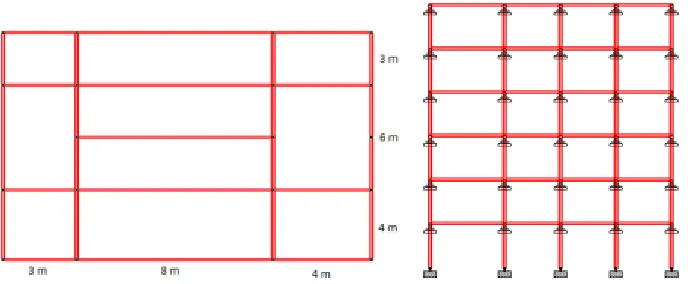
For comparing cost and size of structure one model was made in Staad Pro. Specifications of model are as below.
Beam size = 450*450 mm Column size = 600*300 mm Slab thickness = 140 mm Internal wall = 150 mm External wall = 250 mm
Grade of Concrete = M20 & Grade of Steel – FE 415
Fig : 1 : (a)Showing Staad building plan (b) side view of Staad model
result and discussion
For G+5 building horizontal acceleration Ah = (Z/2) * (Sa/g) * (I/R) Where Z = Zone factor value
Sa/
g = average response acceleration coefficient I = Important factor
R = Response reduction factor
Organized by S.V.B.I.T., Gandhinagar. Available Online at www.ijpret.com16
Table – 2 Ah Value For medium soil sites:
Different zone Old code (IS1893-2002) New code (IS:1893-2016)
Zone 2 0.025 0.030
Zone 3 0.040 0.048
Zone 4 0.060 0.072
Zone 5 0.090 0.108
Table – 3 Ah Value For rocky, or hard soil sites:
Different zone Old code (IS1893-2002) New code (IS:1893-2016)
Zone 2 0.02390 0.02390
Zone 3 0.03824 0.04588
Zone 4 0.05736 0.06883
Zone 5 0.08600 0.10324
Table – 4 Ah Value For soft soil sites:
Different zone Old code (IS1893-2002) New code (IS:1893-2016)
Zone 2 0.025 0.030
Zone 3 0.040 0.048
Zone 4 0.060 0.072
Zone 5 0.090 0.108
CONCLUSIONS
There are many corrections in Value I, R, T and other provisions to improve lateral force resistant capacity of building and due to change in value of most provisions Horizontal acceleration value is high in revised code. And earthquake force directly depending upon mass and acceleration. For most cases value of acceleration is high in new revised edition. Approx 10-17% higher value found in case of Structure analysed using IS 1893-2016 compared to analysed by IS 1893-2002 and due to this cost of structure is approximate 2-3% higher structure which is analysed and designed according revised code.
REFERENCES
1. Anoop Singh, Vikas Srivastava, N.N.Harry “Seismic Analysis and Design of Building Structures in STAAD Pro. ’’ Vol. 5, Issue 7, July 2016, IJIRSET ,PP 12105-12113
Organized by S.V.B.I.T., Gandhinagar. Available Online at www.ijpret.com17 3. Sudhir K Jain “Review of Indian seismic code, IS 1893 (Part 1): 2002. ’’ November 2003, The Indian Concrete Journal ,PP 1414-1422
4. Narayan Malviya, Sumit Pahwa “SEISMIC ANALYSIS OF HIGH RISE BUILDING WITH IS CODE 1893-2002 and IS CODE 1893-2016. ’’ Volume: 04 Issue: 11 Nov -2017, PP 2115-2119
5. Sudhir K. Patel, Prof. A.N.Desai, Prof V.B.Patel “Effect of Number of Storeys To Natural Time Period of Building, ” , 13-14 May 2011 , ncrte
6. Deepmala Pandey “Analysis & Design of G+5 Residential Building with Seismic Load Using Staad.Pro. ’’ , Vol-2, Issue-8, 2016 , ISSN , PP 1206-1208
7. IS:1893-2002 ( part-1), criteria for earthquake resistant design of structure, Bureau of Indian Standards, New Delhi, India