Available Online at www.ijpret.com 50
INTERNATIONAL JOURNAL OF PURE AND
APPLIED RESEARCH IN ENGINEERING AND
TECHNOLOGY
A PATH FOR HORIZING YOUR INNOVATIVE WORK
STUDY AND ANALYSIS OF NATURAL OIL BASED CUTTING FLUIDS USING
MINIMUM QUANTITY LUBRICATION SYSTEM FOR ALLOY STEEL
HASAN MF, DWIVEDI A
ASSISTANT PROFESSOR, DEPARTMENT OF MECHANICAL ENGINEERING, INTEGRAL UNIVERSITY, KURSI ROAD, LUCKNOW, UTTAR PRADESH 226026.
Accepted Date: 12/08/2014; Published Date: 01/10/2014
\
Abstract: A wide variety of cutting fluids are commercially available in the market. Although, these cutting fluids are beneficial in the industries, their uses are being questioned nowadays as regards to health and environmental issues. To minimize the adverse environmental effects associated with the use of cutting fluids, the hazardous components from their formulations have to be eliminated or reduced. Today to diminish the negative effects associated with cutting fluids, researchers have developed new bio based cutting fluids from various vegetable oils. MQL machining was performed much superior compared to the dry and wet machining due to substantial reduction in cutting zone temperature enabling favourable chip formation and chip–tool interaction, with enhanced the tool life and surface finish. Furthermore, MQL provides environment friendliness (maintaining neat, clean and dry working area, avoiding inconvenience and health hazards due to heat, smoke, fumes, gases, etc. and preventing pollution of the surroundings) and improves the machinability characteristics. This paper presents the effects of minimum quantity lubrication (MQL) by vegetable oil based cutting fluid on the turning performance of low alloy steel as compared to completely dry and wet machining in terms of chip–tool interface temperature, chip formation mode, tool wear and surface roughness.
Keywords: Minimum Quantity Lubrication (MQL), Cutting Fluids, Chip Formation, Surface finish, Metal Removal Rate.
Corresponding Author: MR. MOHD FAIZAN HASAN
Access Online On:
www.ijpret.com
How to Cite This Article:
Hasan MF,Dwivedi A; IJPRET, 2014; Volume 3 (2): 50-68
Available Online at www.ijpret.com 51
INTRODUCTION
The basic function of the cutting fluids in metal machining operations is to serve as a coolant as well as a lubricant. It is possible that the application of cutting fluids can improve the tool life and finally it gives the good surface finish by reducing temperature and flushing away of machined chips. The basic aim in conventional metal-removal operations is to raise productivity and reduce costs by machining at the highest practical speed along with maximum tool life, minimum rejects, and low downtime, and with the production of surfaces of satisfactory accuracy and finish. Selecting the right cutting fluid is very important as selecting the suitable machine tools, tooling speed and feed rate because it can always affect the output parameters. The ability to penetrate the cutting fluid into the cutting zone is a critical issue; else, the function of cutting fluid becomes useless. The use of cutting fluid permits higher cutting speeds, higher feed rates, greater depths of cut, lengthened tool life, decreased surface roughness, increased dimensional accuracy, and reduced power consumption .Metal-cutting fluid, in metal-cutting process, has functions of lubricating, cooling, cleaning, anti-rust etc. Its effects increases the durability of cutter and the efficiency of production, improving the product quality, and increases the service life of cutter, in turn increases the service life of machine and ensures the stability and reliability of working conditions of machine.
There are many commercially available cutting fluids which contain organic sulphur, chlorine, nitrite etc. that are harmful to the human body and environment, which have severely negative effects on their applications. The toxicity of cutting fluid causes harm to the human body, machine tools working environment etc. Under the conditions of high speed cutting or high load cutting, which results in high temperature accelerates the oil-based cutting fluid to release harmful gases and oil mist, the lower the ignition point and viscosity of cutting fluid the severer the oil mist . In case of water-based cutting fluid, the resulted micro-droplets irritate and ping the mucous membrane of the respiratory system, and cause infection. The environment pollutions resulted from cutting fluids mainly include two aspects as follows:
(1) The erratic leakage, volatilization, spatter of cutting fluid during the cutting process lead to a drastic environmental deterioration, and severely affect the safety of production.
Available Online at www.ijpret.com 52
CUTTING FLUID CHARACTERISTICS
The primary functions of cutting fluid is effective for cooling and lubrication. The cutting fluid lubrication also reduces the friction. This functions and effects require the cutting fluidsto be in a fluid form. Since the friction can be reduced, they are not able to sink the heat in the cutting zone because of this reason they are not used so frequently. The main application fields for these lubricants are thread cutting or special forming operations. The gas media have not been employed in manufacturing so far because their application is difficult. If particular gases are applied properly, they can remove the heat and also reduce the friction if their chemical properties are suitable.
Nowadays the air-mist cooling is also expanding but the cutting fluids are still the most applicable cooling medium by metal machining. Besides cooling and lubrication effects they also have other functions.
Main functions of cutting fluid are:
• cooling,
• Lubrication
• removing chips and metal fines from the tool/work piece interface,
• flushing,
• Prevention of corrosion.
Cutting fluids are used in machine shops to improve the life and function of cutting tools. These are also a key factor in the machine shop productivity and theMachined parts quality of production. Currently new requirements can be identified in the metal cutting application field. The attention is mainly concentrated on improving of working conditions, reducing the health danger for machine operators, and application of new manufacturing procedures, materials and technologies. Working properties of cutting fluids improve and are able to cover a wide area of requirements for heavy machining operations, which result from production and application of modern metal cutting machines.
Available Online at www.ijpret.com 53
to 90 per cent of all applications. Although straight cutting oils are less popular than they were in the past, they are still the fluid of choice for certain metal-working applications.
Cutting fluids can be divided into two categories :
• water-based fluids -including straight oils and soluble oils,
• oil-based fluids -including synthetics and semi-synthetics
MINIMUM QUANTITY LUBRICATION (M.Q.L)
MQL, also known as “Microlubrication”, is the latest technique of delivering metal cutting fluid to the tool/work interface. Using this technology, a little fluid, when properly selected and applied, can make a substantial difference in how effectively a tool performs. In conventional operations utilizing flood coolant, cutting fluids are selected mainly on the basis of their contributions to cutting performance. In MQL however, secondary characteristics are important. These include their safety properties, (environment pollution and human contact), biodegradability, oxidation and storage stability. This is important because the lubricant must be compatible with the environment and resistant to long term usage caused by low consumption .In MQL, lubrication is obtained via the lubricant, while a minimum cooling action is achieved by the pressurized air that reaches the tool/work interface. Further, MQL reduces induced thermal shock and helps to increase the work piece surface integrity in situations of high tool pressure .
Minimum Quantity Lubrication—the process of applying a minute amount of a quality lubricant directly into the cutting tool-work piece interface—is effective in a wide variety of metal cutting processes, including sawing, turning, milling, drilling, and tapping. Manufacturers using MQL have seen tremendous advantages.
Minimum quantity lubrication (MQL) has increasingly found its way into the area of metal cutting machining and, in many areas, has already been established as an alternative to conventional wet processing. In contrast to flood lubrication, minimum quantity lubrication uses only a few drops of lubrication (approx. 5 ml to 50 ml per hour) in machining.
Available Online at www.ijpret.com 54
iron and aluminium – using MQL in the framework of highly automated large volume production. The advantages of this new technology are clear. With respect to occupational
Safety, MQL offers numerous advantages over water-mixed metalworking fluids. A major advantage is the substantially better compatibility concerning skin care.
THE FUNCTIONAL PRINCIPLE OF MQL
In comparison to conventional flood lubrication, minimum quantity lubrication uses only a few millilitres (ml) of lubrication per hour for the machining process.
Minimum quantity lubrication today uses such precise metering that the lubricant is nearly completely used up. Typical dosage quantities range from 5 ml to 40 ml per process hour (tool cutting time). The extreme reduction in lubricant quantities results in nearly dry work pieces and chips. Losses due to evaporation and wastage, which may be considerable with emulsion lubrication (depending on the work piece being processed), are inconsequential with MQL. This greatly reduces health hazards due to emissions of metalworking fluids on the skin and in the breathed-in air of employees at their workplaces.
Lubricant is supplied by means of a minimum quantity lubrication system (MQL system).
The lubricant is either applied from outside as an aerosol using compressed air or it is “shot” at the tool in the form of droplets.
ADVANTAGES:
• Reduction of metalworking fluid quantities in use
• Decrease in the work required for monitoring and metalworking fluid maintenance
• No need to prepare and dispose of used metalworking fluids
• Decrease in the work required for cleaning the processed pieces and
• Easy recycling of the nearly dry chips due to less oil soiling.
TYPES OF MQL SYSTEMS: There are two basic types of MQL delivery systems:
Available Online at www.ijpret.com 55
Device types for minimum quantity lubrication
The external spray system consists of a coolant tank or reservoir which is connected with tubes fitted with one or more nozzles. The system can be assembled near or on the machine and has independently adjustable air and coolant flow for balancing coolant delivery. The advantages of such systems are simplicity and low cost; they are suited to be retrofitted to existing machines with high-pressure, through the tool coolant capability. They are easy to service; no critical parts are located inside the spindle. The disadvantage is that the oil-mist is subjected to dispersion and separation during its travel from the nozzle.
The second configuration is the internal mixing or two channel systems. Most commonly in a two channel system, two parallel tubes are routed through the spindle to bring oil and air to an external mixing device near the tool holder where the mist is created.
Available Online at www.ijpret.com 56
METHODOLOGY
Study of Working Principle of MQL System
Problem Formulation & Design of Experient
Study the Important Factors for Selecting the Natural Oil as a Feasible Choice
Study and Setup of Experimental Setup
Study of Experimental Parameters
Selection of Machinability Characteristics
Study of Chip Pattern and Formation Mode
Measurement of Tool Wear and Surface Roughness
LITERATURE SURVEY
The concept of minimum quantity lubrication (MQL) was suggested a decade ago as a mean for addressing the issues of environmental intrusiveness and occupational hazard associated with airborne cutting fluid particles on the shop floor. The minimization of cutting fluid leads to economic benefits by saving lubricant costs.
Bennett and Bennett (1987) found that a source of significant exposure to MWF was inhalation of aerosols. NIOSH recommended no respiratory protection for MWF concentrations of 0.5mg/m3 or less.
Derflinger et al. (1996), on the other hand, describes the drilling of aluminium–silicon alloys
as a process where dry cutting is impossible due to the high ductility of the work piece material. Without cooling and lubrication, the chip sticks to the tool and breaks it in a very short time during cutting.
Available Online at www.ijpret.com 57
the goal of the new international global standard ISO14001:1996 is to support environmental protection and prevention of pollution in balance with socioeconomic needs. Organizations that consider the implementation of appropriate and economically viable technologies need only to achieve those environmental objectives incorporated in the standard. The international standard may affect all organizations that aim to supply or manufacture parts on a global or domestic scale.
Klocke and Eisenblätter (1997) demonstrated the interest of dry machining and eventually met with success in the field of environmentally friendly manufacturing. However, these can be sometimes less effective when higher machining efficiency, better surface finish quality
and severer cutting conditions are required. In these circumstances, semidry operations utilizing very small amounts of cutting lubricants are expected to become a powerful tool and, in fact, they already play a significant role in a number of practical applications. Minimum quantity lubrication (MQL) refers to the use of only a minute amount of cutting fluids typically at a flow rate of 50–500ml/h. Sometimes this concept of minimum quantity lubrication is referred to as near dry lubrication or micro lubrication.
Lugscheider et al. (1997) used MQL machining technique in the reaming process of grey cast iron (GG25) and aluminium alloy (AISI 12) with coated carbide tools. The authors concluded that MQL caused a reduction in tool wear as compared to the completely dry process and, consequently, resulted in an improvement in surface quality of the holes.
Machado andWallbank (1997) conducted experiments on turning medium carbon steel (AISI 1040) using a venturi to mix compressed air (the air pressure was of 2.3 bar) with small quantities of a liquid lubricant, water or soluble oil (the mean flow rate was in between 3 and 5ml/min). The mixture was directed onto the rake face of a carbide tool against the chip flow direction. The application of of air and soluble oil was able to reduce the
Consumption of cutting fluid, but it promoted a mist in the environment with problems of odors, bacteria and fungi growth of the overhead flooding system. For this reason, the mixture of air and water was preferred. However, even if the obtained results were encouraging, the system needed yet some development to achieve the required effects in terms of cutting forces, temperature, tool life and surface finish.
Available Online at www.ijpret.com 58
Erdel (1999) demonstrated successfully a method in the minimization of MWFs called near drymachining (NDM). NDM uses very small amounts of MWF in a flow of compressed air that can be approximately 10,000 times less than overhead conventional flood cooling. Besides, the costs of acquisition, care and disposal of MWFs are two times higher and have to be taken into account when the economics involved in machining operations are compared. The increasing cost associated with the use and disposal of MWFs can be up to 17% per part for automotive components. The total manufacturing cost has to be considered even if the costs associated with cutting tools increase with decrease in use of MWF.
Lahres et al. (1999) presented the dry machining of synchronizing cones for automotive application. The work material was austenitic 22Mn6 steel. In the first step of their study, dry machining was compared to machining with coolant and minimal lubricant system. The used minimal lubricant system worked with special oil, which had food grade quality. The volume flow rates of air and oil were about 50 l/min and 20 ml/h respectively and hence, the produced chips were dry after leaving the contact zone of the cutting process. At this oil volume flow, a single chip can carry a maximum of 1ml. Therefore, the chips could be declared as being almost dry and passed for metallic recycling without further treatment. The results exhibited an advantage for the minimal lubricant technique and for the dry machining.
MaClure et al. (2001), the concept of MQL has also been suggested since a decade ago as a means of addressing the issues of environmental intrusiveness and occupational hazards associated with the airborne cutting fluid particles on factory shop floors. The minimization of cutting fluid also leads to economic benefits by way of saving lubricant costs and cycle time for cleaning work piece, tool, and machine. However, there has been little investigation of the cutting fluids to be used in MQL machining.
Available Online at www.ijpret.com 59
method led to lower cutting forces, temperatures, better surface finish, longer tool life. In addition, it was observed that tightly coiled chips were formed during wet turning and during minimal application, while long snarled chips were prevalent during dry turning. It must be noted that during minimal application, the rate of fluid was only 0.05% of that used during wet turning. The major part of the fluid used during minimal quantity application was evaporated; the remnant was carried out by work and chips and was too low in volume to cause contamination of the environment.
Stabler et al. (2003) suggested the types of fluids not applicable for the minimum quantity lubrication were water mixed cooling lubricants and their concentrates, lubricants with organic chlorine or zinc containing additives, lubricants that have to be marked according to the degree on hazardous materials, and products basing on mineral base oils in the cooling lubricant 3 ppm(parts permillion) benzpyrene.
Krahenbuhl (2005), From performance, cost, health, safety and environment points of view, therefore, considered vegetable oils as viable alternative to petroleum based metalworking cutting fluids. Significant progress has been made in dry and semi dry machining recently and MQL machining in particular has been accepted as a successful semidry application due to its environmentally friendly characteristics. Some good results have also been obtained using this technique.
Itoigawa et al. (2005), however, found that in actual conditions with high machining load, existence of this kind of boundary film was uncertain. The review of the literature suggests that the concept of MQL presents itself as a possible solution for machining in achieving slow tool wears while maintaining the cutting forces/power at reasonable levels, if the MQL parameters can be strategically tuned. The main objective of the present work was to experimentally investigate the roles of minimum quantity lubrication by vegetable oil based cutting fluid on chip–tool interface temperature, chip colour and shape, chip reduction coefficient, tool wear and surface roughness in turning alloy steel (AISI 9310) by the industrially used uncoated carbide tool (SNMG 120408 TTS) at different cutting velocities and feeds combinations as compared to wet and dry machining.
Available Online at www.ijpret.com 60
Dhar et al. (2006) employed MQL machining technique in turning AISI 4340 steel with uncoated carbide tool (SNMM120408).During experimentation, process parameters such as cutting velocity, feed rate and depth of cut were kept constant at 110m/min, 0.16mm/rev and 1.5mm respectively .Water soluble cutting fluid was supplied at flow rate of 60 ml/h and mixed with compressed air prior to being impinged on the cutting zone at a high speed.
Under same cutting conditions, MQL caused a significant reduction in tool wear and surface roughness as compared to dry and wet turning.
This study gives that the Emulsifiers have the function of dispersing the oil in water in order to make a stable oil-in-water emulsion. Here the thermal conductivity, kinematic viscosity and pH increased with an increase in the content of emulsifier whereas flash and fire points decreased with an increase in the amount of emulsifier.
REQUIRED PARAMETERS:
VARIABLES EXPERIMENT
Machine tool Lathe machine (15 hp)
Work specimen material Alloy steel ( C=0.12%, Mn= 0.55%, P=0.025%, Si= 0.25%, Ni= 3.4%, S=.025%, Cr=1.3%, Mo= 0.14%)
Hardness (BHN) 257
Size ᶲ100x 710mm
Cutting tool Uncoated carbide
Working tool geometry Inclination angle -6o Orthogonal rake angle -6o Orthogonal clearance angle 6o Nose radius 0.8mm
Cutting velocity, Vc 223,246,348,483 m/min.
Feed rate , So 0.10,0.13, 0.16, 0.18 mm/rev.
Depth of cut ‘t’ 1.0 mm
Cutting fluid MQL Condition- food grade vegetable oil
Cutting fluid supply For MQL cooling- Air- 6 bar
Available Online at www.ijpret.com 61
EXPERIMENTAL SETUP
DESIGN OF EXPERIMENT
Available Online at www.ijpret.com 62
RESULTS
1. EFFECTS OF MQL ON CUTTING TEMPERATURE
RESULTS: (i)
1. Work material: alloy steel 2. Cutting tool: uncoated carbide
3. Depth of cut: 1.0mm 4. Feed rate: 0.10mm/rev.
Table
CUTTING VELOCITY Vc(m/min) AVERAGE CHIP TOOL INTERFACE TEMPERATURE OC
MQL DRY
225 775 835
250 828 900
350 925 975
450 975 1050
475 985 1075
2. 3. 4. 5. 6. Graph
7. RESULT (ii)
1. Work material: alloy steel 2. Cutting tool: uncoated carbide
3. Depth of cut: 1.0mm 4. Feed rate: 0.16mm/rev.
0 200 400 600 800 1000 1200
225 250 350 450 475
A VE R A GE CH IP TOO L INTE R FA CE TE M PE R A TU R E
CUTTING VELOCITY Vc (m/min)
MQL 0 200 400 600 800 1000 1200
225 250 350 450 475
A VE R A GE CH IP TOO L INTE R FA CE TE M PE R A TU R E
CUTTING VELOCITY Vc(m/min)
Available Online at www.ijpret.com 63
Table
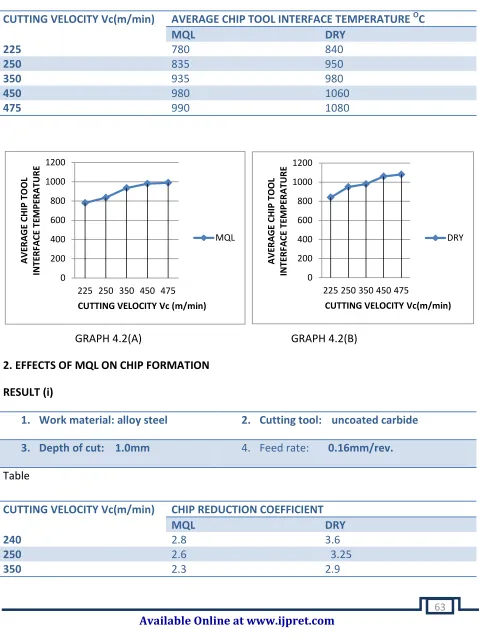
GRAPH 4.2(A) GRAPH 4.2(B)
2. EFFECTS OF MQL ON CHIP FORMATION
RESULT (i)
1. Work material: alloy steel 2. Cutting tool: uncoated carbide
3. Depth of cut: 1.0mm 4. Feed rate: 0.16mm/rev.
Table
CUTTING VELOCITY Vc(m/min) AVERAGE CHIP TOOL INTERFACE TEMPERATURE OC
MQL DRY
225 780 840
250 835 950
350 935 980
450 980 1060
475 990 1080
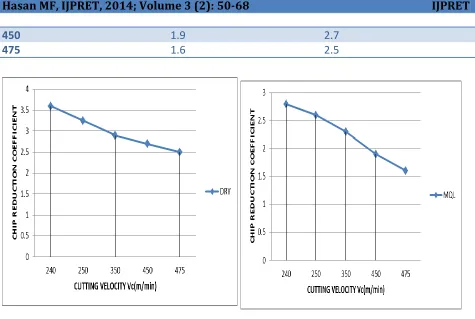
CUTTING VELOCITY Vc(m/min) CHIP REDUCTION COEFFICIENT
MQL DRY
240 2.8 3.6
250 2.6 3.25
350 2.3 2.9
0 200 400 600 800 1000 1200
225 250 350 450 475
A VE R A GE CH IP TOO L INTE R FA CE TE M PE R A TU R E
CUTTING VELOCITY Vc (m/min)
MQL 0 200 400 600 800 1000 1200
225 250 350 450 475
A VE R A GE CH IP TOO L INTE R FA CE TE M PE R A TU R E
CUTTING VELOCITY Vc(m/min)
Available Online at www.ijpret.com 64
RESULT (ii)
1. Work material: alloy steel 2. Cutting tool: uncoated carbide
3. Depth of cut: 1.0mm 4. Feed rate: 0.18mm/rev.
Table
450 1.9 2.7
475 1.6 2.5
CUTTING VELOCITY Vc(m/min) CHIP REDUCTION COEFFICIENT
MQL DRY
225 2.5 3.4
250 2.3 3.3
350 1.9 2.7
450 1.7 2.5
Available Online at www.ijpret.com 65
3. EFFECTS OF MQL ON TOOL WEAR
RESULT (i)
1. Work material: alloy steel 2. Cutting tool: uncoated carbide
3. Depth of cut: 1.0mm 4. Feed rate: 0.18mm/rev.
5. Cutting velocity: 334m/min.
MACHINING TIME AVERAGE PRINCIPLE FLANK WEAR Vb
MQL DRY
0 0 0
4 48 20
12 110 40
22 165 60
31 240 72
35 270 102
40 310 140
Available Online at www.ijpret.com 66
CONCLUSION
Based on the results of the present experimental investigation, the following conclusions can be drawn:
(i) MQL provided significant improvements expectedly, though in varying degree, in respect of chip formation modes, tool wear and surface finish throughout the range of Vc and S0 undertaken mainly due to reduction in the average chip–tool interface temperature. Wet cooling by soluble oil could not control the cutting temperature appreciably and its effectiveness decreased further with the increase in cutting velocity and feed rate.
(ii) The present MQL systems enabled reduction in average chip–tool interface temperature up
to 10% as compared to wet machining depending upon the cutting conditions and even such apparently small reduction, unlike common belief, enabled significant improvement in the major machinability indices.
(iii)The chips produced under both dry and wet condition are of ribbon type continuous chips
at lower feed rates and more or less tubular type continuous chips at higher feed rates. When machined with MQL the form of these ductile chips did not change appreciably but their back surface appeared much brighter and smoother. This indicates that the amount of reduction of temperature and presence of MQL application enabled favorable chip–tool interaction and elimination of even trace of built up edge formation.
(iv) The significant contribution of MQL jet in machinhng the low alloy steel by the carbide
insert undertaken has been the reduction in flank wear, which would enable either remarkable improvement in tool life or enhancement of productivity (MRR) allowing higher cutting velocity and feed. Such reduction in tool wear might have been possible for retardation of abrasion, decrease or prevention of adhesion and diffusion type thermal sensitivity wear at the flanks
0 100 200 300 400
0 10 20 30 40 50
A ve rag e Pr in ci p al f lan k We ar V B (µ m)
Machining Time, min
Dry
Available Online at www.ijpret.com 67
and reduction of built up edge formation that accelerates wear at the cutting edges by chipping and flaking. Minimum quantity lubrication reduces deep grooving, which is very detrimental and may cause premature and catastrophic failure of the cutting tools.
(v) Surface finishes also improved mainly due to reduction of wear and damage at the tooltip by the application of MQL.
FUTURE SCOPE
In practice, demanding production processes (HSC machining) for large-scale mass production have been implemented using process-reliable MQL. For this to be the case it is important that the elements are optimally adjusted to each other. A key objective for the user is to keep the MQL process “easy” to use and initiate. The selected NC program contains all information (optimal interface parameters, lubricant quantity and feed, tool etc.) for the smooth running of the process.
A standard for defining the relevant programs and processes is currently being worked out by a steering committee of industrial companies. This steering committee is composed of experts from companies which have already implemented minimum quantity lubrication in their own production or which, as suppliers, have many years of production system experience in using this technology. The objective of the standardisation is to adapt all commonly used MQL systems to the production process through defined configurations.
REFERENCES
1. Brockhoff, T.Walter, 1998. Fluid minimization in cutting and grinding. Abrasives Magazine (October/November), pp. 38–42.
2. Dhar, N. R. Kamuzzaman, M. Ahmed, 2006. Effect of minimum quantity lubrication (MQL) on tool wear and surface roughness in turning AISI4340 steel. J. Mater. Process. Technol. 172, 299– 304.
3. Emel Kuram, Babur Ozcelik, Erhan Demirbas, (2013), Environmentally Friendly Machining: Vegetable Based Cutting Fluids, ISBN 978-3-642-33791-8, pp 23-47, Publisher Springer Berlin Heidelberg
Available Online at www.ijpret.com 68
5. Greaves, I.A., Eisen, E.A., Smith, T.J., Pothier, L.J., Kriebel, D., Woskie, S.R., 1997. Respiratory health of automobile workers exposed to metalworking fluid aerosols: respiratory symptoms. Am. J. Ind. Med. 32 (5), 450–459.
6. Kalhofer.E.1997. Dry machining principles and applications. In: Proceedings of the 2nd Seminar Inter. delta Tecnologia UNIMEP, Santa Barbara D’Oeste, SP, Julho, Brazil, pp. 519–526.
7. M. M. A. Khan, N. R. Dhar, (2006), Performance evaluation of minimum quantity lubrication by vegetable oil in terms of cutting force, cutting zone temperature, tool wear, job dimension and surface finish in turning AISI-1060 steel, ISSN: 1009-3095, PUBLISHER: Journal of Zhejiang University, Volume 7, Issue 11 , pp 1790-1799
8. http://www.studymode.com/essays/Cutting-Oil-51450494.html
9. http://seminarprojects.net/t-minimum-quantity-lubrication