CrossMark Published by DiscoverSys
ABSTRACT
Introduction: Prehospital emergency health care plays an important role in saving lives. Proper performances of different parts of this system result in the rapid and timely deployment of an ambulance in patient’s place and prevention of death and disability. Thus, this research was conducted to compile performance evaluation indicators for pre-hospital emergency centers in 2017.
Methods: This study is a qualitative-quantitative research conducted in 2017. In order to compile the indexes for evaluating the performance of pre-hospital emergency centers, the study was done in two phases. In phase one of the study, primary items and their fields were identified according to the recent literature. In the second phase, Delphi technic in three rounds was used to finalize the items and the fields. In the first round of Delphi technic, the identified items and fields were given to experts in forms of checklist. The items and fields with average of >4 and standard deviation of <1 were confirmed, items with average of <2 and standard deviation
of <1 were removed, and other items were randomly passed into round two. In the second round, all the items with average of >4 and standard deviation of <1 were confirmed, items with an average of <3 and standard deviation of <1 were removed, and other items were randomly passed into round three. In round three, only items with average of >4 and standard deviation of <1 were confirmed, and other items were removed.
Results: The results of the study showed that 9 items in field of facilities and physical space, 10 items in field of communication, 10 items in field of ambulance, 8 items in field of human resources, 9 items in field of regulations and protocols, 3 items in field of storing equipment in the center, and 3 items in field of training were identified.
Conclusion: Considering the identification of seven effective factors in improving the quantitative and qualitative level of pre-hospital emergency services, it is highly important for authorized managers and decision-makers to improve all necessary factors.
Keywords: performance evaluation, emergency center, pre-hospital, medical emergency
Cite This Article: Askari, R., Bahrami, M.A., Pahlavanpoor, S.R., Afzali, F. 2018. Development of performance evaluation indicators for pre-hospital emergency centers. Bali Medical Journal 7(1): 182-191. DOI:10.15562/bmj.v7i1.898
Development of performance evaluation indicators
for pre-hospital emergency centers
Roohollah Askari,1,2 Mohammad Amin Bahrami,2,3 Saeed Reza Pahlavanpoor,4 Fatemeh Afzali5*
INTRODUCTION
Every organization needs a system to raise aware-ness of its services and activities quality, especially if it is a dynamic and complex organization. Moreover, lack of evaluation and control in a system may harm the organization itself.1 Evaluating the performance of an organization is a tool, not only for the organi-zation to know the efficiency of the staff but also for the staff to aware about their own positions. If this tool is well designed and applied, it can be helpful in improving, training, encouraging and punishing, and fair payment. Thus, this study reviewed the role and importance of pre-hospital emergency centers.2 Pre-hospital emergency system includes an important part of presenting health service3,4 in critical conditions outside the hospital and focuses on prevention of acute death and elimination of threatening conditions with rapid diagnosis and prompt treatment.5 Medical emergency system, which is the most important factor in eliminating death, is the front line of healthcare centers6 since this system should provide health services accord-ing to global standard protocols when dealaccord-ing with
patients. There are some reports showing 12% of the world’s disease burden is due to accidents. Regardless of their reasons and concepts, accidents have tremendous effects on the health systems that provide required care and logistics for the victims.7
The pattern of diseases have changed in recent years. As an example, the reports of Ministry of Health show that death caused by cardiovascular diseases includes all death in the recent decade. Therefore, risk management and emergency surgery increasingly became interesting subject for further researches in Iran.8
Pre-hospital medical emergency services are defined as services bridging the health needs of people outside the hospital. The needs include taking care of life-threatening events, transmitting patients and injured people to health care centers, and being ready to do missions in events with the risk of injury. The more proper, more correct, and faster are these services, the lower will be the number of death and the higher will be people’s trust to our health system.
1Assistant Professor, Healthcare management department, Shahid Sadouqhi University of Medical Sciences, Yazd, Iran
2Hospital management research center, Shahid Sadouqhi University of Medical Sciences, Yazd, Iran 3Associate Professor, Healthcare management department, Shahid Sadouqhi University of Medical Sciences, Yazd, Iran
4General Practioner, MPH. Shahid Sadouqhi University of Medical Sciences, Yazd, Iran
5M.S. Student, School of Public Health, Shahid Sadouqhi University of Medical Sciences, Yazd, Iran
*Correspondence to: Fatemeh Afzali, M.S. Student, School of Public Health, Shahid Sadouqhi University of Medical Sciences, Yazd, Iran [email protected]
Received: 2017-10-1 Accepted: 2017-10-23 Published: 2017-10-28
Volume No.: 7
Issue: 1
First page No.: 182
P-ISSN.2089-1180
E-ISSN.2302-2914
Appropriate performance of different parts of the emergency system results in rapid and well-timed ambulance deployment to the patient’s place to prevent death and disability. The success of the system depends on various factors, such as the competence of the staff, trained personnel, facil-ities, concordance, and communication system.9 Bahrami et al. in their research on evaluating pre-hospital emergency services in Yazd in 2009 found that only 14.3% of emergency centers have enough personnel and none of the ambulances have all 52 types of the equipment.9 In order to improve the services, every country should evalu-ate its emergency medical service (EMS) and start improving its quality which can be reasonably achieved. Considering the importance of pre-hos-pital emergency centers in saving people’s lives, this study was conducted in order to inform authorized managers in Yazd Province on level of standards of pre-hospital emergency services, determine the weak and strong points of each unit, as well as provide proper context to plan promotion of quan-titative and qualitative level of these services.
MATERIALS AND METHODS
This quantitative-qualitative study was conducted in 2017 in two phases in order to compile the indexes for evaluating the performance of pre-hos-pital emergency centers.
Phase One: Literature Review
A checklist was designed by interviewing 30 expe-rienced experts and reviewing researches about this topic, including modified standards of pre-hospital emergency included standards of ambulance and emergency centers equipment (Extracted from Iran National Standards and industrial researches, no. 4373), performance reports of pre-hospital emergency centers, inspection programs approved in emergency centers and drafts of pre-hospital emergency standards in Ministry of Health (No. 25921/401/d).Phase Two: Delphi Technic
In this phase, 20 experts including managers, directors, and staff of pre-hospital emergency centers in the province were selected as the target group of the study. Delphi process was conducted in three rounds.
Round one: The designed checklists for
evaluat-ing the performance of pre-hospital emergency centers in the province were given to the experts. The experts individually studied the mentioned items and fields and expressed their opinions in five-option Likert scale { (5 – highly proper) to (1 – completely improper)}. In the first round of Delphi, the identified items and fields with an
average score of >4 and standard deviation of <1 were confirmed, items with average score of <2 and standard deviation of <1 were removed, and other items were passed into the second round.
Round two: In this round, checklists were prepared individually and given scores for each item in the previous round, and the average score were given to the experts. In the second round, all items with average score of >4 and standard deviation of <1 were confirmed, and items with average score of <3 and standard deviation of <1 were removed.
Round three: Only items with average score of >4 and standard deviation of <1 were confirmed and other items were removed.
This study was approved by ethics code IR.SSU. SPH.REC.1394.9 in Yazd Shahid Sadoughi University of Medical Sciences.
RESULTS
The results of the study showed that 9 items in field of facilities and physical space, 10 items in field of communication, 10 items in field of ambulance, 8 items in field of human resources, 9 items in field of regulations and protocols, 3 items in field of stor-ing equipment in the center, and 3 items in field of training were identified.
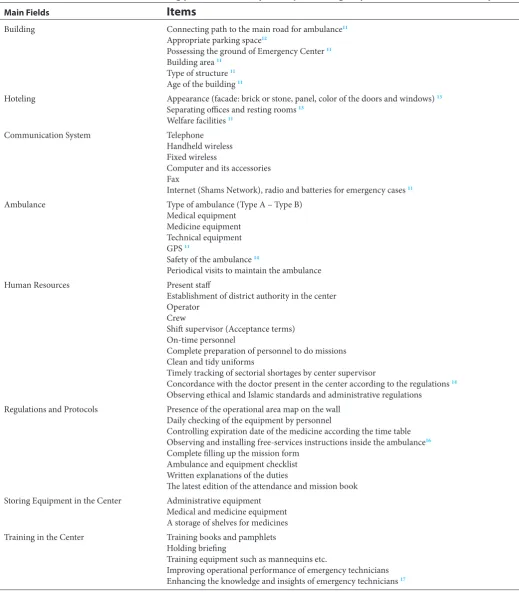
According to table 1, 8 main fields were identi-fied. These fields included building (with 6 items), hoteling (with 3 items), communicating system (with 6 items), ambulance (with 7 items), human resources (with 11 items), regulations and proto-cols (with 8 items), storing equipment in the center (with 3 items), and training in the center (with 5 items).
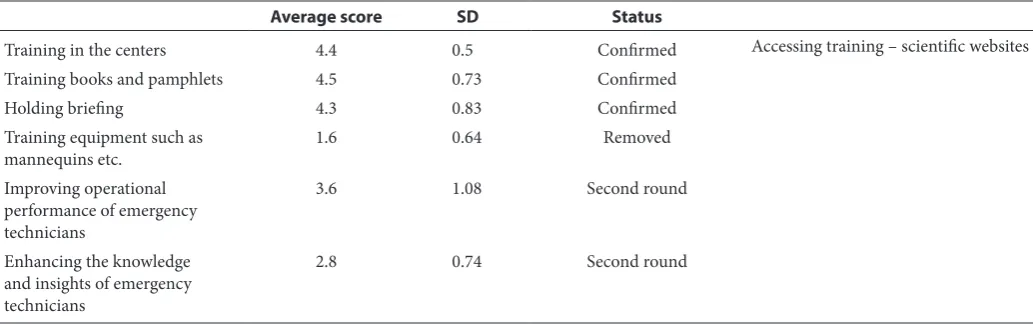
The findings in table 2 show that building field and its four items with average score of >4 and standard deviation of <1 were confirmed and other items were passed to the second round. Hoteling field and one of its items with average score of >4 and standard deviation of <1 were confirmed and two other items were passed to the second round. Three items of communication field were confirmed and other items were passed to the second round. In ambulance field, five items were confirmed, one was removed, and one item was passed to the second round. In human resources field, three items were confirmed, two items were passed to the second round, and others were removed. In storing equip-ment field, two items were confirmed and one item was removed. Finally, in training field, three items were confirmed, one item was removed and two other items were passed to the second round.
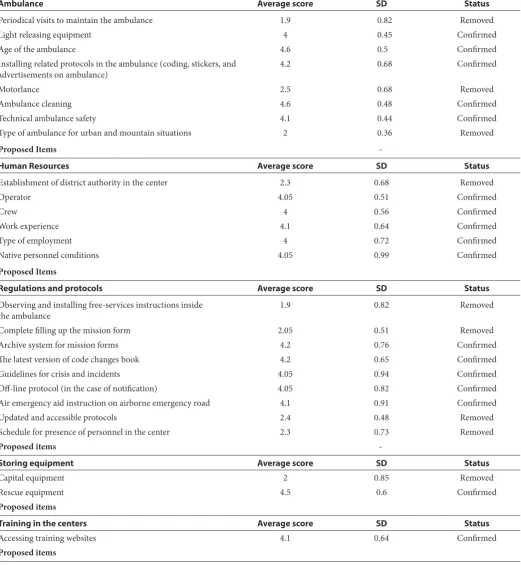
the field of communication, 5 items in the field of ambulance, 5 items in the field of human resources, 5 items in the field of regulations and protocols, 1 item in the field of storing equipment and 1 item in the field of training were confirmed
with the average score of >4 and standard devia-tion of <1.
As seen in table 4, two items in the field of communication with the average score of >4 and standard deviation <1 were confirmed.
Table 1 Fields and items for evaluating performances of pre-hospital emergency centers in literature review phase
Main Fields
Items
Building Connecting path to the main road for ambulance11
Appropriate parking space12
Possessing the ground of Emergency Center 11 Building area 11
Type of structure 11 Age of the building 11
Hoteling Appearance (facade: brick or stone, panel, color of the doors and windows) 13
Separating offices and resting rooms 13 Welfare facilities 11
Communication System Telephone
Handheld wireless Fixed wireless
Computer and its accessories Fax
Internet (Shams Network), radio and batteries for emergency cases 11
Ambulance Type of ambulance (Type A – Type B)
Medical equipment Medicine equipment Technical equipment GPS 11
Safety of the ambulance 14
Periodical visits to maintain the ambulance
Human Resources Present staff
Establishment of district authority in the center Operator
Crew
Shift supervisor (Acceptance terms) On-time personnel
Complete preparation of personnel to do missions Clean and tidy uniforms
Timely tracking of sectorial shortages by center supervisor
Concordance with the doctor present in the center according to the regulations 14 Observing ethical and Islamic standards and administrative regulations
Regulations and Protocols Presence of the operational area map on the wall
Daily checking of the equipment by personnel
Controlling expiration date of the medicine according the time table Observing and installing free-services instructions inside the ambulance16 Complete filling up the mission form
Ambulance and equipment checklist Written explanations of the duties
The latest edition of the attendance and mission book
Storing Equipment in the Center Administrative equipment
Medical and medicine equipment A storage of shelves for medicines
Training in the Center Training books and pamphlets
Holding briefing
Training equipment such as mannequins etc.
Table2 Status of the fields and items for evaluating performance in first round of Delphi technic
Average score SD Status
Building 4.1 0.36 Confirmed Proposed items
Connecting path to the main
road for ambulance 4.7 0.48 Confirmed Parking lot for personnel’s autosExercising space
Emergency exit
Distance between the center and a hospital
Identifying accident-prone centers Greenery of the center
Distance between the center and a village or town
Installing flash light outside or at the door of the center
Type and facilities of the center
Appropriate parking space 4.3 0.65 Confirmed
Possessing the ground of
Emergency Center 3.7 1.3 Second round
Building area 3.9 0.75 Second round
Type of structure 4.05 0.99 Confirmed
Age of the building 4.4 0.68 Confirmed
Average score SD Status
Hoteling 4.2 0.65 Confirmed Center cleanliness
Lightening of the center CCTV
Refreshment for personnel Fencing the center Security of the center Appearance (facade: brick or
stone, panel, color of the doors and windows)
3.5 1 Second round
Separating offices and resting
rooms 3.7 0.92 Second round
Welfare facilities 4.2 0.69 Confirmed
Average score SD Status
Communication 4.7 0.47 Confirmed VOIP telephone
Strapping wireless Safety of the wireless Cellphone
GIS in order to record the address
Telephone 4.5 0.6 Confirmed
Handheld wireless 4.05 0.82 Confirmed
Fixed wireless 4.8 0.52 Confirmed
Computer and its accessories 3.8 0.81 Second round
Fax 2.5 0.88 Second round
Internet (Shams Network) 3.9 0.91 Second round
Average score SD Status
Ambulance 4.7 0.44 Confirmed Light releasing equipment
Age of the ambulance
Installing related protocols in the ambulance (coding, stickers, and advertisements on ambulance) Motor lance
Ambulance cleanliness Technical ambulance safety Type of ambulance for urban and mountain situations
Type of ambulance (Type A –
Type B) 4.3 0.73 Confirmed
Medical equipment 4.6 0.75 Confirmed
Medicine equipment 4.6 0.82 Confirmed
Technical equipment 4.6 0.67 Confirmed
GPS 4.05 0.75 Confirmed
Safety of the ambulance 1.9 0.9 Removed
Periodical visits to maintain the
Table2 Continued
Average score SD Status
Human Resources 4.8 0.36 Confirmed Number of personnel
Work experience Type of employment
Native employment conditions
Present staff 4.6 0.68 Confirmed
Establishment of district
authority in the center 3.3 0.33 Second round
Operator 3.05 0.68 Second round
Crew 3.3 0.73 Second round
Shift supervisor (acceptance
terms) 4.3 0.73 Confirmed
On-time personnel 1.2 0.62 Removed
Complete preparation of
personnel to do missions 1 0.65 Removed
Clean and tidy uniforms 4.1 0.81 Confirmed
Timely tracking of sectoral
shortages by center supervisor 1.5 0.56 Removed
Concordance with the doctor present in the center according to the regulations
1.9 0.92 Removed
Observing ethical and Islamic standards and administrative regulations
0.95 0.64 Removed
Average score SD Status
Regulations and protocols 4.3 0.65 Confirmed Archive system for mission forms
The latest version of code changes Guidelines for crisis and incidents Off-line protocol (in the case of notification)
Air Emergency Aid Instruction on Airborne Emergency Road Updated and accessible protocols Schedule for presence of personnel in the center
Presence of the operational area
map on the wall 4.1 0.55 Confirmed
Daily checking of the equipment
by personnel 1.6 0.62 Removed
Controlling expiration date of the medicine according the time table
1.8 0.82 Removed
Observing and installing free-services instructions inside the ambulance
2.4 0.42 Second round
Complete filling up the
mission form 3.3 0.68 Second round
Ambulance and equipment
checklist 4.2 0.76 Confirmed
Written explanations of the
duties 4.2 0.82 Confirmed
The latest edition of the
attendance and mission book 4.3 0.65 Confirmed
Average score SD Status
Storing equipment 4.4 0.5 Confirmed Capital equipment- rescue equipment
Administrative equipment 4.5 0.6 Confirmed
Medical and medicine
equipment 4.2 0.82 Confirmed
A storage of shelves for
Table 3 Fields and items for evaluating the performance in the second round of Delphi technic
Field of Building and physical facilities Average score SD Status
Possessing the ground of Emergency Center 4.1 0.81 confirmed
Building area 4.1 0.67 confirmed
Parking lot for personnel’s autos 2.3 0.58 Removed
Exercising space 1.2 0.41 Removed
Emergency exit 1.1 0.36 Removed
Distance between the center and a hospital 1.3 0.47 Removed
Identifying accident- prone centers 1.7 0.47 Removed
Greenery of the center 1.6 0.67 Removed
Distance between the center and a village or town 2 0.79 Removed
Installing flash light outside or at the door of the center 4 0.64 Confirmed
Type and facilities of the center 4.2 0.69 Confirmed
Appearance (facade: brick or stone, panel, color of the doors
and windows) 4.1 0.71 Confirmed
Separating offices and resting rooms 4.3 0.58 Confirmed
Center cleanliness 4.2 0.82 Confirmed
Lightening of the center 4.3 0.73 Confirmed
Refreshment for personnel 2.05 0.39 Removed
Security of the center (CCTV, Fencing the center) 4.2 0.92 Confirmed
Proposed items
-Communication field Average score SD Status
Computer and accessories 4.2 0.53 Confirmed
Fax 4 0.32 Confirmed
Internet (Shams Network) 4.2 0.61 Confirmed
VOIP telephone 4.5 0.6 Confirmed
Strapping wireless 2.3 0.74 Removed
Safety of the wireless 2 0.45 Removed
Cellphone 4.3 0.81 Confirmed
GIS in order to record the address 2.5 0.88 Removed
Proposed items Radio with batteries for emergency situations- satellite phone
Table2 Continued
Average score SD Status
Training in the centers 4.4 0.5 Confirmed Accessing training – scientific websites
Training books and pamphlets 4.5 0.73 Confirmed
Holding briefing 4.3 0.83 Confirmed
Training equipment such as
mannequins etc. 1.6 0.64 Removed
Improving operational performance of emergency technicians
3.6 1.08 Second round
Enhancing the knowledge and insights of emergency technicians
Table 3 Continued
Ambulance Average score SD Status
Periodical visits to maintain the ambulance 1.9 0.82 Removed
Light releasing equipment 4 0.45 Confirmed
Age of the ambulance 4.6 0.5 Confirmed
Installing related protocols in the ambulance (coding, stickers, and
advertisements on ambulance) 4.2 0.68 Confirmed
Motorlance 2.5 0.68 Removed
Ambulance cleaning 4.6 0.48 Confirmed
Technical ambulance safety 4.1 0.44 Confirmed
Type of ambulance for urban and mountain situations 2 0.36 Removed
Proposed Items
-Human Resources Average score SD Status
Establishment of district authority in the center 2.3 0.68 Removed
Operator 4.05 0.51 Confirmed
Crew 4 0.56 Confirmed
Work experience 4.1 0.64 Confirmed
Type of employment 4 0.72 Confirmed
Native personnel conditions 4.05 0.99 Confirmed
Proposed Items
Regulations and protocols Average score SD Status
Observing and installing free-services instructions inside
the ambulance 1.9 0.82 Removed
Complete filling up the mission form 2.05 0.51 Removed
Archive system for mission forms 4.2 0.76 Confirmed
The latest version of code changes book 4.2 0.65 Confirmed
Guidelines for crisis and incidents 4.05 0.94 Confirmed
Off-line protocol (in the case of notification) 4.05 0.82 Confirmed
Air emergency aid instruction on airborne emergency road 4.1 0.91 Confirmed
Updated and accessible protocols 2.4 0.48 Removed
Schedule for presence of personnel in the center 2.3 0.73 Removed
Proposed items
-Storing equipment Average score SD Status
Capital equipment 2 0.85 Removed
Rescue equipment 4.5 0.6 Confirmed
Proposed items
Training in the centers Average score SD Status
Accessing training websites 4.1 0.64 Confirmed
Proposed items
Table 4 Fields and items for evaluating the performance in the third round of Delphi technic
Communication field Average score SD Status
Radio with batteries for emergency situations 4.2 0.68 Confirmed
Table 5 Fields and items for evaluating the performance of pre- hospital emergency centers in Yazd Province
Field Items
1 Building and physical facilities Possessing the ground of Emergency center Building area
Type of the structure Ambulance parking
Appearance (facade: brick or stone, panel, color of the doors and windows) Security of the center (CCTV, fencing the center, neighboring offices and buildings) Welfare facilities
Type of the center and building facilities
2 Communication system Telephone
Handheld wireless Fixed wireless
Computer and accessories Fax
Internet (Shams Network)
Radio with batteries for emergency cases VOIP telephone
Cellphone Satellite phone
3 Ambulance Type of ambulance (Type A – Type B)
Medical equipment Medicine equipment Technical equipment GPS
Light releasing equipment Age of the ambulance
Installing related protocols in the ambulance (coding, stickers, and advertisements on ambulance)
Ambulance cleanliness Technical ambulance safety
4 Human resources Present personnel
Operator Crew
Shift supervisor (acceptance terms) Work experience
Type of employment
Native employment conditions Observing personnel dressing
5 Regulations and protocols Ambulance and equipment Checklist equipment
Written explanations of the duties
The latest edition of the attendance and mission book Archive system for mission forms
The latest version of code changes book Guidelines for crisis and incidents
Presence of the operational area map on the wall Off-line protocol (in the case of notification)
Air emergency aid instruction on airborne emergency road
6 Storing equipment in the
centers Administrative equipment Medical and medicine equipment Rescue equipment
7 Training in the centers Training books and pamphlets
Holding briefing
Findings in Table 5 shows that total 9 items in the field of building and physical facilities, 10 items in field of communication, 10 items in the field of ambulance, 8 items in the field of human resources, 9 items in the field of regulations and protocols, 3 items in the field of storing equipment, and 3 items in the field of training were confirmed.
DISCUSSION
According to the literature review and experts’ opinion, seven factors were selected as effective factors in pre-hospital emergency centers in Yazd Province. In this study, the field of human resources was identified as an index for evaluating pre-hospi-tal emergency centers. In a study by Pakhere et al. on ranking the effective factors on the readiness of pre-hospital emergency centers in the view of oper-ational personnel in Mazandaran, human resources were identified as effective factor.18 Another study in Tehran showed that 100% of kermanshah emer-gency centers lack personnel and solutions for providing sufficient human resources, operator, and crew for each center as well as solving multi-shift problem were proposed.19 The mentioned studies are compatible with this study.
Another factor to increase the efficiency of emer-gency centers is sufficient equipment of the centers in Yazd Province. Iri et al., in their study on defin-ing the concept and challenges if service providdefin-ing in pre-hospital emergency centers, considered lack of sufficient equipment and facilities as a critical challenge of the emergency centers in providing services.20 Findings of a study by Bahrahi et al. on evaluating the performance of pre-hospital emergency centers in Yazd Province indicated that none of the present emergency centers owned standardized equipment. The findings of the above- mentioned studies are consistent with this study.
Another important index in evaluating the emergency centers is the field of regulations and protocols. Adnet study which was conducted in France in 2004 indicated that training-related regu-lation could be a critical step to integrate health care services.21 In the study by Iri et al., approved regula-tions was similarly effective in patients’ satisfaction. Another effective index on the performance of the emergency centers is the equipment and improve-ment of the ambulances. The results of a study done in Suskatchewan State in the USA showed that financial issues for providing required equipment for ambulances were considered as a priority in pre-hospital emergency centers there.22 Vaitkaitis reviewed the most important critical problems in emergency services in Lithuania. The findings of his study indicated that age of present ambulances and loss of integrating standard for medical education
were effective factors resulting in a weak perfor-mance of emergency centers in Lithuania.23 A chal-lenge for providing prevention medical services in Iri’s study (2015) in Mazandaran was inappropriate cooling and heating systems in ambulances, age of ambulances, lack of integrity in the fleet of ambu-lances, inappropriate arrangement of equipment in ambulances, time-consuming repairing of ambu-lances, lack of facilities, low quality of equipment, lack of cutting and dispensing devices, and lack of equipment for transferring patients from the upper floors of buildings. The results of the mentioned studies are compatible with the results of this study.
In designing pre-hospital system, appropriate communicative devices should be provided for all EMS service- givers as well as all EMS personnel. This study identified the field of communication as an effective index. Bahadori prioritized the effective factors on the readiness of pre-hospital emergency centers and introduced communication as the most effective factor.24 Mann considered applying IT tools such as telemedicine and GIS as an effective factor in managing health care, and accessing and controlling effective communication.25 Askari et al. studied designing a model for evaluating the responsiveness of the health system to accessing primary services and equipment.26 The results of these studied were compatible with results of this study.
The field of building and physical facilities was another effective factor in the performance of pre-hospital emergency centers. The results of a study by Moti et al. on prevalence of stressors in male technicians of the emergency centers proved that the most important stressors in male techni-cian were physical stressors, the most important of which were lack of enough time for resting, lack and loss of appropriate facilities, lack of a suitable place for resting, unsatisfactory of welfare facilities, and noise pollution in resting places. This study is compatible with the mentioned study.
Training is another important factor in the performance of pre-hospital emergency centers ,as mentioned in the researches of Bahadori and Haghani. Bahadori recognized training and regulations as effec-tive indexes.23 Haghani concluded that unawareness and weak performance of the emergency center’s personnel can be solved by constant trainings.27
CONCLUSION
of communication systems considered necessary. Finally, it is suggested to review personnel’s ideas as owners of pre-hospital emergency processes under-standing their challenges inside and outside the organization. A comprehensive view can be codified and presented as guidelines to the decision-makers.
RESEARCH LIMITATIONS
The remoteness of some emergency centers from the provincial capital and the timing of the information gathering process were subject to research constraints.
ACKNOWLEDGEMENT
We acknowledge all pre-hospital authorities affil-iated by Yazd University of Medical Sciences who helped us in data collection process.
REFERENCES
1. Vahidi A, Arzemani M, Jafakesh moghadam A, Vahidi M, Hashemi M. Investigation into performance of emergency units of hospitals of North Khorasan University of Medical Sciences in 2012. Journal of North Khorasan University of Medical Sciences. 2013;5(1):159-65.
2. Lang ES, Spaite DW, Oliver ZJ, Gotschall CS, Swor RA, Dawson DE, et al. A national model for developing, implementing, and evaluating evidence‐based guidelines for prehospital care. Academic Emergency Medicine. 2012;19(2):201-9.
3. Panahi F, Mohebbi HA, Farahani MA, Vishteh HRK, Assari S. Prehospital Emergency Service for Internal Medicine Problems in Pediatrics; Causes, Time Indices and Outcomes. Iranian Journal of Pediatrics. 2007;17(Suppl 2):179-85.
4. Bahrami MA, Maleki A, Ranjbar Ezzatabadi M, Askari R, Ahmadi Tehrani Gh. Pre-Hospital Emergency Medical Services in Developing Countries: A Case Study about EMS Response Time in Yazd, Iran. Iran Red Crescent Med J 2011; 13(10): 735-738.
5. Georgios Charalambous M. Emergency Department: Basic Prerequisites for the Upgrade of the NHS. International Journal of Caring Sciences. 2012;5(3):215.
6. Mohammadi M, Amir AN, Fakhri M, Bakhtiari A, Azari S, Akbarzadeh A, et al. The Evaluation of Time Performance in the Emergency Response Center to Provide Pre-Hospital Emergency Services in Kermanshah. Global jour-nal of health science. 2015;7(1):274.
7. Hoyois P, Scheuren J-M, Below R, Guha-Sapir D. Annual disaster statistical review: numbers and trends 2006: Catholic University of Louvain (UCL). Centre for research on the epidemiology of disasters (CRED); 2007.
8. UNDP H. Reducing Disaster Risk: A Challenge for Development–A Global Report. New York, USA: UNDP. 2004.
9. Nasiripur A, Bahadori M, Sh T, Gohari M. Prehospital emergency performance in Iran View of comprehen-sive coverage plan. Journal of Critical care nursing. 2010;2(4):3-4.
10. Bahrami MA, Ranjbar Ezzatabadi M, Maleki A, Asqari R, Gh. AT. A Survey on the Yazd Pre-hospital Emergency Medical Services’ Performance Assessment, 2009-2010. tolooe behdasht. 2010;9(4):45-59.
11. Institute of Standards and Industrial Research of Iran. Regulations on the organization of comprehen-sive coverage of pre-hospital emergency medical ser-vices 2013 [Available from: http://treatment.sbmu. ac.ir/?fkeyid=&siteid=62&pageid=6286&siteid=62.
12. Vasić Č, Predić B, Rančić D, Spalević P, Avdić D. Dynamic Relocation of Emergency Ambulance Vehicles Using the AVL Component of the GPS/GPRS Tracking System. Acta Polytechnica Hungarica. 2014;11(9).
13. Perry RW. Disaster exercise outcomes for professional emergency personnel and citizen volunteers. Journal of Contingencies and Crisis Management. 2004;12(2):64-75. 14. Betlehem J, Horvath A, Jeges S, Gondocs Z, Nemeth T,
Kukla A, et al. How healthy are ambulance personnel in Central Europe? Evaluation & the health professions. 2014;37(3):394-406.
15. Afzalimoghadam M, Mozafari J, Talebian MT, Mohammadnejad E, Kasaeian A. Evaluation of emer-gency medical technicians intermediate prediction about their transported patients final disposition in emergency department of Imam Khomeini Hospital. Acta medica Iranica. 2013;51(7):501-5.
16. Jacobs IG, Finn JC, Jelinek GA, Oxer HF, Thompson PL. Effect of adrenaline on survival in out-of-hospital cardiac arrest: A randomised double-blind placebo-controlled trial. Resuscitation. 2011;82(9):1138-43
17. Weiss SJ, Derlet R, Arndahl J, Ernst AA, Richards J, Fernandez-Frackelton M, et al. Estimating the degree of emergency department overcrowding in academic medi-cal centers: results of the National ED Overcrowding Study (NEDOCS). Academic emergency medicine : official jour-nal of the Society for Academic Emergency Medicine. 2004;11(1):38-50.
18. Pakhereh E, Rezaeirad M, Tahmasbi B, Akbarpour F. Ranking the Factors Affecting Readiness of Prehospital Emergency Care According to the Perspectives of Staff in Mazandaran Prehospital Emergency Services. Journal of Mazandaran University of Medical Sciences. 2016;25(134):261-9.
19. Mohammadi M, Amir AN, Fakhri M, Bakhtiari A, Azari S, Akbarzadeh A, et al. The Evaluation of Time Performance in the Emergency Response Center to Provide Pre-Hospital Emergency Services in Kermanshah. Global jour-nal of health science. 2015;7(1):274.
20. Eri M, Jafari N, Kabir Mj, Mahmoodishan G, Moghassemi Mj, Tahanian M, et al. Concept and Challenges of Delivering Preventive and Care Services in Prehospital Emergency Medical Service: A Qualitative Study. Journal of Mazandaran University of Medical Sciences. 2015;25(126):42-57.
21. Adnet F, Lapostolle F. International EMS systems: France. Resuscitation. 2004;63(1):7-9.
22. Cummings D, Mc Morris H. Saskatchewan emergency medical services (EMS) review: inal report. Health minis-try. 2009.
23. Vaitkaitis D. EMS systems in Lithuania. Resuscitation. 2008;76(3):329-32.
24. Bahadori M. Prioritization of Determinants influencing preparedness of Iranian Pre-hospital Emergency Services. Iranian Journal of Critical Care Nursing. 2011;4(2):73-8. 25. Mann NC, Dean JM, Mobasher H, Mears G, Ely M. The
use of national highway traffic safety administration uni-form prehospital data elements in state emergency medical services data collection systems. Prehospital Emergency Care. 2004;8(1):29-33.
26. Askari R, Arab M, Rashidian A, Akbari-Sari A, Hosseini SM, Gharaee H. Designing Iranian model to assess the level of health system responsiveness. Iranian Red Crescent Medical Journal. 2016;18(3).
27. Haghani F, Sadeghi N. Training in Pre-hospital Emergency: Needs and Truths. Iranian Journal of Medical Education. 2011;10(5):1273-80.