Felipe Cardona
Abstract
The development of a montage aesthetic of audiovisual language, as described by Sergei M. Eisenstein in Film Form (1949/1986), seems to have come to a standstill after the discovery of the formal properties of image and sound in the late 1920s with the “Manifesto of orchestral counterpoint” (1928/2014). What happened from the 1930s onwards were stylistic exercises drawing from different social and cultural trends like Italian Neo-Realism, English Free Cinema, American Independent Cinema, and Danish Dogme 95 (all forms of realism). Filmmakers based new formal approaches such as handheld and/or direct sound, the use of natural or amateur actors, daylight photography, and sequence shots, on ideological stances – rather than truly formal cinematographic ideas.
It is important to understand whether recent YouTube videos with a new and authentic form, like Hyperactive (Gjertsen, 2006) or Bond TV (Hideyuki/meganefc, 2005/2007) are a new montage form. Alternatively, they may be a contemporary review of an old concept like rhythmic montage. Perhaps, thanks to the 21st century’s audiovisual technologies, an old dream comes true with sound works that realise some of the ideas of these Russian filmmakers.
Hypothesis
The varieties of Russian and American montage described by Eisenstein (1949/1986) pointed to the narrative possibilities of cinema before the emergence of movies with sound. With the birth of sound cinema, Russian filmmakers writing the “Manifesto of orchestral counterpoint” (1949/1986) tried to give sound an important place among the elements of audiovisual language, rather than dismissing sound as merely a complement to the image. The addition of silent film concepts such as metric and rhythmic montage to concepts derived from the emergence of sound cinema gave birth to a new kind of montage closer to the field of music than literature. We can contrast the practice of Russian filmmakers with Edwin S. Porter or D. W. Griffith and their North American montage methods conceived at the beginning of the 20th Century. These documents provide background for the “videoloop” concept presented in this paper. Influenced by Russian approaches to rhythmic and metric montage, this concept is also closer to the field of music. The videoloop creates an illusion of meaning through reiteration in montage.
Introduction
Certainly, the use of reiterations to create the illusion of rhythm, or the exploration of noise and voices to find tone did not start in the 1980s, let alone with the recent multimodal capabilities of the Internet. During the first three decades of the 20th Century, filmmakers who discovered the wonders of Georges Méliès’ screen works took this great discovery of the cut (edit) and explored its possibilities. They did this from narrative perspectives, as well as in terms of aesthetics, or even just for enjoyment. After trying to imitate Méliès and the Lumière brothers, American filmmakers led by Edwin S. Porter decided to give editing a distinctly narrative use. The Russians instead classified montage methods according to durations and musical concepts. Paths followed by mainstream cinema were more literary than the experimental work of Russian filmmakers taking inspiration from music. With the advent of YouTube and audiovisual democratization, experimentation and the search for musicality became available to more people.
A Language in the Making: Film History and the Creation of
Audiovisual Language
Méliès wanted to explore the creation of the impossible, the illusory, through film editing. He was a devastating creative who, in his way and time, tested the limits of form. He wanted to learn and master a screen craft that enabled the alteration of space and time, showing a window to an imaginary world. Other producers, like Edwin S. Porter, would capitalise on Méliès’ talent, using editing in ways that would strike and impress the screening room audiences.
Movies and Literature: A Forced or Convenient Relationship?
At the dawn of the 20th Century, Edwin S. Porter started his own exploration of cinematographic form using editing techniques that sometimes imitated Méliès. With his first attempts, he sought novelty and surprise in very short narratives such as What happened on Twenty Third Street, New York City (1901). A film with a documentary sensibility that preceded “candid cameras.” In 1900, Porter produced Uncle Josh`s Nightmare, a short film that closely resembles Méliès’ Un Homme de Têtes. It is through the editing, the interrupting and resuming of one continuous action shot with a still camera that Porter makes his characters appear and disappear against an unchangeable setting.
In 1903, Porter made two short films that would forever shape the destiny of North American cinema. They taught subsequent filmmakers like D, W. Griffith that the ultimate aim of cinema was to tell a story and make money through audiences. In Life of an American Fireman and The Great Train Robbery, Porter uses editing to make a story progress from beginning to end in a linear fashion, where the moment shown preceded the next in time and space until the story was over.
Montage, the Essence of Audiovisual Storytelling: A Classification
In Life of an American Fireman, Porter tells the story of how a group of firemen put out a fire. Early in the film, he created one of the most memorable images of the birth of cinema story. The image of a woman and child in danger inside a bubble appears beside a sleeping fireman, suggesting that the character has a vision or some insightful dream. In The Great Train Robbery, Porter adopts a similar linear approach. The story moves from beginning to end with bandits robbing a train station, then a moving train. Finally, they are killed. Eisenstein, in Film Form(1949), theorises the narrative styles used in North America and Russia during those early days. He classified them according to narrative resources or communicational intent. Many Film Schools describe the American montage methods in terms of four techniques within a broader “narrative” group and the Russian montage methods of “film form,” determined by criteria based on duration. The four American editing techniques, easily recognizable in a film are: Linear Montage, when actions occur one after the other until the end; Parallel Montage, when two narrative threads, occurring simultaneously in time, alternate on the screen; Inverted Montage (flashback, flash-forward), which does not adhere to the linearity of time and suggests a dream, memory or longing; and Alternate Montage, when two narrative lines alternate (in turn, each form a parallel montage).
parallel montage. The classification Eisenstein suggests in his montage theory follows a different logic, resting on emotional grounds. It does not refer to the narrative structure, or how one storyline interacts with another, but to the duration of the shot.
Eisenstein’s classifications included: a Metric Montage, that depends absolutely on the duration of fragments and correspondence to a musical time signature; a Rhythmic Montage, where the inner contents of each shot influences the intended rhythm, even if this means that the real length of each fragment is no longer accurate; a Tonal Montage, where the duration of fragments is determined by the tone of the scene, or the set of shots that are being cut (this imposes a higher emotional meaning than singular shots); an Overtonal or Harmonic Montage, referring to the tone of the whole work and the collisions that every scene or set of fragments poses, understood as a search for harmony; and an Intellectual Montage, when at first sight it seems a scene is cut according to one of the other methods but, because of the film’s diegetic context, the viewer senses an inner process within the character who is seen on screen. This last example is similar to the concept of “subtext” in drama, when characters talk about something irrelevant, but the audience understands the real intention behind their words.
It is clear that understanding and recognizing the montage methods of North American cinema is easier than those of Russian filmmaking. The former remind ways of reading novels and short stories, as is the case of parallel montage. Russian montage methods deal with the duration of shots, with the sensation of rhythm and, from Eisenstein’s description, a greater closeness to musical concepts like tone and duration. There are many recognizable examples of North American montage, from Life of an American Fireman onwards until the present day. A more reflexive and thorough review is required to identify recognisable and intelligible examples of Russian montage. In the video, The Hardest Button to Button (2003) by the White Stripes (Stiffkittens, 2008) it is very clear that the editing method is designed to replicate the background music. Directed by Michael Gondry, the video is a very precise example of Eisenstein’s metric montage, but the connection with rhythmic montage is less clear.
In this White Stripes video, many of the shots are as long as each beat of the bass drum, which in turn coincides with each pulse of the bass. If Eisenstein’s definition refers to the “absolute extent of the shots,” this music video may be understood as a very specific example of the “metric montage” editing technique.
With rhythmic montage, the sensation of rhythm is more important than the absolute length of the shots. In the introduction of a documentary Surplus, by Erik Gandini (Kuparanto, 2006), the background music guides the edits without necessarily determining the length of shots. At 00:02:15:00, viewers see the image of an Italian policeman firing a gas gun, and the sound of the shot accompanies the action. Then, four seconds later, the shot bangs again outside of the viewers’ field of vision and then again and again every two-seconds. From 00:02:35:00 onwards, the background music starts to fade until only the noise of a mass protest is left, but the sound of the gas gun shooting is sustained every two seconds. From then on, sometimes the cut matches with the bang and sometimes it does not.
Gondry’s video, the surrounding noise is not used to create a sensation of rhythm, whereas Surplus’ introduction does. The latter also uses the sound of a gunshot as the pulse of the rhythm.
While both can be considered examples of the two first montage methods described by Eisenstein, a question arises at this point. Can this editing form be used as a method to make films, musical videos, documentaries (e.g. Erik Gandini’s work), or perhaps some other type of video-musical creation?
Videoloop: New, or Derived From Previous Narrative Concepts?
This paper introduces the term “videoloop,” defining it as the product of manipulating loops or cycles in video montage. This results in an evident musical disposition, both audibly and through the montage of moving images. Ever since Oskar Fischinger’s experiments or Walt Disney’s Fantasia (1940), film art has wanted to draw in music and its concepts. These engagements may involve recreating sounds with images or trying to imitate sound through montage and animation. Montage methods are valid conceptual tools that can be used to carry out such an approach, whether or not they are metric, rhythmic, tonal, or overtonal. However, cinematographic works that truly capitalize on the musical dimension through montage are hard to find. In a movie that is closer to American editing forms, music is an emotional complement to the tone of a scene tone. A melody that accompanies images can act as a thematic motif through the entire movie. It reminds us of the methods of opera and the work of zarzuela centuries ago. Although certainly, 1930s Busby Berkeley film musicals were much closer to orchestrated staging. Thus, explorations of the musical dimensions of montage, such as Oskar Fischinger’s work, have remained relatively experimental and distant from the mainstream. “Fischinger’s experiments with film phonography (the manipulation of the optical portion of sound film to synthesize sounds) mirrored contemporaneous refinements in recording and synthesis technology of electron beam tubes for film and television” (Brown, 2012, p.83).
However, the search for montage of a musical dimension has not been the sole responsibility of either mainstream or experimental film. In music, German composer Karlheinz Stockhausen has made valuable and courageous experiments with electroacoustic, aleatory, and taped forms of music. Through his admirable experiments and creations, Stockhausen explores the limits of concepts of tone, rhythm, duration, harmony, and melody. Sometimes it seems that he is completely destroying such concepts, but in the end, his works stand as a search for new tones, rhythms, and harmonies. The aleatory character of his creations drives him away from rhythm. In this respect, Stockhausen carries out a pure and absolute musical search.
In the 1970s and 80s, with the incipient use of personal computers for multimedia creation, musicians and audiovisual creators integrated ICT into their working spaces, thus producing musical and audiovisual. In their music video Halber Mensch (1985/ SaintEuchid, 2006), the German group Einstürzende Neubauten tries to create music from noise, integrating it to a musical creation mixing bass, electric guitar, drums, and voice.
successfully compiled from editing, apparently without any clear metric or rhythmic criterion. It is a first attempt to integrate video and noise in montage, with musical intention.
Eighties pop music was influenced by electronic music and made loops or curls with surrounding noise and voices, trying to create the musicality from sound sequencing. The song Rock me Amadeus: Salieri Mix (1985), by Falco, uses conversational voice fragments to support and emphasize certain moments of the rhythmic pulse, which are reiterated to intensify the rhythmic sensation. These voices are not singing in tune. Rather, they repeat odd words to achieve a clear musicality. Similar to Rock me Amadeus, Paul Hardcastle’s 19 (1985) uses voice repetition, this time from a newscast about the Vietnam War. These voices are repeated at fixed intervals to support percussion. We can also think of the video and song Money (1973), by Pink Floyd, mixing in a loop of coins and cash registers with Roger Waters’ bass guitar.
But the question is: which video from the examples above makes the most out of the multiplexed material captured by the camera? Which video draws out both image and sound, without subordinating one to the other in any way?
It was not the aesthetic intentions of the creators of the above examples to meet the challenge of achieving musicality from a montage exercise. They did not intend to reiterate moments to create rhythm, or choose sounds from the video footage so that they acquire a meaning through reiteration. In practice, music is a separate process from the editing, and experimentation consists of adding and looping noise and voices in the search for tone and rhythm. The challenge of the videoloop is to create a musical piece, just with video and the noise captured by a video camera. The practice starts with an audiovisual process of creation and ends with a video-musical product.
Thanks to video experiments available on YouTube by filmmakers like Hideyuki Tanaka and Lasse Gjertsen, we can see video creations that play with sounds and repetition to suggest a musical structure.
Lasse Gjertsen & Hideyuki Tanaka
In Hyperactive (2006) and Amateur (2006), Lasse Gjertsen uses sounds from his mouth or musical instruments in order to create music with video material through precise editing. That is: a combination of material recorded with a video camcorder, and sound produces an audible illusion.
Figure 1.Stomp (2005), Felipe Cardona.
Felipe Cardona
After completing the assignment for Nokia and the agency, I made other videos drawing from some of the resources I had used in Stomp. This technique had a lot of potential to explore different music concepts. Initially, I focused on the concept of rhythm, but I also had to look for opportunities around tone, timbre, melody, and harmony. The videos that followed Stomp were:
Figure 2.éNfasis (2007), Felipe Cardona.
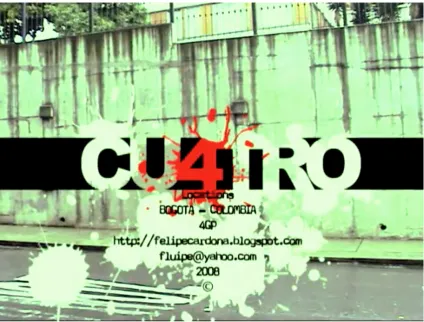
Figure 4.CU4TRO (2007), Felipe Cardona.
It is true that mentioning the origin of certain resources in the making of these videos is not enough to clearly understand the whole technique involved in their creation. The convergence of workflows, in this case video editing and music composition, deserves a more detailed description, so that anyone interested in making a videoloop can have a more accurate starting point.
Conclusions
When Eisenstein described the rhythmic and metric montage methods, he speaks about durations and rhythm. The approach behind the classification of such methods came from music grounds, unlike North American film, whose montage methods came from literature. Eisenstein, Alexandrov, and Pudovkin pleaded for an innovative use of sound from their “Manifesto of orchestral counterpoint” at the same time as movies with sound appeared. They wanted future filmmakers to reflect on montage from that moment and explore the limits of the technique, extended through sound. With the advent of the legendary Sony Portapak, video and audio have come together in a single signal. Since then, users have believed the synchronisation of picture and sound is natural. Nothing could be more wrong! Nothing could be quite as illusory and harmful, given the original intentions of the “Manifesto of orchestral counterpoint.”
techniques and testing the limits that the mainstream global industry has placed on innovation.
References
Alexandrov, G., Eisenstein, S. M., & V. Pudovkin. (2014). A statement on sound. In S. MacKenzie (Ed.), Film manifestos and global cinema cultures (pp. 566 568). Oakland, CA: University of California Press. (Original work published 1928)
Brown, R. H. (2012). The spirit inside each object: John Cage, Oskar Fischinger, and “The Future of Music.” Journal of the Society for American Music, 6(1), 83 113.
Capote, T. (1965). In cold blood. New York, NY: Random House.
Cardona, F. [Felipe Cardona]. (2006, January 19). Stomp [Video file]. Retrieved from http://vimeo.com/14079406
Cardona, F. [Felipe Cardona]. (2008, July 17). El artista [Video file]. Retrieved from http://vimeo.com/14078377
Cardona, F. [Felipe Cardona]. (2008, March 6). CU4TRO [Video file]. Retrieved from http://vimeo.com/14890486
Cardona, F. [Felipe Cardona]. (2010, June 20). éNfasis [Video file]. Retrieved from http://vimeo.com/14079406
Disney, W. (Producer). (1940). Fantasia. United States: Walt Disney Productions.
Eisenstein, S. M. (2010). In Leyda J. (Ed.), El sentido del cine (11th ed.). (N. Lacoste, Trans.). Coyoacán, México: Siglo XXI Editores. (Original work published 1942)
Eisenstein, S. M. (1986). In Leyda J. (Ed.), La forma del cine. (M. L. Puga, Trans.). Coyoacán, México: Siglo XXI Editores. (Original work published 1949)
Falco, Bolland, R., & Bolland, F. (1985). Rock me Amadeus: Salieri mix. On Falco 3 [Vinyl]. Santa Monica, CA: A&M Records.
Gjertsen, L. [Febersyn]. (2006, November 7). Amateur [Video file]. Retrieved from http://youtu.be/JzqumbhfxRo?list=UUz_gUjScjyhPg58hvdk4LDA
Gjertsen, L. [Febersyn]. (2006, May 8). Hyperactive [Video file]. Retrieved from http://youtu.be/o9698TqtY4A
Hardcastle, P. (1985). 19. On Paul Hardcastle [Vinyl]. London, England: Chrysalis Records.
Kuparanto (2006, November 30). Surplus: Terrorized into being Consumers [Video file]. Retrieved from http://youtu.be/5AEiwOM4fAY. (Original work produced 2003)
Meganefc. [meganefc]. (2007, August 15). Bond TV プリンストンガ [Video file]. [Produced by T. Hideyuki]. Retrieved
Méliès, G. (Writer/Director/Producer). (1898). Un homme de têtes [Short film]. France: Star Film.
Porter, E.S. (Writer/Director/Producer). (1900). Uncle Josh`s nightmare [Short film]. United States: Edison Manufacturing Company.
Porter, E.S. (Writer/Director/Producer). (1901). What happened on twenty third street, New York city [Short film]. United States: Edison Manufacturing Company.
Porter, E.S. (Writer/Director/Producer). (1903). The great train robbery [Short film]. United States: Edison Manufacturing Company.
Porter, E.S. (Writer/Director/Producer). (1903). Life of an American fireman [Short film]. United States: Edison Manufacturing Company.
SaintEuchrid. (2006, May 24). Einstürzende neubauten – halber mensch
excerpt [Video file]. Retrieved from http://youtu.be/w2G3KfKbJwE. (Original work produced 1985)
Stiffkittens. (2008, July 6). The white stripes hardest button to button promo
video [Video file]. Retrieved from http://youtu.be/j7h7ViExB68. (Original work produced 2003)
Tomáš Heřmanský. (2011, May 14). Stomp – out loud – full 45min footage [Video file]. Retrieved from http://youtu.be/fN5T8y8bCJ4
Waters, R. (1973). Money. On The dark side of the moon [Vinyl]. London, England: Abbey Road Studios.
Bibliography
Bouhaben, M. A., López, J. A., & Samper, P. M. (2011). Dziga Vertov. Memorias de un cineasta bolchevique. (J. Jordá & R. Font, Trans.). Madrid,
Spain: Capitán Swing Libros.
Buraka Som Sistema [BURAKA01] (2011, May 2). Hangover (BaBaBa) [Video file]. Retrieved from http://youtu.be/wOMe-8Tf1Y0
Cardona, F. [Felipe Cardona]. (2012, May 2). primavera 0.1 [Video file]. Retrieved from http://youtu.be/VjQ1NSOCQIg
Carrera, P. (2008). Andrei Tarkovsky: La imagen total. Buenos Aires, Argentina: Fondo de Cultura Económica de Argentina.
Chion, M. (2004). La voz en el cine. (M. Villarino Rodríguez, Trans.). Madrid, Spain: Ediciones Cátedra (Grupo Anaya S.A.).
Einstürzende Neubauten. (n.d.). In Wikipedia. Retrieved May 11, 2012, from http://es.wikipedia.org/wiki/Einst%C3%BCrzende_Neubauten
Figura musical. (n.d.). In Wikipedia. Retrieved April 12, 2012, from http://es.wikipedia.org/wiki/Figura_musical
Jenkins, H. (2009). Fans, blogueros y videojuegos. (P. Hermida Lazcano, Trans.). Madrid, Spain: Paidós Ibérica. (Original work published 2006)
Karlheinz Stockhausen. (n.d.). In Wikipedia. Retrieved May 11, 2012, from http://en.wikipedia.org/wiki/Karlheinz_Stockhausen
McKee, R. (2011). El guión STORY. Sustancia, estructura, estilo y principios de la escritura de guiones (6th ed.). (J. J. Lockhart Domeño ,Trans.). Barcelona, Spain: Alba Editorial.
Krohn, B. (2010). Maestros del cine: Stanley Kubrick (2nd ed.). (N. Ruiz Martínez, Trans.). Madrid, Spain: Cahiers du Cinéma Sarl.
La Ferla, J. (2009). Cine (y) digital: Aproximaciones a posibles convergencias entre el cinematógrafo y la computadora. Buenos Aires, Argentina: Ediciones
Manantial.
NewMusicXX. (2011, January 26). Stockhausen: “Telemusik” [Video file]. Retrieved from http://youtu.be/jcwLDxlNKdU
Riezinha159. (2008, October 12). Funny Little girl beatbox [Video file]. Retrieved from http://youtu.be/ASucb7x1Glk
Sarriugarte Gómez, Í. (2009). El inefable sendero del budismo zen electrónico: Nam June Paik. Ars Longa: cuadernos de arte, 18, 173-183.
Stam, R. (2010). Teorías del cine – una introducción (3rd ed.). (C. Roche Suárez, Trans.). Barcelona, Spain: Paidós Iberica Ediciones (Paidos Comunicación 126).
Shalom, G. (2009, January 11). Beardbox [Video file]. Retrieved from http://youtu.be/CHMbCodWCnU
Truffaut, F. (2012). El cine según Hitchcock (23rd ed.). (R. G. Redondo, M. Rubio, J. Oliver & R. Artola, Trans.). Madrid, Spain: Alianza Editorial.
List of Figures
Figure 1.Stomp (2005), Felipe Cardona. ... 8
Figure 2.éNfasis (2007), Felipe Cardona. ... 9
Figure 3.El Artista (2007), Felipe Cardona. ... 9
About the Authors
Mobile filmmaking pioneer, winner of short film festivals worldwide including Interfilm Berlin 2004 Micromovie Award (Berlin, Germany), Mobifest Film Festival (Toronto, Canada, 2008), Nontzefilm (Bilbao, Spain, 2006) Función Video (Barcelona, Spain, 2007), Filmmaka (Los Angeles, USA, 2007), among others. Lecturer-researcher in Xaveriana University, previously Social Communication – Journalism Television Area coordinator, at Externado University. Guest speaker in UNESCO Lecture (Xaveriana University, Bogotá 2014), FELAFACS 2012, Lima University (Lima, Peru) and MINA Symposium (2012) at Massey University, Wellington, New Zealand. Social Communicator Journalism studies in Autonoma University (Cali, Colombia), Masters Degree in Information and the Knowledge Society at Universitat Oberta de Catalunya (Barcelona, Spain). Winner of the Colombian Culture Ministry film awards in feature film television (Bogotá, 1998).
Contact: [email protected]
Blog: http://felipecardona.blogspot.com
LinkedIn: http://co.linkedin.com/pub/luis-felipe-cardona-del-real/b/664/781/
The Journal of Creative Technologies (JCT) https://ctechjournal.aut.ac.nz
ISSN: 2230-2115
Colab, Auckland University of Technology, New Zealand Creative Commons Attribution 4.0 International License (CC-BY)
All articles published in The Journal of Creative Technologies (JCT) from Issue 4 onwards are be licensed under a Creative Commons Attribution 4.0 International License (CC-BY). The copyright of the material remains with the author(s), and third-parties are granted permission to use, shared, and adapted the material, provided the original work is appropriately attributed.
The Journal of Creative Technologies (JCT) is an online, open access, peer-reviewed journal for the publication of research and innovation about new technologies, creative practices, and critical theories. The journal aims to explore applied, methodological and theoretical perspectives on emergent technological platforms and strategies through thematically focused issues.