Issues
ISSN: 2146-4138
available at http: www.econjournals.com
International Journal of Economics and Financial Issues, 2016, 6(S1) PB-1.
Special Issue for “Theory and Practice of Organizational and Economic Problems of Territorial Development and the Effectiveness of Social and Economic Systems”
Issues
ISSN: 2146-4138
available at http: www.econjournals.com
International Journal of Economics and Financial Issues, 2016, 6(S1) 243-248.
Special Issue for “Theory and Practice of Organizational and Economic Problems of Territorial Development and the Effectiveness of Social and Economic Systems”
Methodological Approach to Evaluation of Clustering Potential
and Efficiency Improvement Management for Development of the
Regional Industry Clusters
Alena N. Dyrdonova
1,2*
1Kazan Federal University, Kazan 420008, Russian Federation, 2Nizhnekamsk Chemical Technology Institute (Branch) of Kazan National Research Technological University, Nizhnekamsk 423570, Russian Federation. *Email: [email protected]
ABSTRACT
In the current environment, clustering of the economy represents a key factor in improving the competitive ability of the business entities functioning within the area whilst enhancing the interconnections between them and giving a new impulse to development of the regions. This paper offers a proven model of comprehensive evaluation of clustering potential of the regional economic systems, including a method of calculation and analysis of the parameters relating to production and resource, manpower, investment and financial potentials. Furthermore, effects of creation of an industry cluster are determined with respect to each individual participant and territory on the whole, which include economic, research and technology, innovative, social and environmental aspects. Future priority orientations of development of the region are also defined. In the authors’ opinion, formation and growth of the territorial clusters will provide a number of advantages for the regional economy, such as creation of new job places, manufacturing new types of products, development of the regional infrastructure, improvement of research and development (R and D) level, effectiveness of R and D findings implementation etc.
Keywords: Region, Cluster, Clustering, Clustering Potential JEL Classifications: C38, C52, O3
1. INTRODUCTION
The global experience from the point of view of efficiency and competitive ability enhancement of a regional economic system shows that clustering is the trend exhibiting the most promise for growth of industrially developed countries. Scientists and experts give their attention to clustering of an economy as a tool for its competitive ability enhancement, which is due to the fact that, firstly, the clusterization approach represents a means towards achieving objectives of the industrial policy (structural changes, improvement of competitive ability, enhancement of innovativeness, etc.), and, secondly, it is a powerful tool for boosting the growth of the regional economy. As a result, it may help increase the employment rates, wages, assignments to different level budgets, as well as enhance the sustainability and competitive ability of the regional industries.
Three broad definitions of the term “cluster” can be found in the academic literature, where each of the definitions highlights the main feature of the functioning of clusters:
• Regionally limited forms of economic activity within closely related sectors, which are typically linked to some or other research and development (R and D) institutions (R and D institutes, universities, etc.);
• Vertically integrated production chains that represent rather narrow specialized sectors where related stages of a production cycle form a core of the cluster (as an example, a chain “supplier - manufacturer - seller - customer”). This category also includes networks formed around mother companies; • Sectors of industry determined on a high level of aggregation
Any policy aimed at formation of clusters stems from identification of the prerequisites available in the region for origination of clusters, i.e., clustering potential. The clustering potential is availability of competitive advantages for the sectors of industry, enterprises and infrastructural organizations functioning within the region, as well as a possibility to pool the advantages available and make use of them so as to enhance the competitiveness of the region.
Analysis of the clustering potential allows identifying priority areas of economic activities offering an opportunity for formation of clusters effective functioning of which would contribute to higher competitiveness of the region in the long-term outlook whilst making use of the external environment (Melnik and Dyrdonova, 2014). Therefore, the most vital are the issues related to evaluation and enhancement of the clustering potential of the regional economic systems under current conditions.
2. LITERATURE REVIEW
Fundamentals of the cluster approach were set up by the US school of new forms of production process management, which was represented by theoretical and applied investigations carried out by Porter, Larenzen, Maskell, Rosenfeld, Storper, Enright, etc. The founder of the cluster approach Porter created a theory of industrial clusters which was based on the following conclusion from the theory of the diamond model of competitive advantages: Conditions for giving rise to a competitive advantage for the involved regions become better when the firms functioning in one particular industry sector are geographically concentrated (Porter, 2005). According to the theory of regional clusters developed by Enright, competitive advantages resulting from performance of clusters emerge at the regional level rather than at the national one (Enright, 1992).
Another foreign scientist Rosenfeld further developed the theory of regional clusters and investigated the communication channels between the firms (members of the cluster) and related organizations. Rosenfeld considered such communication channels as a significant element of the clusters (Rosenfeld, 1997). According to his approach, a regional cluster is more than just a geographically outlined concentration of interdependent firms. The firms also should have channels designed to facilitate production related transactions, dialogues and communication between middle and small size enterprises. This idea was further explicated by Maskell and Larenzen in the conclusion that setting up a networking cooperation between the firms based on a trust in the partner principle is the main prerequisite for formation of a competitive regional cluster and enhancement of the competitive ability of the firms being members of the cluster (Maskell and Larenzen, 2003). French scientists Tolenado and Soulie defined a cluster as “draw dies,” or an interdependence between different economic sectors in terms of technological complexity levels, which is based upon a necessity of creation of technological links between industrial and economic sectors for proper realization of their potential advantages (Tolenado, 1978; Soulie, 1989). A Swedish scientist Dahmen defined a cluster as a combination of sectors, or “development blocks” where a prerequisite for
progress is availability of a linkage between an ability of one sector to develop and its ability to contribute to progress in another sector (Dahmen, 1950). In such conditions, development should take place on a phased basis, or along “a vertical line of actions” within one industry sector connected with other sectors. Such a method may help achieving competitive advantages. According to Feldman’s point of view expressed in his later theory, a cluster is a diversified group of industries interconnected by the supply and purchase correlations based upon a “cost - output” matrix (Feldman, 1999).
Various aspects related to raising the efficiency of the national economy development and elaboration of cluster-oriented policy on a regional level have been reviewed in the studies by Bergman, Feser, Hasby, Enright, Granberg, etc. A significant contribution to development of the theory and practice of the economic analysis of enterprises was made by Bernstein, Brett, Richard, Thomas, Harman, Helfert, Schumpeter, Ackles, Anthony, etc.
However, notwithstanding a great number of studies related to the topic under discussion no development effort has yet been made towards methodological approaches to evaluation of the clustering potential and growth efficiency management with respect to the industry clusters functioning in the region.
3. DATA AND ESTIMATION TECHNIQUES
The technique for evaluation of creation and functioning of a clustered formation and its clustering potential is based upon generalized criteria that include a set of specific parameters of various areas of activities, which sufficiently enough show the nature of the selected criteria. The developed methodological approach is based on the definition of the clustering potential as availability of competitive advantages for the enterprises ready to form part of a cluster (Melnik and Dyrdonova, 2015).
Therefore, for identification of the enterprises capable to form a core of the cluster, as well as for identification of a key enterprise in the industry cluster the clustering potential analysis is suggested to be used using the developed technique that includes four blocks as shown in Figure 1.
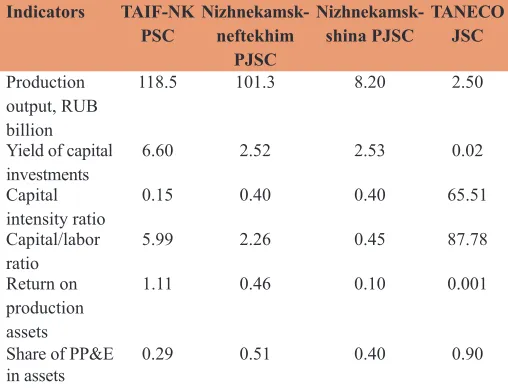
In Block 1 the production and resource potential would be appropriate to be evaluated based on the following indicators: • Production output;
• Yield of capital investments; • Capital intensity ratio; • Capital/labor ratio;
• Return on production assets;
• Share of property, plant and equipment in assets.
The indicators listed above describe both scale of production and ratio of plant and machinery utilization efficiency.
In Block 2the manpower potential is evaluated, i.e., personnel and efficiency of the personnel’s activities at the enterprises under review:
• Average number of the enterprise’s employees; • Manpower inflow ratio;
• Manpower outflow ratio;
• Average annual output of one employee; • Net profit per one employee.
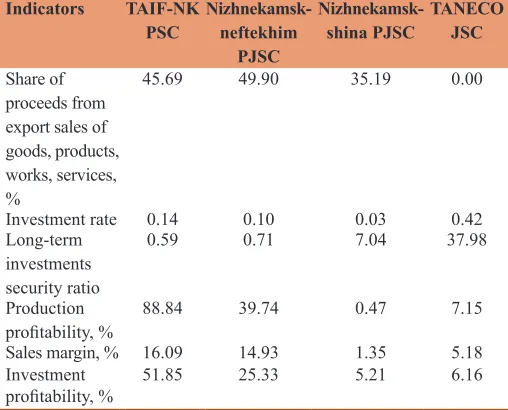
Block 3represents a pattern of assessment of the indicators relating in the theoretical and practical sense to the notion “investment” which implies carrying out an analysis of long-term capital investments into sectors of economy inside and outside of the country, in particular:
• Share of proceeds from export sales of goods, products, works, services;
• Investment rate;
• Long-term investments security ratio;
• Profitability indicators: Production profitability, sales margin, investment profitability.
Financial potential refers to Block 4 of the indicators used for evaluation of financial performance of enterprises. The financial block includes evaluation of financial solvency, liquidity ratio, business efficiency ratio, and financial sustainability.
Financial solvency of an enterprise is its ability and capacity to timely and fully discharge its financial liabilities to both internal and external partners and the national government.
Financial liquidity of an enterprise is its ability to cover the liabilities by assets the term of conversion of which into a monetary form corresponds to the term of liabilities maturity.
Relative indicators of business efficiency show resource utilization efficiency. Therefore the business efficiency analysis comes down to a review of levels and dynamics of various financial turnover ratios. We will calculate an assets turnover ratio and equity turnover ratio of an enterprise.
Financial sustainability is an element of overall sustainability of enterprises, financial flows identity, availability of cash resources allowing the enterprise to maintain its business activity during a definite period of time, in particular, when servicing any obtained loans and manufacturing the products. This section will be represented by three indicators: Equity to total assets ratio, intensity factor, self-financing ratio.
It is important to note that according to the concept of cluster-oriented development of the economy of the Republic of Tatarstan a matter of priority is formation of a petrochemical cluster (Melnik and Dyrdonova, 2014). Therefore, generation and growth of clustered formations is regarded as a strategic pathway from the point of view of increasing the competitiveness of the area and triggering innovative processes for one of the municipal
units - Nizhnekamsk Municipal District that was used as an example for testing the methodological approaches developed by us.
Nizhnekamsk Municipal District is the largest center accommodating the petrochemical industry not only of the Republic of Tatarstan but of the Russian Federation as a whole. Nizhnekamsk industrial center accounts for 23% of overall commercial output of the Republic of Tatarstan, and 30% of regional exports. Nizhnekamsk area encompasses 18% of the fixed production assets of the Republic of Tatarstan, which represent the main domestic industry sectors.
The core industrial business units operating in Nizhnekamsk are represented by the large enterprises involving science-driven technologies, i.e., oil refining and petrochemistry. The Nizhnekamsk city-forming enterprises, in particular, are Nizhnekamskneftekhim Public Joint-Stock Company, Nizhnekamskshina Public Joint-Stock Company, TAIF-NK Public Stock Company, TANECO Joint-Stock Company.
Tables 1-4 show the consolidated data obtained as a result of the clustering potential evaluations made by us through the example of the industrial enterprises functioning in Nizhnekamsk District.
The calculations made using the elaborated technique demonstrate significance of formation of a petrochemical cluster within the territory of Nizhnekamsk Municipal District, which would offer a number of advantages. The core of the petrochemical cluster, i.e., an enterprise featuring an ultimate potential (as compared to other participants of the cluster) in terms of production and resource, manpower, investment and financial indicators, will be Nizhnekamskneftekhim Public Joint-Stock Company. For TAIF-NK Public Stock Company integration with the cluster would make sense from the point of view of achieving a synergetic effect. For Nizhnekamskshina Public Joint-Stock Company and TANECO Joint-Stock Company integration with the cluster would be reasonable from the point of view of increasing their performance efficiency and getting out of the red.
Table 1: Production and resource potential indicators
Indicators TAIF-NK
PSC Nizhnekamsk- neftekhim PJSC
Nizhnekamsk-
shina PJSC TANECO JSC
Production output, RUB
billion
118.5 101.3 8.20 2.50
Yield of capital
investments 6.60 2.52 2.53 0.02
Capital
intensity ratio 0.15 0.40 0.40 65.51
Capital/labor
ratio 5.99 2.26 0.45 87.78
Return on production
assets
1.11 0.46 0.10 0.001
Share of PP&E
in assets 0.29 0.51 0.40 0.90
Therefore, the clustering potential evaluation methodology as described above with respect to the petrochemical cluster in Nizhnekamsk Municipal District appears to be the most reasonable and appropriate for the petrochemical sector since this technique allows considering the most significant parameters whilst being the simplest from the point of view of collection of required information and calculation of all the indicators described above.
4. FINDINGS AND DISCUSSIONS
In the course of the study a multifunctional mathematic model has been developed using the Microsoft Office Excel application, which is aimed at evaluation of the clustering potential of an area based on the elaborated clustering potential analysis technique and identification of “the core” enterprise of the petrochemical cluster in Nizhnekamsk Municipal District. This mathematic model can be regarded as multifunctional not least because the model has been accommodated to any type of cluster and any sector of industry.
This model is intended to enter accounting data covering several enterprises for the last three periods of their operation (for example, 3 years). The mathematic model is designed so that consolidated
data tables could be developed to analyze behavior of the data, plot graphs of variance and comparison, and automatically determine “the core” enterprise in a future cluster using the calculated system of indicators.
In the above described model, effects of petrochemical cluster formation in the municipal district are determined with regard to each individual participant and area on the whole, which could be categorized as follows:
• Economic effects (sales gains in the domestic and export markets; profit from implementation of inventions, patents, know-how; profit from joint promotion of petrochemical products; shortening of an investment pay-back period; saving profits during a downturn in the economy);
• Research and technology, or innovation effects representing effects of R and D findings and operation of small- and mid-size businesses (increase in percentage of advanced information technologies and state-of-the-art technological processes; mastering of new types of products);
• Social effects, i.e., those being of interest to the general public (opening new opportunities for small- and mid-size businesses; increasing wages; boosting employment of the local population; professional improvement of the personnel; increase in percentage of the middle class; improvement of working and leisure conditions; enhancement of creative initiatives of the population);
• Environmental effects (reduction of emissions to atmosphere, lower discharges of harmful components to soil and water; reduction of fines for violations of environmental legislation and other regulatory requirements; improvement of product quality from the environmental point of view).
The effects described above are essentially of objective nature. It should be noted that subjective factors must also be considered. First of all, in each field of activities - Government, business, or general public - there should be leaders that would be willing and able to
Table 2: Manpower potential indicators
Indicators TAIF-NK
PSC Nizhnekamsk- neftekhim PJSC
Nizhnekamsk-
shina PJSC TANECO JSC
Average
number of the
enterprise’s employees,
thousands
people
2.9 17.7 7.2 1.8
Manpower
inflow ratio 0.08 0.05 0.014 0.18
Manpower
outflow ratio 0.007 0.08 0.07 0.03
Average annual output of one employee, RUB million
39.6 5.7 1.1 1.3
Net profit per one employee, RUB million
5.3 0.811 0.044 0.142
Table 3: Investment potential indicators
Indicators TAIF-NK
PSC Nizhnekamsk- neftekhim PJSC
Nizhnekamsk-
shina PJSC TANECO JSC
Share of proceeds from export sales of goods, products, works, services, %
45.69 49.90 35.19 0.00
Investment rate 0.14 0.10 0.03 0.42
Long-term
investments
security ratio
0.59 0.71 7.04 37.98
Production
profitability, % 88.84 39.74 0.47 7.15
Sales margin, % 16.09 14.93 1.35 5.18
Investment
profitability, % 51.85 25.33 5.21 6.16
Table 4: Financial potential indicators
Indicators TAIF-NK
PSC Nizhnekamsk- neftekhim PJSC
Nizhnekamsk-
shina PJSC TANECO JSC
Financial
solvency 2.39 3.43 1.17 1.004
Current
liquidity ratio 1.37 1.66 0.22 0.033
Assets
turnover ratio 2.43 1.79 3.11 0.027
Equity
turnover ratio 4.17 2.54 105.4 7.37
Equity to total
assets ratio 0.58 0.71 0.03 0.004
Intensity factor 0.42 0.29 0.97 0.99
Self-financing
perceive and implement the cluster methodology, i.e. cooperation for the sake of enhancement of global competiveness of the cluster in the context of growing competition within the cluster.
Consequently, in order to create an own effective structure of a petrochemical cluster in the region it would be necessary to outline further priority orientations of its development as follows: 1. Enhance the competitive advantage of the existing production
capacities first of all by improving the quality of the manufactured products (in the context of petrochemical products - the so called “cleanness”) which primarily depends on innovation commitment of the enterprises that in its turn could be enhanced in two-ways as follows:
• Seek and master innovative technologies designed to handle polymer products (set up an institution for development and mastering innovative technologies, systematize exchange of experience with overseas and domestic enterprises);
• Increase the manpower potential (through involvement of competent specialists and setting up an institution for training and advanced vocational training in the higher schools located in the city and across the Republic); 2. Enlarge the volume and range of the products within the
bounds of the existing production capacities. At this stage the volumes of petrochemical feedstock manufactured by Nizhnekamskneftekhim PJSC and TANECO JSC will increase in the course of implementation of their announced investment projects since the Refinery and Petrochemical Complex being under construction is designed to produce not only refinery products but also a wide range of petrochemical products, in particular, polypropylene, polyethylene terephthalate and so on. However, in order to implement such projects (at a higher value) it would be required to enhance investment attractiveness of the region primarily in the following areas: • Seek investors for the region;
• Create a favorable business climate for development of small- and mid-size businesses (support in incorporation of a company, obtaining office premises, a plot of land; reduce administrative barriers; elaborate lending programs for small- and mid-size businesses under acceptable conditions);
• Create an infrastructure for development of small- and mid-size businesses (set up technoparks, business incubators);
• Information support for small- and mid-size businesses; • Pull the strength of small- and mid-size businesses in
order to address any arising issues;
• Develop transportation and logistical infrastructure (improve the quality of road surfaces; build up a port area with a status of a special economic zone in Kamsky Economic Region; upgrade the airport facilities, etc.); 3. Manufacture new types of products of the highest value added.
The concept first of all applies to finished products. This area though exhibiting the most promise owing to a higher value added to a large extent depends on the first two areas because it is essential to have a sufficient amount of high quality products of the lowest and medium value added, high innovation commitment, as well as investment attractiveness of the region.
A higher added value generated by the processing enterprises will be achieved primarily through:
• Increasing a throughput of polymer products manufactured by the enterprises located in the territory of Nizhnekamsk Municipal District (broadening the scope of the existing production capacities, setting up new production facilities designed to handle polymer products);
• Enhancement of competitive advantages of the products manufactured by the small- and mid-size businesses (improvement of product quality, certification of the enterprises and products, reduction of production prime cost).
Consequently, formation and development of the petrochemical cluster for the small- and mid-size businesses will contribute to: • A significant reduction of the barriers on the way to the market
through alignment of the requirements applicable within the cluster;
• A synergetic effect through well-arranged training of the personnel;
• Obtaining an access to purchase orders (customers), as well as increasing effectiveness of purchasing of hardware and software related to information technologies;
• Transfer of the cluster’s positive reputation onto its participants (brand name effect).
A remote effect of such advantages will be reflected in growth of the city of Nizhnekamsk, regional development of the Republic of Tatarstan, and comprehensive growth of the national economy of the Russian Federation.
5. CONCLUDING REMARKS
Thus, application of a cluster-oriented approach is a naturally determined stage in the development of the regional economic systems. Formation and development of clusters within the region will contribute to creation of new job places for the local population, increase tax deductions into the budget, manufacture new types of products, increase both quality and quantity of the output products, replace imported goods by domestic products owing to the use of science-driven, resource-saving and environmentally friendly technologies, considerably increase the role of science, education, R and D centres, design and engineering organizations, academic institutions and higher schools, increase both a transfer level of technologies and R and Ds and effectiveness of their implementation.
REFERENCES
Andreeva, E.S., Dyrdonova, A.N., Girfanova, E.Y, Fomin, N.Y. (2015), Enhancement of performance of infrastructural assets built through a public and private partnership. Mediterranean Journal of Social Sciences, 6(5), 311-316.
Dahmen, E. (1950), Business and Development of Swedish Industry, 1919-1939. Stockholm: IUI. p360.
Enright, M.J. (1992), Why clusters are the way to win the game? Word Link, 5, 24-25.
Review, 43, 409-429.
Maskell, P., Larenzen, M. (2003), The Cluster as Market Organization. DRUID Working Paper, 14, 29.
Melnik, A.N., Dyrdonova, A.N. (2014), Formation and development of industrial clusters in the region. SGEM 2014 International Multidisciplinary Scientific Conferences on Social Sciences and Arts, 3, 215-222.
Melnik, A.N., Dyrdonova, A.N. (2014), Infrastructural support for development of the territorial petrochemical cluster. Mediterranean Journal of Social Sciences, 5(18), 299-304.
Melnik, A.N., Dyrdonova, A.N. (2015), Application of operational analysis
for evaluation of the impact of different factors on performance efficiency of the enterprises forming the regional industrial cluster. Mediterranean Journal of Social Sciences, 6(6), 141-146.
Porter, M. (2005), Competition: Per. from English. Moscow: Publishing House Williams. p258.
Rosenfeld, S.A. (1997), Bringing business clusters into the mainstream of economic development. European Planning Studies, 5, 3-23. Soulie, D. (1989), Filieres de Production et Integration Vertical. Janvier:
Annales des Mines. p21-28.