Volume 2, Issue 8, August 2013
Page 64
Abstract
Coal fired thermal power plants contribute to global climatic change because of emission of anthropogenic greenhouse gases from the products of combustion of coal. This research study carried out in Zimbabwe, a developing country, seeks to investi gate on the feasibility of hybridizing coal fired thermal power plants with solar field made up of solar concentrating parabolic troughs. The paper goes on to review on the comparison between a purely coal fired power plant and a solar hybridized power plant taking into account costs of power generation, profits and emissions. The study can be a useful resource to thermal plant engineers and related practitioners on various solar/thermal power hybridization aspects.
Keywords: anthropogenic, feasibility, hybrid, parabolic, troughs.
1.
I
NTRODUCTIONPower supply of the world mainly depends on the use of conventional energy sources which include coal, oil and natural gas. Conventional energy sources are limited and hence unsustainable. According to International Energy Agency (IEA), energy consumption is going to increase by 50%. World Energy Council (WEC) approximates that energy consumption is going to increase by 70% to 100% by 2050. Because of the increase in energy demand and changes in climate, energy production has to increase to meet demand and such has to happen sustainably and without much environmental pollution. In trying to generate energy at a sustainable base,renewable energy technologies have to be implemented hence concentrating solar parabolic troughs are going to be used.
2.
J
USTIFICATONSolar-coal fired power plant is a combination of two technologies and this will increase the overall efficiency of the power plant and reduced investment per unit of power capacity. The hybrid system will save a significant amount of coal required, will reduce maintenance cost and maintenance man-hours will become less. Since there will be reduction of coal used that implies that flue gas from combustion of coal is reduced. Ash from boilers will also be reduced. Dollar penalties for environmental emissions will also be reduced. Hybrid power plants has a greater initial cost, reduced fuel requirements, maintenance, and capital replacement costs for the life of the system and are a more cost effective option. Solar energy plants necessarily suffer from the intermittency of day/night cycles and also from reduced irradiation periods (winter, cloudy days, and short transients) hence implementing a hybrid power plant coupled with coal as the other source of fuel will be a good solution.Set your page as A4, width 210, height 297 and margins as follows:
3.
L
AYOUT OF EXISTING COAL POWER PLANTIn Zimbabwe there are four coal fired thermal power plants namely; Harare , Hwange, Munyati and Bulawayo Power Station. Harare power station is divided into two sections HPS2 and HPS3. HPS3 consists of 9 boilers and 6 turbines.
3.1 The Boiler Plant
The boilers have a total of 77MW power generating capacity. HPS2uses pulverized fuel to heat up water tube boilers and generate power at 11kV but stepped up to 33kV by an interconnector transformer which then feeds to the national bus bar.
Table 1:HPS2 Boiler capacities
A Feasibility Study of a Hybrid Solar-Coal
Fired Thermal Power Plant in a developing
country- Zimbabwe.
Luxmore Madiye¹, Kumbi Mugwindiri² and Liberty Chiturumani ³
¹,2 Lecturer, University of Zimbabwe, Department of Mechanical Engineering
P O Box MP169, Mount Pleasant, Harare, Zimbabwe
3Graduate Engineer,University of Zimbabwe, Department of Mechanical Engineering
Volume 2, Issue 8, August 2013
Page 65
3.1.1 Boiler Operation
Coal is fed from the bunkers via a chute. It is then spread onto the stoker by a travelling chute through an Archimedean screw. This mechanism of a power screw like, ensures no segregation of coal takes place plus it improves the firing characteristics of the boilers because of good fuel distribution. Tempering steam is introduced to coal just before the Archimedean screw. When coal is loaded onto the grate, it first passes via an ignition arc whose function is to ignite it at the point where primary combustion air Coal is fed from the bunkers via a chute. It is then spread onto the stoker by a travelling chute through an Archimedean screw. This mechanism of a power screw like, ensures no segregation of coal takes place plus itimproves the firing characteristics of the boilers because of good fuel distribution. Tempering steam is introduced to coal just before the Archimedean screw. When coal is loaded onto the grate, it first passes via an ignition arc whose function is to ignite it at the point where primary combustion air enters.
3.1.2 The Turbine Plant
HPS2 consists of 6 turbines with a total capacity of 80MW.
Table 2:HPS3 Turbine capacities
Turbine Capacity
1-4 10 MW
5,6 20 MW
Total Capacity 80 MW
The turbines are connected parallel to each other and operate independently such that others can work while others are on standby.
3.1.3 The Rankine Cycle
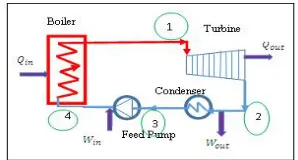
A thermal power plant operates under a rankine cycle. The rankine cycle is heat engine with a vapour power cycle. The rankine cycle is the most useful vapour cycle for power generation whether the fuel is coal, oil, bagasse or natural gas. Figure 1 shows the basic layout of the powerplant cycle.
Figure 1: Basic Coal Thermal Power Plant Layout
Ways to improve the Rankine Cycle efficiency
Increasing the operating pressure of the boiler. This improves the average heat addition temperature in the boiler and at the same time increase the energy of steam from the boiler.
Reducing the operating pressure of the condenser. Lowering condense pressure lowers the steam temperature and at the same time lowers the temperature at which heat is rejected in the condenser.
Superheating steam to high pressures, this increases the net work done by our cycle and hence increasing the overall efficiency.
4
S
OLAR FIELD DESIGNParabolic solar field is intertwined with an existing coal fired thermal power station. The power station in question is Harare Power Station 2. HPS 2 at its maximum capacity can generate 70 MW of electricity. The solar parabolic troughs will be used to heat feed water for boilers. The solar field shall be implemented strictly to HPS 2. The solar field will supply heated feed water during the day and during the night, coal will be used for power generation. A large array of trough shaped mirrors make up the solar field. Pipes containing water are positioned at the focal points of the mirrors. Concentrating heat from thesun increases the temperature of the steam up to 393 = 666K.The basic component of a
Volume 2, Issue 8, August 2013
Page 66
loop consists of 6 SCAs.The parabolic trough solar collector focuses direct solar radiation on an efficient evacuated receiver called a Dewar tube, or heat collector element (HCE). The reflector mirrors are made up of hot formed mirrored glass supported by a truss system, which gives the SCA its structural integrity.
4.1 Hourly solar radiation
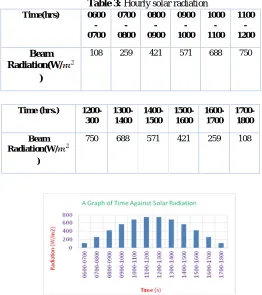
Table 3 shows the average hourly solar radiation in Harare done at Crown Plazza. The hourly average radiations are symmetrical about 12 noon since both the earth and thesun are spherical.
Table 3: Hourly solar radiation
Time(hrs) 0600
-0700
0700 -0800
0800 -0900
0900 -1000
1000 -1100
1100 -1200
Beam Radiation(W/
)
108 259 421 571 688 750
Time (hrs.)
1200-300
1300-1400
1400-1500
1500-1600
1600-1700
1700-1800
Beam Radiation(W/
)
750 688 571 421 259 108
Figure 2: Hourly solar radiation
4.2 Optical Efficiency Parameters of the Solar Field
Optical efficiency of the solar parabolic system depends on the mirror reflectance, receiver (HCE) absorption and transmittance from the Solar Field specification considering materials used on the market.
Table4: Efficiency parameters
Parameter Ratio
HCE absorption(α) 0.95
Mirror Reflectance(ρ) 0.92
Transmittance of the HCE(τ) 0.96
Mirror Interception (γ) 0.95
Hence the optical efficiency = = 0.95 = 0.797 0.8
4.3 Dimensions of the Solar Collector Assembly (SCA) Overall SCA length = 95.2m
Volume 2, Issue 8, August 2013
Page 67
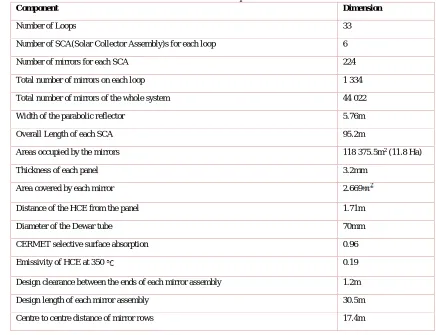
Table 5: Solar field specifications
Component Dimension
Number of Loops 33
Number of SCA(Solar Collector Assembly)s for each loop 6
Number of mirrors for each SCA 224
Total number of mirrors on each loop 1 334
Total number of mirrors of the whole system 44 022
Width of the parabolic reflector 5.76m
Overall Length of each SCA 95.2m
Areas occupied by the mirrors 118 375.5m2 (11.8 Ha)
Thickness of each panel 3.2mm
Area covered by each mirror 2.669
Distance of the HCE from the panel 1.71m
Diameter of the Dewar tube 70mm
CERMET selective surface absorption 0.96
Emissivity of HCE at 350 0.19
Design clearance between the ends of each mirror assembly 1.2m
Design length of each mirror assembly 30.5m
Centre to centre distance of mirror rows 17.4m
4.4 Hybrid solar and coal power generation ratios
Since a 50MW solar field is implemented on the hybrid power plant. The solar field produces 50MW when it is receiving an average radiation of 750W/ .
Hence hourly power generated from solar field =
Hourly power produced from coal = capacity of the hybrid power plant (70MW) Power generated from solar.
Hourly percentage contribution of solar power =
Power generated from coal; Power generated using coal varies from 0600hrs in the morning to 1800hrs in the evening as shown in figure 3. Coal will be generating 100 overnight in the absence of the solar field. Coal is used to its minimum at noon whensolar energy is at its maximum.
Figure 3: Hourly Power Generated from Coal
Volume 2, Issue 8, August 2013
Page 68
Figure 4: Hourly Power Generated from Solar
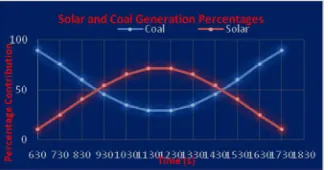
Hourly Percentage Coal and Solar Contribution; Solar field generates a maximum of 71.4 of the total energy
generated with coal generating the remainder. Figure 5 shows the percentage coal and solar generation.
Figure 5: Solar and Coal Generation Percentages
5.
E
NVIRONMENTAL IMPACT ASSESSMENT(
EIA)
Environmental impact assessment is a planning tool used to predict, assess and identify potential impacts that can arise in planned projects. It seeks to minimize negative impacts and enhance positive ones.
5.1 Pollution from Harare Power Station
Harare power station is a thermal station and hence it combust coal for power generation and this is accompanied by water, air, ecological, noise and thermal pollution. Thermal power generation is also accompanied by topographical, health and socio-economic impacts. Implementing a hybrid solar-coal fired system will reduce air, thermal and water pollution.
Air Pollution; Coal burnt is reduced due to the implementation of the hybrid system especially during the day and hence air pollution will be reduced. Air pollution will be at its peak during the night when the solar field is inactive but the overall air pollution will be reduced and reduced tax on carbon emissions. Hybridization will also cause the operations and maintenance cost tobe reduced and also savings of coal as a fuel.
Table 6 shows average carbon dioxide emissions in Europe and USA.
Table 6: Average carbon dioxide emissions per MWh thermal input
Fuel Percentage
of Carbon in fuel
C produced per tonne of fuel (tonnes)
produced per MWh thermal input (kg)
Industrial Coal
58 2.2 285
Fuel oil 88 3.2 267
Gas Oil 87 3.2 254
Natural Gas
74 2.7 185
Rankine thermal efficiency of HPS2 = 19 . From the table above 285kg of C is produced per each MWh thermal input and such were for a thermal power plant with an average Rankine efficiency of 35%.
Volume 2, Issue 8, August 2013
Page 69
Hence total mass C produced per day =
= = 1 973 700kg
= 690.8 tonnes per day.
Hence mass of C produced per month = 690.8 tonnes 30 = 20 724 tonnes.
Therefore mass of C produced per year = 20 724 tonnes 12 = 248 688 tonnes.
5.2 Hourly carbon dioxide emissions
Power generated varies proportionally with the variation of solar radiation. Mass of C is produced per each MWh
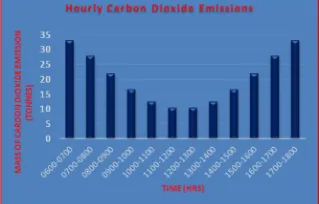
thermal input = 285kg = 0.285 tonnes. Figure 6 shows that most carbon dioxide is produced overnight when the power station is purely coal fired and emissions are limited at noon when the power plant is hybrid.
Figure 6: Hourly Carbon dioxide Emissions
Hence total mass C produced per day
= = 882 000 kg = 882 tonnes per day.
Table 7: hybrid and non hybrid power plant emissions Plant Type Carbon Emissions (tonnes)
Emissions per day
Emissions per month
Emissions per year
Hybrid Power Plant
690.8 20 724 248 688
Non-Hybridised Power Plant
882 26 460 317 520
Hence percentage reduction of Carbon dioxide
= 100 = 21.67 .
Coal Usage at HPS2; Coal usage at HPS2 is 0.6 tonnes/ MWh. Hence calculating hourly used coal, total mass of coal used can be calculated.
Volume 2, Issue 8, August 2013
Page 70
Total amount of coal used by the hybrid power plant = 280.08 tonnes. Considering coal used during the night = capacity of power plant number of hours coal use/MWh.
Hence coal used overnight = 70 12 0.6 = 504 tonnes.
Hence total amount of coal used by the hybrid power plant per day = 504 + 280.08 = 784.08 tonnes.
Table 8: hybrid and non-hybrid power plant coal use
Plant Type Mass of Coal Used (tonnes)
Daily Monthly Annually
Hybrid Power Plant 784 23 522 282 689
Non- hybridised 1 008 30 240 362 880
Hence daily coal use reduction after implementing the hybrid power plant = 1 008 784 = 224 tonnes per day.
Therefore percentage coal reduction = 22.22%.
From the EIA there are benefits in hybridising HPS2 with solar. There is reduction in coal use by 22.2% from using 1008 tonnes/day to using 784 tonnes/day. There is also reduction in carbon dioxide emissions by 21.7% from 2 520 tonnes/day to 1 974 tonnes per day.
Table 9: percentage coal and carbon dioxide emission reduction
Parameter Reduction
Coal Usage 22.2%
Carbon Dioxide Emissions 21.7%
6.
E
CONOMICA
NALYSISDue to stringent environmental policies and the general increase of community concerns (health effects and environmental impacts) mandates the need for power plants to increase efforts in minimizing GHG emissions. Power plants hybridisation is an initiative that seeks to implement renewable energy in power generation so as to reduce GHG emissions.
6.1 Solar Field
According to standards of USA and Europe, cost of construction of a solar field vary due to many factors. The cost of construction vary from $3 000 000 – 5 000 000/MWh. Taking the average such that the cost of construction per MWh = $ 4 000 000. Hence for a solar field of a capacity of 50MW the cost of buying material and constructing will be:
= capacity of the solar field cost/MWh = 50MW $ 4000 000 = $200 000 000.
Solar Field Cost Breakdown; The solar field cost $200 000 000 and the cost breakdown is divided into subdivisions among them steel structure, tubes, civil works and others.
Table 10: Solar Field cost breakdown
Parameter Percentage Cost (%) Cost($)
Tubes 16 32 000 000
Mirrors 12 24 000 000
HTF System 12 24 000 000
Collector Assembly 8 16 000 000
Civil Works 22 44 000 000
Steel Structure 24 48 000 000
Electrical and Monitoring System 6 12 000 000
Volume 2, Issue 8, August 2013
Page 71
Figure 8: Cost breakdown of the Solar Field
6.2 Power Generation Costs
Currently at Harare Power Station, electricity is produced at 6c/kWh and sold at 12c/kWh. Solar field have got high initial cost and a higher cost of generation but with the advantage that it is clean and can reduce GHG emissions when the hybrid power plant is implemented.
Table 11: Cost of power generation at HPS before and after hybridisation Plant
Type
Cost of Generation ($)
0600hrs-1800hrs
1800hrs-0600hrs
Overall cost
($)/kWh
Coal 50 400 50 400 100 800 0.060
Hybrid 28 008 50 400 78 408 0.047
6.3 Profit Margins
There is a profit of 6c/kWh = $0.06/kWh = $60/MWh hence the total profit for the non-hybridised power plant = $60/MWh 24 = $ 100 800 per day.
Hence profit per month = $100 800 30 = $3 024 000 and therefore annual profit= 12 $ 3 024 000
= $ 36 288 000.
Figure 9: Hourly Profit Margins
6.4 Project Payback Period
The cost of a parabolic solar field depend on a number of factors including plant size and materials used. Current capital costs for medium sized power plants is are of the order of 3 000-5000/kWh. Taking the optimum cost of $4 000/kWh = $ 4 000 000/ MWh.
Hence the total capital cost of 50MW solar field is = capacity of the solar power plant cost/MWh = 50MW $ 4 000 000/ MWh = $ 200 000 000 = $200 million.
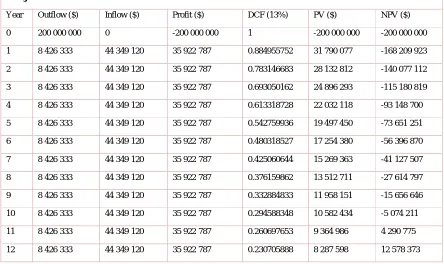
Since the annual profit is of the hybrid power plant will be = $ 44 349 120 annual present value (PV) and net present values (NPV) can be calculated.
Solar hybrid power plants in America spend 12 of the profits on maintenance and labour. Average money spend on maintenance and labour annually (Outflow) = 0.19 $ 44 349 120
= $ 8 426 333.
Volume 2, Issue 8, August 2013
Page 72
Table 12: Project payback period PROJECT PAYBACK PERIOD
Year Outflow ($) Inflow ($) Profit ($) DCF (13%) PV ($) NPV ($)
0 200 000 000 0 -200 000 000 1 -200 000 000 -200 000 000
1 8 426 333 44 349 120 35 922 787 0.884955752 31 790 077 -168 209 923
2 8 426 333 44 349 120 35 922 787 0.783146683 28 132 812 -140 077 112
3 8 426 333 44 349 120 35 922 787 0.693050162 24 896 293 -115 180 819
4 8 426 333 44 349 120 35 922 787 0.613318728 22 032 118 -93 148 700
5 8 426 333 44 349 120 35 922 787 0.542759936 19 497 450 -73 651 251
6 8 426 333 44 349 120 35 922 787 0.480318527 17 254 380 -56 396 870
7 8 426 333 44 349 120 35 922 787 0.425060644 15 269 363 -41 127 507
8 8 426 333 44 349 120 35 922 787 0.376159862 13 512 711 -27 614 797
9 8 426 333 44 349 120 35 922 787 0.332884833 11 958 151 -15 656 646
10 8 426 333 44 349 120 35 922 787 0.294588348 10 582 434 -5 074 211
11 8 426 333 44 349 120 35 922 787 0.260697653 9 364 986 4 290 775
12 8 426 333 44 349 120 35 922 787 0.230705888 8 287 598 12 578 373
Hence the investment payback period = 10 years 7 months.
7.
R
ECOMMENDATIONS7.1 Hybridization of Coal Thermal Plant in Zimbabwe
Hybridisation of Harare Power Station 2 is a good initiative since it reduces coal use by 22.2 % and reduces carbon dioxide emissions by 21.7%. Hybridisation of thermal power plants should be done to the other power plants which include Munyati, Bulawayo and Hwange thermal power stations.
Since there is a power deficit of almost a 1 000MW in Zimbabwe, to solve this problem Concentrating Solar Plants (CSP) can be built in Zimbabwe and the power generation process will be clean since there are no GHGs emitted. The average construction cost of CSP is $ 4 000 000/MWh hence for a capacity of 1000MW, there is a need of is $ 4 000 000/MWh 1 000MW = $ 4 000 000 000 = $ 4 billion.
TABLE 13
Table 13: Daily co2 saved by hybridisation
Power Station Installed Capacity
(MW)
Tonnes of CO2
saved/day by
hybridisation
Harare 110 859.32
Hwange 920 7 187.04
Bulawayo 90 703.08
Munyati 100 781.2
7.2 Use of Thermal Storage Tank in the Solar Field
Volume 2, Issue 8, August 2013
Page 73
8.
C
ONCLUSIONThermal power plant hybridisation is a good initiative accompanied by greater profit margins, clean power generation and a long term merit of reduced GHGs emissions. Hybridisation of thermal power plants with solar is sustainable form of power generation, hence Harare Power Station hybridisation with solar is feasible.
A hybrid solar-coal fired thermal power plant has got high initial cost of the solar field accompanied by the advantage that the solar field has limited maintenance and operating costs as compared to a purely coal fired thermal power plant. Thermal power plants are accompanied by heavy maintenance costs and hence hybridising with solar will go a long way in reducing maintenance costs. The glass heat collector elements of the parabolic troughs arethe onesthat usually break and hence requires regular continuous inspection and repair.
A solar-coal fired thermal power plant have small power generating cost as compared to a purely coal powered power station and hence profit margins of a hybrid power plant are much greater.
A solar field does not need much continuous monitoring when in operation compared to the boilers which combust the coal. Boilers need immense monitoring to such an extent that there are people called boiler operators who control the operation of the boilers. Hence hybridisation also reduces labour costs.
Hybridising coal fired thermal power plants with solar is also accompanied by reduced GHGs emissions because of clean power generation of the solar field hence hybridising Harare Power Station is feasible.
References
[1] Moses Tunde Oladiran, C. K. January 2012. Assessment of Solar-Coal Hybrid Electricity Power Generating Systems.
University of Wyoming, USA.
[2] Mujaku, P. (2012). ZPC Harare Power Station PGT-OPS Write Up to the P.P.M. Harare, Zimbabwe. [3] Organisation, S. W. (n.d.). Water Pollution. Russia.
[4] Power, A. (n.d.). Parabolic Trough Concentrated Solar Power Plants.
[5] Price, D. K. (March 2003). Reducing the Cost of Energyfrom Parabolic Trough SolarPower Plants. Hawaii Island, Hawaii.
[6] Price, H.(March, 2003. A Parabolic Trough Solar Power Plant Simulation Model. Hawaii Island, Hawaii. [7] Rajpal, P. S. March 2012. Energy-Efficient Design of a Cook Stove.
[8] S. Canada, G. C. January 2005. Parabolic Trough Organic Rankine Cycle Solar Power Plant. Denver, Colorado. [9] (February 2010). Simplified Methodology for Designing Parabolic Trough Systems.
[10] Wa, C. J. (n.d.). Working Fluid Selection of an increased efficiency Hybrid Power Plant.
Luxmore Madiye, holder of a B-Tech (Hons) in Mechanical & Production Engineering degree, and MSc in Renewable Energy degree from the University of Zimbabwe. His area of specialisation is Power plants. He has vast experience in both industry and University teaching and is currenlty a Lecturer at the University of Zimbabwe He is also a member of the Zimbabwe Institution of Engineers.
Mugwindiri K completed, Bsc Mechanical Engineering Honours in 1988 at the University of Zimbabwe, and Masters in Manufacturing Systems in 1993 at Cranfield University, England. He is currently teaching Engineering Management at the University of Zimbabwe.
He worked for five years as Workshops Engineer for Zimbabwe Phosphates Industries during which time he was also responsible for heavy maintenance of process plant equipment such as rod mills, filtration equipment, roasters and slurry pumps. In 1993 he carried out a project with the Ford Motor Company to determine ways of improving working patterns and practices. This was a European Union wide project, and he had a chance to study working patterns in Germany and Britain. From March to April 1997, he undertook research in maintenance management in Sweden. From 1999 to 2001 he coordinated a regional project in Clean Technologies. In 2000, he undertook collaborative research in Clean Technologies at Tulane University in New Orleans, He has worked with many organizations researching/and or consulting in Maintenance Engineering and Cleaner Production and is currently employed at the University of Zimbabwe as a lecturer.