The Thirty-Third AAAI Conference on Artificial Intelligence (AAAI-19)
Transferable Interactive Memory Network for
Domain Adaptation in Fine-Grained Opinion Extraction
Wenya Wang, Sinno Jialin Pan
Nanyang Technological University, Singapore {wangwy, sinnopan}@ntu.edu.sg
Abstract
In fine-grained opinion mining, aspect and opinion terms ex-traction has become a fundamental task that provides key in-formation for user-generated texts. Despite its importance, a lack of annotated resources in many domains impede the ability to train a precise model. Very few attempts have ap-plied unsupervised domain adaptation methods to transfer fine-grained knowledge (in the word level) from some labeled source domain(s) to any unlabeled target domain. Existing methods depend on the construction of “pivot” knowledge, e.g., common opinion terms or syntactic relations between aspect and opinion words. In this work, we propose an in-teractive memory network that consists of local and global memory units. The model could exploit both local and global memory interactions to capture intra-correlations among as-pect words or opinion words themselves, as well as the inter-connections between aspect and opinion words. The source space and the target space are aligned through these domain-invariant interactions by incorporating an auxiliary task and domain adversarial networks. The proposed model does not require any external resources and demonstrates promising results on 3 benchmark datasets.
Introduction
Fine-grained opinion extraction involves the identification of aspect terms (a.k.a opinion targets) and opinion terms. As an illustrating example, given a review sentence “It’s kinda loud when the computer fan is running”, the aspect term and the opinion term to be extracted arecomputer fan andloud, respectively. Several supervised models have been proposed for fine-grained opinion extraction given sufficient labeled training data. They treated the task as a sequence labeling problem and apply graphical models (Jakob and Gurevych 2010; Li et al. 2010) or deep learning models (Liu, Joty, and Meng 2015; Yin et al. 2016; Wang et al. 2017; Li and Lam 2017) to solve it. However, the success of these supervised models depends on the availability of annotated resources, which are not the case in many real situations. Although unsupervised methods have also been proposed to extract aspect/opinion terms without any labeled data (Hu and Liu 2004; Qiu et al. 2011), they largely relied on man-ual constructions of rules with pipelined procedures and the performances are not promising.
Copyright c2019, Association for the Advancement of Artificial Intelligence (www.aaai.org). All rights reserved.
To address these problems, unsupervised domain adapta-tion methods can be applied to transfer knowledge learned from labeled source domain to any unlabeled target do-main. Suppose the source domain contains restaurant re-views, e.g., “They have nice food”, and the target do-main is laptop, e.g., “The problem is the noisy fan”. Li et al. (2012) proposed to use opinion seeds (nice, noisy) and pre-mined common syntactic relations between aspect and opinion terms (noisy→amod→fan,nice→amod→food) to bridge the gap between different domains. They applied bootstrapping method to iteratively select candidate aspect terms and opinion terms for the target domain. Ding, Yu, and Jiang (2017) proposed to use auxiliary tasks as a super-vision that are integrated into a recurrent neural network to learn shared representations for words across domains. The auxiliary tasks are generated from manually-designed rules that could inform common syntactic relations between tar-get words. The above works both depend on prior knowl-edge to construct the bridges which are fixed and inflexible. Recently, Wang and Pan (2018) applied recursive neural net-works with pre-generated dependency tree for each sentence to learn dependency-sensitive representation for each word, where structural correspondences across domains are built according to syntactic structures. This approach requires a dependency parser that is not guaranteed to be accurate es-pecially on user-generated texts, which may lead to negative effect on the extraction performance.
Existing works have shown that two kinds of pivot1 in-formation are crucial to transfer knowledge across different domains: (1) common opinion terms. (2) syntactic relations among aspect and opinion words within a sentence. Moti-vated by (1), we incorporate a domain adversarial network (DAN) on global opinion memory at each layer to learn sim-ilar representations for opinion words across domains. For (2), instead of using syntactic structures that rely on imper-fect parsers, we automatically generate 3 types of pivot in-teractions among target terms. The first type refers to intra-correlations among aspect words, e.g.,French friesin restau-rant domain andsound outputin laptop domain are both as-pect compounds. The second type refers to intra-correlations among opinion words, e.g.,tasty and enjoyablein restaurant domain andfast and efficientin laptop domain both contain opinion conjunctions. The third type relates to inter-relations between aspect and opinion words, e.g.,nice foodandnoisy fan share the same pattern where the opinion word modi-fies the aspect word. These 3 interactions can be modeled through global memory interactions, with an auxiliary task to classify the interaction type in order to align two different domains according to target-word interactions.
In summary, our model has the following contributions: 1) We propose to focus on the complex interactions among the target words within a sentence that could be transfered for cross-domain fine-grained opinion extraction and sum-marize these interactions into 3 different categories. 2) We present a novel memory network with both local and global memory interactions that can model the desired relations with sharing strategies automatically without the reliance on external linguistic resources. 3) We demonstrate the effec-tiveness of the proposed model with extensive experiments.
Related Work
Fine-grained opinion extraction has been actively investi-gated using supervised methods, including graphical mod-els (Jin and Ho 2009; Li et al. 2010) and deep learn-ing models (Liu, Joty, and Meng 2015; Yin et al. 2016; Wang et al. 2016; Xu et al. 2018; Zhang, Zhang, and Vo 2015; Li and Lam 2017). Syntactic structure has been proven to be useful for the extraction task (Yin et al. 2016; Wang et al. 2016), however, they are prune to parsing er-rors. Recent works have applied attention mechanism (Mnih et al. 2014) and memory network (Weston, Chopra, and Bordes 2015) to automatically model aspect-opinion cor-relations without the reliance on linguistic parsers (Wang et al. 2017; Li and Lam 2017), but they have not made these interactions precise, neither did they explore the pos-sibility for knowledge transfer. On the other hand, unsu-pervised methods were long since been proposed includ-ing rule-based mininclud-ing (Hu and Liu 2004; Qiu et al. 2011; Zhuang, Jing, and Zhu 2006; Popescu and Etzioni 2005), topic modeling (Titov and McDonald 2008; Mei et al. 2007; Lu, Zhai, and Sundaresan 2009; Zhang et al. 2010; He et al. 2017) and word alignment (Liu et al. 2013). However, prior knowledge is required to achieve reasonable
perfor-1
Pivot information refers to common knowledge shared across domains as a bridge to associate other uncommon information.
mances and they can not make use of labeled data in the cross-domain setting.
Many domain adaptation methods have been proposed for cross-domain sentence-level or document-level sentiment classification. Some of them aimed to utilize pivot infor-mation that are shared across domains as a bridge to align different feature spaces (Blitzer, Dredze, and Pereira 2007; Pan et al. 2010; Bollegala, Maehara, and ichi Kawarabayashi 2015; Yu and Jiang 2016). Another group of works directly learned shared spaces across different domains through pro-jection via auto-encoders (Glorot, Bordes, and Bengio 2011; Chen et al. 2012; Zhou et al. 2016) or domain adversar-ial network (Li et al. 2017). Few works have addressed the problem of cross-domain fine-grained opinion extrac-tion. Jakob and Gurevych(2010) proposed cross-domain CRF that was built on non-lexical invariant feature engi-neering. Li et al.(2012) and Ding, Yu, and Jiang(2017) ex-plored pivot knowledge on opinion lexicon and syntactic re-lations to build correspondences across domains. Wang and Pan(2018) constructed dependency-based recursive neural networks that incorporated syntactic correspondences into the deep model learning process. However, all of these meth-ods depend on external linguistic tools and thus are prune to knowledge errors. To alleviate this problem, we propose an end-to-end memory network without additional resources.
Problem Statement & Motivation
Formally, the task of aspect and opinion terms extraction is modeled as a sequence labeling problem. The input is a se-quence of tokens denoted asw={w1, w2, ..., wn}, with the corresponding word embeddings as x = {x1,x2, ...,xn}. The output is a label sequence that assigns a label for each wordy={y1, y2, ..., yn}withyi∈{BA,IA,BO,IO,N}. Here we use “BIO” encoding scheme to denote “BA” (“BO”) as beginning of an aspect (opinion) term, “IA” (“IO”) as inside of an aspect (opinion) term, and “N” as none of the above. For cross-domain extraction, we are given a set of labeled dataDS ={(xSi,ySi)}
NS
i=1from source domain and a set of
unlabeled data DT = {(xTj)} NT
j=1 from target domain. We
aim to transfer knowledge fromDS toDT in order to pro-duce label sequenceyT for target domain.
Motivation & Overview
HS
m0 Sa
m0So m1
Sa
m1So
HT
rDAN
DAN
lo
ca
l-global
in
teraction
lo
ca
l-global
in
teraction
m0 T o m0T a
in
teraction
m1T o m1
T a
in
teraction
Source Target
rDAN
DAN
global interaction
global interaction
global interaction
rDAN rDAN
DAN DAN
lo
cal-global
lo
ca
l-global
Figure 1: The overall architecture of TIMN.
of which is measured by a 3-dimensional tensor operation. Specifically, we design an interactive memory network that consists of local memories with hidden representation for each word, a global aspect memory and a global opinion memory that integrates aspect candidates and opinion can-didates, respectively. At each layer, the attention module computes the interactions between each local memory and global memories. In that case, if a word has both active intra-correlations with aspect memory and inter-connections with opinion memory, it will be attended as an aspect candidate.
To transfer knowledge across domains, we utilize 2 types of pivot information to bridge the gap between the source domain and the target domain. Firstly, the two domains share some opinion terms, which makes it easier to align two domains through invariant opinion representations. This could be achieved through a DAN on top of opinion mem-ory vector for each layer of the memmem-ory network. Secondly, the interactions among target words, which are summarized into 3 different categories as mentioned above, are also in-variant across domains. To learn interaction-inin-variant rep-resentations, we create an auxiliary task for both domains to predict the relation types on global memory interac-tions. Specifically, we regard the interactions between global aspect (opinion) memories in consecutive layers as intra-correlations and the interactions between aspect and opinion memories in the same layer as inter-connections as the aux-iliary labels for each domain. Furthermore, we use another relational DAN (named as rDAN) to discriminate the con-catenation of aspect memory and opinion memory at each layer across domains to emphasize invariant aspect-opinion relations. It can be deemed as aligning aspect representations conditioned on their corresponding opinion memories.
The overall architecture of TIMN is shown in Figure 1. For illustration, we present networks of both the source and target domains. For the source domain, TIMN consists of two global memory vectors, namely aspect memory mSa and opinion memorymSo, and a local memory matrixHS, where each columnhSi is the hidden representation forwi. We denotemlSaandmlSoas global memory representations at thel-th layer. For each domain, the local memory interacts with two global memory vectors at each layer to update the
global memories at the next layer. At the same time, domain adaptations are incurred through the following strategies (we useP∈ {S, T}to indicate source or target domain): 1)ml
P o at each layer is taken as input to a DAN with domain labels. 2) Bothml
P aandmlP oare fed into rDAN to align aspect-opinion relations. 3) (ml
P a,m l+1
P a), (m l P o,m
l+1
P o) and (m l P a,
mlP o) are fed into the global interaction module to predict interaction type as an auxiliary task.
Transferable Interactive Memory Network
The proposed TIMN focuses on two forms of memory inter-actions: domain-specific local-global memory interactions and cross-domain global memory correlations. Specifically, local-global memory interactions are firstly exploited within each domain to select domain-specific aspect and opinion words and produce global memory representations for each domain, which are then employed for knowledge transfer.
Local-Global Memory Interactions
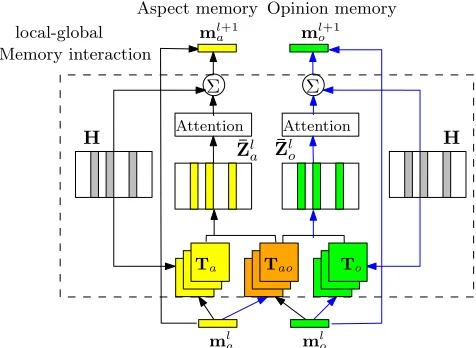
For each domain, the task of aspect and opinion terms ex-traction relies on the modeling of complex relations among aspect words and opinion words. Without any explicit prior knowledge, we summarize these relations into 3 categories and apply tensor operations to exploit multi-level bilinear interactions among the related entities. Figure 2 provides a specific structure for domain-specific local-global memory interaction module for thel-th layer. Here domain subscript is removed for ease of illustration. We use a 3-dimensional tensorTato exploit intra-correlations among aspect words,
To to exploit intra-correlations among opinion words, and
Tao to model inter-connections between aspect words and opinion words. Atl-th layer, the model reads a global as-pect memorymla, a global opinion memorymloand a local memory matrixH. To incorporate sequential information of a sentence,His obtained by applying a GRU (Gated Recur-rent Unit) network on pre-trained word embeddings.
The attention module for each layer computes two sets of outputs, one for aspect memory and the other for opin-ion memory. As a first step, the local memoryhi ∈Rd for
transformed correlation vectors via the following formula:
zla,i = [mla>Tahi:mlo
>
Taohi], (1)
zlo,i = [mlo>Tohi:mla
>
Taohi], (2)
where [:] indicates concatenation of vectors and Ta, To,
Tao ∈ Rk×d×d. zla,i and zlo,i can be regarded as corlation vectors for aspect module and opinion module, re-spectively, that measure the extent of interactions between
hiand global memories. For example, ifhihas high intra-correlations with aspect memoryml
aand inter-connections with opinion memoryml
o, it is more likely to be an aspect word. The final transformation vectors atl-th layer are pro-duced through another GRU network to incorporate contex-tual attention influence:
¯
zla,i = fGRU(zla,i,¯z l a,i−1;θ
a
GRU), (3)
¯zlo,i = fGRU(zlo,i,¯z l o,i−1;θ
o
GRU), (4)
withθa
GRU,θ
o
GRU representing all parameters within a GRU
network. The attentions then compute normalized relevance scoresαl
a,iandαlo,ithat indicate the possibility of each word being an aspect word or opinion word, respectively:
αla,i = exp(e
l a,i) Pn
j=1exp(e
l a,j)
, ela,i=va>¯zla,i, (5)
αlo,i = exp(e
l o,i) Pn
j=1exp(elo,j)
, elo,i=vo>¯zlo,i, (6)
wherevaandvoare one-dimensional vectors to be learned during training. These attentions scores, together with local memories, will generate aspect- or opinion-related represen-tations for the input sentence to update the global memories for the next layer:
mla+1 = tanh(Mamla) + n X
i=1
αla,ihi, (7)
mlo+1 = tanh(Momlo) + n X
i=1
αlo,ihi. (8)
Ma andMoare transformation matrices for global memo-ries. The updates iteratively refine the global memory repre-sentations to incorporate more relevant candidates according to attention mechanism. Without knowledge transfer, this module is similar to (Wang et al. 2017).
Global Memory Correlations
With global aspect and opinion memories generated for each domain, shared pivot knowledge could be exploited to bridge the gap between domains. The first type of pivot knowledge lies in common opinion terms across domains. From (8), the global opinion memory at each layer sum-maries most probable opinion words in the input sentence. Then sharing of opinion representations could be achieved through a domain adversarial network on top of the global opinion memories. As shown in Figure 1, we apply DAN for ml
o at each layer by integrating a domain discrimina-tor that generates a probability distributionP(D|mlo)over
Attention Attention
Σ Σ
H H
mla mlo ml+1a ml+1o
Memory interaction
Aspect memory Opinion memory local-global
Ta Tao To
¯ Zl
a Z¯lo
Figure 2: Local-global memory interaction at layerl.
2 domains, whereD = 1indicates the source domain. The prediction is produced via a fully-connected layer:
¯
mlo = tanh(Wdomlo+bdo), (9)
¯
ydo = P(D|mlo) =softmax(Vodm¯lo+cdo). (10)
Since aspect terms are usually disjoint across domains, sim-ply aligning them is difficult. We propose to use rDAN that learns invariant aspect-opinion relations, thus aligning as-pect memories conditioned on their corresponding opinion representations. With similar procedures, we obtain
¯
mla = tanh(Wda[mla :mlo] +bda), (11)
¯
yad = P(D|mla,mlo) =softmax(Vadm¯la+cda). (12)
The second type of pivot information is domain-invariant correlations among target words. As mentioned previously, there exists 3 types of interactions including aspect-aspect, opinion-opinion and aspect-opinion relations. We formulate these relations with different forms of global memory inter-actions. As the global aspect memoryml
aat each layer con-tains attended aspect candidates at the current timestamp, the aspect-aspect interactions could be modeled by apply-ing tensor operatorTabetween consecutive layersmlaand
mla+1. Similar strategy applies for opinion memories. We use aspect and opinion memories at the same layer to com-pute inter-connections.
ra = mla
>
Tamla+1, (13)
ro = mlo
>
Tomlo+1, (14)
rao = mla
>
Taomlo. (15)
To make these relations invariant across domains, an auxil-iary task is applied on top ofrp∈Rk(p∈{a, o, ao}) to predict
the relation type, which is a 3-class classification task:
¯
ypu=softmax(Vurp+cu). (16)
Training
layer as the input and apply a softmax function to classify the “BIO” position of the word corresponding to aspect terms or opinion terms:
¯
ya,i = softmax(Va L X
l=1
¯zla,i+ca), (17)
¯
yo,i = softmax(Vo L X
l=1
¯
zlo,i+co), (18)
wherey¯a,i,y¯o,i∈R3with each entry indicating the
proba-bility of position “B”, “I” or “O” for aspect or opinion pre-dictions, respectively. The final prediction for each word is generated by comparingy¯a,iwithy¯o,i. If both of them agree on “O”, the final prediction then follows. If only one of them is “O”, we abide by the other prediction. When neither of them belong to “O”, we compare the maximum entry for each vector and choose the largest as the final prediction.
In our unsupervised domain adaptation setting, the aspect and opinion labels are only available for the source domain, which we denote asDS={(xSn,ySa,n,ySo,n)}
NS
n=1. For DAN
and rDAN, we generate domain-labeled data by combining source and target domain asDo
d = {(mlo,n,ydn)}
L,NS+NT l=1,n=1
and Da
d = {(m l
a,n,mlo,n,ydn)}
L,NS+NT
l=1,n=1 . Furthermore,
the auxiliary task for interaction prediction involves both source and target domains with corresponding relation la-bels asDu ={(mlp,n,mlp,n+1,yup,n)}
L−1,NS+NT
l=1,n=1,p∈{a,o,ao}
Dur-ing trainDur-ing, the followDur-ing loss functions are adopted:
LS = X
DS X
p∈{a,o}
`(ySp,n,¯ySp,n), (19)
Ld = X
Da d
L X
l=1
`(ydn,¯yda,l,n) +X Do
d L X
l=1
`(ydn,y¯o,l,nd ),(20)
Lu = X
Du L X
l=1
X
p∈{a,o,ao}
`(yup,n,¯yup,l,n), (21)
where`is the cross-entropy loss. The final objective is
L=LS+λLu−βLd, (22)
whereλandβ are trade-off parameters to control the im-pact of auxiliary task and adversarial networks. Letθf,θS, θd,θu denotes the parameter set for feature learning, word prediction, domain prediction and auxiliary relation predic-tion, respectively. We adopt the Gradient Reversal Layer (GRL) (Ganin and Lempitsky 2015) for training DAN and rDAN. The updates can be carried in the following rules:
θf ← θf−µ
∂L S ∂θf
+λ∂Lu ∂θf
−β∂Ld ∂θf
, (23)
θS ← θS−µ
∂L S ∂θS
, (24)
θu ← θu−µ
λ∂Lu
∂θu
, (25)
θd ← θd−µ
β∂Ld ∂θd
. (26)
Dataset Description Sentences Training Testing RES Restaurant 5,841 4,381 1,460
LAP Laptop 3,845 2,884 961
DEV Digital Device 3,836 2,877 959
Table 1: Data statistics from each domain.
Here µrepresents the learning rate and all parameters are shared across domains.
Experiments
Experimental Setup
Datasets Our experiments are conducted on three bench-mark datasets with customer reviews including restaurant reviews, laptop reviews and reviews from digital device. Follow the setup from (Wang and Pan 2018), we com-bine restaurant reviews from SemEval 2014 task 4 subtask 1 (Pontiki et al. 2014) and SemEval 2015 task 12 subtask 1 (Pontiki et al. 2015) to form our restaurant domain. The laptop reviews consist of challenge dataset from the laptop domain in SemEval 2014 task 4 subtask 1. The device do-main is a combination of the reviews from 5 different digital products provided by (Hu and Liu 2004). Detailed statistics are shown in Table 1. We use three different splits follow-ing (Wang and Pan 2018), where each split consists of3/4
of the original data for training, and the rest constitutes the test set. The number of sentences for training and testing for each split is shown in Table 1. For precise comparison, we take the average results of 3 splits as the final performance.
Settings The input word embeddings are pre-trained us-ingword2vec(Mikolov et al. 2013), with the training corpus being a combination of Yelp Challenge dataset2 and
elec-tronics dataset from Amazon reviews3. The dimension of word vectors is set to be 100. As mentioned earlier, the in-put local memory for each word is obtained through a GRU network on its word embedding. We set the dimension of GRU-transformed vector to be 50. For 3-dimensional ten-sor parameters, we set the number of bilinear interactions as k = 20. For our experiments, the transferable interac-tive memory network consists of 3 layers. The trade-off pa-rameters for adversarial loss and auxiliary loss areβ = 0.5
andλ= 1.0. For training, we apply stochastic gradient de-scent to update all the parameters with 0.1 as the learning rate. To avoid over-fitting, partial dropout strategy is adopted with dropout rate set as 0.5 for non-recurrent GRU param-eters as well as 3-dimensional tensors. All the experiments are conducted with 20 epochs and the best performance for each split is being recorded. Under the setting of unsuper-vised domain adaptation, no labels are available for the tar-get domain. Hence, we only use the labeled training data from source domain and unlabeled training data from target domain to train all the models. And we investigate two dif-ferent settings: transductive setting that tests the model on training data from the target domain and inductive setting
2
http://www.yelp.com/dataset challenge 3
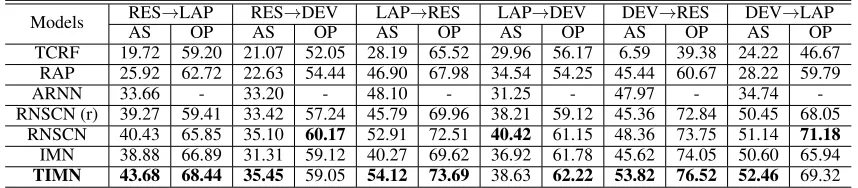
Models RES→LAP RES→DEV LAP→RES LAP→DEV DEV→RES DEV→LAP AS OP AS OP AS OP AS OP AS OP AS OP TCRF 19.72 59.20 21.07 52.05 28.19 65.52 29.96 56.17 6.59 39.38 24.22 46.67
RAP 25.92 62.72 22.63 54.44 46.90 67.98 34.54 54.25 45.44 60.67 28.22 59.79 ARNN 33.66 - 33.20 - 48.10 - 31.25 - 47.97 - 34.74 -RNSCN (r) 39.27 59.41 33.42 57.24 45.79 69.96 38.21 59.12 45.36 72.84 50.45 68.05
RNSCN 40.43 65.85 35.10 60.17 52.91 72.51 40.42 61.15 48.36 73.75 51.14 71.18 IMN 38.88 66.89 31.31 59.12 40.27 69.62 36.92 61.78 45.62 74.05 50.60 65.94 TIMN 43.68 68.44 35.45 59.05 54.12 73.69 38.63 62.22 53.82 76.52 52.46 69.32
Table 2: Comparisons in F1 scores with different baselines.
that tests the model on the test data in the target domain. The evaluations are conducted using F1 scores that only assign a true positive prediction to an exact match for any multi-word aspect or opinion term. We use Intel(R) Xeon(R) CPU E5-1650 v2 @ 3.50GHz for the experiments. Specifically, training 1 epoch with around 6000 sentences takes around 30 mins. The training usually converges at about 5 epochs.
Baselines To demonstrate the effectiveness of TIMN, we compare its performance with several baseline models for unsupervised domain adaptation, listed in the following: • TCRF: Transferable CRF model proposed by Jakob and
Gurevych (2010). It implements a linear-chain CRF for sequence prediction that focuses on non-lexical features, e.g., POS tags and dependency relations, that are shared across different domains.
• RAP: A cross-domain boosting method called Relational Adaptive bootstraPping (Li et al. 2012) that iteratively ex-pand target lexicon according to pivot opinion words and syntactic relations.
• ARNN: A recurrent neural network with auxiliary tasks which are formed from manually-designed rules that in-form the relations among aspect and opinion words (Ding, Yu, and Jiang 2017).
• RNSCN: The recently proposed recursive neural network by Wang and Pan (2018). It incorporates syntactic struc-ture into the deep model and an auto-encoder to denoise relation labels generated from the parser.
• RNSCN (r): Using the same model as RNSCN, but changing the dataset by randomly replacing dependency relations in the source domain that connect to an aspect or opinion word with 50% probability.
• IMN: Single-domain Interactive Memory Network. We directly use the model trained on labeled source domain to make predictions in the target domain.
• TIMN: The proposed Transferable Interactive Memory Network which learns a shared space through memory representations and memory interactions.
Experimental Results
The comparison results with various baselines are shown in Table 2 for inductive setting with average F1 scores over 3 splits. Clearly, traditional feature-engineering-based and boosting-based models TCRF and RAP are not good enough
to extract necessary information to be adapted in the target domain, compared to deep learning models. ARNN relies on the construction of auxiliary tasks, and hence is not flexi-ble to adapt to specific dataset, especially for user-generated texts. Although the most recent method RNSCN proposed by (Wang and Pan 2018) addresses the limitation of manual-designed rules by incorporating syntactic information into a dependency-tree-based recursive neural network, the perfor-mance still relies on the accuracy of the dependency parser. This can be revealed when observing the performance of RNSCN (r). By randomly replacing some of the dependency relations obtained from the parser, it simulates the situation when the parser does not perform well, which is common for informal texts. In this case, the performance for RN-SCN (r) is inferior than RNRN-SCN using the same model, with large degradation for opinion predictions and aspect pre-diction for LAP→RES (7.12% drop). Without any transfer strategy, IMN is already able to achieve comparable perfor-mances for most of the experiments by simply sharing all the parameters learned from the source domain with the tar-get domain. This indicates that the attention mechanism is transferable to some extent in the way it models interactions among aspect and opinion words through local-global mem-ory interactions. To further exploit these shared information, we propose TIMN that explicitly project the interactions from both domains into a shared space. Without any ex-ternal resources, TIMN achieves the state-of-the-art perfor-mances on most experiments. Specifically, it shows 3.25% and 2.59% improvements on aspect and opinion term pre-dictions for RES→LAP, 5.46% and 2.77% improvements on aspect and opinion term predictions for DEV→RES.
outper-Models RES→LAP RES→DEV LAP→RES LAP→DEV DEV→RES DEV→LAP AS OP AS OP AS OP AS OP AS OP AS OP None 38.88 66.89 31.31 59.12 40.27 69.62 36.92 61.78 45.62 74.05 50.60 65.94 DAN 39.70 67.41 32.33 59.13 51.98 72.73 38.27 60.55 51.18 75.72 49.74 69.58 rDAN 42.43 67.72 32.90 58.12 52.33 71.19 38.08 61.30 53.49 76.15 49.79 69.97 aux 41.60 65.25 32.54 59.08 51.20 73.29 37.26 58.60 53.04 75.51 50.47 68.04 DAN+rDAN 42.82 67.91 33.34 57.66 52.46 72.75 37.91 59.79 51.29 74.72 50.58 69.76 DAN+aux 43.11 68.51 33.33 58.71 51.57 72.85 37.95 59.84 51.79 75.56 51.37 70.40 rDAN+aux 42.25 68.05 34.64 58.46 52.96 72.62 37.71 58.72 52.01 75.69 49.81 67.10 TIMN 43.68 68.44 35.45 59.05 54.12 73.69 38.63 62.22 53.82 76.52 52.46 69.32
Table 3: Performances for different combinations of each transfer component in terms of F1 scores.
RES→LAP RES→DEV LAP→RES LAP→DEV DEV→RES DEV→LAP AS OP AS OP AS OP AS OP AS OP AS OP
OUT
1 layer 36.69 65.64 32.98 59.55 46.28 71.95 37.88 61.87 49.21 76.03 51.14 68.75 2 layers 42.65 67.73 31.28 57.20 50.26 72.11 38.75 61.49 51.86 76.09 51.81 68.02 3 layers 43.68 68.44 35.45 59.05 54.12 73.69 38.63 62.22 53.82 76.52 52.46 69.32 4 layers 43.38 68.10 35.04 58.44 52.28 73.45 38.27 59.64 53.63 75.97 52.34 69.05
IN
1 layer 34.37 64.89 31.29 58.89 47.32 72.14 39.22 61.27 47.80 76.89 50.33 68.40 2 layers 39.27 67.42 32.07 57.23 51.69 71.60 40.30 62.13 51.58 76.69 50.34 69.81 3 layers 40.28 67.64 34.45 59.36 52.24 72.85 38.85 60.78 53.94 76.25 52.21 70.13 4 layers 39.49 67.05 34.39 59.01 51.77 72.73 38.62 61.70 53.11 76.43 51.87 70.05
Table 4: Comparisons with different number of layers and settings in terms of F1 scores.
form those independent ones, which shows each constituent actively affect the learning process of the other. For example, if DAN helps to align opinion words across domains, rDAN could in turn make more accurate extraction for aspect terms according to the interactions between aspect memory and opinion memory. Without doubt, the joint model that com-bines all 3 components attains the best performance.
The proposed TIMN model consists of multiple layers to iteratively refine the global memory representations and the transformed hidden vectors for each word. The multi-layer architecture is also crucial for modeling intra-correlations among aspect or opinion words across domains. To prove that, we conduct experiments with different number of lay-ers as shown in Table 4. In most cases, increasing the number of layers from 1 to 3 demonstrates gradual improvements for extraction with the best performance attained using 3 layers. We conjecture that the reason for degradation with 4 lay-ers might be caused by over-extraction when the previous 3 layers are already sufficient to exploit all necessary target information. Note that the model with only 1 layer does not involve global memory interactions for auxiliary task, be-cause there does not exist two consecutive layers to pute the interaction. Hence, it perform much worse com-pared to other results in terms of aspect extraction. Table 4 also presents results for both inductive (OUT) and transduc-tive (IN) settings. We shall observe little difference in the performances between these two settings, which shows the model’s robustness to guarantee comparable results when the data for evaluation is not presented during training.
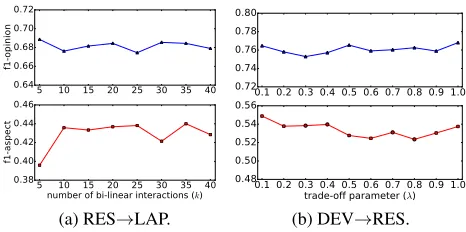
The robustness of the proposed model is illustrated in Figure 3. Specifically, we conduct experiments varying the number of bi-linear interactions (k) in tensor operation for
5 10 15 20 25 30 35 40 0.64
0.66 0.68 0.70 0.72
f1-opinion
5 10 15 20 25 30 35 40 number of bi-linear interactions (k) 0.38
0.40 0.42 0.44 0.46
f1-aspect
(a) RES→LAP.
0.1 0.2 0.3 0.4 0.5 0.6 0.7 0.8 0.9 1.0 0.72
0.74 0.76 0.78 0.80
0.1 0.2 0.3 0.4 0.5 0.6 0.7 0.8 0.9 1.0 trade-off parameter (¸) 0.48
0.50 0.52 0.54 0.56
(b) DEV→RES.
Figure 3: Sensitivity studies for hyper-parameters.
RES→LAP as well as changing the trade-off parameter for auxiliary loss (λ) for DEV→RES. The plots demonstrate stableness of TIMN over different hyper-parameters.
Conclusion
This paper presents a novel memory network that empha-sizes the complex correlations among aspect words and opinion words which are summarized into 3 categories. The model not only exploits local-global memory interactions for attending target terms at each domain, but also asso-ciates global memories and their interactions for aligning source and target spaces. The proposed model could achieve promising results without the dependency over any external resources compared with existing methods.
Acknowledgements
MOE AcRF Tier-1 grant 2016-T1-001-159 and Singapore MOE AcRF Tier-2 grant MOE2016-T2-2-060.
References
Blitzer, J.; Dredze, M.; and Pereira, F. 2007. Biographies, bollywood, boomboxes and blenders: Domain adaptation for sentiment classification. InACL, 187–205.
Bollegala, D.; Maehara, T.; and ichi Kawarabayashi, K. 2015. Unsupervised cross-domain word representation learning. InACL, 730–740.
Chen, M.; Xu, Z.; Weinberger, K. Q.; and Sha, F. 2012. Marginalized denoising autoencoders for domain adapta-tion. InICML, 1627–1634.
Ding, Y.; Yu, J.; and Jiang, J. 2017. Recurrent neural net-works with auxiliary labels for cross-domain opinion target extraction. InAAAI, 3436–3442.
Ganin, Y., and Lempitsky, V. 2015. Unsupervised domain adaptation by backpropagation. InICML, volume 37, 1180– 1189.
Glorot, X.; Bordes, A.; and Bengio, Y. 2011. Domain adap-tation for large-scale sentiment classification: A deep learn-ing approach. InICML, 97–110.
He, R.; Lee, W. S.; Ng, H. T.; and Dahlmeier, D. 2017. An unsupervised neural attention model for aspect extraction. InACL, 388–397.
Hu, M., and Liu, B. 2004. Mining and summarizing cus-tomer reviews. InKDD, 168–177.
Jakob, N., and Gurevych, I. 2010. Extracting opinion tar-gets in a single- and cross-domain setting with conditional random fields. InEMNLP, 1035–1045.
Jin, W., and Ho, H. H. 2009. A novel lexicalized hmm-based learning framework for web opinion mining. InICML, 465– 472.
Li, X., and Lam, W. 2017. Deep multi-task learning for aspect term extraction with memory interaction. InEMNLP, 2886–2892.
Li, F.; Han, C.; Huang, M.; Zhu, X.; Xia, Y.-J.; Zhang, S.; and Yu, H. 2010. Structure-aware review mining and sum-marization. InCOLING, 653–661.
Li, F.; Pan, S. J.; Jin, O.; Yang, Q.; and Zhu, X. 2012. Cross-domain co-extraction of sentiment and topic lexicons. In ACL, 410–419.
Li, Z.; Zhang, Y.; Wei, Y.; Wu, Y.; and Yang, Q. 2017. End-to-end adversarial memory network for cross-domain senti-ment classification. InIJCAI, 2237–2243.
Liu, K.; Xu, L.; Liu, Y.; and Zhao, J. 2013. Opinion target extraction using partially-supervised word alignment model. InIJCAI, 2134–2140.
Liu, P.; Joty, S.; and Meng, H. 2015. Fine-grained opin-ion mining with recurrent neural networks and word embed-dings. InEMNLP, 1433–1443.
Lu, Y.; Zhai, C.; and Sundaresan, N. 2009. Rated aspect summarization of short comments. InWWW, 131–140.
Mei, Q.; Ling, X.; Wondra, M.; Su, H.; and Zhai, C. 2007. Topic sentiment mixture: Modeling facets and opinions in weblogs. InWWW, 171–180.
Mikolov, T.; Sutskever, I.; Chen, K.; Corrado, G. S.; and Dean, J. 2013. Distributed representations of words and phrases and their compositionality. InNIPS, 3111–3119. Mnih, V.; Heess, N.; Graves, A.; and Kavukcuoglu, K. 2014. Recurrent models of visual attention. InNIPS. 2204–2212. Pan, S. J.; Ni, X.; Sun, J.-T.; Yang, Q.; and Chen, Z. 2010. Cross-domain sentiment classification via spectral feature alignment. InWWW, 751–760.
Pontiki, M.; Galanis, D.; Pavlopoulos, J.; Papageorgiou, H.; Androutsopoulos, I.; and Manandhar, S. 2014. Semeval-2014 task 4: Aspect based sentiment analysis. InSemEval, 27–35.
Pontiki, M.; Galanis, D.; Papageorgiou, H.; Manandhar, S.; and Androutsopoulos, I. 2015. SemEval-2015 task 12: As-pect based sentiment analysis. InSemEval 2015, 486–495. Popescu, A.-M., and Etzioni, O. 2005. Extracting product features and opinions from reviews. InEMNLP, 339–346. Qiu, G.; Liu, B.; Bu, J.; and Chen, C. 2011. Opinion word expansion and target extraction through double propagation. Comput. Linguist.37(1):9–27.
Titov, I., and McDonald, R. 2008. Modeling online reviews with multi-grain topic models. InWWW, 111–120.
Wang, W., and Pan, S. J. 2018. Recursive neural structural correspondence network for cross-domain aspect and opin-ion co-extractopin-ion. InACL, 2171–2181.
Wang, W.; Pan, S. J.; Dahlmeier, D.; and Xiao, X. 2016. Recursive neural conditional random fields for aspect-based sentiment analysis. InEMNLP, 616–626.
Wang, W.; Pan, S. J.; Dahlmeier, D.; and Xiao, X. 2017. Coupled multi-layer tensor network for co-extraction of as-pect and opinion terms. InAAAI, 3316–3322.
Weston, J.; Chopra, S.; and Bordes, A. 2015. Memory net-works. InICLR.
Xu, H.; Liu, B.; Shu, L.; and Yu, P. S. 2018. Double embed-dings and cnn-based sequence labeling for aspect extraction. InACL, 592–598.
Yin, Y.; Wei, F.; Dong, L.; Xu, K.; Zhang, M.; and Zhou, M. 2016. Unsupervised word and dependency path embeddings for aspect term extraction. InIJCAI, 2979–2985.
Yu, J., and Jiang, J. 2016. Learning sentence embeddings with auxiliary tasks for cross-domain sentiment classifica-tion. InEMNLP, 236–246.
Zhang, L.; Liu, B.; Lim, S. H.; and O’Brien-Strain, E. 2010. Extracting and ranking product features in opinion docu-ments. InCOLING, 1462–1470.
Zhang, M.; Zhang, Y.; and Vo, D. T. 2015. Neural networks for open domain targeted sentiment. InEMNLP.
Zhou, G.; Xie, Z.; Huang, J. X.; and He, T. 2016. Bi-transferring deep neural networks for domain adaptation. In ACL, 322–332.