The Thirty-Third AAAI Conference on Artificial Intelligence (AAAI-19)
Towards Automated Semi-Supervised Learning
Yu-Feng Li,
1Hai Wang,
1,2Tong Wei,
1Wei-Wei Tu
21National Key Laboratory for Novel Software Technology, Nanjing University, Nanjing 210023, China 24Paradigm Inc., Beijing, China
{liyf,wanghai,weit}@lamda.nju.edu.cn; [email protected]
Abstract
Automated Machine Learning (AutoML) aims to build an appropriate machine learning model for any unseen dataset automatically, i.e., without human intervention. Great efforts have been devoted on AutoML while they typically focus on supervised learning. In many applications, however, semi-supervised learning (SSL) are widespread and current AutoML systems could not well address SSL problems. In this paper, we propose to present an automated learning system for SSL (AUTO-SSL). First, meta-learning with enhanced meta-features is employed to quickly suggest some instantiations of the SSL techniques which are likely to perform quite well. Second, a large margin separation method is proposed to fine-tune the hyperparameters and more importantly, alleviate performance deterioration. The basic idea is that, if a certain hyperparame-ter owns a high quality, its predictive results on unlabeled data may have a large margin separation. Extensive empirical re-sults over 200 cases demonstrate that our proposal on one side achieves highly competitive or better performance compared to the state-of-the-art AutoML systemAUTO-SKLEARNand classical SSL techniques, on the other side unlike classical SSL techniques which often significantly degenerate performance, our proposal seldom suffers from such deficiency.
Introduction
In traditional machine learning, given a dataset, a fine-tuned learning model is built by human. Nowadays, how-ever, along with the successfulness of machine learning, more and more communities (governments, industrial compa-nies) require a learning model for their specific data. Ex-isting approaches based on manually fine-tuned learning models consume a large amount of human resources and efforts. To overcome this issue, the development of auto-mated machine learning (AutoML) (Thornton et al. 2013; Feurer et al. 2015), which attempts to build an appropriate machine learning model for unseen dataset in an automatic manner (without human intervention), has received increas-ing attention recently. For example, many workshops have been hold in recent machine learning conferences,1 and a number of AutoML competitions have been organized.2
Copyright © 2019, Association for the Advancement of Artificial Intelligence (www.aaai.org). All rights reserved.
1
http://automl.chalearn.org 2
https://www.4paradigm.com/competition/nips2018
AutoML is magnificent yet challenging, since absolute AutoML is infeasible (Guyon et al. 2016). Previous work on AutoML typically focuses on supervised learning prob-lems, and addresses the difficulties including feature engi-neering (Guyon et al. 2016), model selection (Sun 2016) and hyperparameter optimization (Hutter, Hoos, and Leyton-Brown 2011). Recently there are a couple of systematical schemes that achieve promising performance. For exam-ple, AUTO-WEKA combines the machine learning frame-work WEKA (Hall et al. 2009) with a bayesian optimiza-tion method (Hutter, Hoos, and Leyton-Brown 2011) to se-lect a good instantiation ofWEKAfor a new dataset.AUTO -SKLEARN(Feurer et al. 2015) improvesAUTO-WEKAand uses meta-learning (Lemke, Budka, and Gabrys 2015) to warmstart the bayesian optimization procedure, and finally includes an automated ensemble construction step. Google Cloud AutoML is a suite of machine learning products that can automatically train high quality models by leveraging google’s state-of-the-art transfer learning techniques and neu-ral architecture search techniques.3These above studies show
that one could automatically select a quite good learning model and hyperparameter for supervised learning problems. In many applications, except for supervised learning sce-nario, many other problems such as semi-supervised learning (SSL) (Chapelle, Sch¨olkopf, and Zien 2006; Zhou and Li 2010) are widespread in reality. However, the efforts on Auto-mated SSL remain limited. In this work we study autoAuto-mated SSL and it is notable that existing AutoML techniques could not directly be applied for the automated SSL problem, since SSL introduces some new challenges.
• First, although meta-learning is able to quickly suggest some instantiations of the learning techniques which are likely to perform quite well, the feature engineering is much harder for SSL since many meta-features extracted from a number of labeled examples (Feurer et al. 2015) are no longer available and suitable.
• Second, unlike supervised learning which typically has per-formance improvement with more labeled examples, SSL with the use of auxiliary unlabeled instances may some-times even be outperformed by direct supervised learning with only limited labeled examples (Li and Zhou 2015; Krijthe and Loog 2015; Li, Kwok, and Zhou 2016). Such
3
phenomenon is crucial for SSL and needs to be alleviated in automated SSL. Recently, a scheme termed safe SSL (Li and Zhou 2015) has been presented to alleviate the per-formance deterioration issue in SSL. They are proposed to address the performance unsafeness in terms of data quality (Li, Wang, and Zhou 2016), model uncertainty (Li and Zhou 2015; Krijthe and Loog 2015) and measure flex-ibility (Li, Kwok, and Zhou 2016). These works typically focus on one aspect of the learning process, which do not finalize a systematical solution and are not automated SSL. To alleviate these issues, in this paper we propose to present an automated learning system (AUTO-SSL) for SSL. First, inspired byAUTO-SKLEARN(Feurer et al. 2015), we consider meta-learning to quickly suggest some instantiations of the SSL techniques that are likely to perform quite well. By considering that unlabeled data distribution is important to SSL techniques, diverse unsupervised clustering algorithms are performed and meta-features with respect to intra-cluster and inter-cluster statistics are extracted to enhance the per-formance of meta-learning. Second, we propose a large mar-gin separation method to fine-tune the hyperparameters and meanwhile alleviate the performance deterioration issue in SSL. Our basic idea is that, if a certain hyperparameter owns a high quality, its predictive results on unlabeled data may have a large- margin separation. We should exploit the large margin hyperparameters while keeping the small margin hy-perparameters (which might be risky) to be rarely exploited. Extensive empirical results on 40 datasets over 200 cases demonstrate that our proposal achieves highly competitive or better performance compared to the state-of-the-art AutoML system AUTO-SKLEARNand classical SSL techniques, in addition unlike classical SSL techniques often degenerate performance significantly, our proposal seldom suffers from such deficiency.
In the following, we first highlight the differences with related work, and then present our proposal and the extensive empirical justification, finally we conclude this work.
Related Work
This work is mostly related to two branches of studies. AutoML: AutoML is challenging. Many issues have been raised (Guyon et al. 2016), such as automated feature engi-neering (Guyon et al. 2016), automated model selection (Sun 2016), automated hyperparameter optimization (Hutter, Hoos, and Leyton-Brown 2011). From the systematical scheme aspect, one of the earliest work for AutoML is AUTO -WEKA(Hall et al. 2009) which combines the machine learn-ing frameworkWEKAwith a bayesian optimization method to select a good configuration for a new dataset. Later on, to fur-ther alleviate the high computational cost and derive a more accurate solution,AUTO-SKLEARN(Feurer et al. 2015) im-provesAUTO-WEKAand uses meta-learning (Lemke, Budka, and Gabrys 2015) step to warmstart the bayesian optimiza-tion procedure, and finally includes an automated ensemble construction for robustness. Although many AutoML tech-niques have been proposed, they typically work on supervised learning, while the efforts on semi-supervised learning (SSL) remain to be limited.
Safe SSL: Safeness is one important aspect to AutoSSL, since it is not desirable to have an automated yet performance-degenerated SSL system. Recently, safe SSL has some stud-ies, conquering the performance unsafeness in terms of data quality (Li, Wang, and Zhou 2016), model uncertainty (Li and Zhou 2015; Krijthe and Loog 2015) and measure flexi-bility (Li, Kwok, and Zhou 2016). Nevertheless, they are not AutoSSL sine they do not finalize a systematical scheme.
Towards Automated SSL
Generally, an AutoML system consist of four procedures. Given a collection of datasets, an AutoML system performs meta-learning which extracts meta-features of datasets and then uses a supervised learning model to select a learning algorithm which is likely to perform well for unseen dataset. Then, the AutoML system performs hyperparameter opti-mization/selection, to derive a good candidate hyperparam-eter for the selected algorithm. Later, model evaluation is conducted to finalize the ultimate model. Finally, in the pre-diction phrase, given a new dataset, the AutoML system first represents the dataset via meta-features, and then predicts an appropriate algorithm with a good hyperparameter, which finally finalizes the learning model.
Among the above procedures, we need to tackle with two major difficulties. a) How to design appropriate SSL meta-features to facilitate a better meta-learning? b) How to choose a good quality parameter and alleviate the performance de-generation issue in SSL? In the following, we first present preliminaries and problem description, then we present a scheme for the above two difficulties respectively.
Preliminaries and Problem Definition
Let D = {{xi, yi}li=1,{xj}lj+=ul+1}be a SSL dataset with limited labeled data and a large amount of unlabeled data, whereL={xi, yi}li=1corresponds to the labeled instances andU ={xj}lj+=ul+1corresponds to the unlabeled instances.
yi∈ {+1,−1}corresponds to the label of instancexi,i=
1, . . . , l. Inspired by (Feurer et al. 2015), we have the goal of
AutoSSL as following.
Definition 1 (AutoSSL) LetS={S1,
· · · , SN
}be a set of SSL algorithms, and the hyper-parameters of each algorithm
Sjhave a domainΘj. LetAbe a baseline supervised
learn-ing algorithm, and the hyper-parameters of algorithmAhave domainΛ. Suppose thatMautois the output model of the
automated SSL system on data setDandAΛ the model of supervised learning algorithm trained on labeled data setL. The goal of the automated SSL system is thatP er(Mauto)is
always significantly better thanP er(AΛ), and rarely worse thanP er(AΛ), whereP er(M)denotes the performance of modelMon testing data.
which does not suffer from performance degeneration prob-lem, the reliability of AutoSSL is crucial and stated. Com-pared to the description of Safe SSL (Li and Zhou 2015; Li, Zha, and Zhou 2017) where the automated model evalua-tion is not menevalua-tioned, AutoSSL explicitly highlights it.
Meta-Learning with Enhanced Meta-Features
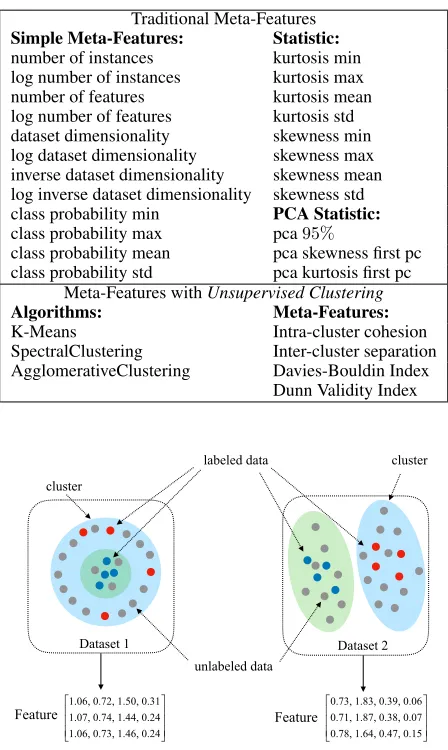
Meta-learning (Brazdil et al. 2008) aims to reason about the performance of learning algorithms across different datasets. Specifically, in AutoML, we collect the performance data and a set of meta-features for a large number of datasets, where meta-features are characteristics of the dataset that help determine which algorithm to use for a new dataset and can be computed in an efficient manner (Feurer et al. 2015). Meta-feature is central to meta-learning. Rather than the reasoning based on meta-features, meta-features themselves play a more important role to the final performance (Feurer et al. 2015). However, there is a lack of a principle way to design appropriate meta-features for meta-learning. Multiple kinds of meta-features from different aspects have been tried and presented in previous AutoML studies, including a) simple meta-features: describe the basic dataset structure (Michie et al. 1994; Feurer, Springenberg, and Hutter 2015), such as the number of instances, the number of features, etc. b) statistical meta-features (Michie et al. 1994): characterize the data via descriptive statistics such as the kurtosis and skewness; c) PCA-based meta-features (Bardenet et al. 2013): compute various statistics of the dataset principal components.For SSL, it is important to include characteristics that related to SSL techniques. Nevertheless, current general Au-toML meta-features have little to do with SSL methods. To alleviate it, we propose to characterize the distribution of unlabeled data or data distribution assumption (Chapelle, Sch¨olkopf, and Zien 2006; Zhou and Li 2010), which is known as an important factor for SSL, by unsupervised clus-tering algorithms. Specifically, different SSL techniques pre-fer to difpre-ferent data distributions, e.g.,
• Graph-based SSL techniques (Zhu, Ghahramani, and Laf-ferty 2003; Zhou et al. 2004) prefer to manifold assump-tion or smoothness assumpassump-tion, where similar instances are likely to have similar labels.
• large margin SSL techniques (Joachims 1999; Li and Zhou 2015) prefer to low-density assumption or cluster assumption, where the decision boundary goes across a low-density region of data distribution.
To our best knowledge, meta-features for the above data dis-tribution assumptions have not been throughly studied before. In this paper, we employ classical clustering algorithms to realize different data assumptions of unlabeled data. The first one is the k-means algorithm (Jain 2010), which describes the mixture-gaussian data distribution and each cluster simulates a density function of data distribution. Therefore, k-means al-gorithm is a choice to realize the low-density assumption. The second one is the spectral clustering algorithm (Von Luxburg 2007), which partitions the data with respect to data similarity matrix and each cluster simulates a manifold structure of data distribution. Consequently, spectral clustering algorithm is a choice to realize the manifold assumption. Finally, the last
Table 1: List of Meta-Features inAUTO-SSL
Traditional Meta-Features
Simple Meta-Features: Statistic:
number of instances kurtosis min
log number of instances kurtosis max
number of features kurtosis mean
log number of features kurtosis std
dataset dimensionality skewness min
log dataset dimensionality skewness max inverse dataset dimensionality skewness mean log inverse dataset dimensionality skewness std
class probability min PCA Statistic:
class probability max pca95%
class probability mean pca skewness first pc class probability std pca kurtosis first pc
Meta-Features withUnsupervised Clustering
Algorithms: Meta-Features:
K-Means Intra-cluster cohesion
SpectralClustering Inter-cluster separation
AgglomerativeClustering Davies-Bouldin Index Dunn Validity Index
labeled data
unlabeled data
cluster
cluster
Dataset 1 Dataset 2
Feature Feature
0.73, 1.83, 0.39, 0.06 0.71, 1.87, 0.38, 0.07 0.78, 1.64, 0.47, 0.15
⎡
⎣ ⎢ ⎢ ⎢
⎤
⎦ ⎥ ⎥ ⎥ 1.06, 0.72, 1.50, 0.31
1.07, 0.74, 1.44, 0.24 1.06, 0.73, 1.46, 0.24
⎡
⎣ ⎢ ⎢ ⎢
⎤
⎦ ⎥ ⎥ ⎥
Figure 1: Meta-features via unsupervised clustering
one is the hierarchical clustering algorithm (Jain and Dubes 1988) which provides a flexible way to hybrid multiple lo-cal clusters. For each clustering algorithm, four popular and prominent meta-features (Maulik and Bandyopadhyay 2002; Davies and Bouldin 1979), namely, intra-cluster cohesion, inter-cluster separation, Davies-Bouldin index and Dumn Validity index are employed.
0.6 0.5
0.9 0.6 0.7 0.1 0.5 0.7 0.5
o
Predictive results
0.8 0.6 0.4
0.7 0.8
+ + + + + +
0.5 0.3
0.8 0.1 0.3
o
+ + + + +
……
-1 0 +1
-1 0 +1
Large margin
)
z }| {
Accuracy: 90%
Small margin
)
z }| {
Accuracy: 70% Dataset
Model with Hyperparameter 1
Model with Hyperparameter c
Figure 2: Illustration for hyperparameter selection by large margin separation
the meta-features highlight that spectral clustering is more coincident with the first dataset while k-means is more coin-cident with the second one. Table 1 summarizes the list of meta-features used inAUTO-SSL.
Large Margin Hyperparameter Selection
Meta-learning is good at suggesting some instantiations of the SSL techniques which are likely to perform well in a quick manner, whereas it could not provide fine-grained per-formance. In contrast, hyperparameter optimization is good at fine-tuning performance over time, but it is much slower. The above two steps are complementary and help each other. For automated supervised learning, it is now widely ac-cepted that tree-based Bayesian optimization approach, e.g., SMAC (Hutter, Hoos, and Leyton-Brown 2011) achieves promising performance, which fine tunes the hyperparameter based on its accelerated process of k-fold cross-validation.
However, it is not available to fine tune hyperparameters in SSL since the labeled examples are often too few to afford a reliable model selection. What is worse, the performance may be even degenerated compared to direct supervised learning with only labeled examples, as reported in many SSL stud-ies (Li and Zhou 2015). It is desired to choose a good-quality parameter and thus alleviate performance degeneration.
In this paper, we propose to present a large margin sepa-ration method for hyperparameter optimization in AutoSSL. The basic idea is that once a certain hyperparameter owns a high quality, its predictive results on the unlabeled data may have a large margin separation and vice versa (Vapnik 1999). Intuitively, Figure 2 illustrates the idea of large mar-gin hyperparameter selection. It can be seen that when one hyperparameter owns a better accuracy on the unlabeled data, it may also have a larger margin separation (Vapnik 1999). In other words, large margin separation may help judge the qual-ity of hyperparameter. Based on this recognition, we should exploit the large margin hyperparameters while keeping the small margin hyperparameter (which might be risky) to be rarely exploited.
Formally, suppose we perform a classical SSL methodS
with a set of hyperparametersΘ ={θ1,· · · , θr}, and collect
the corresponding predictive valuesF = {fθ1,· · ·,fθr} where fθi = [fθi(x
l+1);. . .;fθi(xl+u)], i = 1,· · ·, r
refers to the prediction on unlabeled data based on the hyper-parameterθi. LetP ={j|fθi(xj)>0, j=l+1,· · ·, l+u}
andN ={j|fθi(x
j)≤0, j=l+ 1,· · ·, l+u}denote the
sets of predictive positive an negative instances. large margin separation is to select the high-quality hyperparameter of SSL model, such that the margin of the predictive results is maximized,
θ?∈arg max
θk∈Θ |
1
|P| X
i∈P
fθk(xi)−
1
|N | X
j∈N
fθk(xj)| (1)
The large margin separation principle is simple, and rather effective to exclude poor quality parameters. Since it only runs the model once, it is much faster to compute than the expensive standard cross-validation procedure.
Finally, once the candidate best hyperparameterθ?is se-lected, model evaluation is conduct to finalize the best model for unseen data. In order to select a robust model that will not be outperformed by direct supervised learning with only labeled data, both the hyperparameters of SSL techniques and baseline supervised learning algorithm are considered for comparison, and we employK-fold cross-validation (Kohavi 1995) to be an estimate of the model performance. Formally,
letD={{xi, yi}l
i=1,{xj}lj+=ul+1}be a training set which is
split intoKcross-validation folds{D1train,· · ·, DKtrain}and
{Dvalid1 ,· · ·, DKvalid} such that Ditrain = Dtrain\Dvalidi
fori= 1,· · ·, K.AUTO-SSLselects model that minimizes the empirical loss (Feurer et al. 2015) on the dataset:
M?∈ arg min
M∈S∗
θ∪Aλ,λ∈Λ 1 K
K
X
i=1
L(M, Dtraini , Divalid) (2)
(a) (b)
Figure 3: Improved performance ofAUTO-SSLagainstAUTO-SKLEARN
Experiments
To explore the ability ofAUTO-SSLin realistic settings with-out domain-specific parameter tuning, extensive experiments are conducted on a broad range of40 datasets that cover diverse domains including business (blood), life (echocar-diogram), physical (cylinder-bands), social (house-votes), finance (credit-approval), computer (spambase), etc. Detail information of datasets please refer to the supplementary file. AUTO-SSLis compared with the two state-of-the-art super-vised counterparts and two classic SSL techniques.
• SVM: The baseline supervised learning method SVM (Vap-nik 1999) on only labeled examples, a discriminative clas-sifier formally defined by a separating hyperplane. Its hy-perparameter, the penalty factorCsvmis selected from 7 configurations{2−3,2−2,2−1,20,21,22,23
}.
• AUTO-SKLEARN: The state-of-the-art automated machine learning system (Feurer et al. 2015), which shows promis-ing performance on supervised learnpromis-ing problems. The running time is set to one minute which is sufficient to ensureAUTO-SKLEARNsystem to finish successfully. • CMN: The classic graph-based SSL technique (Zhu,
Ghahramani, and Lafferty 2003). Without sufficient do-main knowledge of graph construction,k-nearest neighbor graph is recognized as a good candidate graph (Zhu 2008) and the value ofkis the hyperparameter selected from 3 configurations{5,7,9}.
• TSVM: The classic large margin SSL technique (Joachims 1999) seeks the largest separation between labeled and unlabeled data. The penalty factorCT SV Mis its
hyperpa-rameter selected from the same configurations of SVM. For each data set, a series of limited labeled instances (20,40,60,80,100) are considered, where labeled data are randomly chosen, and the remaining data are used as unla-beled data. Each dataset is split for 20 times and average performance in terms of accuracy and area Under the ROC Curve (AUC) is reported. In the meta-learning ofAUTO-SSL,
performance data of two classical SSL techniques are col-lected on a large amount of testing data, and we use paired t-tests at 95%significance level to select the best learning algorithm for one dataset. In testing phrase, each time one empirical dataset is treated as target dataset, while the other ones are used as the training datasets of automated SSL. For target dataset,6NN is employed to the supervised learner in meta-learning. We have tried many other supervised learners in AUTO-SKLEARN(such as linear model, random forest, SVM) andk-nearest neighbor works the best.
AUTO-SSL
vs.
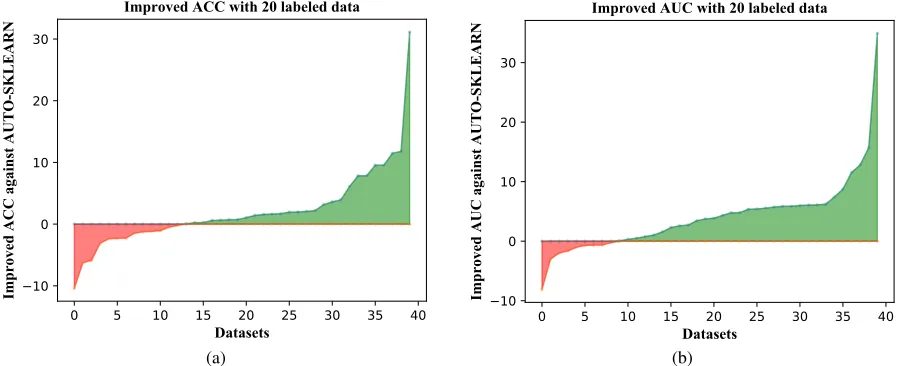
AUTO-SKLEARNIn comparison toAUTO-SKLEARN, Tables 2-3 show the de-tail comparison results and Figure 3 shows improved ac-curacy and AUC of AUTO-SSL against AUTO-SKLEARN with 20 labeled data. More detail results with similar ob-servation please refer to our supplementary file. In Fig-ure 3, the green part indicates the amount of performance improvement, and the red part indicates the amount of performance degradation. Specifically, letP er(AUTO-SSL) and P er(AUTO-SKLEARN) be the performance of AUTO -SSL and AUTO-SKLEARN, respectively, and the values
P er(AUTO-SSL)−P er(AUTO-SKLEARN)on 40 datasets are plotted in increasing order. As can be seen, in the SSL setting, particularly when labeled data are few,AUTO-SSL works clearly better than direct supervised AutoML. These above results demonstrate the effectiveness ofAUTO-SSL, i.e., AUTO-SSLwith the use of unlabeled instances work better than the automated supervised learning solution.
AUTO-SSL
vs. Classical SSL Techniques
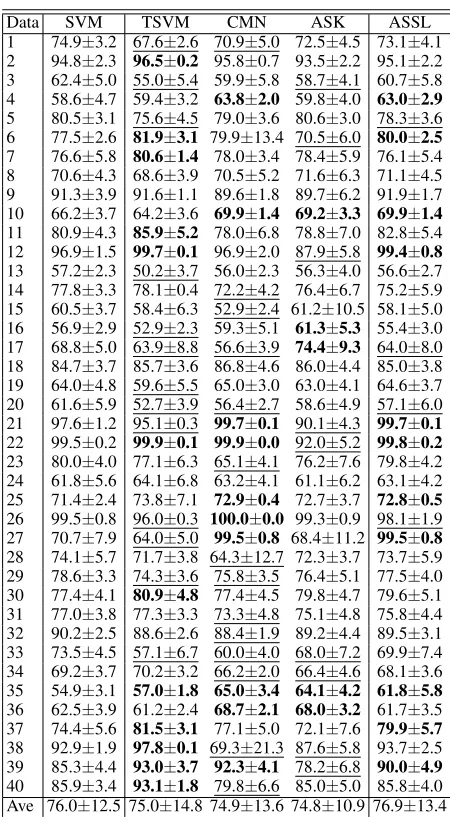
-Table 2: Accuracy%(mean±std) on 20 labeled instances for the compared methods. For the compared methods, if the performance is significantly better/worse than the baseline SVM, the corresponding entries are then bolded/underlined. The average performance is listed for comparison. ASK is short forAUTO-SKLEARNand ASSL is short forAUTO-SSL.
Data SVM TSVM CMN ASK ASSL
1 74.9±3.2 67.6±2.6 70.9±5.0 72.5±4.5 73.1±4.1 2 94.8±2.3 96.5±0.2 95.8±0.7 93.5±2.2 95.1±2.2 3 62.4±5.0 55.0±5.4 59.9±5.8 58.7±4.1 60.7±5.8 4 58.6±4.7 59.4±3.2 63.8±2.0 59.8±4.0 63.0±2.9
5 80.5±3.1 75.6±4.5 79.0±3.6 80.6±3.0 78.3±3.6 6 77.5±2.6 81.9±3.1 79.9±13.4 70.5±6.0 80.0±2.5
7 76.6±5.8 80.6±1.4 78.0±3.4 78.4±5.9 76.1±5.4 8 70.6±4.3 68.6±3.9 70.5±5.2 71.6±6.3 71.1±4.5 9 91.3±3.9 91.6±1.1 89.6±1.8 89.7±6.2 91.9±1.7 10 66.2±3.7 64.2±3.6 69.9±1.4 69.2±3.3 69.9±1.4
11 80.9±4.3 85.9±5.2 78.0±6.8 78.8±7.0 82.8±5.4 12 96.9±1.5 99.7±0.1 96.9±2.0 87.9±5.8 99.4±0.8
13 57.2±2.3 50.2±3.7 56.0±2.3 56.3±4.0 56.6±2.7 14 77.8±3.3 78.1±0.4 72.2±4.2 76.4±6.7 75.2±5.9 15 60.5±3.7 58.4±6.3 52.9±2.4 61.2±10.5 58.1±5.0 16 56.9±2.9 52.9±2.3 59.3±5.1 61.3±5.3 55.4±3.0 17 68.8±5.0 63.9±8.8 56.6±3.9 74.4±9.3 64.0±8.0 18 84.7±3.7 85.7±3.6 86.8±4.6 86.0±4.4 85.0±3.8 19 64.0±4.8 59.6±5.5 65.0±3.0 63.0±4.1 64.6±3.7 20 61.6±5.9 52.7±3.9 56.4±2.7 58.6±4.9 57.1±6.0 21 97.6±1.2 95.1±0.3 99.7±0.1 90.1±4.3 99.7±0.1
22 99.5±0.2 99.9±0.1 99.9±0.0 92.0±5.2 99.8±0.2
23 80.0±4.0 77.1±6.3 65.1±4.1 76.2±7.6 79.8±4.2 24 61.8±5.6 64.1±6.8 63.2±4.1 61.1±6.2 63.1±4.2 25 71.4±2.4 73.8±7.1 72.9±0.4 72.7±3.7 72.8±0.5
26 99.5±0.8 96.0±0.3 100.0±0.0 99.3±0.9 98.1±1.9 27 70.7±7.9 64.0±5.0 99.5±0.8 68.4±11.2 99.5±0.8
28 74.1±5.7 71.7±3.8 64.3±12.7 72.3±3.7 73.7±5.9 29 78.6±3.3 74.3±3.6 75.8±3.5 76.4±5.1 77.5±4.0 30 77.4±4.1 80.9±4.8 77.4±4.5 79.8±4.7 79.6±5.1 31 77.0±3.8 77.3±3.3 73.3±4.8 75.1±4.8 75.8±4.4 32 90.2±2.5 88.6±2.6 88.4±1.9 89.2±4.4 89.5±3.1 33 73.5±4.5 57.1±6.7 60.0±4.0 68.0±7.2 69.9±7.4 34 69.2±3.7 70.2±3.2 66.2±2.0 66.4±4.6 68.1±3.6 35 54.9±3.1 57.0±1.8 65.0±3.4 64.1±4.2 61.8±5.8
36 62.5±3.9 61.2±2.4 68.7±2.1 68.0±3.2 61.7±3.5 37 74.4±5.6 81.5±3.1 77.1±5.0 72.1±7.6 79.9±5.7
38 92.9±1.9 97.8±0.1 69.3±21.3 87.6±5.8 93.7±2.5 39 85.3±4.4 93.0±3.7 92.3±4.1 78.2±6.8 90.0±4.9
40 85.9±3.4 93.1±1.8 79.8±6.6 85.0±5.0 85.8±4.0 Ave 76.0±12.5 75.0±14.8 74.9±13.6 74.8±10.9 76.9±13.4
SSL achieves better performance than classical SSL tech-niques in most cases, which further justifies the effectiveness of automated SSL.
AUTO
-SSL
vs. Direct Supervised Learning
Finally, we extensively discuss the comparison with direct supervised learning, i.e., baseline SVM with only labeled data. According to results in Tables 2-3 and Figure 4, SVM obtains highly competitive performance with few labeled examples. Classic SSL techniques are not easy to beat SVM, and often significantly degenerate the performance, while AUTO-SSLobtains more reliable performance.
Table 3: AUC%(mean±std) on 20 labeled instances for the compared methods. For the compared methods, if the performance is significantly better/worse than the baseline SVM, the corresponding entries are then bolded/underlined. The average performance is listed for comparison. ASK is short forAUTO-SKLEARNand ASSL is short forAUTO-SSL.
Data SVM TSVM CMN ASK ASSL
1 70.9±4.1 63.2±4.7 64.7±5.2 59.5±10.0 65.4±5.5 2 98.7±1.3 99.1±0.1 99.1±0.1 98.9±0.2 98.6±1.3 3 67.5±6.4 55.7±6.7 65.3±5.8 58.4±7.7 64.6±7.6 4 59.4±5.4 58.2±3.8 60.9±4.7 57.2±5.4 59.9±4.7 5 68.3±11.2 69.8±10.1 67.4±7.5 56.3±8.6 67.9±8.2 6 86.2±2.2 84.2±3.3 96.3±1.9 78.8±7.5 94.6±4.4
7 82.6±5.2 86.3±1.8 82.9±3.7 83.1±4.2 83.8±4.6 8 75.5±4.1 70.9±4.1 71.7±4.6 73.1±8.6 73.2±5.6 9 97.2±2.6 97.8±0.6 94.7±0.8 94.9±3.8 97.2±2.4 10 66.9±5.6 59.9±6.2 62.9±5.7 55.8±9.1 61.6±6.6 11 81.1±6.7 90.8±4.9 83.7±4.9 80.3±10.9 86.4±5.4
12 99.5±0.3 99.9±0.0 99.7±0.1 93.7±5.7 99.7±0.2 13 53.0±5.8 48.8±4.5 51.9±3.7 55.7±5.8 52.7±4.9 14 84.3±3.8 84.6±1.1 80.2±3.1 81.4±9.4 82.4±4.1 15 64.5±5.5 63.0±8.5 54.9±2.7 61.5±10.5 59.8±7.1 16 49.8±3.2 50.6±4.1 53.3±3.9 50.2±3.2 50.6±4.1 17 75.3±5.6 68.5±9.3 59.3±4.4 78.6±10.0 70.4±10.3 18 89.5±3.2 87.6±3.6 86.7±4.8 90.3±5.8 88.3±4.3 19 64.9±5.3 55.3±8.3 60.5±6.4 55.2±5.8 59.9±6.4 20 65.5±7.1 50.5±4.6 58.6±4.4 58.3±7.0 57.6±7.1 21 99.8±0.1 97.7±0.7 99.9±0.0 96.0±4.8 99.9±0.0
22 99.9±0.0 99.9±0.0 99.9±6.1 96.2±4.3 99.9±6.1
23 86.4±4.1 82.9±7.2 87.7±2.7 81.3±12.1 86.7±5.5 24 64.2±6.4 67.9±7.6 67.6±4.0 61.7±8.4 67.5±4.9 25 66.9±5.4 78.0±14.5 75.7±3.9 69.9±11.7 77.3±5.2
26 99.9±0.0 98.5±0.4 100.0±0.0 99.9±0.0 99.2±0.7 27 72.4±10.5 60.7±5.9 99.2±1.2 64.3±13.2 99.2±1.2
28 67.0±5.5 69.4±3.5 64.8±7.6 63.6±9.0 66.1±7.4 29 86.5±3.4 80.3±3.9 83.0±3.4 81.5±6.8 83.1±4.5 30 83.8±3.5 85.6±5.5 82.9±2.4 85.5±3.7 84.4±4.5 31 85.2±4.0 85.1±3.2 81.8±4.3 78.5±6.0 83.9±4.4 32 96.5±0.6 95.5±1.8 95.5±0.8 95.0±3.1 95.5±1.4 33 81.7±5.1 61.4±10.9 67.2±5.2 72.1±9.3 77.6±8.6 34 71.5±6.1 75.4±4.8 67.1±4.3 64.2±11.6 73.0±5.9 35 50.4±3.6 50.2±2.7 50.9±3.0 50.7±2.3 50.1±2.7 36 62.0±6.2 56.9±4.4 56.4±4.1 56.1±8.2 59.5±6.0 37 81.7±6.1 88.7±2.4 84.8±3.6 77.9±9.8 84.0±6.1 38 98.2±0.8 99.7±0.0 99.2±0.1 95.0±6.4 99.3±1.0
39 93.9±2.7 95.9±2.6 99.0±0.9 86.2±8.1 99.0±0.9
40 97.2±1.0 97.9±0.7 96.5±0.9 92.1±4.9 96.9±0.9 Ave 78.6±14.8 76.8±16.8 77.8±16.5 74.7±15.4 78.9±16.0
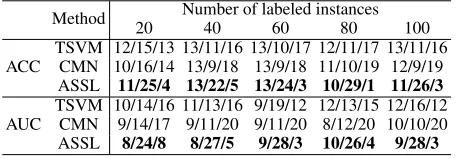
Table 4 further gives the counts of Win/Tie/Loss against SVM with different number of labeled instances for all com-pared methods andAUTO-SSL. The results further justify that AUTO-SSLobtains quite good performance. Specifically, in terms of ACC,AUTO-SSLrarely degenerates the performance and is the most robust among all the compared methods. Sim-ilar conclusion can also be reached in terms of AUC.
Conclusion
Previ-(a) (b)
Figure 4: Improved performance against SVM on 40 datasets
(a) (b)
Figure 5: Average performance with different numbers of labeled insatnces on 40 datasets
Table 4: The counts of Win/Tie/Loss against SVM with re-spect to all compared methods. ‘Win/Tie/Loss’ counts the datasets for which the compared methods is statistically sig-nificantly better/comparable/sigsig-nificantly worse than SVM (paired t-tests at 95% significance level). The method with the smallest number of losses against SVM is bolded.
Method Number of labeled instances
20 40 60 80 100
ACC
TSVM 12/15/13 13/11/16 13/10/17 12/11/17 13/11/16
CMN 10/16/14 13/9/18 13/9/18 11/10/19 12/9/19
ASSL 11/25/4 13/22/5 13/24/3 10/29/1 11/26/3
AUC
TSVM 10/14/16 11/13/16 9/19/12 12/13/15 12/16/12
CMN 9/14/17 9/11/20 9/11/20 8/12/20 10/10/20
ASSL 8/24/8 8/27/5 9/28/3 10/26/4 9/28/3
ous work on AutoML typically focuses on supervised learn-ing problems. In many applications, however, other prob-lems such as semi-supervised learning (SSL) probprob-lems are widespread. Existing AutoML techniques could not well ad-dress such difficulties. In this paper, we present an automated SSL system (AUTO-SSL). We first consider meta-learning that transforms automated SSL as a supervised learning and
then exact appropriate features for data sets by not only tradi-tional meta-features but also unsupervised learning. To alle-viate performance deterioration, which is crucial for SSL, we design a large margin principle to avoid low-quality hyper-parameters, and save considerable computation overhead compared to direct cross-validation. Extensive empirical re-sults show that our proposal outperforms classical SSL tech-niques and state-of-the-art AutoML systemAUTO-SKLEARN, in addition clearly improves the reliability of SSL.
Our system could be improved by removing some short-comings. For instance, we have not yet tackled SSL with multi-class problems or very large-scale datasets. Moreover, applying our system to deep learning models and deriving a good representation (meta-features) of datasets would be a worth-studying future work.
Acknowledgements
References
Bardenet, R.; Brendel, M.; K´egl, B.; and Sebag, M. 2013. Collaborative hyperparameter tuning. InProceedings of the 30th International Conference on Machine Learning, 199– 207.
Brazdil, P.; Carrier, C. G.; Soares, C.; and Vilalta, R. 2008. Metalearning: Applications to data mining. Springer Science & Business Media.
Chapelle, O.; Sch¨olkopf, B.; and Zien, A. 2006. Semi-Supervised Learning. Cambridge, MA: MIT Press.
Davies, D. L., and Bouldin, D. W. 1979. A cluster separa-tion measure. IEEE Transactions on Pattern Analysis and Machine Intelligence(2):224–227.
Feurer, M.; Klein, A.; Eggensperger, K.; Springenberg, J. T.; Blum, M.; and Hutter, F. 2015. Efficient and robust auto-mated machine learning. InAdvances in Neural Information Processing Systems 28. 2962–2970.
Feurer, M.; Springenberg, J. T.; and Hutter, F. 2015. Initializ-ing bayesian hyperparameter optimization via meta-learnInitializ-ing. InProceedings of the 29th AAAI Conference on Artificial Intelligence, 1128–1135.
Guyon, I.; Chaabane, I.; Escalante, H.; and et al. 2016. A brief review of the chalearn automl challenge. InProceedings of AutoML workshop on the 33rd International Conference on Machine Learning.
Hall, M.; Frank, E.; Holmes, G.; Pfahringer, B.; Reutemann, P.; and Witten, I. H. 2009. The weka data mining software: an update.ACM SIGKDD Explorations Newsletter11(1):10–18. Hutter, F.; Hoos, H. H.; and Leyton-Brown, K. 2011. Se-quential model-based optimization for general algorithm con-figuration. InProceedings of International Conference on Learning and Intelligent Optimization, 507–523.
Jain, A. K., and Dubes, R. C. 1988.Algorithms for clustering data. Prentice-Hall, Inc.
Jain, A. K. 2010. Data clustering: 50 years beyond k-means. Pattern Recognition Letters31(8):651–666.
Joachims, T. 1999. Transductive inference for text clas-sification using support vector machines. InProceedings of the 16th International Conference on Machine Learning, 200–209.
Kohavi, R. 1995. A study of cross-validation and bootstrap for accuracy estimation and model selection. In Proceed-ings of the 9th AAAI Conference on Artificial Intelligence, volume 14, 1137–1145.
Krijthe, J. H., and Loog, M. 2015. Implicitly constrained semi-supervised least squares classification. InAdvances in 14th International Symposium on Intelligent Data Analysis, 158–169.
Lemke, C.; Budka, M.; and Gabrys, B. 2015. Metalearning: a survey of trends and technologies. Artificial Intelligence Review44(1):117–130.
Li, Y.-F., and Zhou, Z.-H. 2015. Towards making unlabeled data never hurt.IEEE Transactions on Pattern Analysis and Machine Intelligence37(1):175–188.
Li, Y.-F.; Kwok, J.; and Zhou, Z.-H. 2016. Towards safe semi-supervised learning for multivariate performance measures. InProceedings of the 30th AAAI Conference on Artificial Intelligence, 1816–1822.
Li, Y.-F.; Wang, S.-B.; and Zhou, Z.-H. 2016. Graph quality judgement: a large margin expedition. InProceedings of the 25th International Joint Conference on Artificial Intelligence, 1725–1731.
Li, Y.-F.; Zha, H.-W.; and Zhou, Z.-H. 2017. Learning safe prediction for semi-supervised regression. InProceedings of the 31st AAAI Conference on Artificial Intelligence, 2217– 2223.
Maulik, U., and Bandyopadhyay, S. 2002. Performance evaluation of some clustering algorithms and validity indices. IEEE Transactions on Pattern Analysis and Machine Intelli-gence24(12):1650–1654.
Michie, D.; Spiegelhalter, D. J.; Taylor, C. C.; and Camp-bell, J. 1994. Machine Learning, Neural and Statistical Classification. Ellis Horwood.
Sun, L. 2016. Automl challenge: System description. In Proceedings of AutoML workshop on the 33rd International Conference on Machine Learning.
Thornton, C.; Hutter, F.; Hoos, H. H.; and Leyton-Brown, K. 2013. Auto-weka: Combined selection and hyperparameter optimization of classification algorithms. InProceedings of the 19th ACM SIGKDD International Conference on Knowl-edge Discovery and Data mining, 847–855.
Vapnik, V. N. 1999. An overview of statistical learning theory. IEEE Transactions on Neural Networks10(5):988–999. Von Luxburg, U. 2007. A tutorial on spectral clustering. Statistics and Computing17(4):395–416.
Zhou, Z.-H., and Li, M. 2010. Semi-supervised learn-ing by disagreement. Knowledge and Information Systems 24(3):415–439.
Zhou, D.; Bousquet, O.; Lal, T. N.; Weston, J.; and Sch¨olkopf, B. 2004. Learning with local and global consistency. In Advances in Neural Information Processing Systems 16. 321– 328.
Zhu, X.; Ghahramani, Z.; and Lafferty, J. D. 2003. Semi-supervised learning using gaussian fields and harmonic func-tions. InProceedings of the 20th International Conference on Machine Learning, 912–919.